
Judge, 1915-10-23 · page 17 of 28
Judge — October 23, 1915 — page 17: what you’re looking at
What you’re looking at
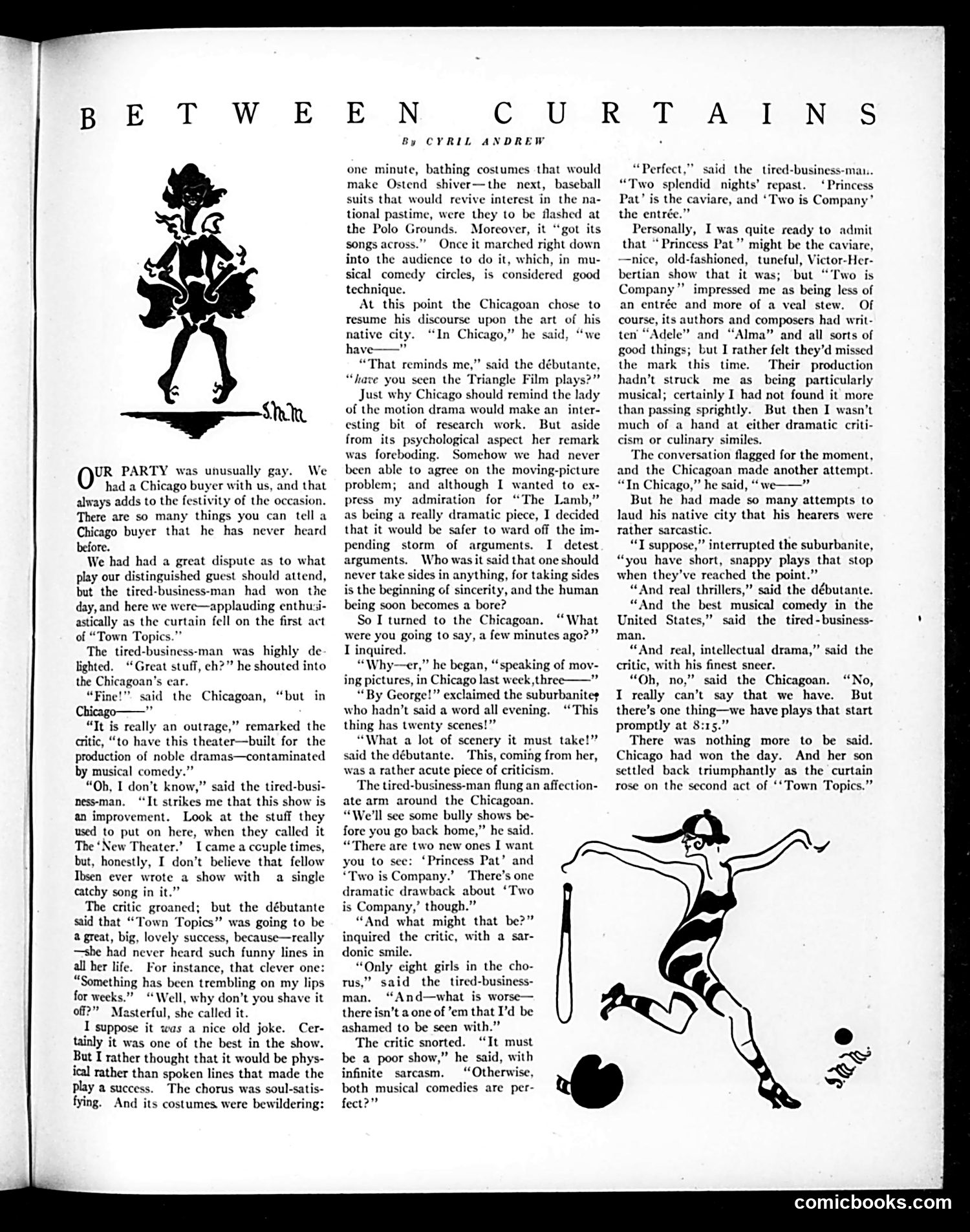
This Cyril Andrew piece satirizes early 1910s theater culture and social pretension. The narrative depicts a "tired-business-man" (a stock Judge character representing practical Americana) defending the musical comedy "Town Topics" against a snobbish theater critic who condemns it as lowbrow contamination of a noble venue. The satire targets cultural gatekeeping: the critic dismisses musical comedy and glorifies Ibsen, while the businessman notes Ibsen's shows lack "catchy songs" — suggesting serious drama can be tedious. A débutante enthusiastically praises a crude joke, exposing that "high culture" doesn't guarantee sophistication. The cartoons accompanying the text show figures in exaggerated dance poses, emphasizing the physical spectacle of musical comedy — the very "lowbrow" entertainment the critic despises but audiences enjoy. The piece mocks intellectual snobbery while defending popular entertainment's legitimacy.
📄 Transcribed text from this page (OCR, searchable)
Machine-transcribed from the original scan — historical spelling and the odd misread are preserved.
BET WE § UR PARTY was unusually gay. We had a Chicago buyer with us, and that always adds to the festivity of the occasion. There are so many things you can tell a Chicago buyer that he has never heard before. We had had a great dispute as to what play our distinguished guest should attend, but the tired-business-man had won the day, and here we were—applauding enthusi- astically as the curtain fell on the first act of “Town Topics.” The tired-business-man was highly de lighted. “Great stuff, ch?” he shouted into the Chicagoan’s ear. “Fine!” said the Chicagoan, “but in “Tt is really an outrage,” remarked the artic, “to have this theater—built for the production of noble dramas—contaminated by musical comedy.” “Ob, I don’t know,” said the tired-busi- ness-man. “It strikes me that this show is an improvement. Look at the stuff they used to put on here, when they called it The ‘New Theater.’ I came a couple times, but, honestly, I don’t believe that fellow Ibsen ever wrote a show with a single catchy song in it.” The critic groaned; but the débutante said that “Town Topics” was going to be a great, big, lovely success, because—really —she had never heard such funny lines in all her life. For instance, that clever one: “Something has been trembling on my lips for weeks.” “Well, why don’t you shave it off?” Masterful, she called it. I suppose it was a nice old joke. Cer- tainly it was one of the best in the show. But Trather thought that it would be phys- ical rather than spoken lines that made the play a success. The chorus was soul-satis- fying. And its costumes were bewildering: E N By CYRIL ANDREW one minute, bathing costumes that would make Ostend shiver—the next, baseball suits that would revive interest in the na- tional pastime, were they to be flashed at the Polo Grounds. Moreover, it “got its songs across.” Once it marched right down into the audience to do it, which, in mu- sical comedy circles, is considered good technique. At this point the Chicagoan chose to resume his discourse upon the art of his native city. “In Chicago,” he said, “we have——” “That reminds me,” said the débutante, “have you seen the Triangle Film plays?” Just why Chicago should remind the lady of the motion drama would make an_ inter- esting bit of research work. But aside from its psychological aspect her remark was foreboding. Somehow we had never been able to agree on the moving-picture problem; and although I wanted to ex- press my admiration for “The Lamb,” as being a really dramatic piece, I decided that it would be safer to ward off the im- pending storm of arguments. I detest arguments. Who was it said that one should never t sides in anything, for taking sides is the beginning of sincerity, and the human being soon becomes a bore? So I turned to the Chicagoan. “What were you going to say, a few minutes ago?” 1 inquired. “Why—er,” he began, “speaking of mov- ing pictures, in Chicago last week ,three——” “By George!” exclaimed the suburbanite who hadn’t said a word all evening. ‘This thing has twenty scenes!” “What a lot of scenery it must take said the débutante. This, coming from her, was a rather acute piece of criticism. The tired-business-man flung an affection- ate arm around the Chicagoan. “We'll see some bully shows be- fore you go back home,” he said. “There are two new ones I want you to sec: ‘Princess Pat’ and ‘Two is Company.’ There’s one dramatic drawback about ‘Two is Company,’ though.” “And what might that be?” inquired the critic, with a sar- donic smile. “Only eight girls in the cho- tus,” said the tired-business- man, ‘“And—what is worse— there isn’t a one of ’em that I’d be ashamed to be seen with.” The critic snorted. “It must be a poor show,” he said, with infinite sarcasm. “Otherwise, both musical comedies are per- fect?” C U RT Noes “Perfect,” said the tired-business-mau. Two splendid nights’ repast. ‘Princess Pat’ is the caviare, and ‘Two is Company’ the entré Personally, I was quite ready to admit that “Princess Pat” might be the caviare, —nice, old-fashioned, tuneful, Victor-Her- bertian show that it was; but “Two is Company”’ impressed me as being less of an entrée and more of a veal stew. Of course, its authors and composers had writ- ten’ “Adele”? and “Alma” and all sorts of good things; but I rather felt they’d missed the mark this time. Their production hadn’t struck me as_ being particularly musical; certainly I had not found it more than passing sprightly. But then I wasn’t much of a hand at either dramatic criti- cism or culinary similes. The conversation flagged for the moment, and the Chicagoan made another attempt. “In Chicago,” he said, “we——” But he had made so many attempts to laud his native city that his hearers were rather sarcastic. “T suppose,” interrupted the suburbanite, “you have short, snappy plays that stop when they’ve reached the point.” “And real thrillers,” said the débutante. “And the best musical comedy in the United States,” said the tired -business- man. “And real, intellectual drama,” said the critic, with his finest sneer. “Oh, no,” said the Chicagoan. “No, I really can’t say that we have. But there’s one thing—we have plays that start promptly at 8:15.” There was nothing more to be said. Chicago had won the day. And her son settled back triumphantly as the curtain rose on the second act of ‘Town Topics.” comicbooks.com