
Judge, 1915-10-23 · page 18 of 28
Judge — October 23, 1915 — page 18: what you’re looking at
What you’re looking at
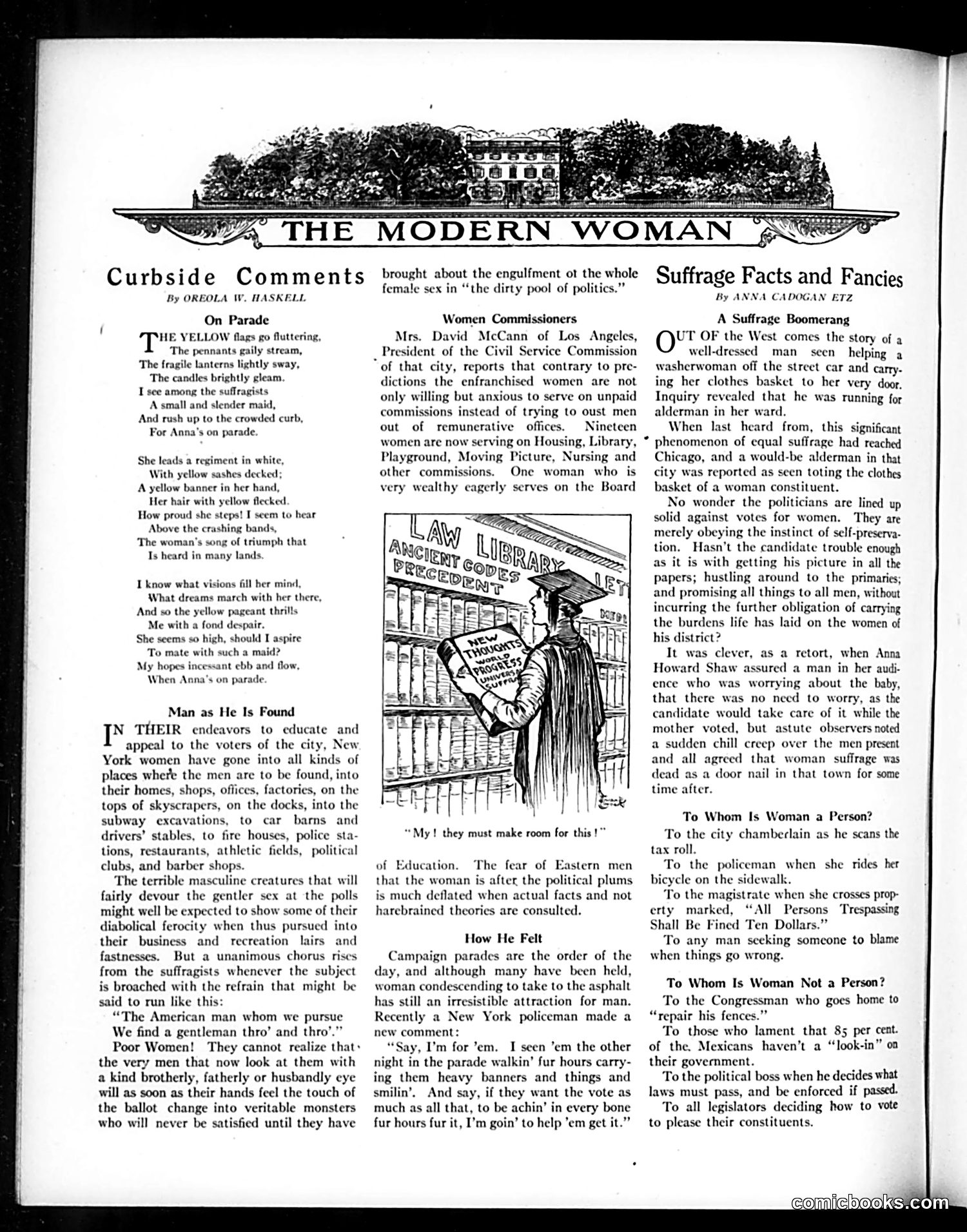
This Judge magazine page satirizes the women's suffrage movement through multiple angles: **"On Parade"** (left column): A romantic poem mocking a young suffragist marching in a parade with yellow flags and banners—yellow being the suffrage movement's color. The narrator's conflicted admiration ("fond despair") ridicules the elevation of suffragists as heroic figures. **"Man as He Is Found"** mocks suffragists' optimism about male support. It claims women canvassing factories and bars find men "gentlemen," but sarcastically suggests these same men will become "veritable monsters" once women gain voting power, supposedly fearing women will enter "the dirty pool of politics." **The cartoon** shows a man at a library card catalog labeled "How to Get the Female Vote," suggesting male politicians cynically study how to manipulate women voters. **Right-side articles** present "facts" allegedly proving suffragists' fears unfounded—women commissioners work unpaid, a policeman supports voting rights—but the framing remains dismissive, treating women's political participation as curiosity rather than justice.
📄 Transcribed text from this page (OCR, searchable)
Machine-transcribed from the original scan — historical spelling and the odd misread are preserved.
Curbside Comments By OREOLA W. HASKELL On Parade HE YELLOW flags go fluttering, ‘The pennants gaily stream, ‘The fragile lanterns lightly sway, The candles brightly gleam. I see among the suffragists A small and slender maid, And rush up to the crowded curb, For Anna's on parade. She leads a regiment in white, With yellow sashes decked; A yellow banner in her hand, Her hair with yellow flecked How proud she steps! I seem to hear Above the crashing bands, The woman's song of triumph that Is heard in many lands. I know what visions fill ber mind, What dreams march with her there, And so the yellow pageant thrills Me with a fond despair. She seems so high, should I aspire To mate with such a maid? My hopes incessant ebb and flow, When Anna’s on parade. Man as He Is Found N THEIR endeavors to educate and appeal to the voters of the city, New York women have gone into all kinds of places where the men are to be found, into their home: s, factories, on the tops of sky into the subway excavations, to car barns and drivers’ stables, to fire hou: police tions, restaurants, athletic fields, politic clubs, and barber Ss. The terrible masculine creatures that will fairly devour the gentler sex at the polls might well be expected to show some of their diabolical ferocity when thus pursued into their business and recreation lairs and fastnesses. But a unanimous chorus rises from the suffragists whenever the subject is broached with the refrain that might be said to run like this: “The American man whom we pursue We find a gentleman thro’ and thro’.” Poor Women! the very men that now look at them with a kind brotherly, fatherly or husbandly eye will as soon as their hands feel the touch of the ballot change into veritable monsters who will never be satisfied until they have They cannot realize that> brought about the engulfment ot the whole female sex in “the dirty pool of politics.” Women Commissioners Mrs. David McCann of Los Angeles, _ President of the Civil Service Commission of that city, reports that contrary to pre- dictions the enfranchised women are not only willing but anxious to serve on unpaid commissions instead of trying to oust men out of remunerative offices. Nineteen women are now serving on Housing, Library, * Playground, Moving Picture, Nursing and other commissions. One woman who is very wealthy eagerly serves on the Board “My! they must make room for this!” of Education. The fear of Eastern men that the woman is after the political plums is much deflated when actual facts and not harebrained theories are consulted. How He Felt Campaign parades are the order of the day, and although many have been held, woman condescending to take to the asphalt has an irresistible attraction for man. Recently a New York policeman made a new comment: “Say, I’m for ’em. I seen ’em the other night in the parade walkin’ fur hours carry- ing them heavy banners and things and smilin’, And say, if they want the vote as much as all that, to be achin’ in every bone fur hours fur it, I’m goin’ to help 'em get it.” Suffrage Facts and Fancies By ANNA CADOGAN ETZ A Suffrage Boomerang or OF the West comes the story of a well-dressed man seen helping a washerwoman off the street car and carry ing her clothes basket to her very door, Inquiry revealed that he was running for alderman in her ward. When last heard from, this significant phenomenon of equal suffrage had reached Chicago, and a would-be alderman in that city was reported as seen toting the clothes basket of a woman constituent. No wonder the politicians are lined up solid against votes for women. They are merely obeying the instinct of self-preserva- Hasn't the candidate trouble enough as it is with getting his picture in all the papers; hustling around to the primaries; and promising all things to all men, without incurring the further obligation of carrying the burdens life has laid on the women of his district? It was clever, as a retort, when Anna Howard Shaw assured a man in her audi- ence who was worrying about the baby, that there was no need to worry, as the candidate would take care of it while the mother voted, but astute observers noted a sudden chill creep over the men present and all agreed that woman suffrage was dead as a door nail in that town for some time after. To Whom Is Woman a Person? To the city chamberlain as he scans the tax roll. To the policeman when she rides her bicycle on the sidewalk. To the magistrate when she crosses prop- erty marked, “All Persons Trespassing Shall Be Fined Ten Dollars.” To any man seeking someone to blame when things go wrong. To Whom Is Woman Not a Person? To the Congressman who goes home to “repair his fences.” To those who lament that 85 per cent. of the. Mexicans haven’t a “look-in” oa their government. To the political boss when he decides what laws must pass, and be enforced if passed. To all legislators deciding how to vote to please their constituents.