
A complete issue · 24 pages · 1915
Judge — June 19, 1915
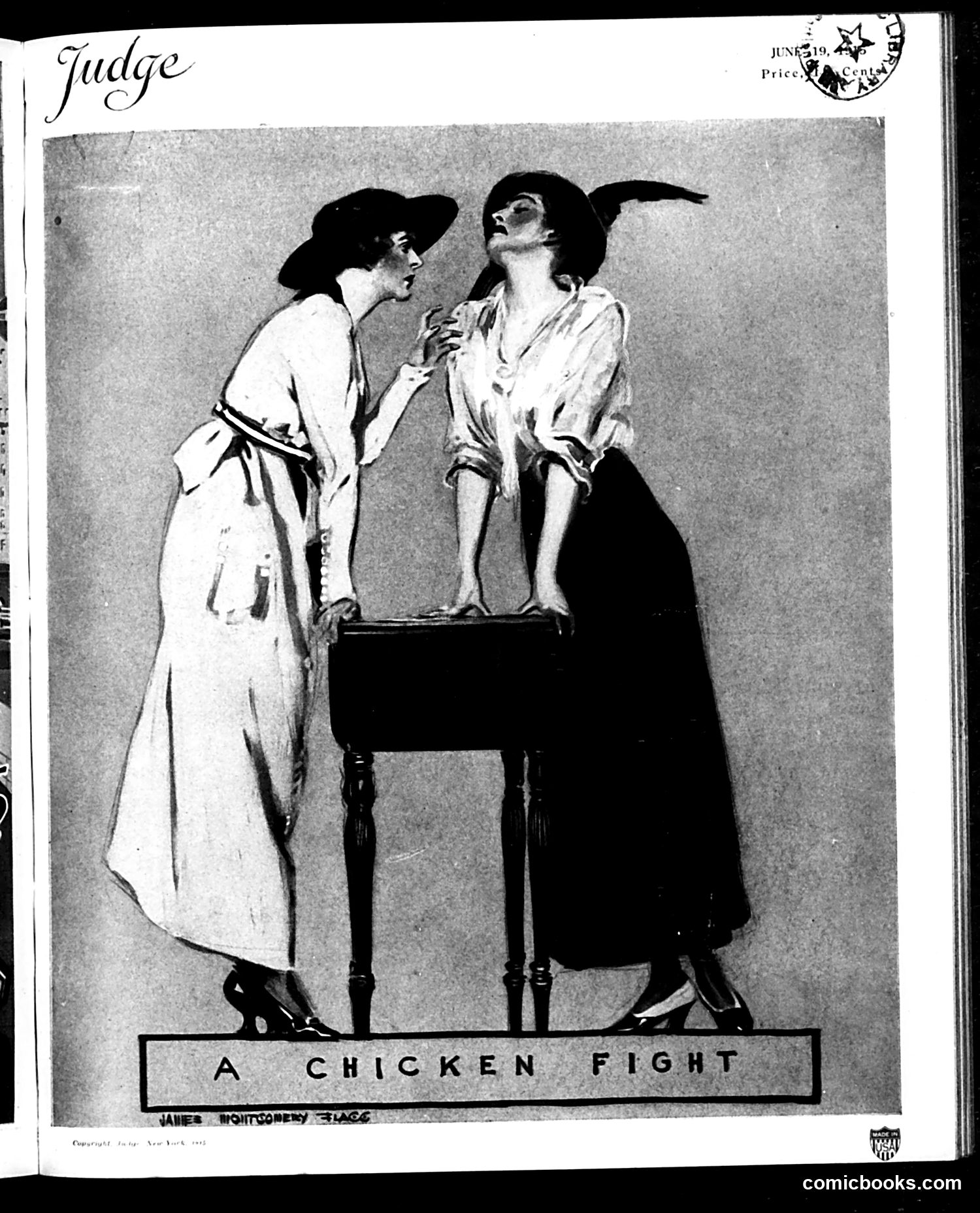
This satirical illustration depicts two women standing on a table, apparently engaged in a heated argument or "fight." The caption "A Chicken Fight" is a period phrase meaning a trivial quarrel or petty dispute between women. The cartoon likely satirizes domestic conflict or female quarreling as frivolous entertainment. Both figures wear early 20th-century clothing including wide-brimmed hats. One woman appears to be gesticulating animatedly while the other looks skyward, suggesting exaggerated emotional display. The humor relies on the dated stereotype that women's arguments were inherently less serious than men's disputes—hence "chicken" (trivial) rather than a genuine conflict. This reflects Judge magazine's typical approach of mocking contemporary social behaviors and gender roles through visual comedy.
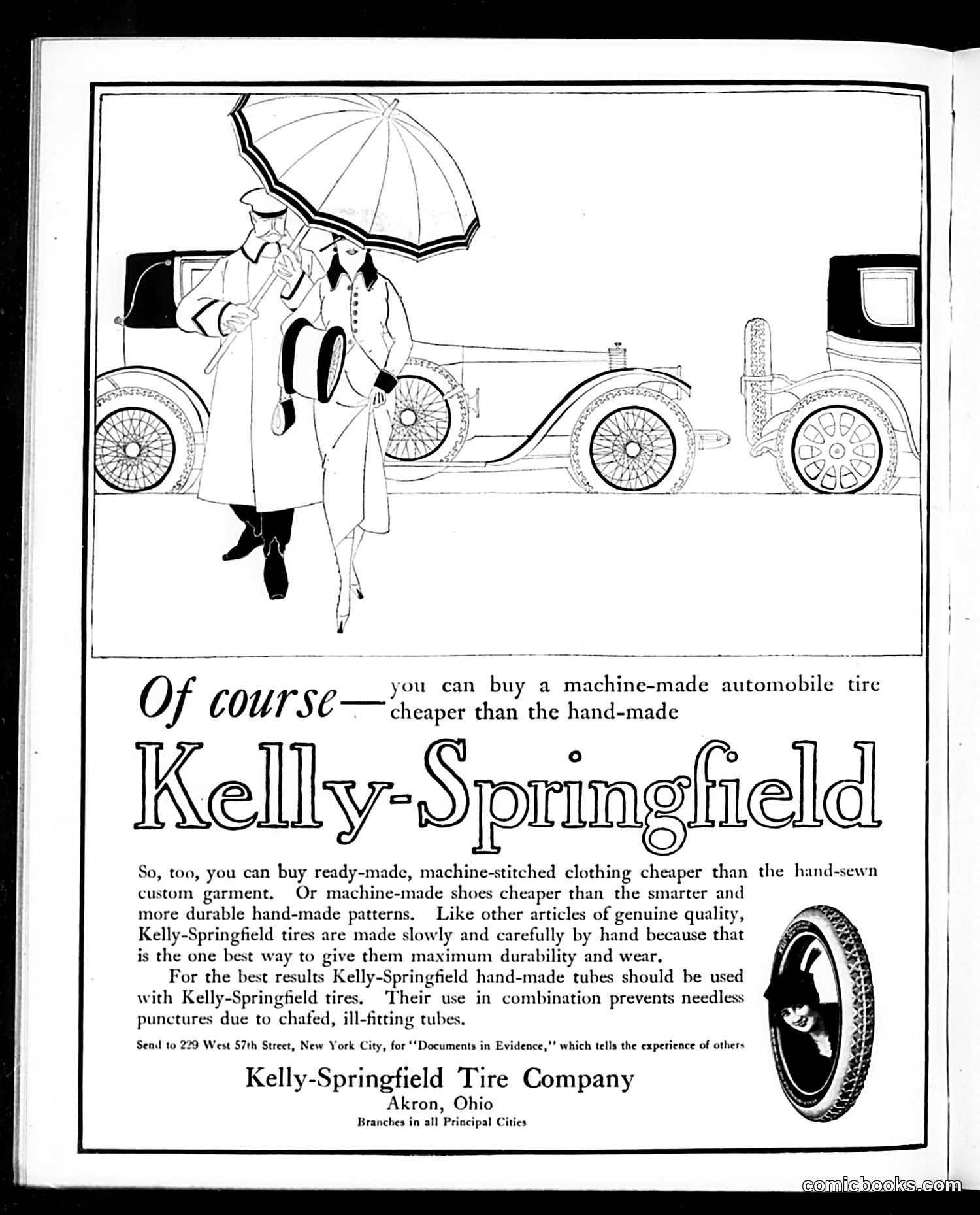
This page is primarily **advertising, not satire or editorial content**. It's a Kelly-Springfield Tire Company advertisement from their Akron, Ohio headquarters. The illustration shows a fashionable woman with an umbrella standing before parked automobiles, establishing an aspirational lifestyle context. The ad's argument uses an analogy: just as machine-made clothing and shoes are cheaper than hand-sewn items yet still quality products, so too are machine-made automobile tires cheaper than hand-made ones. However, Kelly-Springfield claims a distinction—their tires are "made slowly and carefully by hand" for durability, positioning hand-craftsmanship as a premium feature justifying their product against cheaper machine-made competitors. The ad targets affluent consumers valuing both economy and quality.
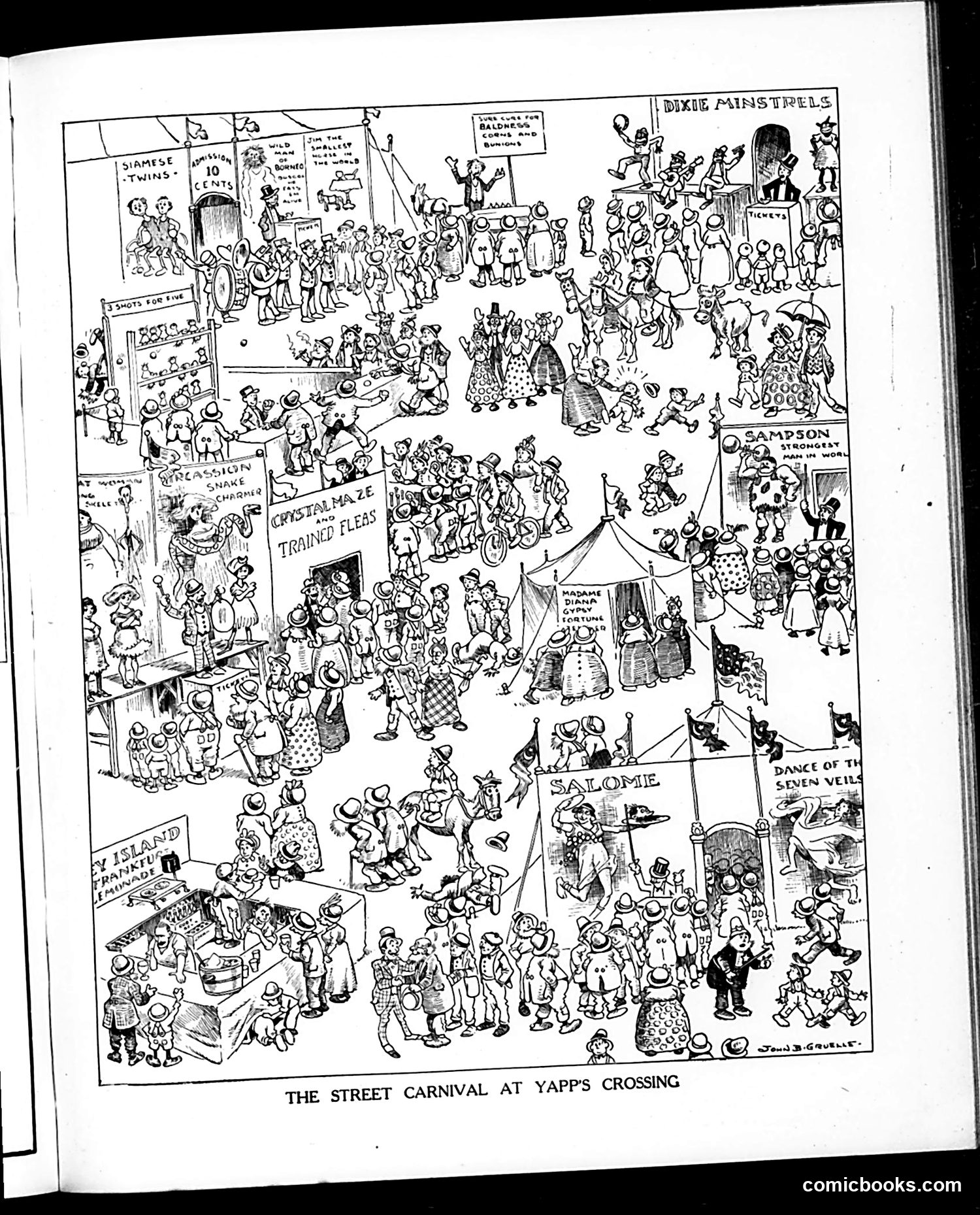
This is a busy, detailed street fair illustration depicting a turn-of-the-century carnival or public celebration. The labeled attractions include "Siamese Twins," "Trained Fleas," "Ghost in a Maze," "Dixie Minstrels," "Sampson the Strongest Man," and fortune telling. The artist captures typical carnival attractions of the era, including sideshows and exotic/novelty acts that would have been popular entertainment. The illustration satirizes mass entertainment culture and public spectacle, showing crowds drawn to sensationalistic attractions. The "Dixie Minstrels" reference reflects the period's racist entertainment practices. The overall tone appears to mock both the garish carnival atmosphere and the public's appetite for such spectacles, presenting the carnival as chaotic, crowded, and driven by curiosity about the unusual or exploitative.
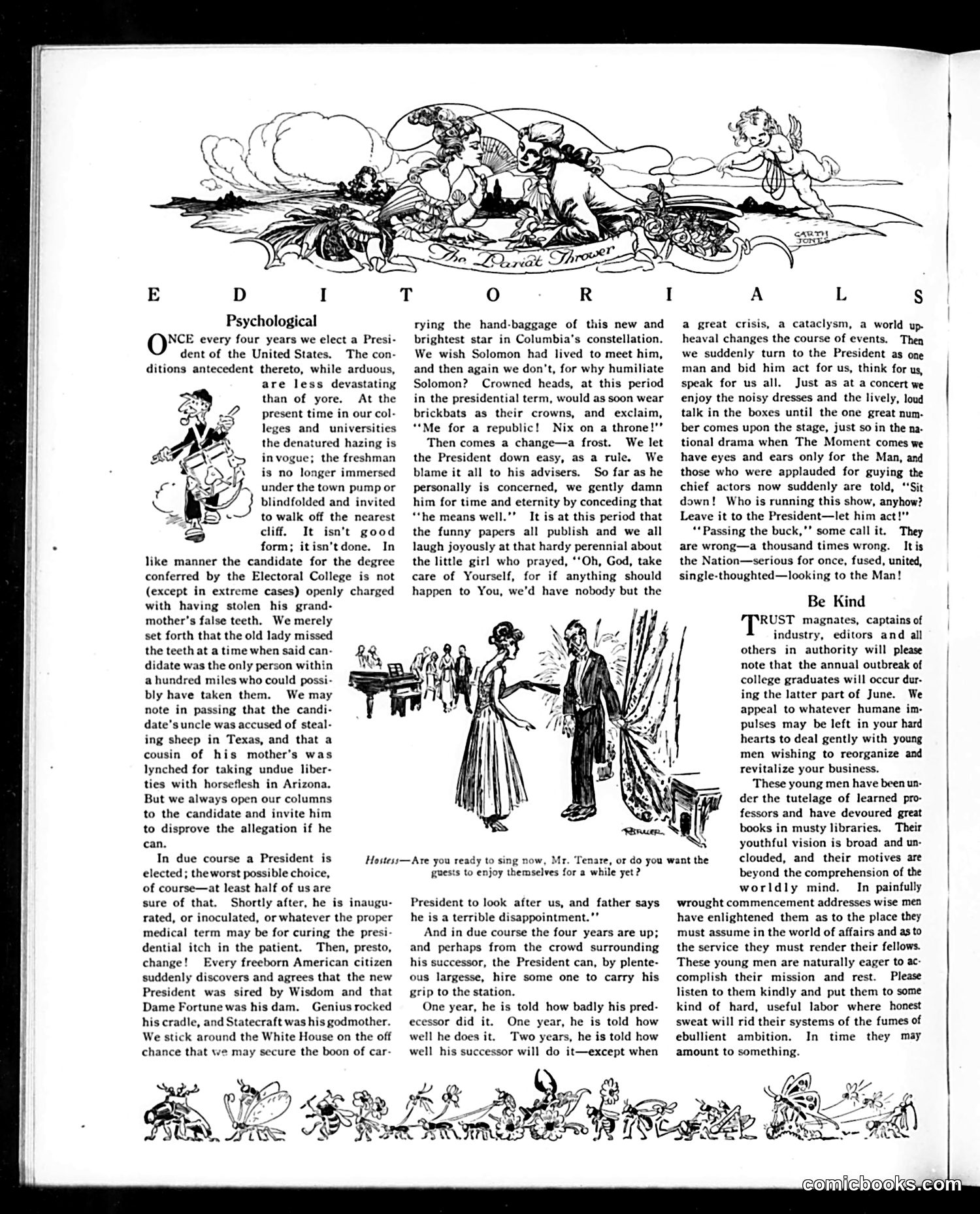
This page from *Judge* magazine satirizes the U.S. presidential election cycle. The main editorial, "Psychological," mocks how Americans elect presidents every four years despite consistently poor results. The author argues that candidates are often unqualified—comparing them to unsuitable people who might be lynched or involved in scandals—yet voters still choose them. The accompanying illustration depicts a woman asking a man (likely representing a candidate or political figure) if he's "ready now" for social engagement, suggesting unpreparedness for leadership. The "Be Kind" section appeals to business leaders to treat young college graduates entering the workforce gently during economic uncertainty, implying the nation faces serious challenges requiring experienced, thoughtful leadership—which elected officials apparently lack.
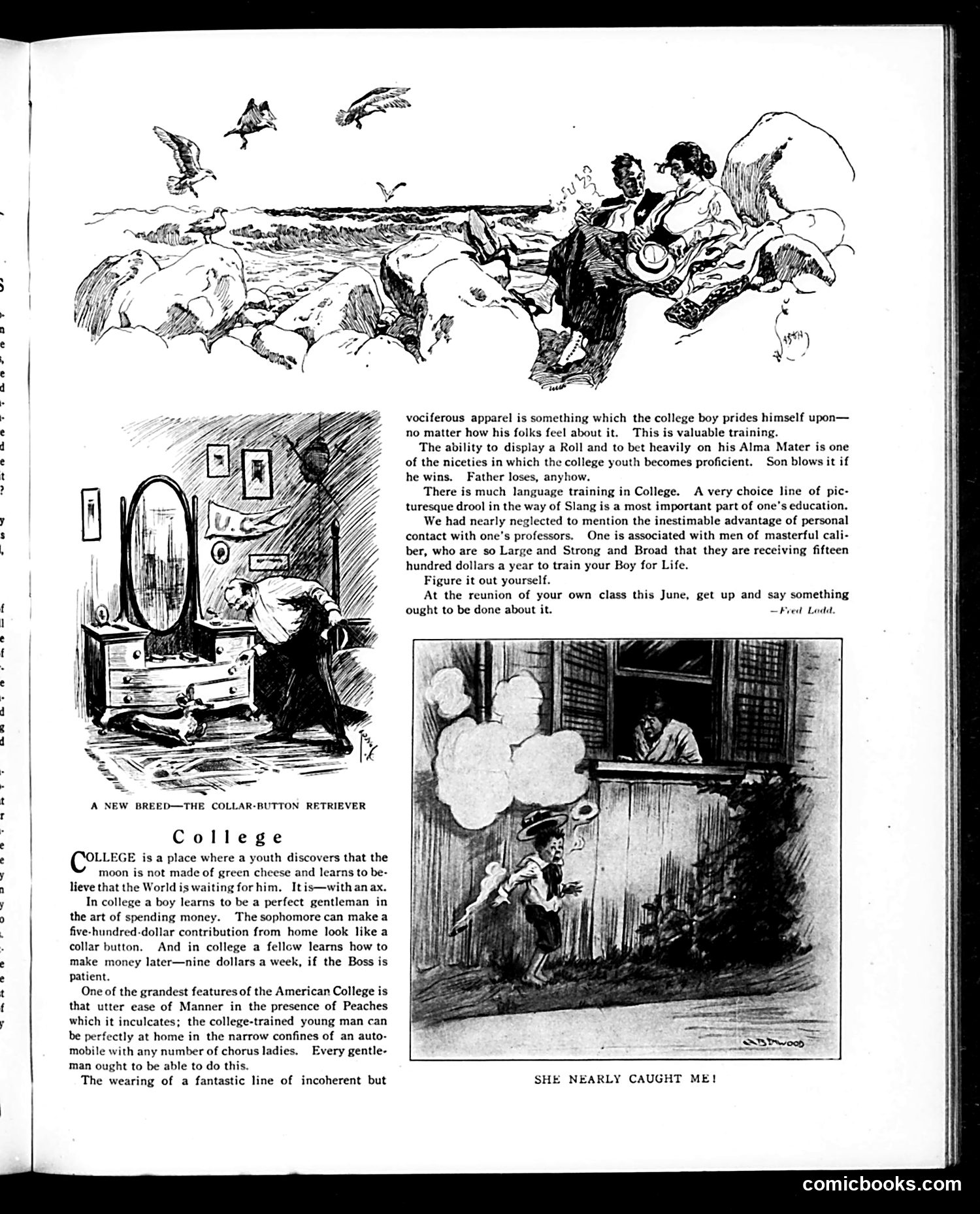
This page satirizes American college culture and its commercialization. The top cartoon shows students displaying their "vociferous apparel"—expensive clothing worn as status symbols. The text mocks how college boys pride themselves on fashionable dress regardless of actual learning. The middle illustration titled "A NEW BREED—THE COLLAR-BUTTON RETRIEVER" depicts a student searching under a dresser, humorously suggesting college boys are preoccupied with trivial matters like lost clothing rather than serious education. The main "College" section satirizes how institutions teach genteel manners and spending habits rather than genuine knowledge. It jokes that college teaches boys to spend money recklessly (nine dollars weekly) and perform sophistication around women—skills of dubious value. The photograph captioned "SHE NEARLY CAUGHT ME!" appears to show a student hiding from a woman, reinforcing the satirical theme of frivolous college social behavior.
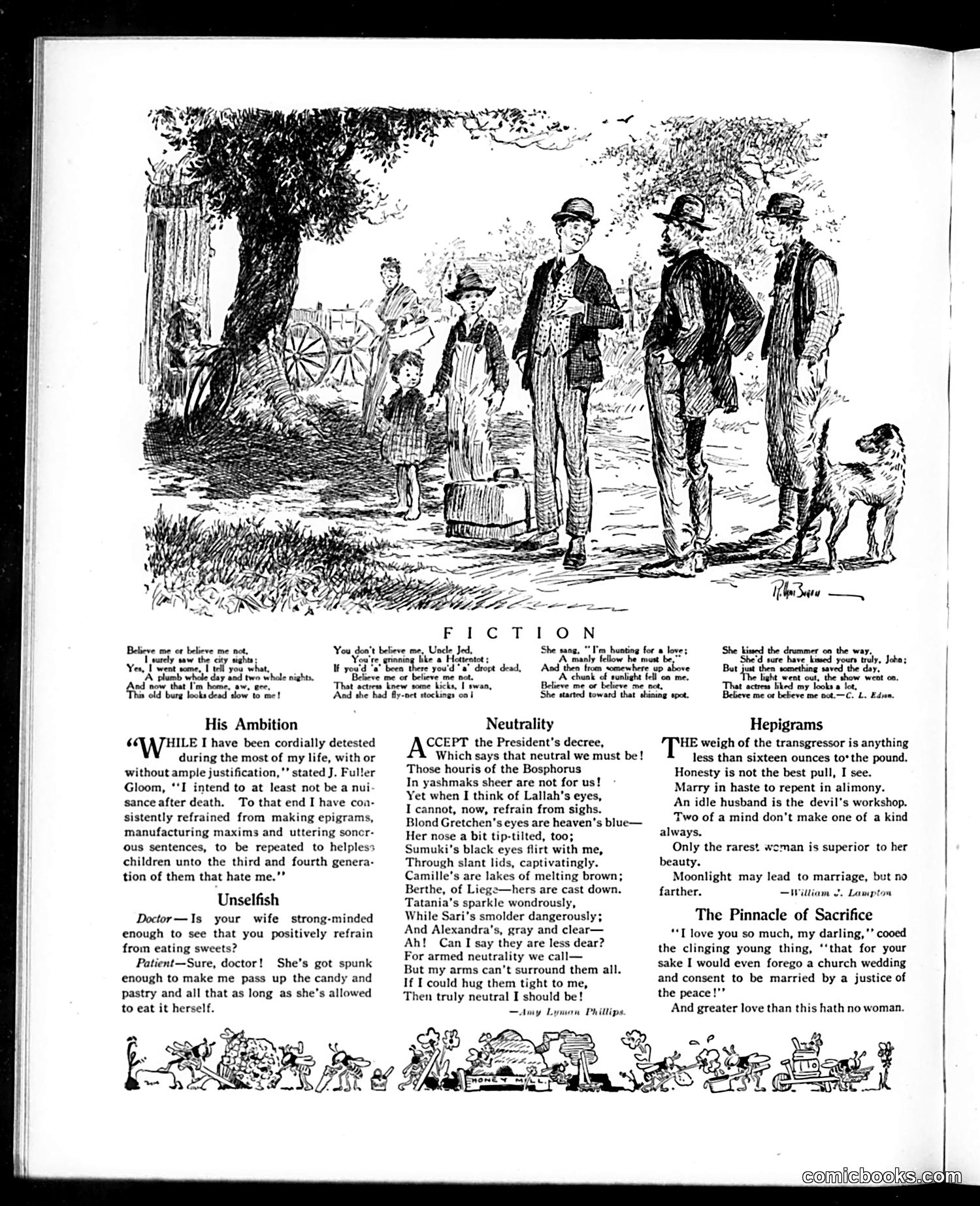
This Judge magazine page contains satirical short pieces and jokes typical of early 20th-century American humor: **"His Ambition"** mocks a character (J. Fuller Gloom) for his pretentious desire to avoid leaving behind memorable sayings, wanting to be forgotten rather than quoted negatively. **"Unselfish"** uses a doctor-patient dialogue to joke about marital dynamics—the wife enforces the husband's diet restrictions while exempting herself, exposing hypocrisy disguised as care. **"Neutrality"** satirizes American neutrality during WWI by depicting a lovesick man unable to resist multiple women's charms while claiming neutrality—punning on "armed neutrality" (military policy) versus his literal inability to keep his arms to himself. **"Hepigrams"** offers cynical one-liners about marriage, honesty, and women—the final piece jokes that a woman "sacrifices" a church wedding for a justice-of-peace marriage, mocking women's supposed romantic drama over trivial matters. The top illustration depicts rural/immigrant characters, likely satirizing working-class perspectives on city life.
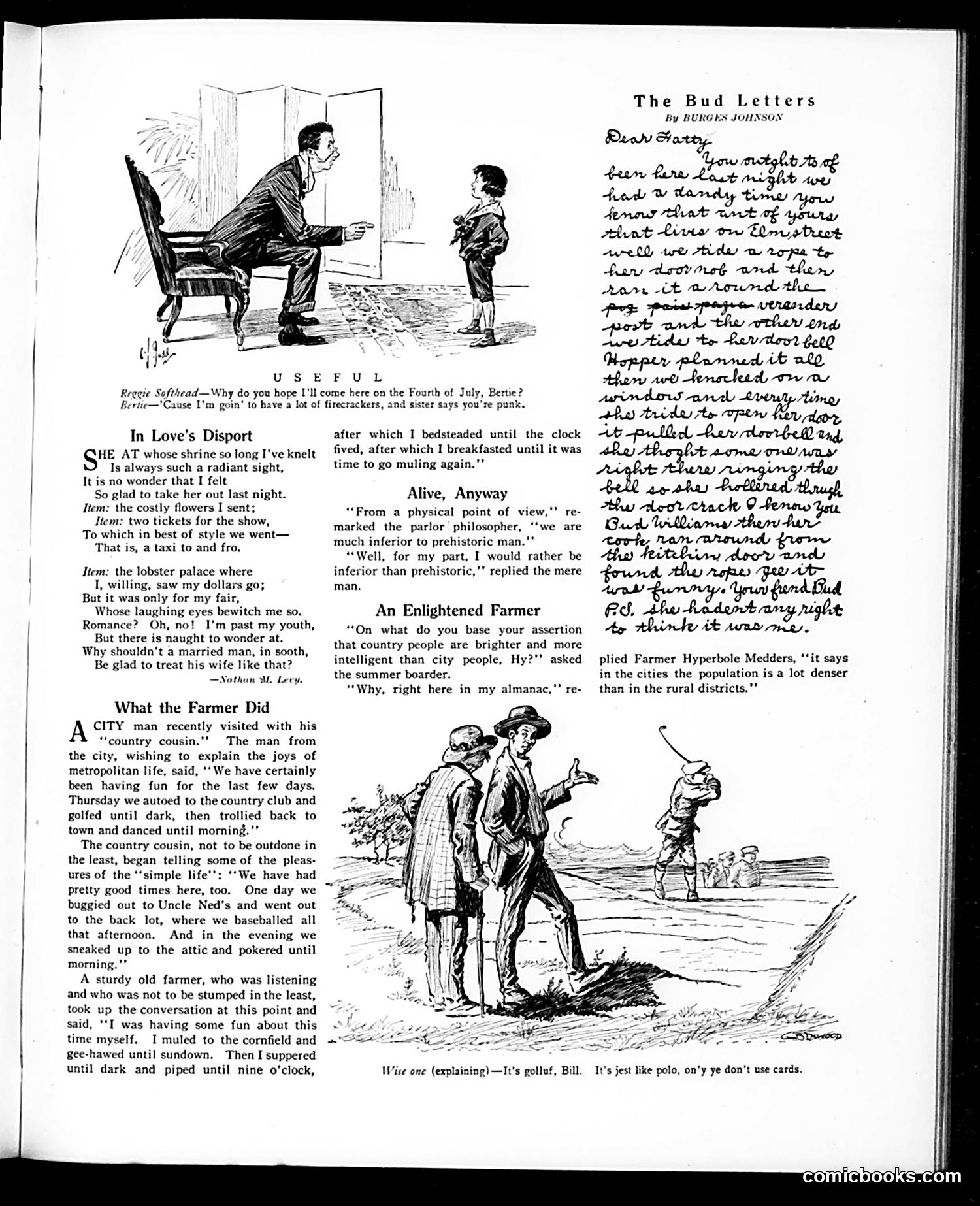
This page contains several short humorous pieces satirizing early 20th-century American life: **"What the Farmer Did"** mocks the competitive one-upmanship between city and country dwellers. A city man brags about motoring, golfing, and dancing; a country cousin counters with rural activities. A farmer tops both by comically converting everyday farm work into leisure activities—"muled," "gee-hawed," "bedsteaded," "piped"—creating absurd verbs from mundane tasks. The joke: rural folk must dignify simple labor as entertainment to compete with city sophistication. **"An Enlightened Farmer"** presents another rural character claiming country people are smarter, but his "evidence" is merely consulting an almanac—suggesting farmers conflate any printed material with genuine intelligence. **"In Love's Disport"** satirizes a married man's self-justifying poem about lavishly treating his wife, missing that such expenses should be normal marital behavior, not remarkable. These pieces reflect early 20th-century urban-rural class tensions and gentle mockery of provincial attitudes.
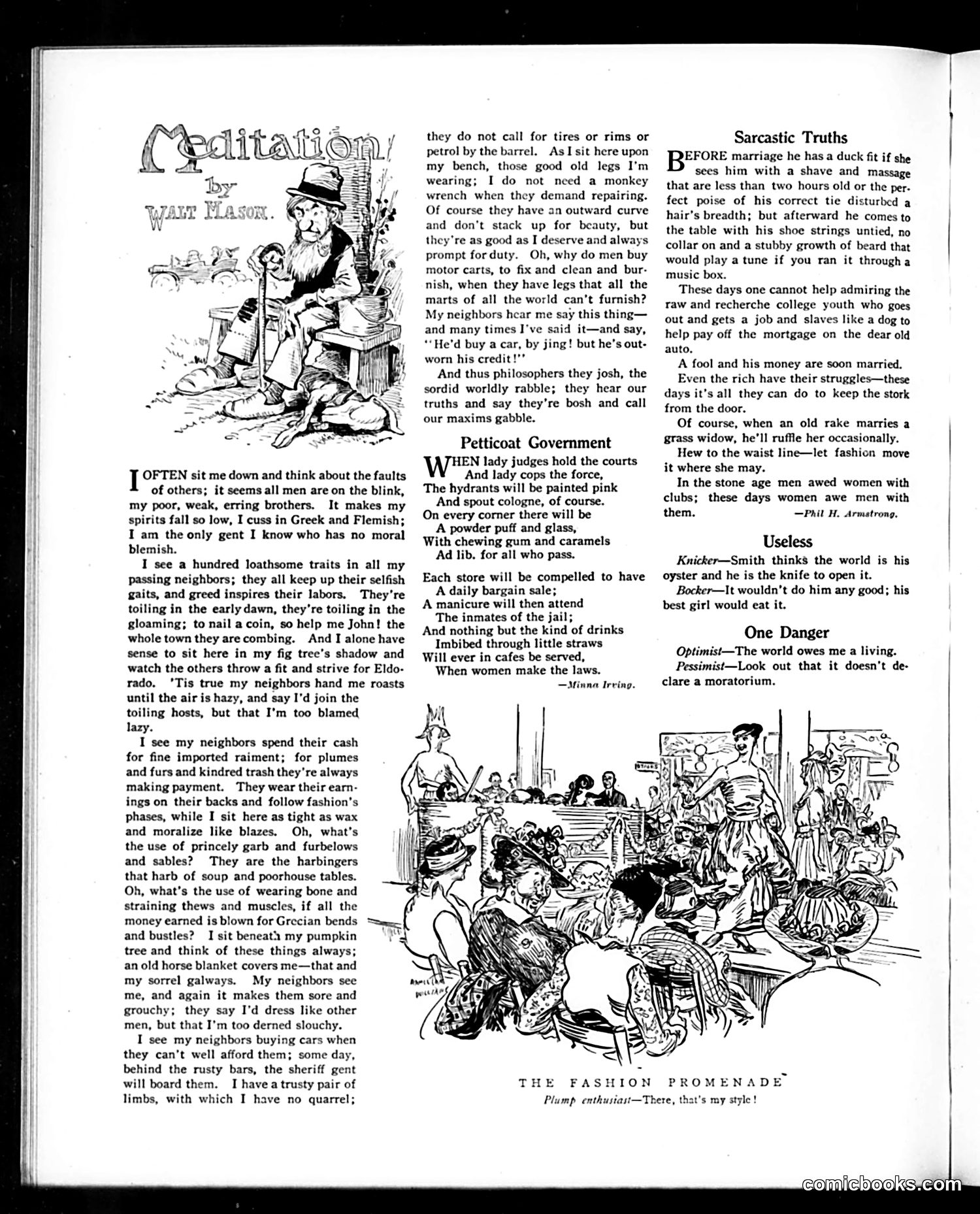
This page from *Judge* magazine contains three satirical pieces: **"Meditation by Walt Mason"** (left): A self-righteous narrator boasts of his moral superiority while criticizing neighbors for buying cars, fine clothes, and following fashion. The joke is that he's actually just too lazy and poor to participate—he rationalizes his shabby appearance and lack of ambition as virtue. He condemns their consumerism while living under an old horse blanket, revealing his hypocrisy. **"Petticoat Government"** (center): A humorous poem satirizing fears about female suffrage/political power. It mockingly predicts absurd outcomes if women held political office: pink fire hydrants, mandatory manicures in jails, and cosmetic-focused laws. This reflects early 20th-century anxieties about women's expanding rights. **"Sarcastic Truths" and "The Fashion Promenade"** (right): Brief satirical observations on marriage and fashion, with accompanying caricature sketches mocking social pretension.
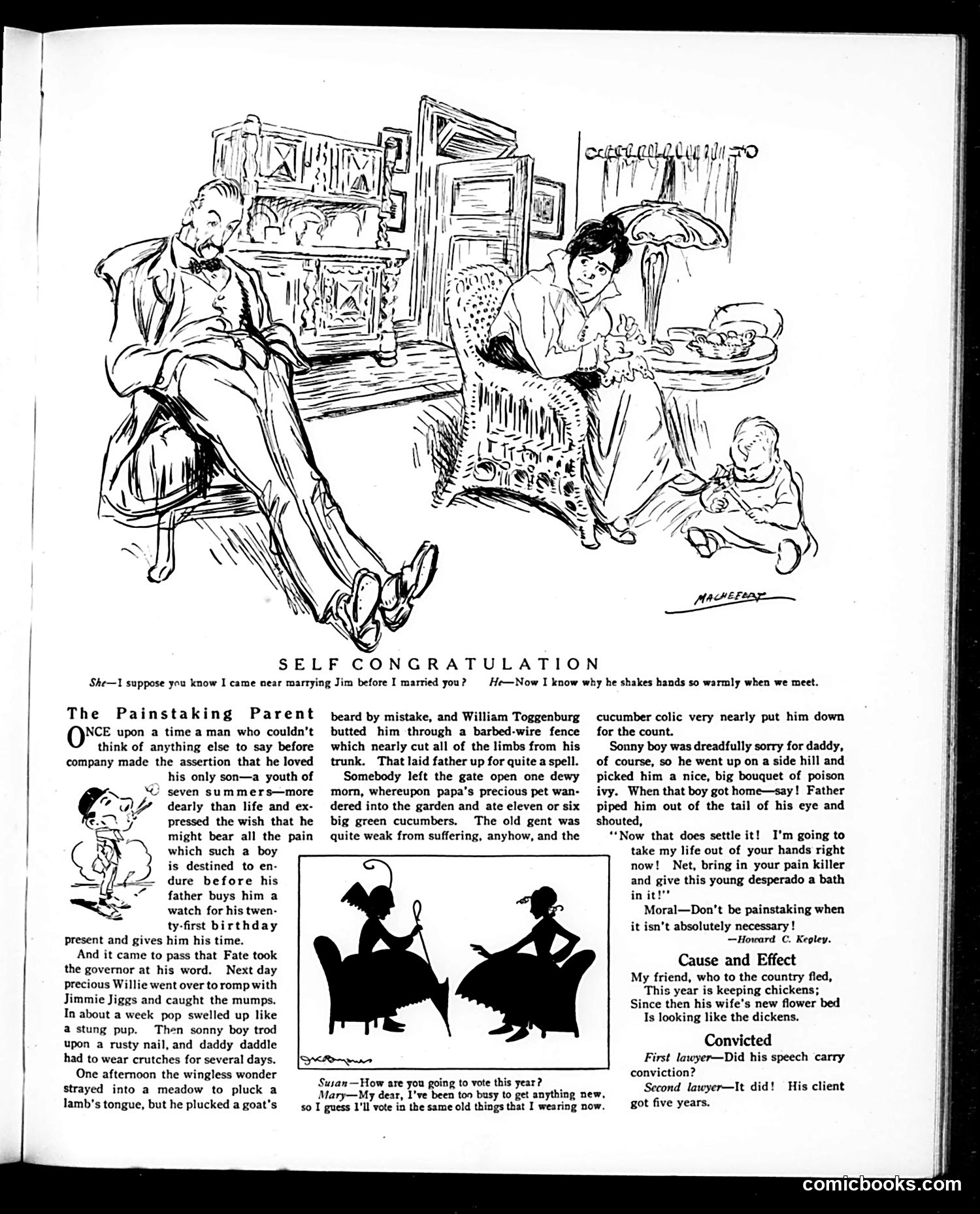
This page contains three distinct satirical pieces: **"Self Congratulation"** (top): A sketch showing a couple where the man remarks he now understands why someone shakes his hand warmly upon meeting—implying the woman previously dated that person. The joke plays on awkward social dynamics and past romantic entanglements. **"The Painstaking Parent"** (main story): A humorous cautionary tale mocking a father who boasts he loves his son more than life itself and wishes to bear all his pain. When taken literally by Fate, the boy's mishaps (mumps, rusty nail, goat attack, cucumber poisoning) all transfer suffering to the father instead. The moral warns against excessive sentimentality when unnecessary. **"Cause and Effect"** and **"Convicted"** (bottom): Brief joke pieces—one about a country-dwelling friend whose chicken-keeping ruins his wife's garden; another about a lawyer whose persuasive speech earned his client a five-year sentence. These represent typical Judge magazine humor: domestic comedy, wordplay, and light social satire aimed at middle-class readers.
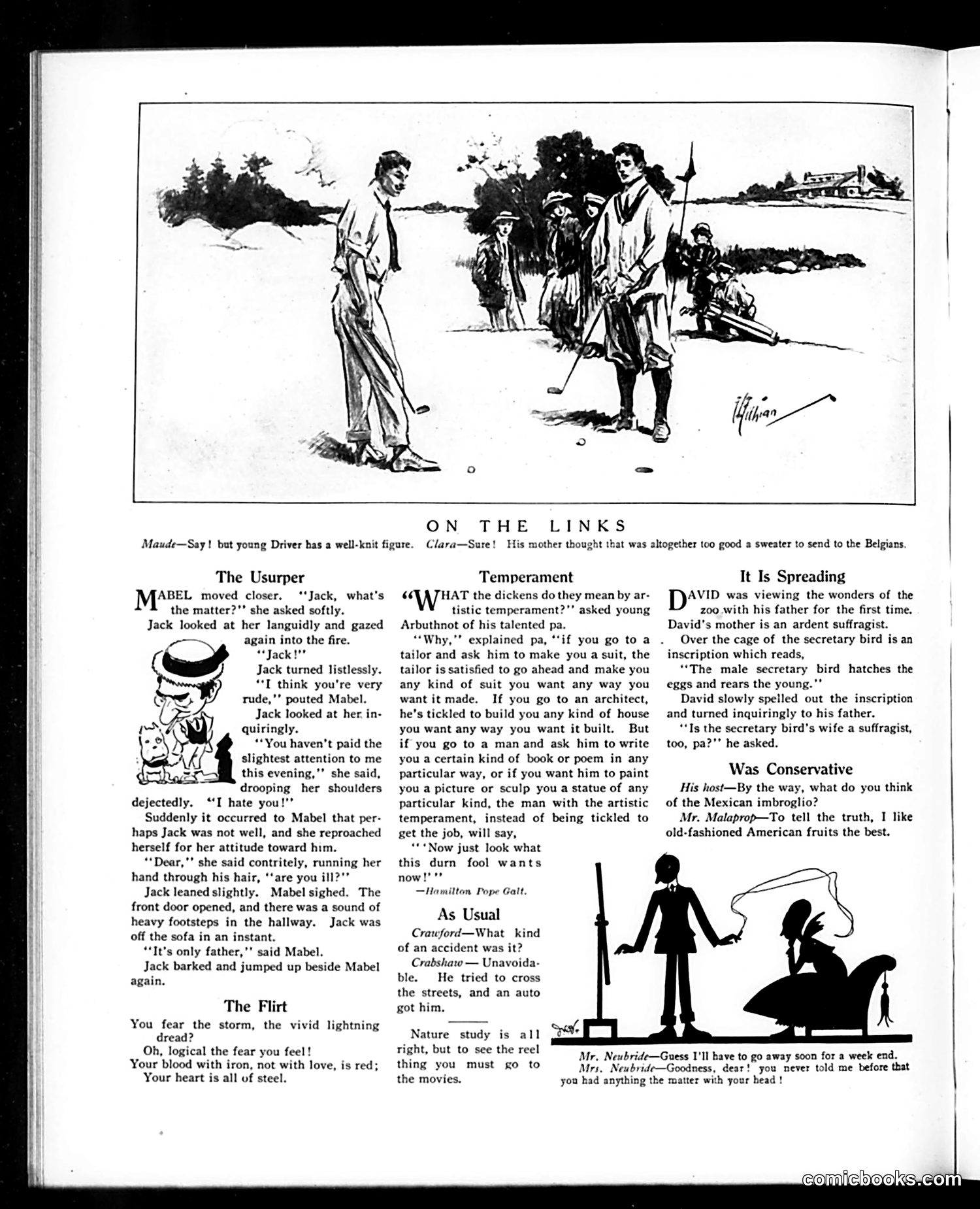
This page from *Judge* contains several short satirical pieces and cartoons: **"On the Links"** references WWI: a woman notes a young golfer's physique, and her friend quips his mother thought it "too good a sweater to send to the Belgians"—mocking wealthy Americans who shipped clothing to war-torn Belgium while their own sons enjoyed leisure. **"The Usurper"** is a domestic comedy: Jack ignores his girlfriend Mabel until her father arrives, then immediately jumps up—Jack is revealed to be a dog, not a man. The joke is Mabel's emotional manipulation over a pet. **"Temperament"** satirizes artistic ego: artists demand creative control, unlike practical professionals (tailors, architects) who simply fulfill requests. **"It Is Spreading"** uses a child's innocent misreading: seeing a secretary bird raises its eggs, David asks if the bird's wife is a suffragist—topical humor about the women's suffrage movement. **"Was Conservative"** plays on malapropism: "Mexican imbroglio" (political turmoil) is mistaken for Mexican fruit, suggesting willful ignorance of current events.
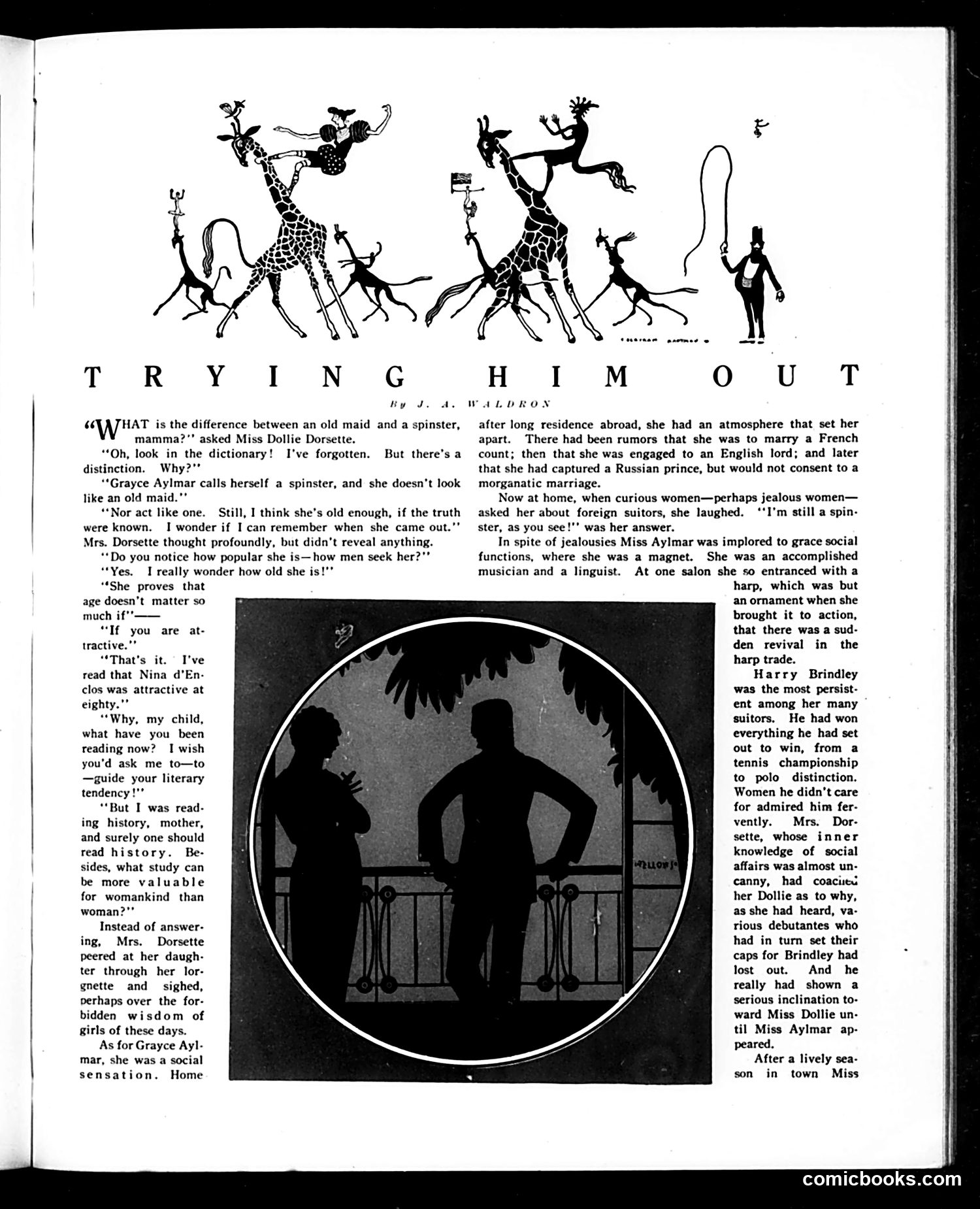
This page presents a romantic/social satire about unmarried women and courtship in early 20th-century America. The headline illustration shows silhouettes of figures in an intimate moment on a balcony or veranda. The story concerns Grayce Aylmar, a socially accomplished woman recently returned from abroad who becomes the social sensation of the season. She's pursued by multiple suitors, including the previously unattainable Harry Brindley—a champion athlete and serial romantic victor. The satire targets the era's obsessions with: women's marriageability and age (the "spinster vs. old maid" opening dialogue), foreign sophistication as social currency, women's limited accomplishments (music, language skills), and the competitive marriage market where women strategically position themselves. Miss Aylmar's mysterious past of titled suitors abroad and her refusal to settle gives her power in the domestic marriage game—she "tries out" suitors rather than desperately seeking marriage, inverting the expected gender dynamics of the era's courtship.
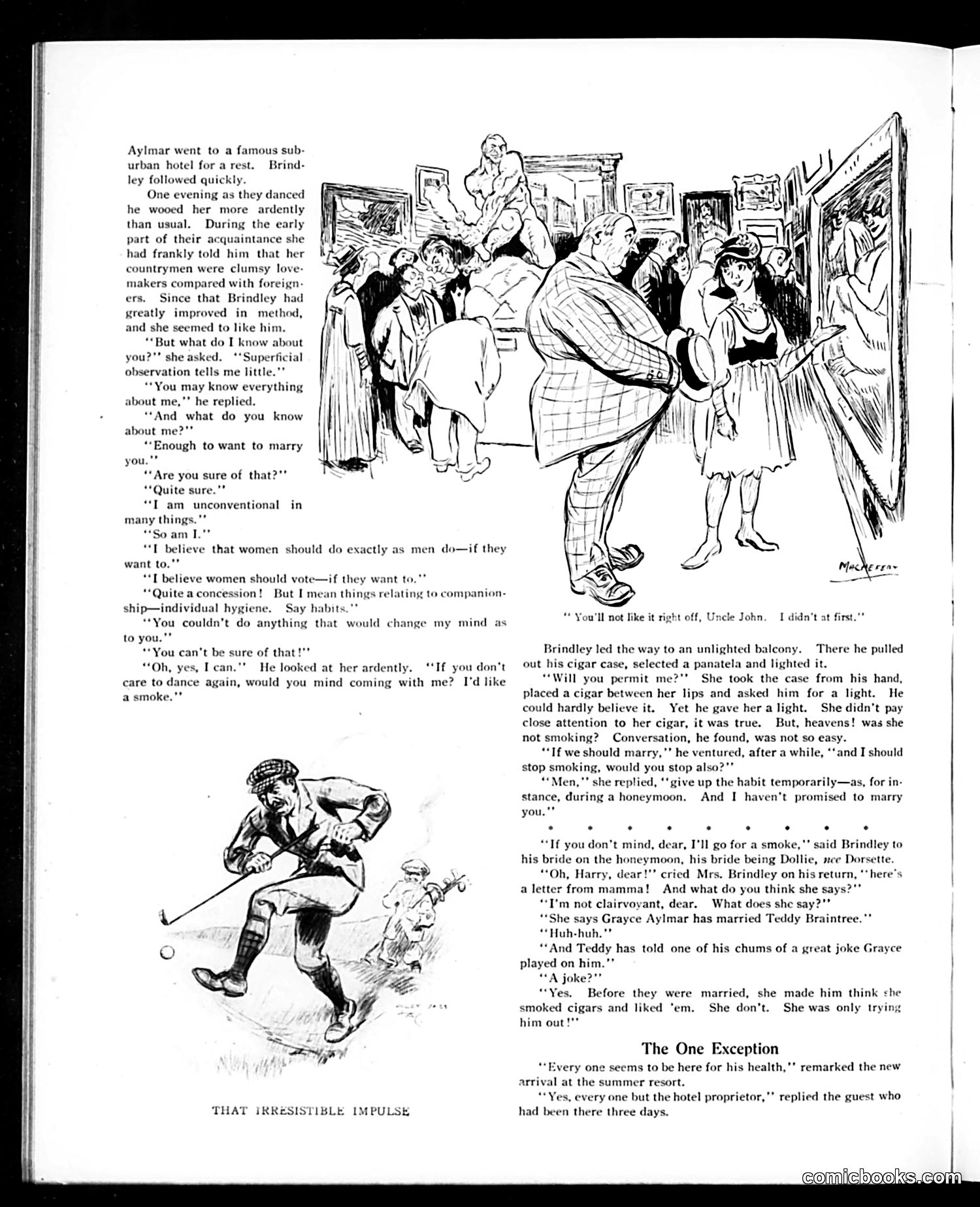
This page satirizes evolving attitudes toward women's independence and social convention. The main story depicts a courtship where the woman (Grayce Aylmar) claims to be "unconventional"—she believes women should vote and do "exactly as men do." The male protagonist (Brindley) is impressed until she smokes a cigar on their balcony, shocking him into awkward silence. The punchline reveals she was testing him: she doesn't actually smoke or enjoy cigars. She merely performed unconventionality to gauge his true acceptance of female independence before marriage. The satire targets both genders: the woman for faking progressivism, and the man for being deceived—despite his stated acceptance, he's unsettled by her actual behavior. The joke reflects real anxieties of the era about "New Women" and whether men's professed support for female equality was genuine or merely performative. The secondary cartoon ("That Irresistible Impulse") involves a golfer, seemingly unrelated.
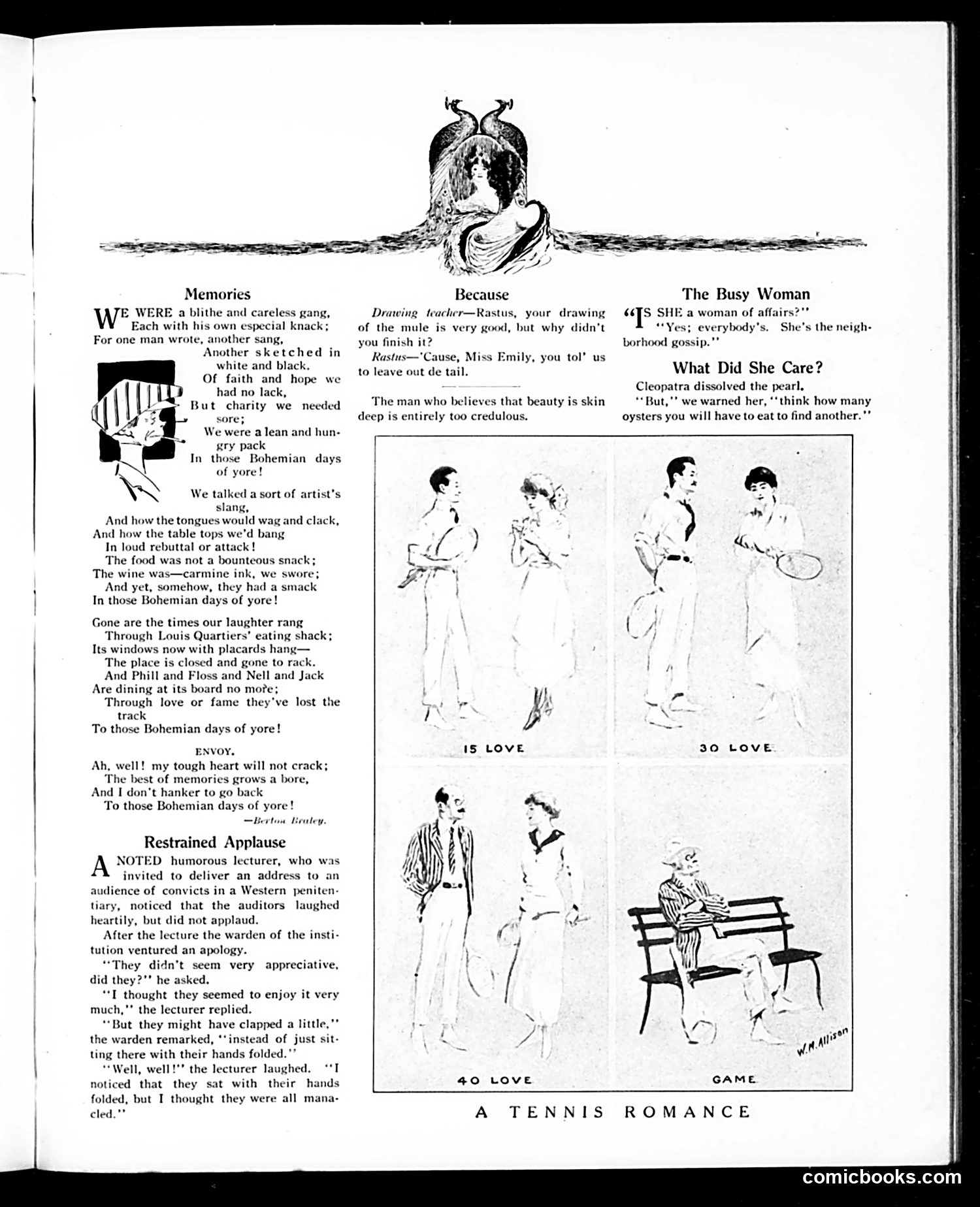
This page contains three distinct pieces of humor typical of early 20th-century satirical magazines: **"Memories"** is a nostalgic poem by Berton Bealey about bohemian artists' poverty and camaraderie in Paris's Latin Quarter. The satire lies in romanticizing deprivation—they ate poorly ("carmine ink" wine, meager food) yet found joy in artistic company. The poem laments how commercialism has replaced this authentic bohemian lifestyle. **"Restrained Applause"** is a joke about a prison lecture where convicts laughed but didn't clap. The punchline reveals they were handcuffed, making applause impossible—satirizing both the lecturer's obliviousness and the absurdity of expecting enthusiastic response from restrained prisoners. **The remaining content** includes brief jokes ("Because," "The Busy Woman") and "A Tennis Romance," a visual gag sequence showing the progression of a romantic relationship through tennis scoring terminology (15 Love, 30 Love, 40 Love, Game), depicting courtship stages humorously. The page reflects Judge's mix of literary satire, social commentary, and visual humor aimed at educated, urban readers.
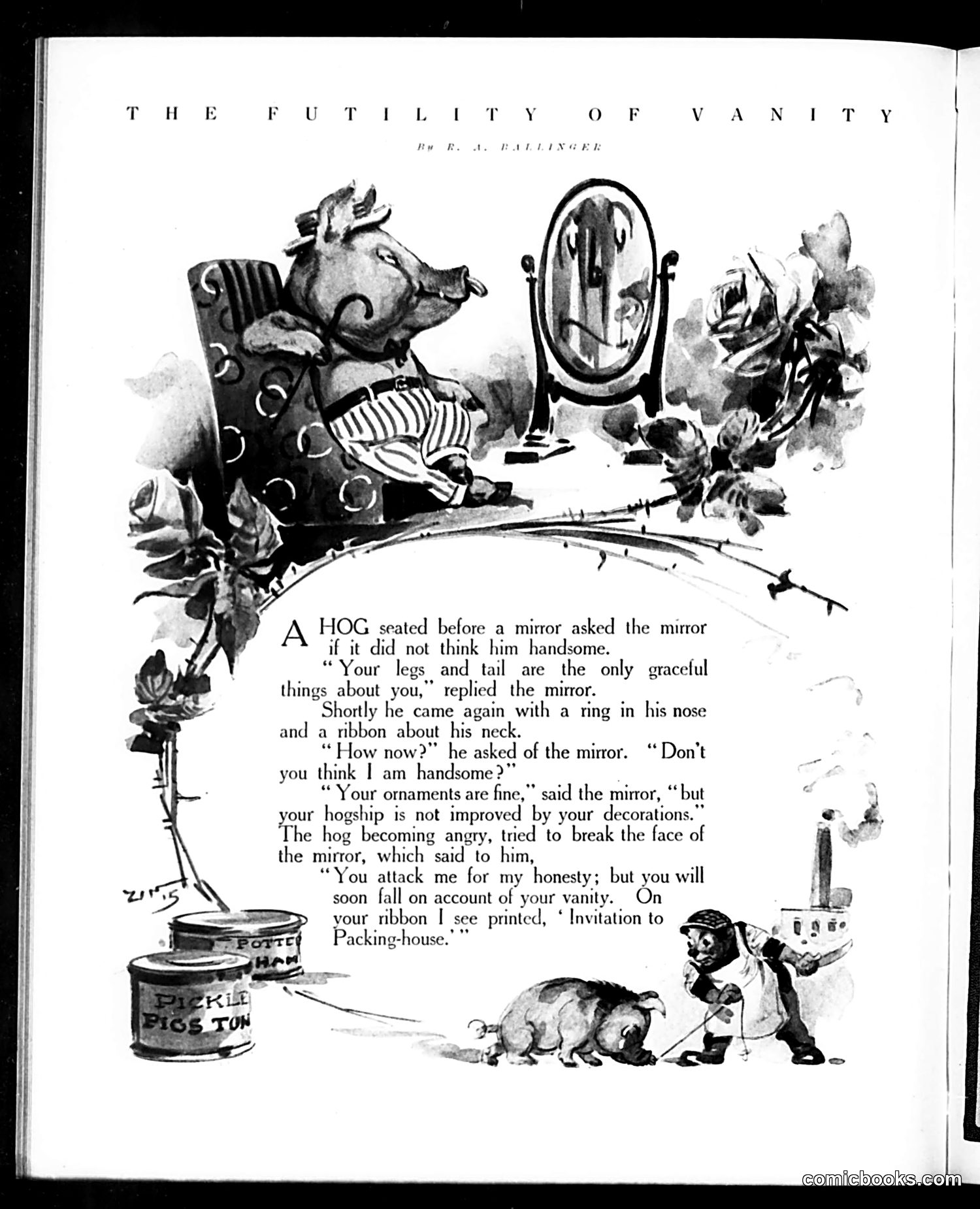
This is a moral fable illustrated as a cautionary tale about superficial self-improvement. A hog, dissatisfied with his appearance, adorns himself with a nose ring and ribbon, seeking validation from a mirror. The mirror—representing truth and honest judgment—refuses to flatter him, pointing out that decorations cannot change his fundamental nature. The punchline is darkly satirical: the ribbon reads "Invitation to Packing-house," suggesting the hog is being dressed up for slaughter. The moral critiques vanity as futile and self-destructive—no amount of ornamentation can alter one's essential fate or character. The story satirizes human vanity generally, suggesting that people who obsess over superficial improvements while ignoring deeper truths are foolishly marching toward their own demise.
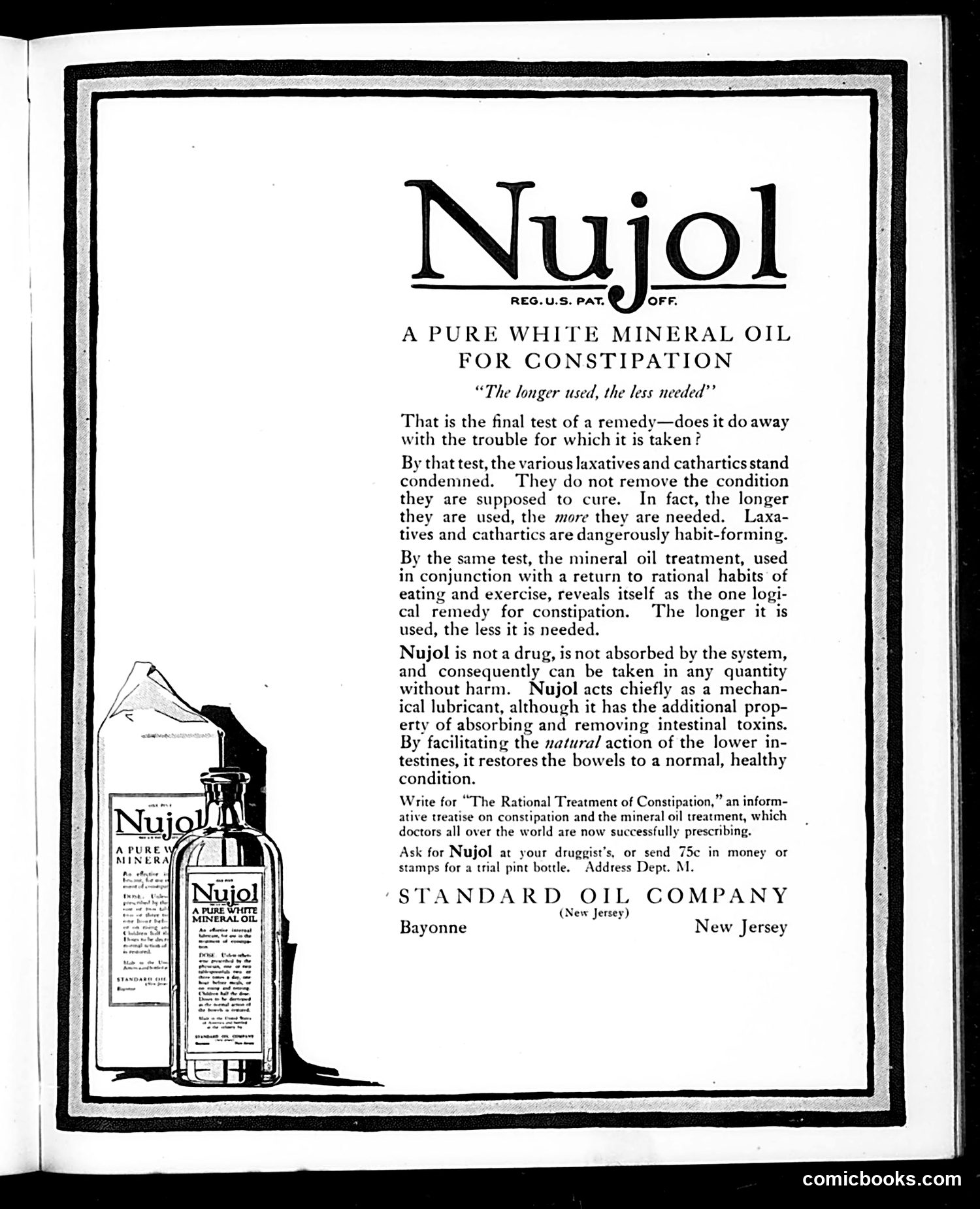
This is **not a cartoon or satire**—it's a straightforward advertisement for Nujol, a mineral oil laxative made by Standard Oil Company (New Jersey). The page promotes Nujol as superior to traditional laxatives and cathartics, claiming it addresses constipation's root cause rather than creating dependency. The key selling point: "the longer used, the less it is needed"—contrasting it with habit-forming competitors that require increasing doses. The ad emphasizes Nujol is "not a drug" and acts as a mechanical lubricant, positioning it as a rational, scientific solution. It encourages readers to request a trial pint bottle (75 cents) or write for an informative treatise on constipation treatment. The accompanying bottle illustration and smaller product label reinforce the brand identity. This reflects early-20th-century patent medicine marketing, when digestive remedies were heavily advertised in magazines like *Judge* to mainstream audiences.
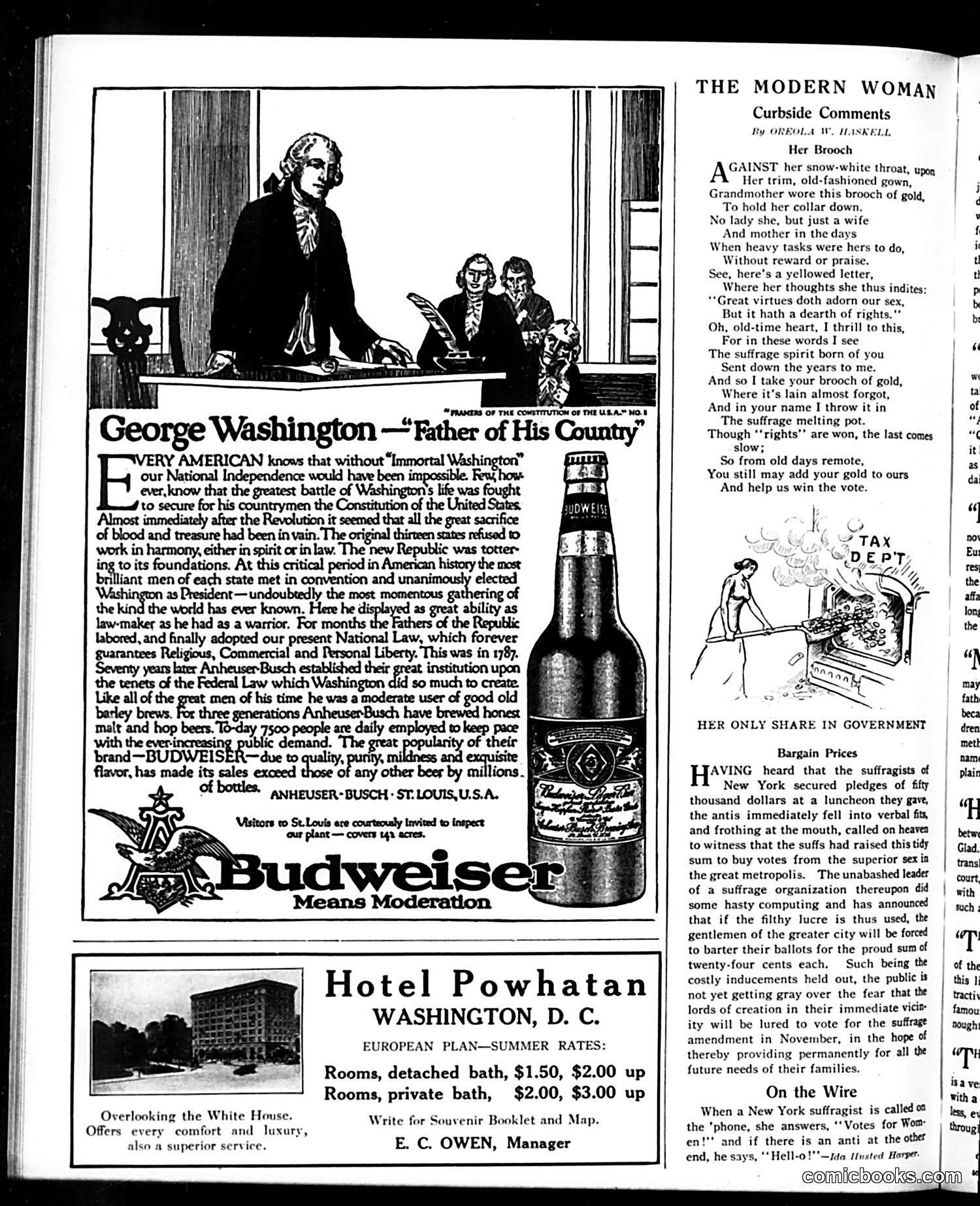
This page combines historical tribute with women's suffrage satire. The left side features a Budweiser advertisement using George Washington's image to promote beer as representing "moderation"—a common early-20th-century advertising technique. The right side contains three suffrage-related pieces mocking women's voting rights advocates: 1. **"Her Brooch"** poem: Sentimental narrative about a grandmother's suffrage activism, positioning women's rights as inherited legacy. 2. **"Her Only Share in Government"** cartoon: Depicts a woman at a tax desk, sarcastically suggesting taxation without representation—ironic commentary on women paying taxes but lacking voting power. 3. **Anti-suffrage satire**: Mocks New York suffragists for fundraising, calculating that men would sell their votes for mere pennies. The final joke about suffragists answering phones with "Votes for Women!" ridicules their activism as obsessive. The page's overall tone suggests Judge magazine's skeptical, dismissive stance toward women's suffrage during this pre-1920 period.
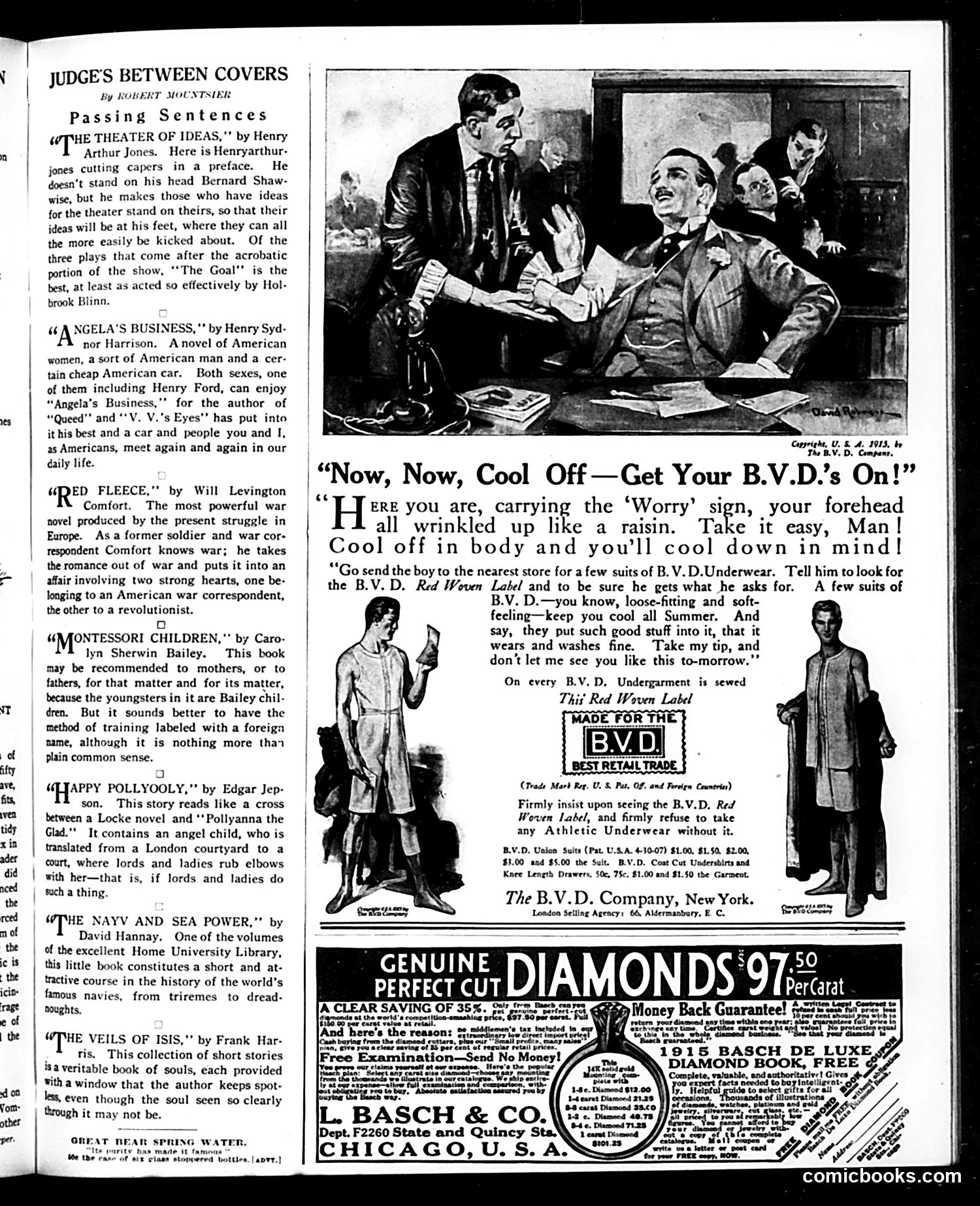
This page consists primarily of **book reviews** and a **B.V.D. underwear advertisement**—it is not a political cartoon. The left column features Robert Mountsier reviewing current books, including works on theater, war novels, and fiction. These are straightforward literary critiques typical of Judge's cultural coverage. The dominant image is a **commercial advertisement** showing a man counseling another about stress relief. The ad's humor is motivational rather than satirical: a worried man with a furrowed brow is told to "cool off" by wearing B.V.D. brand underwear, implying that comfortable clothing promotes mental calm. The tagline plays on this: keeping your body cool helps you "cool down in mind." Below is a **diamond sales advertisement** from Basch & Co. in Chicago. **For modern readers:** This page illustrates how Judge balanced cultural criticism (book reviews) with commercial advertising. The B.V.D. ad represents early 20th-century marketing that connected everyday products to emotional well-being—a precursor to modern advertising psychology.
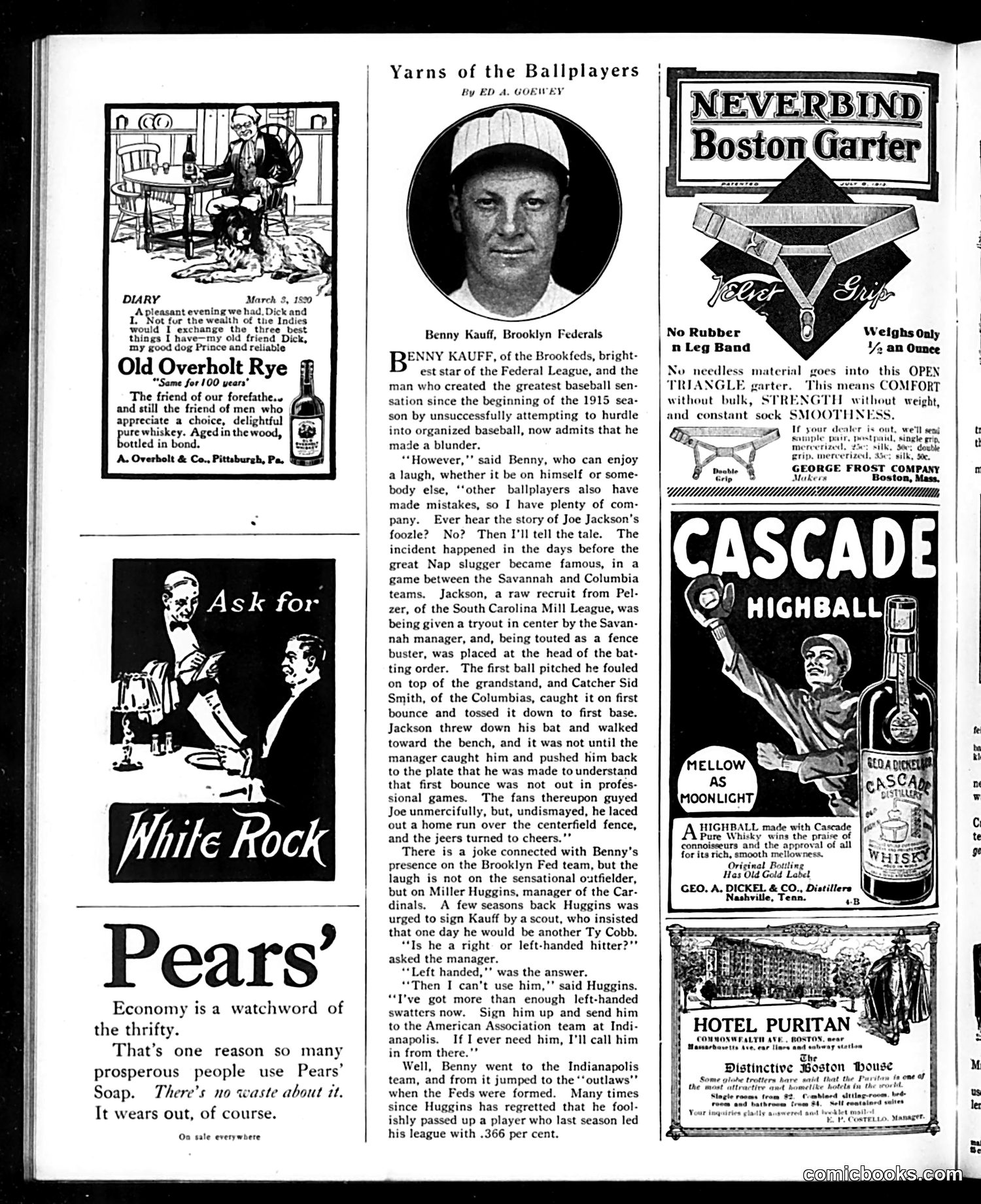
This is primarily an **advertising page** from Judge magazine (circa 1920), not a political cartoon. The main content is "Yarns of the Ballplayers" by Ed A. Goewey, a baseball anecdote about Benny Kauff of the Brooklyn Federals. The story recounts Joe Jackson's early baseball mistake—walking off the field after hitting a foul ball, not realizing it wasn't an out in professional baseball. The humor lies in Jackson's eventual redemption with a home run. The page also features a joke at manager Miller Huggins's expense: he rejected Kauff as a left-handed batter but later regretted it when Kauff became a star player (.366 batting average). The rest of the page consists of period advertisements for whiskey (Old Overholt Rye, Cascade Highball), soap (Pears'), garters (Neverbind), and hotels—typical magazine filler with no satirical content.
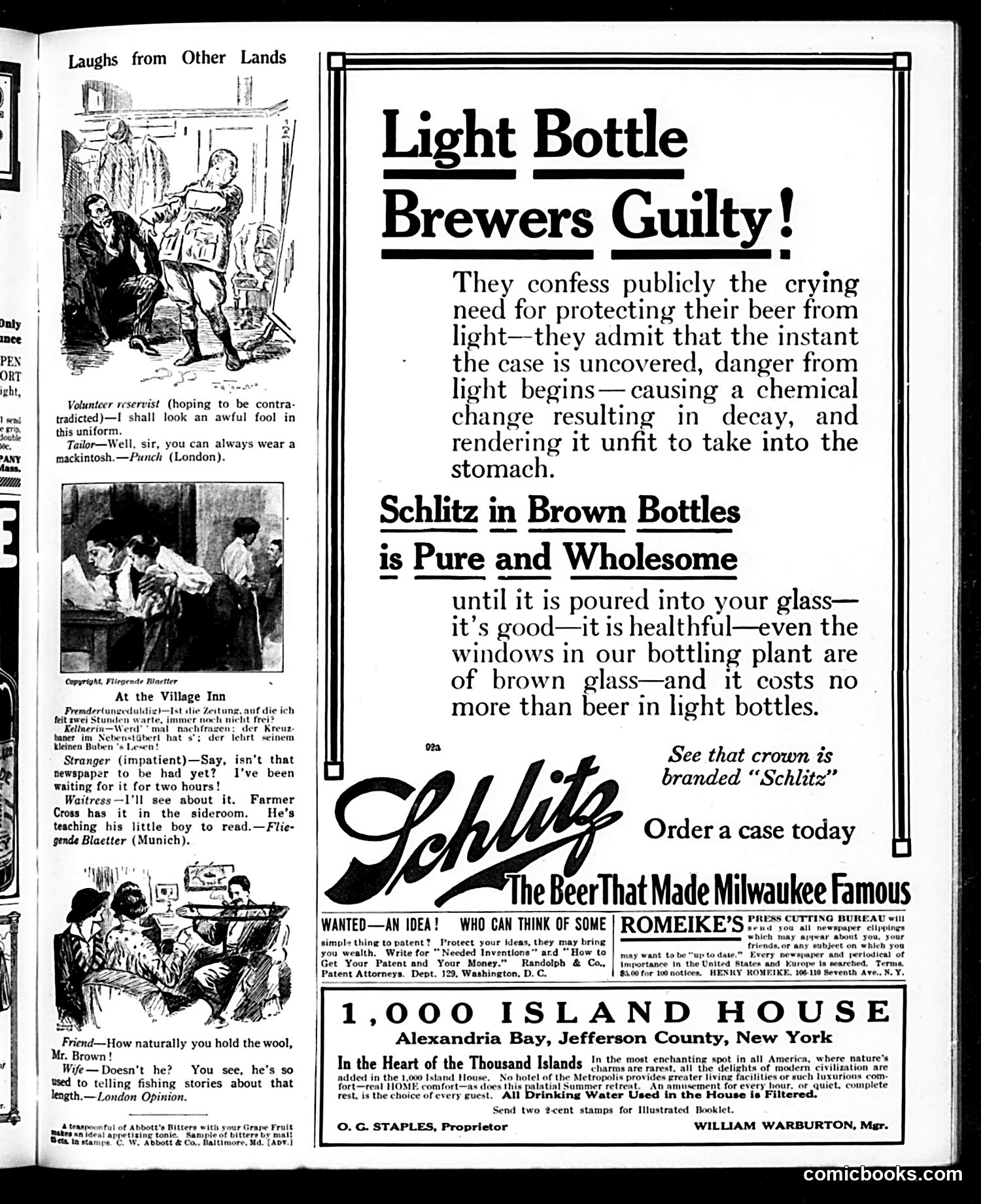
This page combines international humor with advertising. The left side reprints jokes from European publications (Punch, Fligende Blaetter, London Opinion), featuring gentle satire about military uniforms, newspaper delays, and fishing stories. The dominant content is a **Schlitz beer advertisement** claiming moral superiority through defensive marketing. Light-colored beer bottles, Schlitz argues, allow damaging light exposure that causes chemical decay—a genuine concern in early beer chemistry. By packaging in brown glass, Schlitz positions itself as "pure and wholesome," implicitly attacking competitors using clear bottles. The ad's framing as "Light Bottle Brewers Guilty!" uses accusatory language to turn a technical advantage into moral superiority, a common early-20th-century advertising tactic. The page also includes small ads for patent attorneys and a resort, typical of Judge's mixed content model—serious satire interspersed with revenue-generating advertisements.
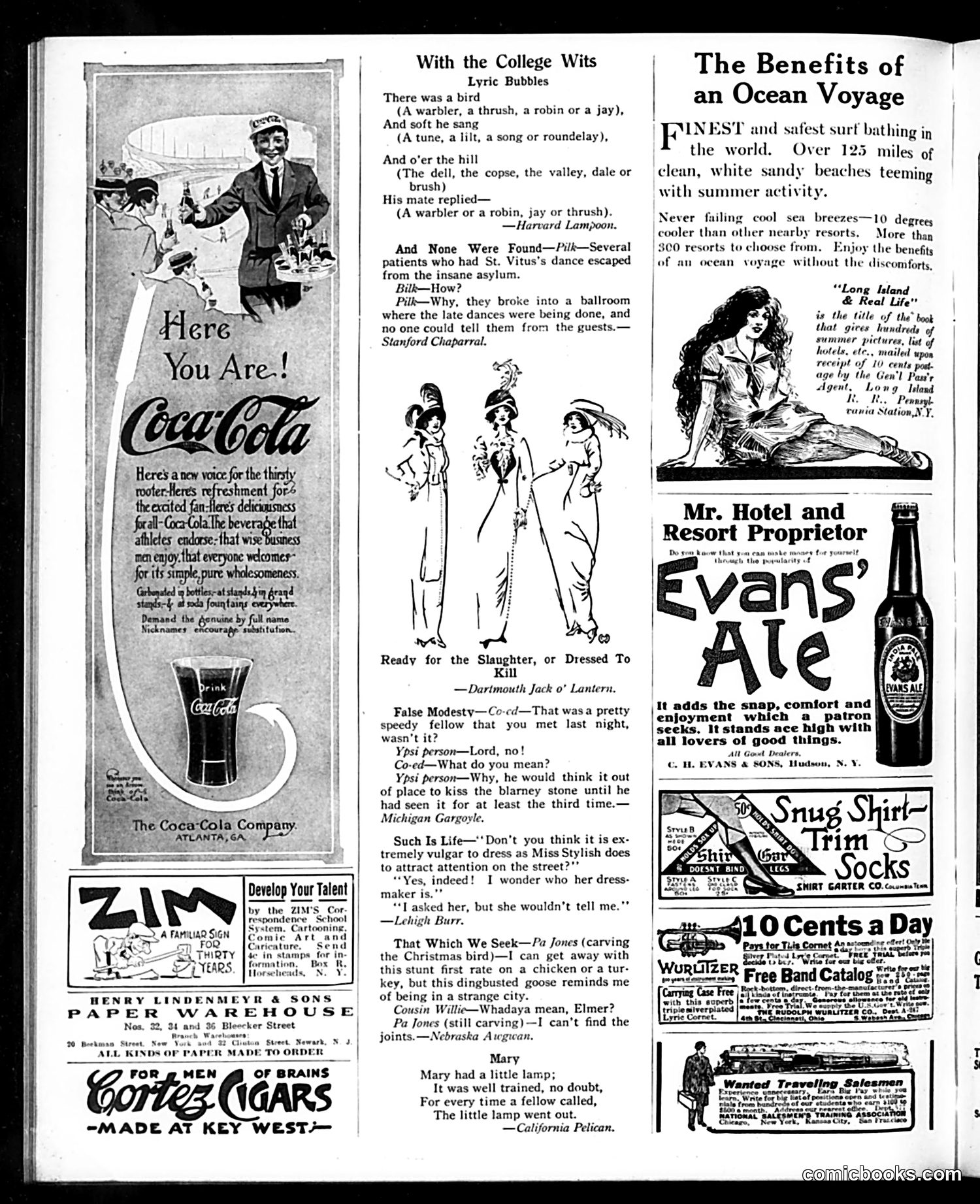
This page is primarily **advertising and humorous college content**, not political satire. The main elements include: **"With the College Wits"** — a humor section featuring jokes from university magazines (Harvard Lampoon, Stanford Chaparral, Michigan Gargoyle, etc.). These are light gags about college life: students escaping an asylum by dancing undetected at a ball, a coed's false modesty about her suitor, carving poultry, etc. The humor is gentle, campus-focused wordplay typical of early 20th-century college publications. **Advertisements** dominate the page: Coca-Cola ("Here You Are!"), Cortez Cigars, Evans' Ale, Snug Shirt Trim Socks, and various business services. These reflect consumer goods and services of the period. **"The Benefits of an Ocean Voyage"** promotes Long Island beaches and resort travel—marketing material emphasizing safe bathing and cool breezes. There is **no evident political cartoon or satire** on this page. The content is entertainment and commercial advertising typical of Judge magazine's format—mixing collegiate humor with period advertisements.
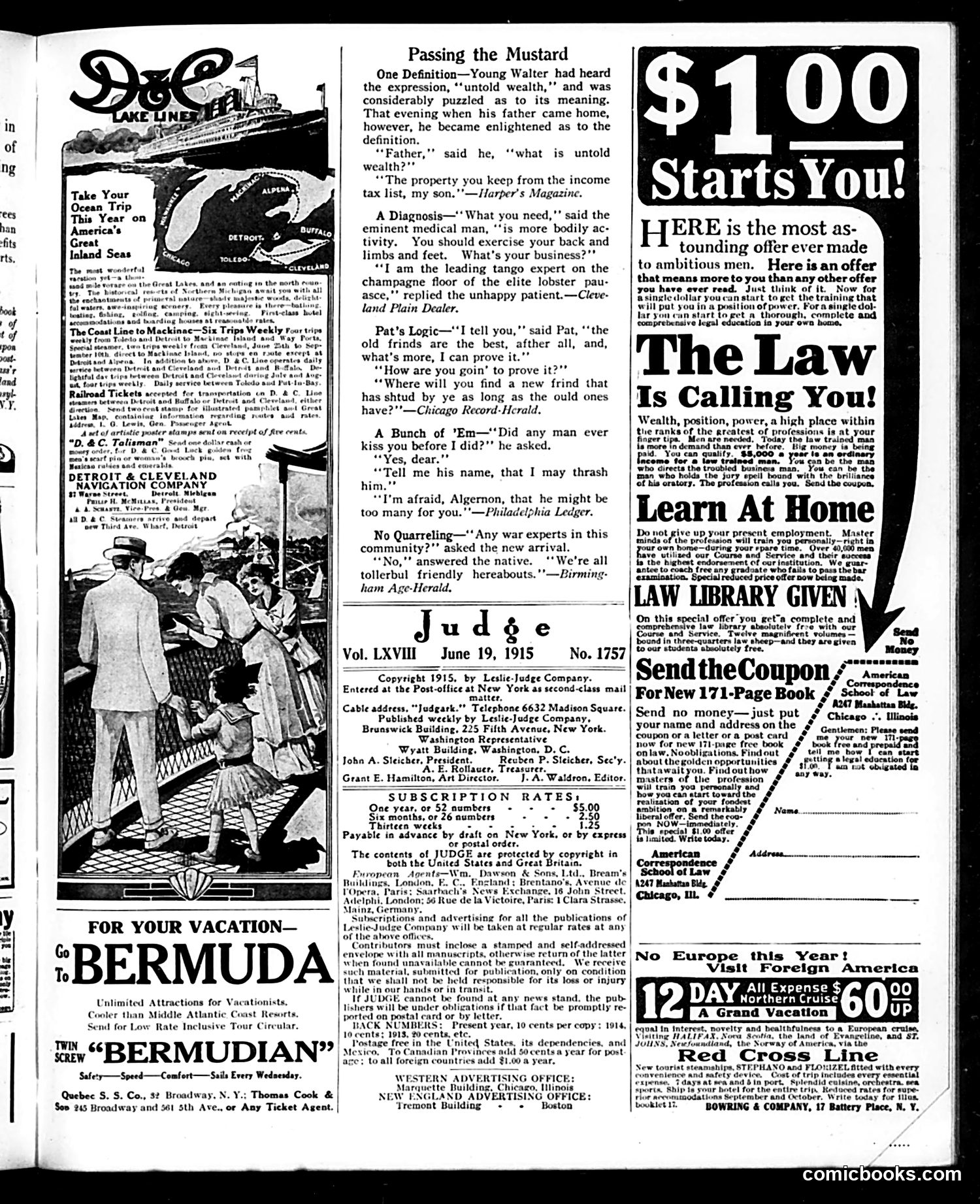
This page from the satirical magazine *Judge* contains several short humorous anecdotes ("Passing the Mustard") rather than political cartoons. The jokes target contemporary social issues: 1. **Tax Evasion**: A father defines "untold wealth" as property kept from tax authorities—satirizing wealthy Americans' tax avoidance. 2. **Leisure vs. Labor**: A doctor prescribes exercise to a tango expert on a "champagne floor" of an elite establishment, mocking the idle wealthy who avoid physical work. 3. **Friendship**: An Irish character argues old friends are best because new ones haven't had time to disappoint you yet. 4. **Romance**: A man demands to know the names of his girlfriend's previous suitors so he can fight them—absurdist humor about jealousy. The page primarily functions as a title/contents page with advertisements for vacation travel and a correspondence law school, rather than containing substantive political satire. The humor reflects early 20th-century concerns about wealth inequality and leisure-class pretension.
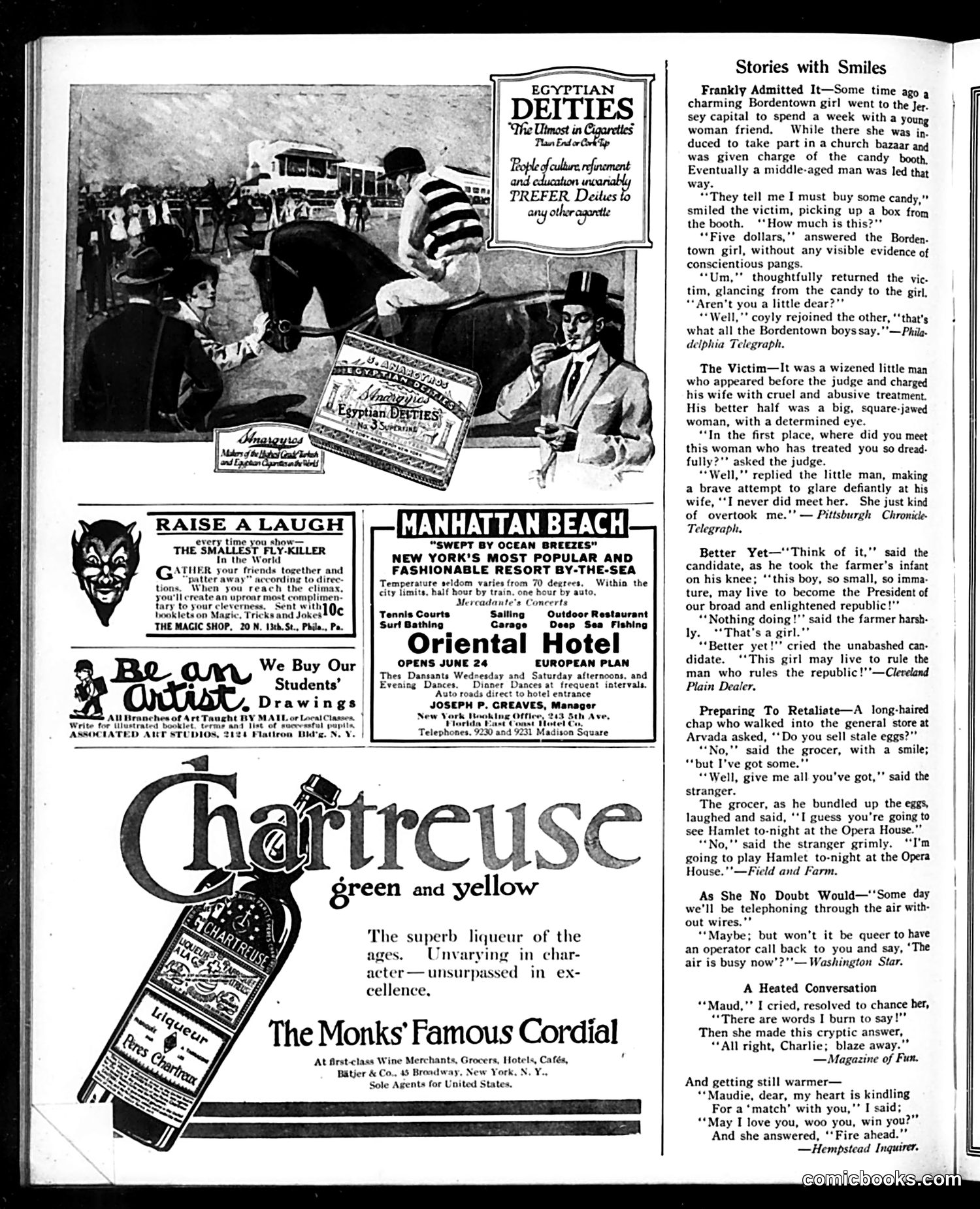
This page is primarily **advertising and humor content** rather than political satire. The main cartoon at top shows an "Egyptian Deities" advertisement—appears to be promoting some product or service using pseudo-Egyptian imagery, a common early 20th-century marketing trope exploiting exotic aesthetics. The bulk of the page contains **short humorous anecdotes** under "Stories with Smiles," typical Judge fare: lighthearted tales about romance, marriage, and rural/small-town life. These rely on gentle, period-appropriate humor—a woman overcharging at a bazaar, a henpecked husband, a political candidate's gaffe, and wordplay about eggs and Shakespeare. The remaining space features **advertisements** for hotels (Manhattan Beach, Oriental Hotel), liqueur (Chartreuse), art lessons, and novelty items (fly-killer). **For modern readers:** This reflects pre-1920s American popular humor—sentimental, domestic-focused, with no sharp political edge. The "satire" is mild social observation rather than biting commentary.
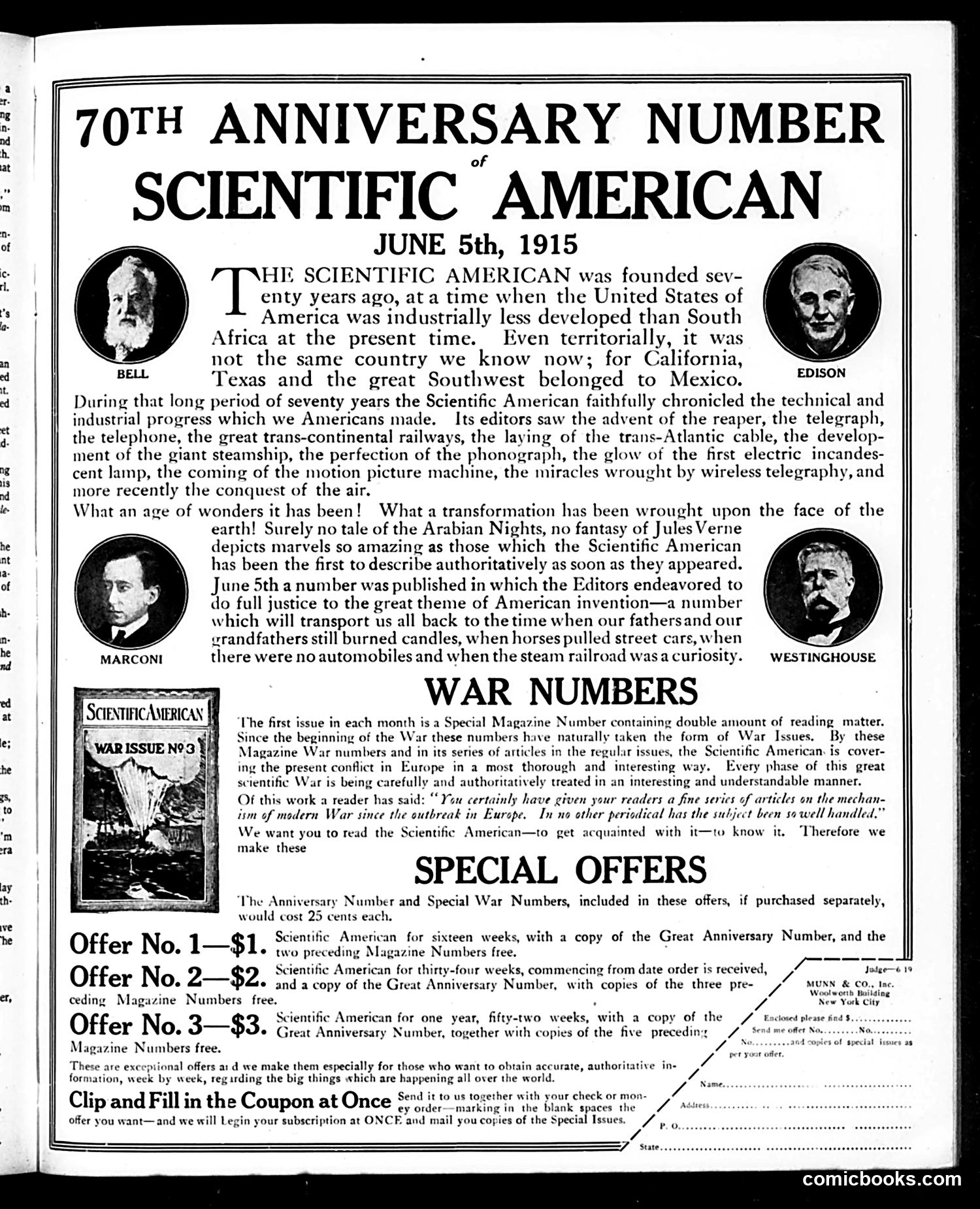
This is a **promotional advertisement**, not a cartoon or satirical content. It celebrates *Scientific American* magazine's 70th anniversary (June 5, 1915) by featuring portraits of four famous American inventors: **Bell, Edison, Marconi, and Westinghouse**—titans of technological progress. The page's key point: It contrasts America's transformation over 70 years (from a nation less industrially developed than South Africa, lacking California and the Southwest) with the stunning innovations *Scientific American* documented—telegraphs, railroads, electric lights, wireless technology, automobiles, and aviation. The "War Numbers" section references World War I (then ongoing in Europe), noting the magazine's coverage of the conflict's technical and scientific dimensions. The three subscription offers at bottom are straightforward sales pitches with varying price points ($1-$3) bundling the anniversary issue with regular subscriptions. This is primarily **boosterism**—celebrating American technological achievement and inviting readers to subscribe.
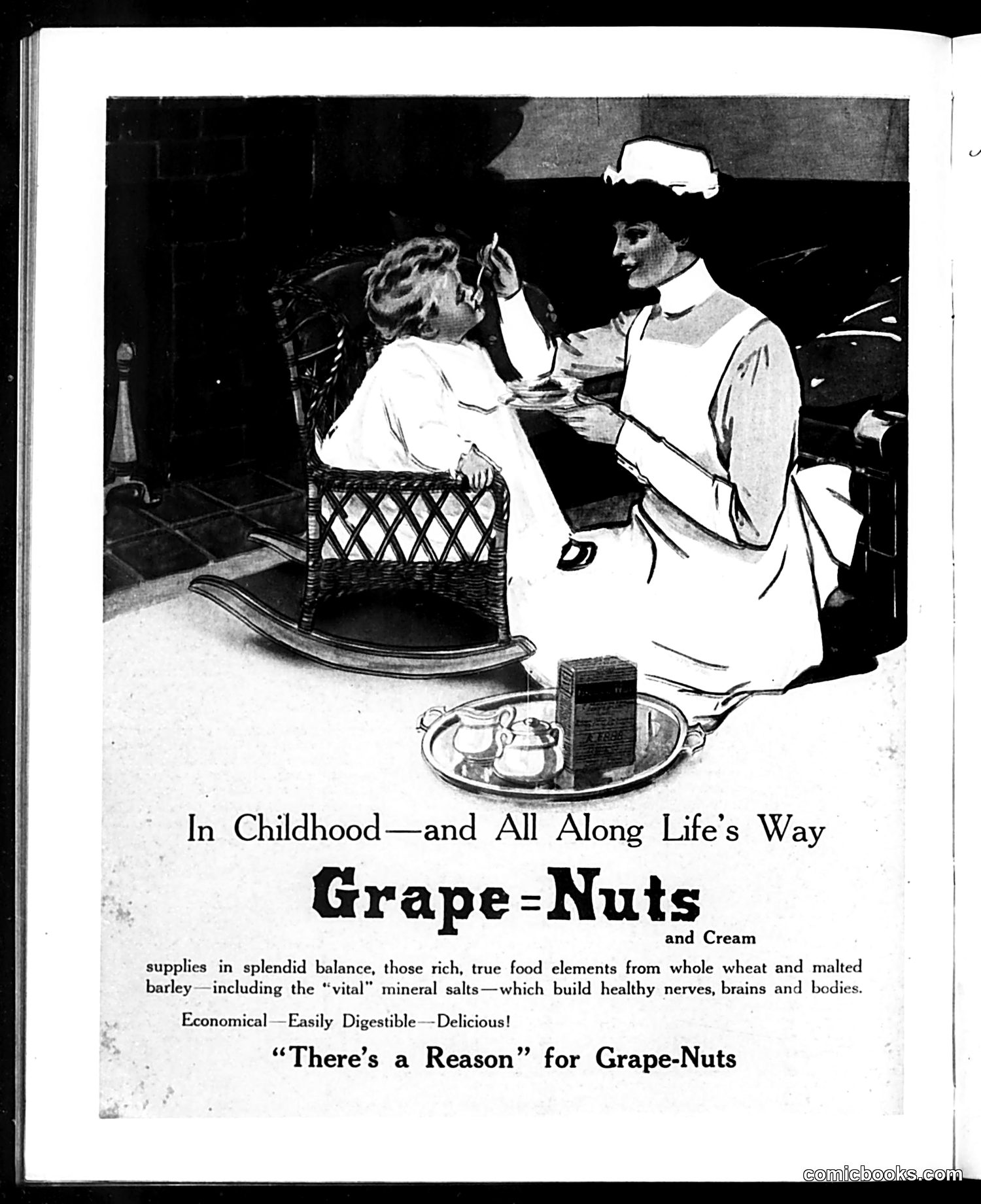
This is a **Grape-Nuts cereal advertisement**, not political satire. The image shows a woman feeding a child at a table, illustrating the product's appeal to mothers concerned with nutrition. The ad employs early 20th-century health rhetoric, claiming Grape-Nuts contains "vital" mineral salts from wheat and barley that build "healthy nerves, brains and bodies." The phrase "There's a Reason" was Grape-Nuts' actual advertising slogan. The caption "In Childhood—and All Along Life's Way" suggests lifelong nutritional benefits. The advertisement targets mothers by positioning the cereal as economical yet scientifically formulated—typical marketing strategy of the era when commercial breakfast cereals were relatively new and manufacturers emphasized their health properties to justify premium pricing. This reflects period anxieties about proper child nutrition and the growing acceptance of processed foods.