
Judge, 1915-06-19 · page 4 of 24
Judge — June 19, 1915 — page 4: what you’re looking at
What you’re looking at
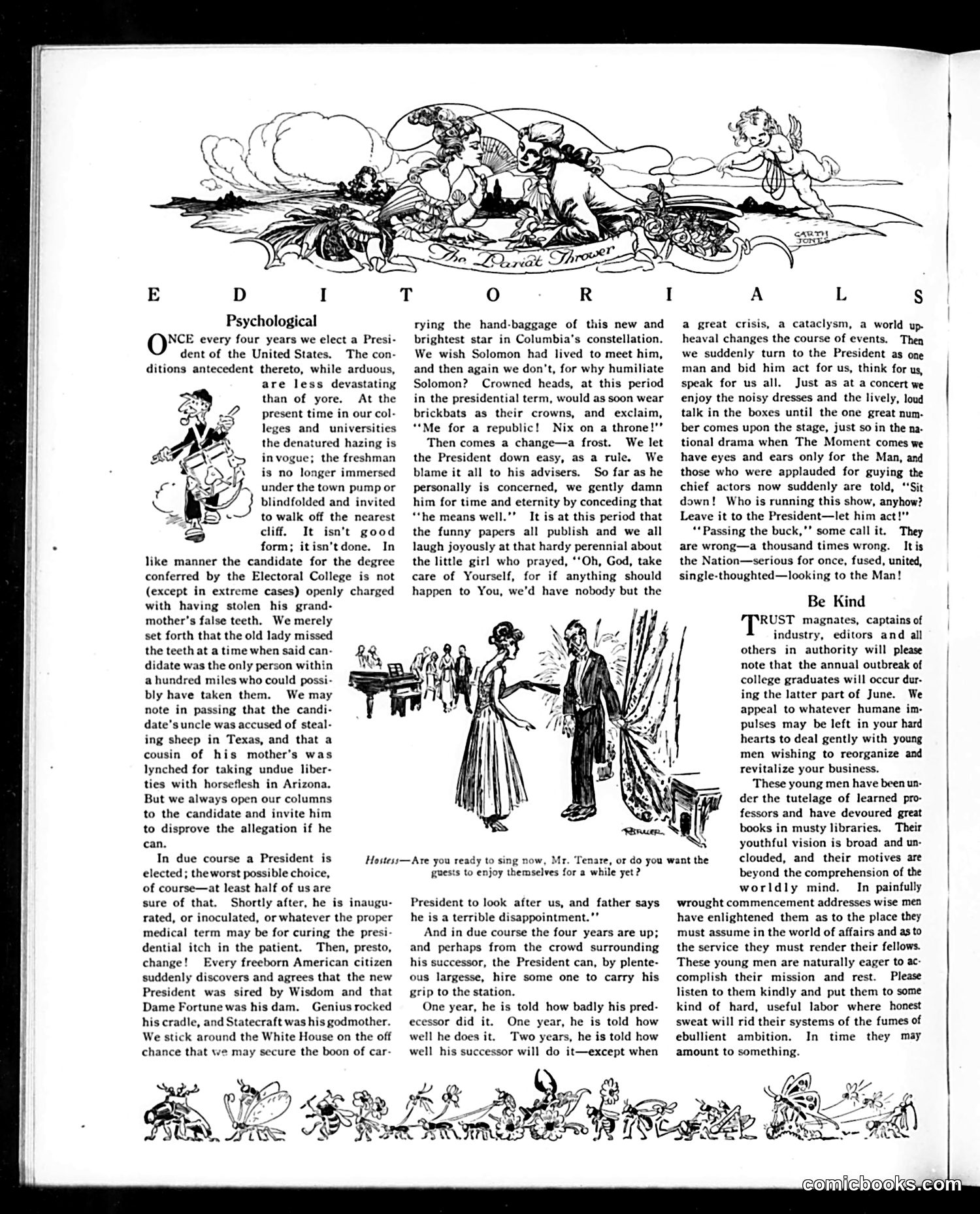
This page from *Judge* magazine satirizes the U.S. presidential election cycle. The main editorial, "Psychological," mocks how Americans elect presidents every four years despite consistently poor results. The author argues that candidates are often unqualified—comparing them to unsuitable people who might be lynched or involved in scandals—yet voters still choose them. The accompanying illustration depicts a woman asking a man (likely representing a candidate or political figure) if he's "ready now" for social engagement, suggesting unpreparedness for leadership. The "Be Kind" section appeals to business leaders to treat young college graduates entering the workforce gently during economic uncertainty, implying the nation faces serious challenges requiring experienced, thoughtful leadership—which elected officials apparently lack.
📄 Transcribed text from this page (OCR, searchable)
Machine-transcribed from the original scan — historical spelling and the odd misread are preserved.
Psychological NCE every four years we elect a Presi- dent of the United States. The con- ditions antecedent thereto, while arduous, are less devastating than of yore. At the present time in our col- leges and universities the denatured hazing is invogue; the freshman is no longer immersed under the town pump or blindfolded and invited to walk off the nearest cliff. It isn’t good form; itisn’tdone. In like manner the candidate for the degree conferred by the Electoral College is not (except in extreme cases) openly charged with having stolen his grand- mother's false teeth. We merely set forth that the old lady missed the teeth at a time when said can- didate was the only person within a hundred miles who could possi- bly have taken them. We may note in passing that the candi- date’s uncle was accused of steal- ing sheep in Texas, and that a cousin of his mother’s was lynched for taking undue liber- ties with horseflesh in Arizona. But we always open our columns to the candidate and invite him to disprove the allegation if he can. In due course a President is elected ; the worst possible choice, of course—at least half of us are sure of that. Shortly after, he is inaugu- rated, or inoculated, or whatever the proper medical term may be for curing the presi dential itch in the patient. Then, presto, change! Every freeborn American citizen suddenly discovers and agrees that the new President was sired by Wisdom and that Dame Fortune was his dam. Genius rocked his cradle, and Statecraft was his godmother, We stick around the White House on the off chance that we may secure the boon of car- rying the hand-baggage of this new and brightest star in Columbia's constellation. We wish Solomon had lived to meet him, and then again we don't, for why humiliate Solomon? Crowned heads, at this period in the presidential term, would as soon wear brickbats as their crowns, and exclaim, **Me for a republic! Nix on a throne!’’ Then comes a change—a frost. We let the President down easy, as a rule. We blame it all to his advisers. So far as he personally is concerned, we gently damn him for time and eternity by conceding that ‘the means well.”’ It is at this period that the funny papers all publish and we all laugh joyously at that hardy perennial about the little girl who prayed, ‘‘Oh, God, take care of Yourself, for if anything should happen to You, we'd have nobody but the Hostess—Are you ready to sing now, Mr. Tenare, or do you want the guests to enjoy themselves for a while yet ? President to look after us, and father says he is a terrible disappointment."" And in due course the four years are up; and perhaps from the crowd surrounding his successor, the President can, by plente- ous largesse, hire some one to carry his grip to the station. One year, he is told how badly his pred- ecessor did it. One year, he is told how well he does it. Two years, he is told how well his successor will do it—except when AS iret tite Bi SS PRR a great crisis, a cataclysm, a world up. heaval changes the course of events. Then we suddenly turn to the President as one man and bid him act for us, think for us, speak for us all. Just as at a concert we enjoy the noisy dresses and the lively, loud talk in the boxes until the one great num. ber comes upon the stage, just so in the na- tional drama when The Moment comes we have eyes and ears only for the Man, and those who were applauded for guying the chief actors now suddenly are told, ‘Sit down! Who is running this show, anyhow? Leave it to the President—let him act!" “*Passing the buck,’’ some call it. They are wrong—a thousand times wrong. It is the Nation—serious for once, fused, united, single-thoughted—looking to the Man! Be Kind RUST magnates, captains of industry, editors and all others in authority will please note that the annual outbreak of college graduates will occur dur- ing the latter part of June. We appeal to whatever humane im- pulses may be left in your hard hearts to deal gently with young men wishing to reorganize and revitalize your business. ‘These young men have been un- der the tutelage of learned pro- fessors and have devoured great books in musty libraries, Their youthful vision is broad and un- clouded, and their motives are beyond the comprehension of the worldly mind. In painfully wrought commencement addresses wise men have enlightened them as to the place they must assume in the world of affairs and as to the service they must render their fellows. These young men are naturally eager to ac- complish their mission and rest. Please listen to them kindly and put them to some kind of hard, useful labor where honest sweat will rid their systems of the fumes of ebullient ambition. In time they may amount to something.