
A complete issue · 24 pages · 1915
Judge — March 20, 1915
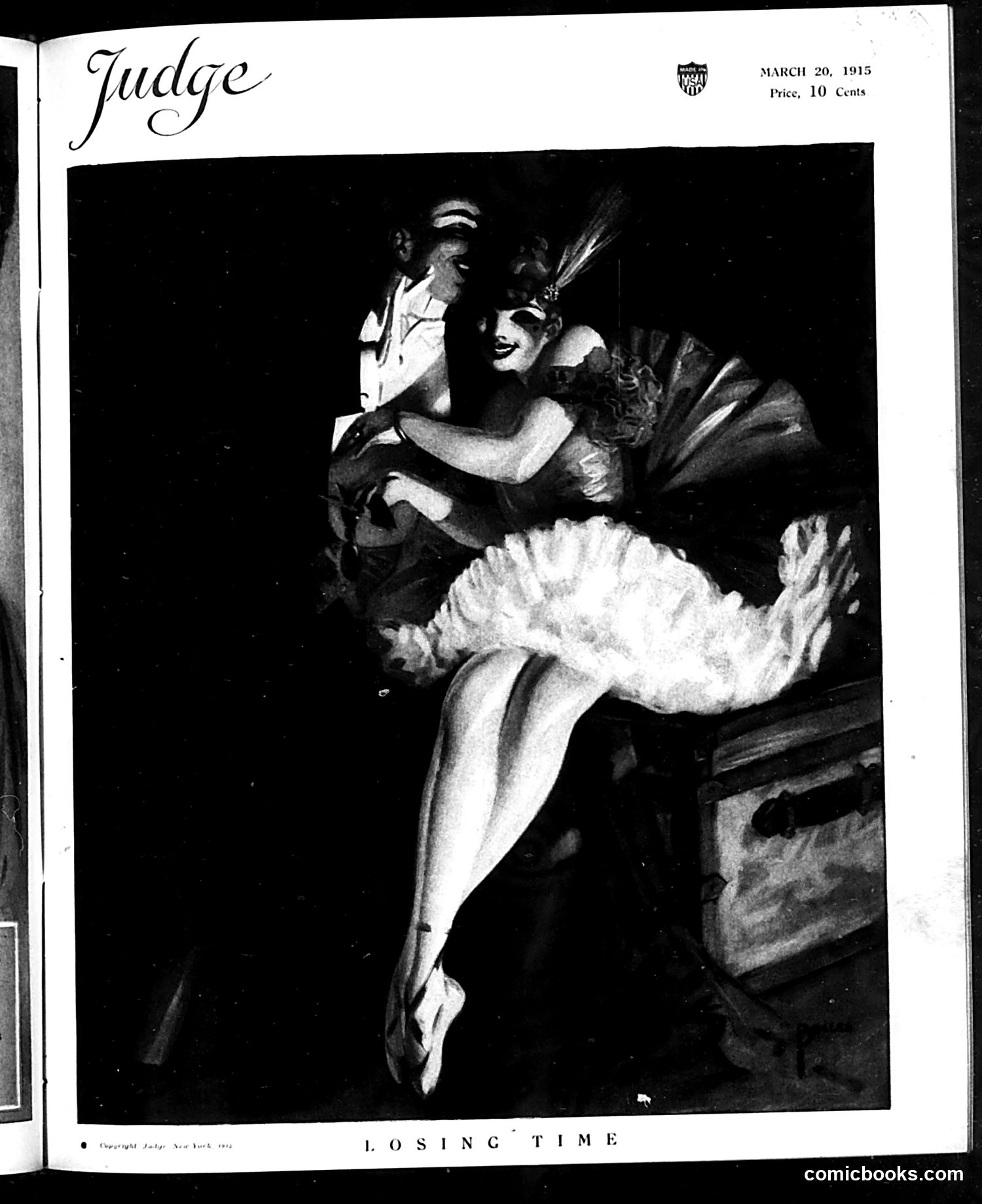
This illustration depicts a couple in an intimate embrace, with the caption "LOSING TIME." The satire appears to target leisure activities and romantic dalliance during what was likely a period when time-consciousness and productivity were increasingly valued in American culture. The woman wears an elaborate feathered hat and revealing dress, while the man is partially undressed in a chauffeur's or porter's uniform. The "losing time" reference suggests mockery of those who waste hours on romance and pleasure rather than productive work—a common theme in early 20th-century social satire about changing morality and work ethic. The image reflects Judge magazine's tendency to lampoon frivolous behavior and leisure pursuits among the wealthy or careless classes.
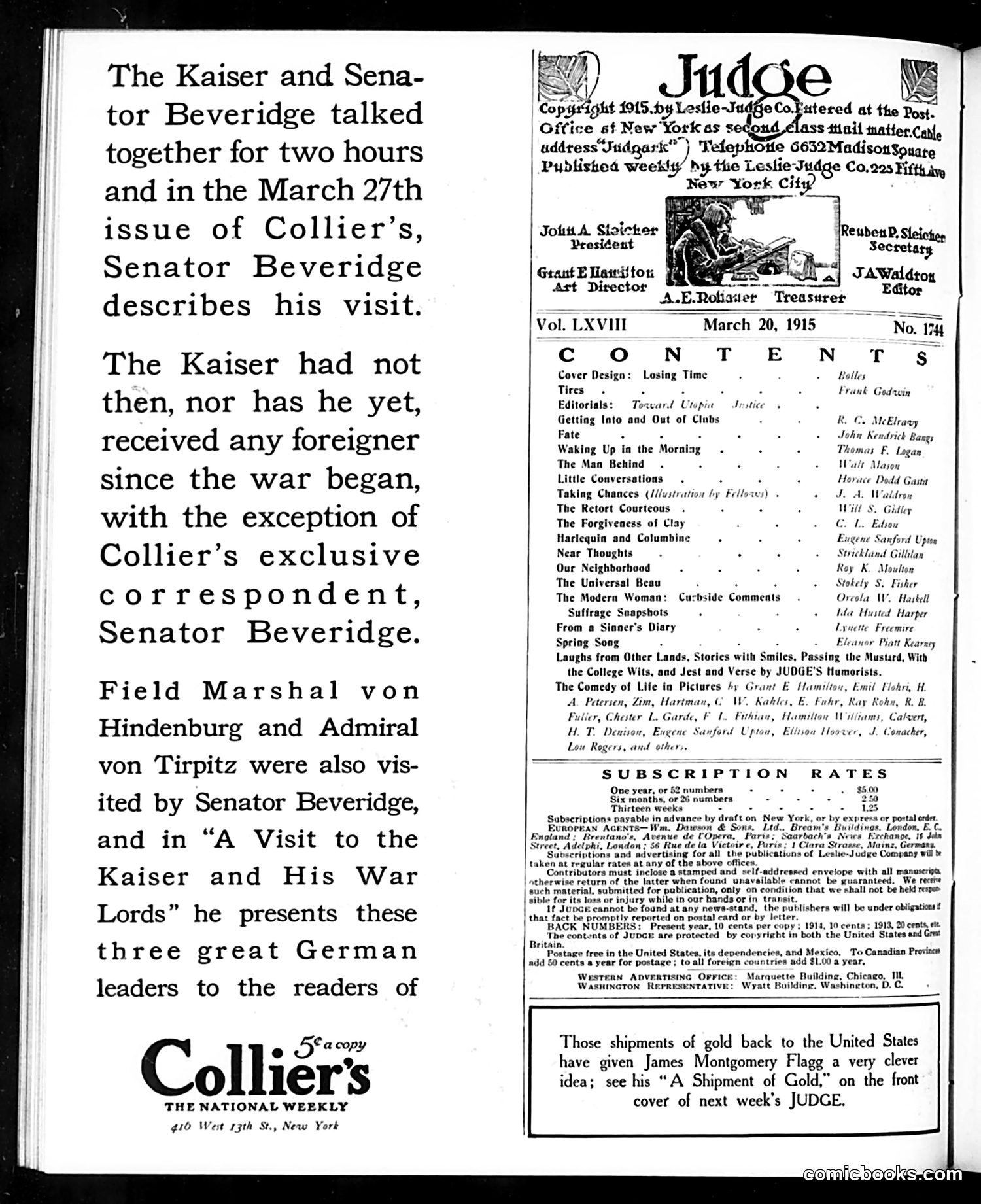
The left page advertises Collier's magazine, promoting Senator Albert Beveridge's exclusive account of meeting Kaiser Wilhelm II during World War I. The text emphasizes this was the Kaiser's first contact with any foreigner since the war began, making it a significant diplomatic moment. Beveridge also met Field Marshal von Hindenburg and Admiral von Tirpitz. The right page shows Judge's masthead and table of contents. The satire appears directed at American media's fascination with German leadership during WWI—presenting Beveridge's access as extraordinary while implicitly questioning the propaganda value of such encounters. The competing magazines' race to publish insider accounts of enemy leaders reflects American neutrality-era curiosity about the conflict.
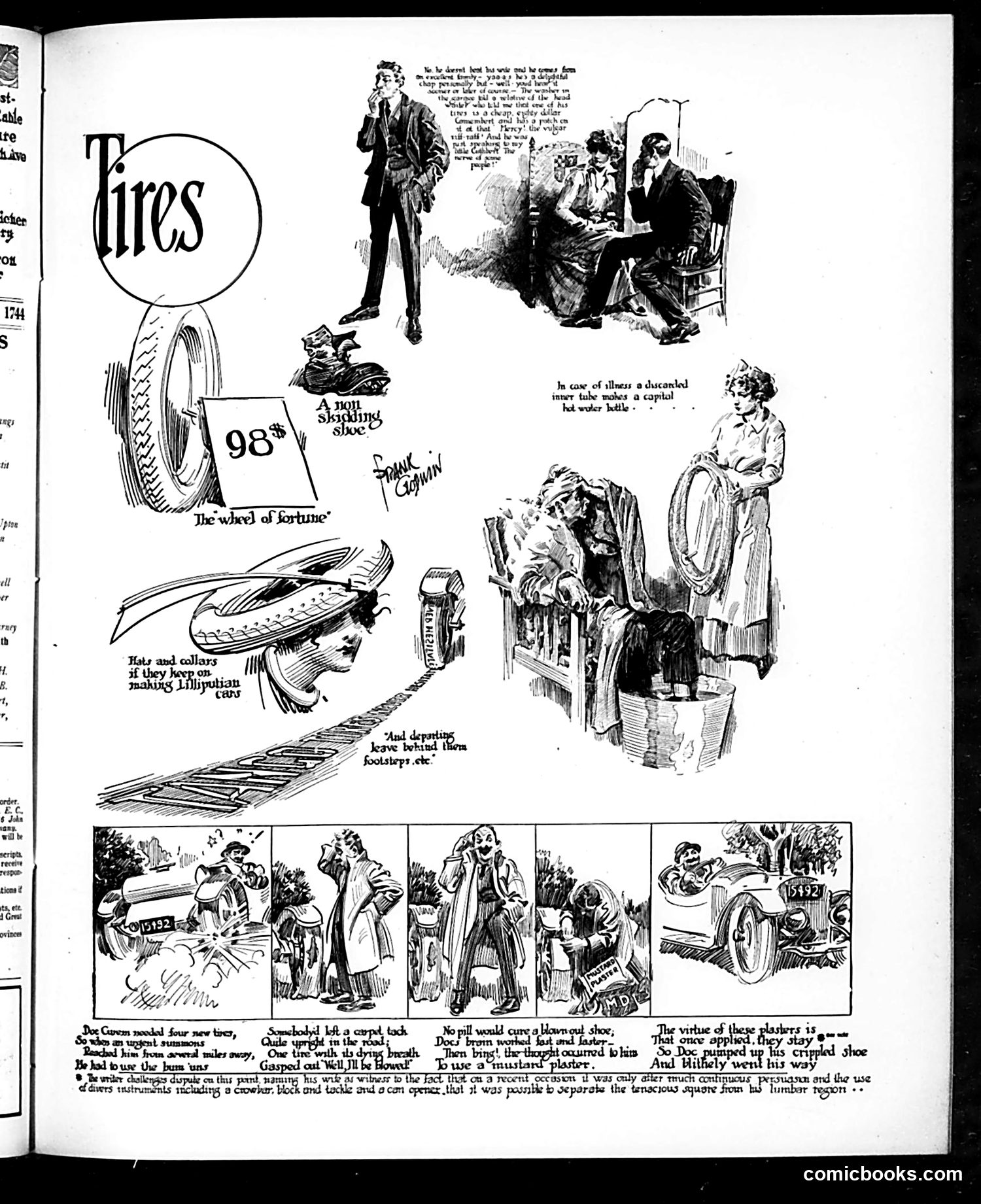
This page satirizes the widespread problem of automobile tire failures in the early automotive era. The central motif—a tire labeled "98¢" as "The wheel of fortune"—suggests that cheap tires were unreliable gambles. The cartoon sequences depict various tire-related disasters: blowouts requiring urgent summons, disputes over repairs, and the ineffectiveness of "plasters" (temporary patches). The accompanying text notes that such patches "stay on" only briefly before the shoe fails again. The satire targets both manufacturers of cheap, defective tires and the false economy of purchasing low-quality products. For modern readers, this illustrates early-1900s consumer frustrations with nascent automotive technology—before standardized safety regulations—when buying tires was genuinely hazardous to one's vehicle and finances.
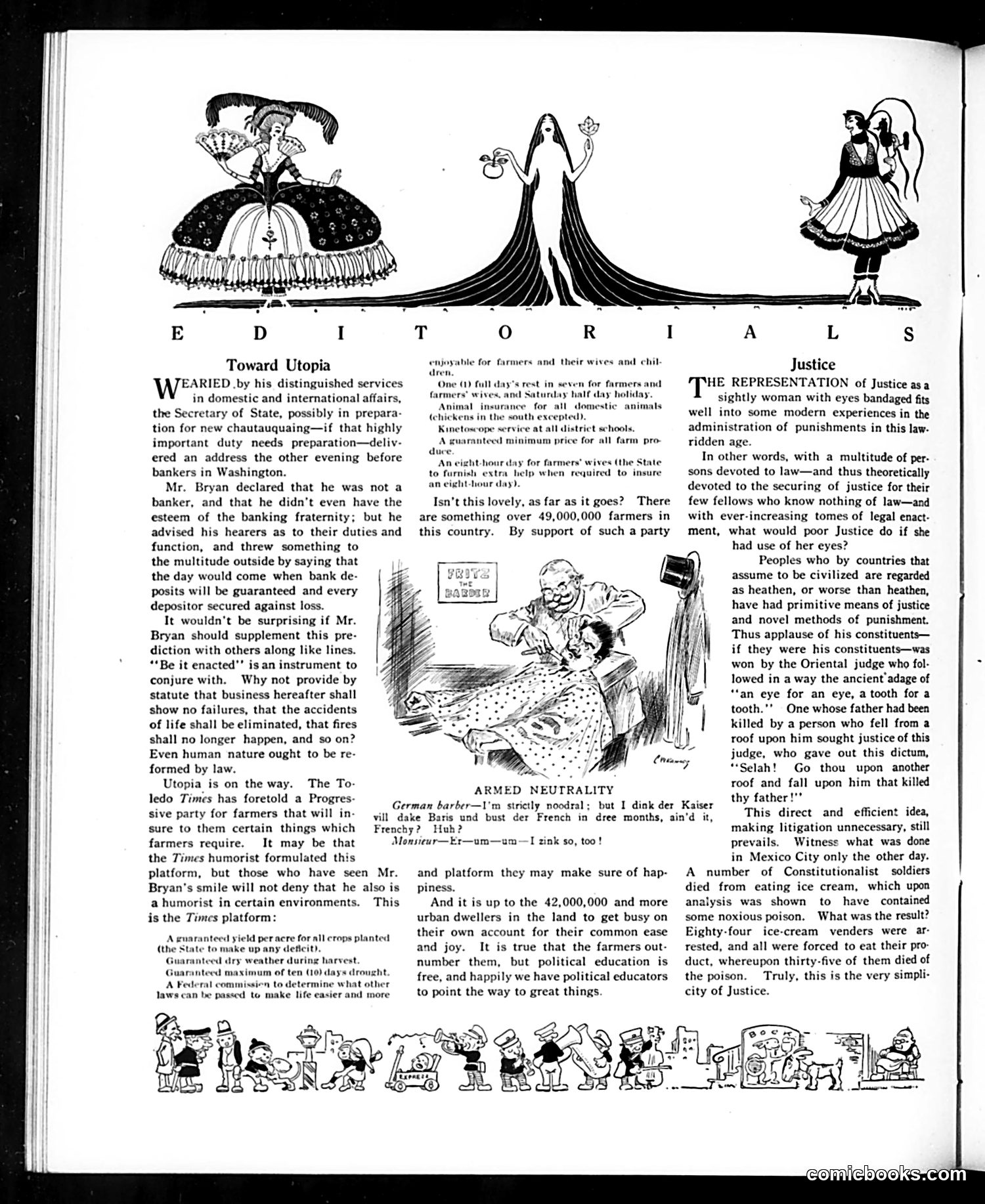
This Judge magazine page satirizes progressive reform proposals through allegorical female figures labeled "Toward Utopia." The left figure represents a wealthy woman with elaborate dress, mocking proposals for farmers' welfare and labor reforms. The center figure in dramatic black robes appears to represent "Justice" — depicted as blindfolded but ineffective. The main cartoon shows a judge administering harsh punishment, satirizing primitive justice systems. The accompanying text criticizes both Mr. Bryan (likely William Jennings Bryan, the populist politician) and the Toledo Times for promoting utopian farming reforms. The satire suggests these reforms are impractical idealism. A secondary cartoon about "Armed Neutrality" references German-French tensions, likely from the pre-WWI period. The overall page mocks progressive reformers as naive utopians.
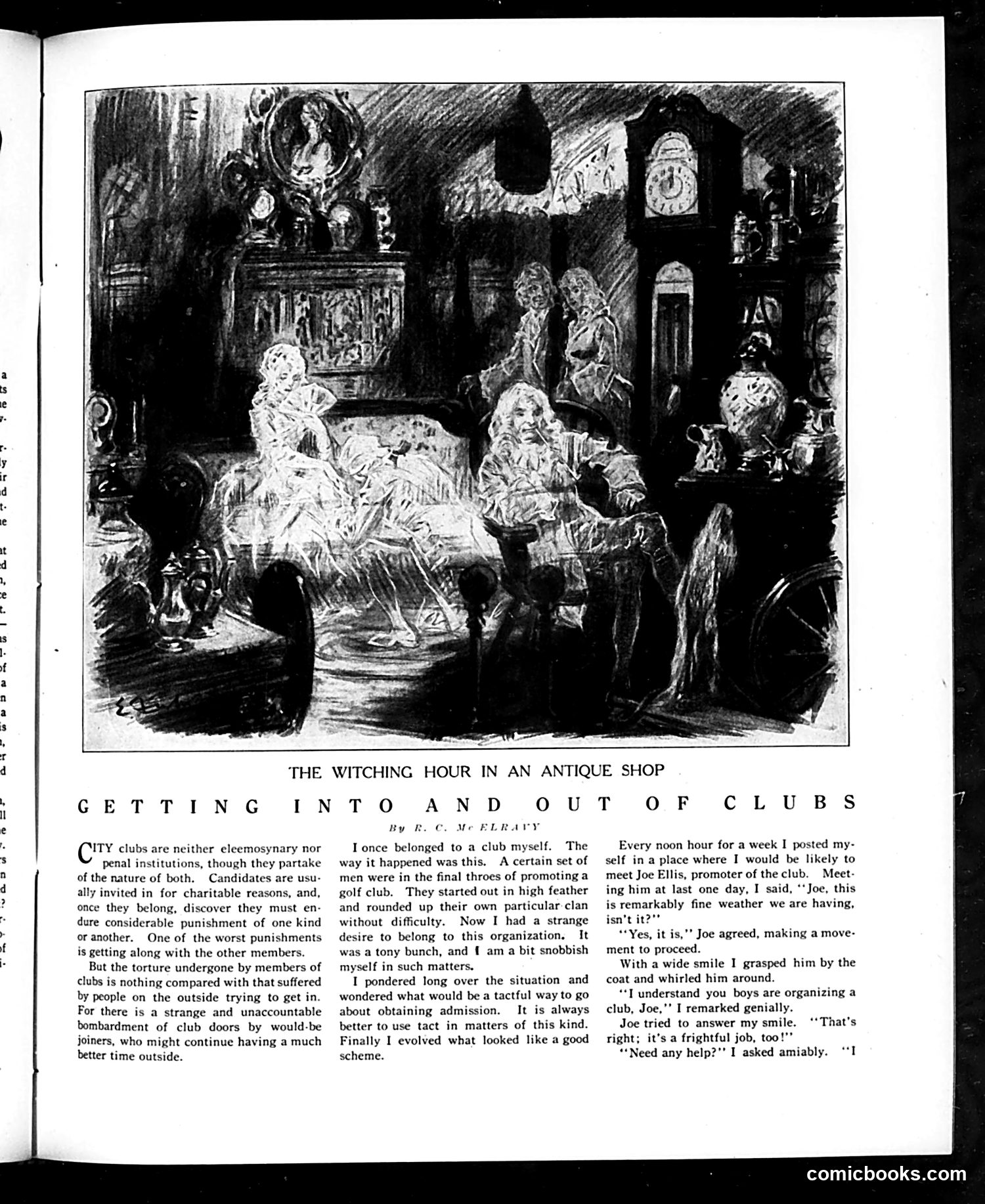
This satirical piece by E.C. McElray mocks the exclusionary practices of private clubs in early 20th-century America. The accompanying illustration, "The Witching Hour in an Antique Shop," depicts a deliberately obscure, cluttered scene—likely symbolizing the mysterious and unwelcoming nature of club membership. The text describes the author's struggle to join a club, highlighting how membership committees use arbitrary gatekeeping to control access. McElray sarcastically notes that clubs combine "eleemosynary" (charitable) pretenses with actual exclusivity, making membership difficult despite no clear criteria. The piece criticizes how established members protect their social privileges through vague selection processes and difficult "bombardment" at entrance. The satire targets class-based social institutions that claim democratic ideals while maintaining strict barriers.
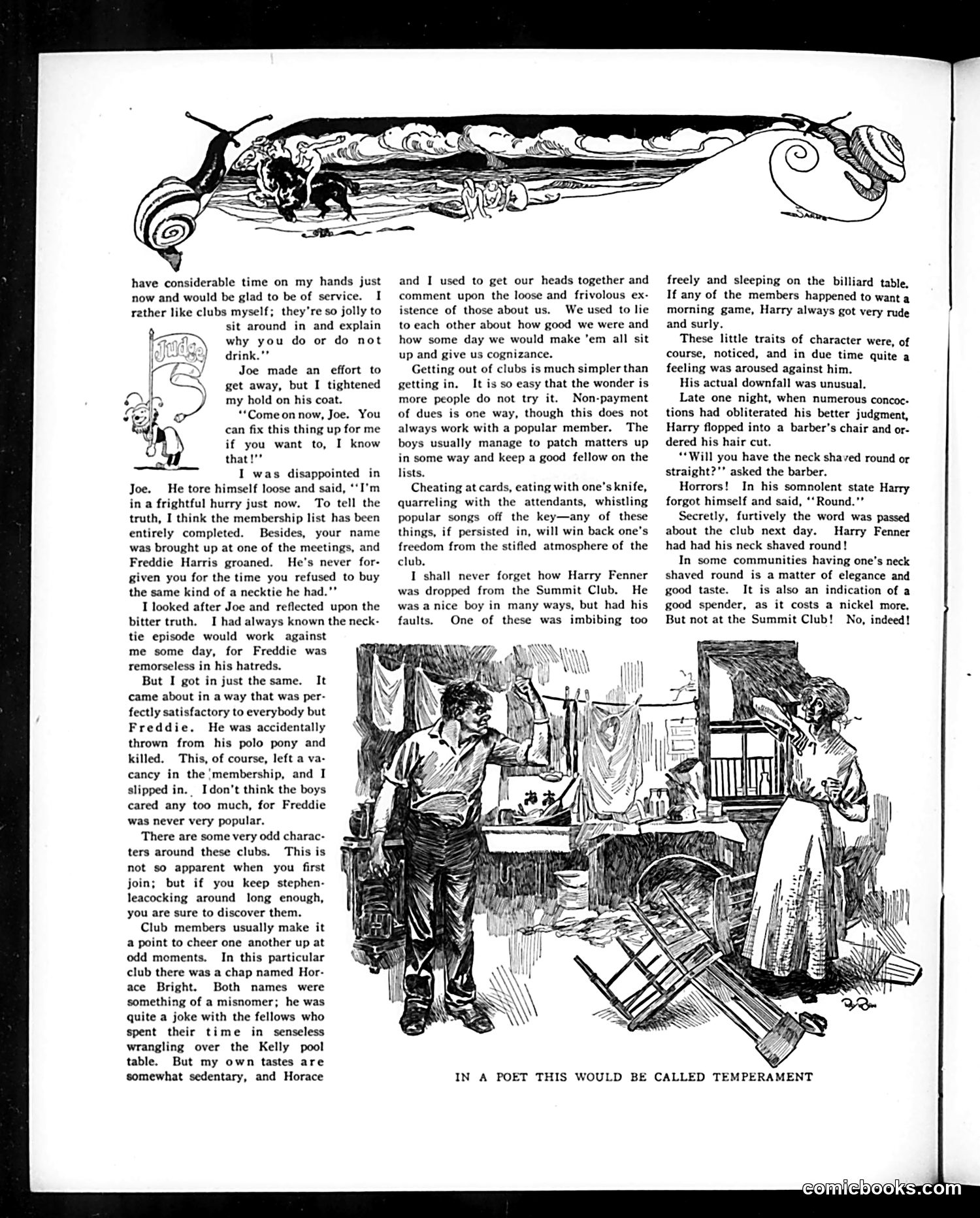
This is a humorous essay about men's social clubs, likely from the early 20th century. The author satirizes club culture by recounting absurd membership rules and petty social hierarchies. The main joke concerns **Harry Fenner's expulsion from the "Summit Club"** for having his neck shaved in a round style (rather than straight). This trivial fashion choice becomes scandalous within the club's rigid social codes—the round neck shave costs extra and signals extravagance, making members view him as a spendthrift. The broader satire mocks how clubs enforce conformity through arbitrary rules: members can be ejected for cheating at cards, eating with knives, whistling off-key, or public drunkenness. More darkly, the narrator admits he gained membership after a rival, Freddie Harris, was "accidentally thrown from his polo pony and killed"—a convenient vacancy the author exploited. The essay ridicules male club culture's combination of snobbery, pettiness, and sometimes sinister competitiveness, dressed up as gentlemanly fellowship. The bottom illustration shows a domestic scene unrelated to the main text.
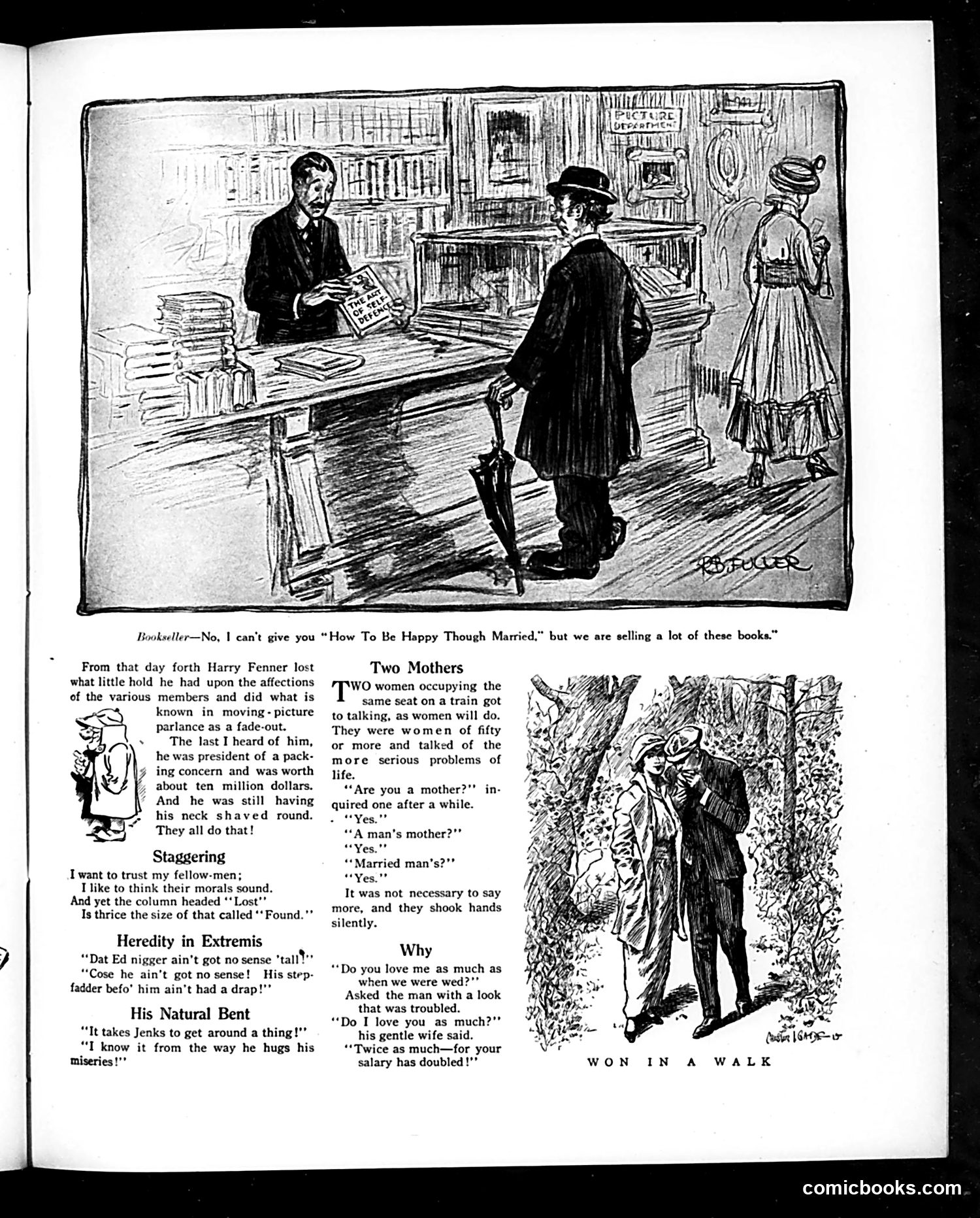
The main cartoon satirizes marriage and domestic life. A bookseller tells a customer he can't stock "How To Be Happy Though Married," implying the book is in such demand it sells out—suggesting marriage unhappiness is widespread. The accompanying story notes the protagonist "lost what little hold he had upon the affections" of his family after this encounter, ultimately becoming a successful businessman. The shorter pieces mock social hypocrisy and relationships. "Staggering" contrasts people's claimed morality with actual behavior (more "Lost" notices than "Found" ones). "Heredity in Extremis" uses period-inappropriate dialect to suggest alcoholism runs in families. "Two Mothers" presents a touching moment between two women, both wives of successful men—an implied commentary on feminine experience. The final joke "Why" subverts romantic sentiment: a wife claims she loves her husband twice as much because his salary doubled, reducing love to financial calculation and poking fun at mercenary marriage motivations.
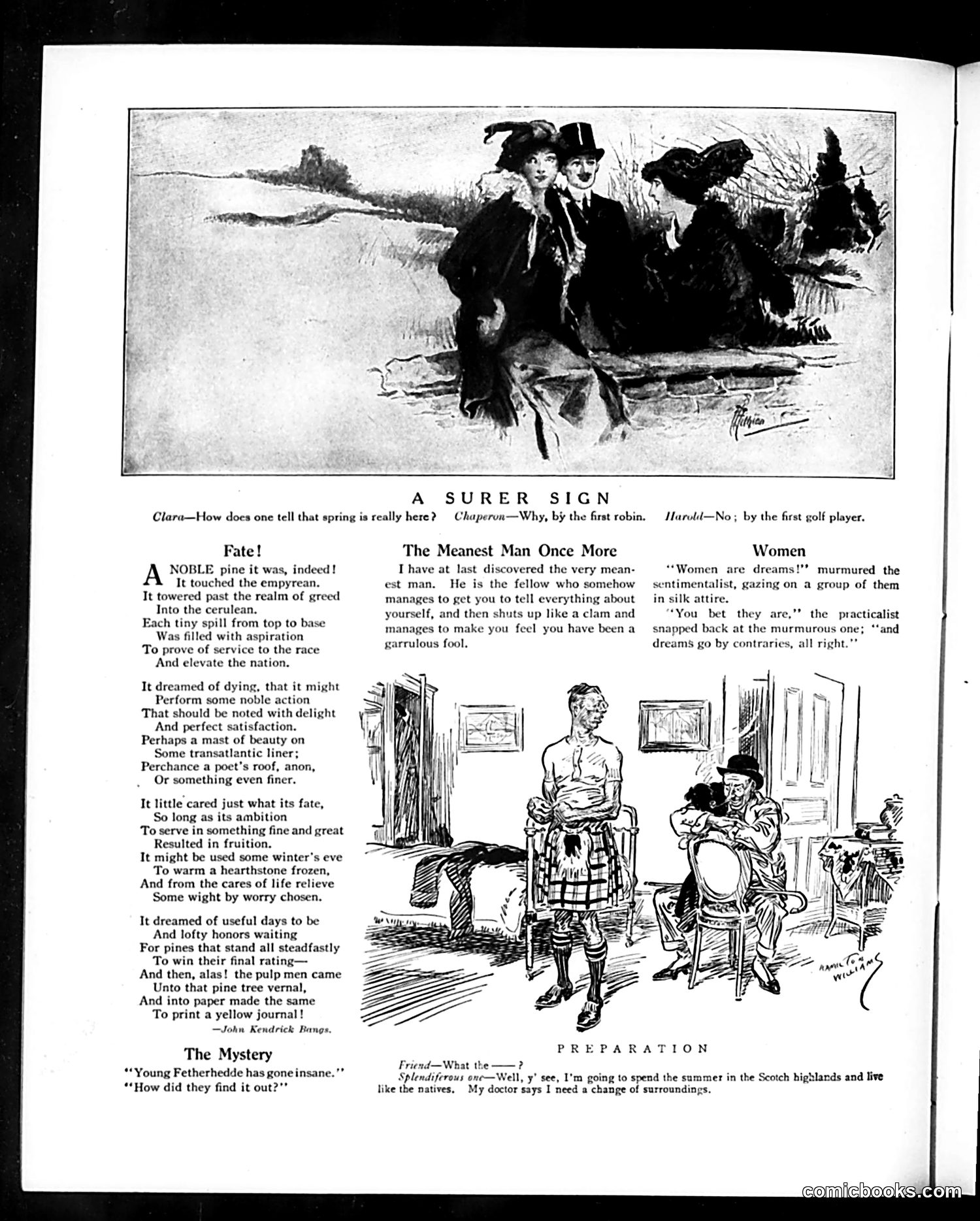
This page contains several short satirical pieces typical of early 20th-century American humor: **"A Surer Sign"** is a three-panel joke about detecting spring. Clara asks how to know spring has arrived; the Chaperon answers "the first robin," while Harold cynically counters "the first golf player"—mocking the leisure pursuits of the wealthy. **"Fate!"** is a mock-serious poem by John Kendrick Bangs lamenting a noble pine tree's lofty aspirations for service, only to be pulped into "a yellow journal"—satirizing sensationalist newspapers. **"The Meanest Man Once More"** satirizes social behavior: the worst person is one who extracts your secrets, then falls silent, leaving you feeling foolish. **"Women"** mocks sentimentality: when a man romantically sighs "women are dreams," a practical woman retorts that dreams are unreliable—subverting romantic idealization. **"The Mystery"** and **"Preparation"** appear incomplete or fragmentary on this page. The overall tone reflects upper-class, domestic humor with gentle social criticism.
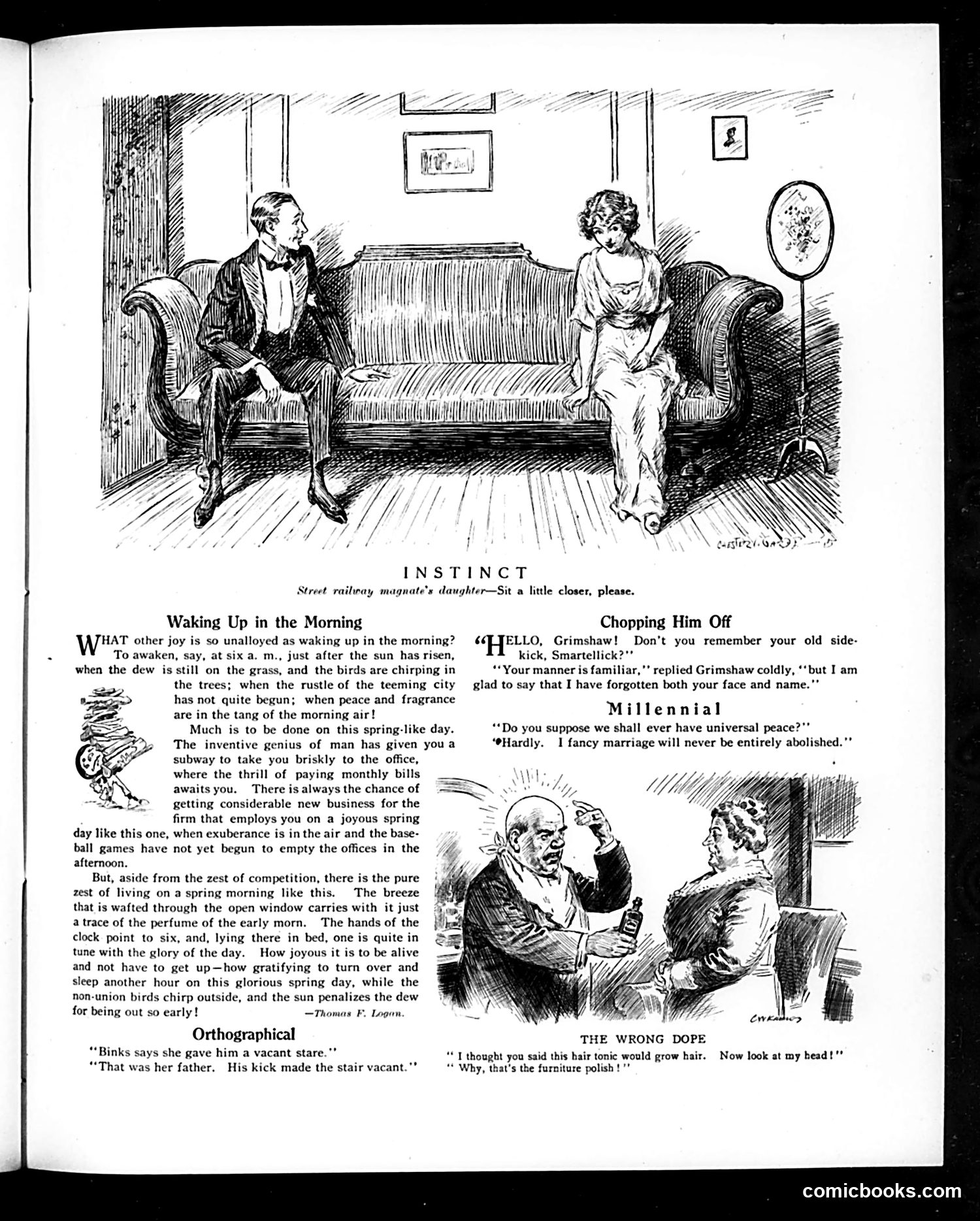
This page contains multiple satirical pieces typical of early 20th-century American humor: **"Instinct"** (top): A cartoon mocking street railway magnates' daughters—upper-class women expected to maintain propriety. The joke: she asks a man to sit closer, violating social convention, revealing her "instinct" overrides her breeding. **"Waking Up in the Morning"** by Thomas F. Logan: Sentimental prose satirizing the contradiction between appreciating a beautiful spring morning and the tedium of urban work—paying monthly bills, commuting via subway, office competition. **"Chopping Him Off"**: A man tries reconnecting with an acquaintance who coldly rejects him, claiming to have forgotten his face and name entirely—social embarrassment humor. **"Millennial"**: A couple discusses universal peace; the man jokes that marriage will never be "entirely abolished," suggesting matrimonial conflict as inevitable and eternal—cynical commentary on marriage. **"Orthographical" and "The Wrong Dope"**: Brief pun-based jokes about misunderstandings (vacant stare/stair; hair tonic/furniture polish). The page showcases Judge's mix of satirical social commentary and lighthearted wordplay.
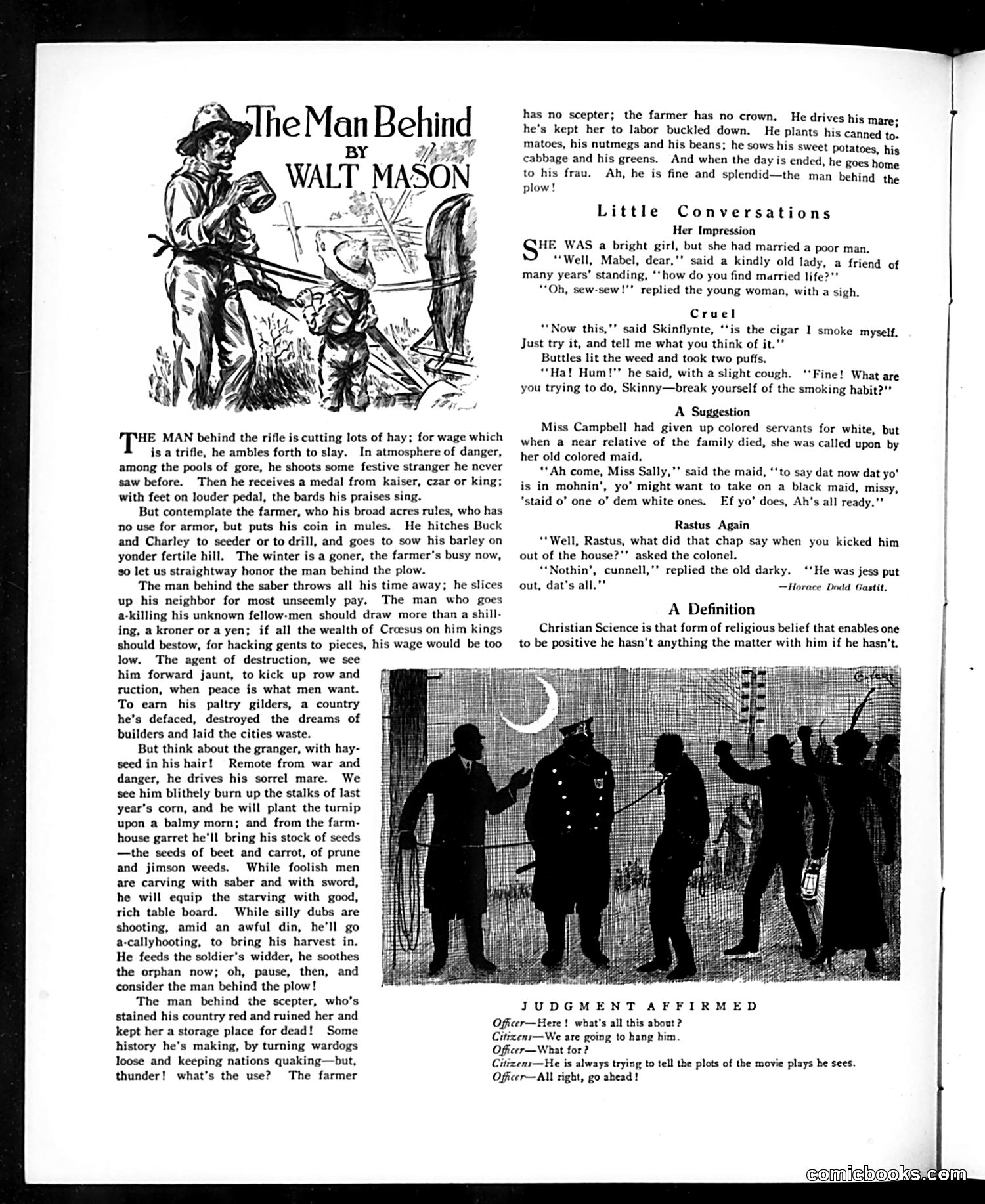
This is anti-war propaganda from Judge magazine, likely from World War I era. Mason's poem contrasts soldiers unfavorably with farmers. The central argument: soldiers ("the man behind the rifle," "the saber") destroy for meager pay and medals, serving despots ("kaiser, czar or king") who ruin nations. Meanwhile, farmers—ordinary men with no crown or scepter—quietly feed populations by cultivating crops and sustaining life. The poem elevates agricultural labor as morally superior to military service. It's pacifist rhetoric disguised as humble praise of farming, positioning the farmer as civilization's true hero while depicting warfare as destructive folly undertaken for corrupt rulers and inadequate compensation. The accompanying "Little Conversations" are unrelated humor pieces, including period-typical racial stereotypes in dialogue.
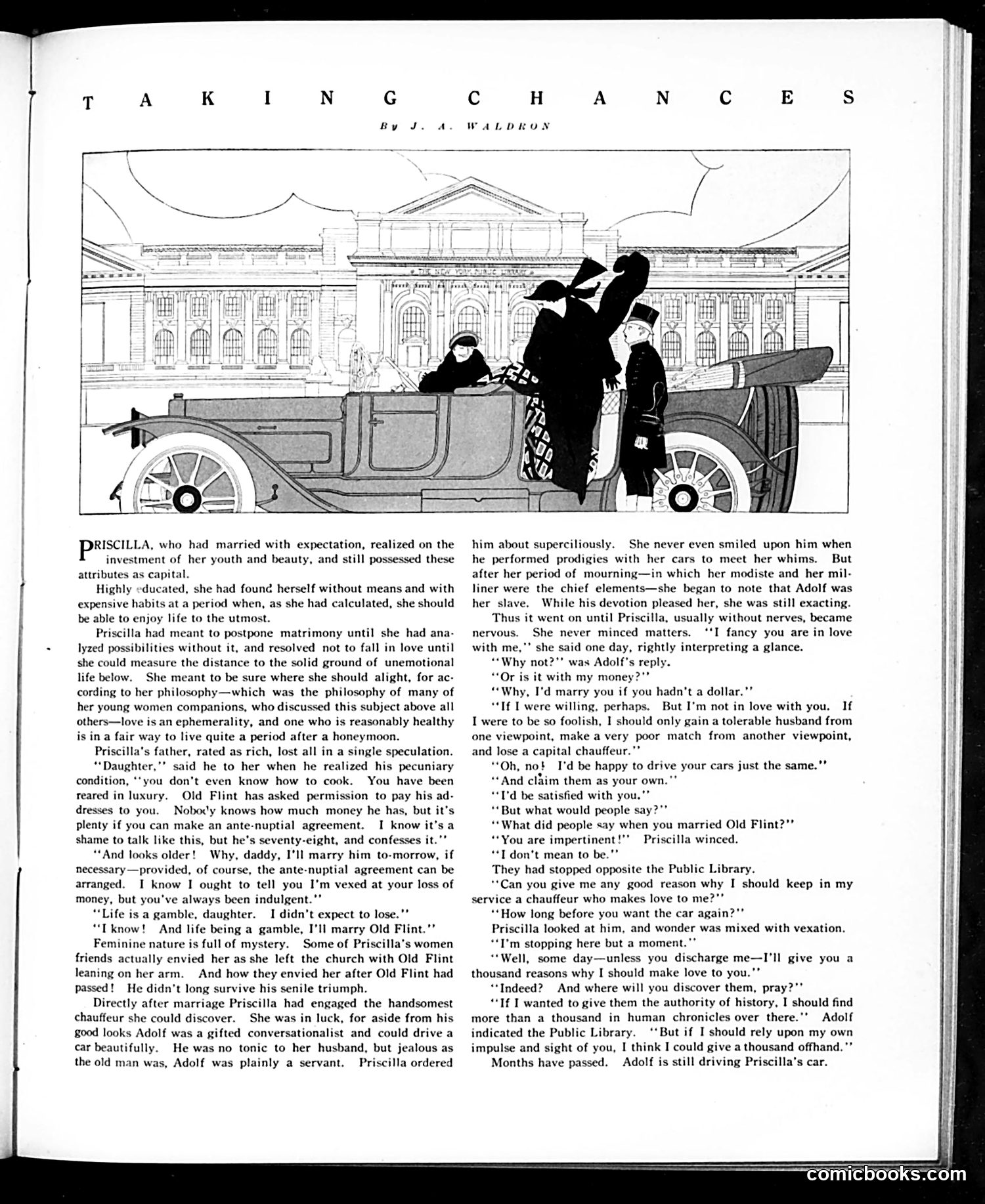
This satirical story critiques the mercenary marriage practices of wealthy society women. Priscilla, educated but financially dependent, marries the elderly "Old Flint" purely for money—an arrangement explicitly formalized through an ante-nuptial agreement. After his death, she hires the handsome chauffeur Adolf. The satire targets female hypocrisy: Priscilla claims to reject emotional entanglement and views marriage as a practical transaction, yet becomes jealously attached to Adolf. When he declares love, she refuses him—not from principle, but because marrying him would be "a very poor match" socially and financially, despite her earlier philosophy about love being ephemeral. The illustration shows Priscilla in her automobile with Adolf driving, emphasizing her wealth and his servile position. The joke highlights the contradiction between modern women's professed rationality about love and their actual class-conscious behavior. Priscilla values her chauffeur only as long as he remains subordinate—once he presumes equality, he becomes disposable.
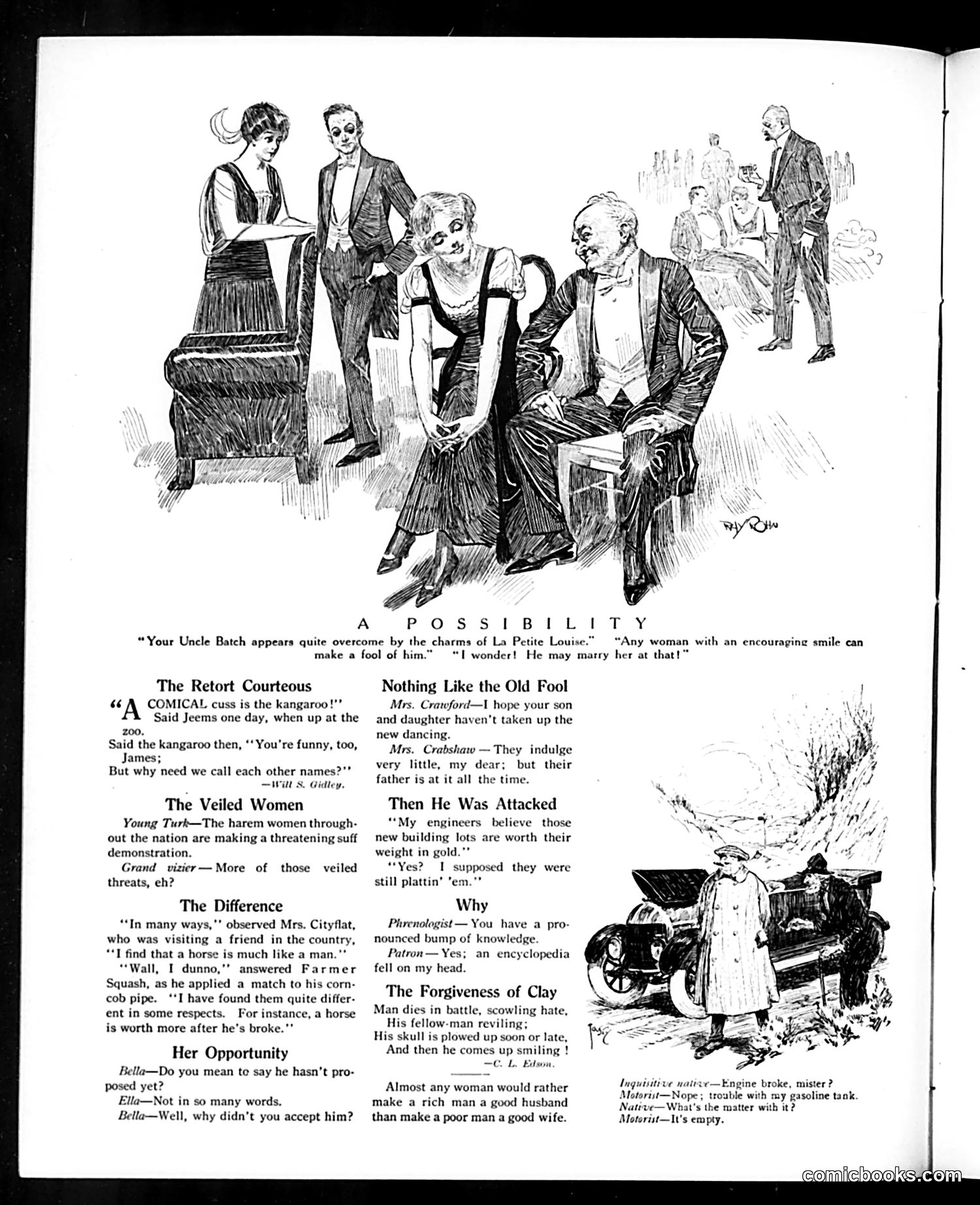
This page contains multiple short humorous dialogues and jokes typical of early 20th-century American satire magazine humor. **Key content:** - **"The Veiled Women"**: References the Young Turk movement and Ottoman Empire's harem system, satirizing both women's suffrage activism and Eastern practices through the Grand Vizier's dismissive response to women's protests. - **"The Difference"**: Rural/urban class humor: a farmer crudely suggests horses are more valuable after being "broken" (trained), implying a cynical parallel about men gaining worth through hardship. - **"Nothing Like the Old Fool"**: Generational satire—older men adopting fashionable new dances while their children remain conservative. - **General themes**: The page emphasizes courtship, marriage market economics, gender relations, and the contrast between rural and urban sophistication—reflecting early 1900s preoccupations with modernization, women's roles, and social propriety. The humor relies on contemporary readers' familiarity with these social debates and dated attitudes toward women, courtship, and class distinctions.
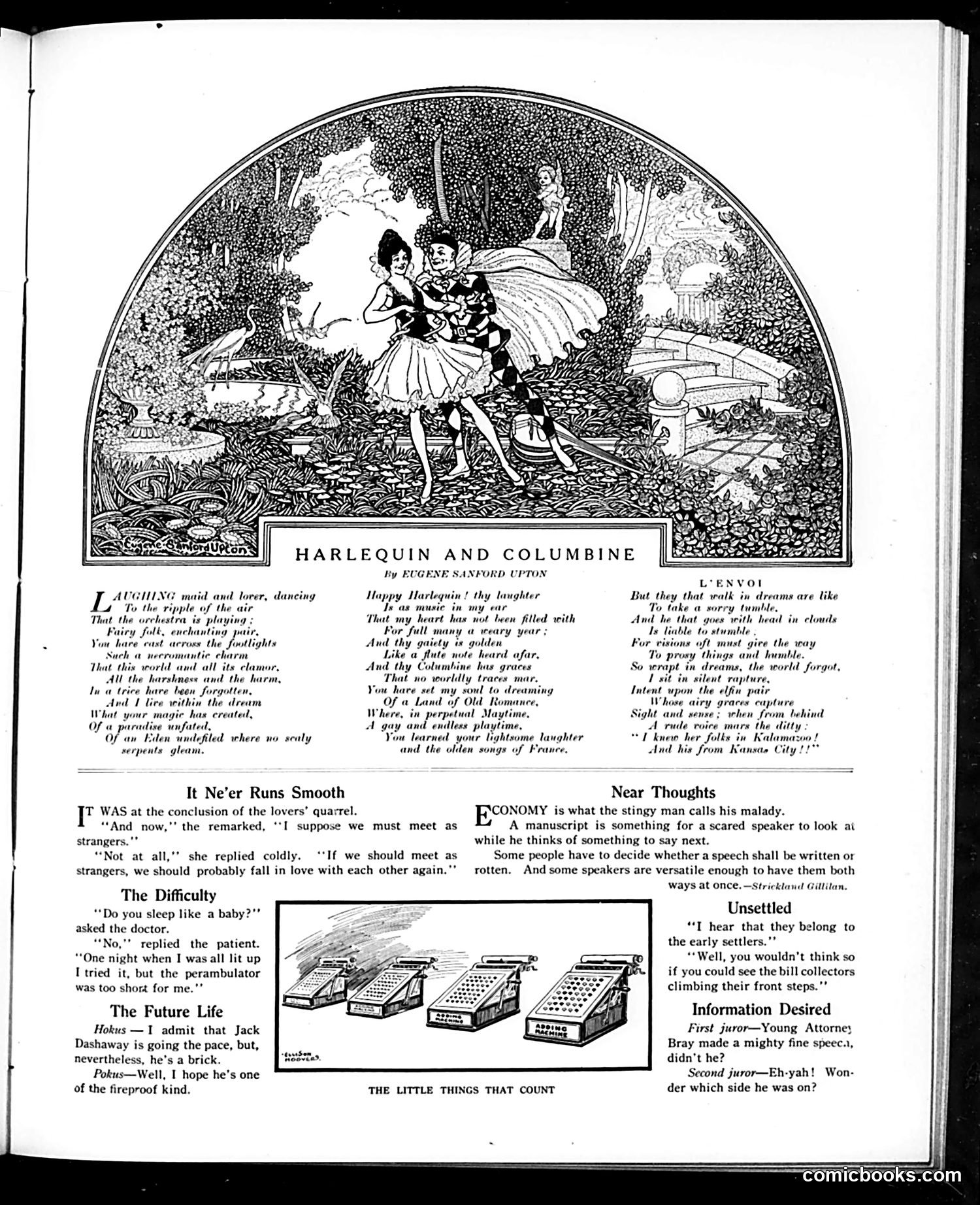
This page from *Judge* magazine contains literary and humorous content rather than political cartoons. **"Harlequin and Columbine"** is a romantic poem by Eugene Sanford Upton celebrating the theatrical characters Harlequin and Columbine—stock figures from commedia dell'arte representing love and fantasy. The poem praises how their performance transports the narrator to an idealized romantic world, away from harsh reality. The illustration shows these costumed characters in a garden setting. The remaining items are brief humorous vignettes: - **"It Ne'er Runs Smooth"**: A lovers' quarrel joke where the woman coldly suggests they should meet as strangers (inverting Shakespeare's "course of true love") - **"The Difficulty"**: A doctor joke about insomnia - **"The Future Life"**: A joke implying a man leads such a wild lifestyle he'll need fireproofing in the afterlife - **"Near Thoughts," "Unsettled," "Information Desired"**: Brief satirical observations about economy, social pretension, and courtroom rhetoric These are general social satires typical of early-20th-century humor magazines—no specific political figures or events are referenced.
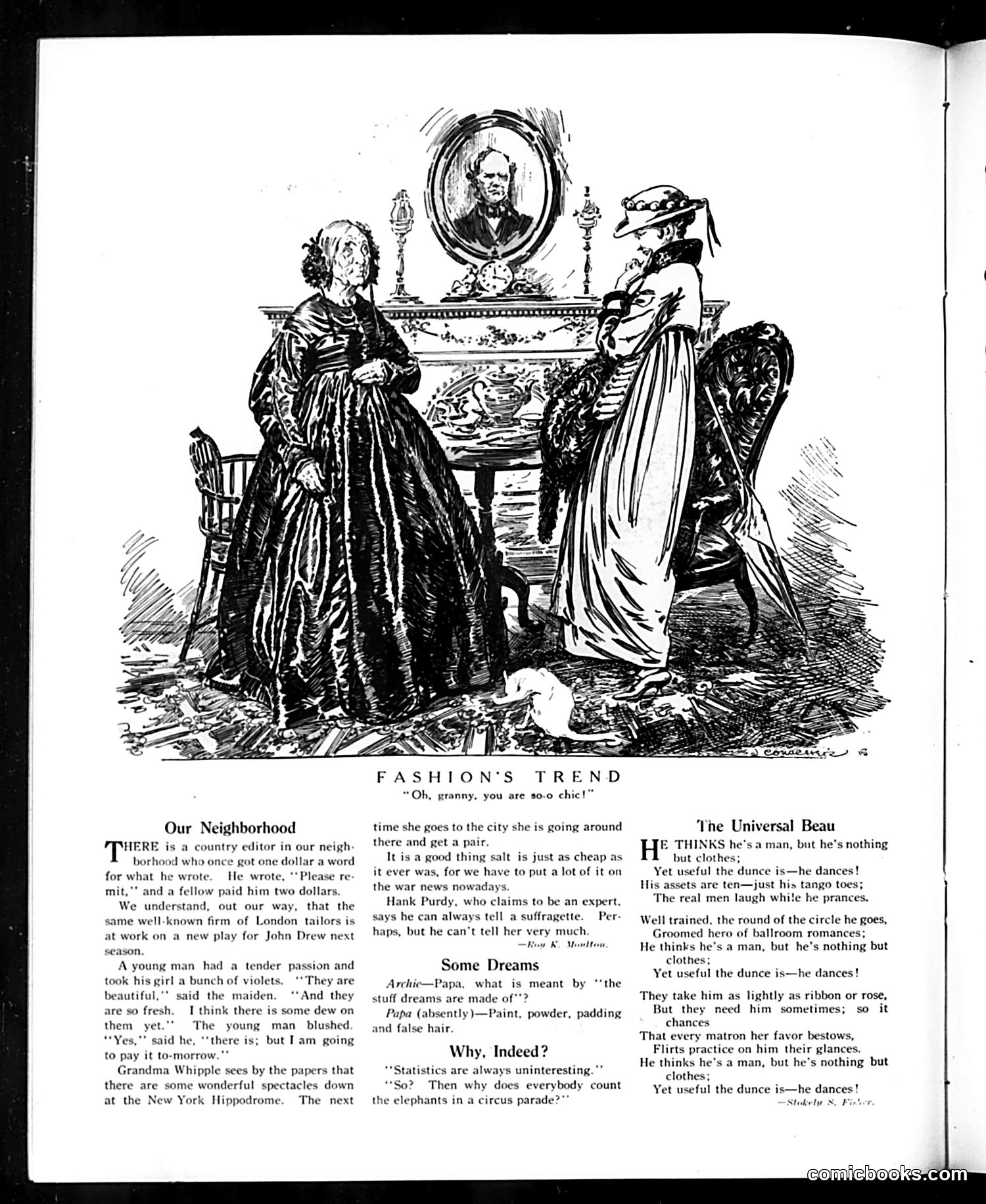
The main cartoon, "Fashion's Trend," depicts an elderly woman admiring a younger woman's fashionable dress, exclaiming "Oh, granny, you are so-o chic!" The satire mocks how fashion trends cycle—what was once worn by grandmothers becomes fashionable again for younger generations. The portrait above them likely represents a previous fashion icon or historical figure. The surrounding text contains brief humor pieces typical of Judge's satirical style: - **"Our Neighborhood"** offers small-town anecdotes poking fun at rural life, editors, and common foolishness - **"Some Dreams"** mocks superficial femininity (paint, powder, padding) - **"The Universal Beau"** critiques shallow, well-dressed men who are "nothing but clothes"—attractive but intellectually empty, useful only for dancing and entertainment The overall message reflects early 20th-century social satire criticizing fashion obsession, gender stereotypes, and the emptiness of purely aesthetic pursuits.
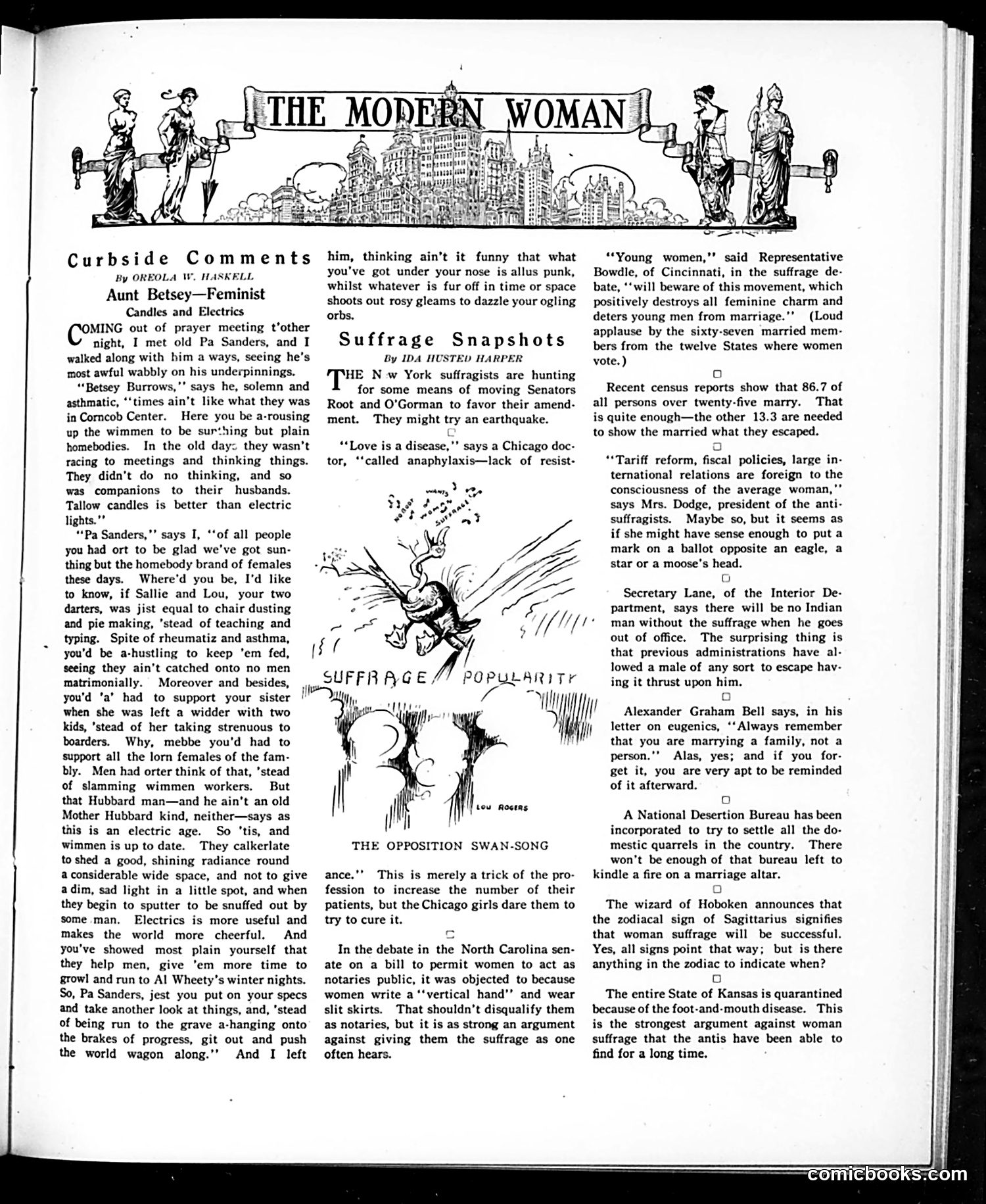
This Judge magazine page satirizes early 1900s debates over women's expanding roles, particularly women's suffrage. **"Aunt Betsey—Feminist"** features a colloquial dialogue between an old man (Pa Sanders) nostalgic for when women were "plain homebodies," and Aunt Betsey defending modern women's education and independence. She argues that women teachers and breadwinners benefit families economically—without them, men would have to support unemployed female relatives. The "electric lights" metaphor contrasts outdated thinking with progress. **"Suffrage Snapshots"** by Ida Husted Harper collects anti-suffrage arguments and satirizes them. Notable: Representative Bowdle warns women's suffrage destroys "feminine charm" and deters marriage (receiving applause from married congressmen). Harper's witty rebuttals mock these claims—noting that unmarried women actually benefit society, and that women should grasp basic ballot mechanics regardless of "tariff reform." The cartoons illustrate suffrage opponents' absurdity and the economic realities pushing women's advancement.
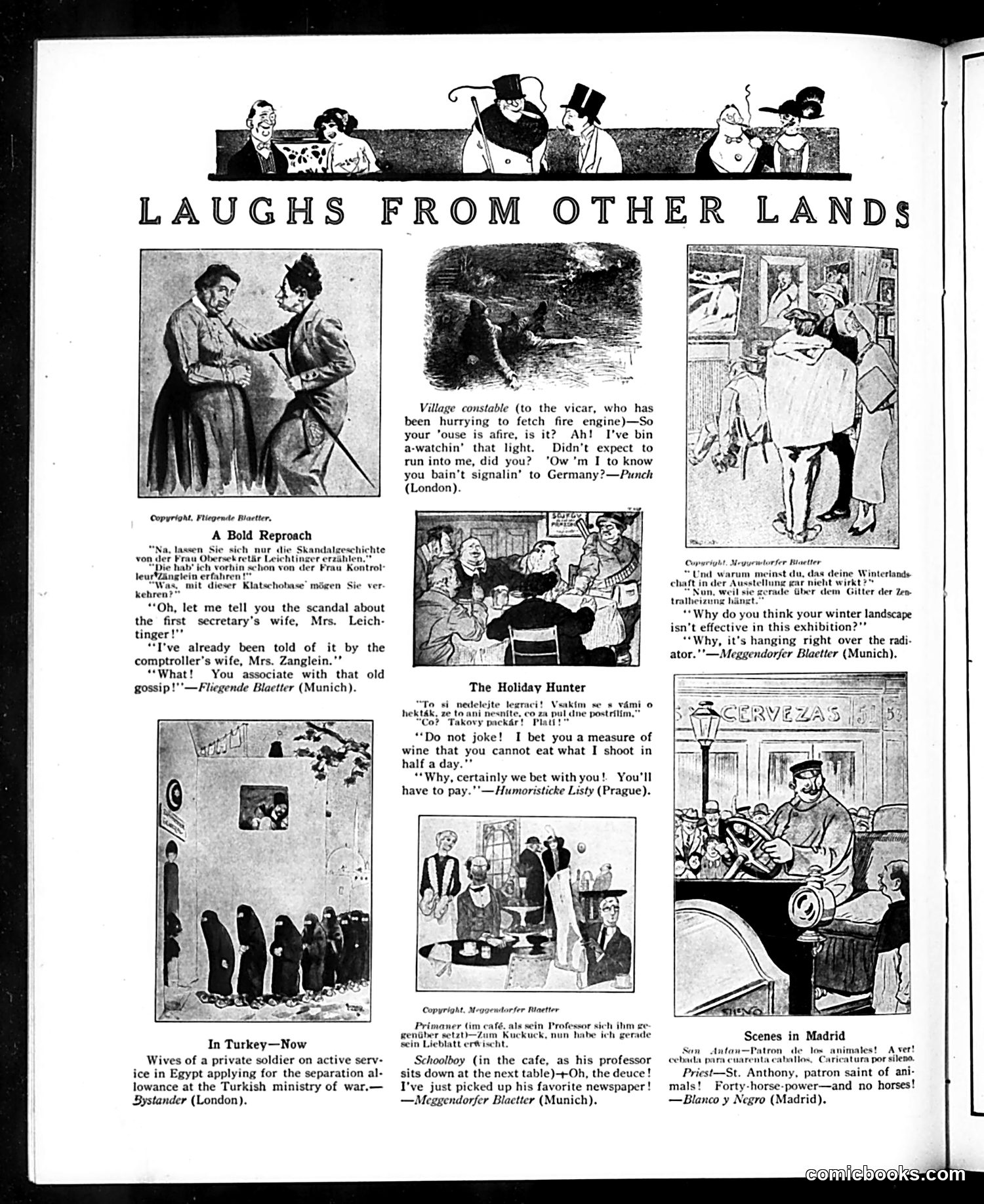
This page collects satirical cartoons from European publications, arranged thematically around WWI-era anxieties and social observation. **"A Bold Reproach"** (Munich): Mocks gossip culture—a woman is indignant that her confidante associates with another gossip, not recognizing her own hypocrisy. **"In Turkey—Now"** (London): References the Ottoman Empire's wartime separation allowance policy, satirizing bureaucratic procedures affecting soldiers' families. **"Village Constable"** (London): A British constable suspects a vicar's nighttime fire-fetching as potential enemy signaling to Germany—wartime paranoia about civilian activity. **"The Holiday Hunter"** (Prague/Munich/Madrid): Multiple jokes about hunting bets and consumption, suggesting leisure pursuits amid conflict. **"Scenes in Madrid"**: The priest invoking "St. Anthony" over a forty-horsepower engine satirizes Spain's modernization gap—replacing traditional animal power with machinery. The page reflects international wartime humor: bureaucratic absurdity, spy anxiety, class observation, and the clash between tradition and industrial modernity.
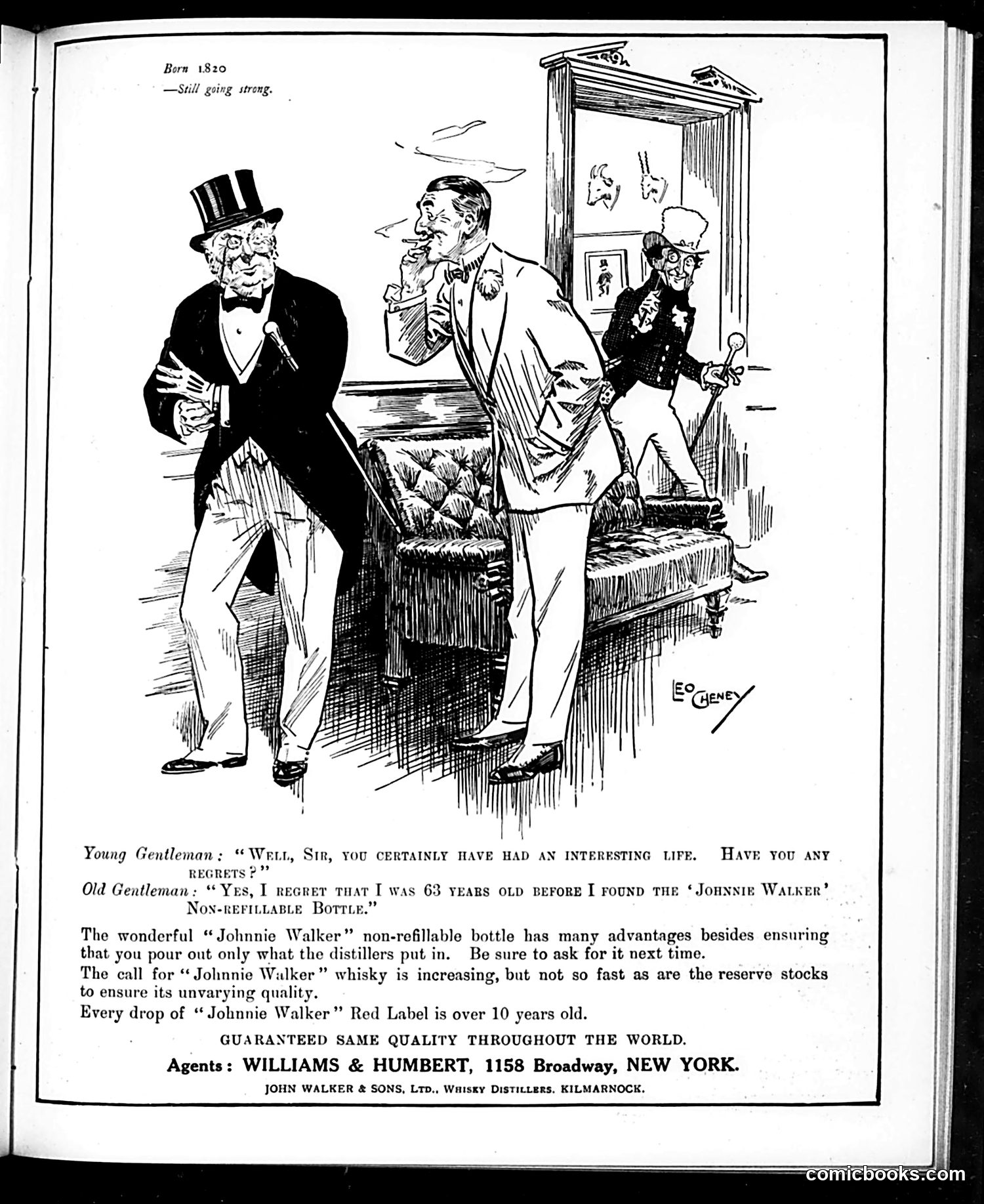
This is primarily **advertising disguised as editorial cartoon** for Johnnie Walker whisky. The humor plays on longevity: an old gentleman (born 1820, now roughly 100 years old) attributes his long life to discovering Johnnie Walker whisky at age 63—implying the product kept him alive for decades. The satire's edge targets the **non-refillable bottle innovation**, which the ad presents as a consumer benefit (preventing tampering/dilution) while actually serving distillers' interests by ensuring full consumption. The "still going strong" caption reinforces both the whisky's quality and the elderly man's vitality. The cartoon's cynical joke: what appears to be wisdom about a long, interesting life actually reduces to brand loyalty and alcohol consumption. The young gentleman's respectful curiosity gets answered with product placement rather than genuine reflection. This represents early 20th-century advertising before strict regulations on alcohol marketing.
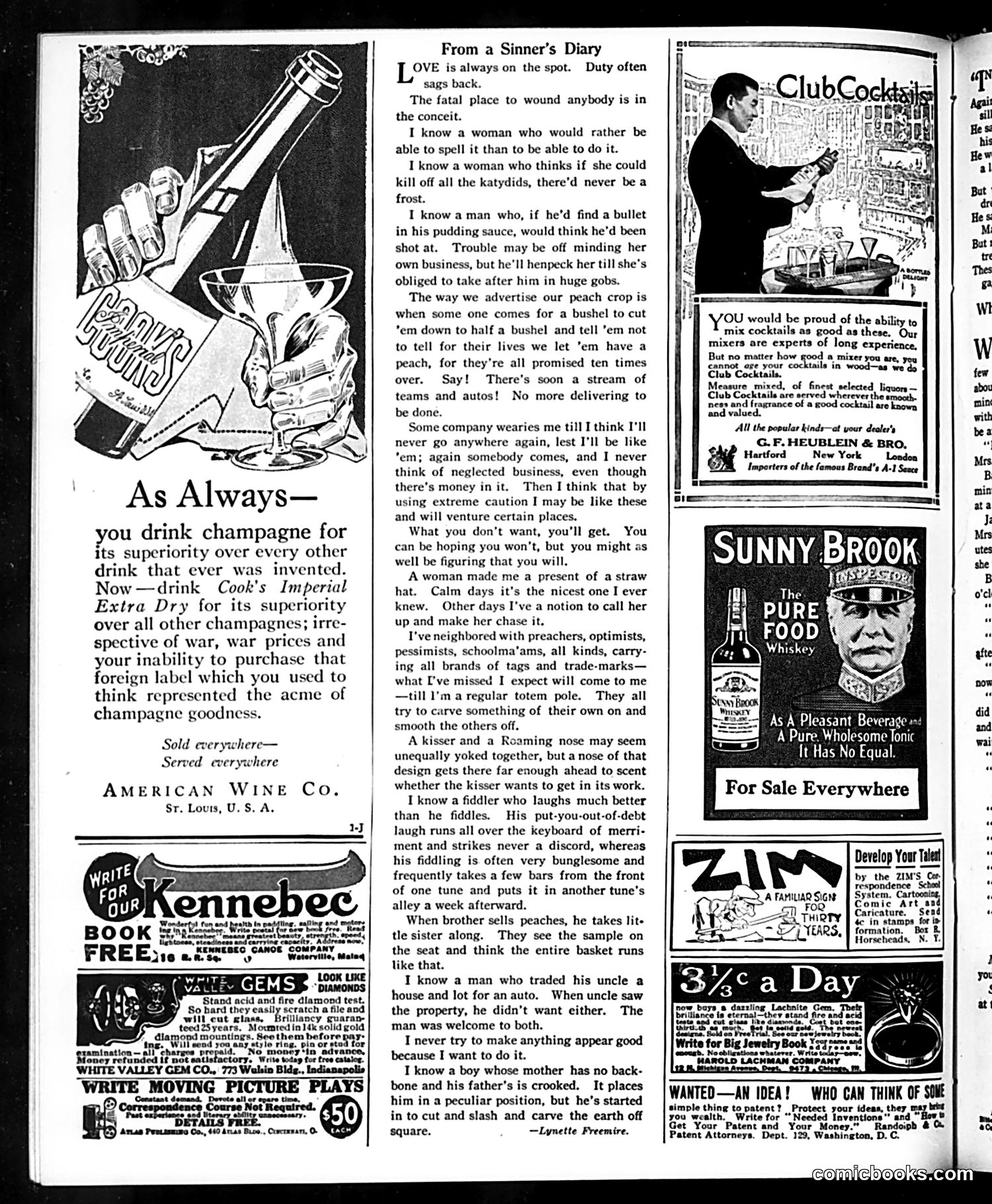
This page is primarily a **humorous column** by Lynette Premure offering satirical observations on human nature and social behavior. Rather than political satire, it's social commentary aimed at early 20th-century American readers. Key observations include critiques of: female vanity and poor spelling; marital nagging; deceptive advertising practices (the peach crop anecdote mocking dishonest salesmanship); the corrupting influence of social circles; romantic incompatibility; and parental weakness. The column uses rural/everyday scenarios (peach farmers, fiddle players, automobile trades) to mock universal human failings—hypocrisy, self-deception, and moral compromise. The tone is gently cynical but resigned, suggesting these character flaws are inevitable rather than correctable. The left page features a **Cook's Imperial champagne advertisement** emphasizing patriotic consumption of American wine during wartime (likely WWI-era, given references to "war prices").
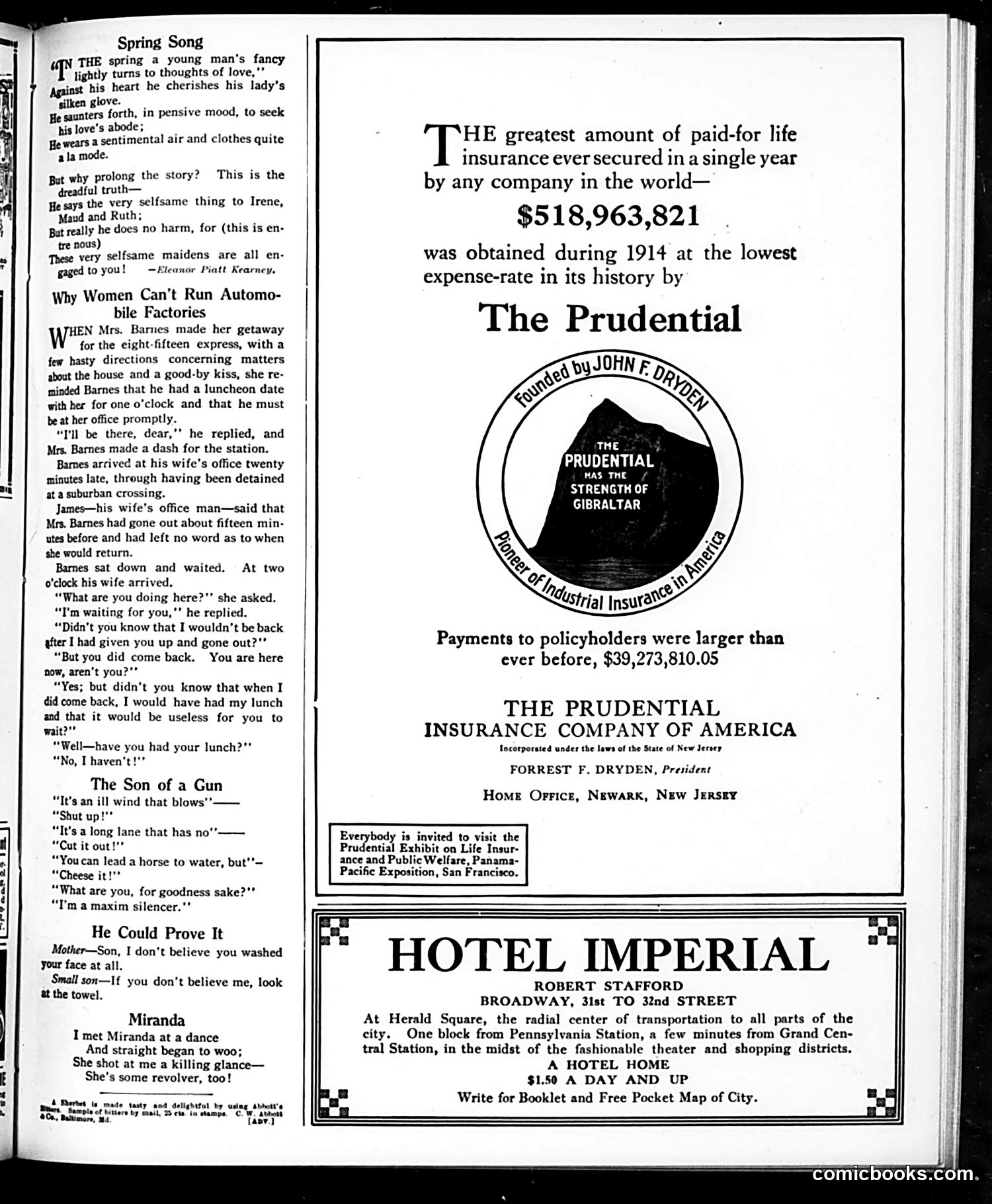
This page mixes light humor with advertising. The left column contains several short satirical pieces typical of Judge's style: **"Spring Song"** mocks male romanticism—a young man claims to court one woman but confesses he tells the same sentimental lines to multiple girlfriends. The joke: the women are all engaged to other men anyway, so his "harmless" deception doesn't matter. **"Why Women Can't Run Automobile Factories"** satirizes gender roles through marital miscommunication. Mrs. Barnes, working in an office, leaves her husband waiting for lunch because she assumed he wouldn't return after she left. The implication: women's supposedly illogical thinking makes them unsuitable for industrial management. **Other brief pieces** ("The Son of a Gun," "He Could Prove It," "Miranda") are standard joke fare about wordplay and courtship. The right side contains a full-page **Prudential Insurance advertisement** celebrating record payouts in 1914, and a **Hotel Imperial advertisement** targeting New York visitors. The page is primarily advertising-driven content interspersed with genteel humor reflecting early 20th-century attitudes about gender and romance.
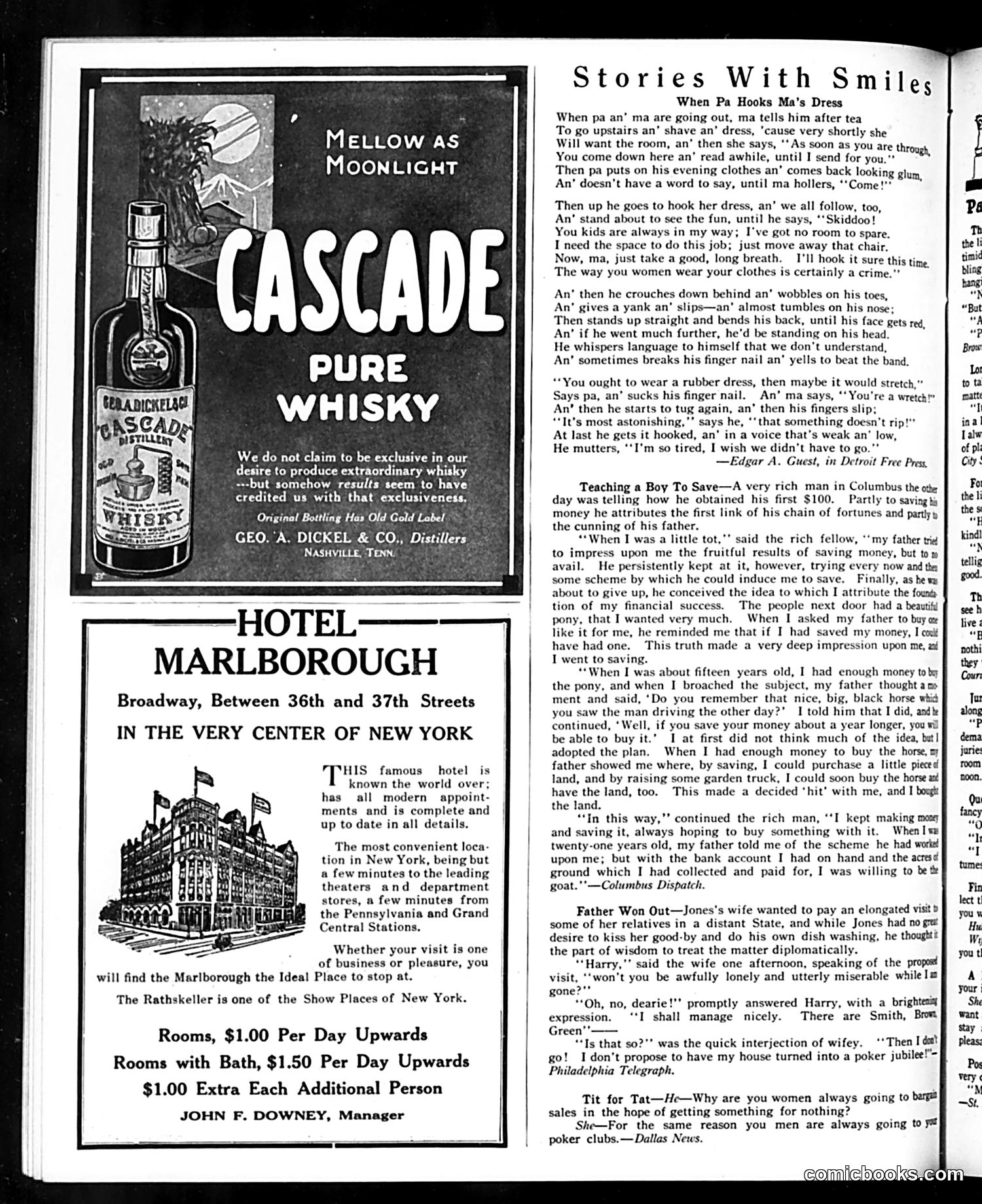
This page is primarily **advertisements and humorous stories** rather than political cartoons. The ads feature **Cascade Whisky** ("Mellow as Moonlight") and the **Hotel Marlborough** in New York, targeting affluent travelers and drinkers. The humor content includes two pieces by **Edgar A. Guest**: 1. **"When Pa Hooks Ma's Dress"** — a comedic domestic scene depicting the frustration of a husband struggling to fasten his wife's dress before going out. The joke centers on the physical difficulty and his exasperation with tight clothing and cramped space—relatable domestic humor about gender roles and marital dynamics. 2. **"Teaching a Boy To Save"** — an anecdote about a wealthy man crediting his financial success to his father's lesson using a pony as motivation. It's a morality tale about thrift and delayed gratification, popular in early 20th-century American magazines. Both pieces reflect the magazine's focus on **middle to upper-class domestic life and values**.
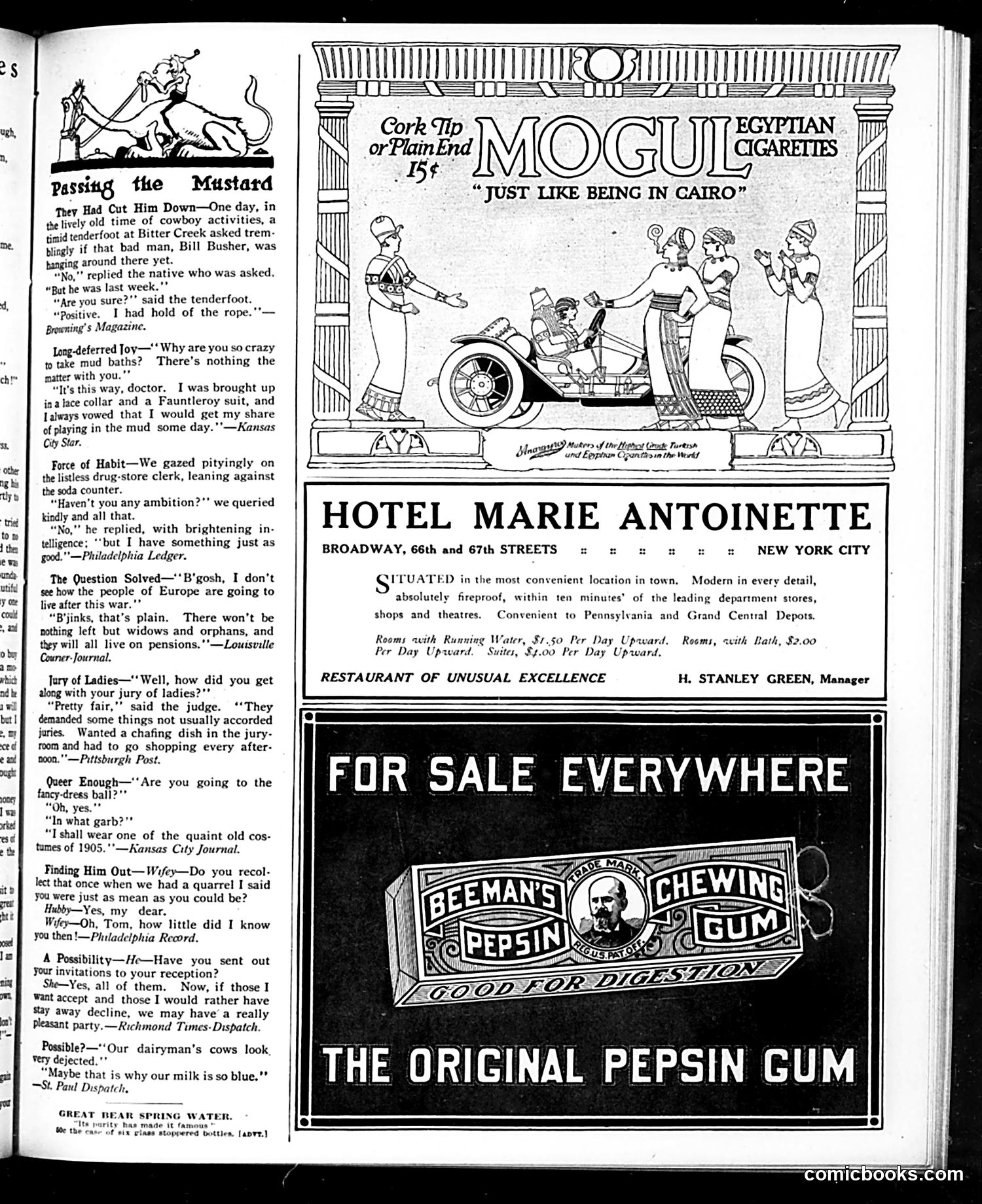
This page is primarily **advertisements and short humorous anecdotes**, not political cartoons. **The anecdotes** are light social humor typical of Judge's era—jokes about male/female differences (judges baffled by women jurors wanting shopping breaks), frontier comedy ("I had hold of the rope" after a hanging), and domestic situations (wives realizing husbands weren't as bad as they seemed). **The advertisements** include: - **Mogul Egyptian Cigarettes** (featuring an Art Deco-style illustration of people in an automobile driven by Egyptian figures, playing on the "exotic Cairo" appeal) - **Hotel Marie Antoinette** in New York (fine dining, fireproof, convenient to theaters) - **Beeman's Pepsin Gum** ("The Original Pepsin Gum—Good for Digestion") The page reflects early 20th-century America: commercial aspirations, casual attitudes toward now-taboo products (cigarettes, pepsin products), and light, genial humor targeting middle-class readers.
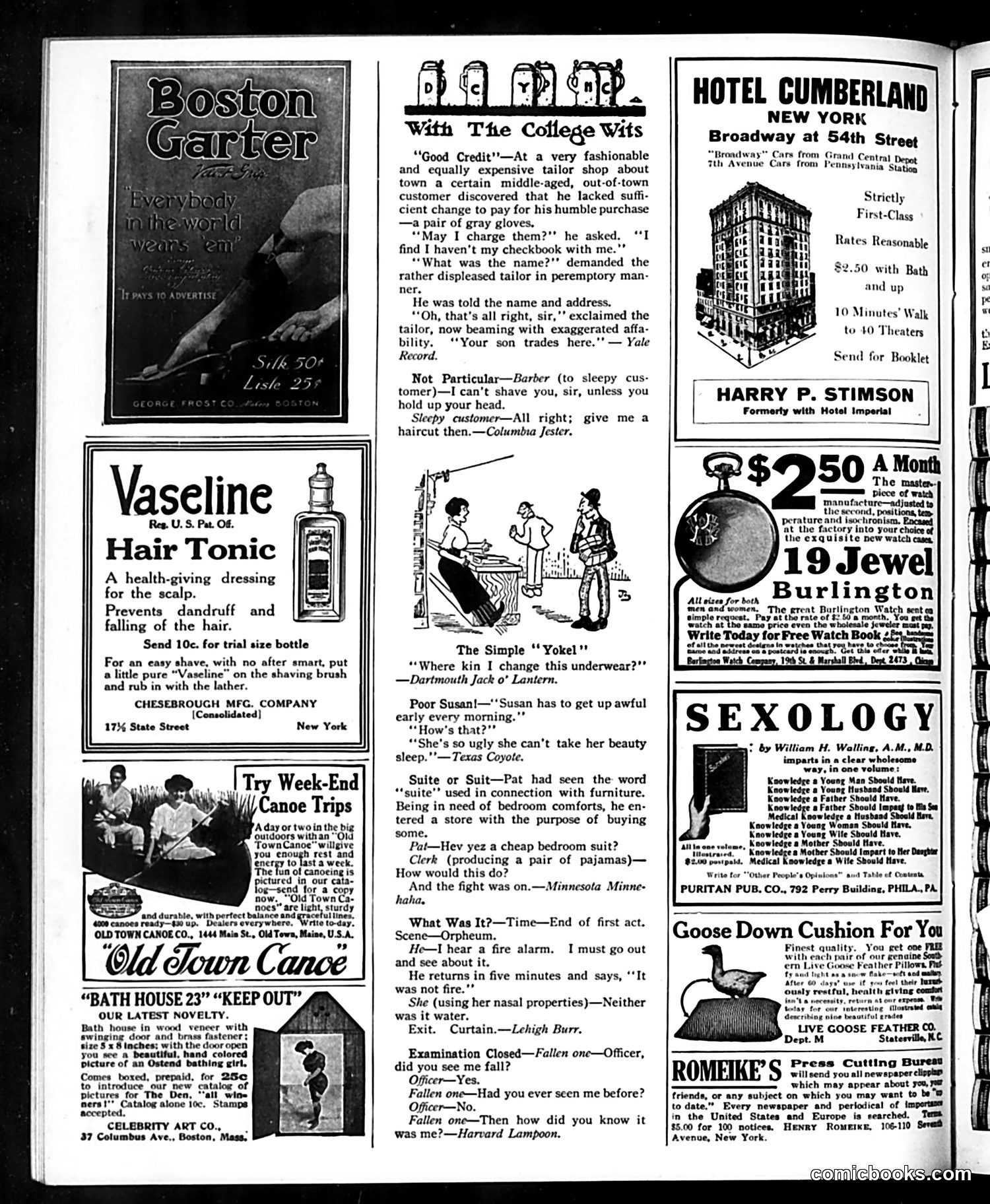
This page is primarily **advertising**, with a sidebar section of college humor jokes. The main content includes ads for Vaseline Hair Tonic, Old Town Canoe trips, a novelty bath-house toy, Hotel Cumberland, a Burlington pocket watch, a book on sexual education (*Sexology*), and goose-down cushions. The humor section, "With The College Wits," contains brief satirical anecdotes from university publications (Yale Record, Columbia Jester, etc.). These jokes target common social awkwardness: a tailor's sudden politeness upon learning a customer's son is a patron; a sleepy barber customer requesting a haircut instead; a man confused about bedroom "suits" (mishearing "pajamas"); and a drunk unable to explain how an officer recognized him after a fall. The jokes rely on wordplay, class anxiety, and physical comedy typical of 1910s collegiate humor—no specific political content is evident. The *Sexology* book advertisement suggests emerging openness to discussing sexuality in educational contexts.
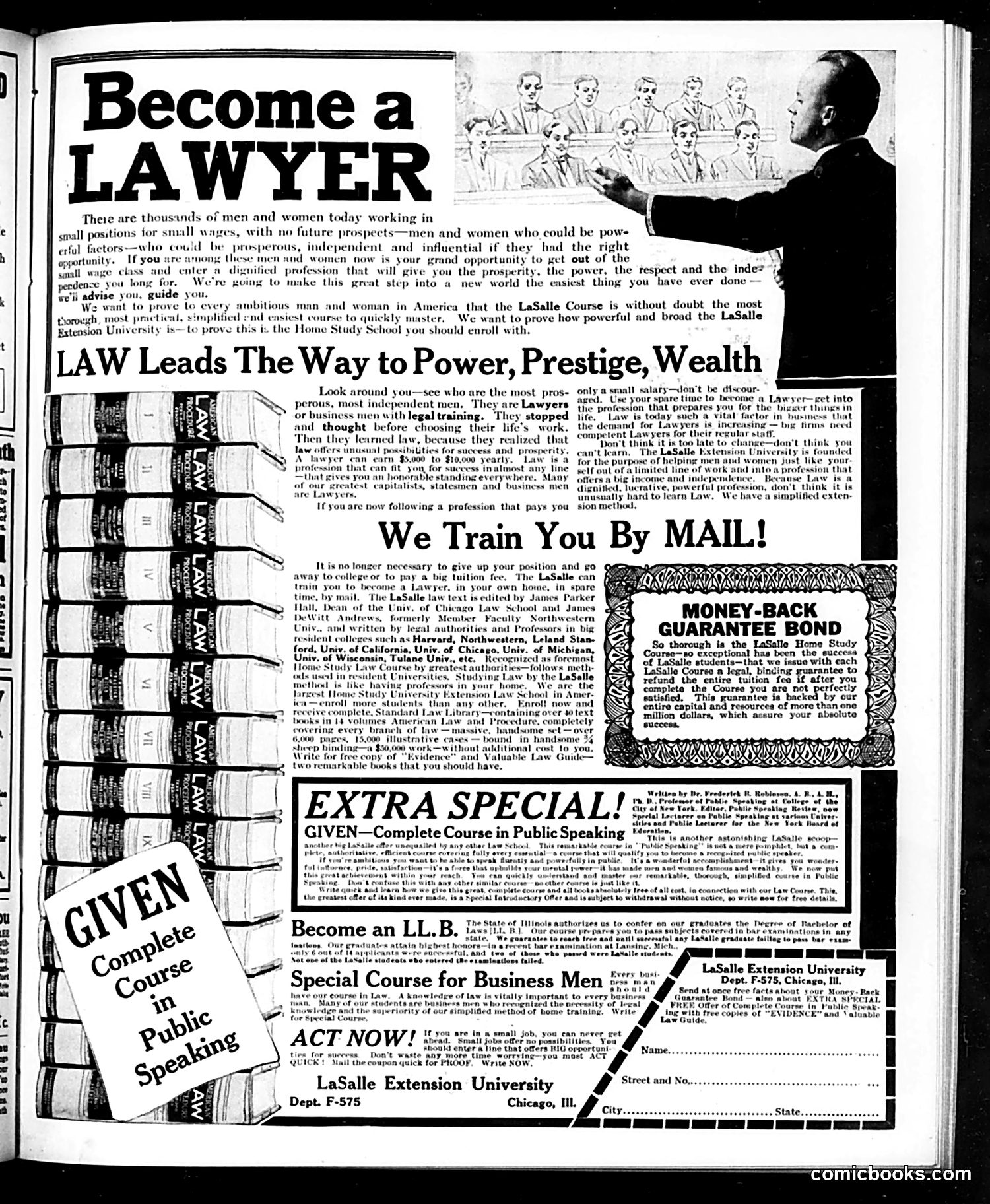
This is primarily a **full-page advertisement**, not a political cartoon. It promotes LaSalle Extension University's correspondence law courses. The page targets working-class people trapped in low-wage jobs, promising that studying law by mail will lead to "power, prestige, wealth" and escape from "the mill wage class." The visual rhetoric is striking: stacked law books on the left suggest legitimate education, while an illustration shows a confident man (likely a lawyer) addressing a courtroom. The appeal is explicitly class-based—positioning law as the pathway from poverty to prosperity and social standing. Notable for a modern reader: this reflects the early 20th-century mail-order education boom, when correspondence schools were heavily marketed to working Americans. The "money-back guarantee bond" suggests skepticism about such programs even then. The page includes an "Extra Special" offer of a free public speaking course, indicating LaSalle bundled multiple self-improvement programs to attract enrollees.
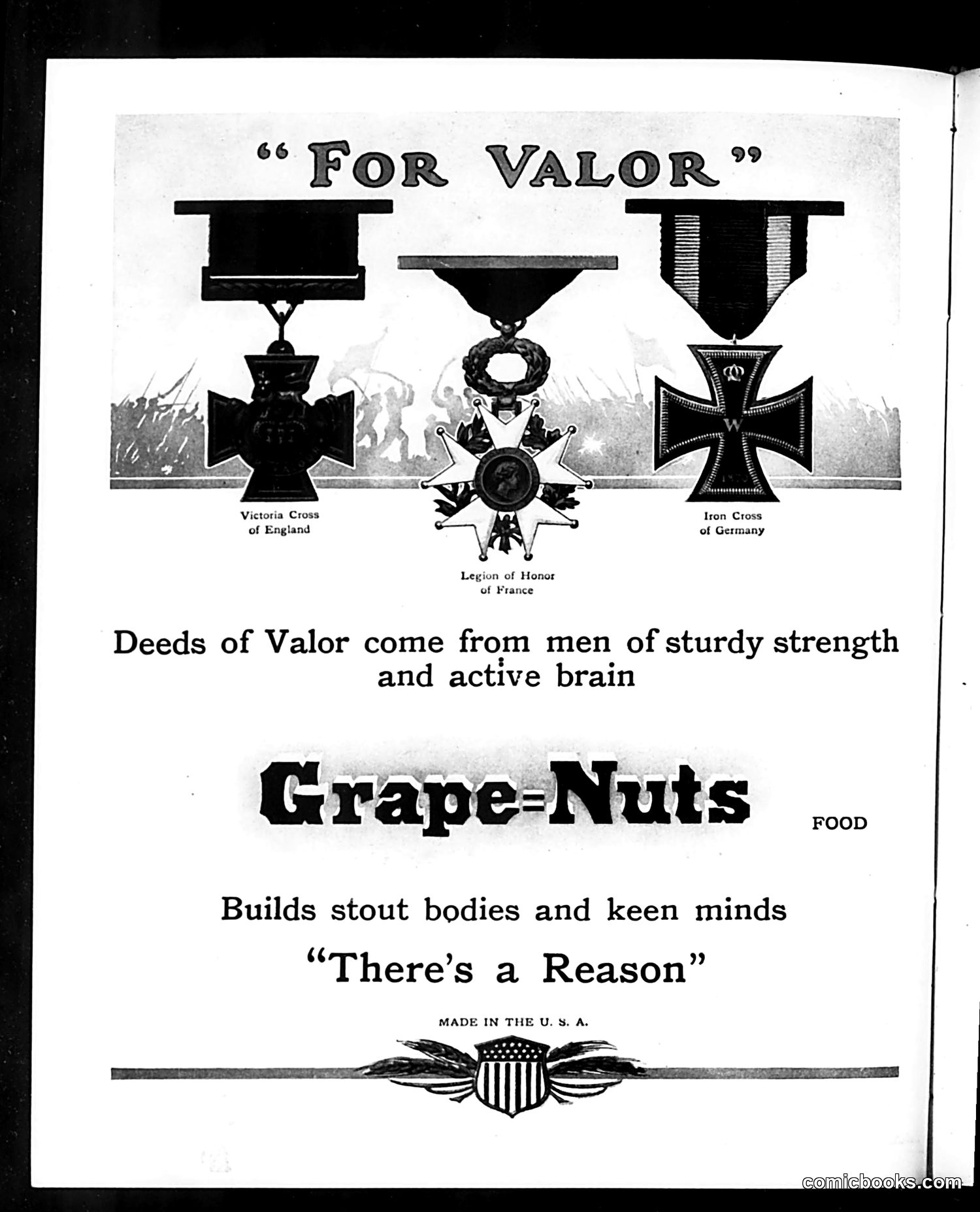
This is a **Grape-Nuts cereal advertisement**, not political satire. The page uses patriotic imagery to sell breakfast food during what appears to be the World War I era. The ad displays three military decorations—Britain's Victoria Cross, France's Legion of Honor, and Germany's Iron Cross—alongside the claim that "deeds of valor come from men of sturdy strength and active brain." It then pivots to argue that Grape-Nuts cereal "builds stout bodies and keen minds," implying the product creates the physical and mental toughness necessary for military heroism. The "Made in the U.S.A." seal at bottom emphasizes American manufacturing. This is **nationalist advertising**: it conflates patriotism, military valor, and nutritional strength to market breakfast cereal to American consumers, particularly families wanting to raise strong, capable children.