
Judge, 1915-03-20 · page 5 of 24
Judge — March 20, 1915 — page 5: what you’re looking at
What you’re looking at
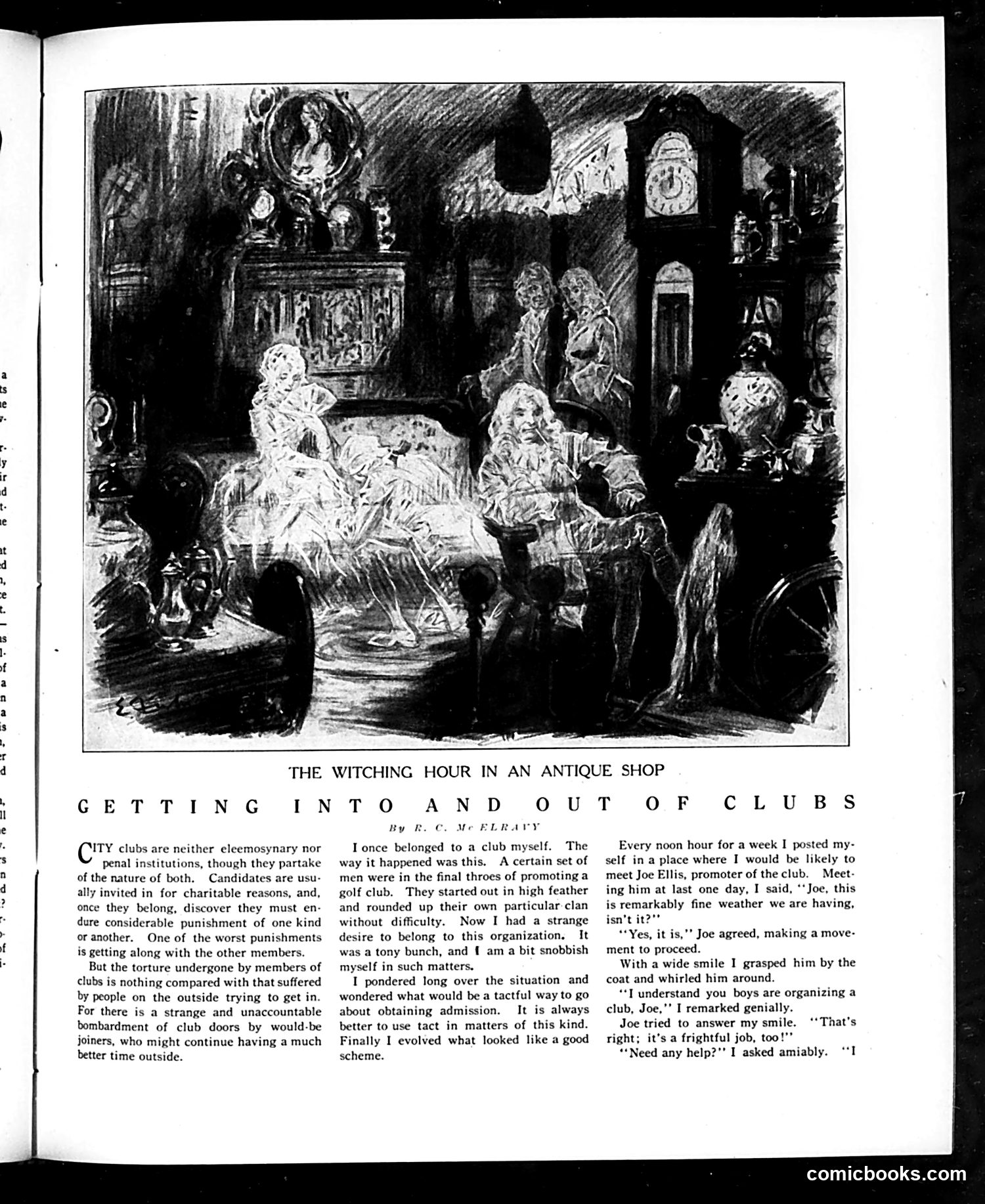
This satirical piece by E.C. McElray mocks the exclusionary practices of private clubs in early 20th-century America. The accompanying illustration, "The Witching Hour in an Antique Shop," depicts a deliberately obscure, cluttered scene—likely symbolizing the mysterious and unwelcoming nature of club membership. The text describes the author's struggle to join a club, highlighting how membership committees use arbitrary gatekeeping to control access. McElray sarcastically notes that clubs combine "eleemosynary" (charitable) pretenses with actual exclusivity, making membership difficult despite no clear criteria. The piece criticizes how established members protect their social privileges through vague selection processes and difficult "bombardment" at entrance. The satire targets class-based social institutions that claim democratic ideals while maintaining strict barriers.
📄 Transcribed text from this page (OCR, searchable)
Machine-transcribed from the original scan — historical spelling and the odd misread are preserved.
THE WITCHING HOUR IN AN ANTIQUE SHOP GETTING I ITY clubs are neither eleemosynary nor penal institutions, though they partake of the nature of both. Candidates are usu- ally invited in for charitable reasons, and, once they belong, discover they must en- dure considerable punishment of one kind or another. One of the worst punishments is getting along with the other members. But the torture undergone by members of clubs is nothing compared with that suffered by people on the outside trying to get in. For there is a strange and unaccountable bombardment of club doors by would-be joiners, who might continue having a much better time outside. N T O A N D By BR. C. Me ELRAVY I once belonged to a club myself. The way it happened was this. A certain set of men were in the final throes of promoting a golf club, They started out in high feather and rounded up their own particular clan without difficulty. Now I had a strange desire to belong to this organization, It w tony bunch, and { am a bit snobbish myself in such matters. I pondered long over the situation and wondered what would be a tactful way to go about obtaining admission. It is always better to use tact in matters of this kind. Finally I evolved what looked like a good scheme. OU T OF CLUBS Every noon hour for a week I posted my- self in a place where I would be likely to meet Joe Ellis, promoter of the club. Meet- ing him at last one day, I said, ‘‘Joe, this is remarkably fine weather we are having, isn't it?"’ **Yes, it is," Joe agreed, making a move- ment to proceed. With a wide smile I grasped him by the coat and whirled him around. “‘T understand you boys are organizing a club, Joe,’’ I remarked genially. Joe tried to answer my smile. right; it’s a frightful job, too!’’ “*Need any help?'’ I asked amiably. ‘‘I “That's comicbooks.com