
Judge, 1915-03-20 · page 4 of 24
Judge — March 20, 1915 — page 4: what you’re looking at
What you’re looking at
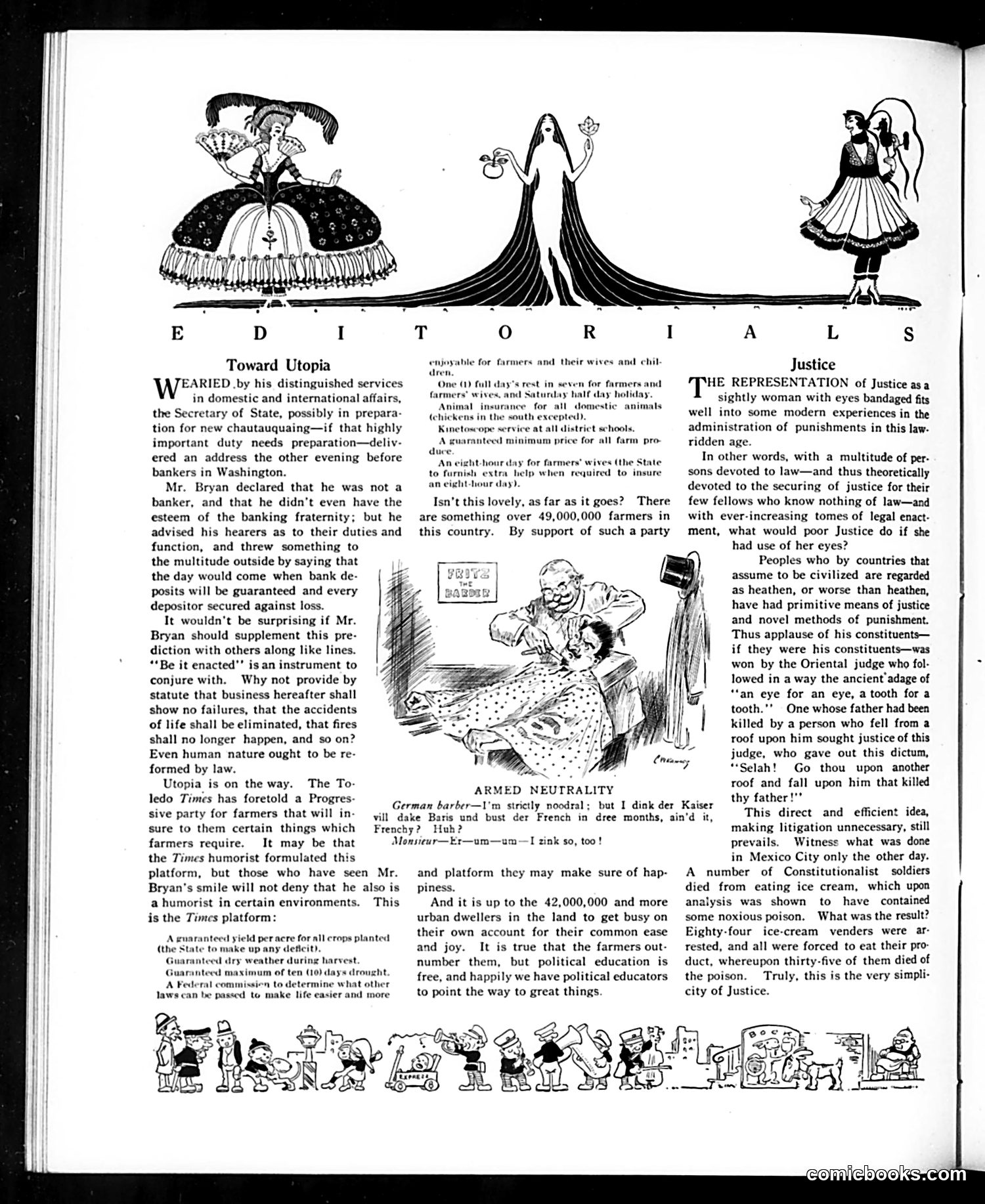
This Judge magazine page satirizes progressive reform proposals through allegorical female figures labeled "Toward Utopia." The left figure represents a wealthy woman with elaborate dress, mocking proposals for farmers' welfare and labor reforms. The center figure in dramatic black robes appears to represent "Justice" — depicted as blindfolded but ineffective. The main cartoon shows a judge administering harsh punishment, satirizing primitive justice systems. The accompanying text criticizes both Mr. Bryan (likely William Jennings Bryan, the populist politician) and the Toledo Times for promoting utopian farming reforms. The satire suggests these reforms are impractical idealism. A secondary cartoon about "Armed Neutrality" references German-French tensions, likely from the pre-WWI period. The overall page mocks progressive reformers as naive utopians.
📄 Transcribed text from this page (OCR, searchable)
Machine-transcribed from the original scan — historical spelling and the odd misread are preserved.
Toward Utopia EARIED .by his distinguished services in domestic and international affairs, the Secretary of State, possibly in prepara- tion for new chautauquaing—if that highly important duty needs preparation—deliv- ered an address the other evening before bankers in Washington. Mr. Bryan declared that he was not a banker, and that he didn’t even have the esteem of the banking fraternity; but he advised his hearers as to their duties and function, and threw something to the multitude outside by saying that the day would come when bank de- posits will be guaranteed and every depositor secured against loss. It wouldn't be surprising if Mr. Bryan should supplement this pre- diction with others along like lines. “*Be it enacted"’ is an instrument to conjure with. Why not provide by statute that business hereafter shall show no failures, that the accidents of life shall be eliminated, that fires shall no longer happen, and so on? Even human nature ought to be re- formed by law. Utopia is on the way. The To- ledo Times has foretold a Progres- south excepted). Jjowope service at all district schools. anteed minimum price for all farm pro- it-hour day for farmers’ wives (the St W extra help when required to insure ht-hour day). Isn't this lovely, as far as it goes? There are something over 49,000,000 farmers in this country. By support of such a party ARMED NEUTRALITY - for f hat will f German barber—I'm strictly noodral; but I dink der Kaiser sive party for farmers that will in- vil! dake Baris und bust der French in dree months, ain’d it, sure to them certain things which Frenchy? Huh? farmers require. It may be that the Times humorist formulated this platform, but those who have seen Mr. Bryan’s smile will not deny that he also is a humorist in certain environments. This is the Times platform: A guaranteed yield per acre for all crops planted State to make up any deficit), ther during harvest. ys drought. “n to determi at oth laws can be passed to make life easier and more some D. De $3 = P a) @ RS Bx : Monsieur—Er—um—um—I zink so, too! and platform they may make sure of hap- piness. And it is up to the 42,000,000 and more urban dwellers in the land to get busy on their own account for their common ease and joy. It is true that the farmers out- number them, but political education is free, and happily we have political educators to point the way to great things. ii Peasant Justice THe REPRESENTATION of Justice asa sightly woman with eyes bandaged fits well into some modern experiences in the administration of punishments in this law- ridden age. In other words, with a multitude of per- sons devoted to law—and thus theoretically devoted to the securing of justice for their few fellows who know nothing of law—and with ever-increasing tomes of legal enact- ment, what would poor Justice do if she had use of her eyes? Peoples who by countries that assume to be civilized are regarded as heathen, or worse than heathen, have had primitive means of justice and novel methods of punishment. Thus applause of his constituents— if they were his constituents—was won by the Oriental judge who fol- lowed in a way the ancient’ adage of “tan eye for an eye, a tooth for a tooth."’ One whose father had been killed by a person who fell from a roof upon him sought justice of this judge, who gave out this dictum, “Selah! Go thou upon another roof and fall upon him that killed thy father!"" This direct and efficient idea, making litigation unnecessary, still prevails. Witness what was done in Mexico City only the other day. A number of Constitutionalist soldiers died from eating ice cream, which upon analysis was shown to have contained some noxious poison, What was the result? Eighty-four ice-cream venders were ar- rested, and all were forced to eat their pro- duct, whereupon thirty-five of them died of the poison. Truly, this is the very simpli- city of Justice.