
Judge, 1915-03-20 · page 10 of 24
Judge — March 20, 1915 — page 10: what you’re looking at
What you’re looking at
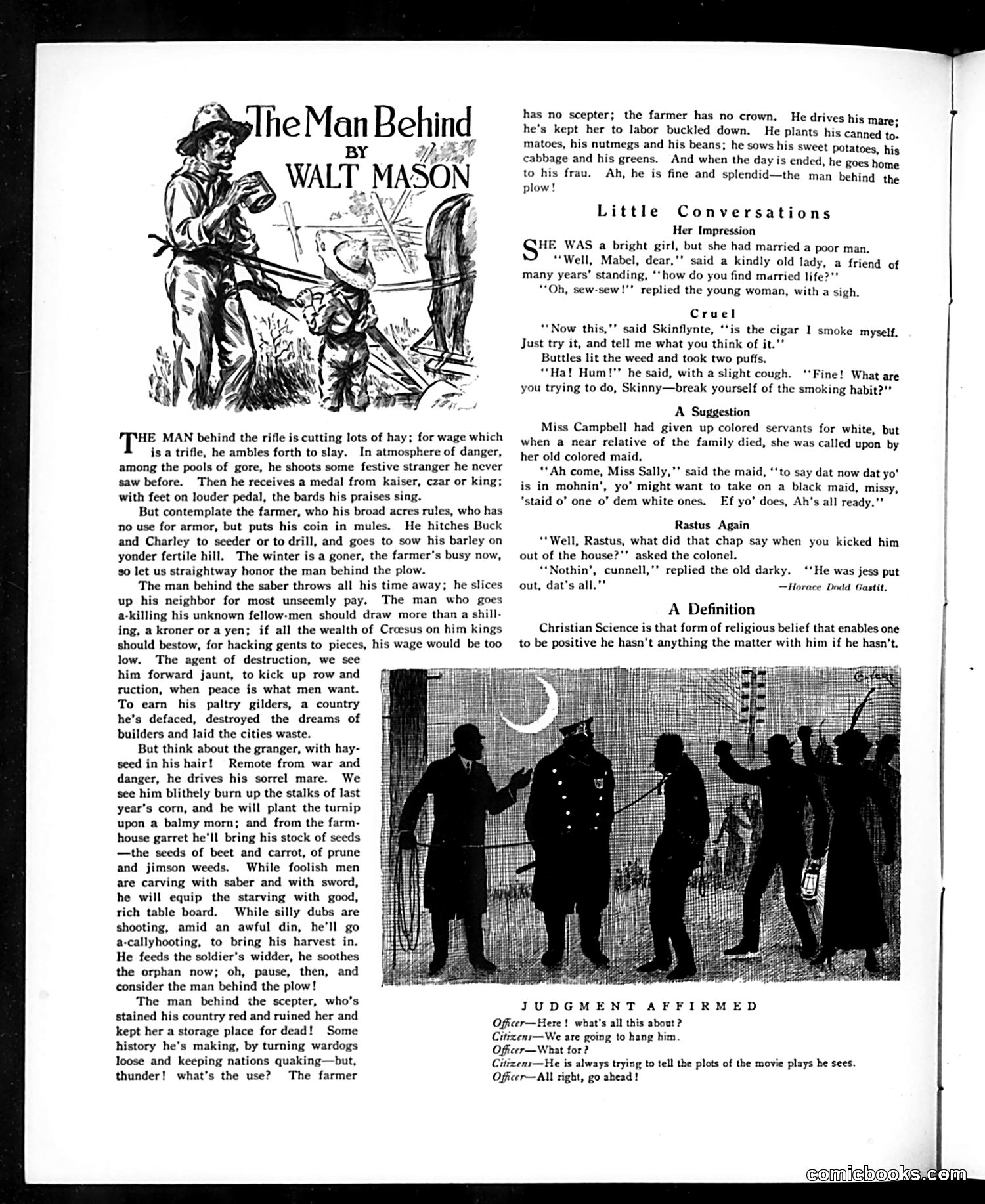
This is anti-war propaganda from Judge magazine, likely from World War I era. Mason's poem contrasts soldiers unfavorably with farmers. The central argument: soldiers ("the man behind the rifle," "the saber") destroy for meager pay and medals, serving despots ("kaiser, czar or king") who ruin nations. Meanwhile, farmers—ordinary men with no crown or scepter—quietly feed populations by cultivating crops and sustaining life. The poem elevates agricultural labor as morally superior to military service. It's pacifist rhetoric disguised as humble praise of farming, positioning the farmer as civilization's true hero while depicting warfare as destructive folly undertaken for corrupt rulers and inadequate compensation. The accompanying "Little Conversations" are unrelated humor pieces, including period-typical racial stereotypes in dialogue.
📄 Transcribed text from this page (OCR, searchable)
Machine-transcribed from the original scan — historical spelling and the odd misread are preserved.
plheMan Behind WALT. MASON HE MAN behind the rifle is cutting lots of hay; for wage which is a trifle, he ambles forth to slay. In atmosphere of danger, among the pools of gore, he shoots some festive stranger he never saw before. Then he receives a medal from kaiser, czar or king; with feet on louder pedal, the bards his praises sing. But contemplate the farmer, who his broad acres rules, who has no use for armor, but puts his coin in mules. He hitches Buck and Charley to seeder or to drill, and goes to sow his barley on yonder fertile hill. The winter is a goner, the farmer's busy now, so let us straightway honor the man behind the plow. The man behind the saber throws all his time away; he slices up his neighbor for most unseemly pay. The man who goes a-killing his unknown fellow-men should draw more than a shill- ing, a kroner or a yen; if all the wealth of Croesus on him kings should bestow, for hacking gents to pieces, his wage would be too low. The agent of destruction, we see him forward jaunt, to kick up row and ruction, when peace is what men want. To earn his paltry gilders, a country he’s defaced, destroyed the dreams of builders and laid the cities waste. But think about the granger, with hay- seed in his hair! Remote from war and danger, he drives his sorrel mare. We see him blithely burn up the stalks of last year’s corn, and he will plant the turnip upon a balmy morn; and from the farm- house garret he'll bring his stock of seeds —the seeds of beet and carrot, of prune and jimson weeds. While foolish men are carving with saber and with sword, he will equip the starving with good, rich table board. While silly dubs are shooting, amid an awful din, he'll go a-callyhooting, to bring his harvest in. He feeds the soldier's widder, he soothes the orphan now; oh, pause, then, and consider the man behind the plow! The man behind the scepter, who's stained his country red and ruined her and kept her a storage place for dead! Some history he’s making, by turning wardogs loose and keeping nations quaking—but, thunder! what's the use? The farmer has no scepter; the farmer has no crown. He drives his mare; he's kept her to labor buckled down. He plants his canned to. matoes, his nutmegs and his beans; he sows his sweet potatoes, his cabbage and his greens. And when the day is ended, he goes home to his frau. Ah, he is fine and splendid—the man behind the plow! Little Conversations Her Impression HE WAS a bright girl, but she had married a poor man. “Well, Mabel, dear,’’ said a kindly old lady, a friend of many years’ standing, ‘how do you find married life? “Oh, sew-sew!"? replied the young woman, with a sigh. Cruel “Now this,"’ said Skinflynte, ‘is the cigar I smoke myself. Just try it, and tell me what you think of it."” Buttles lit the weed and took two puffs. “Ha! Hum!" he said, with a slight cough. ‘‘Fine! What are you trying to do, Skinny—break yourself of the smoking habit?’* A Suggestion Miss Campbell had given up colored servants for white, but when a near relative of the family died, she was called upon by her old colored maid. **Ah come, Miss Sally,"’ said the maid, ‘‘to say dat now dat yo’ is in mohnin’, yo’ might want to take on a black maid, missy, ‘staid o’ one o’ dem white ones. Ef yo’ does, Ah’s all ready."” Rastus Again **Well, Rastus, what did that chap say when you kicked him out of the house?"’ asked the colonel. ‘Nothin’, cunnell,’’ replied the old darky. ‘*He was jess put out, dat’s all.’" —Horace Dodd Gastit, A Definition Christian Science is that form of religious belief that enables one to be positive he hasn’t anything the matter with him if he hasn't. JUDGMENT AFFIRMED Officer—Here ! what's all this about ? Citizens—We are going to hang him Officer—What for ? Citrzens—He is always trying to tell the plots of the movie plays he sees. Officer—All right, go ahead! | | | { | | }