
A complete issue · 24 pages · 1915
Judge — February 20, 1915
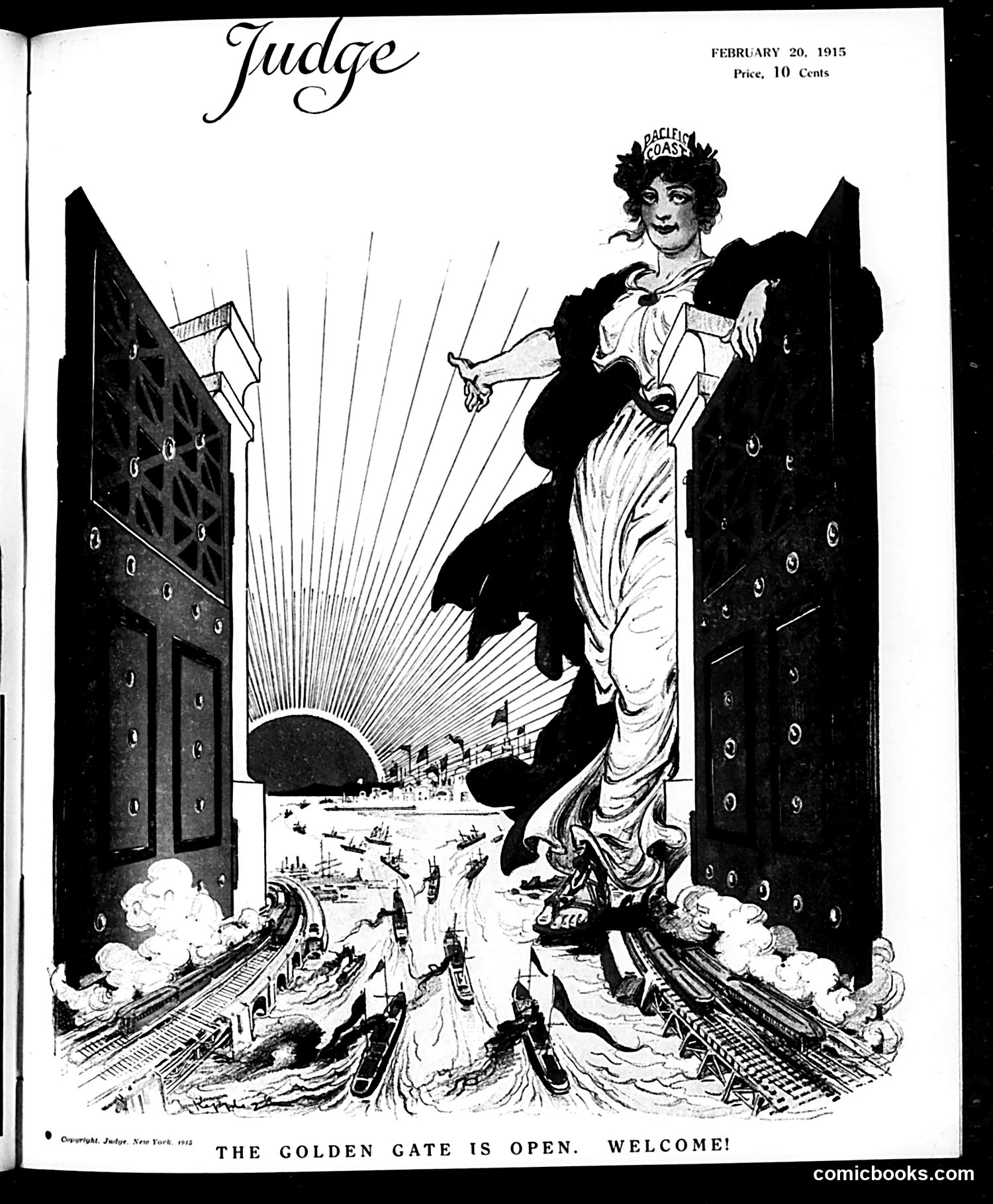
This political cartoon depicts the opening of the Panama Canal, which occurred in 1914. "The Golden Gate is Open. Welcome!" references the canal's completion and international significance. The central female figure appears to be Lady Liberty or a personification of America, crowned and welcoming ships through massive gates. The "Gaelic Coast" reference on her crown likely indicates Irish or European maritime interests. Below, various ships—both military and commercial vessels—pass through the canal, with smoke and activity suggesting bustling trade. The cartoon celebrates American engineering achievement and the canal's role in facilitating global commerce and naval operations. This reflects American pride in the canal as a major technological and geopolitical accomplishment, positioning the U.S. as a welcoming commercial and naval power.
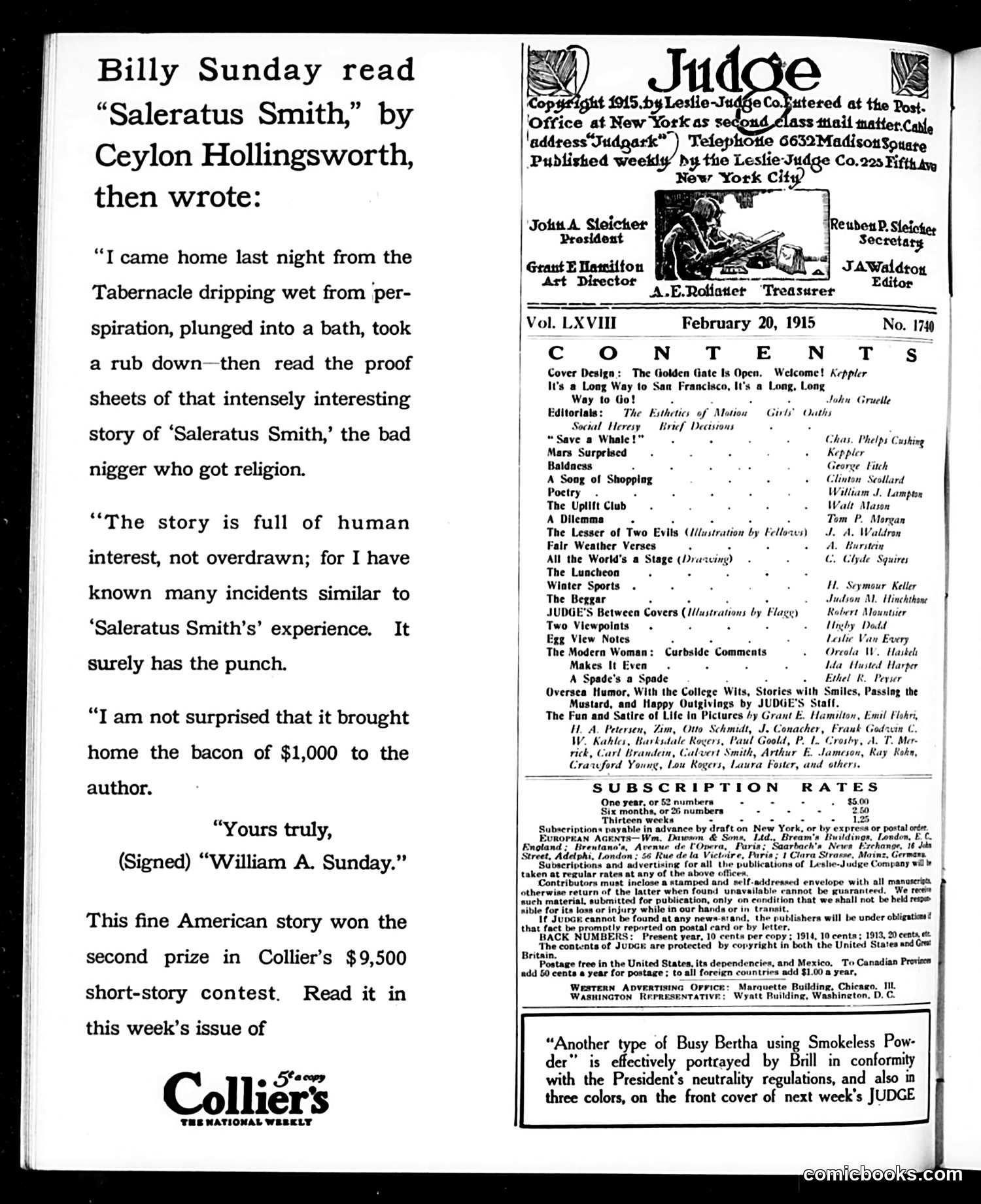
This page is primarily **advertising and editorial content** rather than political satire. The left side features a testimonial from "William A. Sunday" praising Ceylon Hollingsworth's story "Saleratus Smith" about "the bad nigger who got religion." Sunday notes the story won second prize ($1,000) in Collier's short-story contest. The right side shows the **Judge magazine masthead** (February 20, 1915) with its table of contents, subscription rates, and publication details. The racial language reflects the casual prejudice of 1915 America. The story's apparent appeal lay in its "human interest" rather than explicit satire. This page demonstrates how period magazines mixed entertainment promotion with period-typical racist terminology that modern readers find deeply offensive.
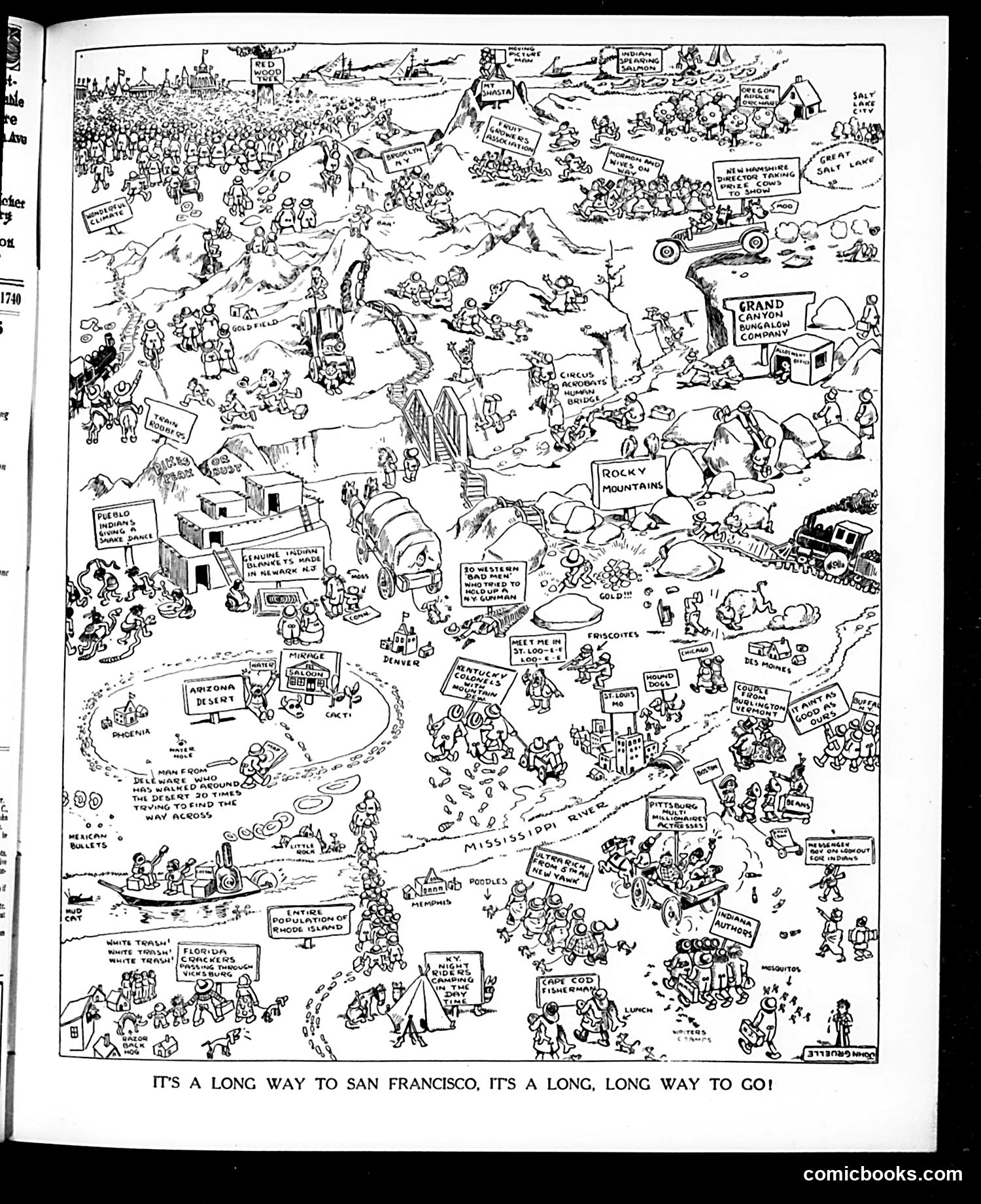
This is a humorous map satirizing the 1849 California Gold Rush and the journey to San Francisco. The phrase "It's a Long Way to San Francisco, It's a Long, Long Way to Go!" captures the central joke—the treacherous, arduous route prospectors faced. The map depicts various hazards and detours: desert conditions (Arizona), mountains (Rocky Mountains), Native American encounters, cholera outbreaks, criminal activity, and failed enterprises. Labels identify locations like the Grand Canyon, Pikes Peak, and the Mississippi River. The cartoon mocks the Gold Rush enthusiasm by showing the reality: countless obstacles, deaths, disease, and false promises of wealth. The masses of tiny figures represent hopeful prospectors confronting danger, starvation, and disillusionment. It's essentially cautionary satire against Gold Rush fever, emphasizing the gap between romantic expectation and brutal reality.
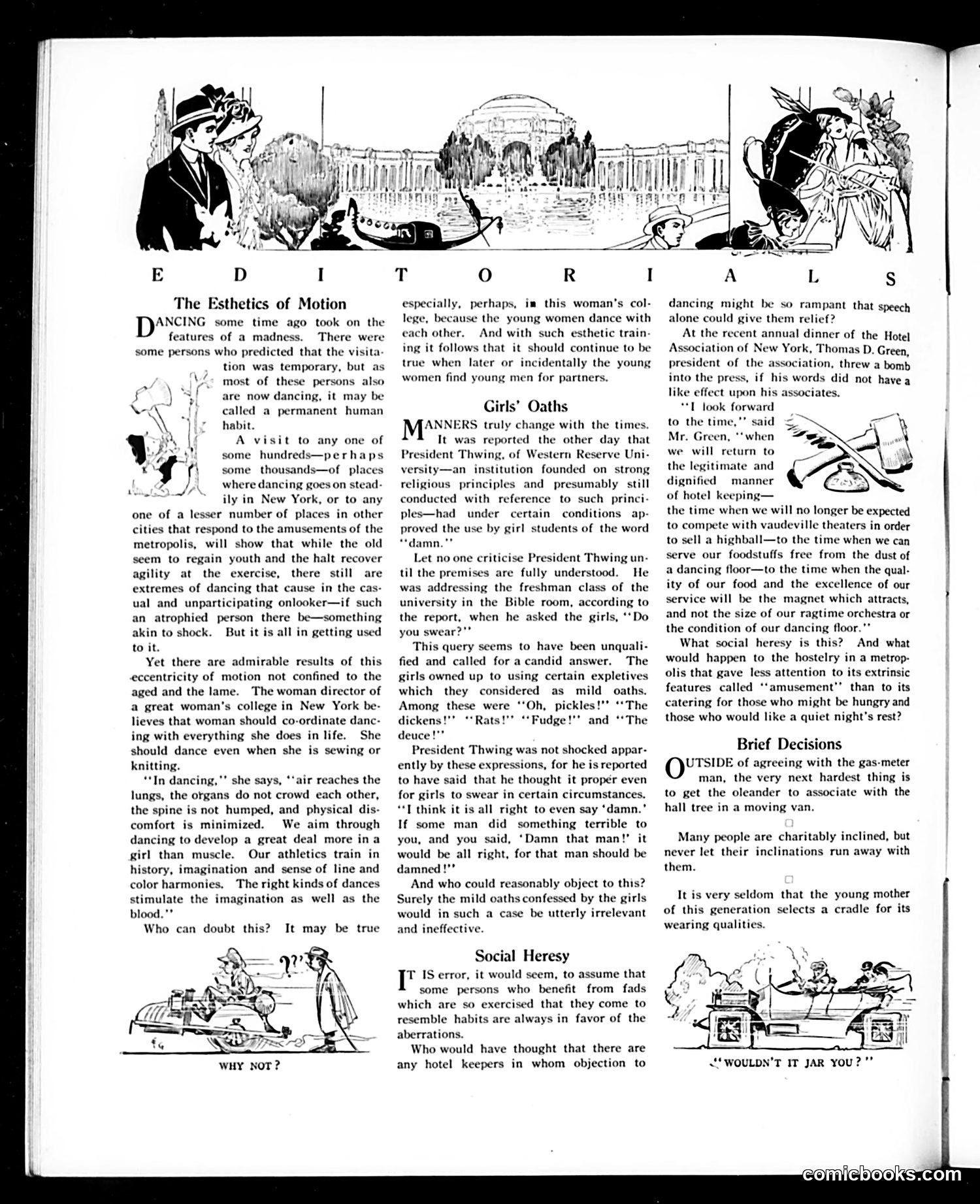
This page satirizes 1920s social attitudes toward dancing and women's behavior. The main article, "The Esthetics of Motion," defends dancing against critics who view it as morally suspect. It references President Thwing of Western Reserve University, who apparently criticized young women's dancing and use of mild profanity ("damn," "pickles"). The satire supports the young women, arguing their dancing is physically and culturally beneficial. The "Girls' Oaths" section mocks concerns about female propriety, suggesting women should be free from restrictive social expectations about language and leisure activities. The smaller cartoons ("Why Not?" and "Wouldn't It Jar You?") offer visual humor about social incongruity—likely contrasting old-fashioned morality with modern behavior. The page reflects Jazz Age debates over changing gender roles and youth culture.
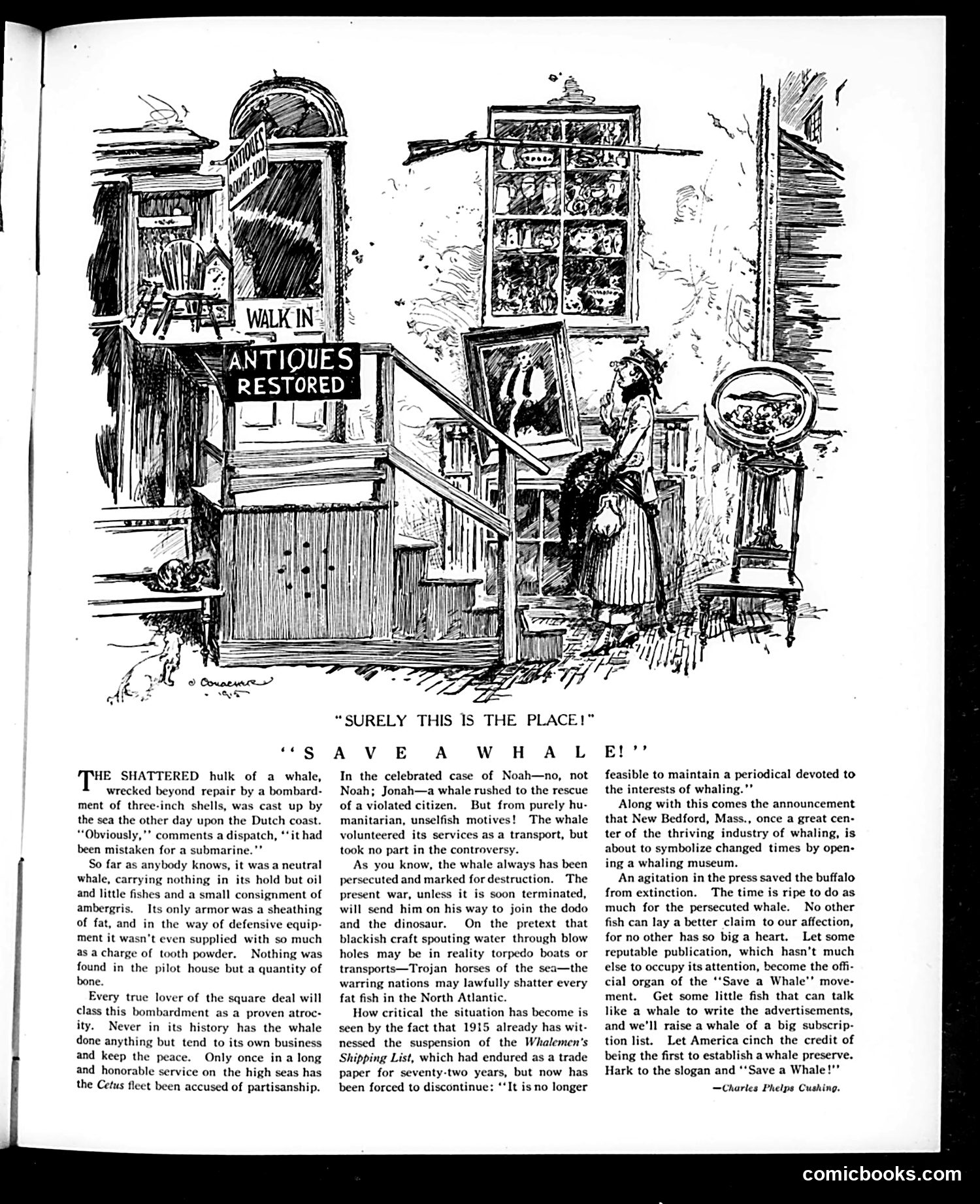
This page satirizes an early conservation movement to preserve whales from extinction. The illustration shows an "Antiques Restore" shop, punning on the whale preservation effort's apparent futility—treating a dying industry like salvaging broken antiques. The text references a specific controversy: a stranded whale carcass became a symbolic focal point. Rather than genuine humanitarian concern, the article mocks the "Save a Whale" campaign as performative activism—a fashionable cause celebre that allows people to virtue-signal without substance. The satire targets how the movement prioritizes the whale's symbolic value over practical action, noting the irony that the whaling industry (the *Whalemen's Shipping List*) is itself dying anyway. The joke: activists romanticize preservation while the real industry collapses on its own.
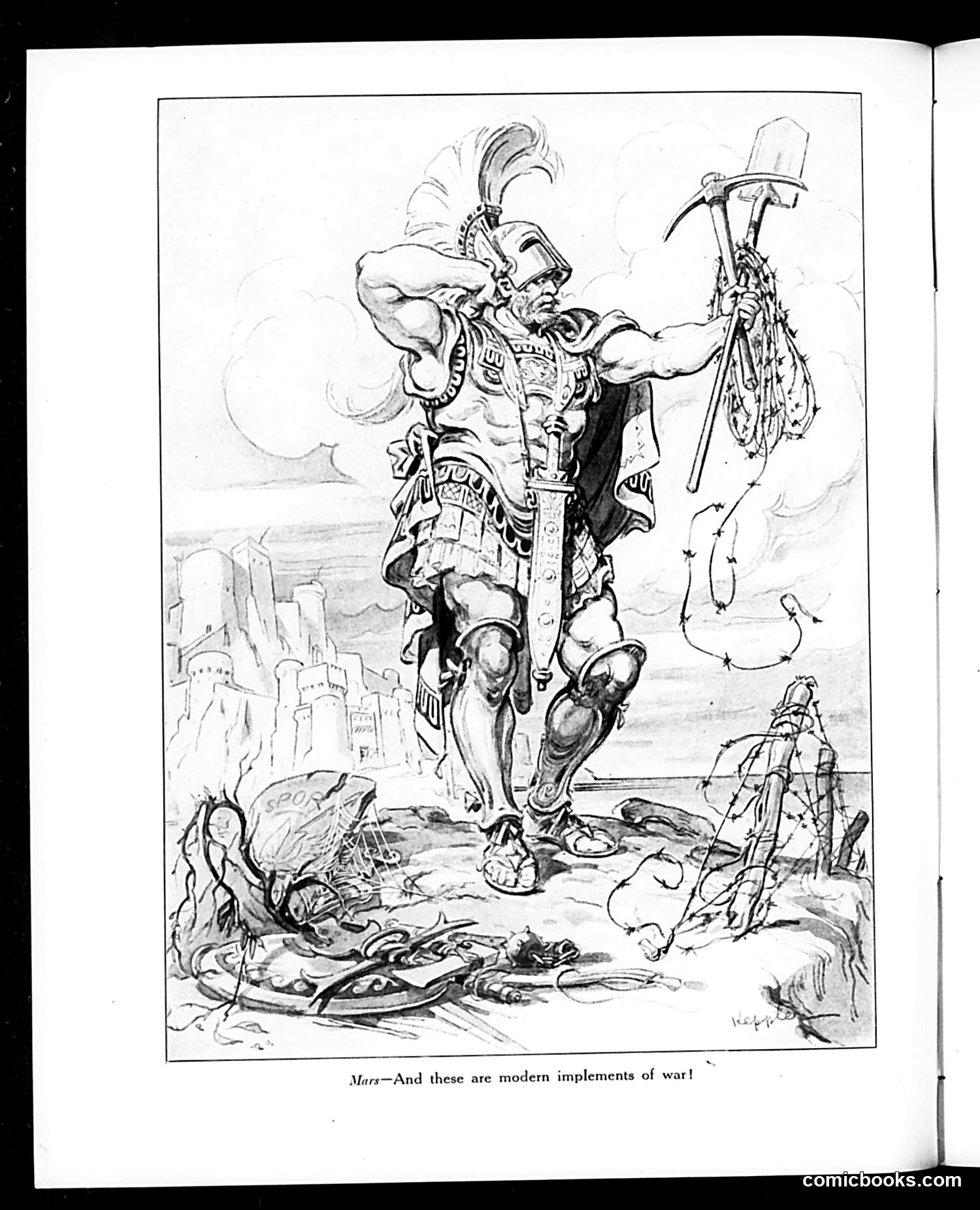
This cartoon depicts Mars, the Roman god of war, surveying the debris of modern warfare. The figure stands armored and militant, holding what appears to be a scythe or reaping tool—traditionally Mars's symbol—while observing scattered implements of contemporary combat around him. The satire criticizes the technological sophistication of modern warfare by showing Mars confronting industrial-age weapons and tools of destruction. The caption suggests irony: these "modern implements" represent progress, yet they're merely different tools serving war's ancient, destructive purpose. The cartoon likely comments on early-20th-century militarization and arms development, suggesting that despite technological advancement, humanity remains enslaved to the same violent impulses of antiquity. Mars, unchanged, presides over this "progress."
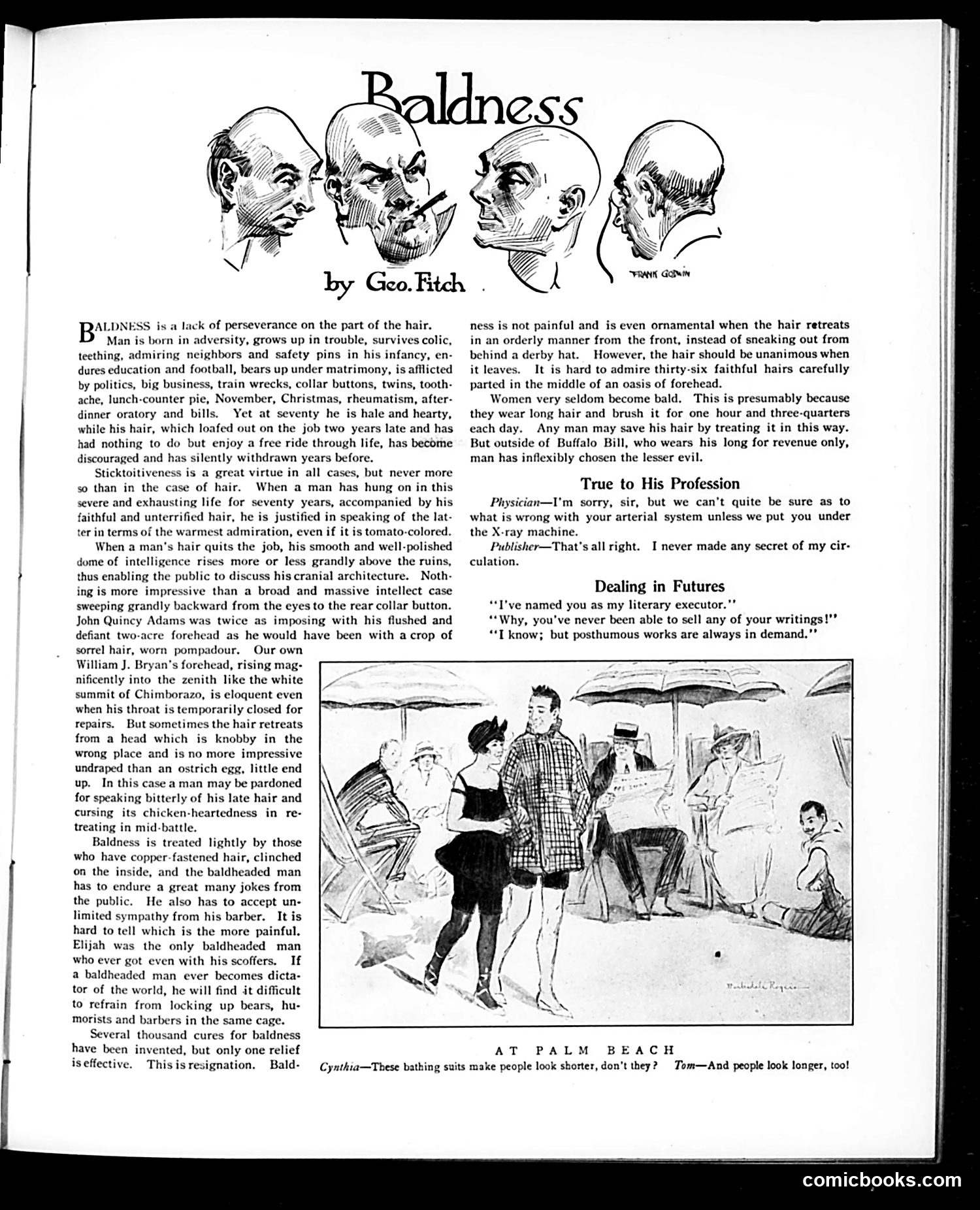
This page from *Judge* magazine contains humorous essays on baldness and brief jokes mocking contemporary figures and professions. **The Main Essay ("Baldness" by Geo. Fitch):** A comedic lament treating hair loss as a betrayal. The text humorously compares men's survival through life's hardships to hair's "cowardice" in abandoning the scalp. It references specific historical figures—**John Quincy Adams** and **William J. Bryan**—whose prominent foreheads are presented as intellectual advantages. The essay jokes that baldness forces men to endure public ridicule and barber sympathy equally. **The Cartoon ("At Palm Beach"):** Depicts beachgoers in bathing suits; the accompanying joke plays on how bathing suits make people appear shorter while making others look taller—visual wordplay about perspective. **The Two Brief Jokes:** One satirizes a **publisher** claiming his poor book sales don't matter because "posthumous works are always in demand"—mocking both vanity and publishing conventions. Another jokes about a doctor's "circulation"—a pun on medical circulation and newspaper circulation. The page is primarily entertainment and social satire targeting baldness anxiety, literary pretension, and professional pomposity.
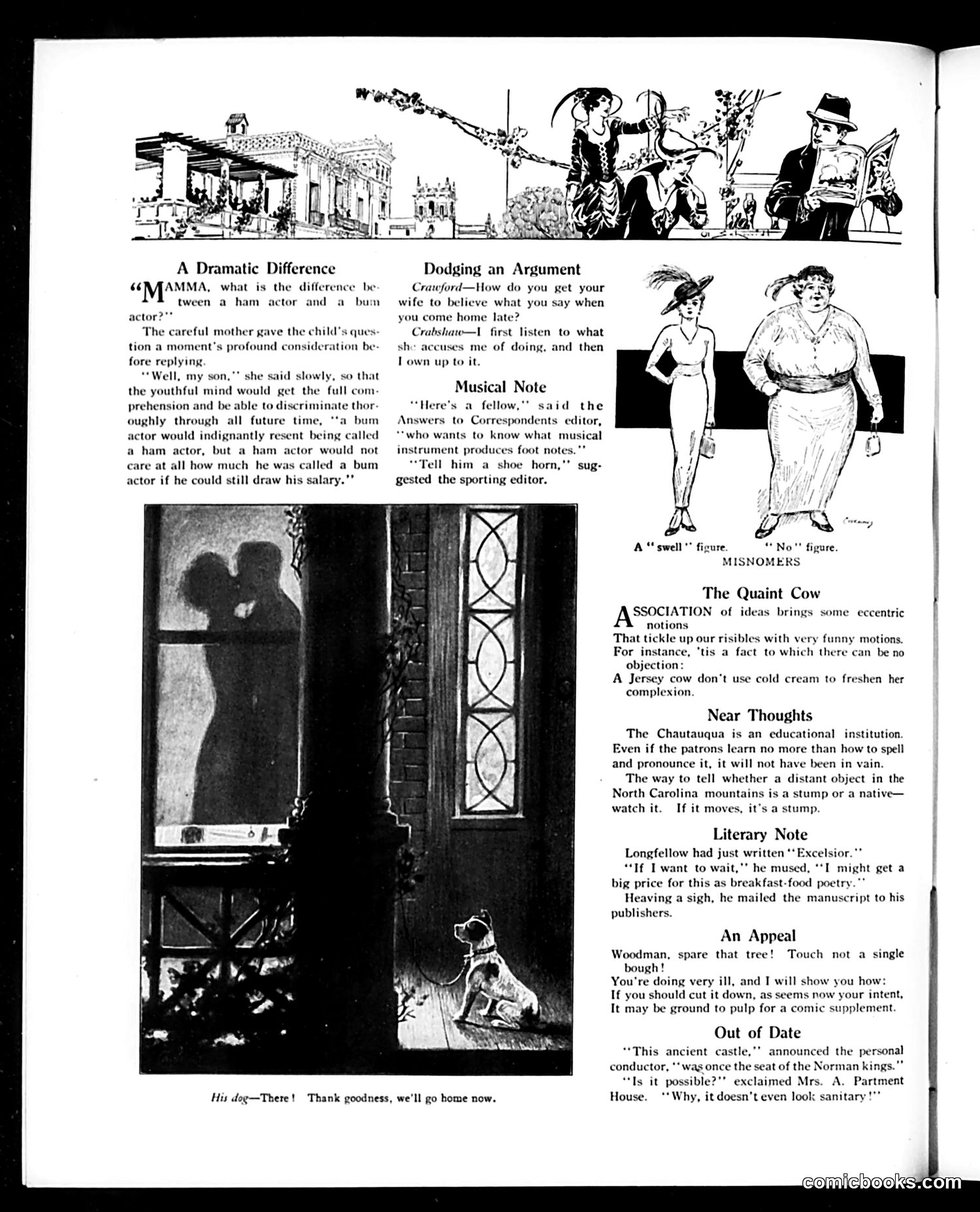
This page contains several brief humorous pieces typical of early 20th-century American satirical magazines: **"A Dramatic Difference"** contrasts "ham actors" (overacting performers) with struggling "bum actors"—the joke being that ham actors don't care about their terrible reputations as long as they're paid, while genuinely desperate actors would resent the insult. **"Dodging an Argument"** is a marital humor piece: a husband avoids spousal conflict by simply confessing to whatever she accuses him of doing. **"Musical Note"** is a pun: when asked what instrument produces "foot notes," the answer is a "shoe horn." **"Misnomers"** compares female body types as "swell" versus "no" figures. The remaining items—"The Quaint Cow," "Near Thoughts," "Literary Note," "An Appeal," and "Out of Date"—are brief comic observations about cows, education, Longfellow, deforestation, and outdated castles. This represents Judge's accessible, pun-heavy house style mixing social observation with wordplay.
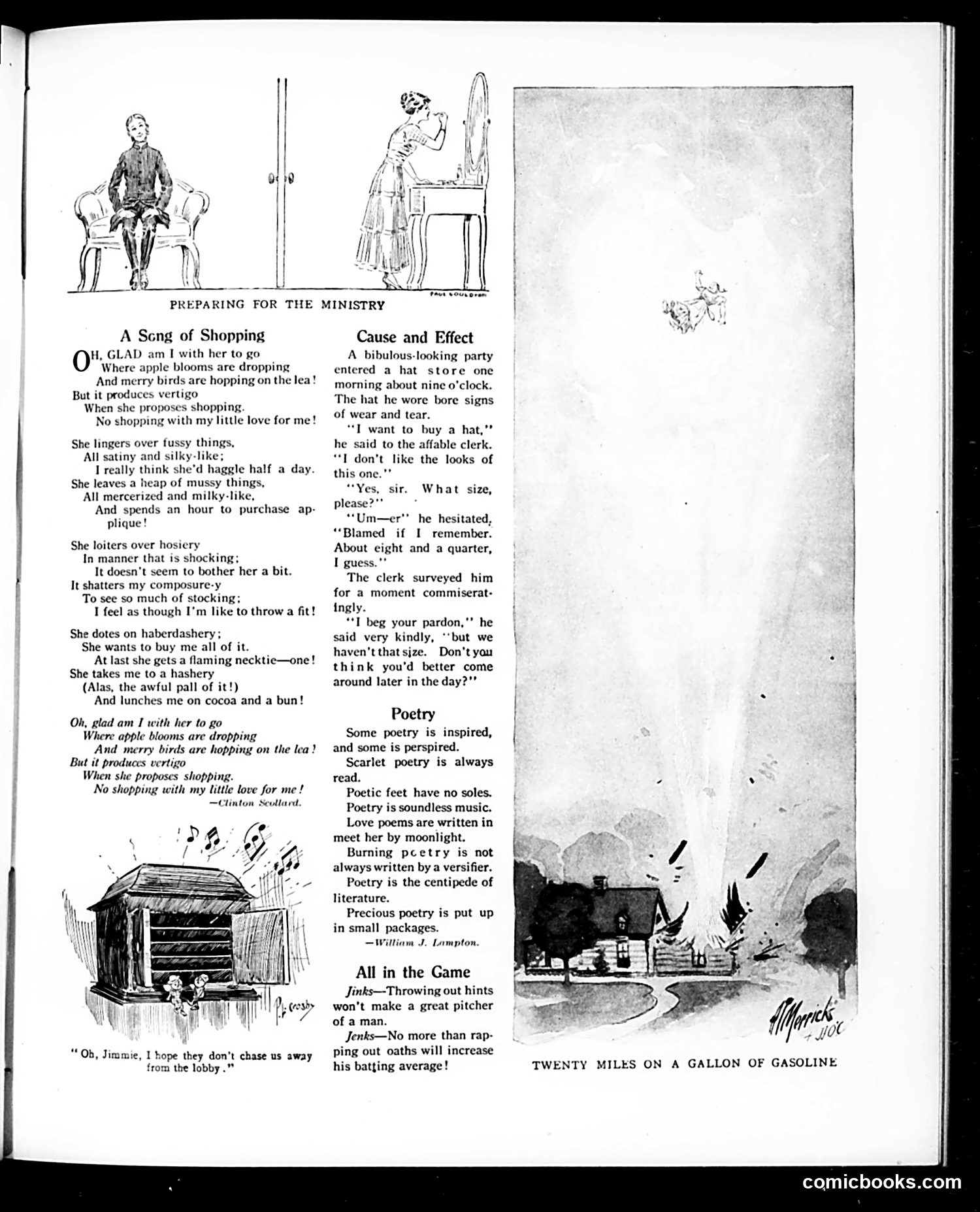
This Judge magazine page contains three distinct pieces satirizing early 20th-century American life: **"A Song of Shopping"** mocks the frustration of husbands accompanying wives on shopping excursions. The poem depicts women as indecisive, lingering over frivolous items (stockings, haberdashery, appliqué) while exhausting their male companions—a common domestic comedy trope of the era reflecting gender anxieties about women's consumer culture participation. **"Cause and Effect"** depicts a disheveled, apparently drunk man buying a hat. The clerk's polite suggestion to "come around later in the day" is subtle satire—implying the customer should sober up before making purchases, critiquing both alcoholism and poor judgment. **The remaining items** include brief poetry commentary and baseball wordplay ("All in the Game"), standard filler humor typical of Judge's satirical approach. The overall page targets domestic friction, consumer culture, and male exasperation with female shopping habits—reflecting period anxieties about changing gender roles and modern commercialism.
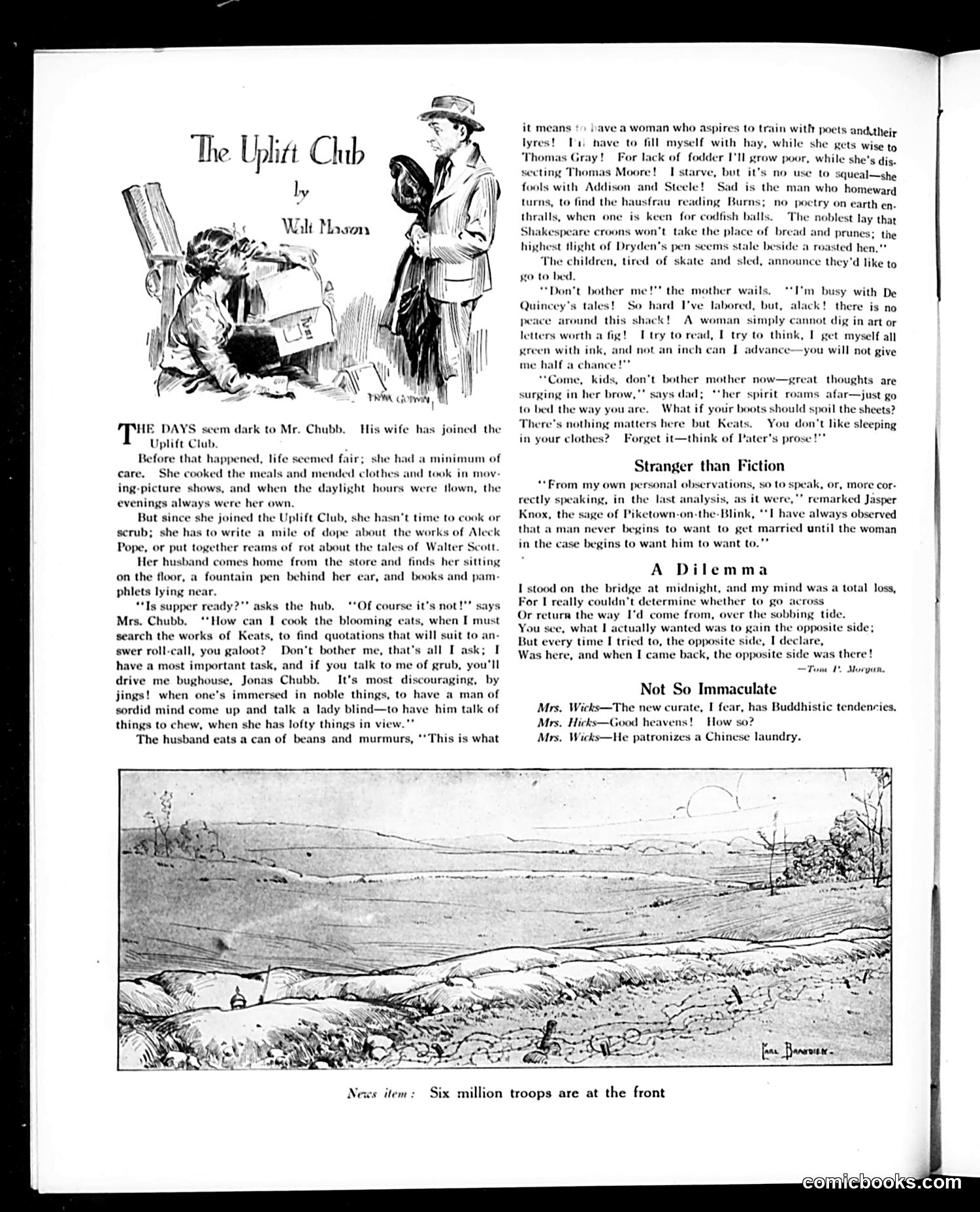
This 1910s-era satirical piece mocks the "Uplift Club," a women's self-improvement organization focused on literary and intellectual pursuits. The cartoon ridicules Mr. Chubb's domestic frustration: his wife, now absorbed in studying classical poets (Keats, Burns, Pope, Scott), neglects housework, cooking, and childcare to write earnest analytical essays for club meetings. The satire targets emerging feminist intellectualism and women's clubs, portraying them as impractical and disruptive to family life. The husband's complaints—eating beans while his wife reads De Quincey, children ignored while she pursues "noble things"—frame women's intellectual ambitions as selfish neglect of domestic duties. The accompanying wartime reference ("Six million troops at the front") likely dates this to WWI, when such domestic humor provided escapism. The humor assumes readers would share the husband's exasperation with women prioritizing learning over traditional household roles—a position that reveals the era's gender assumptions about women's "proper" place.
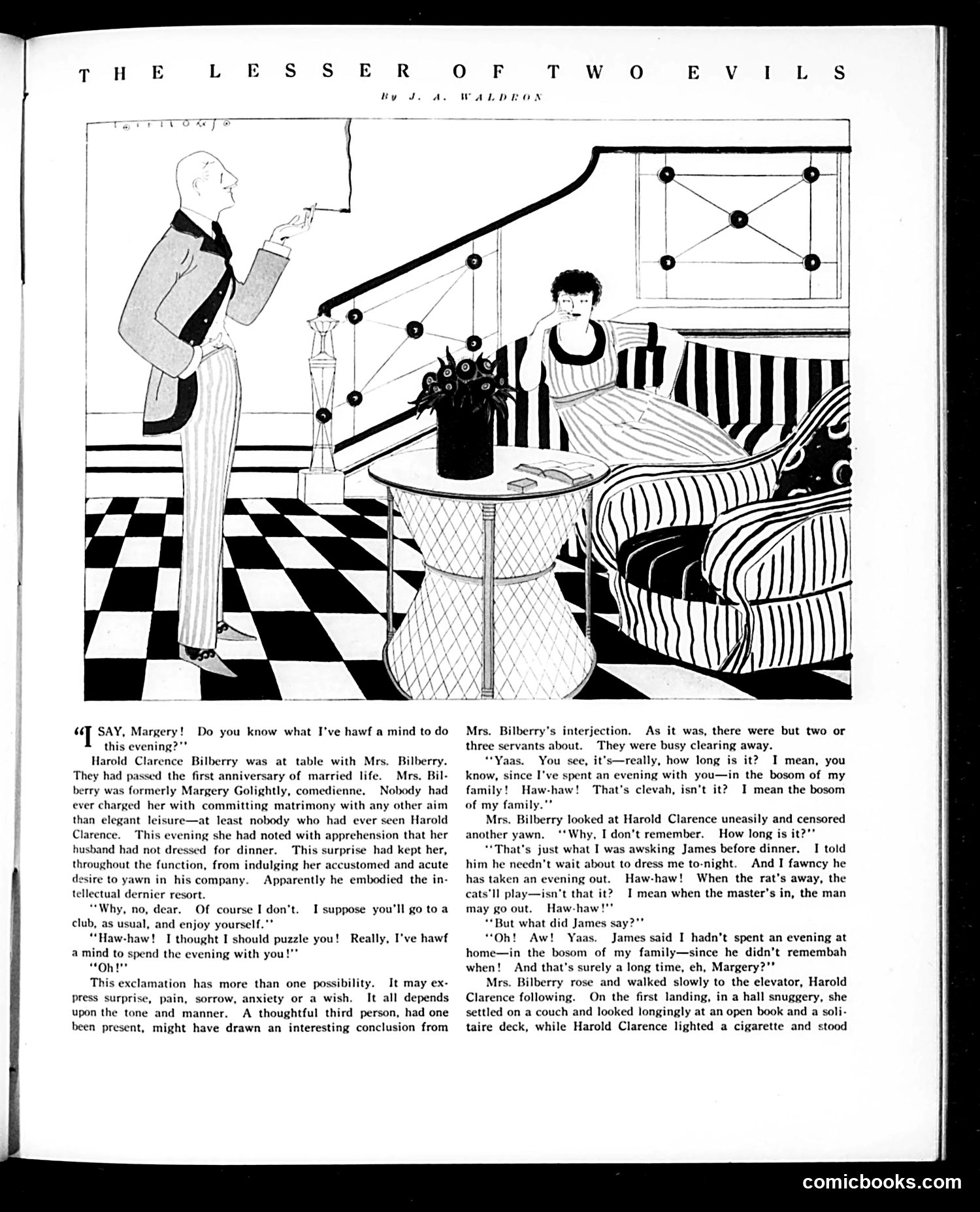
This is a satirical story illustrated in the style of early 1900s Judge magazine, titled "The Lesser of Two Evils" by J.A. Waldron. The satire targets a newly married husband, Harold Clarence Bilberry, whose idea of "spending the evening" with his wife Margery (a former comedienne) involves endless, tedious chatter and forced jovality rather than genuine companionship. His affected laugh ("Haw-haw"), pretentious wordplay, and self-absorbed monologues reveal his obliviousness to her obvious boredom—she repeatedly "censored another yawn." The joke's bitter edge: Margery, who married for "elegant leisure," finds married life with this buffoon so unbearable that she *prefers* being alone with a book and solitaire cards to his company. The title suggests marriage itself is the "lesser of two evils" compared to spinsterhood. The satire mocks both pretentious husbands and the disappointing reality of marriage for women of that era.
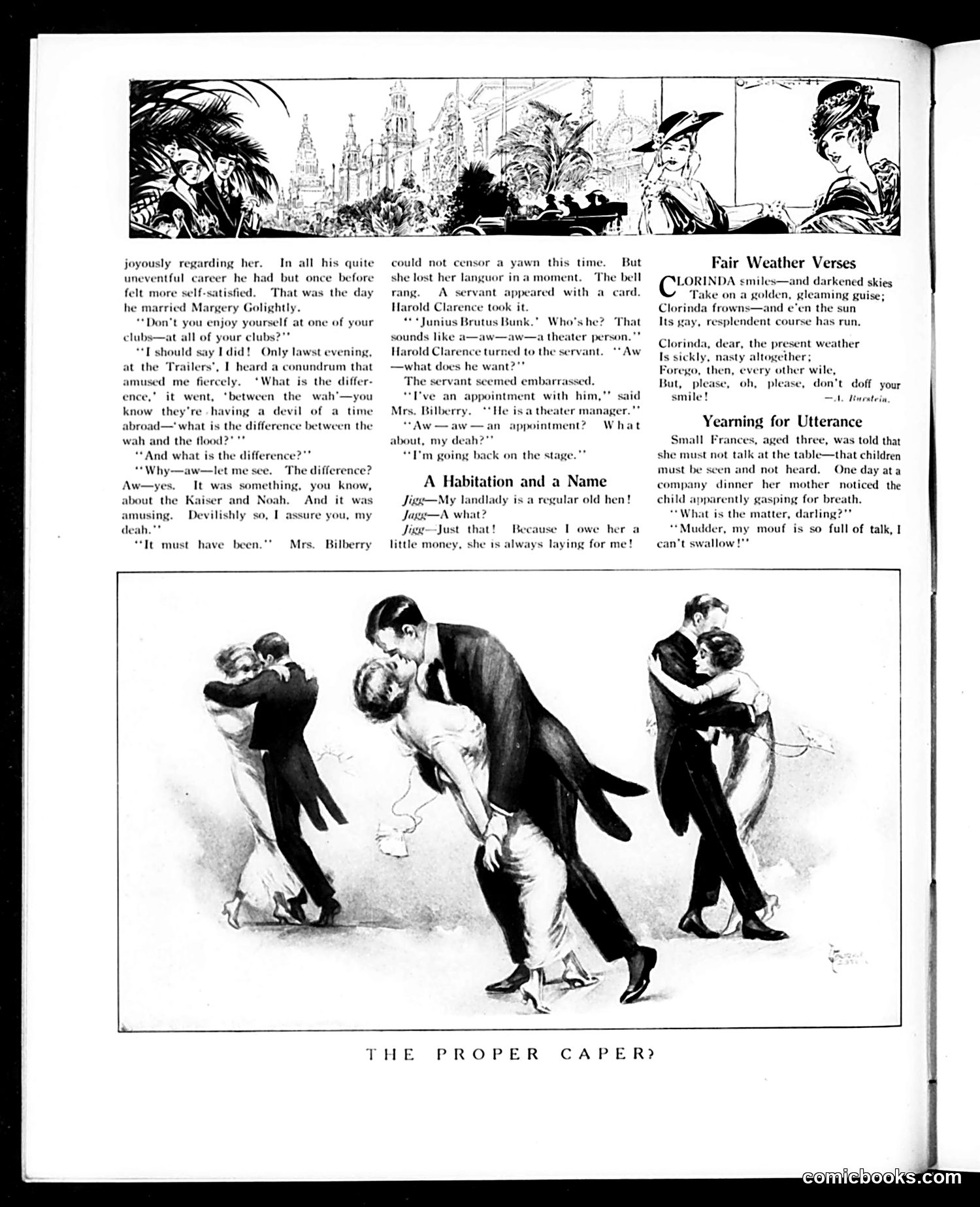
This page contains social humor typical of early 20th-century Judge magazine. The main cartoon depicts three couples dancing, captioned "THE PROPER CAPER?"—a pun on "caper" (a dance/prank) that likely satirizes proper etiquette around dancing or social behavior. The surrounding text includes several unrelated comic anecdotes: a conversation about theater people and appointments; wordplay about a landlady ("regular old hen") who pursues tenants for unpaid rent; a child's struggle to remain silent at dinner despite being "full of talk"; and "Fair Weather Verses" about a woman's emotional influence on weather. The humor relies on class anxiety, theatrical pretension, landlord-tenant conflict, and strict Victorian child-rearing norms. Without specific historical context, the precise targets remain unclear, but the satire generally mocks social pretension and rigid propriety.
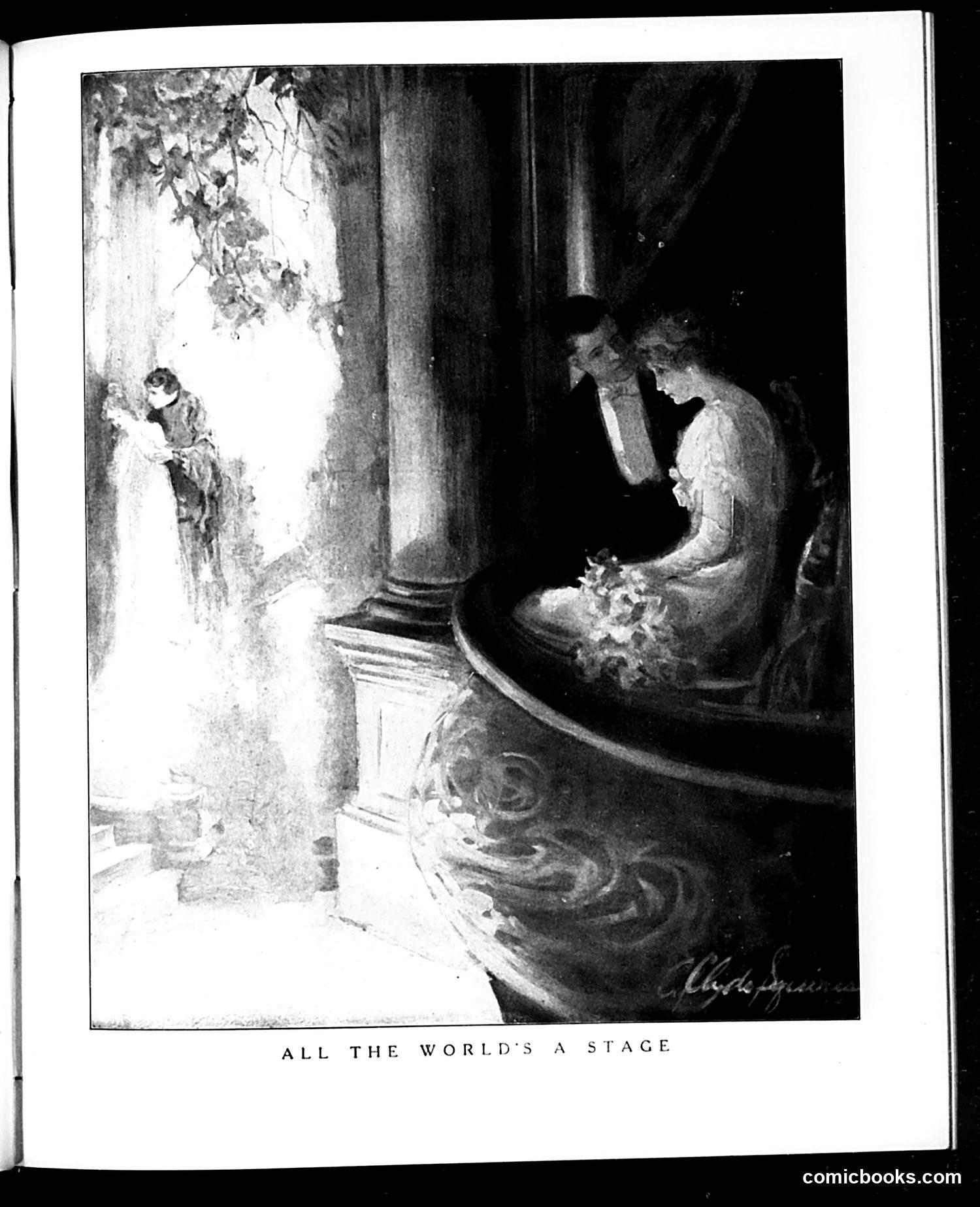
This page shows an illustration titled "ALL THE WORLD'S A STAGE," referencing Shakespeare's famous metaphor that life is theatrical performance. The image depicts what appears to be an ornate theatrical box or balcony scene. Two figures in formal dress observe a scene playing out, while a figure on the left appears to be performing or demonstrating something. The elaborate decorative elements and theatrical setting suggest this is satirizing society's performative nature—how people present carefully constructed versions of themselves in public. Without additional context or clearer identification of the specific figures, the exact satirical target remains unclear. However, the cartoon's point appears to be commentary on social pretense and the artificial nature of public behavior during this Judge magazine era.
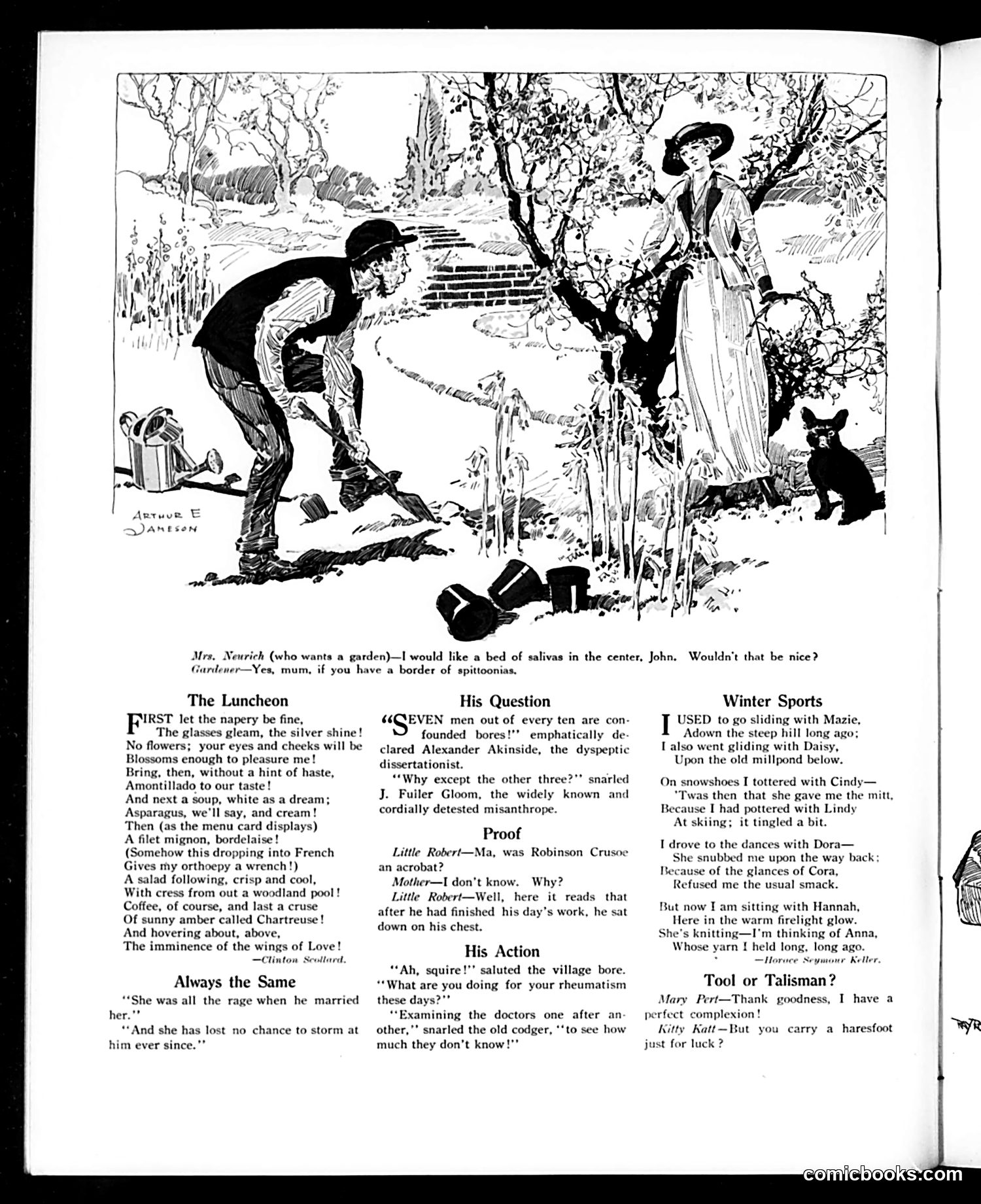
This page from the satirical magazine *Judge* contains several humorous short pieces typical of early 20th-century American humor: **Main Cartoon:** Shows a gardener and Mrs. Neurich discussing garden beds. The joke is a pun on botanical names: she proposes "salivas" (salvia plants), and he suggests a border of "spittoonias"—a fabricated plant name that sounds like "spittoons" (the brass receptacles for tobacco spit, common in that era). The humor relies on mocking her pretentious mispronunciation while suggesting an embarrassingly crude alternative. **Other Content:** The remaining pieces are humorous prose and poetry, not political satire. "Always the Same" jokes about a difficult marriage; "His Question" mocks bores and misanthropes; "Winter Sports" is a poem about romantic entanglements during seasonal activities; and "Tool or Talisman?" plays on superstition about lucky charms. The page represents *Judge's* lighthearted domestic and social humor rather than hard political commentary.
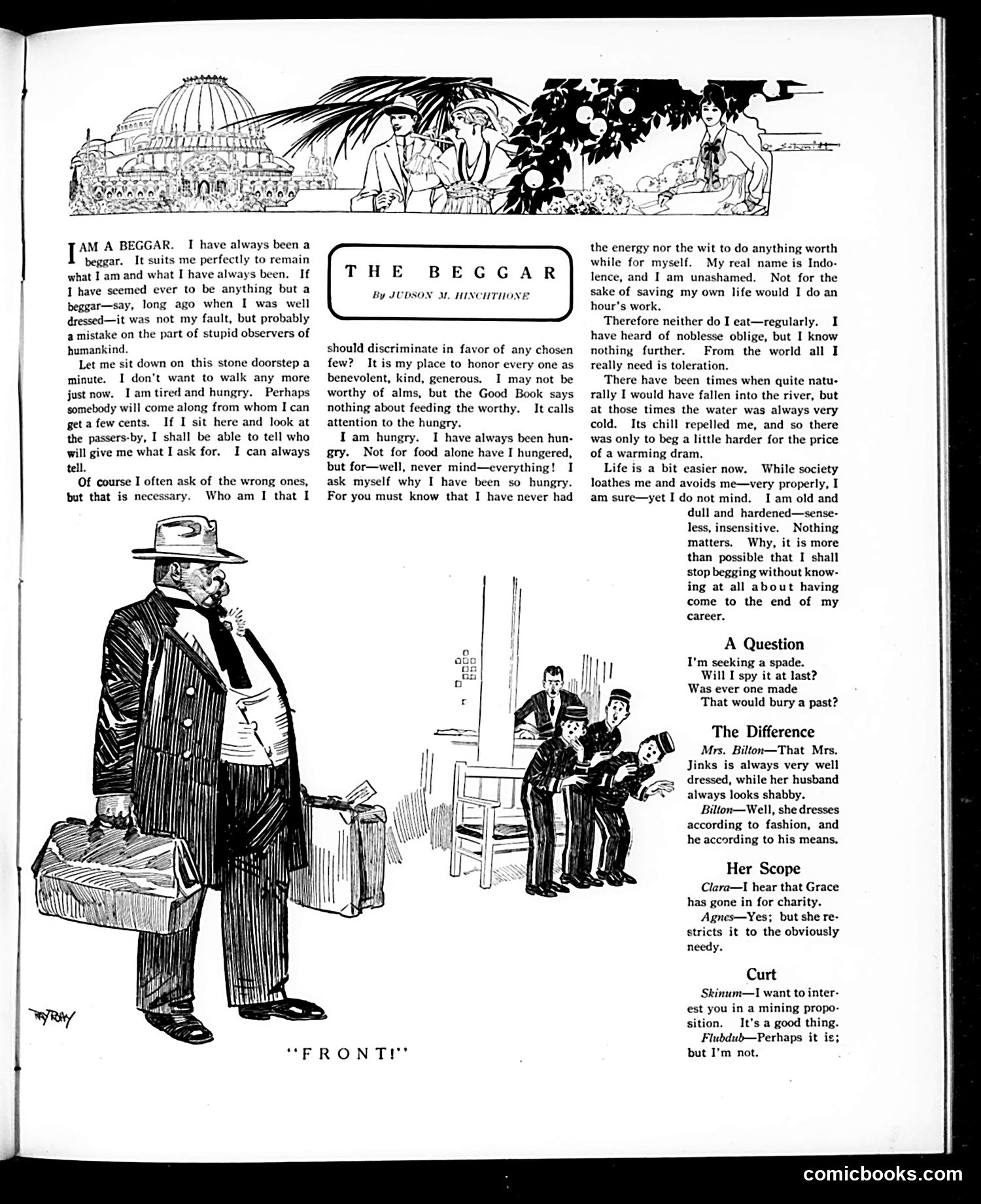
This page features a satirical short story by Judson M. Hinchthone about a beggar named "Indolence" who unapologetically refuses to work. The accompanying illustration shows a shabby, well-dressed vagrant. The satire targets **late 19th/early 20th-century attitudes toward poverty and labor**. The beggar's monologue ironically presents laziness as a philosophy—he claims begging suits him perfectly and refuses to exert effort, yet expects sympathy. The joke is that he personifies idleness itself and admits he lacks "energy nor the wit" for productive work. The accompanying short jokes ("A Question," "The Difference," "Her Scope," "Curt") employ typical period humor about class distinctions, spousal finances, and social pretense. The satire likely critiques both **vagrant culture** and **naive charitable impulses**, suggesting some poor people were simply unwilling to work rather than genuinely destitute—a common conservative argument of the era used to justify limiting poor relief.
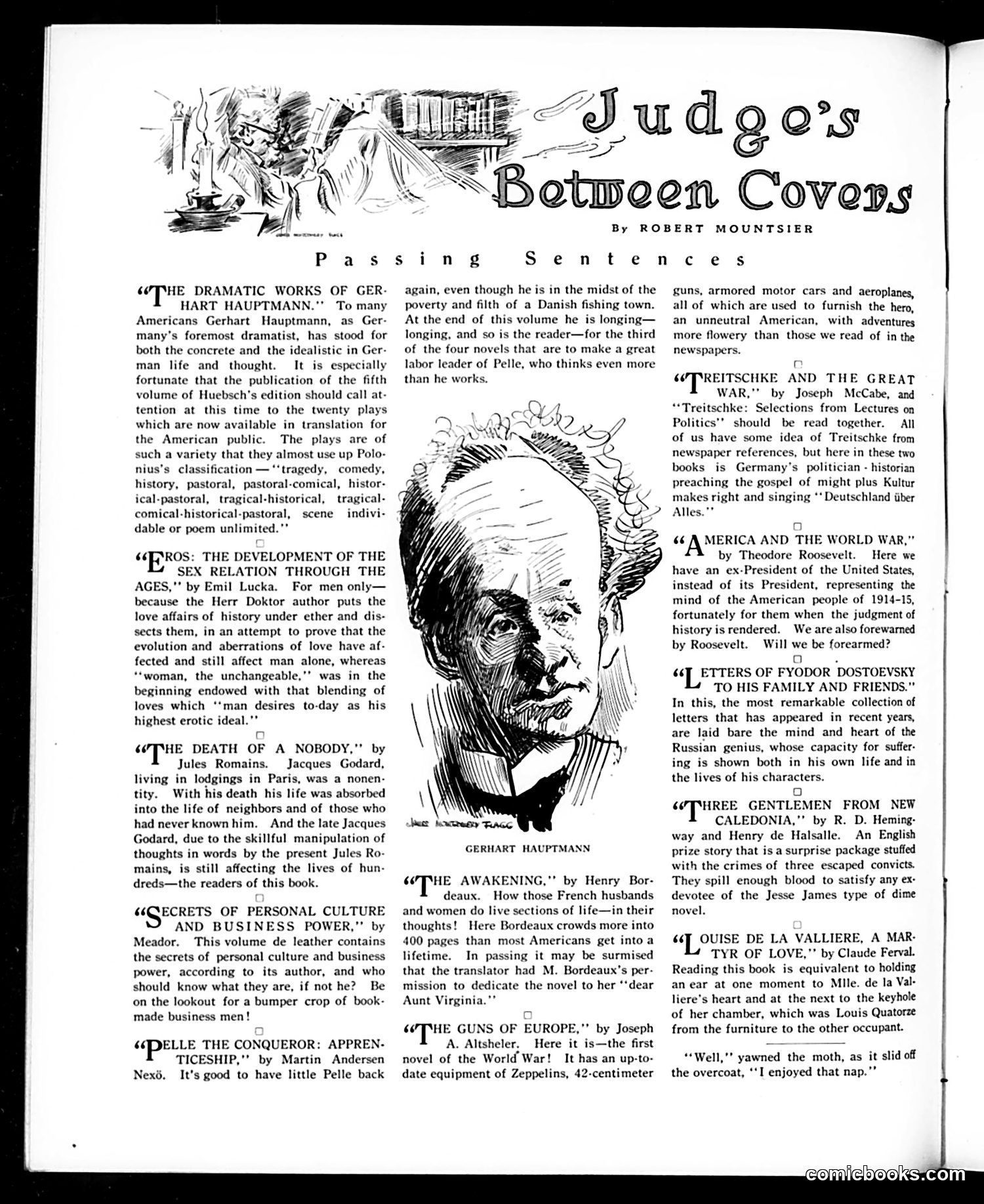
This is a **book review section** titled "Judge's Between Covers," not primarily a political cartoon. The page features a portrait sketch of **Gerhart Hauptmann**, Germany's foremost dramatist, and reviews contemporary literary works. The reviews reveal early WWI-era American intellectual interests and anxieties. Notable entries include: - **"The Guns of Europe"** — described as the first World War novel, featuring modern weapons (Zeppelins, armored cars, aeroplanes) - **Theodore Roosevelt's "America and the World War"** — framed as an ex-President offering the American perspective of 1914-15 - **Works on German philosophy** (Treitschke) — presenting German militarism and the doctrine "might plus Kultur makes right" The reviews suggest American fascination with European intellectualism while simultaneously expressing concern about German imperial ideology and the emerging mechanized warfare. The inclusion of Hauptmann's portrait alongside reviews emphasizing German thought reflects pre-American entry debates about German culture and its implications.
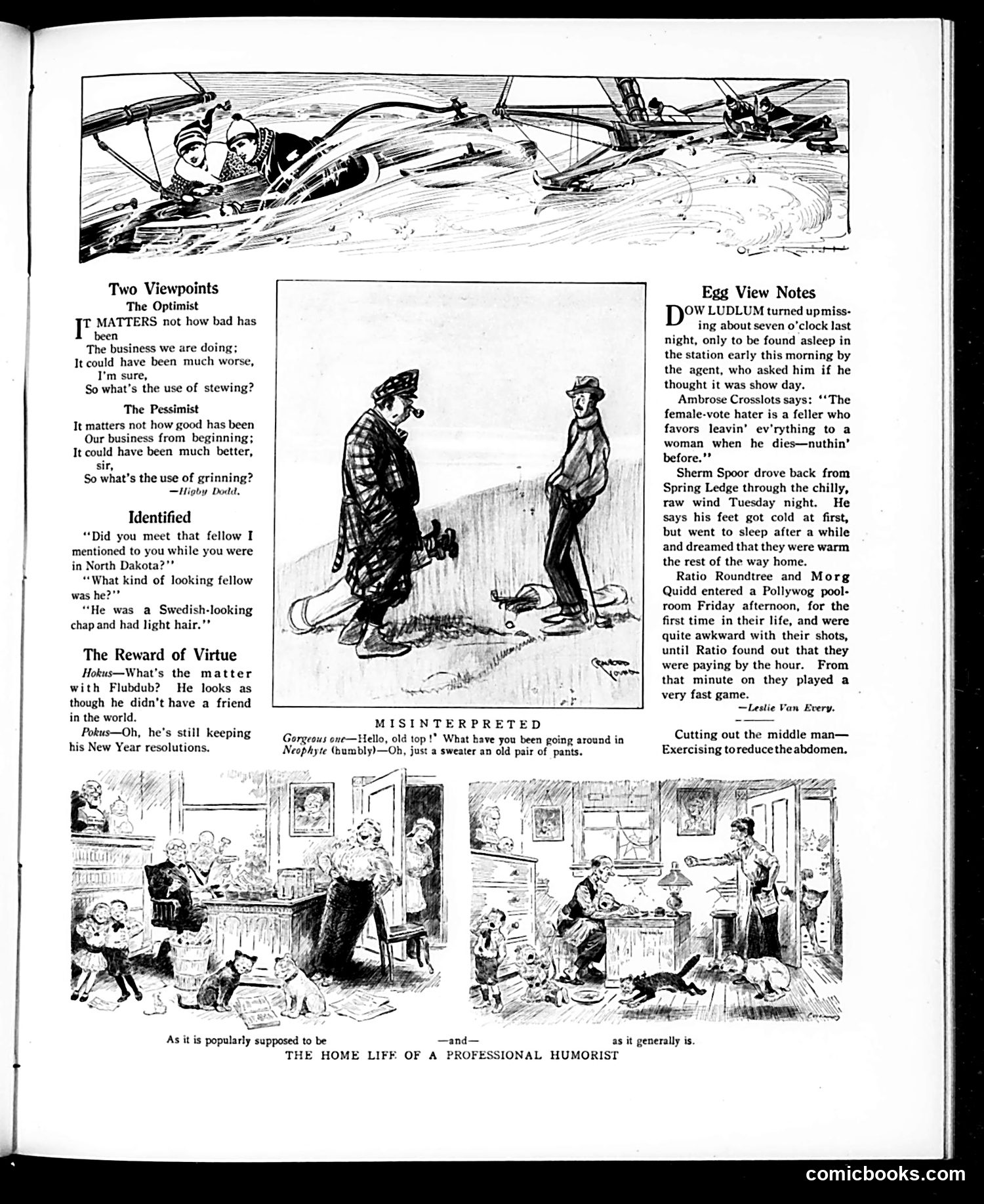
This page from the satirical magazine *Judge* contains several short humorous pieces mocking American life and attitudes around the early 20th century. "Two Viewpoints" presents contrasting philosophies: an optimist and pessimist arguing about business, both reaching opposite conclusions despite identical circumstances—satirizing how perspective distorts judgment. "Egg View Notes" collects anecdotes about rural or small-town characters (Ludlum, Spoor, Ratio Roundtree, Morg Quidd) in comedic situations, poking fun at unsophisticated behavior and naïveté. "The Reward of Virtue" jokes that a man keeping New Year's resolutions has lost all friendships—mocking both resolution-keeping and social isolation. "Misinterpreted" shows miscommunication between social classes, where a wealthy person's casual greeting confuses a lower-class person. The bottom section, "The Home Life of a Professional Humorist," illustrates cartoon chaos contrasting reality against the supposed orderly domestic life of comedy writers—satirizing the disconnect between professionals' public personas and actual chaotic home lives.
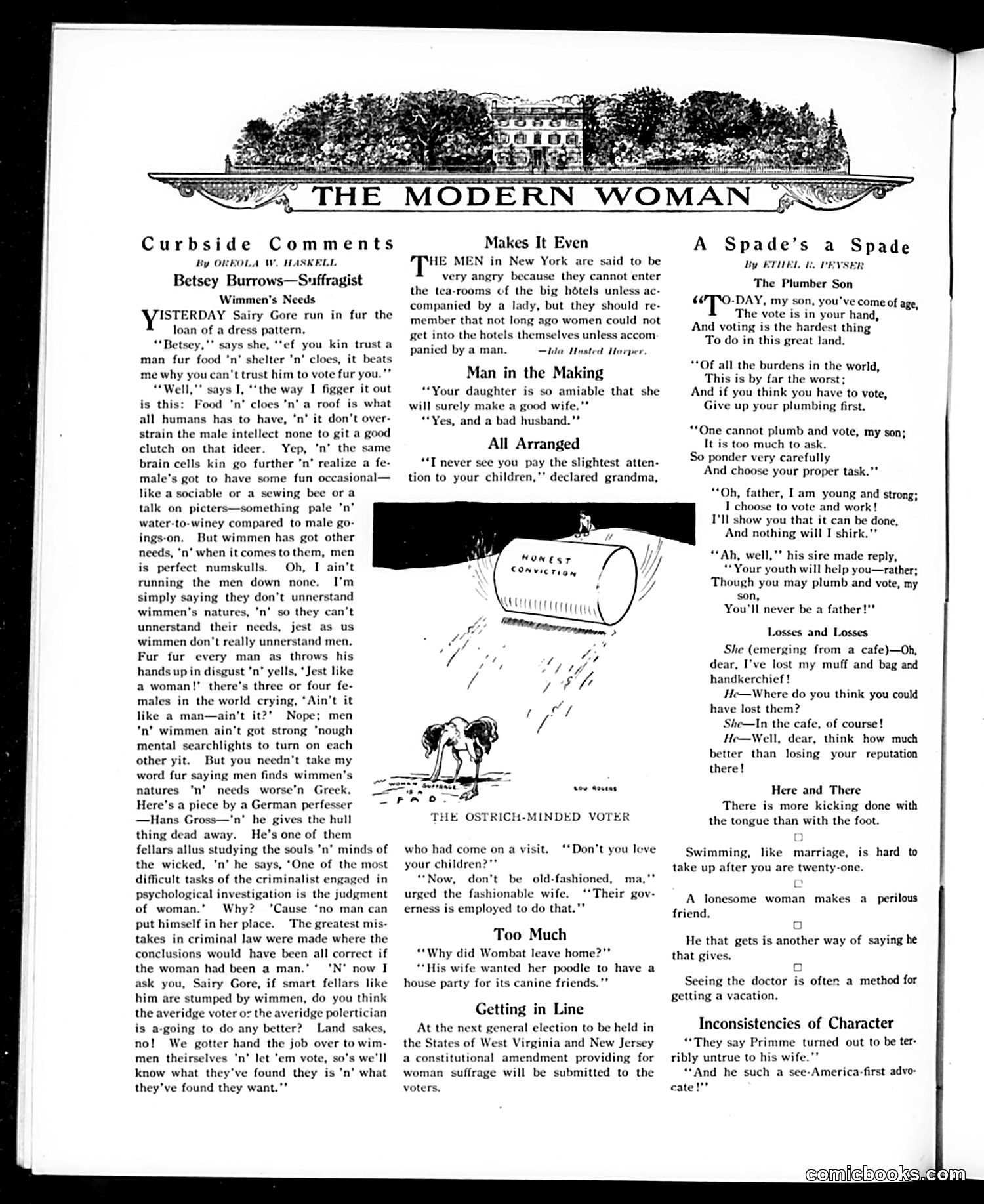
This *Judge* magazine page satirizes women's suffrage debates circa 1910s-1920s through multiple pieces: **Main cartoon** ("The Ostrich-Minded Voter"): Depicts a woman burying her head like an ostrich while holding a "Honest Convention" document—mocking anti-suffrage arguments that women were too naive or uninformed to vote intelligently. **Curbside Comments** (by Haskell): A rural character argues men can't understand women's needs well enough to decide what's best for them—therefore women should vote for themselves. The piece sarcastically cites a German criminologist claiming men cannot psychologically understand women, so why should politicians? **"A Spade's a Spade"** (by Peyser): A father warns his son that voting is harder than plumbing—satirizing the absurdity of excluding women from voting while trusting them with other serious responsibilities. The page advocates *for* women's suffrage by mocking anti-suffrage logic, using humor to argue women deserve political voice and self-determination.
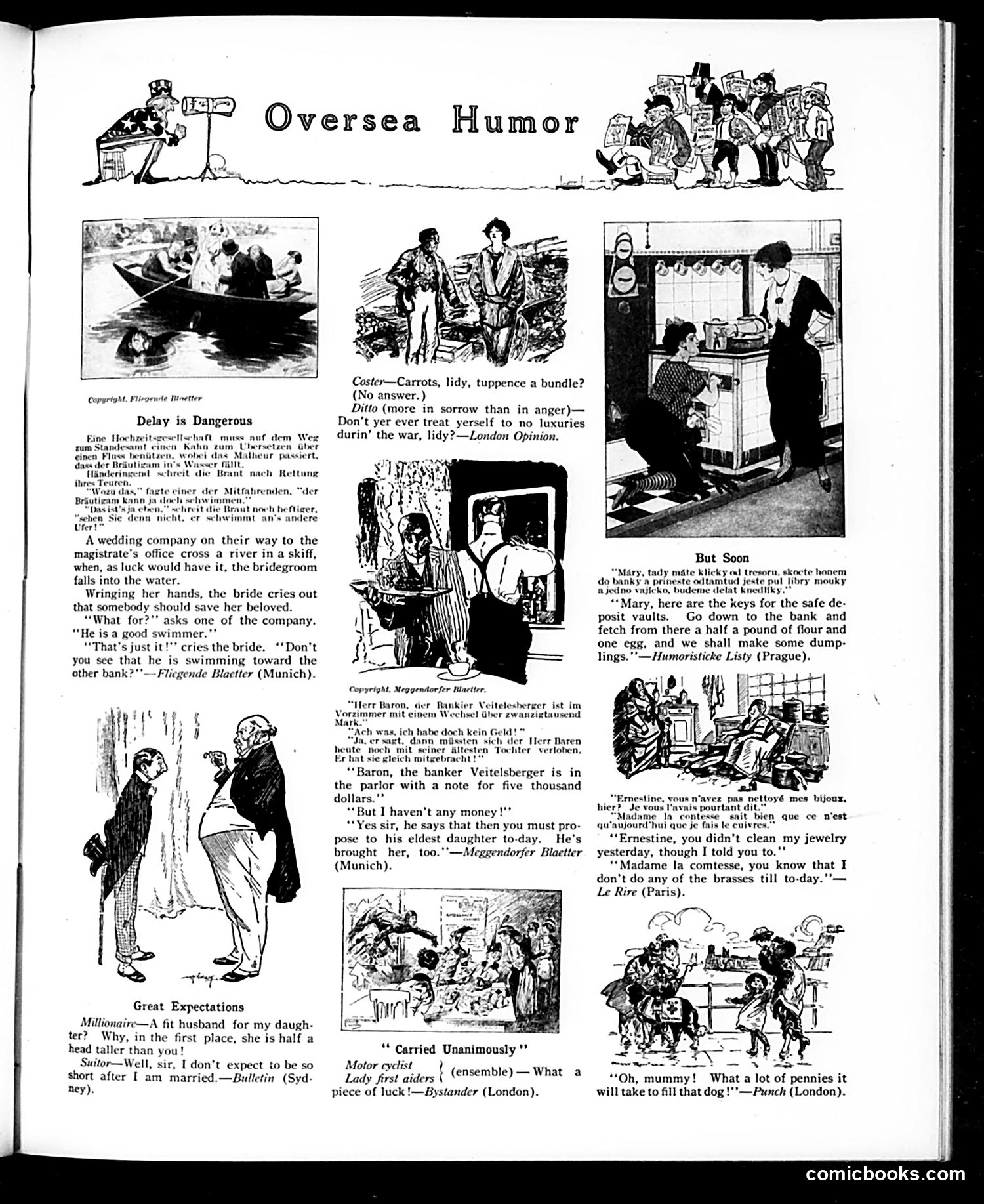
This page collects humorous anecdotes from European and British satirical magazines, reflecting early 20th-century social attitudes during wartime (likely WWI era, given references to wartime privations). The jokes mock various social classes and gender dynamics: - **"Delay is Dangerous"**: A bride's illogical panic when her groom falls overboard—the humor lies in her contradictory concern despite his swimming ability. - **"Great Expectations"**: A wealthy father's height-based objection to a suitor, with the suitor assuming marriage will diminish him physically—satirizing class-conscious materialism. - **"Carried Unanimously"**: A motorist and lady escape danger; the joke's full meaning is unclear from the fragmented OCR text. - **Servant narratives** ("But Soon," "Ernestine"): Maids caught prioritizing household tasks over luxury items, reflecting wartime austerity and servant-class humor about their work priorities. The page demonstrates how international humor magazines shared similar comedic tropes about marriage, class, and domestic life across cultures.
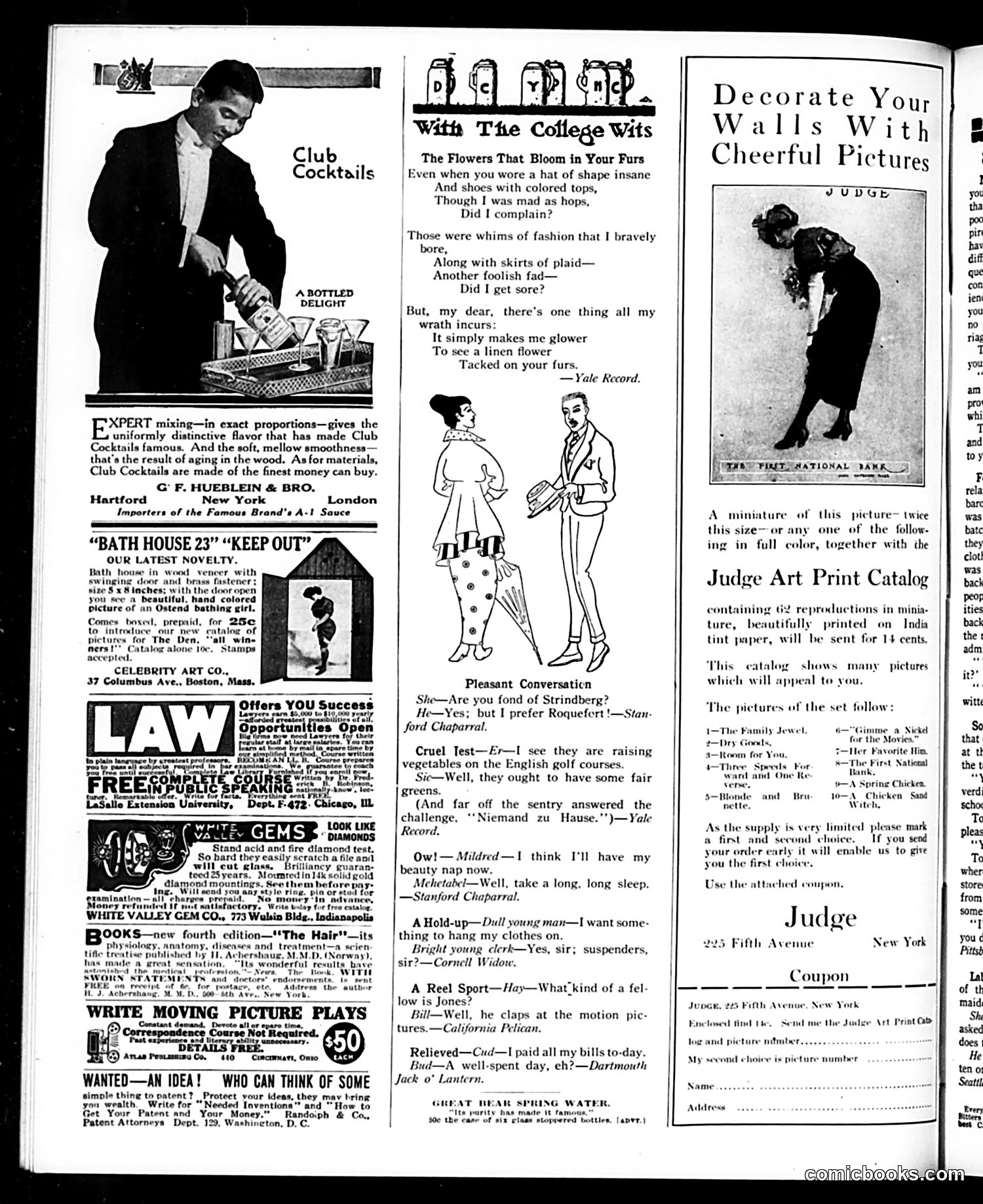
This page is primarily **advertising and humor pieces**, not political satire. The content includes: **Main Advertisements:** - Club Cocktails (liquor brand) - Bath House novelty item (wood veneer box with hidden bathing girl picture) - Diamond gems, law school courses, books, and patent attorney services **Humor Section ("With The College Wits"):** A collection of brief jokes reprinted from college newspapers (Yale Record, Stanford Chaparral, Cornell Widow, etc.). These are light social humor about dating and relationships—particularly a complaint about fake linen flowers on fur coats being worse than past fashion absurdities. **Picture Catalog:** Judge Art Print Catalog advertising reproductions of prints available to readers. **Historical Context:** This appears to be from the 1910s-1920s based on fashion references and advertising styles. The page reflects Judge's evolution from political satire toward general humor and commercial content. There is no identifiable political cartoon or caricature of specific figures on this page.
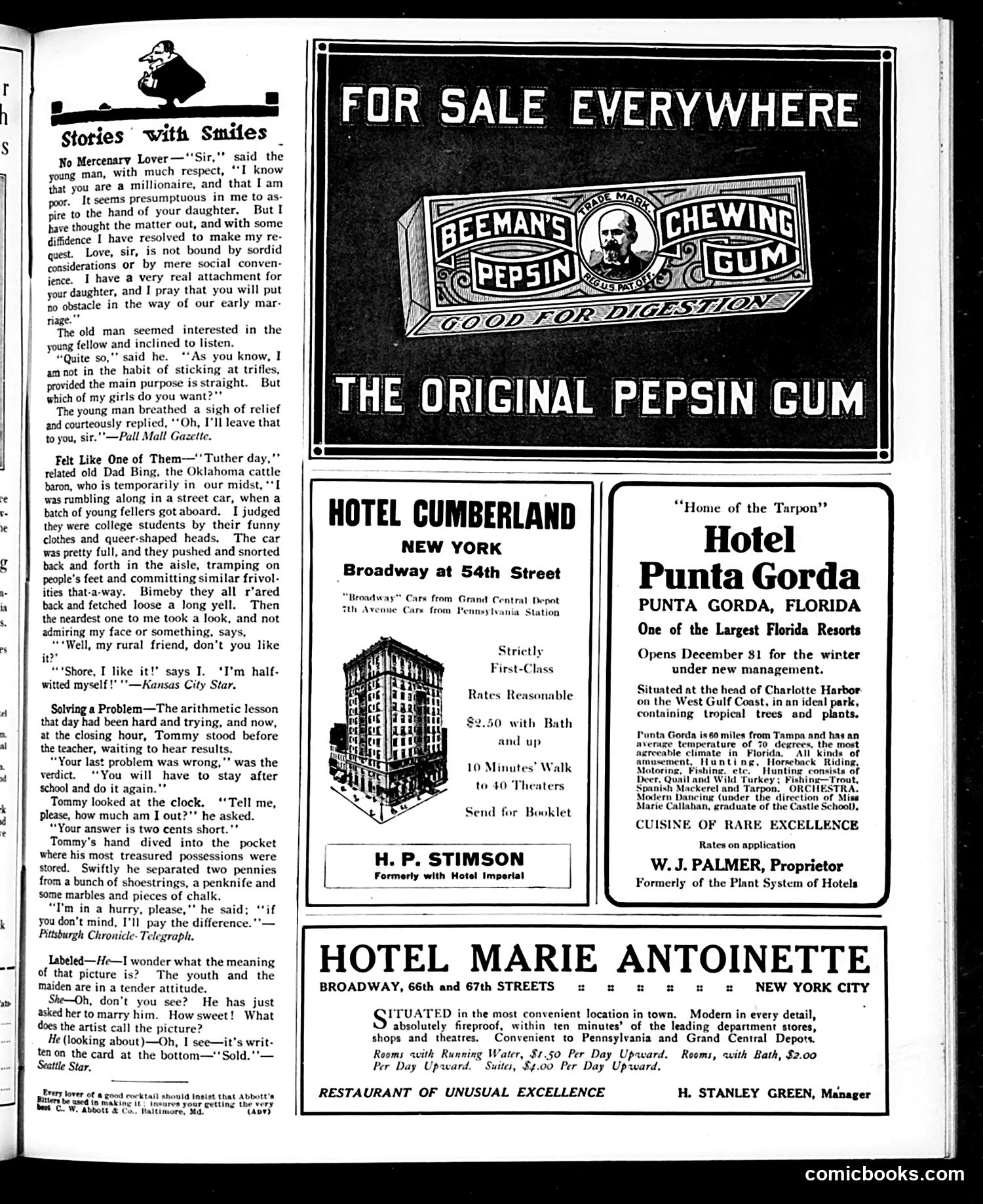
This page from Judge magazine consists primarily of **paid advertisements** rather than satirical editorial cartoons. The main content includes hotel ads (Hotel Cumberland in New York, Hotel Marie in New York, and Hotel Punta Gorda in Florida) and a Beeman's Pepsin Chewing Gum advertisement. The only actual humor content appears in the left column under "Stories with Smiles"—brief anecdotes without political significance. These gentle jokes concern courtship between a poor man and millionaire's daughter, college students' rowdy behavior on a streetcar, a schoolboy settling a math debt with pennies, and an ironic comment about an engagement portrait labeled "Sold." No political satire or caricature appears on this page. It represents a typical mixed editorial-commercial page from an early 20th-century magazine.
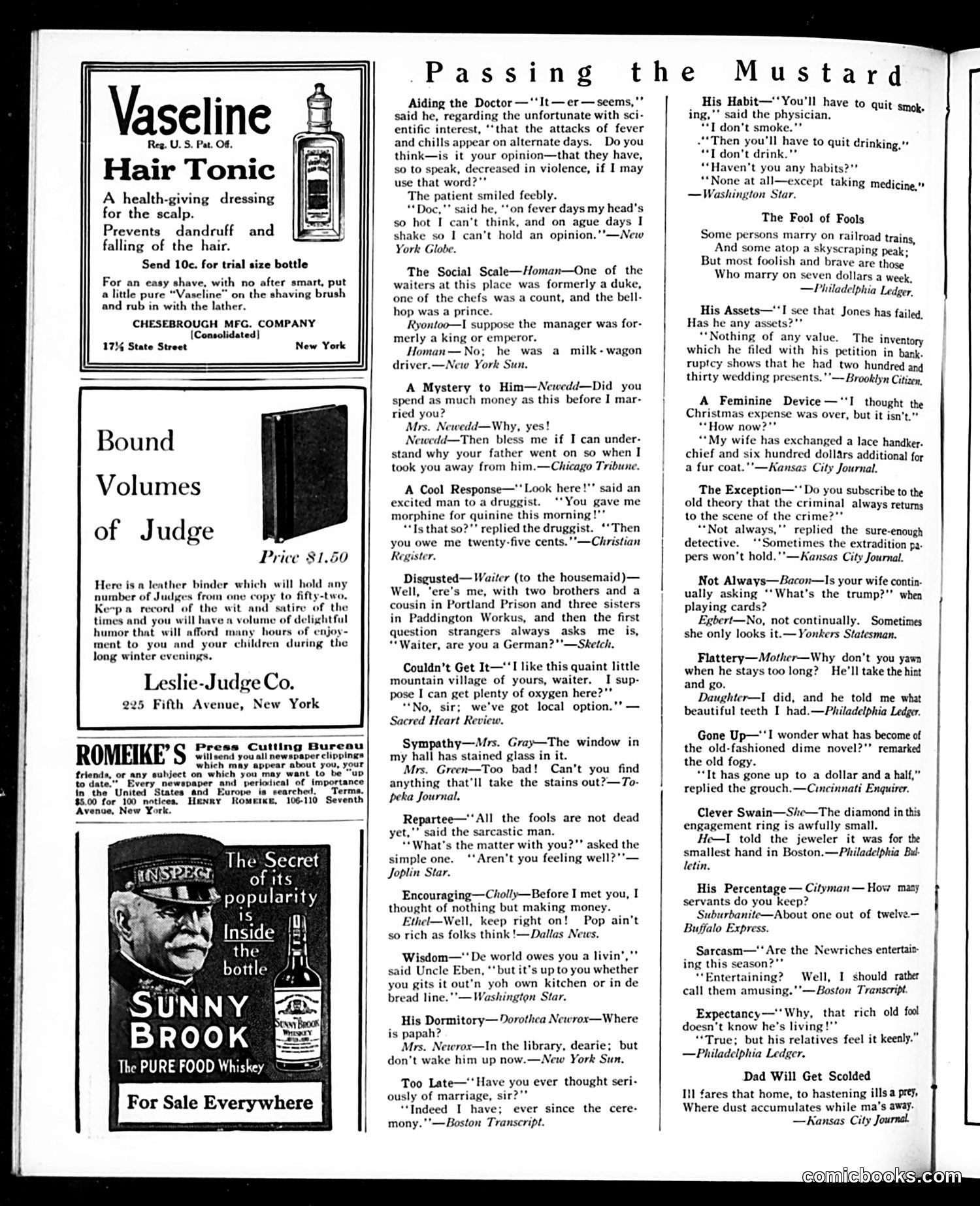
This page is primarily **advertising and humor shorts** rather than political cartoons. The content consists of: **Advertisements** for period products (Vaseline Hair Tonic, bound Judge volumes, Sunny Brook Whiskey, a press-cutting bureau). **Humor shorts**—brief jokes organized under witty titles—that satirize everyday social situations: a doctor's confusion about a fever patient's logic, class pretension (a former duke working as a waiter), marital finances, a waiter's embarrassing criminal family connections, and courtship mishaps. **Social commentary themes** include: immigration anxiety ("Are you German?"), class mobility, gender relations in marriage, and working-class struggles. The humor targets both the upper classes (social climbers, wealthy husbands) and the poor (workhouse residents, street life). These are gentle, domestic satires typical of Judge magazine's early 20th-century audience—middle-class readers finding humor in relatable social awkwardness and financial anxiety rather than hard political critique.
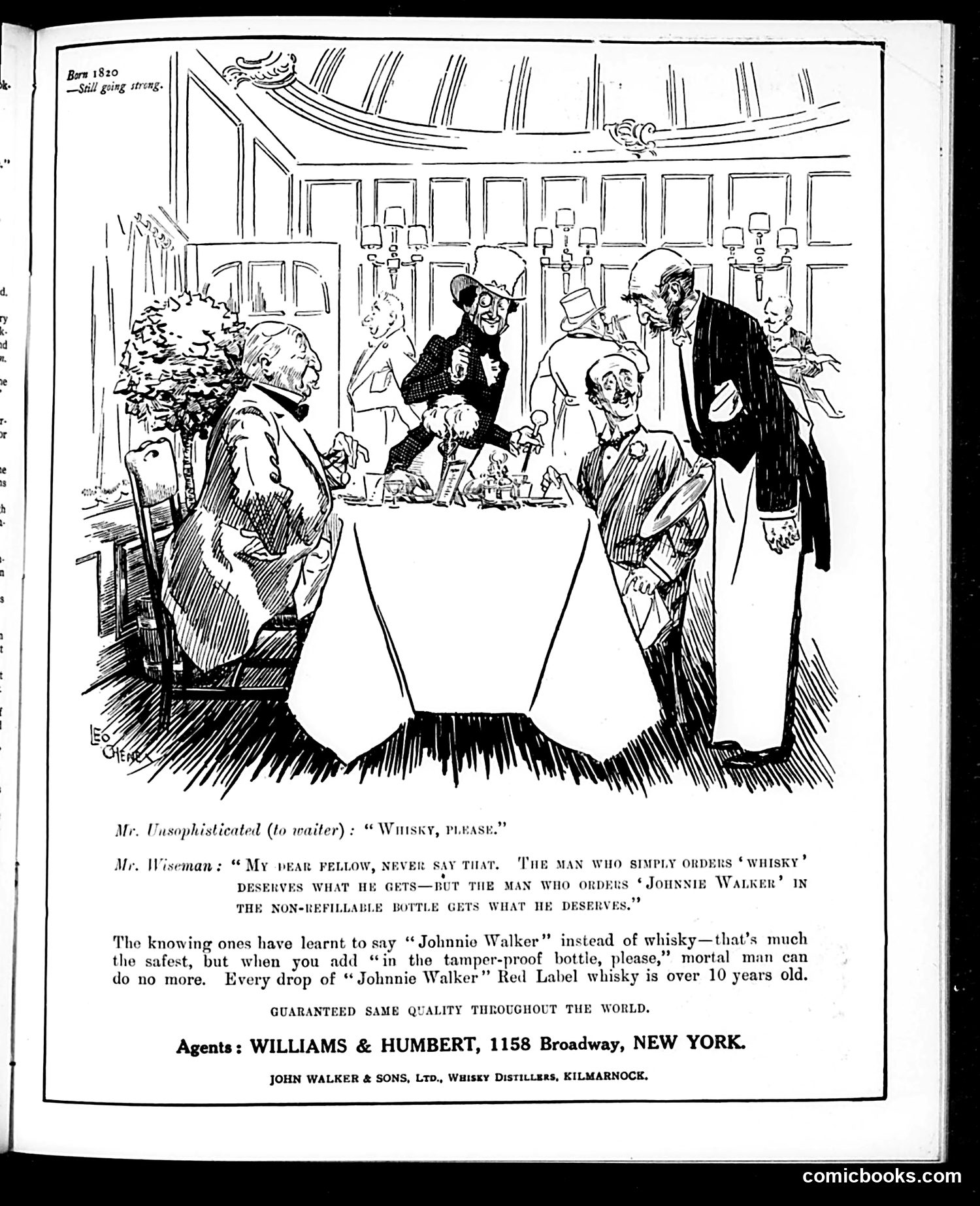
This is primarily a **whisky advertisement** disguised as satirical humor, published in *Judge* magazine around 1820 (the brand's founding date). **The "Joke":** Two diners illustrate class sophistication through drink ordering. An "unsophisticated" man simply orders "whisky" and is mocked by a "wiseman" who explains that only refined gentlemen specify "Johnnie Walker" whisky in a "tamper-proof bottle." **The Satire:** The piece gently ridicules social pretension—the implication that *how* you order matters more than *what* you order. The wiseman suggests that merely saying "whisky" means you deserve whatever inferior product you receive, while those sophisticated enough to demand a specific branded bottle "deserve" quality. **The Advertisement:** This is fundamentally promotional copy presenting Johnnie Walker as the mark of discerning taste. The "guarantee" emphasizes the product's age (10+ years) and consistency. The humor relies on readers recognizing the absurdity of equating brand-consciousness with actual quality or moral worth—while simultaneously encouraging readers to become exactly that sort of brand-conscious consumer.
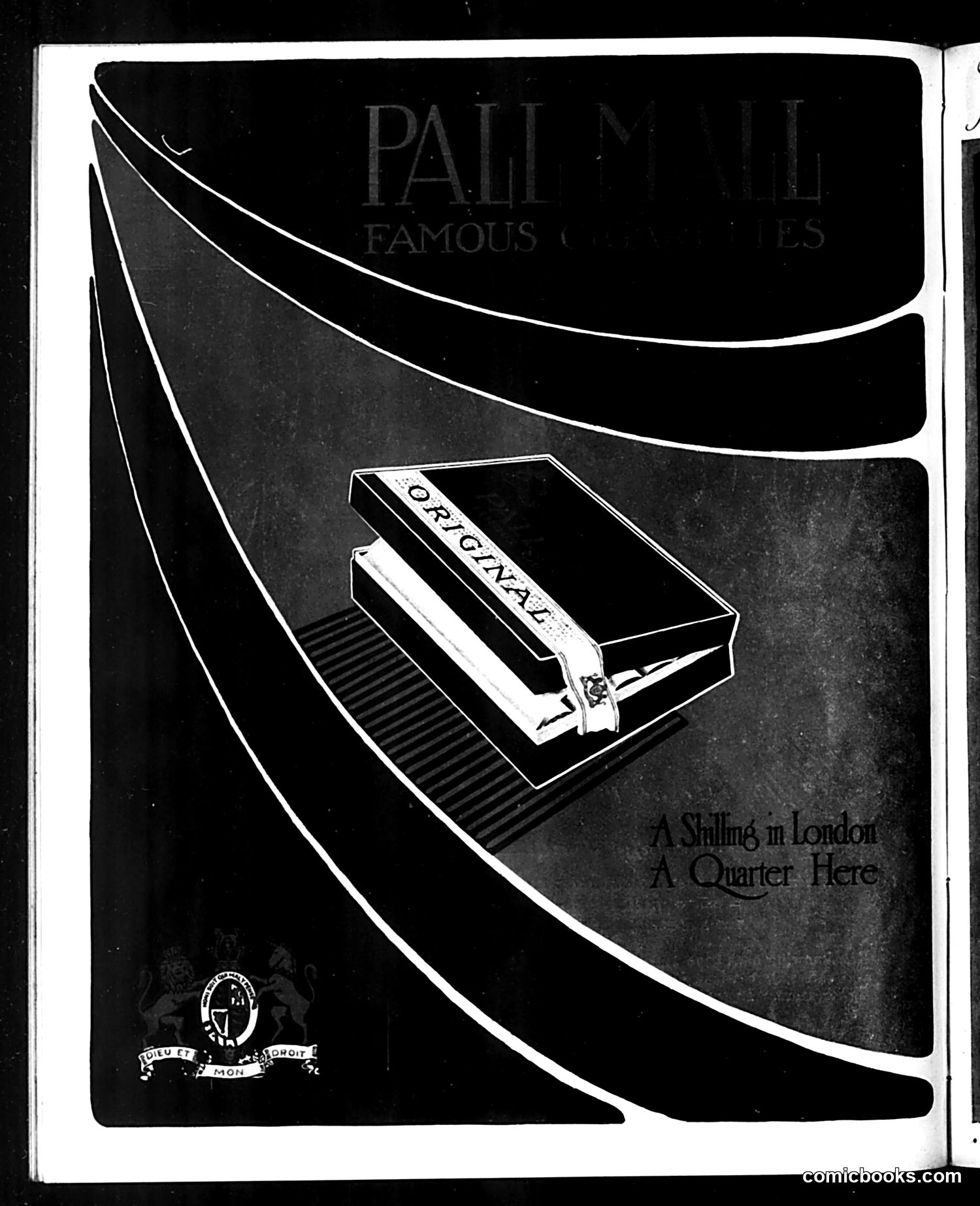
This is primarily an **advertisement page** for "Original" brand (appears to be a product, likely food or consumer goods based on the packaging shown). The main visual is a stylized box of "Original" product displayed against dramatic curved lines in an Art Deco design typical of 1920s advertising. The tagline reads "A Shilling in London / A Quarter Here," suggesting this advertisement is promoting the product's affordability and value—a shilling in Britain versus a quarter (25 cents) in America. This price comparison was a common advertising strategy emphasizing that consumers got quality goods at reasonable cost. The dramatic lighting and modernist design aims to make the mundane product appear luxurious and desirable to readers of *Judge* magazine.