
Judge, 1915-02-20 · page 4 of 24
Judge — February 20, 1915 — page 4: what you’re looking at
What you’re looking at
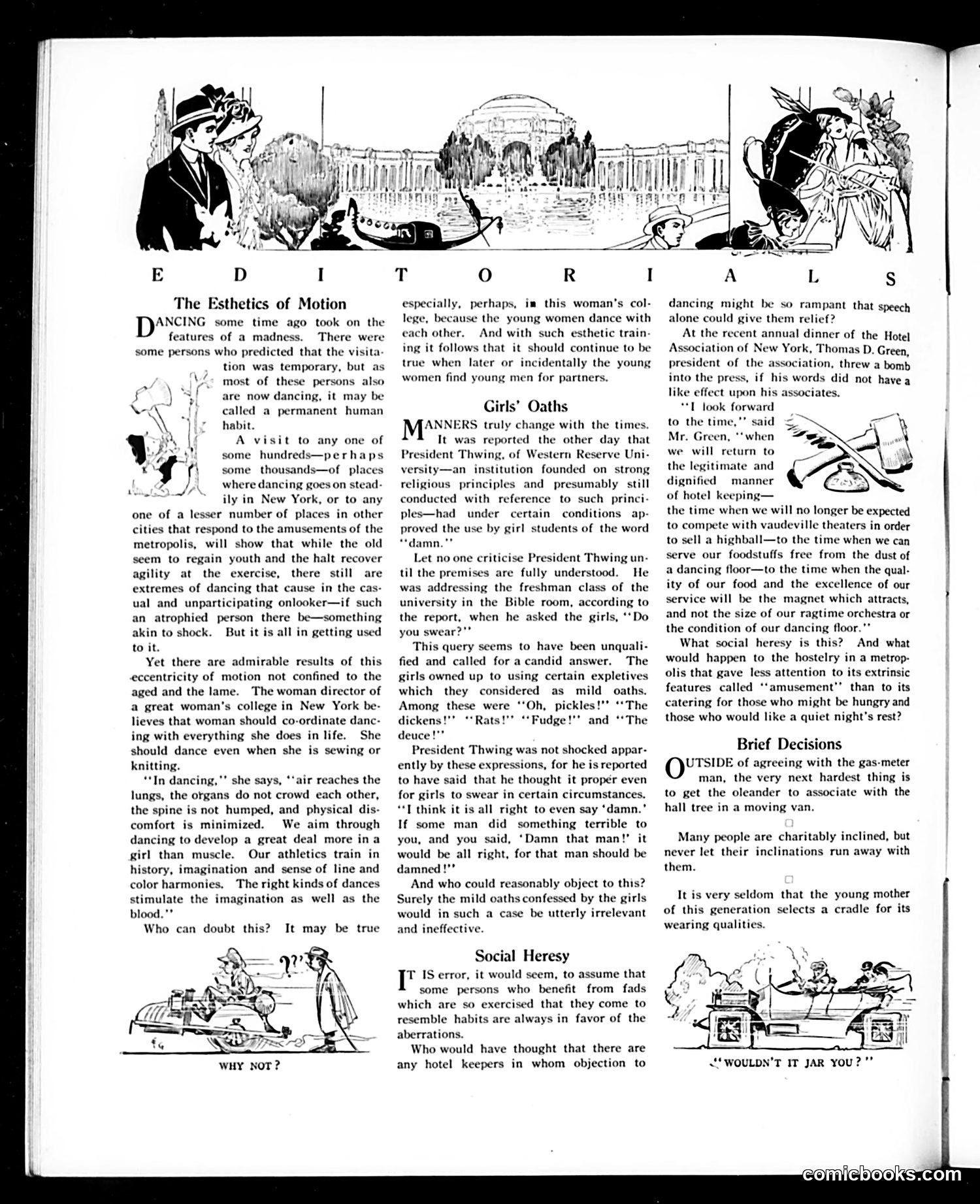
This page satirizes 1920s social attitudes toward dancing and women's behavior. The main article, "The Esthetics of Motion," defends dancing against critics who view it as morally suspect. It references President Thwing of Western Reserve University, who apparently criticized young women's dancing and use of mild profanity ("damn," "pickles"). The satire supports the young women, arguing their dancing is physically and culturally beneficial. The "Girls' Oaths" section mocks concerns about female propriety, suggesting women should be free from restrictive social expectations about language and leisure activities. The smaller cartoons ("Why Not?" and "Wouldn't It Jar You?") offer visual humor about social incongruity—likely contrasting old-fashioned morality with modern behavior. The page reflects Jazz Age debates over changing gender roles and youth culture.
📄 Transcribed text from this page (OCR, searchable)
Machine-transcribed from the original scan — historical spelling and the odd misread are preserved.
E The Esthetics of Motion DANCING some time ago took on the features of a madness. There were some persons who predicted that the visita- tion was temporary, but as most of these persons also are now dancing, it may be called a permanent human habit. A visit to any one of some hundreds—perhay some thousands—of plac: where dancing goes on stead- ily in New York, or to any one of a lesser number of places in other cities that respond to the amusements of the metropolis, will show that while the old seem to regain youth and the halt recover agility at the exercise, there still are extremes of dancing that cause in the cas- such an atrophied person there be—something akin to shock. But it is all in getting used to it. Yet there are admirable results of this eccentricity of motion not confined to the aged and the lame. The woman director of a great woman's college in New York be- lieves that woman should co-ordinate danc- ing with everything she does in life. She should dance even when she is sewing or knitting. ‘In dancing,” she says, ‘‘air reaches the lungs, the organs do not crowd each other, the spine is not humped, and physical di comfort is minimized. We aim through dancing to develop a great deal more ina girl than muscle. Our athletics train in history, imagination and sense of line and color harmonies, The right kinds of dances stimulate the imagination as well as the blood."* Who can doubt this? It may be true WHY NOT? perhaps, im this woman's col- lege, b use the young women dance with ach other. And with such esthetic train- ing it follows that it should continue to be true when later or incidentally the young women find young men for partners. Girls’ Oaths espec Manne S truly change with the times. It was reported the other day that sident Thwing, of Western Reserve Uni- ity—an institution founded on strong religious principles and presumably. still conducted with reference to such princi- ples—had under certain conditions ap- proved the use by girl students of the word “damn."" Let no one criticise President Thwing un- til the premises are fully understood. He was addressing the freshman class of the university in the Bible room, according to the report, when he asked the girls, ‘*Do you swear?"’ This query seems to have been unquali- fied and called for a candid answer. The girls owned up to using certain expletives which they considered as mild oaths. Among these were ‘‘Oh, pickles!" “The dicke: * *Rats!"" ‘*Fudge!"" and ‘*The deuce! President Thwing was not shocked appar- ently by these expressions, for he is reported to have said that he thought it proper even for girls to swear in certain circumstances, “LT think it is all right to even say ‘damn.’ If some man did something terrible to you, and you said, ‘Damn that man!" it would be all right, for that man should be damned !"" And who could reasonably object to this: Surely the mild oaths confessed by the girls would in such a case be utterly irrelevant and ineffective. Social Heresy cr IS error, it would seem, to assume that some persons who benefit from fads which are so exercised that they come to resemble habits are always in favor of the aberrations. Who would have thought that there are any hotel keepers in whom objection to dancing might be so rampant that speech alone could give them relief? At the recent annual dinner of the Hotel Association of New York, Thomas D. Green, president of the association, threw a bomb into the press, if his words did not have a like effect upon his i “TL look forward to the time,"’ said Mr. Green, ‘when we will return to the legitimate and dignified manner of hotel keeping— the time when we will no longer be expected to compete with vaudeville theaters in order to sell a highball—to the time when we can serve our foodstuffs free from the dust of a dancing floor—to the time when the qual- ity of our food and the excellence of our service will be the magnet which attracts, and not the size of our ragtime orchestra or the condition of our dancing floor.’* What social heresy this And what would happen to the hostelry in a metrop- olis that gave less attention to its extrinsic features called ‘‘amusement’’ than to its catering for those who might be hungry and those who would like a quiet night's rest? Brief Decisions UTSIDE of agreeing with the gas-meter man, the very next hardest thing is to get the oleander to associate with the hall tree in a moving van. Many people are charitably inclined, but never let their inclinations run away with them. It is very seldom that the young mother of this generation selects a cradle for its wearing qualities. {WOULDN'T IT JAR YOU?"’