
Judge, 1915-02-20 · page 15 of 24
Judge — February 20, 1915 — page 15: what you’re looking at
What you’re looking at
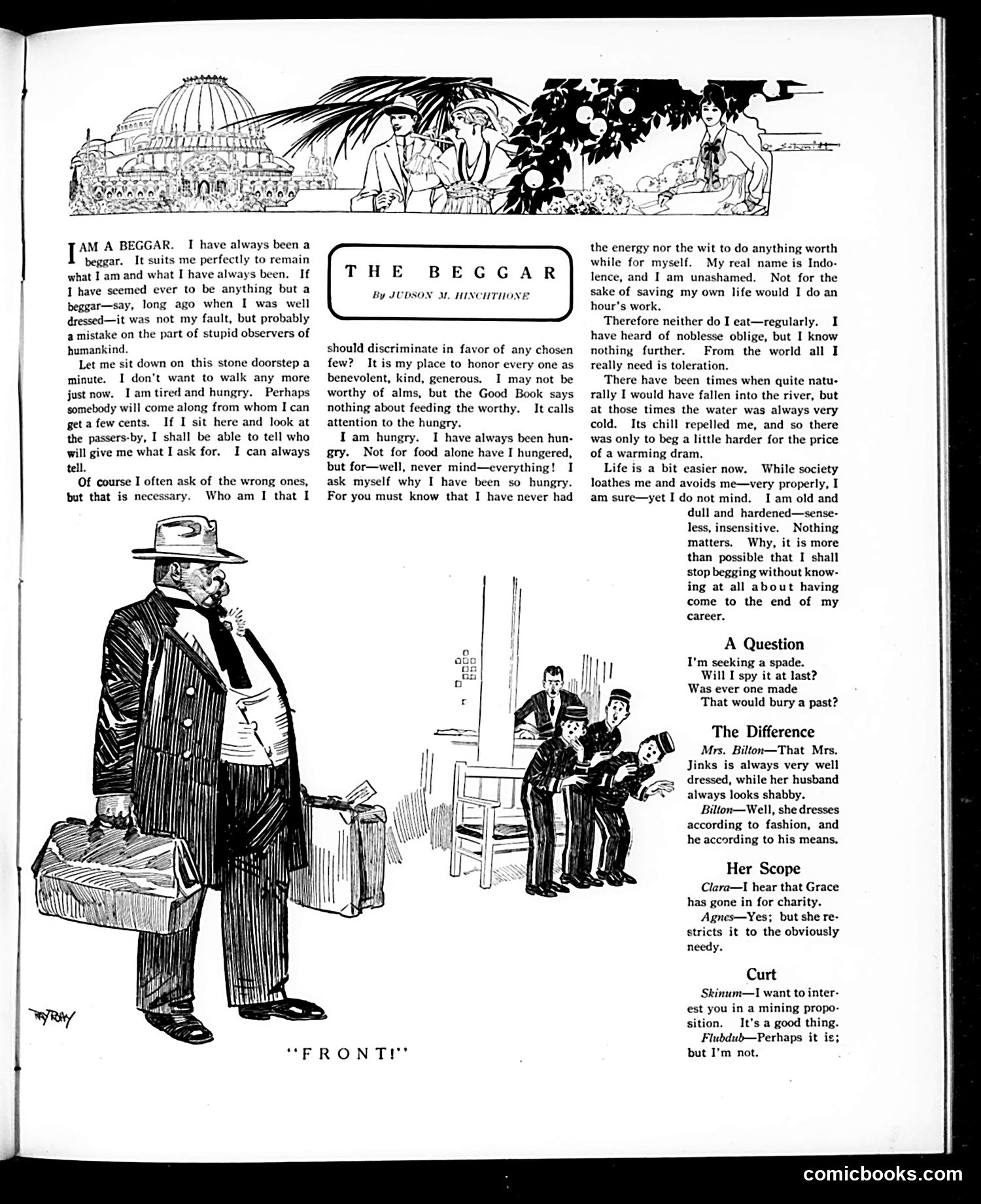
This page features a satirical short story by Judson M. Hinchthone about a beggar named "Indolence" who unapologetically refuses to work. The accompanying illustration shows a shabby, well-dressed vagrant. The satire targets **late 19th/early 20th-century attitudes toward poverty and labor**. The beggar's monologue ironically presents laziness as a philosophy—he claims begging suits him perfectly and refuses to exert effort, yet expects sympathy. The joke is that he personifies idleness itself and admits he lacks "energy nor the wit" for productive work. The accompanying short jokes ("A Question," "The Difference," "Her Scope," "Curt") employ typical period humor about class distinctions, spousal finances, and social pretense. The satire likely critiques both **vagrant culture** and **naive charitable impulses**, suggesting some poor people were simply unwilling to work rather than genuinely destitute—a common conservative argument of the era used to justify limiting poor relief.
📄 Transcribed text from this page (OCR, searchable)
Machine-transcribed from the original scan — historical spelling and the odd misread are preserved.
AM A BEGGAR. I have always been a I beggar. It suits me perfectly to remain what I am and what I have always been. If I have seemed ever to be anything but a beggar—say, long ago when I was well dressed—it was not my fault, but probably a mistake on the part of stupid observers of humankind. Let me sit down on this stone doorstep a minute. I don’t want to walk any more just now. I am tired and hungry. Perhaps somebody will come along from whom I can get a few cents. If I sit here and look at the passers-by, I shall be able to tell who will give me what I ask for. I can always tell. Of course I often ask of the wrong ones, but that is necessary. Who am I that I NN THE BEGGAR By JUDSON M, HINCHTHONE should discriminate in favor of any chosen few? It is my place to honor every one as benevolent, kind, generous. I may not be worthy of alms, but the Good Book says nothing about feeding the worthy. It calls attention to the hungry. Iam hungry. I have always been hun- gry. Not for food alone have I hungered, but for—well, never mind—everything! I ask myself why I have been so hungry. For you must know that I have never had “FRONT!” the energy nor the wit to do anything worth while for myself. My real name is Indo- lence, and I am unashamed. Not for the sake of saving my own life would I do an hour’s work. Therefore neither do I eat—regularly. I have heard of noblesse oblige, but I know nothing further. From the world all I really need is toleration. There have been times when quite natu- rally I would have fallen into the river, but at those times the water was always very cold. Its chill repelled me, and so there was only to beg a little harder for the price of a warming dram. Life is a bit easier now. While society loathes me and avoids me—very properly, I am sure—yet I do not mind. I am old and dull and hardened—sense- less, insensitive. Nothing matters. Why, it is more than possible that I shall stop begging without know- ing at all about having come to the end of my career. A Question I'm seeking a spade. Will I spy it at last? Was ever one made That would bury a past? The Difference Mrs. Bilton—That Mrs. Jinks is always very well dressed, while her husband always looks shabby. Bilton—Well, she dresses according to fashion, and he according to his means, Her Scope Clara—I hear that Grace has gone in for charity. Agnes—Yes; but she re- stricts it to the obviously needy. Curt Skinum—I want to inter- est you in a mining propo- sition. It’s a good thing. Flubdub—Perhaps it is; but I'm not. comicbooks.com