
Judge, 1915-02-20 · page 11 of 24
Judge — February 20, 1915 — page 11: what you’re looking at
What you’re looking at
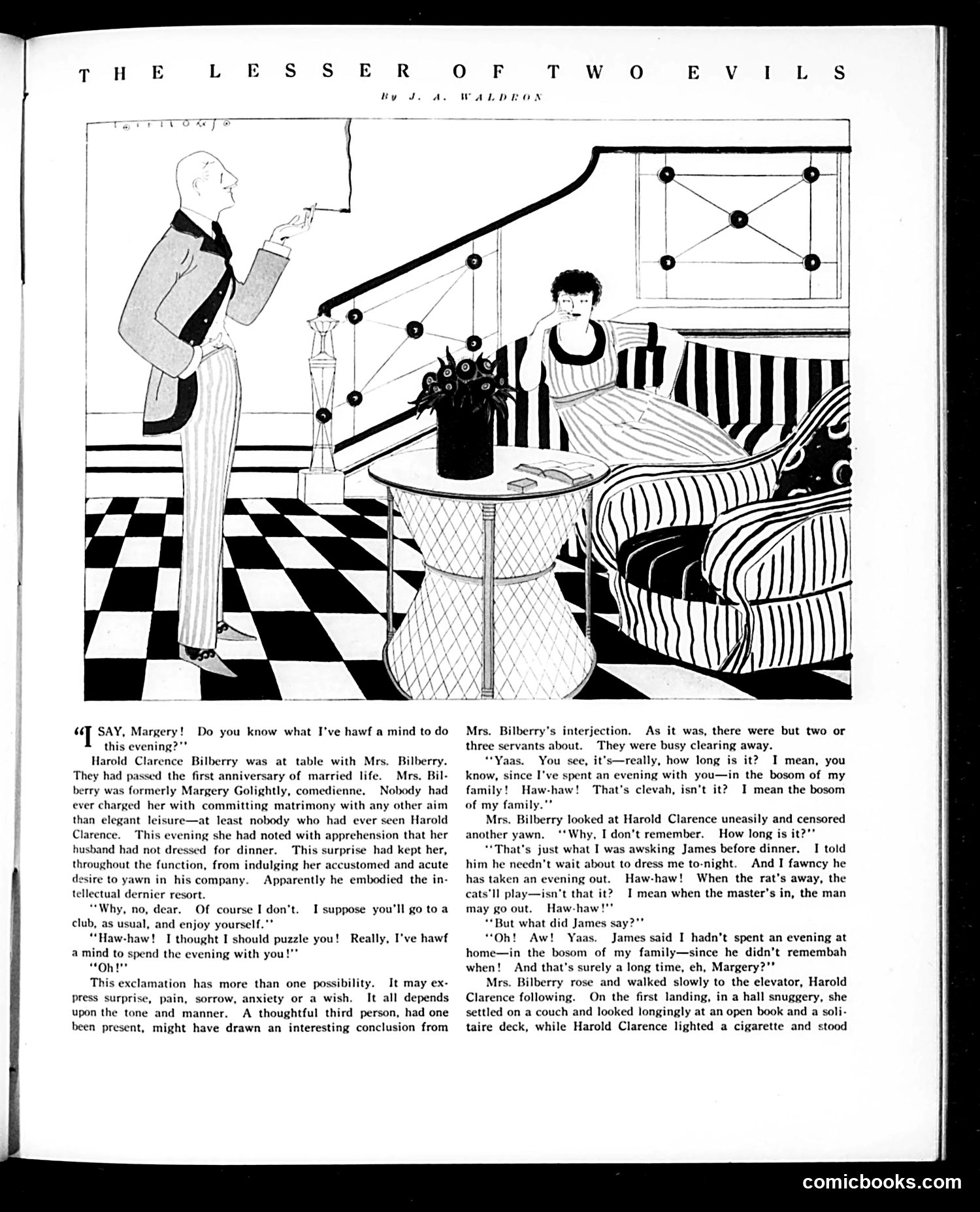
This is a satirical story illustrated in the style of early 1900s Judge magazine, titled "The Lesser of Two Evils" by J.A. Waldron. The satire targets a newly married husband, Harold Clarence Bilberry, whose idea of "spending the evening" with his wife Margery (a former comedienne) involves endless, tedious chatter and forced jovality rather than genuine companionship. His affected laugh ("Haw-haw"), pretentious wordplay, and self-absorbed monologues reveal his obliviousness to her obvious boredom—she repeatedly "censored another yawn." The joke's bitter edge: Margery, who married for "elegant leisure," finds married life with this buffoon so unbearable that she *prefers* being alone with a book and solitaire cards to his company. The title suggests marriage itself is the "lesser of two evils" compared to spinsterhood. The satire mocks both pretentious husbands and the disappointing reality of marriage for women of that era.
📄 Transcribed text from this page (OCR, searchable)
Machine-transcribed from the original scan — historical spelling and the odd misread are preserved.
L ES S E R Wy JooaA. O F WALDRON T 667 SAY, Margery! this evening?"’ Harold Clarence Bilberry was at table with Mrs. Bilberry. They had passed the first anniversary of married life. Mrs. Bil- berry was formerly Margery Golightly, comedienne. Nobody had charged her with committing matrimony with any other aim than elegant leisure—at least nobody who had ever seen Harold Clarence. This evening she had noted with apprehension that her husband had not dressed for dinner. This surprise had kept her, throughout the function, from indulging her accustomed and acute desire to yawn in his company. Apparently he embodied the in- tellectual dernier resort. “Why, no, dear. Of course I don’t. club, as usual, and enjoy yourself."* “Haw-haw! I thought I should puzzle you! a mind to spend the evening with you!"’ “On? This exclam: Press surprise Do you know what I've hawf a mind to do I suppose you'll go to a Really, I've hawf ion has more than one possibility. It may ex- pain, sorrow, anxiety or a wish. It all depends upon the tone and manner. A thoughtful third person, had one been present, might have drawn an interesting conclusion from Mrs. Bilberry’s interjection. As it was, there were but two or three servants about. They were busy clearing away. s. You see, it's—really, how long is it? I mean, you know, since I've spent an evening with you—in the bosom of my family! Haw-haw! That's clevah, isn’t it? I mean the bosom of my family."* Mrs. Bilberry looked at Harold Clarence uneasily and censored another yawn. ‘*Why, I don’t remember. How long is it?"" “That's just what I was awsking James before dinner. I told him he needn't wait about to dress me to-night. And I fawncy he has taken an evening out. Haw-haw! When the rat's away, the cats’ll play—isn’t that it? I mean when the master’s in, the man may go out. Haw-haw!"* But what did James say “Oh! Aw! Y: James said I hadn’t spent an evening at home—in the bosom of my family—since he didn’t remembah when! And that’s surely a long time, eh, Margery?” Mrs. Bilberry rose and walked slowly to the elevator, Harold Clarence following. On the first landing, in a hall snuggery, she settled on a couch and looked longingly at an open book and a soli- taire deck, while Harold Clarence lighted a cigarette and stood comicbooks.com