
Judge, 1915-02-20 · page 16 of 24
Judge — February 20, 1915 — page 16: what you’re looking at
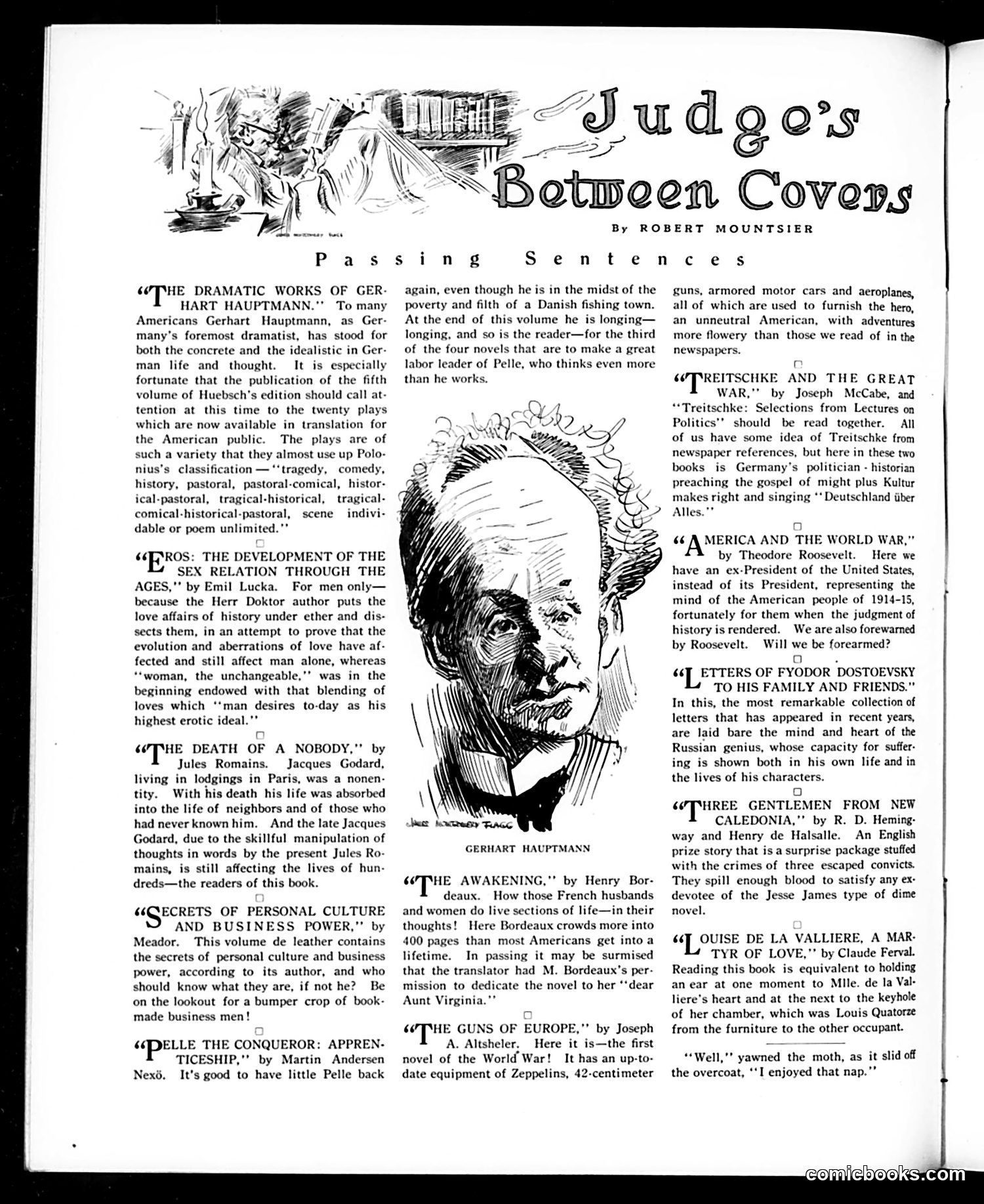
What you’re looking at
This is a **book review section** titled "Judge's Between Covers," not primarily a political cartoon. The page features a portrait sketch of **Gerhart Hauptmann**, Germany's foremost dramatist, and reviews contemporary literary works. The reviews reveal early WWI-era American intellectual interests and anxieties. Notable entries include: - **"The Guns of Europe"** — described as the first World War novel, featuring modern weapons (Zeppelins, armored cars, aeroplanes) - **Theodore Roosevelt's "America and the World War"** — framed as an ex-President offering the American perspective of 1914-15 - **Works on German philosophy** (Treitschke) — presenting German militarism and the doctrine "might plus Kultur makes right" The reviews suggest American fascination with European intellectualism while simultaneously expressing concern about German imperial ideology and the emerging mechanized warfare. The inclusion of Hauptmann's portrait alongside reviews emphasizing German thought reflects pre-American entry debates about German culture and its implications.
📄 Transcribed text from this page (OCR, searchable)
Machine-transcribed from the original scan — historical spelling and the odd misread are preserved.
6@THE DRAMATIC WORKS OF GER- HART HAUPTMANN." To many Americans Gerhart Hauptmann, as Ger- many’s foremost dramatist, has stood for both the concrete and the idealistic in Ger- man life and thought. It is espe fortunate that the publication of the fifth volume of Huebsch’s edition should call at- tention at this time to the twenty plays which are now available in translation for the American public. The plays are of such a variety that they almost use up Polo- ion —‘‘tragedy, comedy, history, pastoral, pastoral-comical, histor- ical-pastoral, tragical-histor tragic comical-historical-pastoral, indivi- dable or poem unlimited."" scene 66—.ROS: THE DEVELOPMENT OF THE SEX RELATION THROUGH THE AGES," by Emil Lucka. For men only— because the Herr Doktor author puts the love affairs of history under ether and dis- sects them, in an attempt to prove that the evolution and aberrations of love have af- fected and still affect man alone, whereas *‘woman, the unchangeable,'’ was in the beginning endowed with that blending of loves which ‘‘man desires to-day as his highest erotic ideal."’ - 6¢@T.HE DEATH OF A NOBODY," by Jules Romains. Jacques Godard, living in lodgings in Paris, was a nonen- tity. With his death his life was absorbed into the life of neighbors and of those who had never known him. And the late Jacques Godard, due to the skillful manipulation of thoughts in words by the present Jules Ro- mains, is still affecting the lives of hun- dreds—the readers of this book. 66QECRETS OF PERSONAL CULTURE AND BUSINESS POWER," by Meador. This volume de leather contains the secrets of personal culture and business power, according to its author, and who should know what they are, if not he? Be on the lookout for a bumper crop of book- made business men! éOPDELLE THE CONQUEROR: APPREN- TICESHIP,"’ by Martin Andersen Nexé. It’s good to have little Pelle back os udgo%s =Botwoen Covons By ROBERT MOUNTSIER ing again, even though he is in the midst of the poverty and filth of a Danish fishing town. At the end of this volume he is longing— longing, and so is the reader—for the third of the four novels that are to make a great labor leader of Pelle, who thinks even more than he works. GERHART HAUPTMANN 60°THE AWAKENING,"’ by Henry Bor- deaux. How those French husbands and women do live sections of life—in their thoughts! Here Bordeaux crowds more into 400 pages than most Americans get into a lifetime. In passing it may be surmised that the translator had M. Bordeaux's per- mission to dedicate the novel to her ‘dear Aunt Virginia." oTHE GUNS OF EUROPE,"’ by Joseph A. Altsheler, Here it is—the first novel of the World War! It has an up-to- date equipment of Zeppelins, 42-centimeter Sentences guns, armored motor cars and aeroplanes, all of which are used to furnish the hero, an unneutral Ameri with adventures more flowery than those we read of in the newspapers. c 6MPREITSCHKE AND THE GREAT WAR," by Joseph McCabe, and “Treitschke: Selections from Lectures on Politics’’ should be read together. All of us have some idea of Treitschke from newspaper references, but here in these two books is Germany's politician - historian preaching the gospel of might plus Kultur makes right and singing ‘‘ Deutschland tiber Alles. 66 A MERICA AND THE WORLD WAR,” by Theodore Roosevelt. Here we have an ex-President of the United States, instead of its President, representing the mind of the American people of 1914-15, fortunately for them when the judgment of history is rendered. We are also forewamed by Roosevelt. Will we be forearmed? o 5 66]. ETTERS OF FYODOR DOSTOEVSKY TO HIS FAMILY AND FRIENDS.” In this, the most remarkable collection of letters that has appeared in recent years, are laid bare the mind and heart of the Russian genius, whose capacity for suffer- ing is shown both in his own life and in the lives of his characters. a [email protected] GENTLEMEN FROM NEW CALEDONIA,”’ by R. D. Heming- way and Henry de Halsalle. An English prize story that is a surprise package stuffed with the crimes of three escaped convicts. They spill enough blood to satisfy any ex- devotee of the Jesse James type of dime novel. 66] OUISE DE LA VALLIERE, A MAR- TYR OF LOVE,"’ by Claude Ferval. Reading this book is equivalent to holding an ear at one moment to Mlle. de la Val- liere’s heart and at the next to the keyhole of her chamber, which was Louis Quatorze from the furniture to the other occupant. “Well,"? yawned the moth, as it slid of the overcoat, ‘'I enjoyed that nap.””