
Judge, 1915-02-20 · page 10 of 24
Judge — February 20, 1915 — page 10: what you’re looking at
What you’re looking at
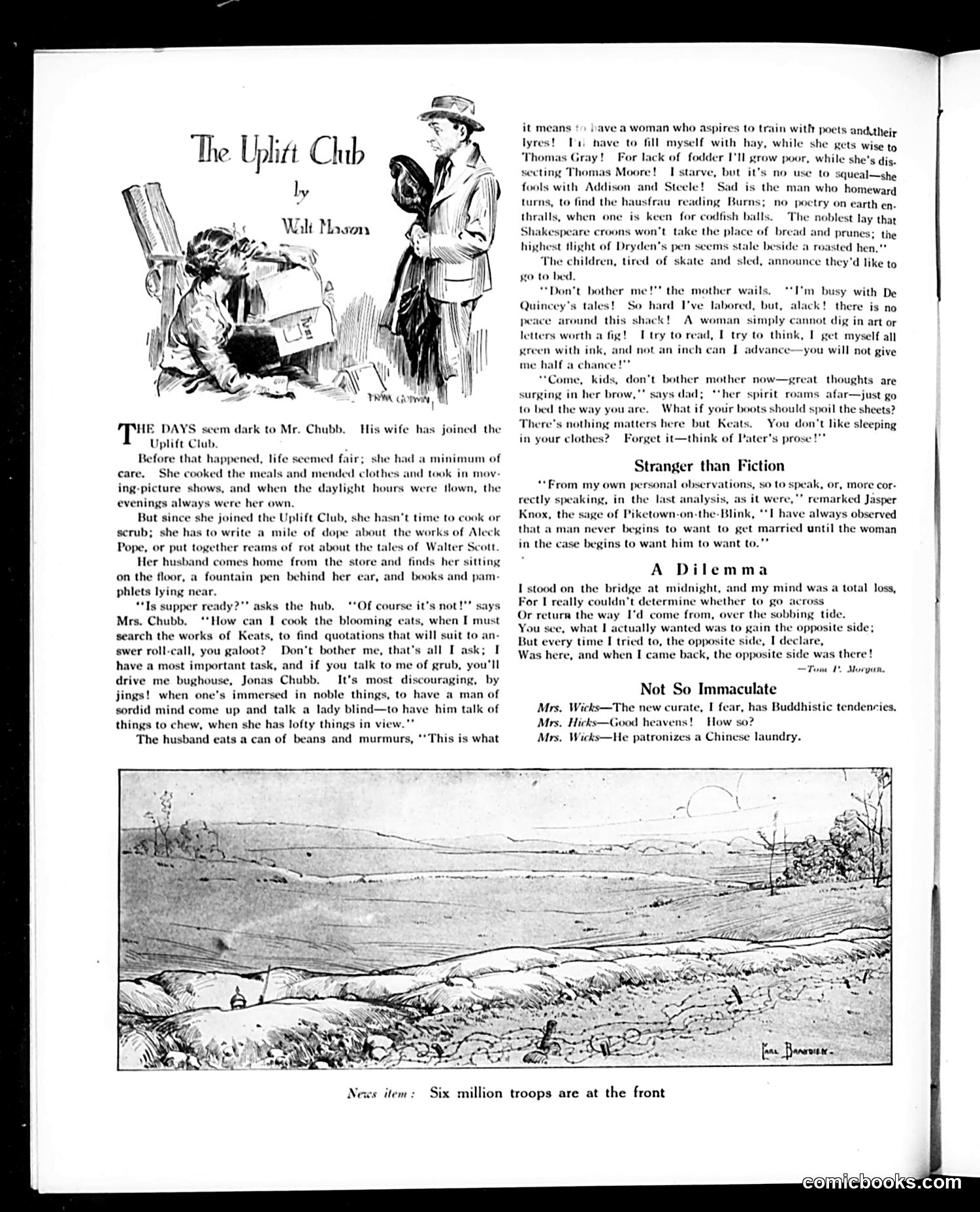
This 1910s-era satirical piece mocks the "Uplift Club," a women's self-improvement organization focused on literary and intellectual pursuits. The cartoon ridicules Mr. Chubb's domestic frustration: his wife, now absorbed in studying classical poets (Keats, Burns, Pope, Scott), neglects housework, cooking, and childcare to write earnest analytical essays for club meetings. The satire targets emerging feminist intellectualism and women's clubs, portraying them as impractical and disruptive to family life. The husband's complaints—eating beans while his wife reads De Quincey, children ignored while she pursues "noble things"—frame women's intellectual ambitions as selfish neglect of domestic duties. The accompanying wartime reference ("Six million troops at the front") likely dates this to WWI, when such domestic humor provided escapism. The humor assumes readers would share the husband's exasperation with women prioritizing learning over traditional household roles—a position that reveals the era's gender assumptions about women's "proper" place.
📄 Transcribed text from this page (OCR, searchable)
Machine-transcribed from the original scan — historical spelling and the odd misread are preserved.
THK GonwA 4 ba DAYS seem dark to Mr. Chubb. His wife has joined the Uplift Club. Before that hi care. She cool ing-picture show: evenings always were her own. But since she joined the Uplift Club, she hasn’t time to cook or scrub; she has to write a mile of dope about the works of Aleck Pope, or put together reams of rot about the tales of Walter Scott. Her husband comes home from the store and finds her sitting on the floor, a fountain pen behind her ear, and books and pam- phlets lying n Is supper r ks the hub. **Of cours ‘s not!"” sa Mrs. Chubb. ‘‘How can I cook the blooming eats, when T must search the works of Keats, to find quotations that will suit to an- swer roll-call, you galoot? Don’t bother me, that’s all [ ask; I have a most important task, and if you talk to me of grub, you'll drive me bughouse, Jonas Chubb. It’s most discouraging, by jings! when one’s immersed in noble things, to h 1 man of sordid mind come up and talk a ly blind—to him talk of things to chew, when she has lofty things in vies The husband eats a can of beans and murmu »pened, life seemed fair; she had a minimum of nd took in mov. d the meals and mended clothes nd when the daylight hours were tlown, the yo" ‘This is what it means lyres! have a woman who aspires to train with poets andtheir Tu. have to fill myself with hay, while she gets wise to ay! For lack of fodder I'll grow poor, while she’s dis. secting Thomas Moore I starve, but it's no use to squeal—she fools with Addison and Steele! Sad is the man who homeward turns, to find the hausfrau reading Burns; no poctry on earth en. thralls, when one is keen for codfish balls. ‘The noblest lay that Shakespeare croons won't take the place of bread and prunes; the highest flight of Dryden's pen seems sta de a roasted hen,” The children, tired of skate and sled, announce they'd like to je be #0 to bed. “Don't bother me!? the mother wails. ‘I'm busy with De Quince: So hard Ive labored, but, alack! there is no peace around this shack! A woman simply cannot dig in art or letters worth a fig! LT try to read, I try to think, I get myself all xreen with ink, and not an inch can [ advance—you will not give alfa chance !"* Come, kids, don’t bother mother now—great thoughts are “ther spirit roams afar—just go to bed the way you are. What if yotir boots should spoil the sheets? There's nothing matters here but Keats. You don't like sleeping Forget it—think of Pater’s prose !"" tales! surging in her bro in your clothes? Stranger than Fiction “From my own personal observations, so to speak, or, more cor- rectly speaking, in the last sit were," ren Knox, the sage of Piketown-on- . TL have alwa that a man never begins to want to get married until the woman in the case begins to want him to want to. A Dilemma I stood on the bridge at midnight, and my mind was a total loss, For I really couldn't determine whether to go acro: Or return the way I'd come from, over the sobbing tide. You see, what I actually wanted was to gain the opposite side; But every time I tried to, the opposite sid Was here, and when I came back, the opposite side w as there! wd Not So Immaculate Mrs. Wicks—The new curate, I fear, has Buddhistic tendencies, Mrs. Hicks—Good heavens! How so? Mrs. Wicks—He patronizes a Chinese laundry. res item: Six million troops are at the front