
A complete issue · 24 pages · 1914
Judge — April 11, 1914
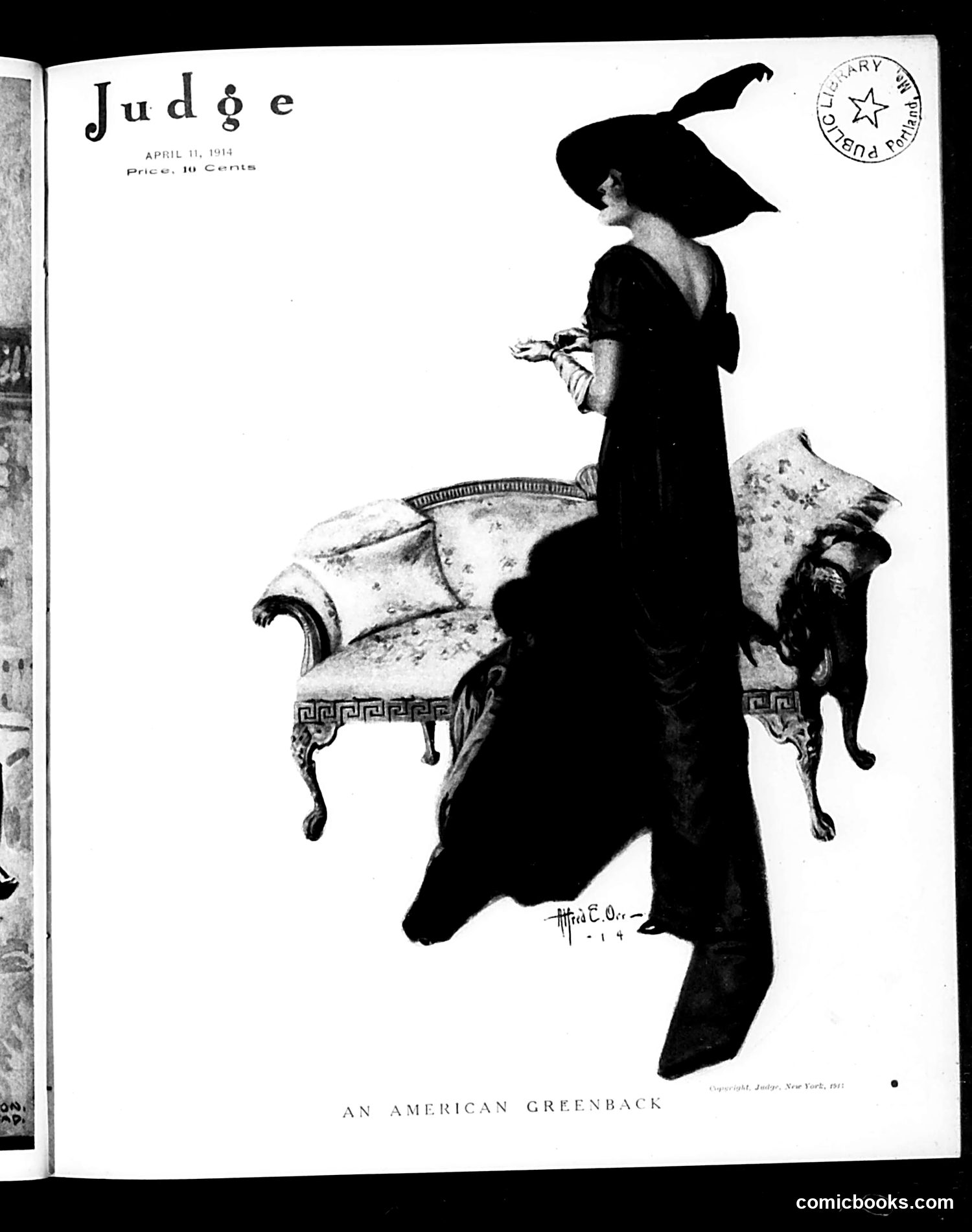
This Judge magazine cover from April 11, 1914 satirizes American wealth and materialism through a stylized silhouette. A fashionably dressed woman in an enormous hat stands beside an ornate chair, holding what appears to be money or valuables. A small dog sits at her feet. The title "An American Greenback" (slang for U.S. currency) suggests the cartoon equates the woman herself with money—she represents American wealth, excess, and the nouveau riche aesthetic of the era. The exaggerated hat and silhouette mock contemporary high society fashion and conspicuous consumption. The woman's posture suggests vanity and superficiality. This likely critiques early 20th-century American materialism and the ostentatious displays of wealth common among the wealthy class during the Progressive Era.
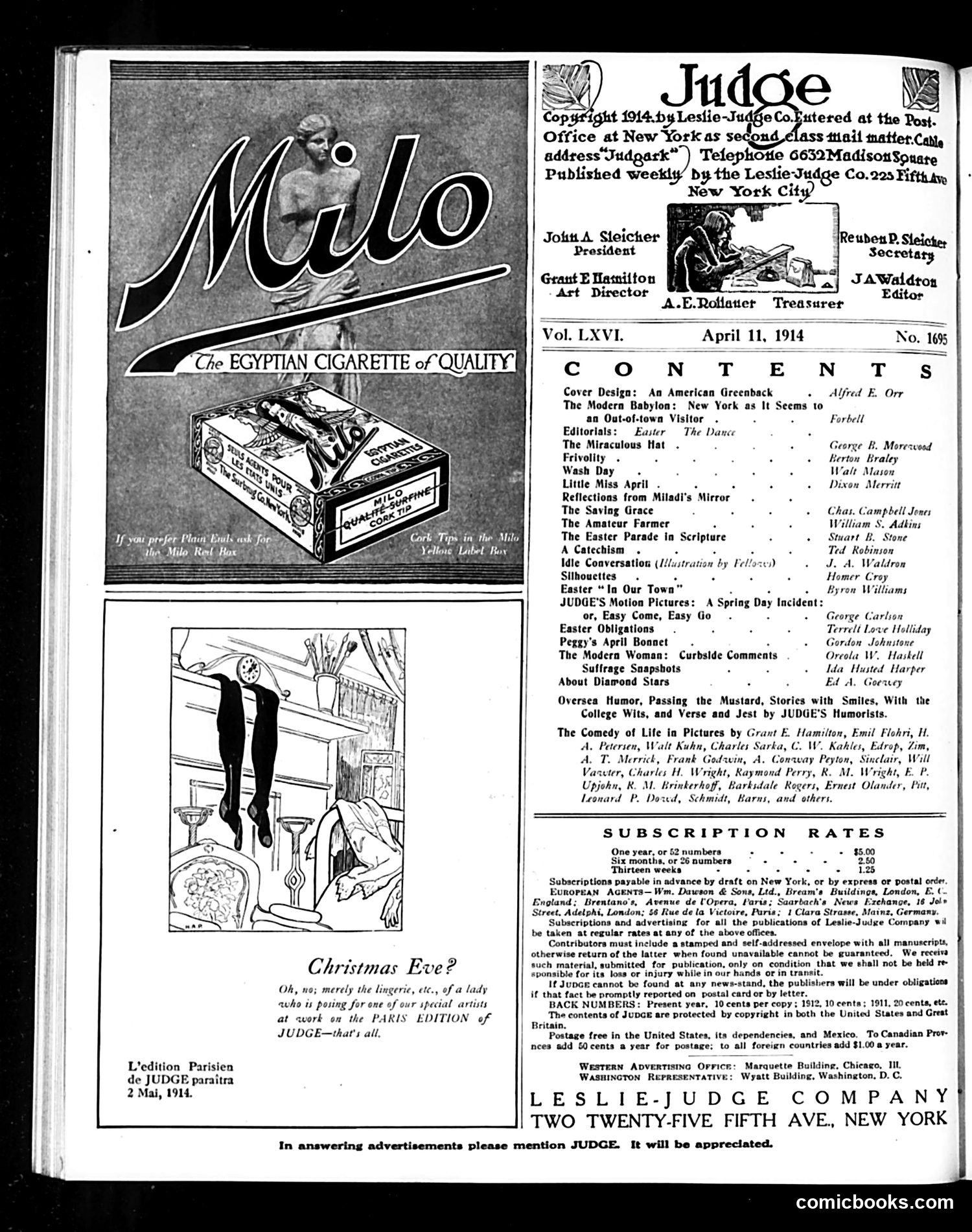
This is primarily a **Milo cigarette advertisement** rather than political satire. The page's main cartoon depicts a man hanging from a noose in an elegant interior, with the caption "Christmas Eve?" and text below referencing "the PARIS EDITION of JUDGE—that's all," dated May 2, 1914. The joke appears to be a dark humor advertisement: the man's predicament humorously suggests that smoking Milo cigarettes is preferable to the alternatives suggested by his situation. It's employing macabre comedy to sell cigarettes—a marketing approach reflecting early 20th-century advertising's looser standards around taste and subject matter. The cartoon contains no identifiable political figures or social commentary beyond this morbid commercial humor.
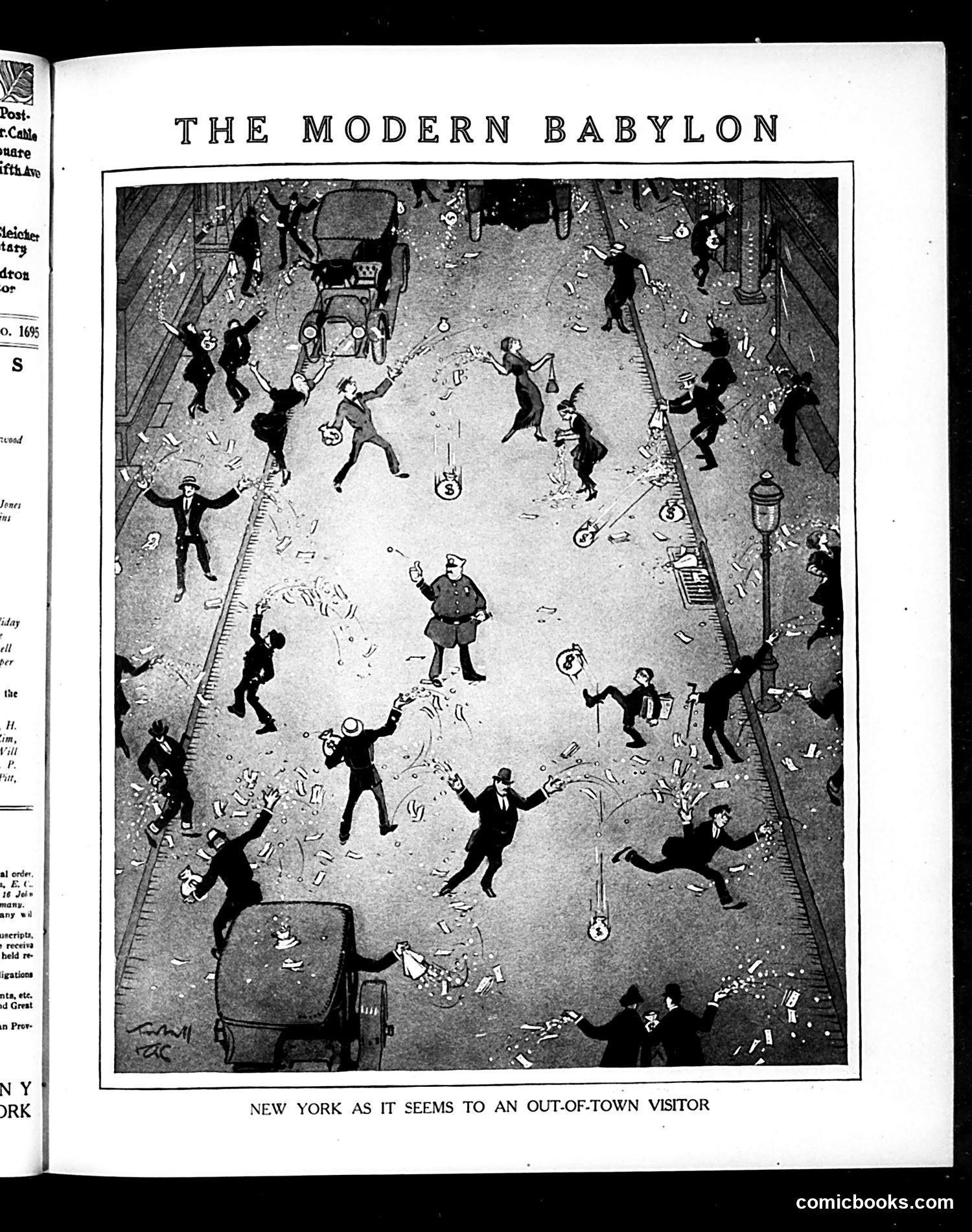
This satirical illustration presents New York as a chaotic, crowded street scene viewed from above. The caption reads "New York as it seems to an out-of-town visitor," suggesting the perspective is exaggerated and caricatured. The image depicts numerous figures in suits scattered across a street in frantic, disorganized poses—some falling, jumping, gesticulating wildly. A policeman stands centrally observing the chaos. There's a horse-drawn cart visible, along with what appear to be numbered markers scattered throughout. The satire mocks the frenetic pace and disorder of modern urban life in New York, portraying the city as bewilderingly chaotic and hectic to outsiders. It's a commentary on the overwhelming, fast-paced nature of early 20th-century city life that visitors found disorienting and absurd.
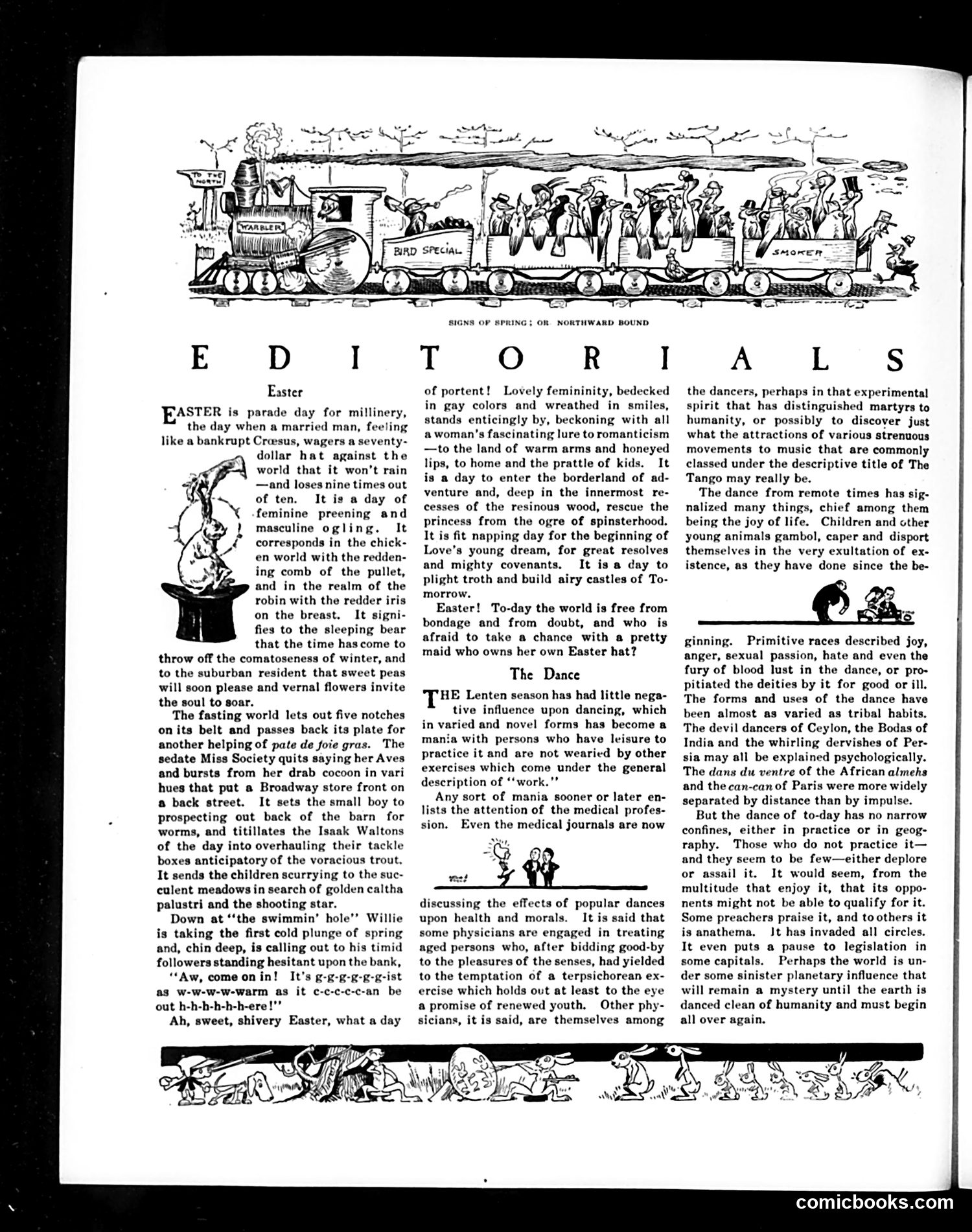
This Judge magazine editorial page celebrates Easter and spring's arrival, featuring a whimsical train illustration titled "Signs of Spring: Or Northward Bound" at the top. The main editorials discuss Easter as a holiday representing renewal and feminine fashion ("millinery"), and analyze social dancing's moral implications. The text criticizes physicians and moralists who debate whether popular dances like the Tango promote vice or are harmless recreation. The satirical angle targets contemporary anxiety about modern dance—particularly the Tango, which was considered scandalous in early 20th-century America for its close partner contact and sensual movements. The editorial mocks both medical professionals and moral crusaders for obsessing over dancing's dangers, suggesting their concerns are overwrought. The decorative borders and tone reflect Judge's satirical commentary on American social debates of its era.
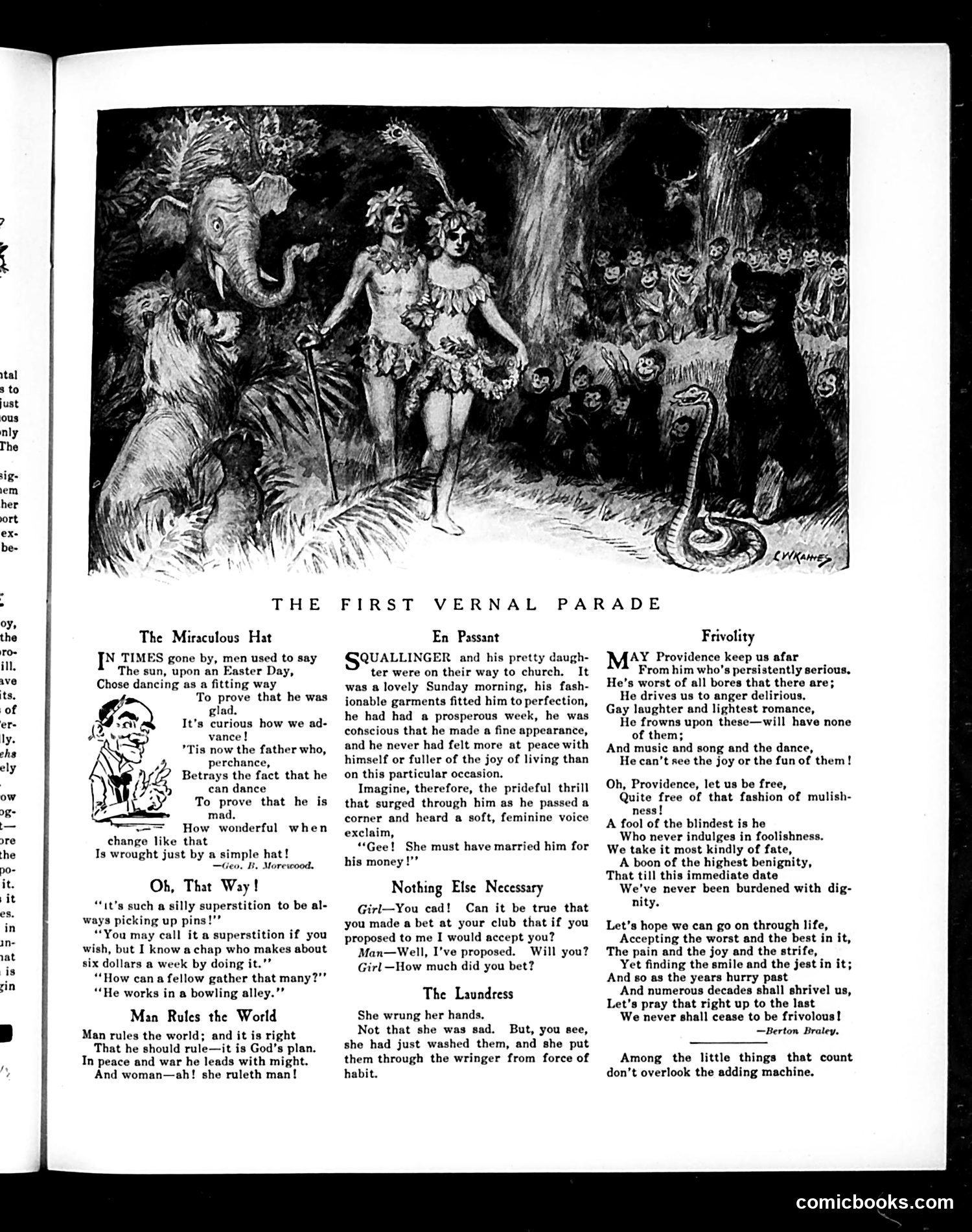
This page presents humorous sketches about Easter traditions and gender roles, typical of Judge's early 20th-century satirical approach. The main illustration depicts a whimsical woodland scene with anthropomorphic animals and figures, titled "The First Vernal Parade"—likely satirizing the then-contemporary Easter parade tradition (fashionable public displays of new spring clothing). The accompanying text pieces mock Victorian social conventions: "The Miraculous Hat" jokes about men's superstitions regarding Easter finery; "Man Rules the World" presents ironic commentary on male dominance; and "The Laundress" humorously depicts domestic labor. The humor relies on period-specific references to Easter fashion, social hierarchies, and gender dynamics that would have resonated with Judge's educated readership concerned with critiquing middle-class pretension and social absurdities.
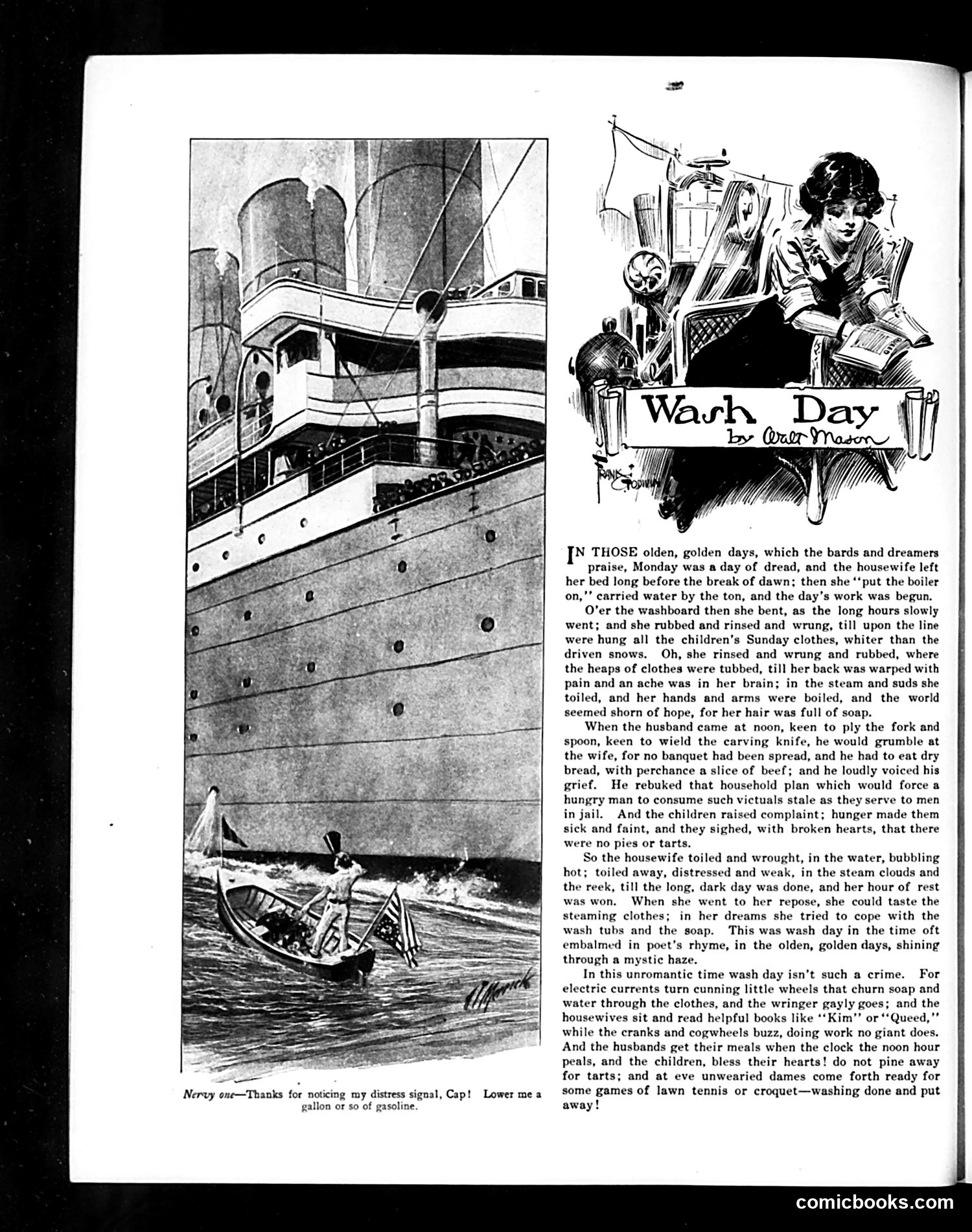
This satirical piece contrasts the grueling hardship of laundry day in "the olden, golden days" with modern convenience. The narrative nostalgically praises the past while actually describing brutal conditions: women rising before dawn, laboring for hours over washboards and boiling water, enduring physical pain, while husbands and children ungratefully demand meals and complain about food. The satire inverts romanticization of "the good old days." By the 1910s-1920s (when Judge published this), modern washing machines and electric-powered equipment had transformed housework. The piece mocks sentimental nostalgia by showing the old system was actually oppressive drudgery. The accompanying illustration depicts a luxury steamship, contrasting leisure travel with women's domestic toil. The final section celebrates modern technology: electric washers, wringers, and freed time for reading and recreation instead of endless labor. The broader point: progress and technology genuinely improved women's lives, despite any mythologizing of "simpler times."
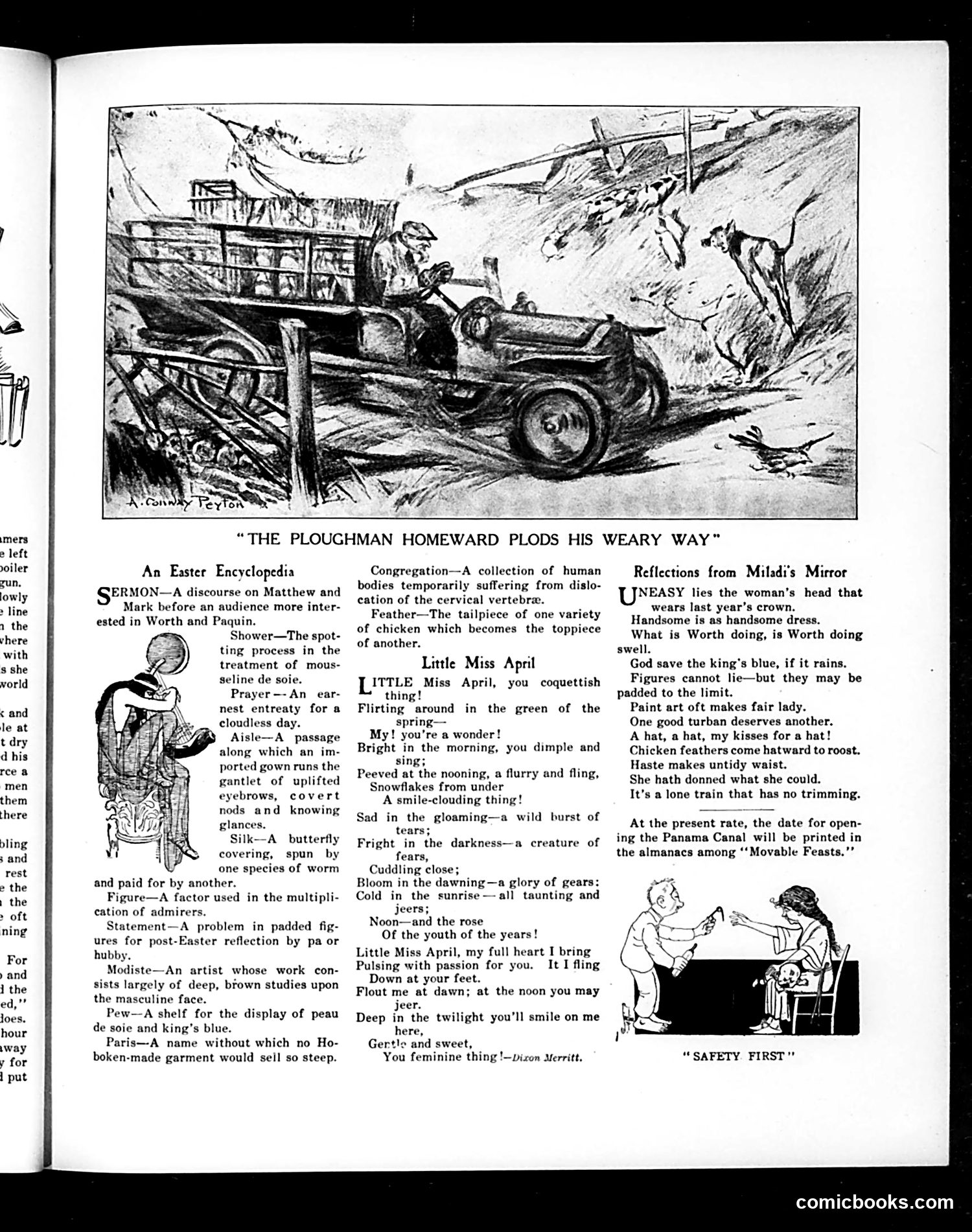
This 1910s Judge magazine page satirizes Easter fashion culture among wealthy women. The main cartoon shows a farmer's simple cart contrasted with an elaborate Easter procession—mocking how Easter had become a fashion display rather than a religious observance. The "Easter Encyclopedia" is satirical wordplay: "Sermon" defines it as secondary to discussing designer fashion houses (Worth and Paquin); "Congregation" describes women craning their necks to see each other's outfits; "Pew" becomes merely a display shelf for expensive fabrics. The humor targets how materialism and vanity had overtaken Easter's spiritual meaning. "Little Miss April" is sentimental verse about spring's mood swings. "Reflections from Miladi's Mirror" offers cynical observations on women's fashion obsession—"Figures cannot lie—but they may be padded to the limit" suggests women padding both clothing and post-Easter bills for their husbands. The page satirizes Gilded Age excess and the commercialization of religious holidays among the wealthy.
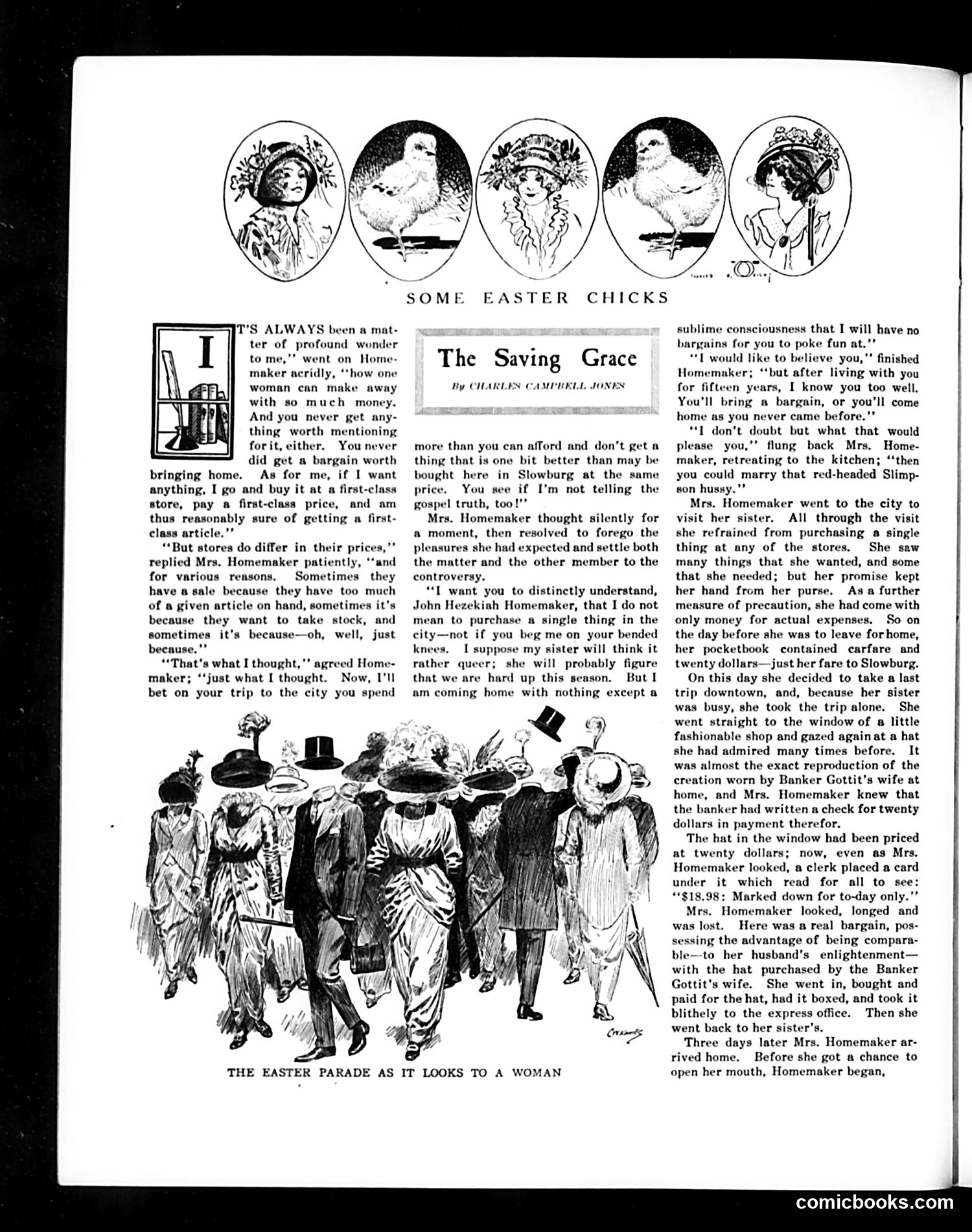
This story satirizes marital dynamics and consumer behavior in the early 20th century. A husband (Homemaker) criticizes his wife for wasteful shopping, claiming she always overspends in the city. She bets she'll return with nothing, determined to prove him wrong. However, the satire's "point" lies in the ironic ending: Mrs. Homemaker successfully resists purchases until spotting a hat marked down from $20 to $18.98—the exact model worn by the wealthy banker's wife. The markdown becomes her rationalization for breaking her promise, buying it anyway. The joke targets both spouses: the husband's sanctimonious lecturing and the wife's susceptibility to sales tactics and social comparison (wanting the banker's wife's status symbol). The "saving grace" is actually a saving *face*—she can tell her husband she got a bargain, thus avoiding his "I told you so." The cartoon illustrates the futility of her resolution through the Easter parade image above.
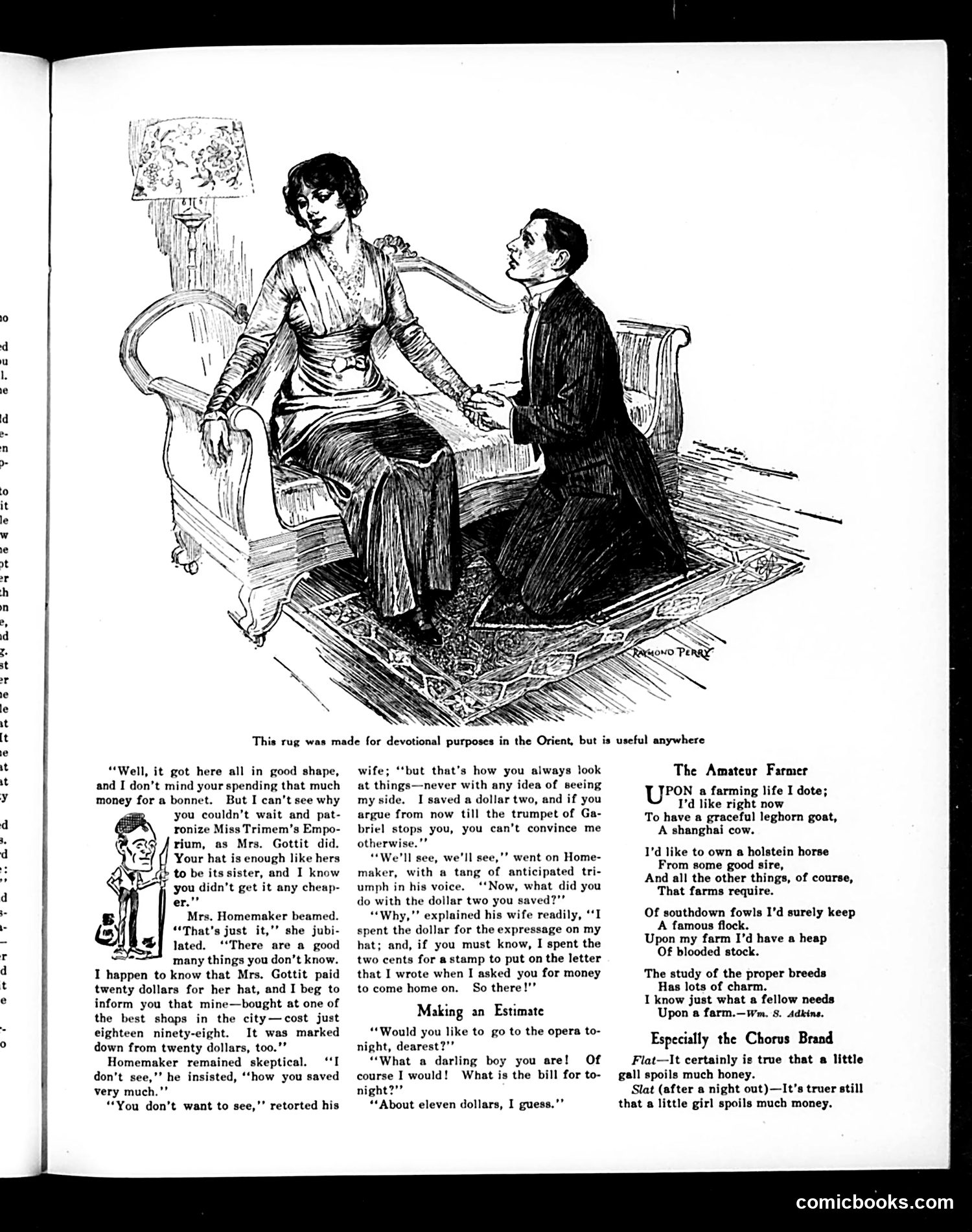
This page contains three separate satirical pieces from Judge magazine: **Main Cartoon (top):** Depicts a domestic dispute where a husband questions his wife's hat purchase. She claims to have "saved" money by buying it marked down, then reveals she spent the savings on delivery and postage—a circular logic that defeats her own argument. The satire mocks wives who engage in self-deceptive financial reasoning and husbands' exasperation with it. This reflects early 20th-century gender dynamics around household spending and marital communication. **"The Amateur Farmer" (right):** A humorous poem about someone romanticizing farm life without practical knowledge—wanting fancy livestock breeds but lacking actual farming experience. The satire targets urban dabbling in agriculture. **"Making an Estimate" & "Especially the Chorus Brand":** Brief comedic dialogues. The first jokes about opera costs; the second contains wordplay about women ("gall," "honey," "girls") spoiling finances—typical period humor that's now dated in its gender assumptions. The top image appears decorative rather than narrative-specific.
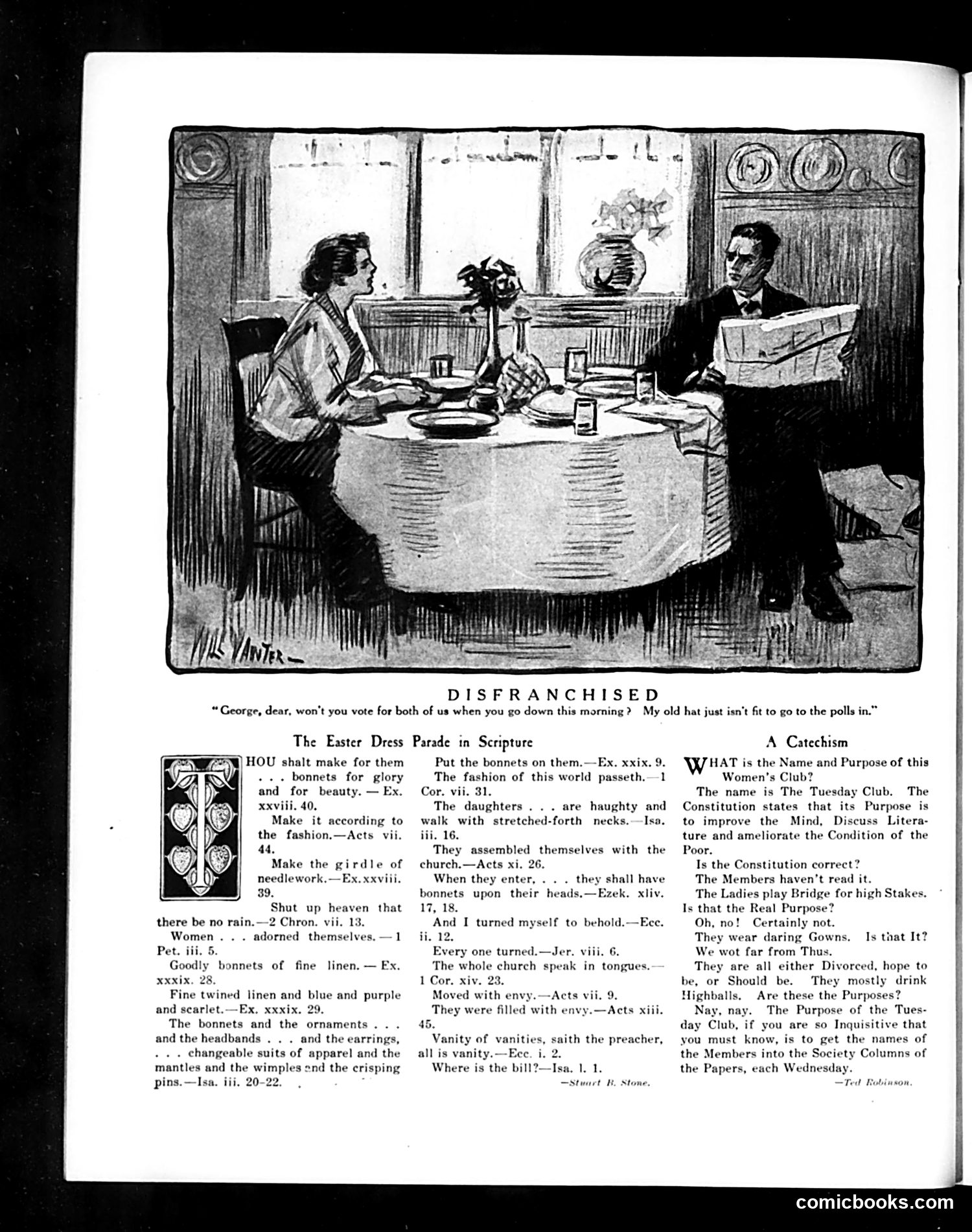
**The Main Cartoon ("Disfranchised"):** Shows a married couple at breakfast. The wife asks her husband to vote for both of them at the polls, revealing she cannot vote herself. This satirizes women's disenfranchisement—women lacked voting rights and had to rely on male relatives to represent their interests politically. The title's wordplay ("dis-franchised") highlights this exclusion. **"The Easter Dress Parade in Scripture":** Mocks women's vanity by pairing Biblical passages about modest religious garments with Isaiah's condemnation of women's ostentatious clothing and adornments. The satire suggests contemporary women prioritize fashionable display over spiritual virtue. **"A Catechism":** A mock religious Q&A that exposes the gap between the stated purpose of "The Tuesday Club" (improving minds, helping the poor) and its actual purpose: getting members' names into society columns for status. The sarcastic responses ("The Members haven't read it") ridicule women's clubs as vain social climbing rather than genuine charitable or intellectual endeavors. **Overall:** The page criticizes women as politically powerless, spiritually vain, and socially superficial.
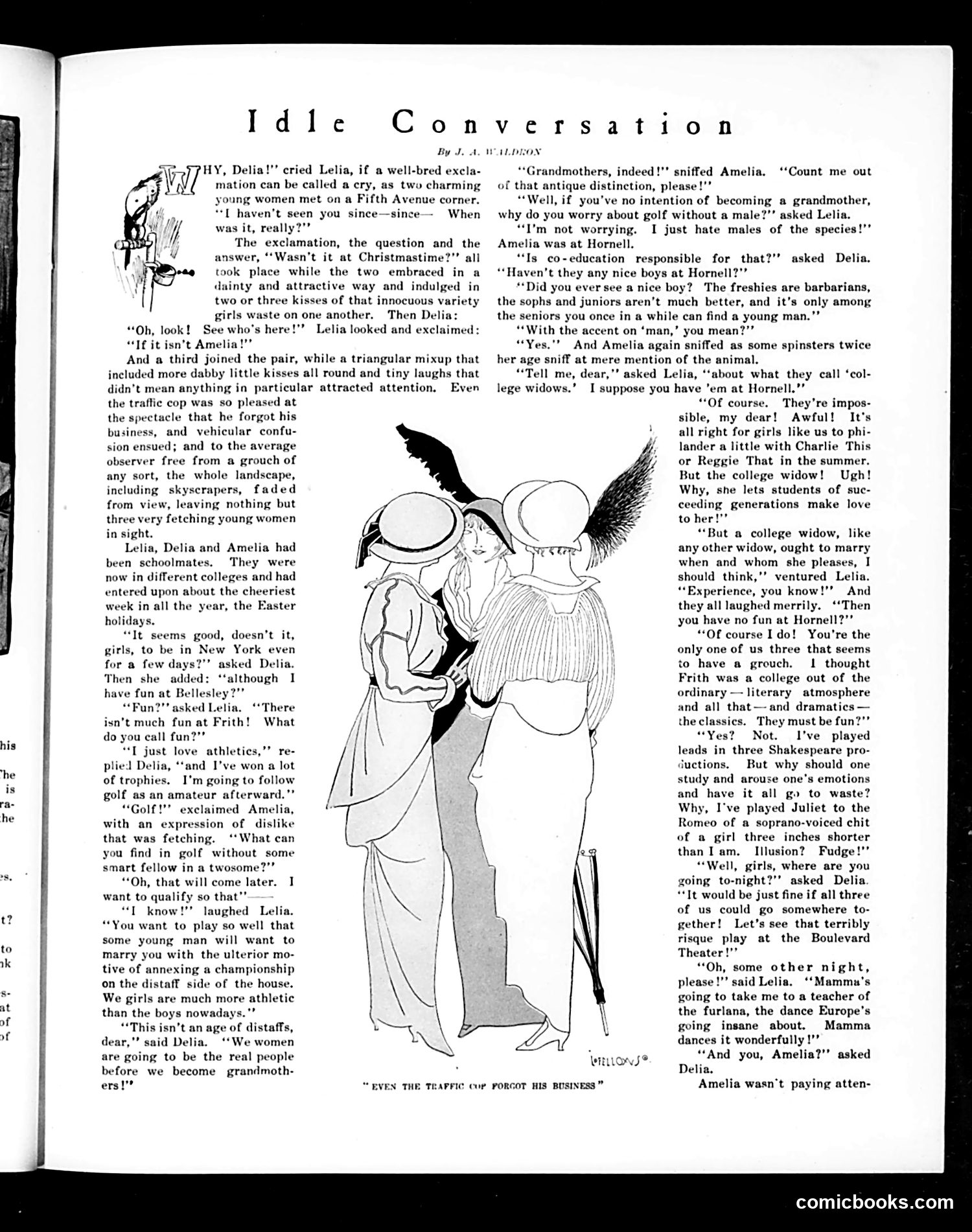
This humorous sketch satirizes the contradictions in young college women's attitudes toward gender and romance circa the 1910s. Three educated female friends—Delia, Lelia, and Amelia—reunite during Easter holidays and discuss their college lives. The satire targets their simultaneous claims of independence and anti-male sentiment while actually remaining preoccupied with attracting male attention. Delia pursues golf to "qualify" for marriage to a championship-caliber man. Amelia denounces males yet admits to summer flirtations. They mock "college widows" (women who date multiple generations of students) as scandalous, yet their own behavior mirrors it. The cartoon's humor lies in exposing the hypocrisy: these "new women" pursuing athletics and education still measure success through romance and marriage prospects, despite their feminist posturing. The traffic cop's distraction by their "fetching" appearance reinforces that their primary social currency remains physical attractiveness rather than intellectual achievement.
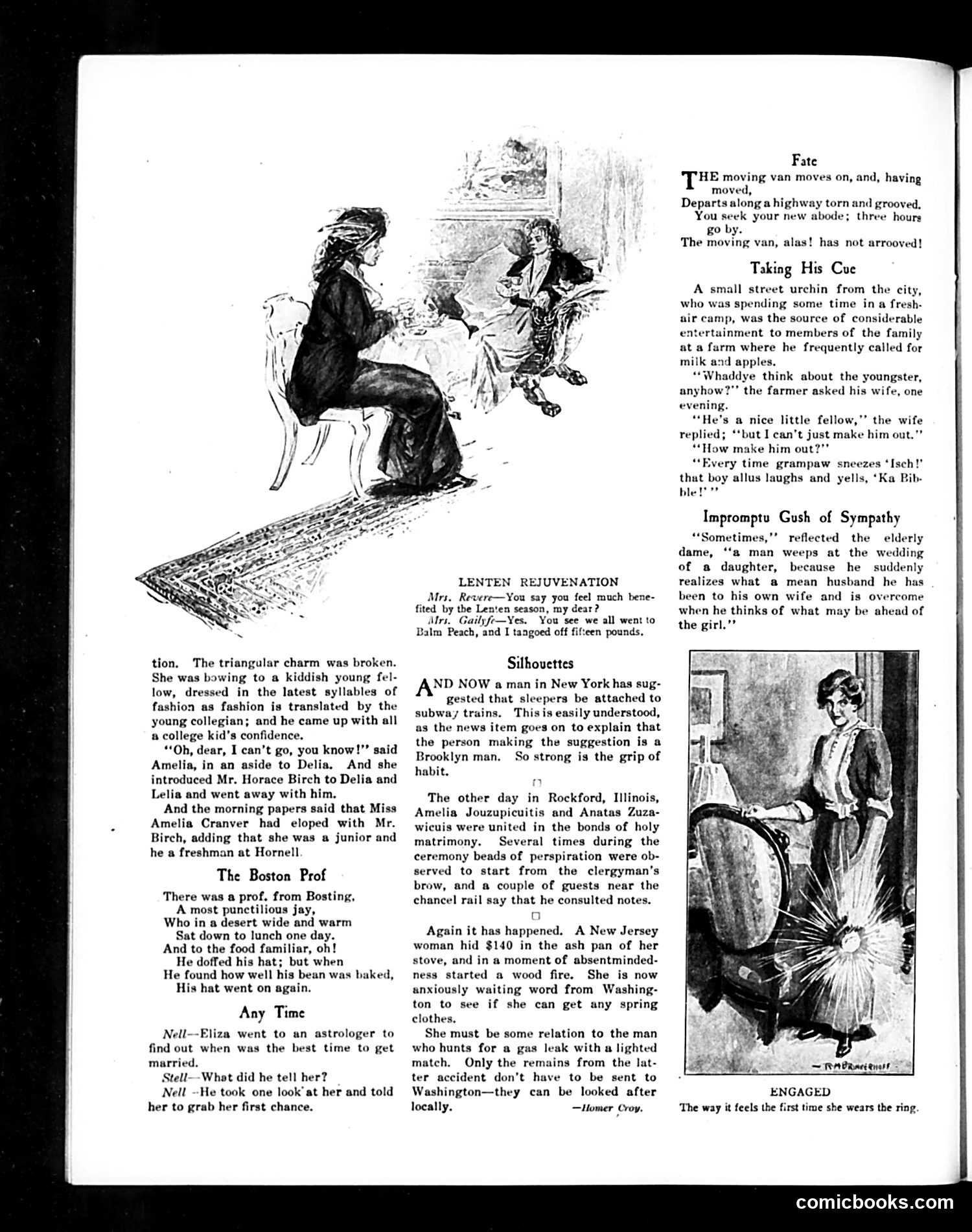
This page from Judge magazine contains multiple short humorous pieces typical of early 20th-century American satire: **Main illustrations and jokes:** 1. **"Lenten Rejuvenation"**: A society joke about women losing weight during Lent at seaside resorts ("Balm Peach"), specifically through the then-trendy "tango" dance—satirizing fashionable leisure pursuits among the wealthy. 2. **"Silhouettes" section**: Brief satirical observations including a jab at Brooklyn's subway culture (suggesting Brooklynites are so habituated to trains they'd sleep on them) and a dark joke about a New Jersey woman who hides money in her stove, then accidentally burns it. 3. **"Taking His Cue"**: A dialect humor piece about a city child in a fresh-air camp who mimics a farmer's grandfather's sneeze, mocking both rural speech patterns and urban-rural cultural differences. 4. **Illustration lower right**: Shows an engaged couple, captioned about the emotional significance of first wearing an engagement ring. The humor relies on contemporary social class distinctions, ethnic/dialect comedy, and observations of modern life (moving vans, subway habits, Lenten fashions).
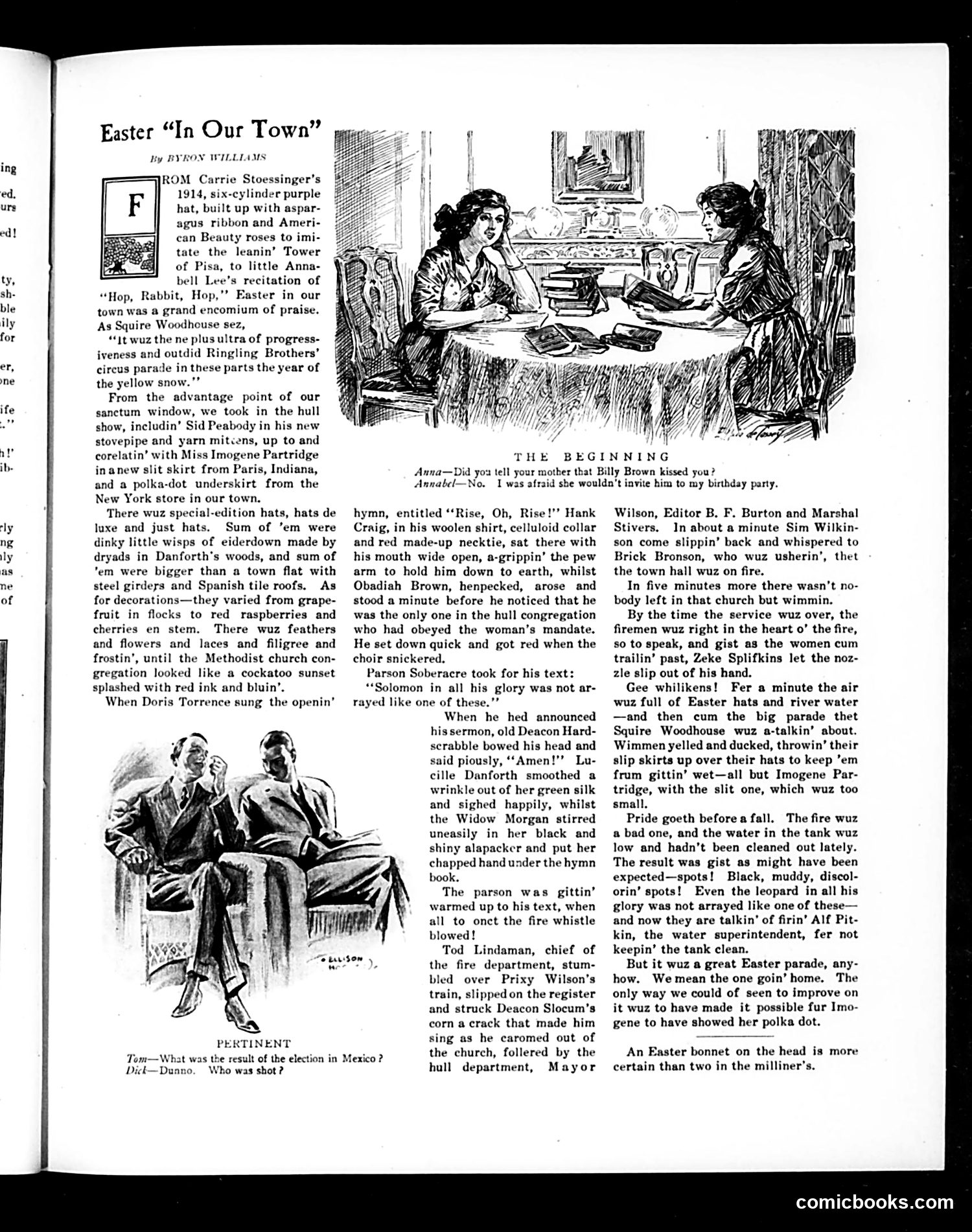
This is a humorous short story set in a small American town during Easter services in 1914. The satire targets small-town social pretension: residents obsess over elaborate Easter fashions (oversized hats, Paris imports) while attending church. The joke escalates when a fire alarm interrupts the sermon. Men rush out to fight a town hall fire, leaving only women in the church. When fireman Zeke Splifkins accidentally sprays the departing women with a fire hose, their elaborate Easter outfits—especially the fashionable "slit skirts"—get soaked. The irony: all that expense and vanity literally washed away in seconds. The accompanying cartoons appear to show domestic humor ("Did you tell your mother Billy Brown kissed you?") and a joke about Mexican politics. The piece satirizes rural American materialism and the gap between pretension and reality—characteristic Judge magazine humor of the era.
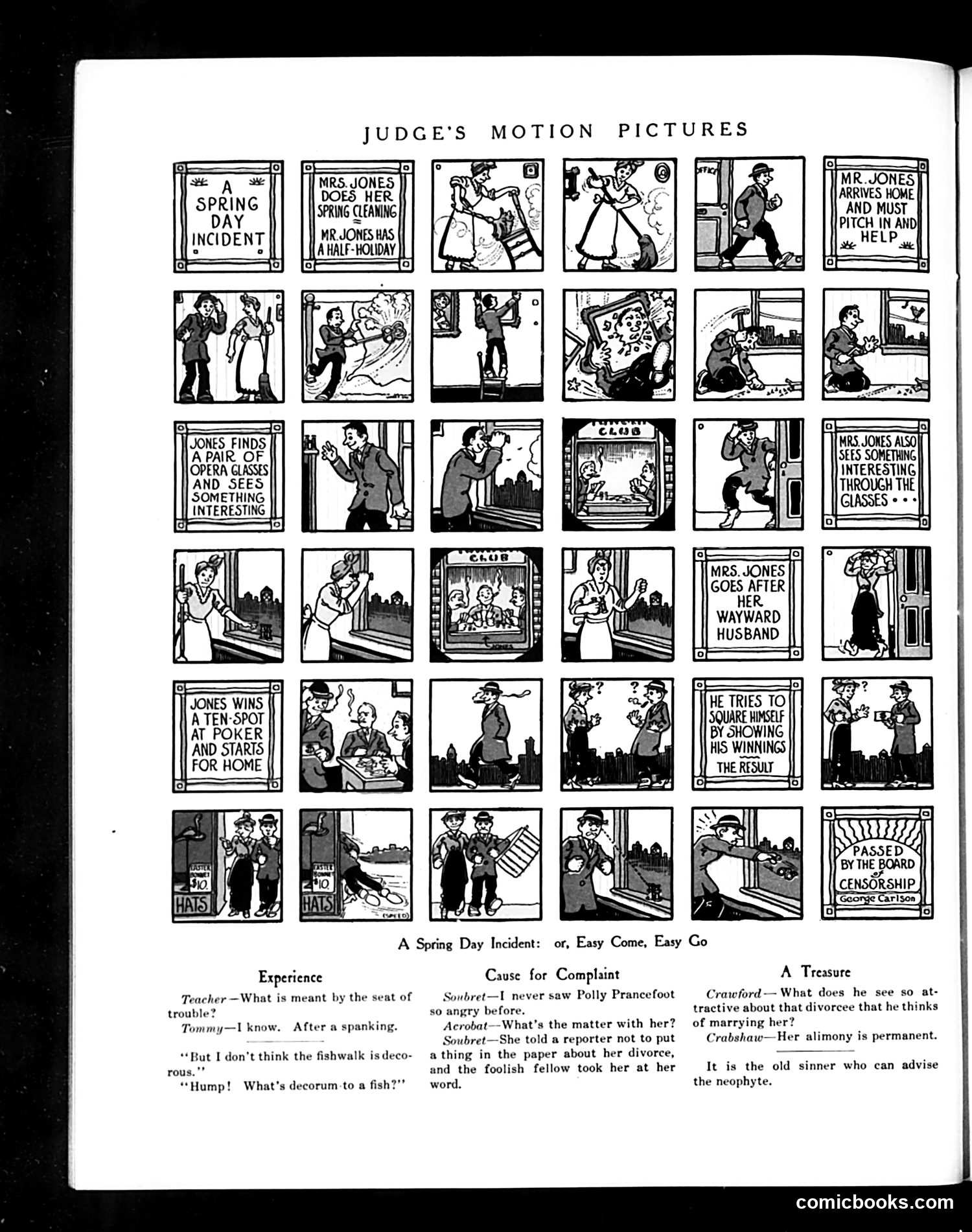
This page presents a six-panel silent comic strip titled "A Spring Day Incident: or, Easy Come, Easy Go," depicting the misadventures of Mr. and Mrs. Jones. The narrative follows a domestic comedy: Mrs. Jones cleans house for spring, Mr. Jones arrives home needing to help, various physical mishaps ensue (Mrs. Jones chasing her wayward husband), and Jones attempts to regain dignity by winning money at poker to prove his worth. Below are three brief satirical jokes about contemporary social issues: one mocking corporal punishment in education, another criticizing divorce gossip and press coverage (suggesting Polly Prancefoot's attempt to suppress newspaper coverage backfired), and a cynical observation about alimony and remarriage among the wealthy. The humor reflects early 20th-century attitudes toward marriage, scandal, and domestic life among affluent classes.
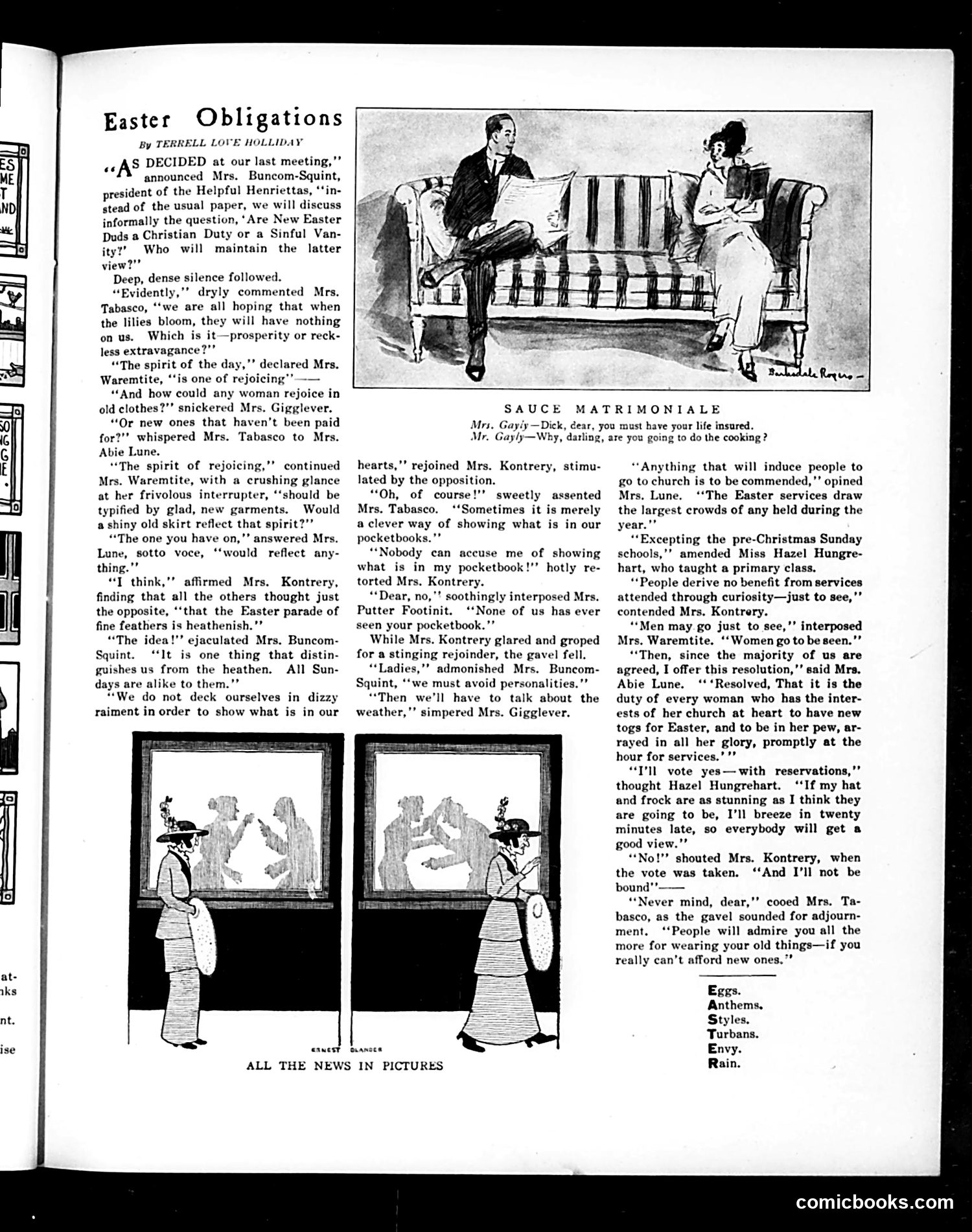
This satirical piece mocks upper-middle-class women's priorities regarding Easter observance. The "Helpful Henriettas" club debated whether new Easter clothes are Christian duty or sinful vanity—but the satire reveals their true motivation: displaying wealth and fashion, not spiritual devotion. The joke centers on exposed hypocrisy: women rationalize extravagant spending as religious obligation while actually caring about outshining each other socially. Mrs. Kontrery's complaint about "heathenish" fine feathers is undercut by the revelation she simply can't afford new clothes. The resolution ironically "resolves" that attending church well-dressed is women's duty—legitimizing consumerism as piety. The "Sauce Matrimoniale" cartoon mocks wives' domestic power: Mrs. Gayly's life insurance comment implies her cooking is so dangerous it justifies insurance—a jab at women's domestic incompetence. The final list ("Eggs. Anthems. Styles. Turbans. Envy. Rain") summarizes Easter's mixed sacred and secular elements, with "Envy" cutting to the satire's core: Easter is about conspicuous consumption dressed as faith.
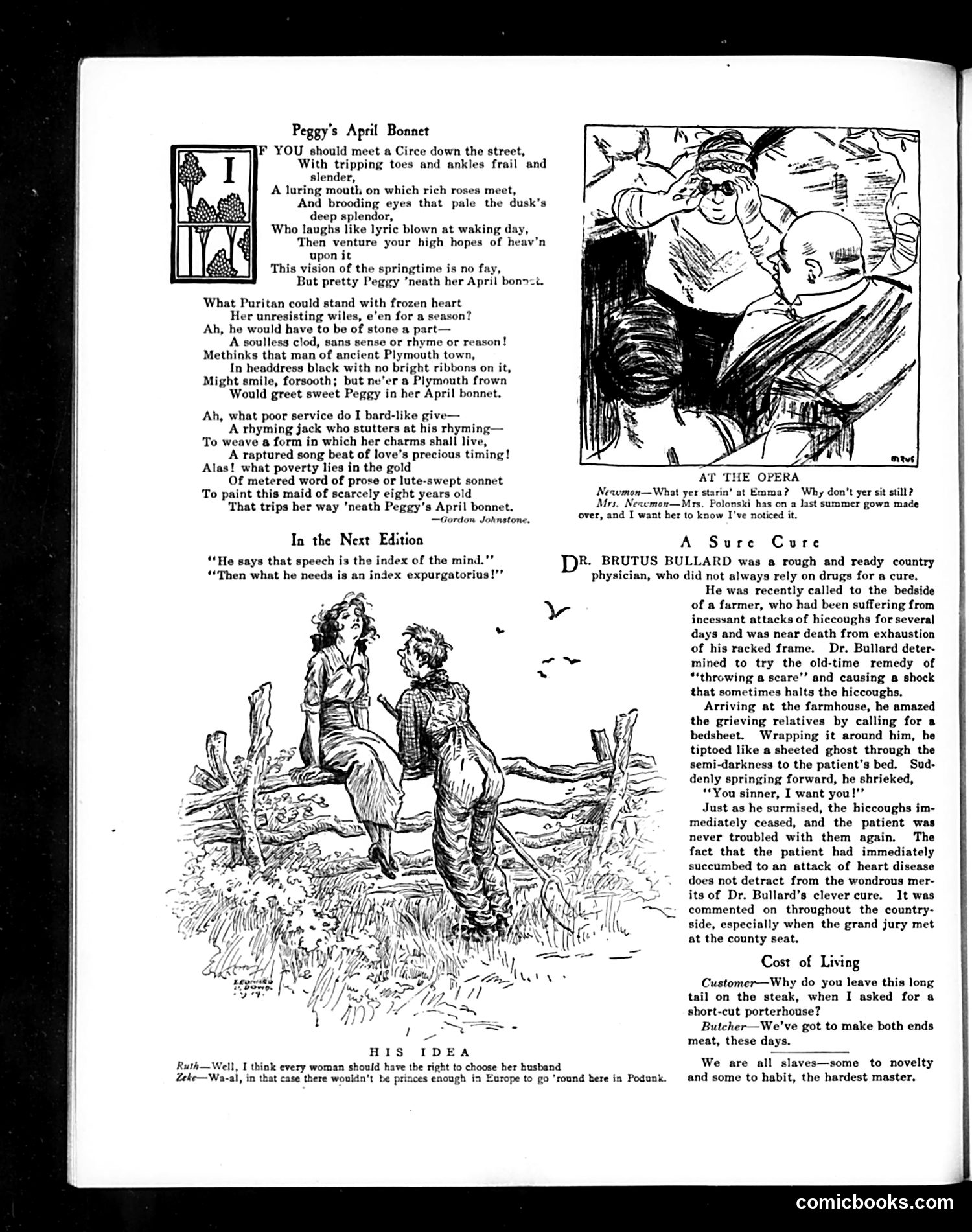
This page contains several distinct pieces of humor typical of early 20th-century satirical magazines: **"Peggy's April Bonnet"** is a romantic poem celebrating a beautiful young woman in springtime, written in flowery Victorian verse. It contrasts her attractiveness with Puritan restraint, suggesting even stern Plymouth colonists would smile at her charm. **"At the Opera"** is a brief joke about social climbing: Mrs. Newson publicly stares at Mrs. Polonski to ensure she notices her wearing last summer's reused gown—a dig at class-conscious social pretense and economic hardship. **"A Sure Cure"** is dark humor: Dr. Bullard frightens a farmer's hiccoughs away by disguising himself as a ghost, but the shock causes a fatal heart attack. The joke's point: the "cure" technically worked, though it killed the patient—satirizing dubious folk medicine and its rationalization. **"Cost of Living"** and **"His Idea"** are brief economic jokes about postwar austerity and women's marriage rights, reflecting Depression-era concerns and gender debates.
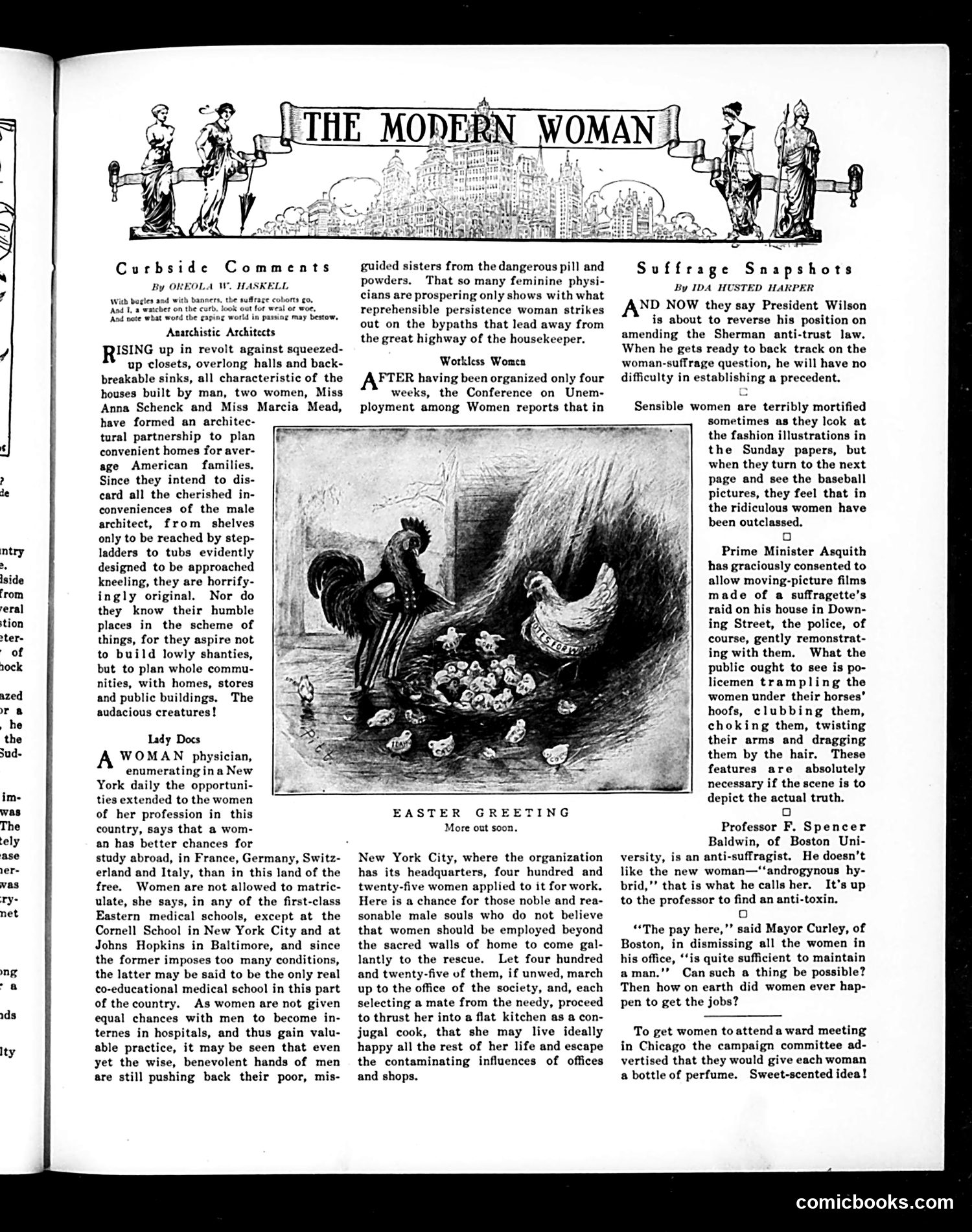
This page from *Judge* employs heavy irony to mock early 20th-century feminism and women's expanding roles. The satirical pieces attack: **"Anarchistic Architects"**: Two women architects (Schenck and Mead) planning entire communities are mocked as dangerously "original" for daring to design beyond "their humble places." **"Workless Women"**: Sarcastically suggests unemployed women should be "rescued" by unmarried men forced into marriage—implying women belong in homes, not workforces. **"Lady Docs"**: Condemns female physicians, claiming they've abandoned "the great highway of the housekeeper" through "reprehensible persistence." **"Suffrage Snapshots"**: Suggests President Wilson will easily flip-flop on women's suffrage as he has other issues, treating the cause as trivial. The cartoon (labeled "Easter Greeting") appears to depict suffragettes in conflict, likely referencing militant British suffragette actions. Overall, *Judge* ridicules women's professional ambitions, medical careers, and political activism as violations of proper feminine domesticity.
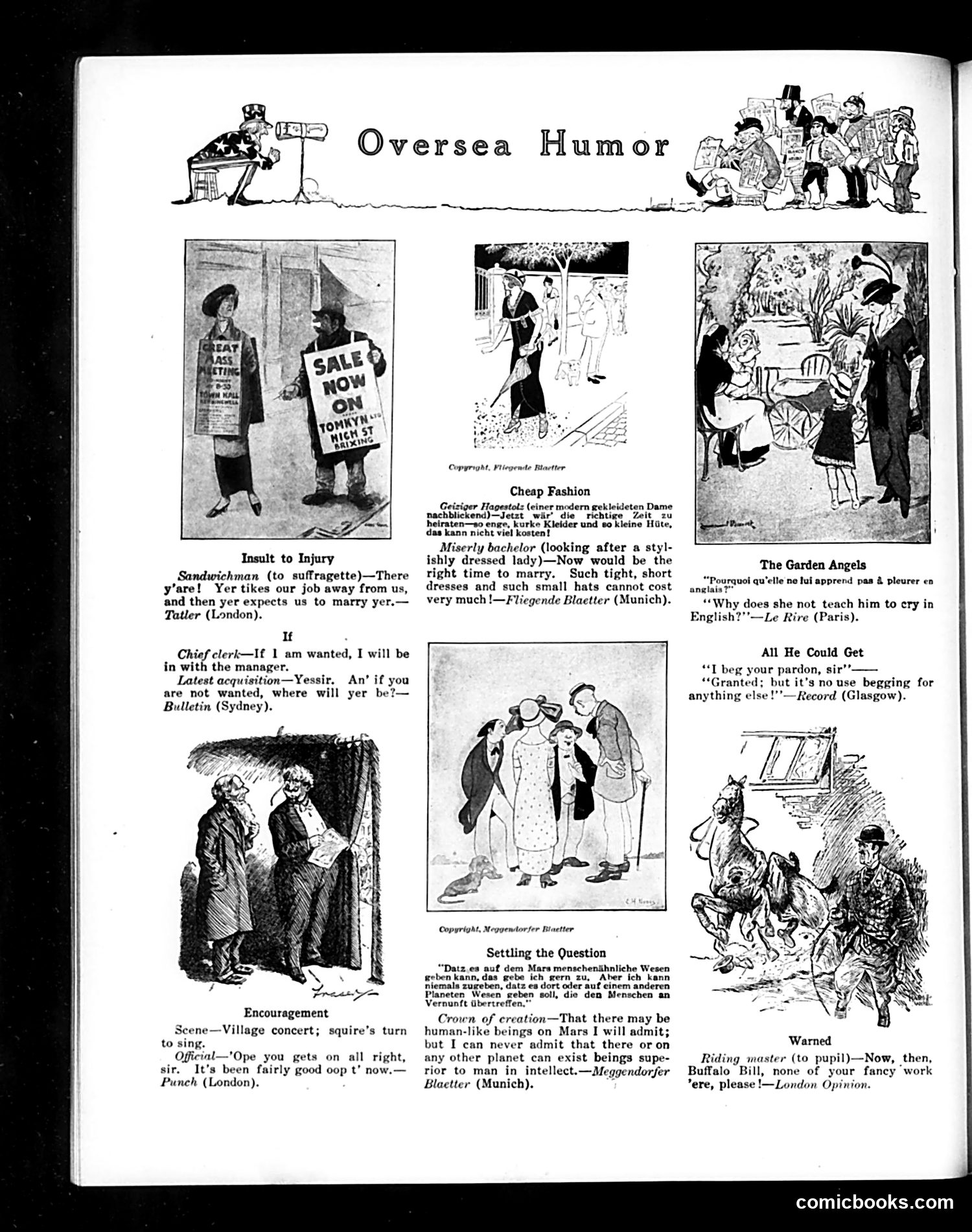
This page collects humorous cartoons and jokes from European and British publications, showcasing period anxieties about social change. The "Insult to Injury" cartoon depicts a sandwichman complaining that suffragettes are taking men's jobs while demanding marriage—reflecting contemporary resentment of women's workforce participation and suffrage activism. "Cheap Fashion" mocks a bachelor's logic: he observes a stylishly dressed woman and calculates that tight, short dresses and small hats must be inexpensive, therefore now is the ideal time to marry—satire on male economic calculation in courtship. "Crown of Creation" defends human intellectual superiority against hypothetical Martian competition—reflecting period anxiety about human exceptionalism amid emerging evolutionary thinking. Other items humorously capture workplace dynamics, romantic hesitation, and class relations typical of early 20th-century Anglo-European social commentary.
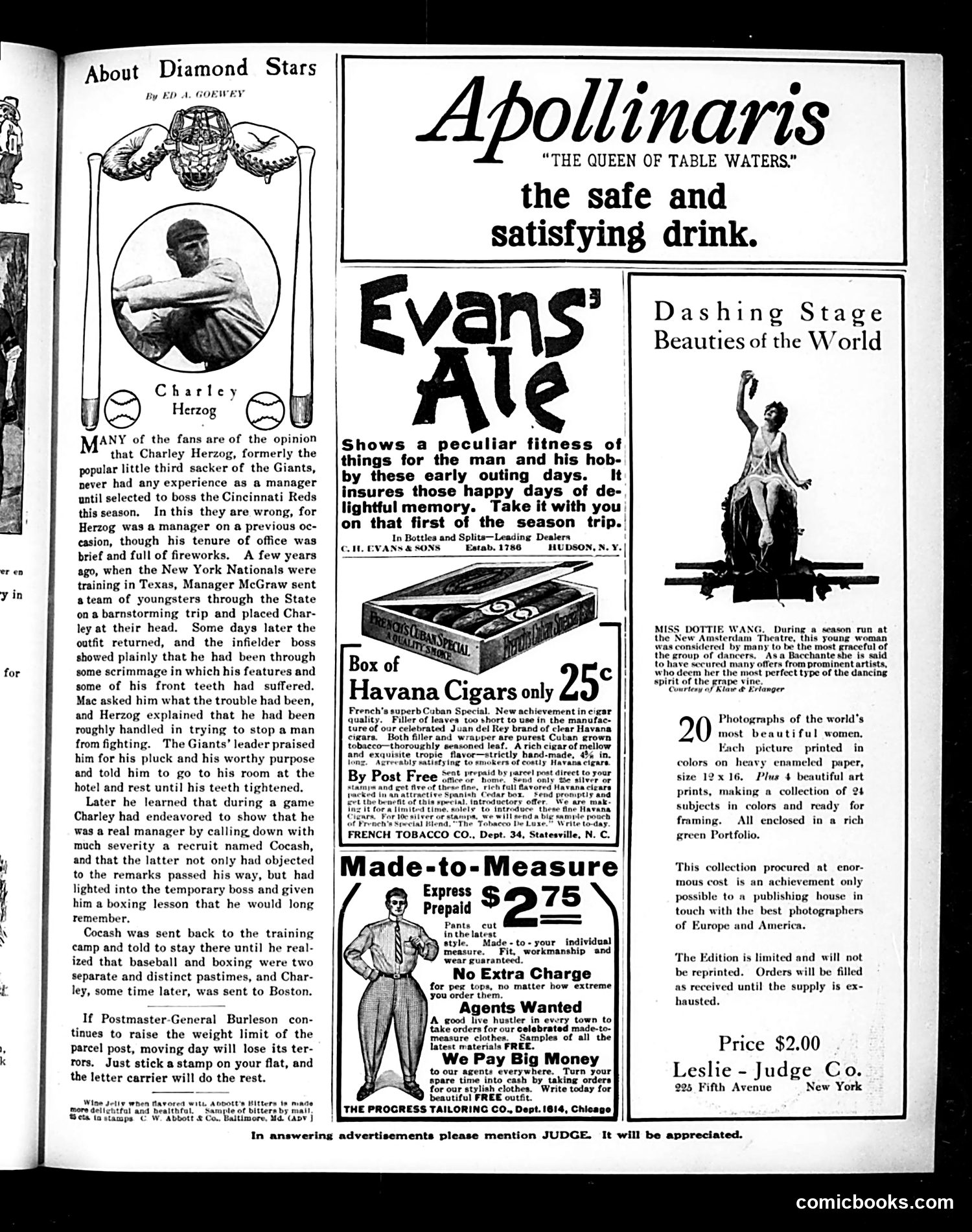
This page is primarily **advertising**, not political satire. The main content is a brief sports anecdote about Charley Herzog, a minor league baseball manager, followed by multiple commercial ads. **The Herzog Article**: Herzog managed the Cincinnati Reds and had previously managed a training team. The humorous story describes how Herzog disciplined a recruit named Cocash for fighting during practice; Cocash responded by boxing Herzog himself, leaving him injured with broken teeth. The joke illustrates Herzog's inexperience managing—he attempted managerial authority but was physically overpowered by a subordinate. **The Advertisements** include: - Apollinaris mineral water - Evans' Ale beer - Box of Havana cigars (25¢) - Made-to-measure clothing ($2.75) - Photographs of beautiful women (20 for $2.00) - A brief political joke about Postmaster-General Burleson expanding parcel post service There is no substantial political cartoon or satirical commentary on this page—it's a typical Judge magazine format mixing sports gossip with period advertisements.
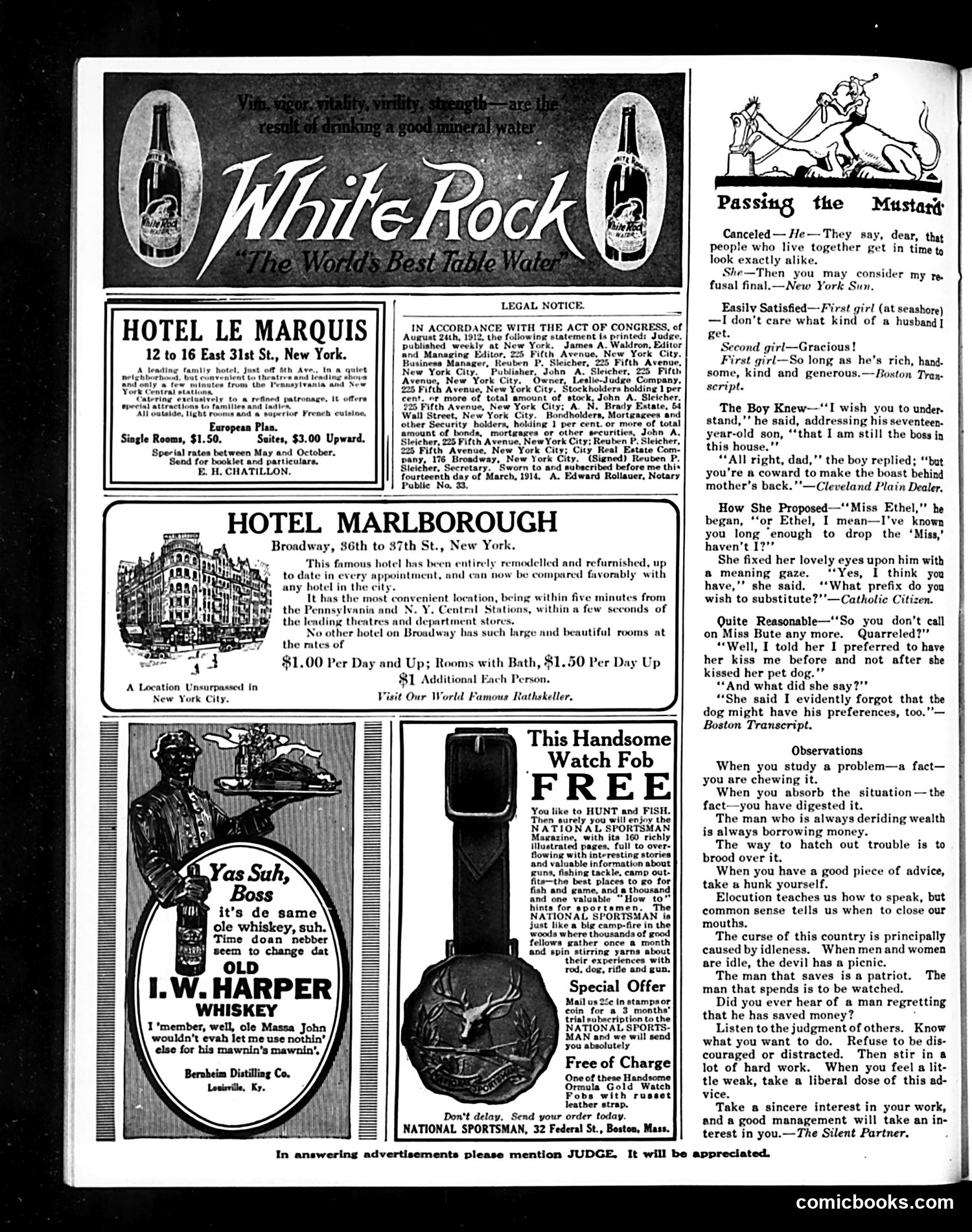
This page from **Judge** magazine (circa 1914, based on the legal notice) is primarily **advertising and humor content** rather than political satire. The page features: **Cartoons/Humor:** - "Passing the Mustard" and related short comic dialogues about courtship and marriage—typical early 20th-century domestic humor - A recurring theme mocking couples who resemble each other and gender dynamics in relationships **Advertisements:** - Hotel Le Marquis and Hotel Marlborough (NYC lodging) - I.W. Harper Whiskey (featuring a period-appropriate serving illustration) - A "National Sportsman" magazine watch fob offer - White Rock mineral water **"Observations" column:** Generic advice about life and money—not satirical, just platitudes. No identifiable political figures or specific contemporary events appear on this page. The satire is **social rather than political**—poking fun at dating, marriage expectations, and gender relations typical of Judge's humor style. The page reflects early 20th-century attitudes toward courtship and domesticity without addressing particular current events or public figures.
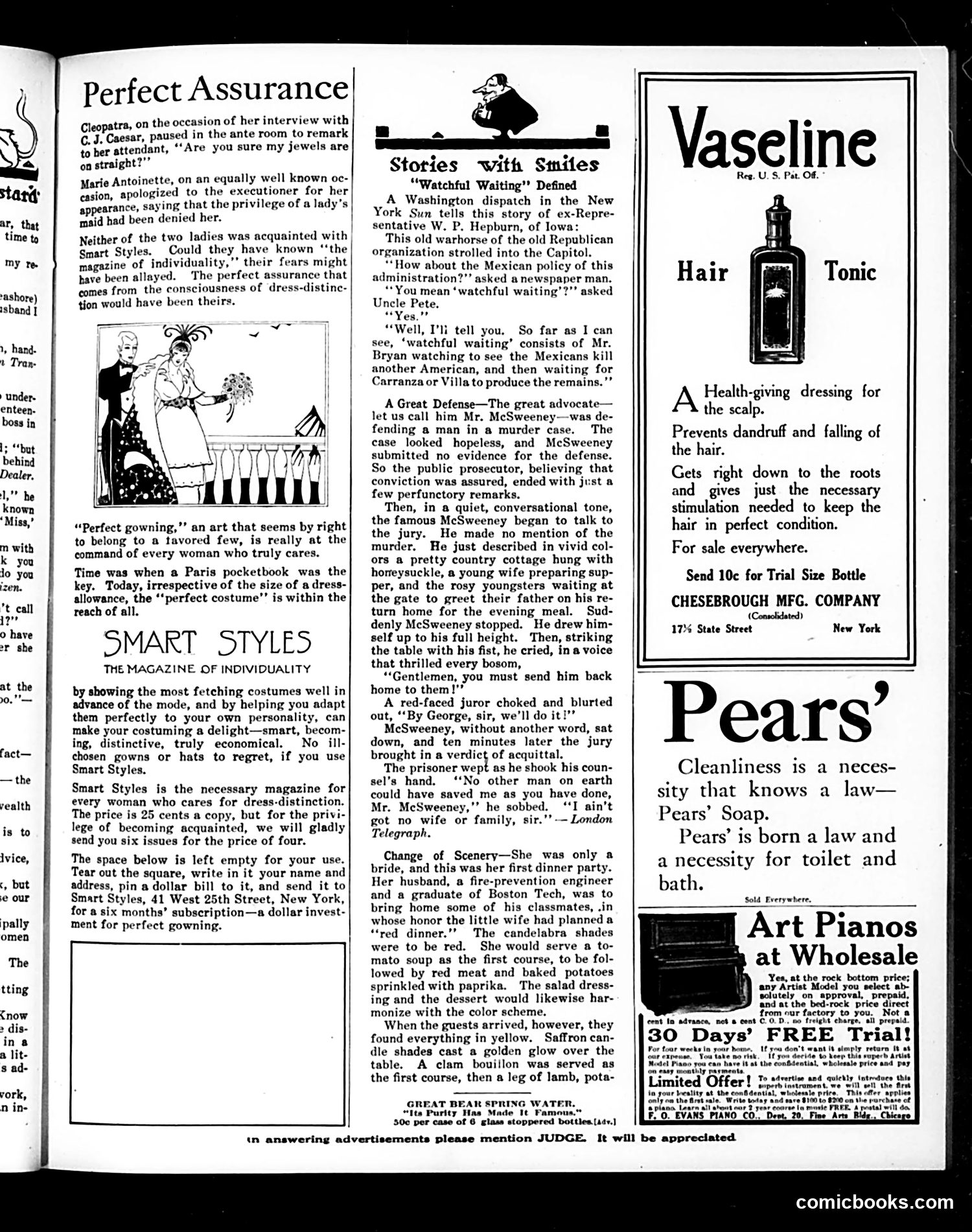
This page is primarily **advertisements and light satirical stories**, not political cartoons. The "Perfect Assurance" piece humorously contrasts historical figures (Cleopatra, Marie Antoinette) who worried about their appearance before important moments with modern women who could find confidence through "Smart Styles" magazine—a pitch for the publication itself. "Stories with Smiles" contains anecdotes mocking political figures: one ridicules President Wilson's "watchful waiting" policy toward Mexico (a real 1913-1914 policy) by suggesting it meant waiting for Americans to be killed before acting. Another celebrates a defense lawyer's emotional appeal securing an acquittal. The page is dominated by **product advertisements**: Vaseline Hair Tonic, Pears' Soap, and Art Pianos. The satirical content serves mainly as editorial filler between ads—typical for Judge's business model. The political humor assumes readers' familiarity with contemporary Mexican policy debates and legal proceedings.
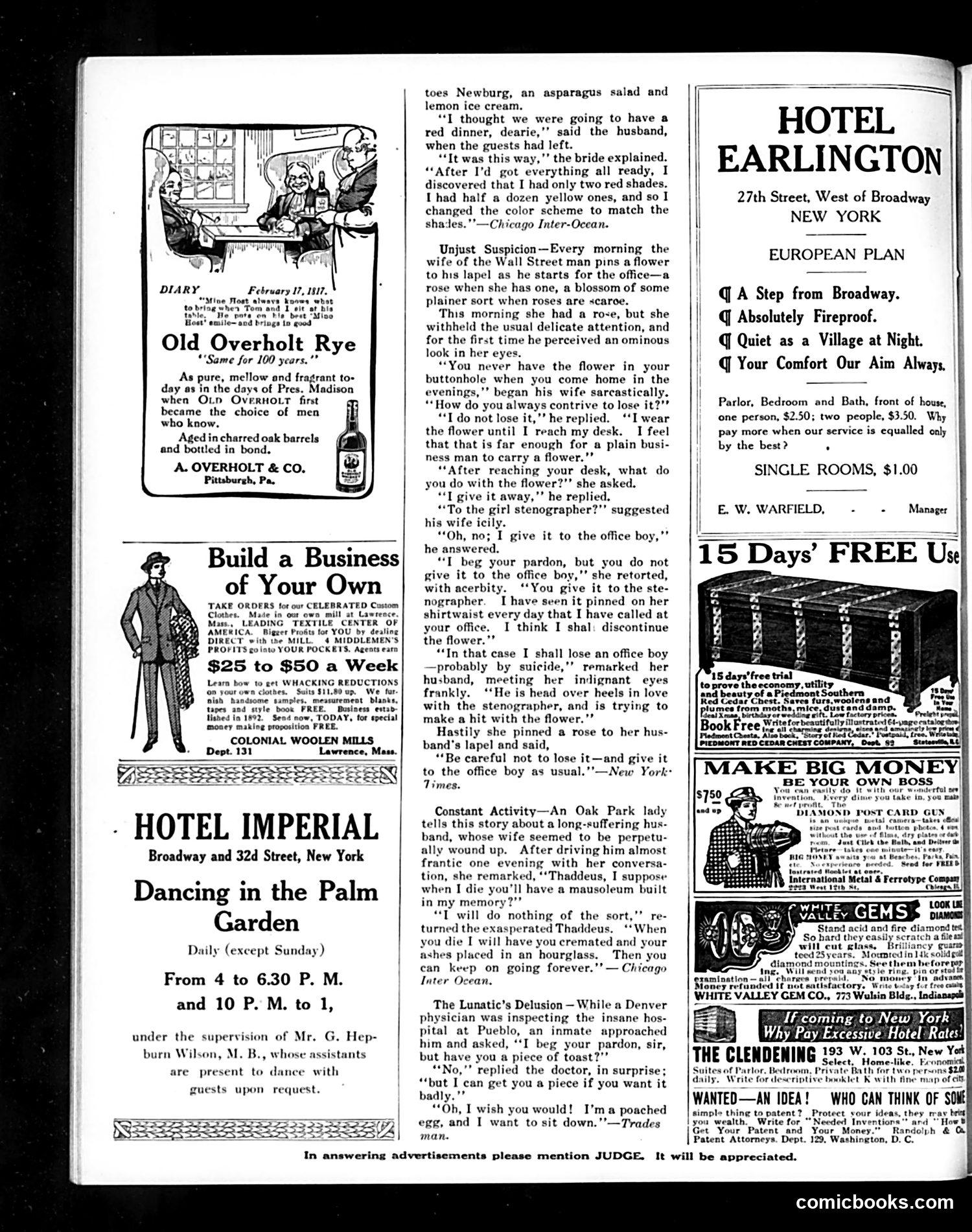
This page is primarily **advertisements and humorous anecdotal pieces**, typical of Judge magazine's format. The cartoons are minimal; the main visual is a small sketch of two figures at a dinner table (labeled "Diary"). **The humor pieces** are domestic satires reflecting early 20th-century gender dynamics: 1. **"The Flower"**: A Wall Street husband's wife suspects him of giving flowers meant for her to a stenographer. The twist: he's actually giving them to a lovestruck office boy. The satire mocks wives' suspicions and office gossip. 2. **"Constant Activity"**: An exasperated husband fantasizes about cremating his perpetually talkative wife and placing her ashes in an hourglass so she'll literally keep moving forever. Dark humor at women's chattiness. Both jokes traffic in familiar period tropes: suspicious wives, straying husbands, office flirtations, and female chattiness—reflecting anxieties about changing gender roles and workplace dynamics of the 1910s era.
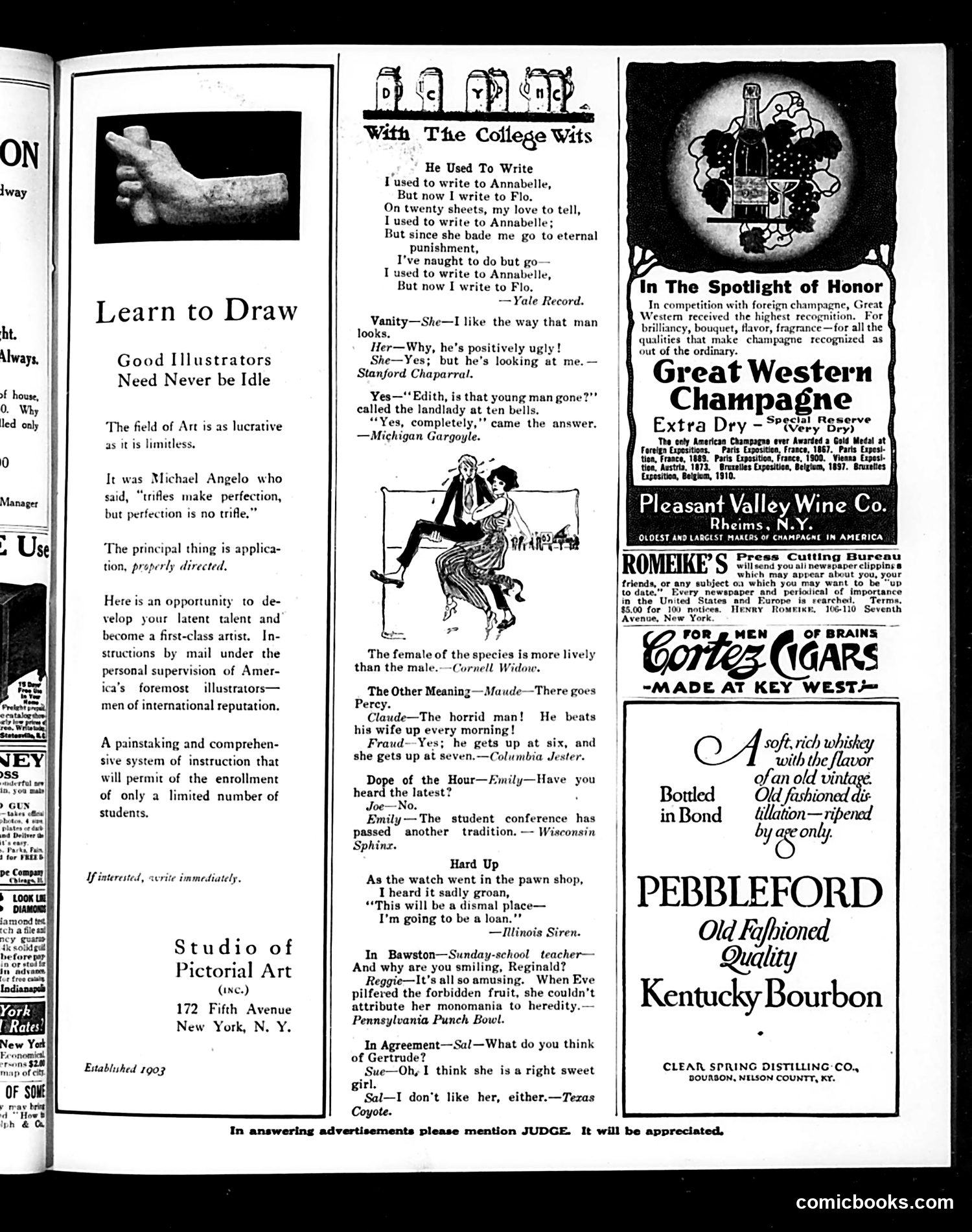
This page features humor pieces from college publications rather than political cartoons. The central content is "With The College Wits," a collection of brief jokes reprinted from university magazines (Yale Record, Stanford Chaparral, Michigan Gargoyle, etc.). The jokes target college-life stereotypes: romantic rejection, shallow vanity, landlady encounters, and student poverty. One example: a man who once wrote love letters to "Annabelle" now writes to "Flo" because Annabelle rejected him. Another satirizes female superficiality—a woman finds an ugly man attractive solely because he's looking at her. The page is primarily **advertising**: Great Western Champagne, Pebbleford Kentucky Bourbon, Romeike Press Clipping Bureau, and a "Studio of Pictorial Art" correspondence course dominate the layout. These ads suggest the magazine's affluent readership. The humor reflects early 20th-century college culture and gender attitudes now dated and problematic, but the satire targets universal human foibles—vanity, rejection, and financial struggle—that remain recognizable to modern readers.
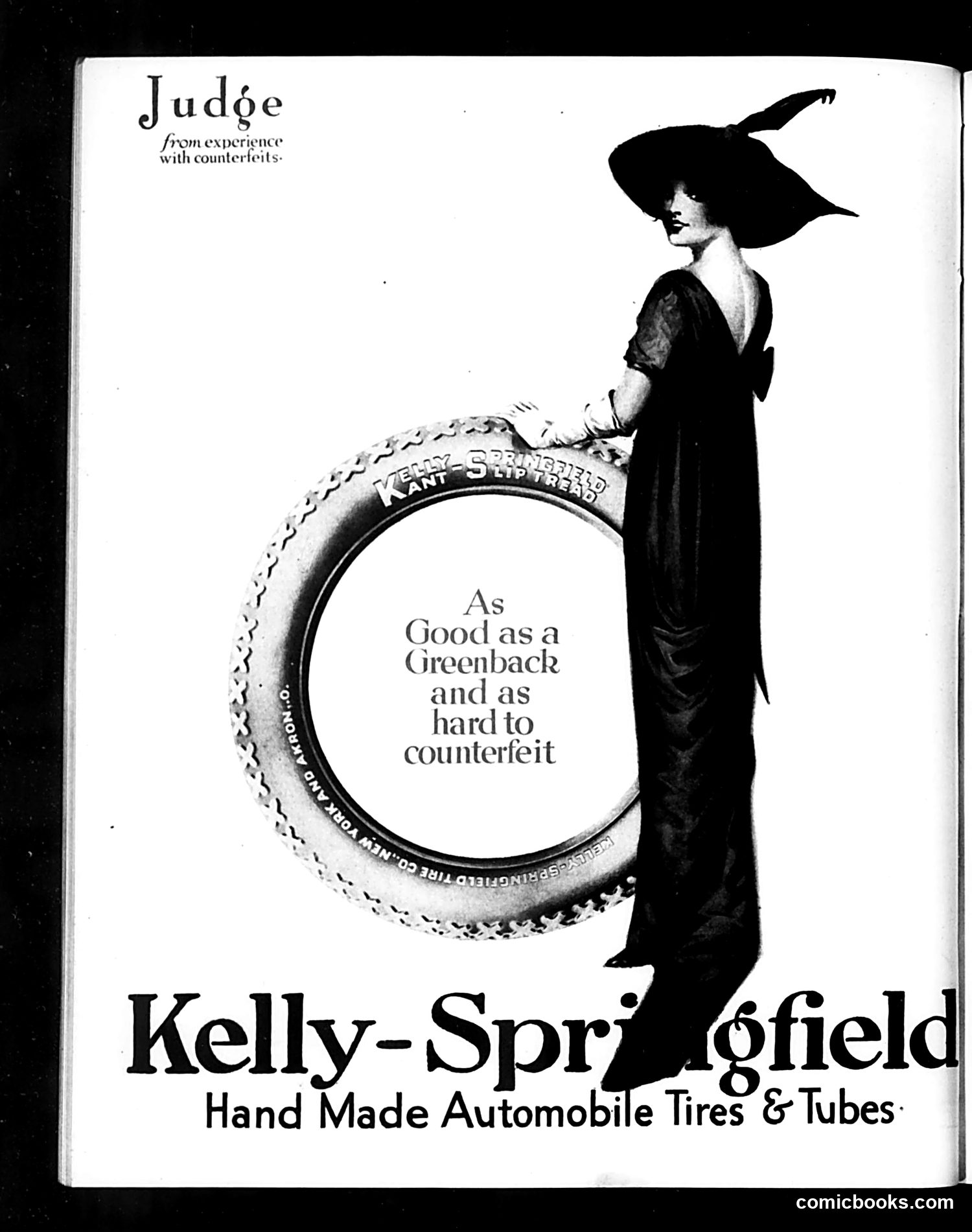
This is a **Kelly-Springfield tire advertisement**, not satirical content. The "Judge" header indicates it appeared in Judge magazine, but the page itself is a commercial ad. The ad uses a stylish woman in an enormous hat as a model, positioned next to a large tire. The tagline "Judge from experience with counterfeits" suggests tire knockoffs were a market problem. The phrase "As Good as a Greenback and as hard to counterfeit" compares Kelly-Springfield tires to U.S. currency—claiming they're both high-quality and difficult to fake illegally. This reflects early 1900s concerns about counterfeit automobile parts flooding the market. The elegant woman conveys luxury and reliability, targeting wealthy motorists who could afford quality tires and feared purchasing inferior fakes.