
Judge, 1914-04-11 · page 16 of 24
Judge — April 11, 1914 — page 16: what you’re looking at
What you’re looking at
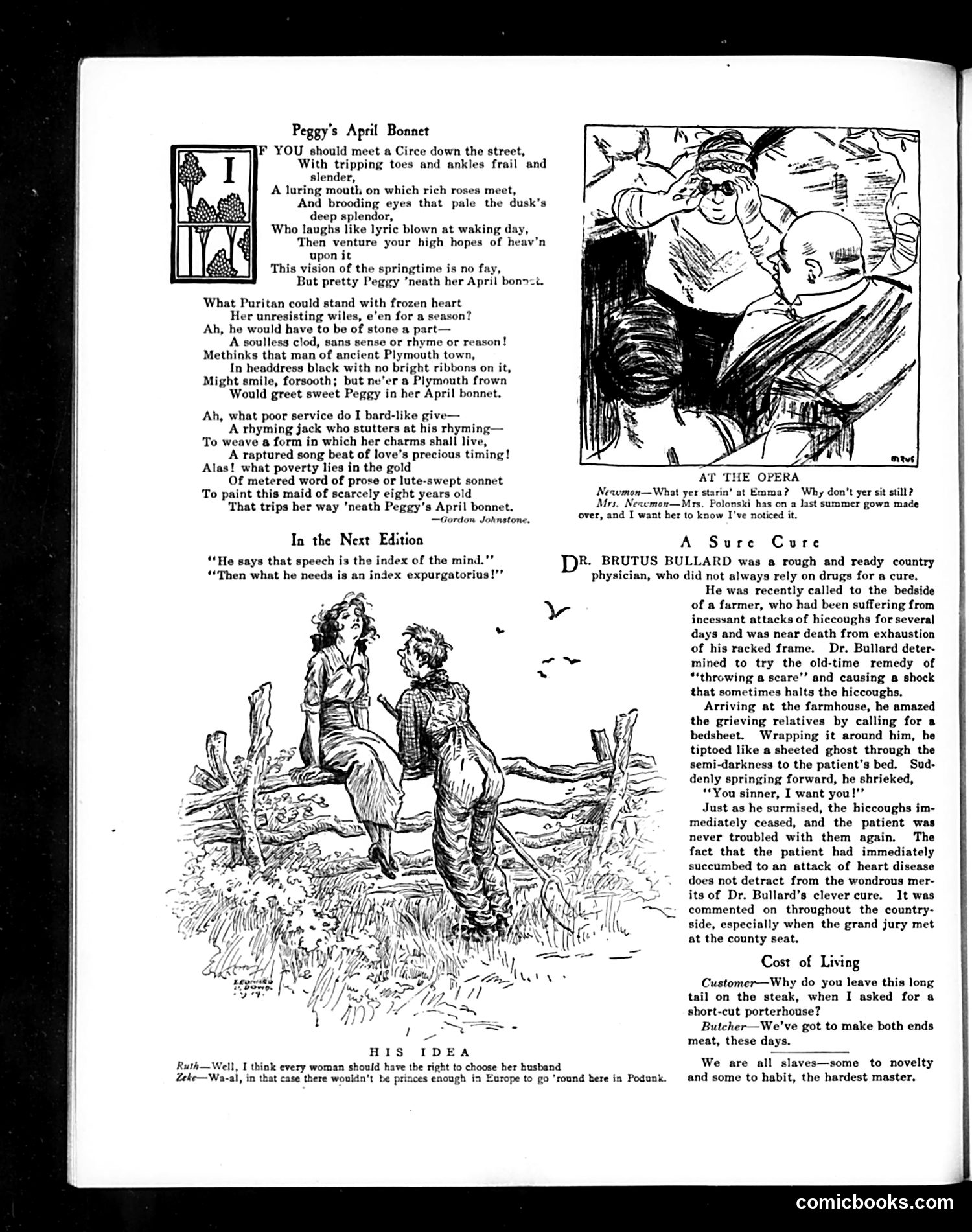
This page contains several distinct pieces of humor typical of early 20th-century satirical magazines: **"Peggy's April Bonnet"** is a romantic poem celebrating a beautiful young woman in springtime, written in flowery Victorian verse. It contrasts her attractiveness with Puritan restraint, suggesting even stern Plymouth colonists would smile at her charm. **"At the Opera"** is a brief joke about social climbing: Mrs. Newson publicly stares at Mrs. Polonski to ensure she notices her wearing last summer's reused gown—a dig at class-conscious social pretense and economic hardship. **"A Sure Cure"** is dark humor: Dr. Bullard frightens a farmer's hiccoughs away by disguising himself as a ghost, but the shock causes a fatal heart attack. The joke's point: the "cure" technically worked, though it killed the patient—satirizing dubious folk medicine and its rationalization. **"Cost of Living"** and **"His Idea"** are brief economic jokes about postwar austerity and women's marriage rights, reflecting Depression-era concerns and gender debates.
📄 Transcribed text from this page (OCR, searchable)
Machine-transcribed from the original scan — historical spelling and the odd misread are preserved.
Peggy’s April Bonnet F YOU should meet a Circe down the street, With tripping toes and ankles frail and slender, A luring mouth on which rich roses meet, And brooding eyes that pale the dusk’s deep splendor, Who laughs like lyric blown at waking day, Then venture your high hopes of heav’n upon it This vision of the springtime is no fay, But pretty Peggy ‘neath her April bonoct. What Puritan could stand with frozen heart Her unresisting wiles, e’en for Ah, he would have to be of stone a part— A soulless clod, sans sense or rhyme or reason! Methinks that man of ancient Plymouth town, In headdress black with no bright ribbons on it, Might smile, forsooth; but ne’er a Plymouth frown Would greet sweet Peggy in her April bonnet. Ah, what poor service do I bard-like give— A rhyming jack who stutters at his rhyming— To weave a form in which her charms shall live, A raptured song beat of love's precious timing! Alas! what poverty lies in the gold ———— Of metered word of prose or lute-swept sonnet AT THE OPERA To paint this maid of scarcely eight years old Newwmon—What yer starin’ at Emma? Why don't yer sit still? ‘That trips her way ‘neath Peggy's April bonnet. Mrs, Necemon—Mrs, Polonski has on a last Summer gown made a aaa a ia Se over, and I want her to know I've noticed it. In the Next Edition A Sure Cure “He says that speech is the index of the mind."’ DF BRUTUS BULLARD was a rough and ready country “Then what he needs is an index expurgatorius!’’ physician, who did not always rely on drugs for a cure. He was recently called to the bedside of a farmer, who had been suffering from incessant attacks of hiccoughs for several days and was near death from exhaustion of his racked frame. Dr. Bullard deter- mined to try the old-time remedy of “‘throwing a scare’? and causing a shock that sometimes halts the hiccoughs. Arriving at the farmhouse, he amazed the grieving relatives by calling for a bedsheet. Wrapping it around him, he tiptoed like a sheeted ghost through the semi-darkness to the patient's bed. Sud- denly springing forward, he shrieked, “You sinner, I want you!”’ Just as he surmised, the hiccoughs im- mediately ceased, and the patient was never troubled with them again. The fact that the patient had immediately succumbed to an attack of heart disease does not detract from the wondrous mer- its of Dr. Bullard’s clever cure. It was commented on throughout the country- side, especially when the grand jury met at the county seat. Cost of Living Customer—Why do you leave this long tail on the steak, when I asked for a short-cut porterhouse? Butcher—We've got to make both ends meat, these days. We are all slaves—some to novelty Zete—Wa-al, in that case there wouldn't be princes enough in Europe to go ‘round here in Podunk. and some to habit, the hardest master. Ruth—Well, I think every woman should have the right to choose her husband comicbooks.com