
Judge, 1914-04-11 · page 7 of 24
Judge — April 11, 1914 — page 7: what you’re looking at
What you’re looking at
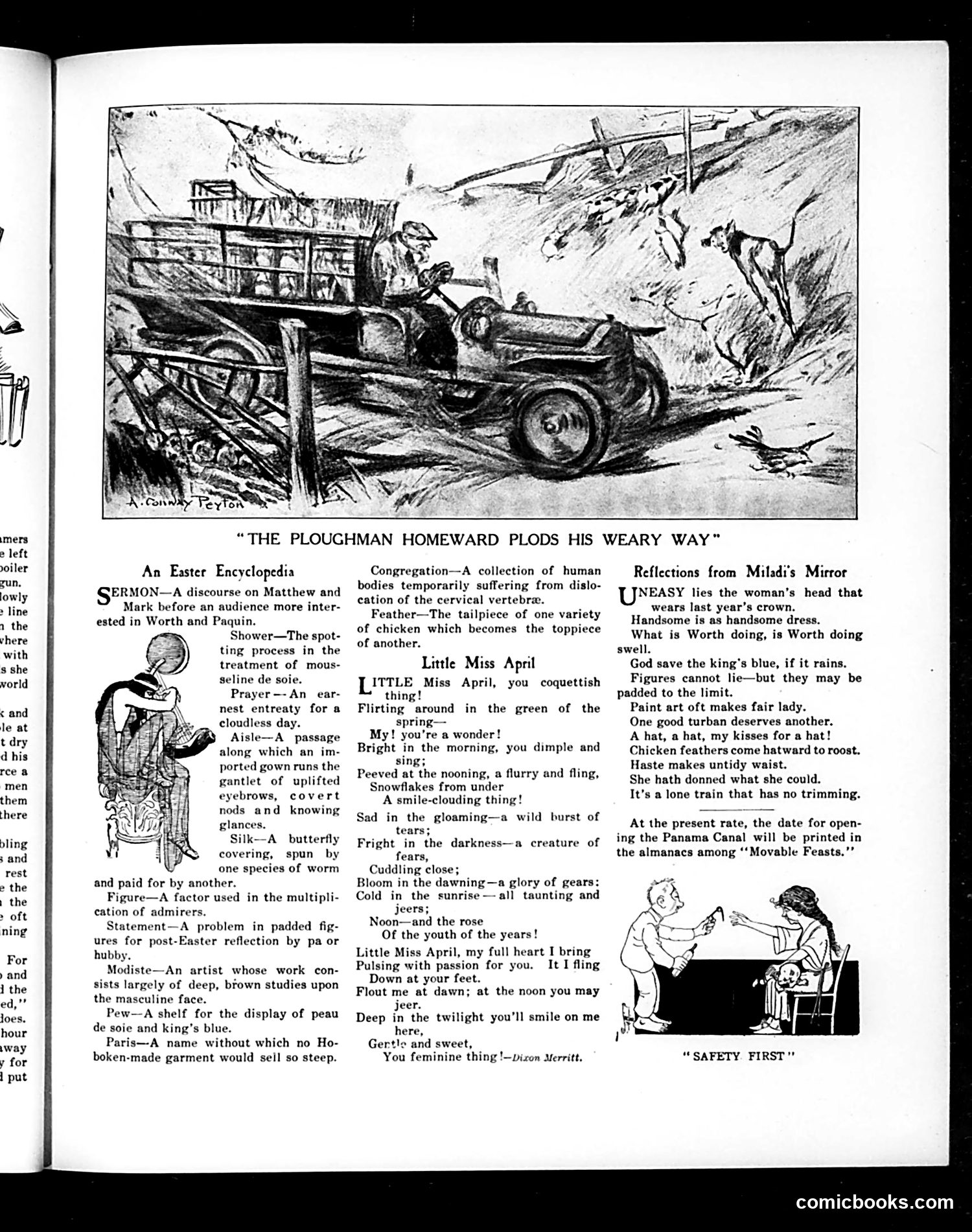
This 1910s Judge magazine page satirizes Easter fashion culture among wealthy women. The main cartoon shows a farmer's simple cart contrasted with an elaborate Easter procession—mocking how Easter had become a fashion display rather than a religious observance. The "Easter Encyclopedia" is satirical wordplay: "Sermon" defines it as secondary to discussing designer fashion houses (Worth and Paquin); "Congregation" describes women craning their necks to see each other's outfits; "Pew" becomes merely a display shelf for expensive fabrics. The humor targets how materialism and vanity had overtaken Easter's spiritual meaning. "Little Miss April" is sentimental verse about spring's mood swings. "Reflections from Miladi's Mirror" offers cynical observations on women's fashion obsession—"Figures cannot lie—but they may be padded to the limit" suggests women padding both clothing and post-Easter bills for their husbands. The page satirizes Gilded Age excess and the commercialization of religious holidays among the wealthy.
📄 Transcribed text from this page (OCR, searchable)
Machine-transcribed from the original scan — historical spelling and the odd misread are preserved.
“THE PLOUGHMAN HOMEWARD PLODS HIS WEARY WAY” An Easter Encyclopedia ERMON—A discourse on Matthew and Mark before an audience more inter- ested in Worth and Paquin. Shower—The spot- ting process in the treatment of mous- seline de soie. Prayer—-An_ ear- nest entreaty for a cloudless day. Aisle—A passage along which an im- ported gown runs the gantlet of uplifted eyebrows, covert nods and knowing glances. Silk—A_ butterfly covering, spun by one species of worm and paid for by another. Figure—A factor used in the multipli- cation of admirers. Statement—A problem in padded fig- ures for post-Easter reflection by pa or hubby. Modiste—An artist whose work con- sists largely of deep, brown studies upon the masculine face. Pew—A shelf for the display of peau de soie and king's blue. Paris—A name without which no Ho- boken-made garment would seil so steep. Congregation—A collection of human bodies temporarily suffering from dislo- cation of the cervical vertebra. Feather—The tailpiece of one variety of chicken which becomes the toppiece of another. Little Miss April LITTLE Miss April, you coquettish thing! Flirting around in spring— My! you're a wonder! Bright in the morning, you dimple and sing; Peeved at the nooning, a flurry and fling, Snowflakes from under A smile-clouding thing! Sad in the gloaming—a wild burst of tears; Fright in the darkness—a creature of fears, Cuddling close; Bloom in the dawning—a glory of gears: Cold in the sunrise — all taunting and jeers; Noon—and the rose Of the youth of the years! Little Miss April, my full heart I bring Pulsing with passion for you. It I fling Down at your feet. Flout me at dawn; at the noon you may jeer. Deep in the twilight you'll smile on me here, Gertle and sweet, You feminine thing !—vizon Merritt, the green of the Reflections from Miladi’s Mirror NEASY lies the woman's head that wears last year’s crown. Handsome is as handsome dress. What is Worth doing, is Worth doing swell. God save the king's blue, if it rains. Figures cannot lie—but they may be padded to the limit. Paint art oft makes fair lady. One good turban deserves another. A hat, a hat, my kisses for a hat! Chicken feathers come hatward to roost. Haste makes untidy waist. She hath donned what she could. It’s a lone train that has no trimming. At the present rate, the date for open- ing the Panama Canal will be printed in the almanacs among ‘‘Movable Feasts.’’ “SAFETY FIRST" comicbooks.com