
Judge, 1914-04-11 · page 4 of 24
Judge — April 11, 1914 — page 4: what you’re looking at
What you’re looking at
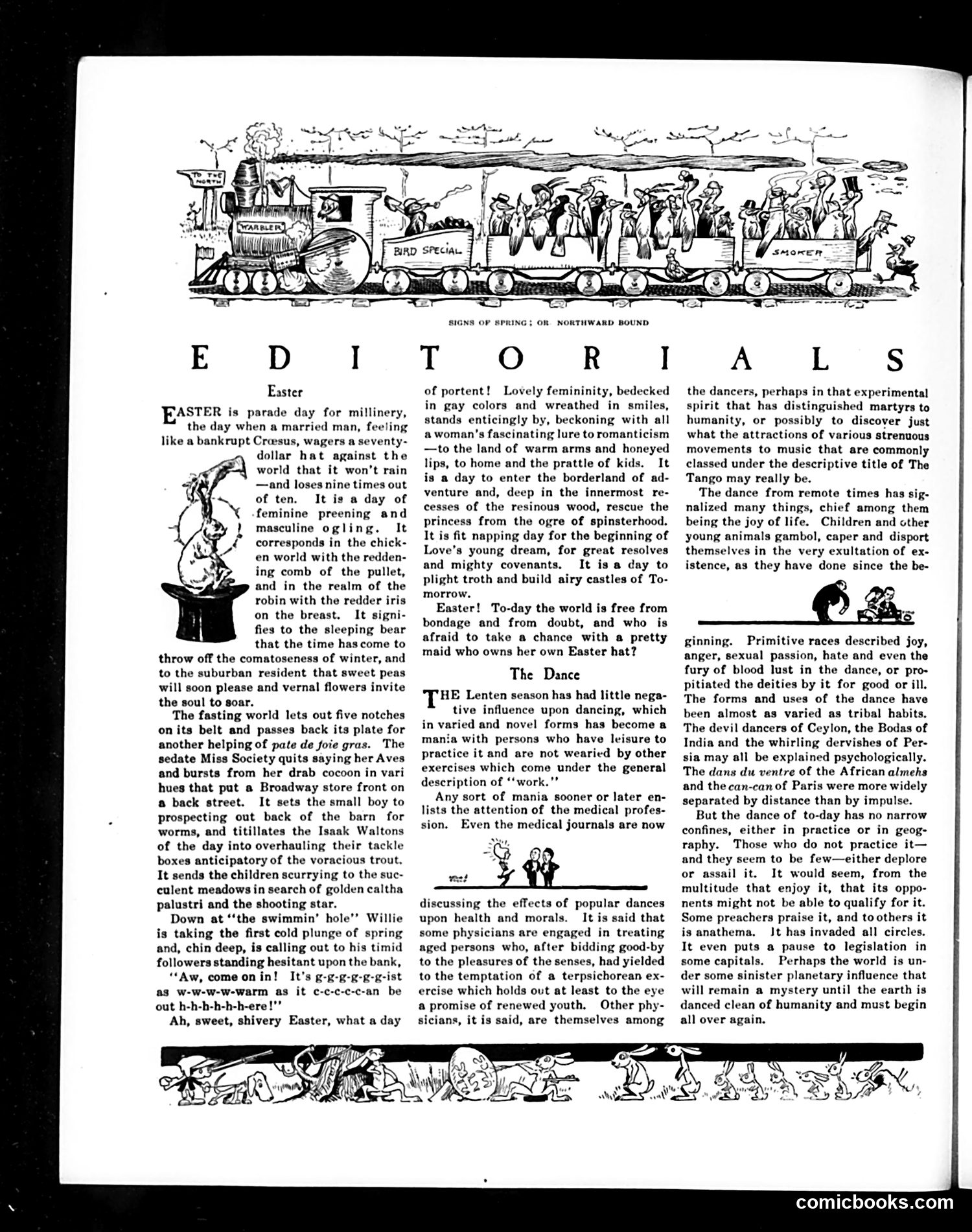
This Judge magazine editorial page celebrates Easter and spring's arrival, featuring a whimsical train illustration titled "Signs of Spring: Or Northward Bound" at the top. The main editorials discuss Easter as a holiday representing renewal and feminine fashion ("millinery"), and analyze social dancing's moral implications. The text criticizes physicians and moralists who debate whether popular dances like the Tango promote vice or are harmless recreation. The satirical angle targets contemporary anxiety about modern dance—particularly the Tango, which was considered scandalous in early 20th-century America for its close partner contact and sensual movements. The editorial mocks both medical professionals and moral crusaders for obsessing over dancing's dangers, suggesting their concerns are overwrought. The decorative borders and tone reflect Judge's satirical commentary on American social debates of its era.
📄 Transcribed text from this page (OCR, searchable)
Machine-transcribed from the original scan — historical spelling and the odd misread are preserved.
Easter ASTER is parade day for millinery, the day when a married man, feeling like a bankrupt Croesus, wagers a seventy- dollar hat against the world that it won't rain —and loses nine times out of ten. It is a day of feminine preening and masculine ogling. It corresponds in the chick- en world with the redden- ing comb of the pullet, and in the realm of the robin with the redder iris on the breast. It signi- fies to the sleeping bear that the time has come to throw off the comatoseness of winter, and to the suburban resident that sweet peas will soon please and vernal flowers invite the soul to soar. The fasting world lets out five notches on its belt and passes back its plate for another helping of pate de foie gras. The sedate Miss Society quits saying her Aves and bursts from her drab cocoon in vari hues that put a Broadway store front on 8 back street. It sets the small boy to prospecting out back of the barn for worms, and titillates the Isaak Waltons of the day into overhauling their tackle boxes anticipatory of the voracious trout. It sends the children scurrying to the suc- culent meadows in search of golden caltha palustri and the shooting star. Down at ‘‘the swimmin’ hole’’ Willie is taking the first cold plunge of spring and, chin deep, is calling out to his timid followers standing hesitant upon the bank, ‘Aw, come on in! It's g-g-g-g-g-g-ist as w-w-w-w-warm as it c-c-c-c-c-an be out h-h-h-h-h-h-ere!"” Ah, sweet, shivery Easter, what a day SIGNS OF SPRING; OR NORTHWARD BOUND T O R I of portent! Lovely femininity, bedecked in gay colors and wreathed in smiles, stands enticingly by, beckoning with all a woman's fascinating lure to romanticism —to the land of warm arms and honeyed lips, to home and the prattle of kids. It is a day to enter the borderland of ad- venture and, deep in the innermost re- cesses of the resinous wood, rescue the princess from the ogre of spinsterhood. It is fit napping day for the beginning of Love’s young dream, for great resolves and mighty covenants. It is a day to plight troth and build airy castles of To- morrow. Easter! To-day the world is free from bondage and from doubt, and who is afraid to take a chance with a pretty maid who owns her own Easter hat? The Dance HE Lenten season has had little nega- tive influence upon dancing, which in varied and novel forms has become a mania with persons who have leisure to practice it and are not wearied by other exercises which come under the general description of ‘‘work.’” Any sort of mania sooner or later en- lists the attention of the medical profes- sion. Even the medical journals are now discussing the effects of popular dances upon health and morals. It is said that some physicians are engaged in treating aged persons who, after bidding good-by to the pleasures of the senses, had yielded to the temptation of a terpsichorean ex- ercise which holds out at least to the eye a promise of renewed youth. Other phy- sicians, it is said, are themselves among A the dancers, perhaps in that experimental spirit that has distinguished martyrs to humanity, or possibly to discover just what the attractions of various strenuous movements to music that are commonly classed under the descriptive title of The Tango may really be. The dance from remote times has sig- nalized many things, chief among them being the joy of life. Children and other young animals gambol, caper and disport themselves in the very exultation of ex- istence, as they have done since the be- ginning. Primitive races described joy, anger, sexual passion, hate and even the fury of blood lust in the dance, or pro- pitiated the deities by it for good or ill. The forms and uses of the dance have been almost as varied as tribal habits. The devil dancers of Ceylon, the Bodas of India and the whirling dervishes of Per- sia may all be explained psychologically. The dans du ventre of the African almehs and the can-canof Paris were more widely separated by distance than by impulse. But the dance of to-day has no narrow confines, either in practice or in geog- raphy. Those who do not practice it— and they seem to be few—either deplore or assail it. It would seem, from the multitude that enjoy it, that its oppo- nents might not be able to qualify for it. Some preachers praise it, and to others it is anathema, Jt has invaded all circles. It even puts a pause to legislation in some capitals. Perhaps the world is un- der some sinister planetary influence that will remain a mystery until the earth is danced clean of humanity and must begin all over again. OS comicbooks.com