
Judge, 1914-04-11 · page 5 of 24
Judge — April 11, 1914 — page 5: what you’re looking at
What you’re looking at
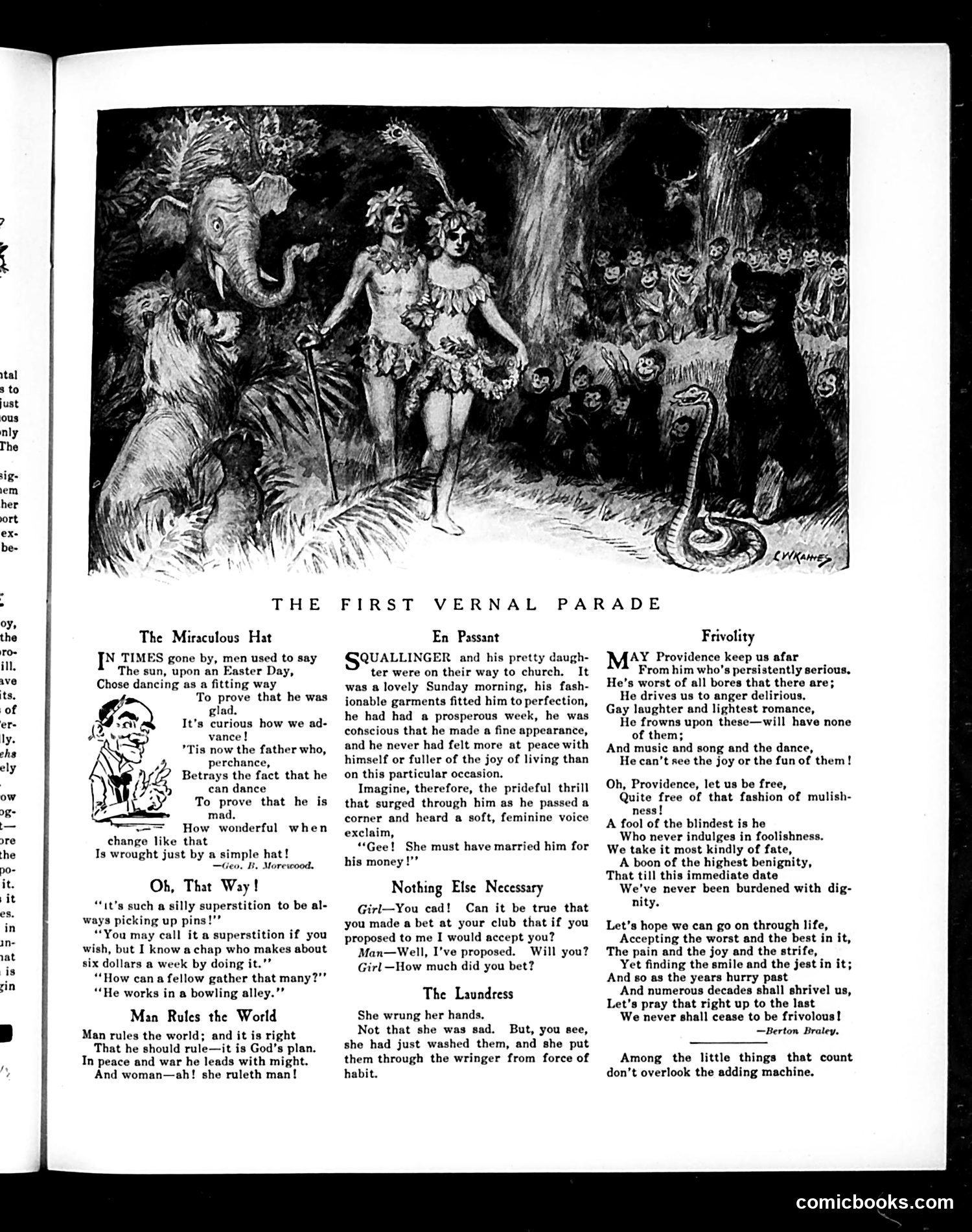
This page presents humorous sketches about Easter traditions and gender roles, typical of Judge's early 20th-century satirical approach. The main illustration depicts a whimsical woodland scene with anthropomorphic animals and figures, titled "The First Vernal Parade"—likely satirizing the then-contemporary Easter parade tradition (fashionable public displays of new spring clothing). The accompanying text pieces mock Victorian social conventions: "The Miraculous Hat" jokes about men's superstitions regarding Easter finery; "Man Rules the World" presents ironic commentary on male dominance; and "The Laundress" humorously depicts domestic labor. The humor relies on period-specific references to Easter fashion, social hierarchies, and gender dynamics that would have resonated with Judge's educated readership concerned with critiquing middle-class pretension and social absurdities.
📄 Transcribed text from this page (OCR, searchable)
Machine-transcribed from the original scan — historical spelling and the odd misread are preserved.
THE FIRST VERNAL PARADE The Miraculous Hat [' TIMES gone by, men used to say The sun, upon an Easter Day, Chose dancing as a fitting way ¢ To prove that he was glad. ¥ Bes It’s curious how we ad- Be rs vance! (“s) ‘Tis now the father who, 5 perchance, Ve Betrays the fact that he . te, ~ can dance ay To prove that he is mad, > How wonderful when change like that Is wrought just by a simple hat! 0, B, Morewood, Oh, That Way! “it’s such a silly superstition to be al- ways picking up pins!” “You may call it a superstition if you wish, but I know a chap who makes about six dollars a week by doing it."” “How can a fellow gather that many?’’ “He works in a bowling alley.”” Man Rules the World Man rules the world; and it is right That he should rule—it is God’s plan. In peace and war he leads with might. And woman—ah! she ruleth man! En Passant SQUALLINGER and his pretty daugh- ter were on their way to church. It was a lovely Sunday morning, his fash- ionable garments fitted him to perfection, he had had a prosperous week, he was conscious that he made a fine appearance, and he never had felt more at peace with himself or fuller of the joy of living than on this particular occasion. Imagine, therefore, the prideful thrill that surged through him as he passed a corner and heard a soft, feminine voice exclaim, “Gee! She must have married him for his money!’’ Nothing Else Necessary Girl—You cad! Can it be true that you made a bet at your club that if you proposed to me I would accept you? Man—Well, I've proposed. Will you? Girl —How much did you bet? The Laundress She wrung her hands. Not that she was sad. But, you see, she had just washed them, and she put them through the wringer from force of habit. Frivolity AY Providence keep us afar From him who’s persistently serious, He’s worst of all bores that there are; He drives us to anger delirious, Gay laughter and lightest romance, He frowns upon these—will have none of them; And music and song and the dance, He can’t ree the joy or the fun of them! Oh, Providence, let us be free, Quite free of that fashion of mulish- ness! A fool of the blindest is he Who never indulges in foolishness. We take it most kindly of fate, A boon of the highest benignity, That till this immediate date We've never been burdened with dig- nity. Let’s hope we can go on through life, Accepting the worst and the best in it, The pain and the joy and the strife, Yet finding the smile and the jest in it; And so as the years hurry past And numerous decades shall shrivel us, Let’s pray that right up to the last We never shall cease to be frivolous! —Berton Braley. Among the little things that count don’t overlook the adding machine. comicbooks.com