
Judge, 1914-04-11 · page 8 of 24
Judge — April 11, 1914 — page 8: what you’re looking at
What you’re looking at
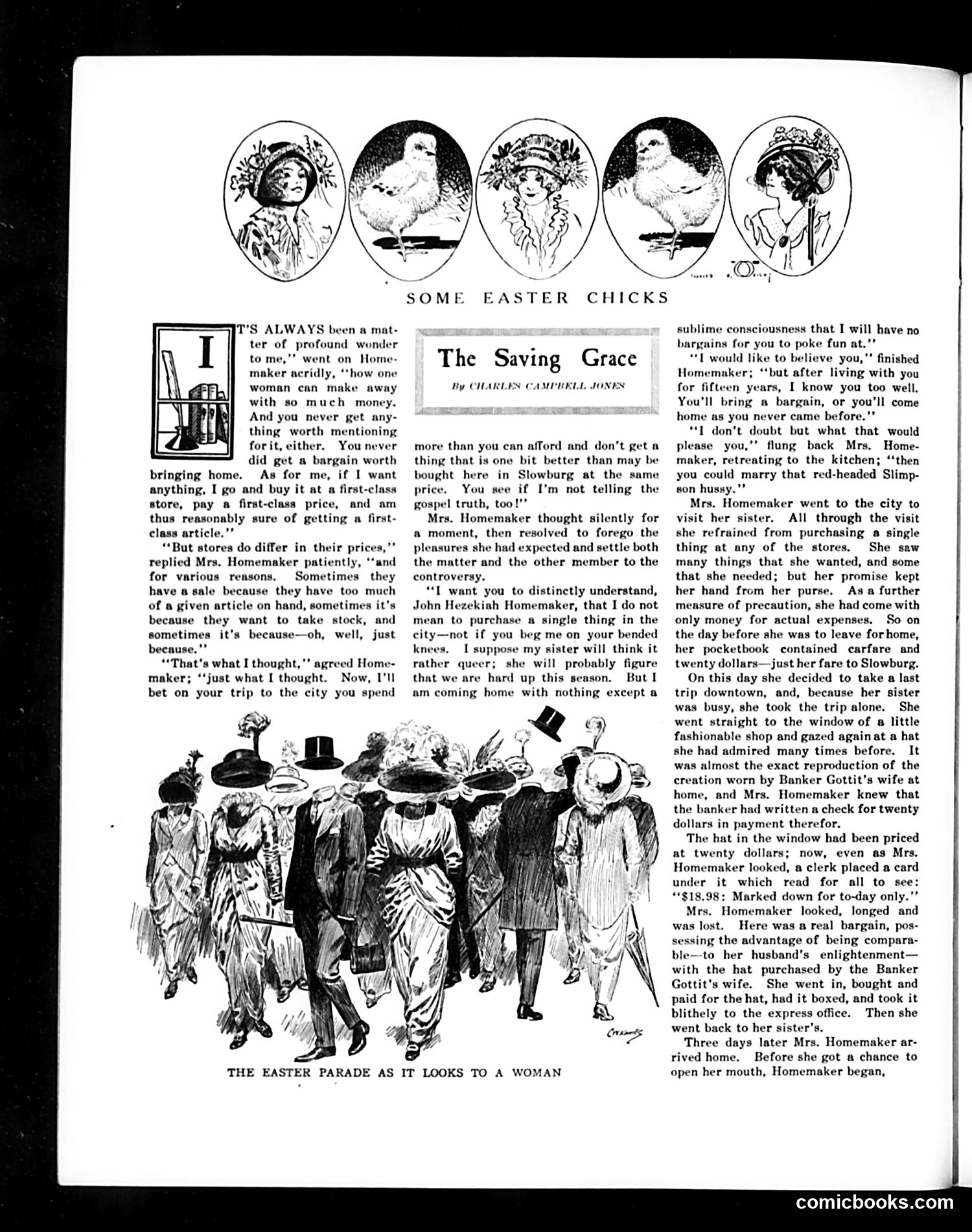
This story satirizes marital dynamics and consumer behavior in the early 20th century. A husband (Homemaker) criticizes his wife for wasteful shopping, claiming she always overspends in the city. She bets she'll return with nothing, determined to prove him wrong. However, the satire's "point" lies in the ironic ending: Mrs. Homemaker successfully resists purchases until spotting a hat marked down from $20 to $18.98—the exact model worn by the wealthy banker's wife. The markdown becomes her rationalization for breaking her promise, buying it anyway. The joke targets both spouses: the husband's sanctimonious lecturing and the wife's susceptibility to sales tactics and social comparison (wanting the banker's wife's status symbol). The "saving grace" is actually a saving *face*—she can tell her husband she got a bargain, thus avoiding his "I told you so." The cartoon illustrates the futility of her resolution through the Easter parade image above.
📄 Transcribed text from this page (OCR, searchable)
Machine-transcribed from the original scan — historical spelling and the odd misread are preserved.
IT’S ALWAYS been a mat- ter of profound wonder to me,”” went on Home- maker acridly, “how one woman can make away with so much money. And you never get any- thing worth mentioning forit, either. You never did get a bargain worth bringing home. As for me, if I want anything, I go and buy it at a first-class store, pay a first-class price, and am thus reasonably sure of getting a first- class article."’ “But stores do differ in their prices,’’ replied Mrs. Homemaker patiently, ‘tand for various reasons. Sometimes they have a sale because they have too much of a given article on hand, sometimes it's because they want to take stock, and sometimes it’s because—oh, well, just because."’ “That's what I thought,'’ agreed Home- maker; ‘‘just what I thought. Now, I'll bet on your trip to the city you spend The Saving Grace By CHARLES CAMPRELL JONES more than you can afford and don’t get a thing that is one bit better than may be bought here in Slowburg at the same price. You see if I'm not telling the gospel truth, too!’’ Mrs. Homemaker thought silently for & moment, then resolved to forego the pleasures she had expected and settle both the matter and the other member to the controversy. “T want you to distinctly understand, John Hezekiah Homemaker, that I do not mean to purchase a single thing in the city—not if you beg me on your bended knees. I suppose my sister will think it rather queer; she will probably figure that we are hard up this season. But I am coming home with nothing except a THE EASTER PARADE AS IT LOOKS TO A WOMAN sublime consciousness that I will have no bargains for you to poke fun at.” “*L would like to believe you,’’ finished Homemaker; ‘‘but after living with you for fifteen years, I know you too well. You'll bring a bargain, or you'll come home as you never came before.”” “IT don't doubt but what that would please you,’’ flung back Mrs. Home- maker, retreating to the kitchen; ‘then you could marry that red-headed Slimp- son hussy.”? Mrs. Homemaker went to the city to visit her sister. All through the visit she refrained from purchasing a single thing at any of the stores. She saw many things that she wanted, and some that she needed; but her promise kept her hand from her purse. As a further measure of precaution, she had come with only money for actual expenses. So on the day before she was to leave for home, her pocketbook contained carfare and twenty dollars—just her fare to Slowburg. On this day she decided to take a last trip downtown, and, because her sister was busy, she took the trip alone. She went straight to the window of a little fashionable shop and gazed again at a hat she had admired many times before. It was almost the exact reproduction of the creation worn by Banker Gottit’s wife at home, and Mrs. Homemaker knew that the banker had written a check for twenty dollars in payment therefor. The hat in the window had been priced at twenty dollars; now, even as Mrs, Homemaker looked, a clerk placed a card under it which read for all to see: “$18.98: Marked down for to-day only.’” Mrs. Homemaker looked, longed and was lost. Here was a real bargain, pos- sessing the advantage of being compara- ble—to her husband’s enlightenment— with the hat purchased by the Banker Gottit’s wife. She went in, bought and paid for the hat, had it boxed, and took it blithely to the express office. Then she went back to her sister’s. Three days later Mrs. Homemaker ar- rived home. Before she got a chance to open her mouth, Homemaker began, comicbooks.com