
A complete issue · 24 pages · 1914
Judge — March 21, 1914
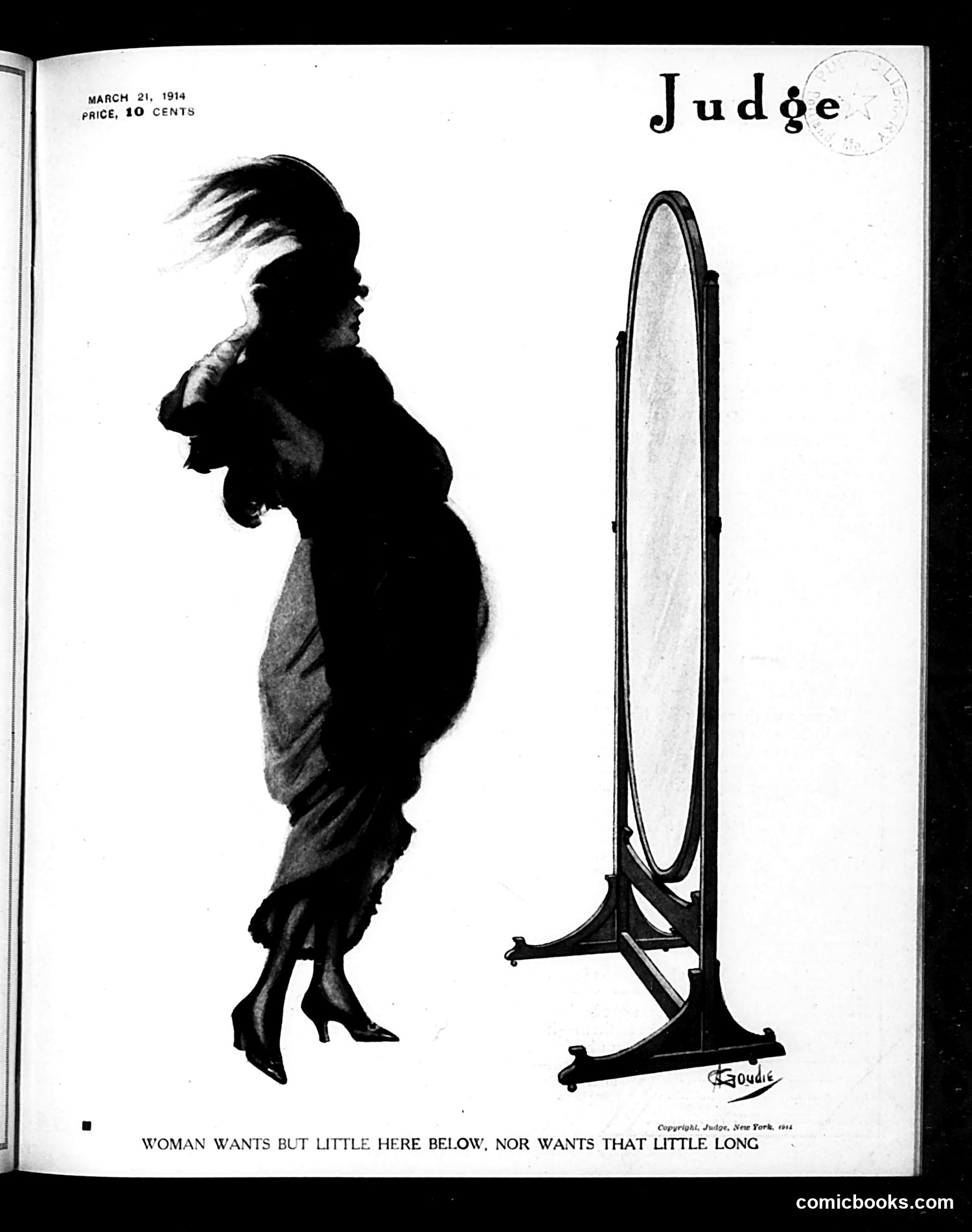
This cartoon satirizes women's fashion and body image standards of the early 20th century. A silhouetted woman admires herself in a full-length mirror, her body exaggerated with an extremely prominent posterior—a caricature of the fashionable S-bend corset silhouette popular in that era. The caption reads: "Woman wants but little here below, nor wants that little long"—a twist on a famous poem, suggesting women desire minimal things but don't want them to last (implying fashion's fleeting nature or the temporary nature of beauty standards). The cartoon mocks both female vanity and the absurd body proportions that corsetry produced, while also critiquing how fashion industries constantly shift what's considered desirable, making women perpetually dissatisfied.
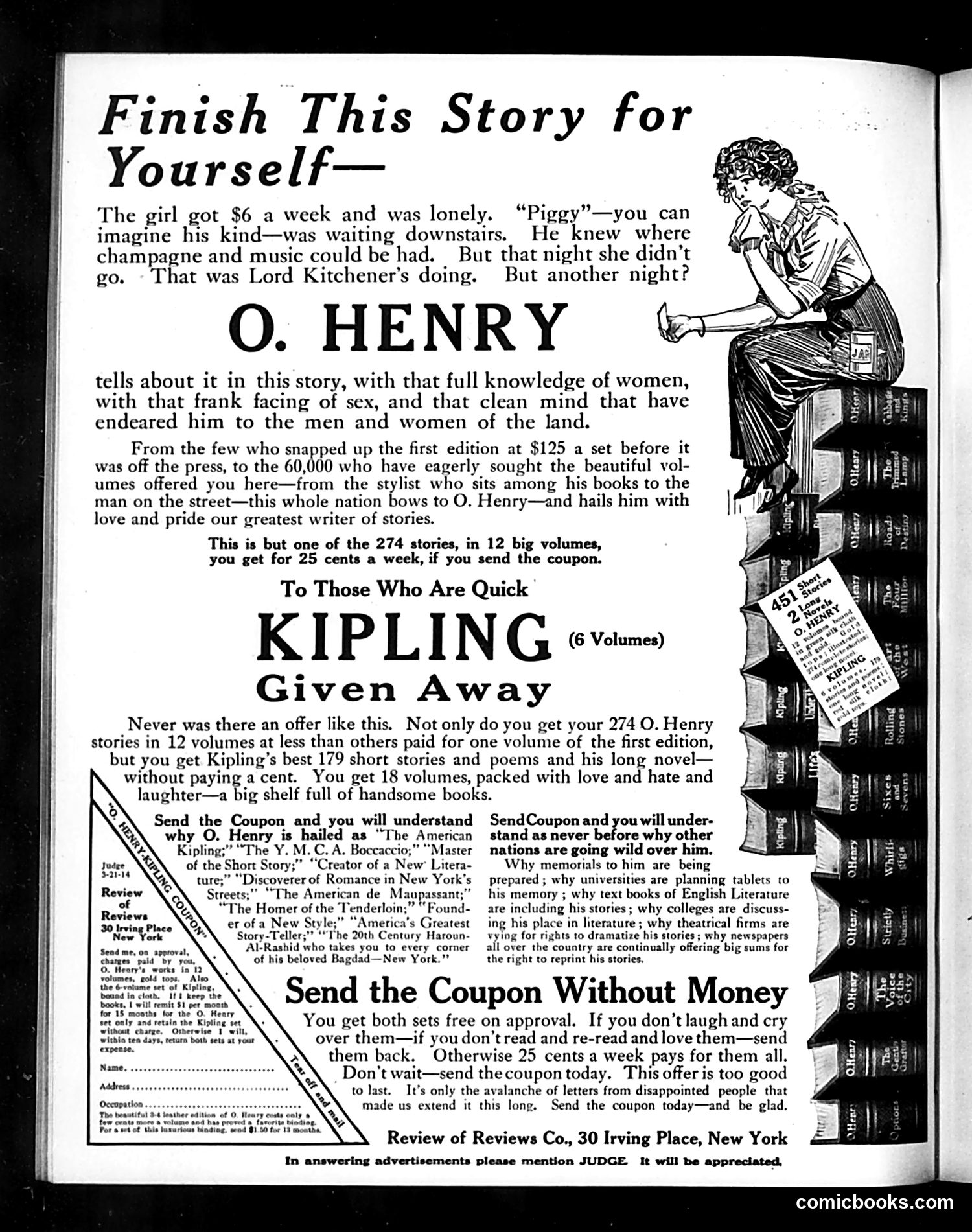
This page is primarily **advertising, not satire or political commentary**. It promotes two book collections: 1. **O. Henry stories** — advertised as tales showcasing the author's "knowledge of women" and "frank facing of sex," appealing to readers seeking sophisticated, adult-oriented short fiction. 2. **Kipling works** — a giveaway offer of 6 volumes bundled with the O. Henry set, emphasizing Kipling's popularity and literary status. The small illustration shows a woman sitting atop stacked books, seemingly pondering which to read—a visual metaphor for the abundance of literature being offered. The "Finish This Story Yourself" prompt at top is a reader-engagement device, not political satire. This is a **commercial pitch** leveraging popular authors' reputations to sell subscription-based book collections at 25 cents weekly.
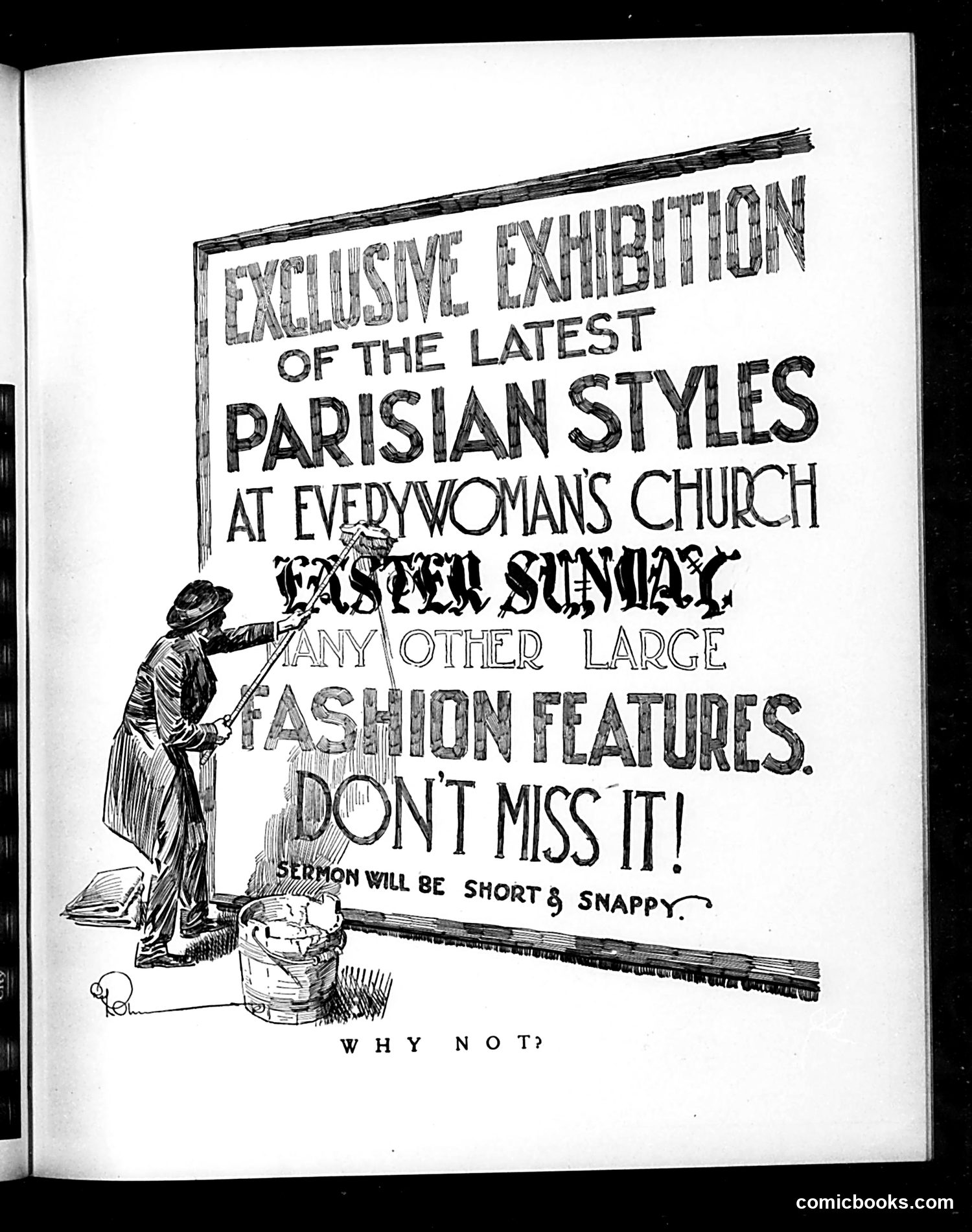
This is primarily an **advertisement** for an Easter Sunday event at Everywoman's Church, disguised as a satirical announcement. The image shows a figure (appears to be a woman) posting or pointing to the notice, with painter's supplies at her feet. The satire targets the commercialization of religious observance: the church is promoting an "Exclusive Exhibition of the Latest Parisian Styles" as the main attraction, with the actual sermon dismissed as merely "short & snappy." The joke critiques how fashion display has become more important than spiritual content at some churches. The phrase "Why Not?" at the bottom suggests ironic resignation to this priorities inversion. This reflects early-20th-century Judge magazine's frequent mockery of religious institutions' worldliness and consumerism.
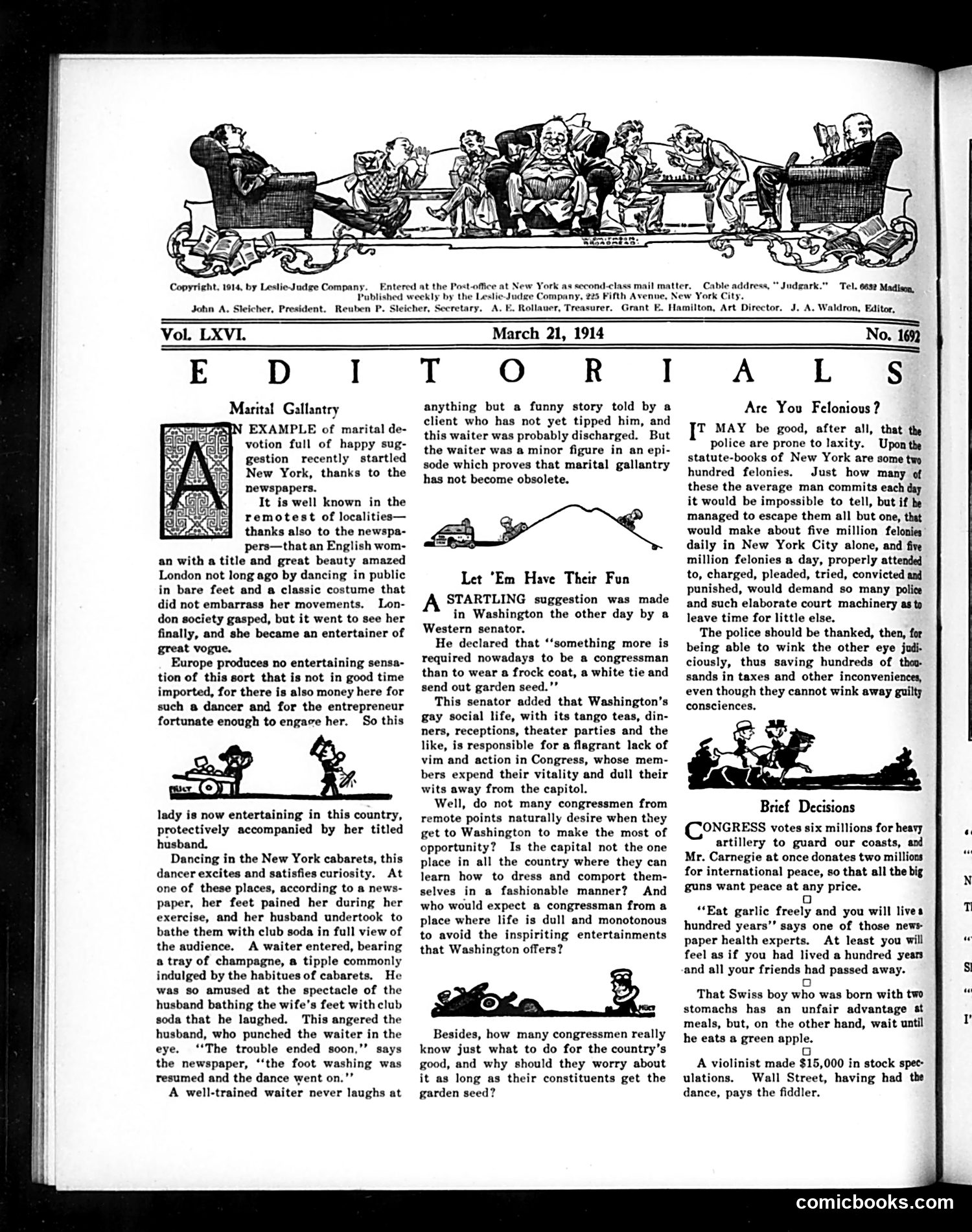
The page contains three satirical pieces about Washington social life and congressional conduct: **"Marital Gallantry"** mocks the "new woman" dancing in cabarets—a scandalous activity for respectable society. A waiter punches a husband after he laughs at his wife's public bathing display, satirizing changing gender norms and marital dynamics. **"Let 'Em Have Their Fun"** critiques congressmen's frivolous social activities (theater parties, receptions, tangos) while they neglect legislative duties. A senator suggests congressmen should dress fashionably rather than focus on substantive work—mocking their priorities. **"Are You Felonious?"** argues New York's felony problem stems from inadequate police attention to petty crime, suggesting five million daily felonies go unpunished due to resource constraints. The cartoons satirize idle wealth, changing morality, and governmental ineffectiveness.
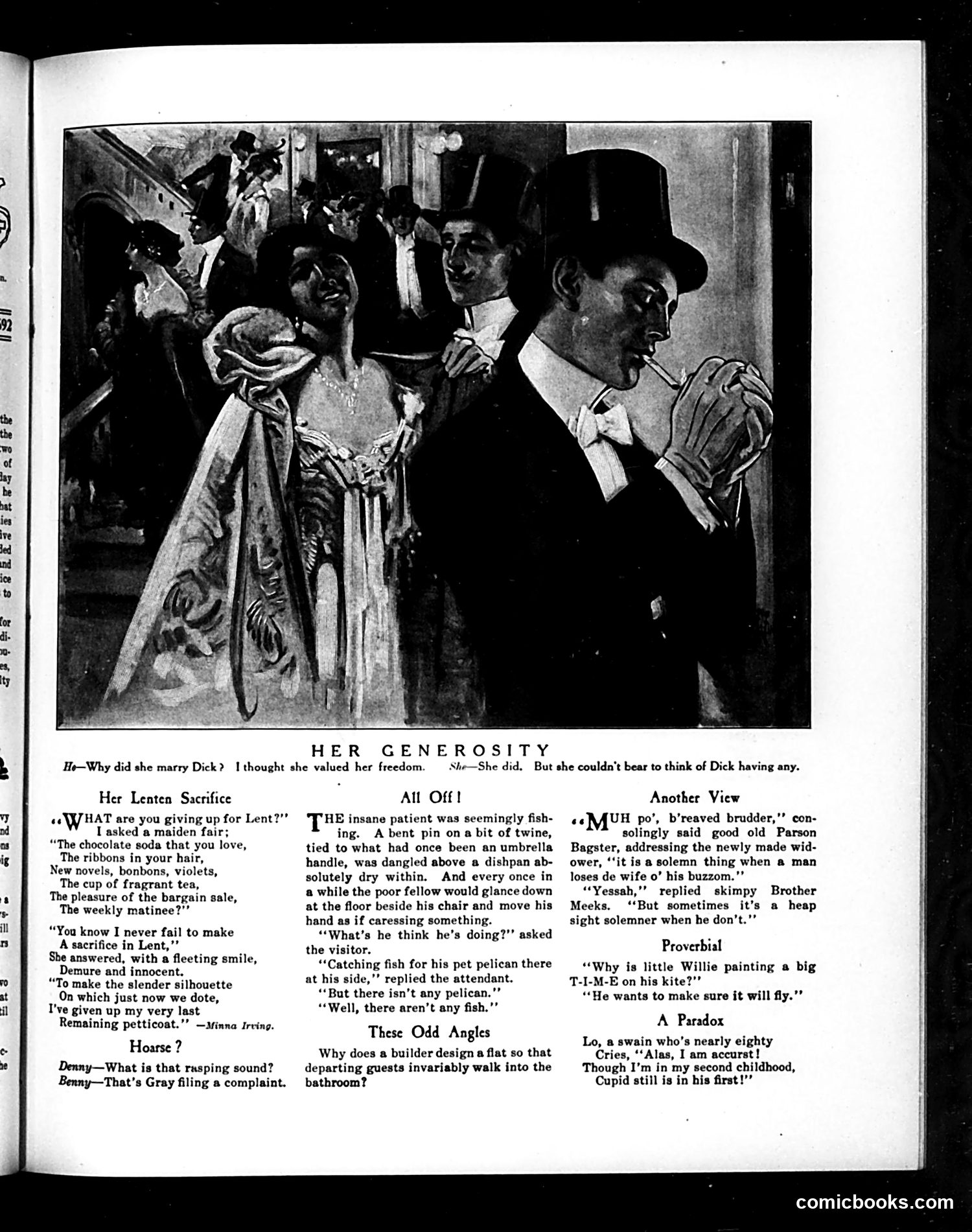
This page contains humorous sketches and jokes rather than political cartoons. The top image titled "HER GENEROSITY" depicts a social scene where a woman marries a man named Dick, prompting the caption "Why did she marry Dick? I thought she valued her freedom." Below are several short joke sections: - **"Her Lenten Sacrifice"** satirizes women making trivial sacrifices for Lent (chocolate soda, ribbons) - **"All Of It"** jokes about an insane asylum patient's delusions - **"Another View"** contains crude humor about widows - **"These Odd Angles"** and other sections offer brief domestic and social humor The content represents typical early 20th-century Judge magazine fare: satirizing gender relations, marriage dynamics, and social pretension through lighthearted domestic humor rather than political commentary.
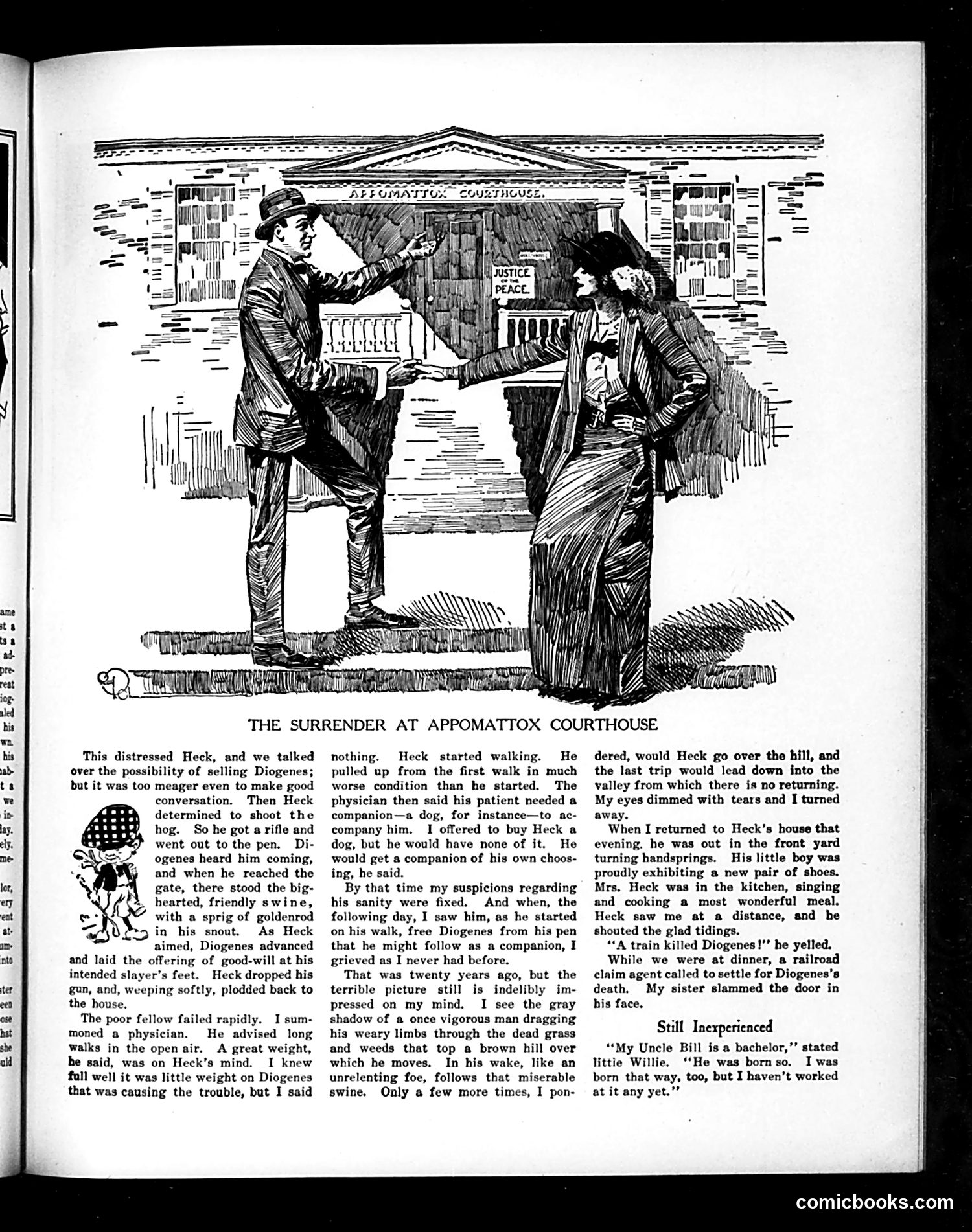
This page contains two distinct pieces. The main cartoon depicts two figures at a courthouse (labeled "Justice" and "Peace") in what appears to be a formal surrender scene, likely referencing the Civil War's end at Appomattox in 1865. Below is a longer prose story about a man named Heck who becomes emotionally attached to his pig, Diogenes. The narrative traces Heck's depression and recovery after the pig is killed by a train. The story uses the pig's death as darkly comic relief—Heck's mental state improves dramatically once his burden (literally and figuratively) is removed. At bottom is a brief humor section titled "Still Inexperienced" featuring a child's naive joke about his uncle's bachelorhood. The page mixes Civil War-era political satire with character humor typical of Judge magazine's satirical approach.
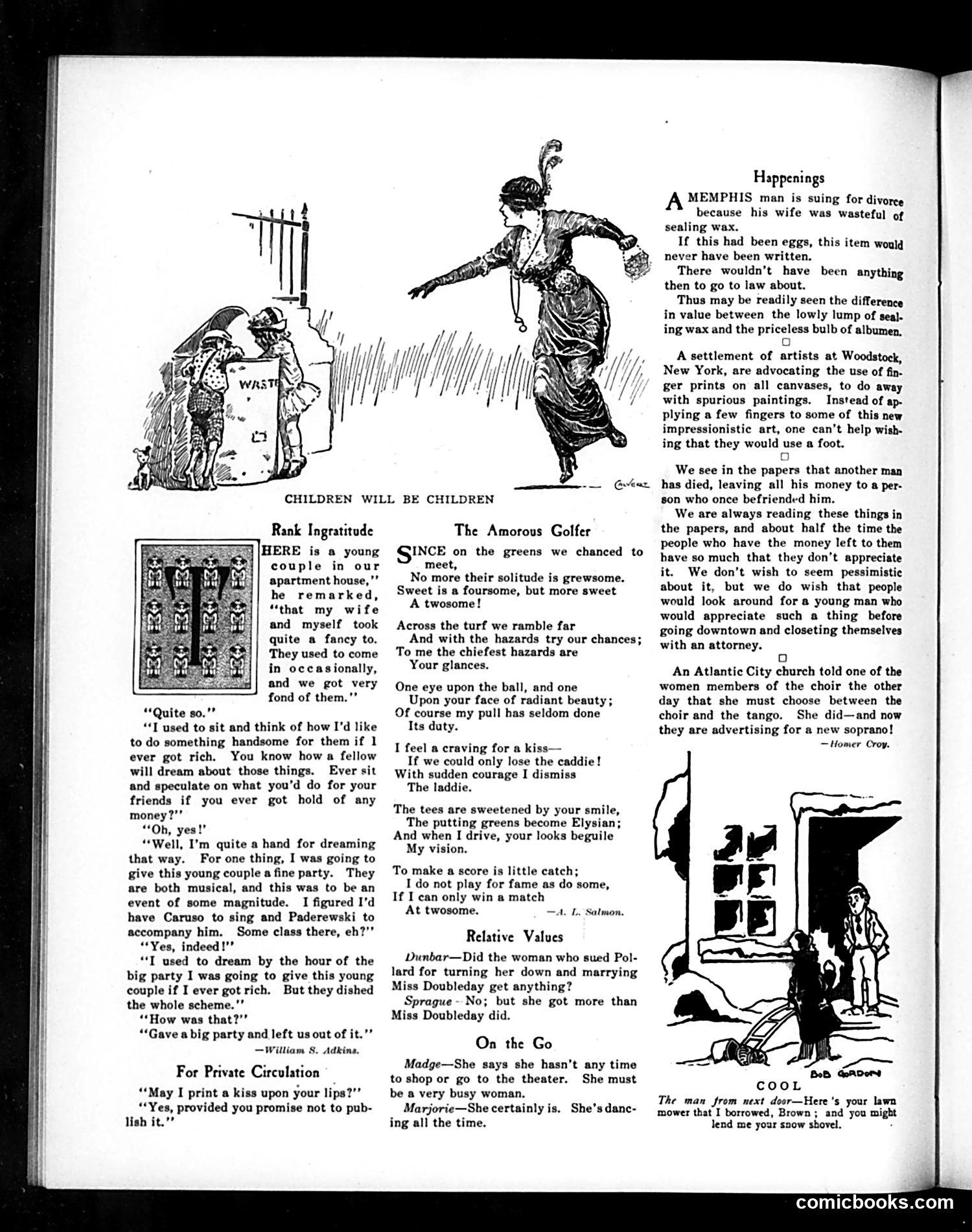
This page contains several short humorous pieces satirizing early 20th-century social behavior. The main cartoon, "Rank Ingratitude," mocks a man's disappointed expectations. He fantasized about befriending a poor young couple and eventually throwing them a lavish party (featuring famous musicians Caruso and Paderewski). However, the couple threw their own party and didn't invite him—so his imagined generosity never materialized. The joke targets both his presumption and the absurdity of elaborate daydreams about wealth. Other pieces mock contemporary social follies: a Memphis divorce over "wasteful" sealing wax (trivializing marriage), artists proposing fingerprints on paintings to prevent forgery, a woman choosing the tango over church choir duties, and the tired trope of deathbed money bequests to old acquaintances. The humor is gentle domestic satire typical of Judge magazine—poking fun at middle-class pretensions, romantic delusions, and social hypocrisy without harsh edge.
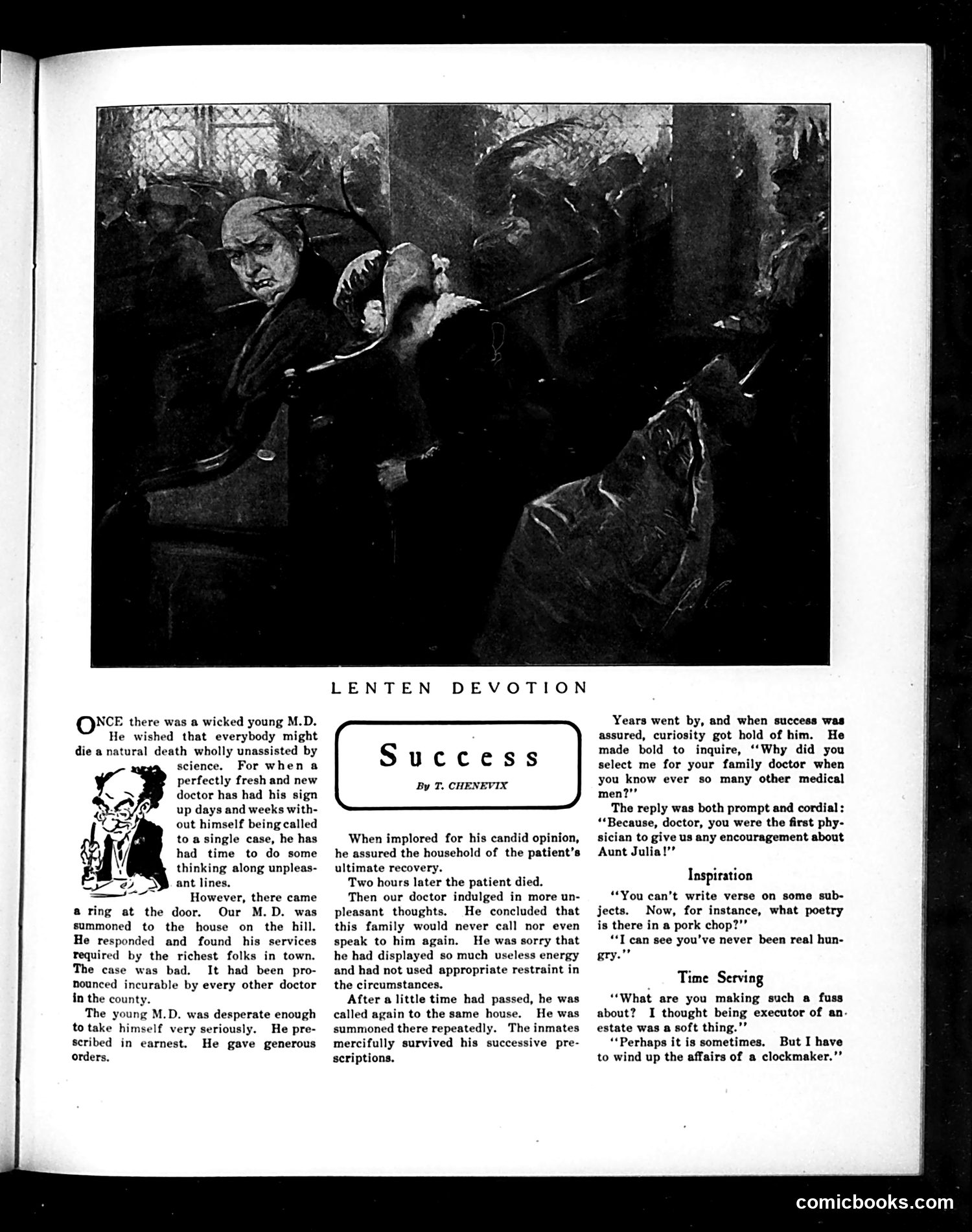
This story satirizes medical practice and professional ethics in the early 20th century. A desperate young doctor, frustrated by lack of patients, is finally summoned to treat a wealthy family's incurable case. He prescribes aggressively and predicts recovery—the patient dies anyway. The joke: the family becomes his *loyal* patients afterward, repeatedly calling him back. When asked why they chose him despite the initial failure, they credit his "encouragement about Aunt Julia"—meaning his false optimism gave them hope, not actual medical competence. The satire targets how doctors built practices through confidence and bedside manner rather than actual skill, and how wealthy families valued encouragement over results. It's a cynical commentary on the medical profession's foundations in reassurance rather than science. The accompanying humor sections ("Inspiration," "Time Serving") are separate jokes about poetry and estate administration.
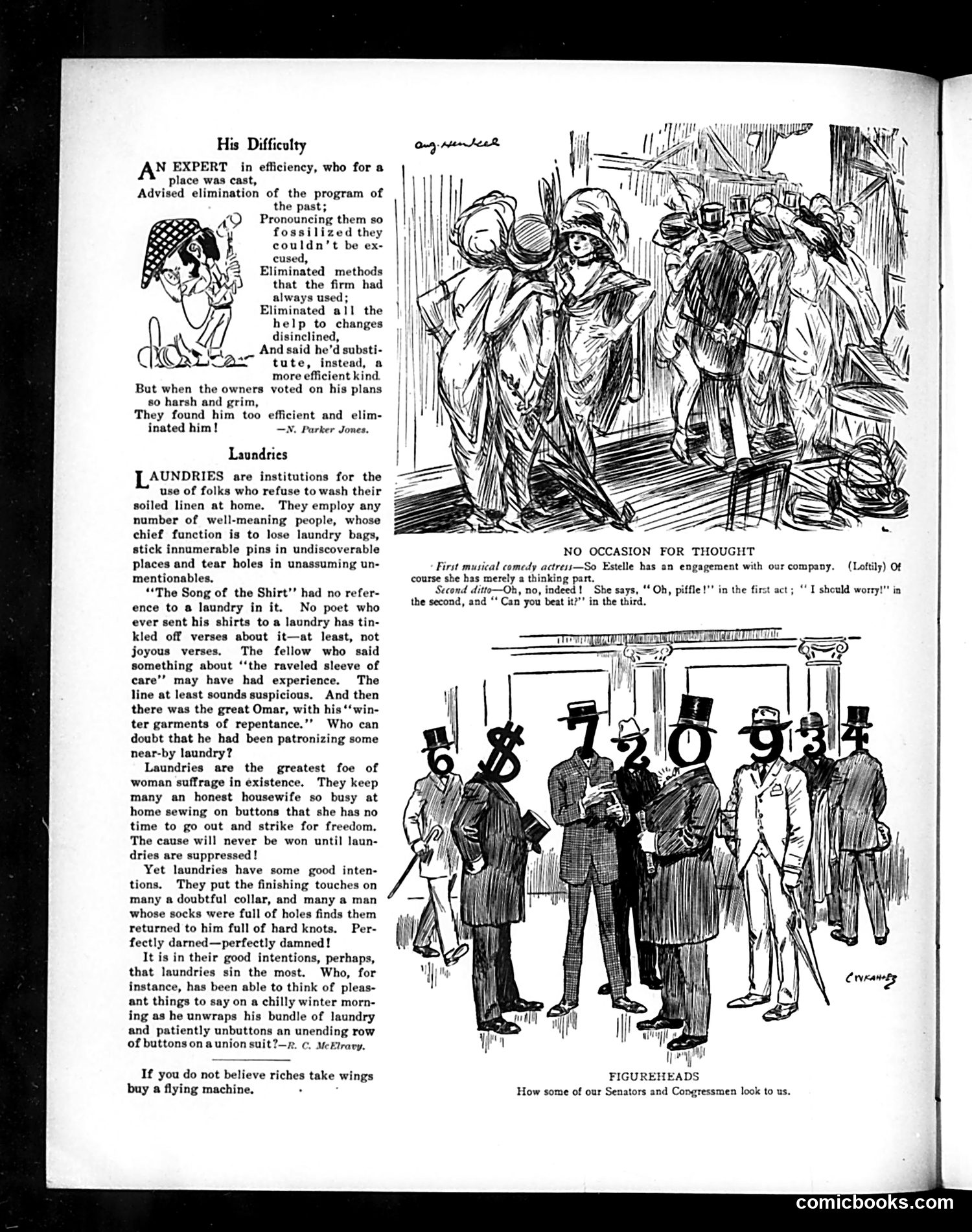
The page contains two main satirical pieces. **"His Difficulty"** (top left) mocks an "efficiency expert" hired to modernize a business. He eliminates old methods and workers he deems obsolete, replacing them with harsh new systems. However, the owners find him "too efficient" and eliminate *him*—a joke about how radical "efficiency" can backfire and alienate people in power. **"Figureheads"** (bottom) is a crude political cartoon depicting senators and congressmen as literal figureheads—their heads replaced by large numbers. The caption notes they "look to us" this way, suggesting politicians are interchangeable, faceless, or purely decorative rather than meaningful individuals. This reflects early-20th-century cynicism about governmental effectiveness. The other content discusses laundries (humorously blaming them for preventing women's suffrage by keeping housewives busy) and a theater joke about an actress hired only for trivial lines, not actual acting talent.
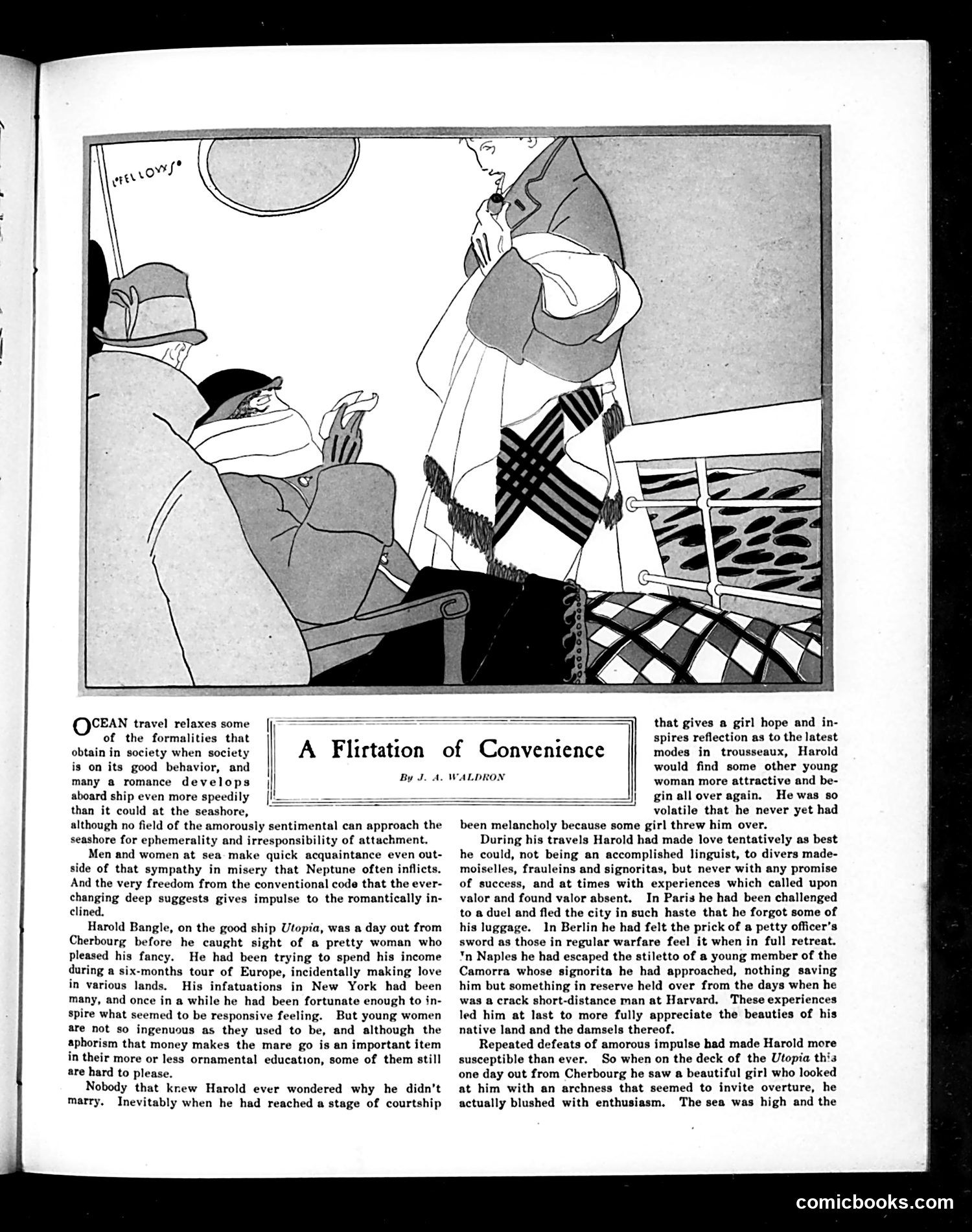
This is a short story (not a political cartoon) by J.A. Waldron about Harold Bangle, a wealthy American tourist who serially pursues women across Europe with little success. The narrative satirizes the romantic foolishness of a privileged man who treats courtship as casual sport during his leisure travels. Harold's repeated failures—being challenged to duels in Paris, stabbed in Berlin, chased by the Camorra in Naples—mock his incompetence and entitlement. The story suggests that ocean travel loosens social conventions, making shipboard romance both easier and more frivolous. The satire targets masculine vanity: Harold's money and leisure enable constant romantic attempts, yet his volatility and cowardice undermine each pursuit. The tale seems to argue that such irresponsible flirtation abroad reflects poorly on American travelers and reveals the hollowness of wealthy idleness.
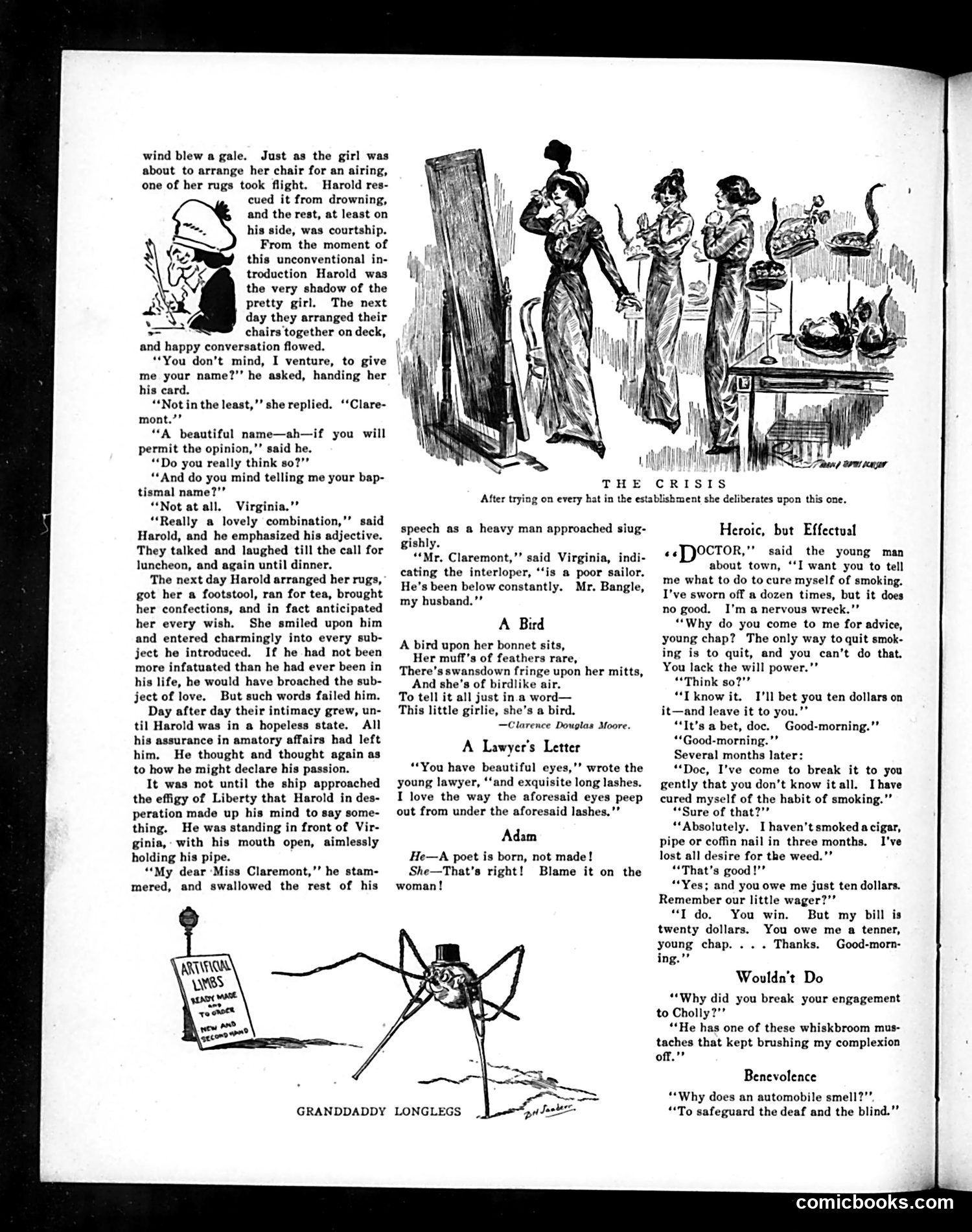
This page contains several humorous short stories and poems typical of early 20th-century satirical magazines: **"The Crisis"** depicts a shipboard romance where Harold falls for Virginia Claremont, works up courage to propose as the ship approaches the Statue of Liberty, only to have his confession interrupted by the arrival of her husband, Mr. Bangle—a cruel ironic twist on his romantic anticipation. **"A Bird"** is a light poem playing on the phrase "she's a bird" (slang for an attractive woman) by describing a woman dressed entirely in feathers and fur. **"A Lawyer's Letter"** satirizes flowery romantic language through mock-legal diction. **"Adam"** is a brief joke blaming poets' lack of talent on women. **"Heroic, but Effectual"** shows a doctor outwitting a patient who quits smoking through a bet—the doctor collects his medical fee, negating the patient's winnings. The cartoons and brief jokes reflect common satirical subjects: romance, fashion, and human vanity.
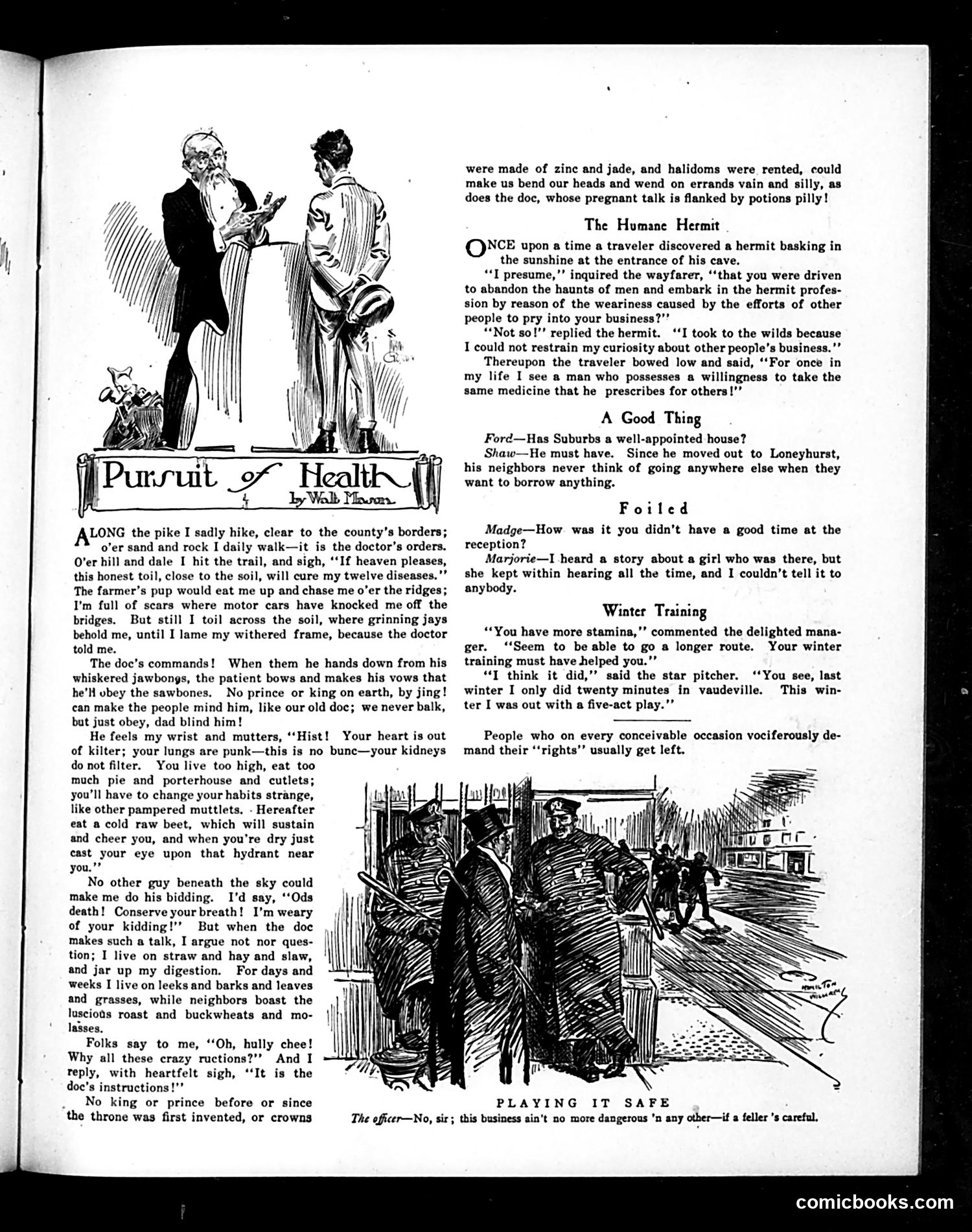
This Judge magazine page contains three satirical pieces: **"Pursuit of Health"** (top): A humorous poem mocking blind obedience to doctors' orders. The narrator follows absurdly strict medical advice—living on raw vegetables and constant walking despite injury—simply because "the doc" commands it. The satire critiques how people unquestioningly follow physician authority, treating doctors like absolute rulers. This reflects early 20th-century attitudes toward medical expertise as unquestionable. **"The Humane Hermit"** (middle): A brief ironic tale where a hermit admits he retreated to wilderness not to escape society, but because he *couldn't stop* prying into others' business. The joke: he's now receiving the same unwanted intrusion from the traveler. **"A Good Thing," "Foiled," and "Winter Training"** (bottom): Short joke vignettes on neighborly borrowing, gossip at parties, and athletic training—standard social humor. The cartoons are straightforward illustrations accompanying these texts. The overall page reflects early 20th-century middle-class anxieties about authority, privacy, and social etiquette.
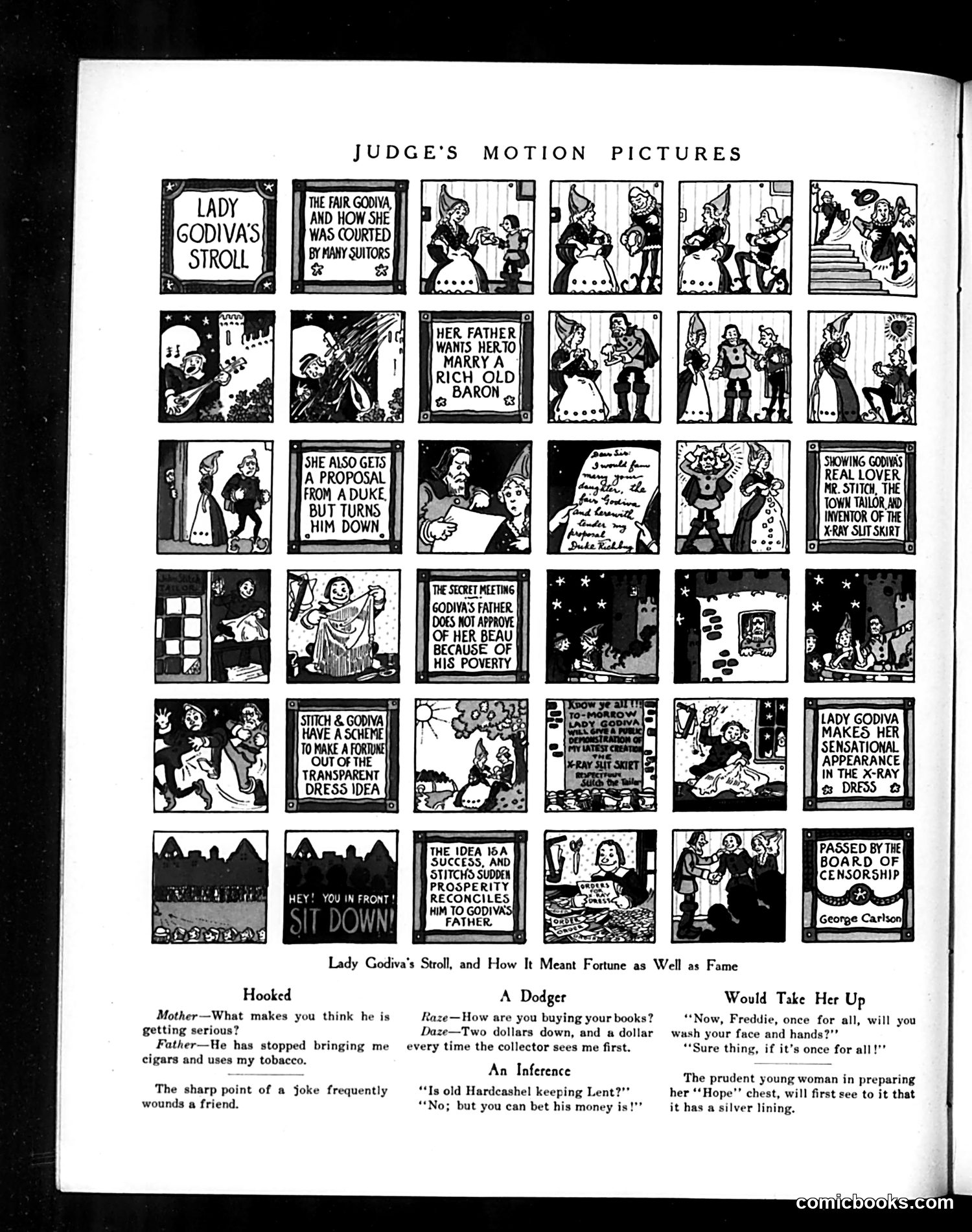
This page presents a comedic film synopsis about Lady Godiva, the legendary medieval figure who rode naked through town to protest taxation. The strip follows her romantic troubles: her father disapproves of her suitor's poverty, leading to a scheme where she and a character named "Stitch" devise a transparent dress idea that becomes a scandalous success, ultimately reconciling her to her father. The satire plays on multiple levels: the "Board of Censorship" approval joke mocks film censorship standards of the era (likely 1910s-1920s); the accompanying quips mock middle-class courtship, book-buying habits ("two dollars down"), and financial hypocrisy ("Hardcashel keeping Lent"). The humor relies on period anxieties about morality, propriety, and changing social customs rather than political commentary.
This page satirizes opposition to women's suffrage and evolving gender roles circa 1910s America. **"Suffrage Snapshots"** (by Ida Husted Harper) mocks anti-suffrage tactics: Montana prosecutors threaten to prosecute women's tea parties encouraging voter registration as "corrupt practices"—while ignoring men's backroom saloon organizing. The piece ridicules male arguments against women's education and voting rights, noting that college-educated women simply have higher marriage standards, implying men need improvement, not women restriction. **"Curbside Comments"** satirizes women's traditional domestic roles and maternal neglect, criticizing women who abandon childcare responsibilities. **Poems** ("A Transformation," "As Asti Mother") contrast old and new women: Fred's previously quiet, domestic wife now reads newspapers and engages politics, transforming marriage. The satire suggests these changes alarm traditionalists. The overall tone is pro-suffrage and pro-women's advancement, mocking opponents' hypocrisies and outdated gender expectations while celebrating women's intellectual and civic awakening.
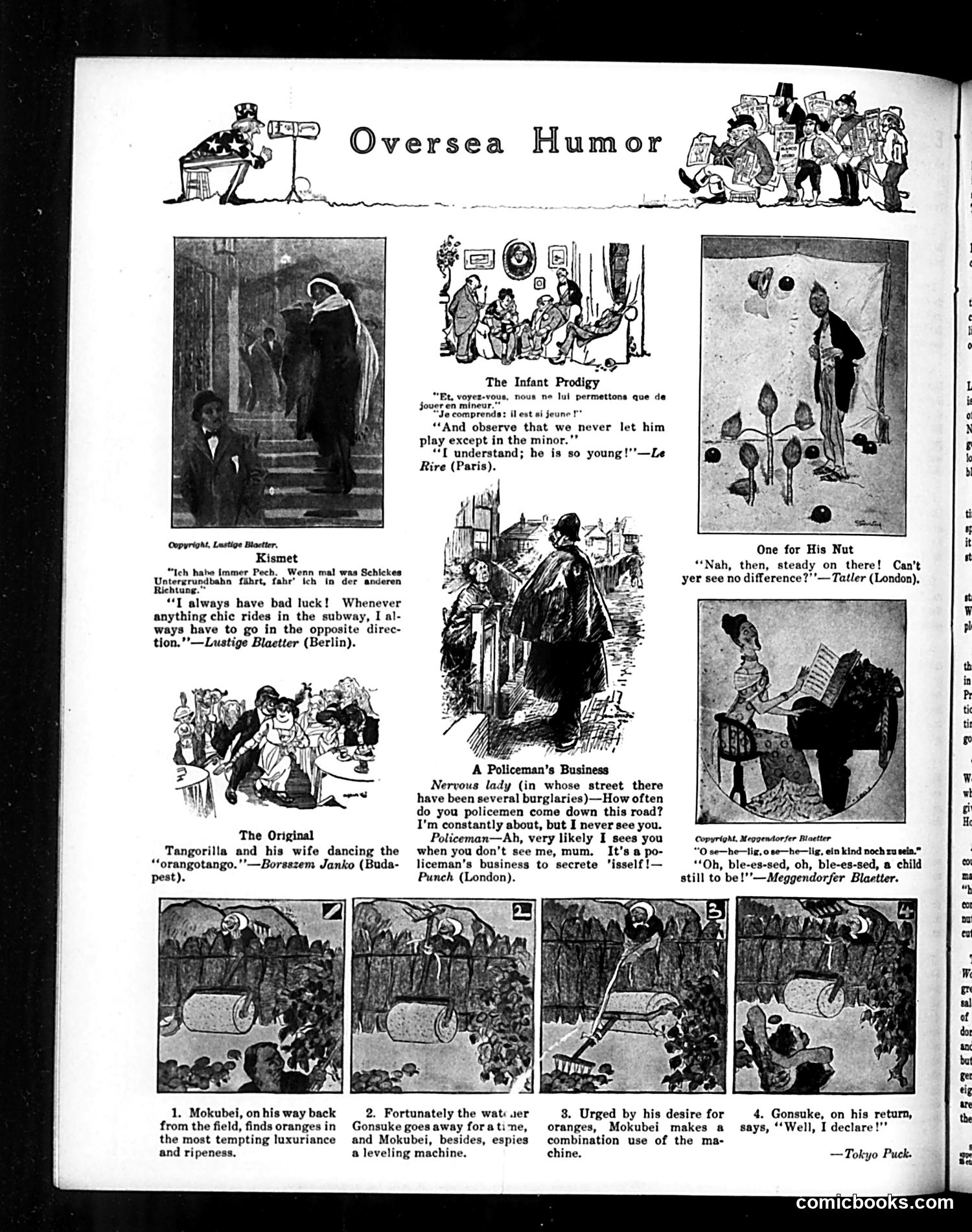
This page collects international satirical cartoons from European and Japanese publications, showcasing humor across different cultures. The content includes: **Individual cartoons** on everyday social situations: a Berlin subway passenger's bad luck always catching the wrong train; a Budapest couple dancing the "orangotango"; a Parisian music teacher restricting a young student to minor keys; and a London policeman explaining his invisibility is job security during a crime wave. **A four-panel Japanese comic** (Tokyo Puck) depicts a farmer named Mokubei who finds oranges, then uses a water-powered machine to process them into juice—the visual humor lying in the absurd mechanical contraption. The page demonstrates Judge magazine's practice of reprinting humor from international sources, likely to amuse American readers with foreign perspectives and comic styles. The selections emphasize relatable urban and domestic situations with gentle, non-political satire.
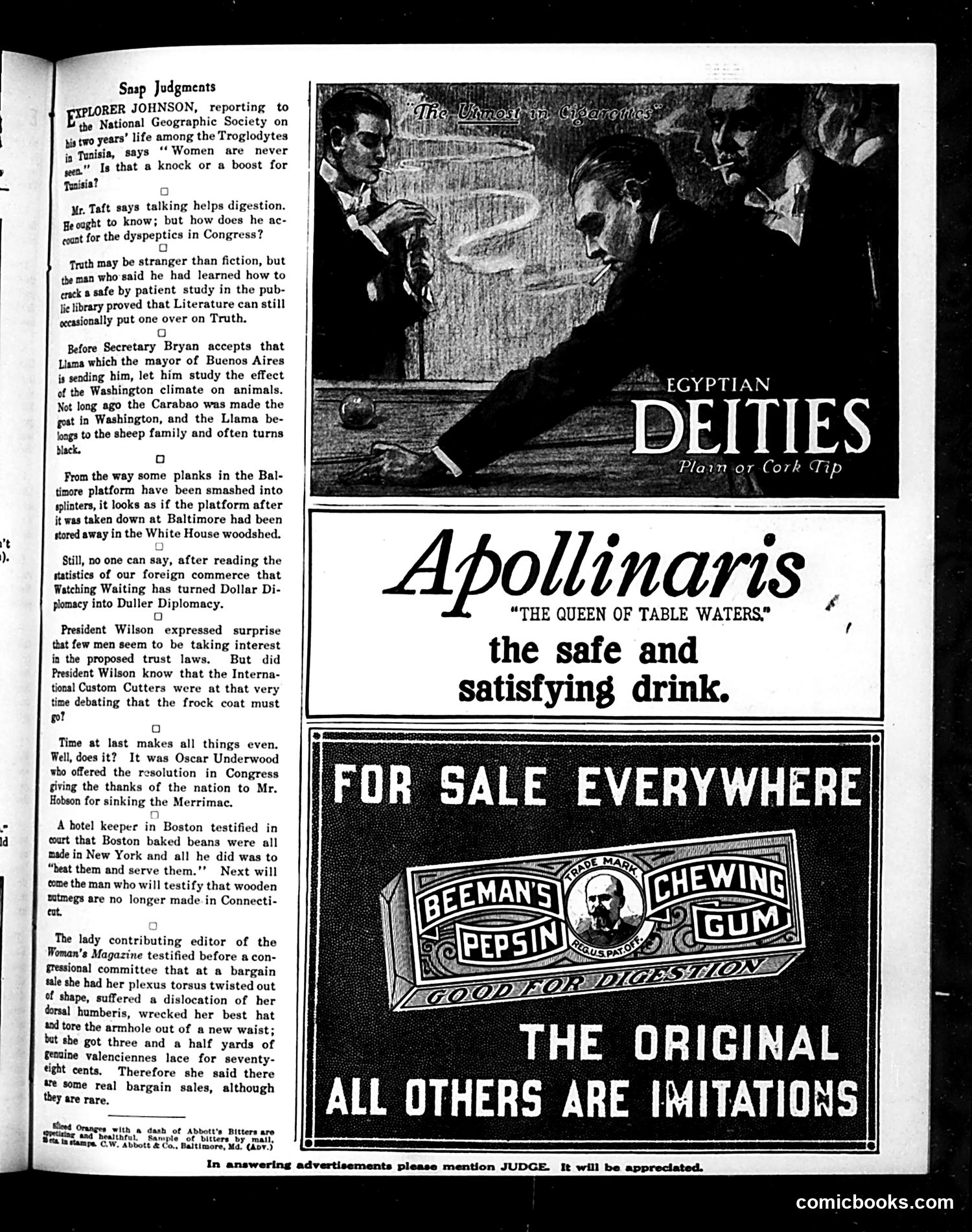
This page contains brief satirical commentary on contemporary political and social figures, primarily targeting the Wilson administration and related public figures. **Key references:** - **Explorer Johnson**: Mocked for claiming women are "never seen" among Troglodytes—satirizing dubious anthropological claims. - **Mr. Taft** (former President William Howard Taft): Ridiculed for claiming talking aids digestion, with a jab at Congressional dysfunction. - **Secretary Bryan**: William Jennings Bryan is warned humorously about accepting a llama from Buenos Aires, playing on the animal's unpredictability. - **Baltimore platform**: References the Democratic National Convention's platform, mocking its deterioration (stored in a "White House woodshed"). - **President Wilson**: Criticized for seeming unconcerned about trust law debates, particularly regarding dress codes ("frock coat"). - **Oscar Underwood**: Ridiculed for offering Congressional thanks to Hobson for sinking the *Merrimac*. The commentary employs absurdist humor to critique political incompetence and insincerity. The page is primarily advertising-driven, featuring product advertisements for Egyptian cigarettes, Apollinaris water, and Beeman's chewing gum.
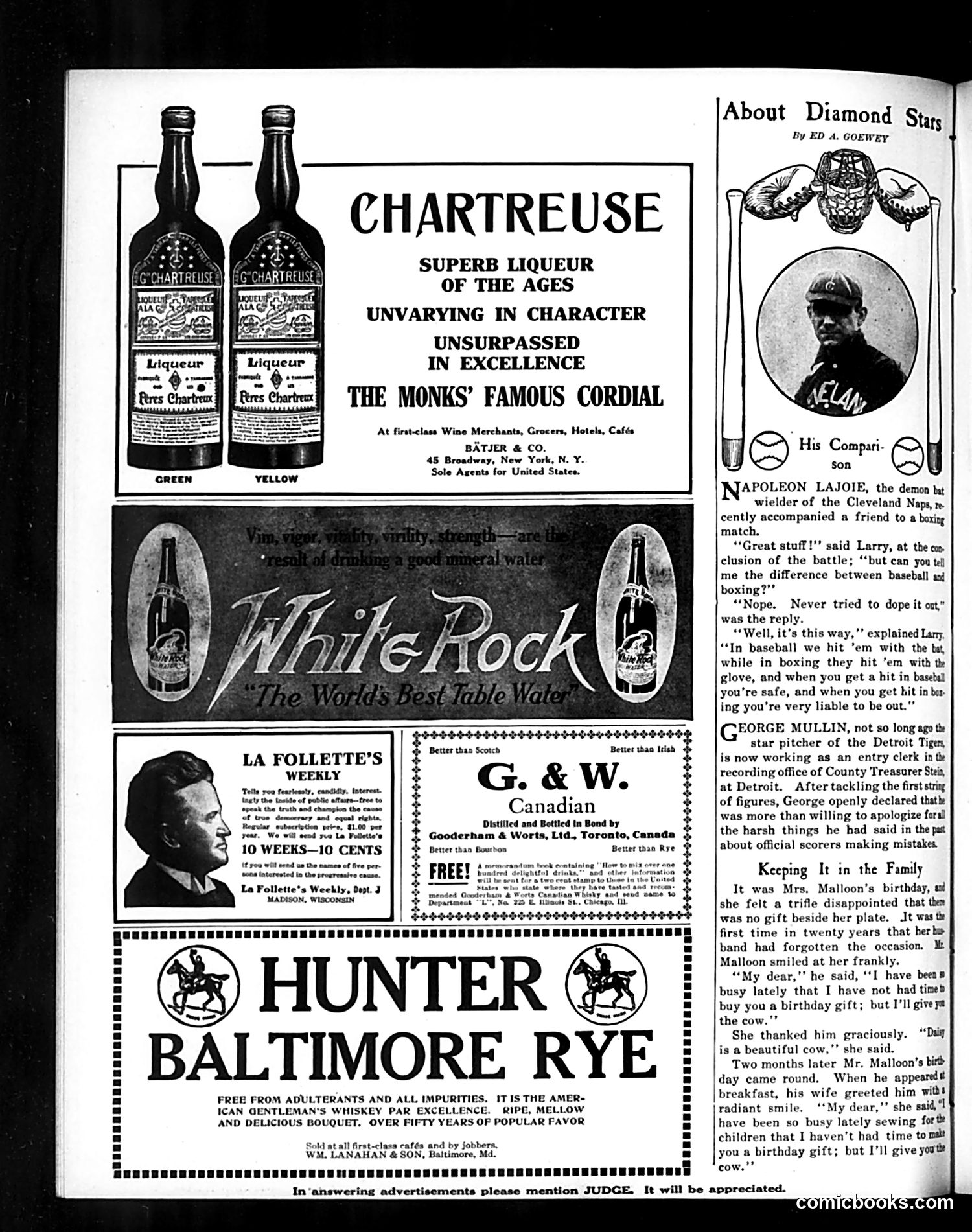
This is primarily an **advertising page** with a small sports humor section. The main content consists of liquor advertisements (Chartreuse, White Rock mineral water, G&W whiskey, Hunter Baltimore Rye) and a subscription pitch for *La Follette's Weekly*, a progressive political magazine. The only satirical content is a brief "Diamond Stars" column by Ed. A. Goewey featuring baseball anecdotes: 1. **Napoleon Lajoie** (Cleveland Naps player) attends a boxing match and humorously confuses baseball with boxing—the joke being the difference is merely which implement hits you (bat vs. glove). 2. **George Mullin** (former Detroit Tigers pitcher) now works as a clerk and admits he was wrong to criticize official scorers—implying accounting/clerical work is harder than he thought. 3. A domestic humor piece about the Malloons exchanging a cow as birthday gifts due to being busy. The satire is gentle workplace humor rather than political commentary.
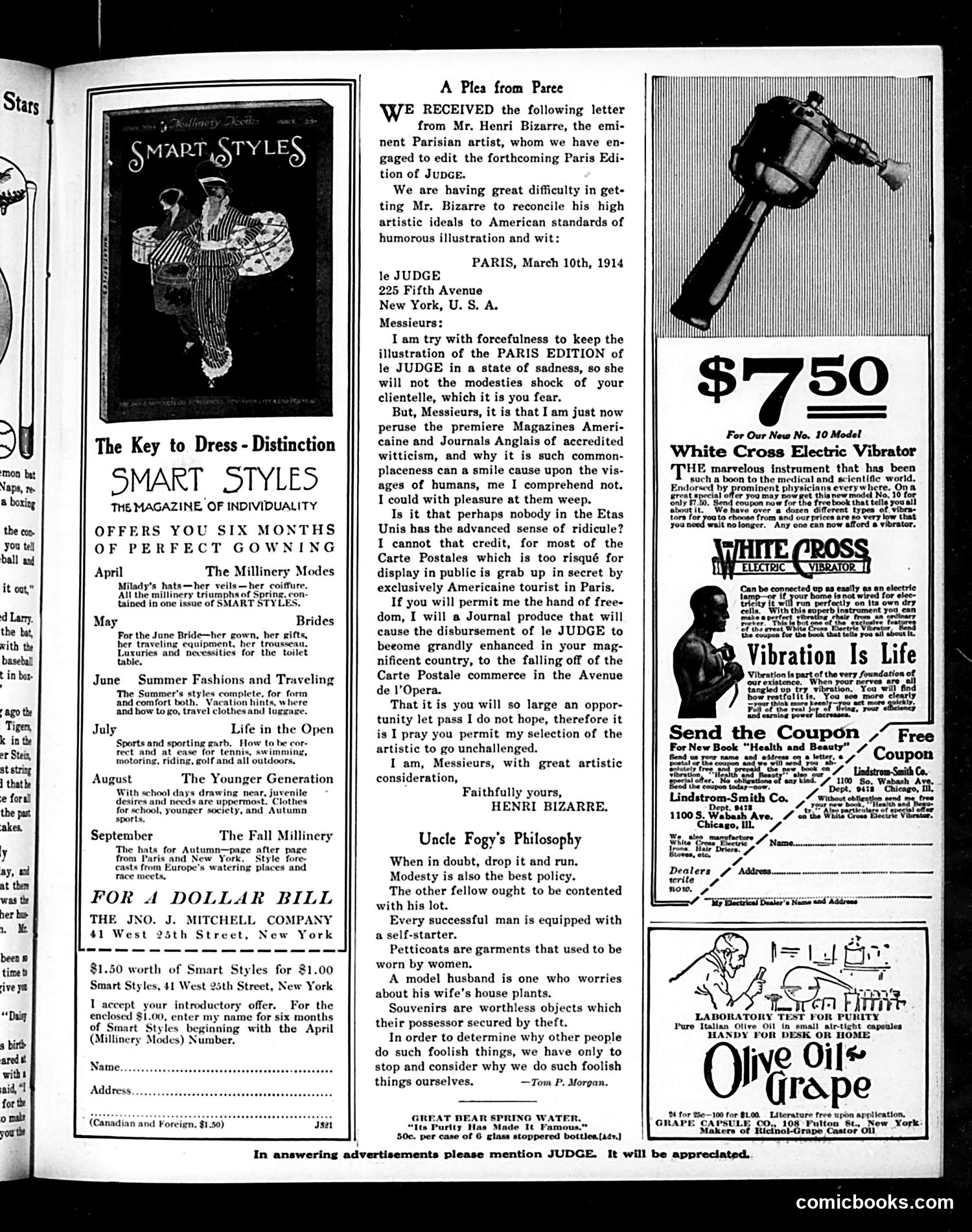
This page is primarily **advertising and editorial content** rather than political satire. The main feature is a humorous letter from "Henri Bizarre," a fictional Parisian artist hired to edit Judge's Paris Edition. **The Satire:** Bizarre writes in deliberately fractured English, complaining that American humor lacks sophistication. He contrasts this with risqué French postcards ("Carte Postales"), which American tourists secretly purchase in Paris. The joke mocks American prudishness and hypocrisy—Americans publicly demand "modest" illustrations yet privately consume racy content. **Historical Context:** Set in March 1914 (pre-WWI), this reflects the era's transatlantic cultural tensions. Paris represented artistic freedom and sophistication to Americans, while America was viewed as buttoned-up and provincial. The broken French-English syntax amplifies the comedy, playing on stereotypes of affected Continental artists. The rest of the page consists of advertisements for Smart Styles magazine, a dollar-bill offer, a White Cross Electric Vibrator, and Olive Oil Grape products—typical early 20th-century periodical content.
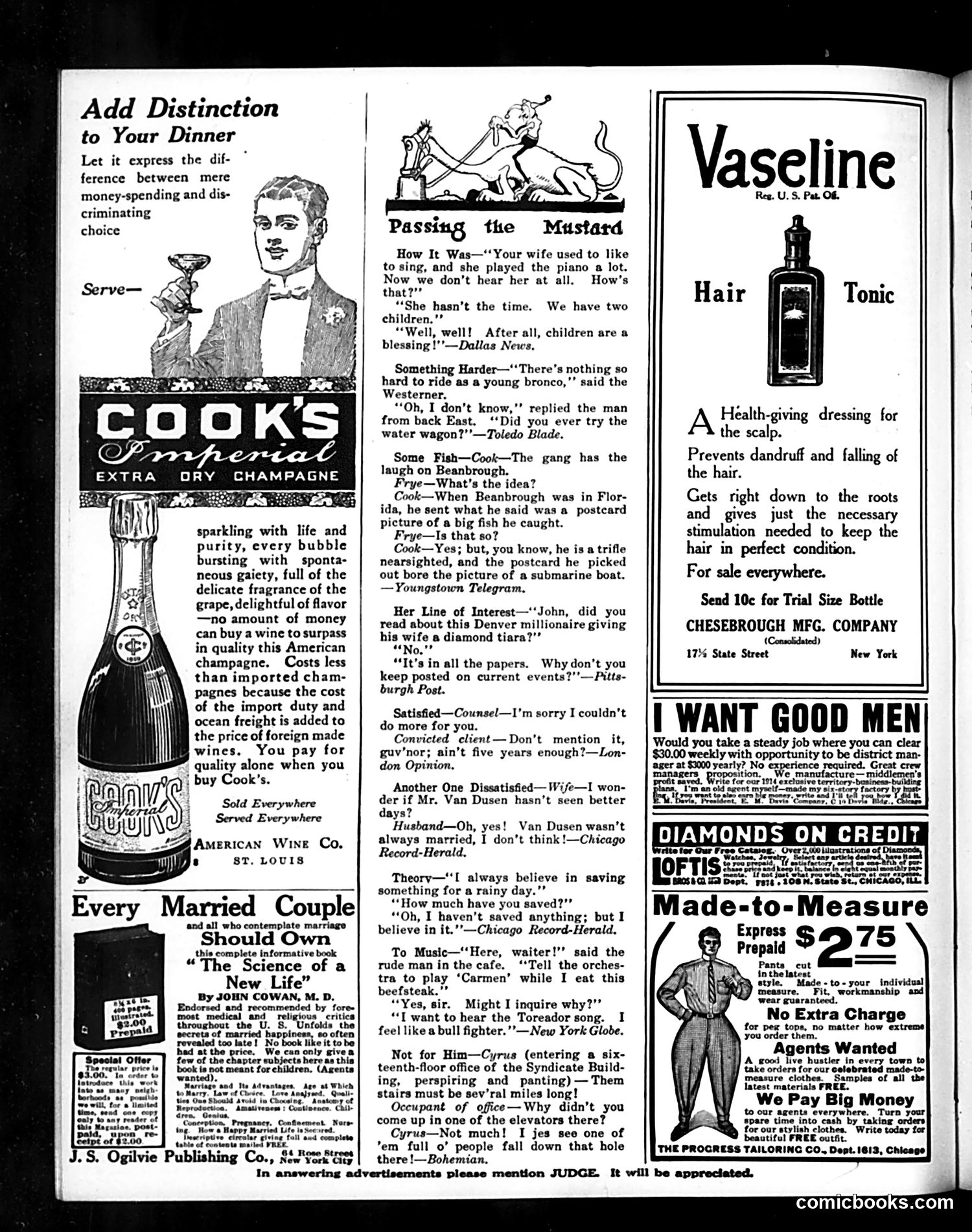
This is primarily an **advertising page** with humorous filler content rather than political satire. The page features ads for Cook's champagne, Vaseline Hair Tonic, and marriage/self-help books, alongside a section titled "Passing the Mustard" containing brief comedic anecdotes. The humor is domestic and observational rather than political: jokes about wives losing musical interests after having children, elevator accidents, and men's reluctance to take stairs. One anecdote mocks a near-sighted man who mistook a submarine postcard for a fish photo. The champagne ad emphasizes American superiority over imported wines—a common early 20th-century marketing angle during rising nationalist sentiment, though this appears commercial rather than satirical. The page reflects period attitudes about marriage, gender roles, and class aspirations typical of Judge's middle-class readership, but contains no identifiable political cartoons or caricatures of public figures.
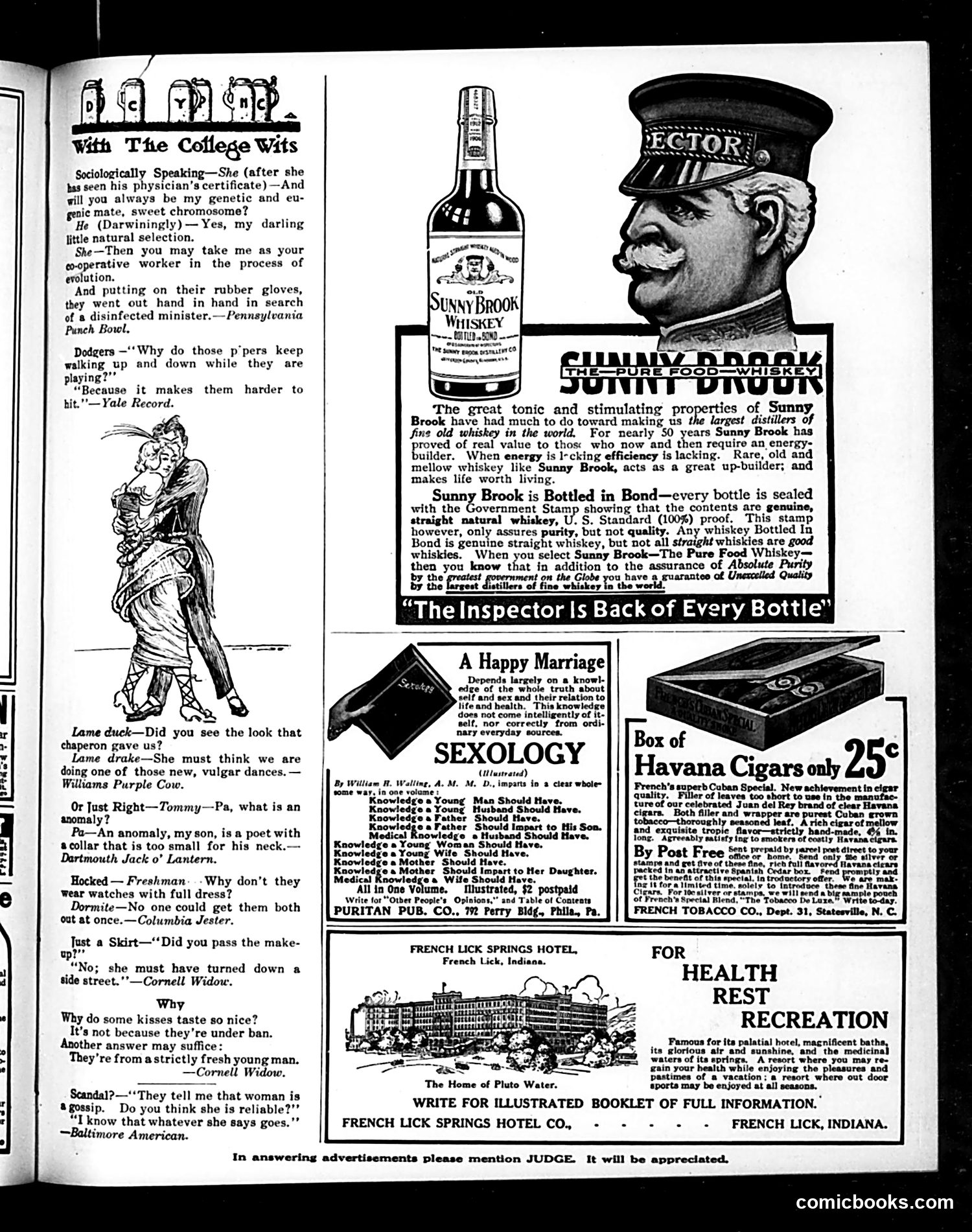
This page contains mostly **college humor** and **advertisements** rather than political cartoons. The "College Wits" section collects brief jokes from university publications, satirizing student life and contemporary social trends. The humor reflects early 20th-century college culture: references to eugenics and Darwin (trendy scientific topics), dating conventions, and academic life. One joke mocks Prohibition-era hypocrisy about kissing "fresh young men." The advertisements are period-typical: Sunny Brook whiskey (pre-Prohibition or early Prohibition-era), a "Sexology" book promising marital knowledge, Cuban cigars, and French Lick Springs spa resort. **Notable context**: The eugenics references in the opening joke reflect that pseudoscience was considered sophisticated intellectual humor at the time—a disturbing reminder of how casually such ideas circulated in mainstream publications before WWII exposed their dangers. The page is primarily entertainment and advertising rather than satirical commentary on major political events.
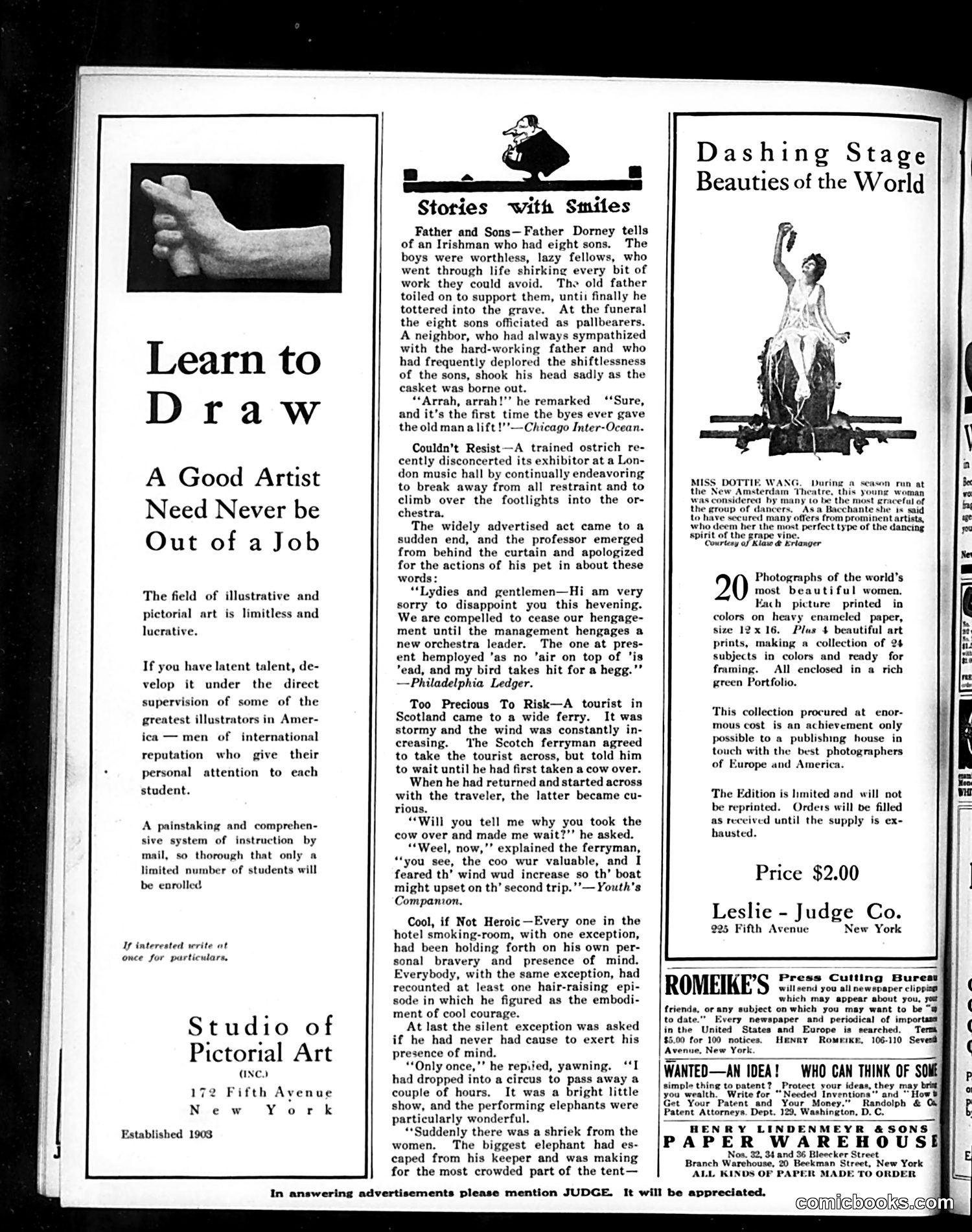
This page is primarily **advertising and filler content**, not political satire. It contains: **Left side:** An ad for a mail-order art instruction course ("Studio of Pictorial Art"), emphasizing that artists needn't worry about employment. **Center:** "Stories with Smiles"—humorous anecdotes with ethnic/class-based humor typical of early 20th-century magazines. These include jokes about lazy Irish sons, a trained ostrich disrupting an orchestra, a Scottish ferryman's thriftiness, and a man boasting about courage. The humor relies on stereotypes and situational comedy rather than political commentary. **Right side:** An ad for "Dashing Stage Beauties of the World"—a portfolio of photographs of actresses/performers, marketed as an art collection. **No political cartoons appear on this page.** The content reflects period attitudes toward immigration, class, and entertainment, but contains no specific political targets or satirical commentary beyond mild social observation in the joke section.
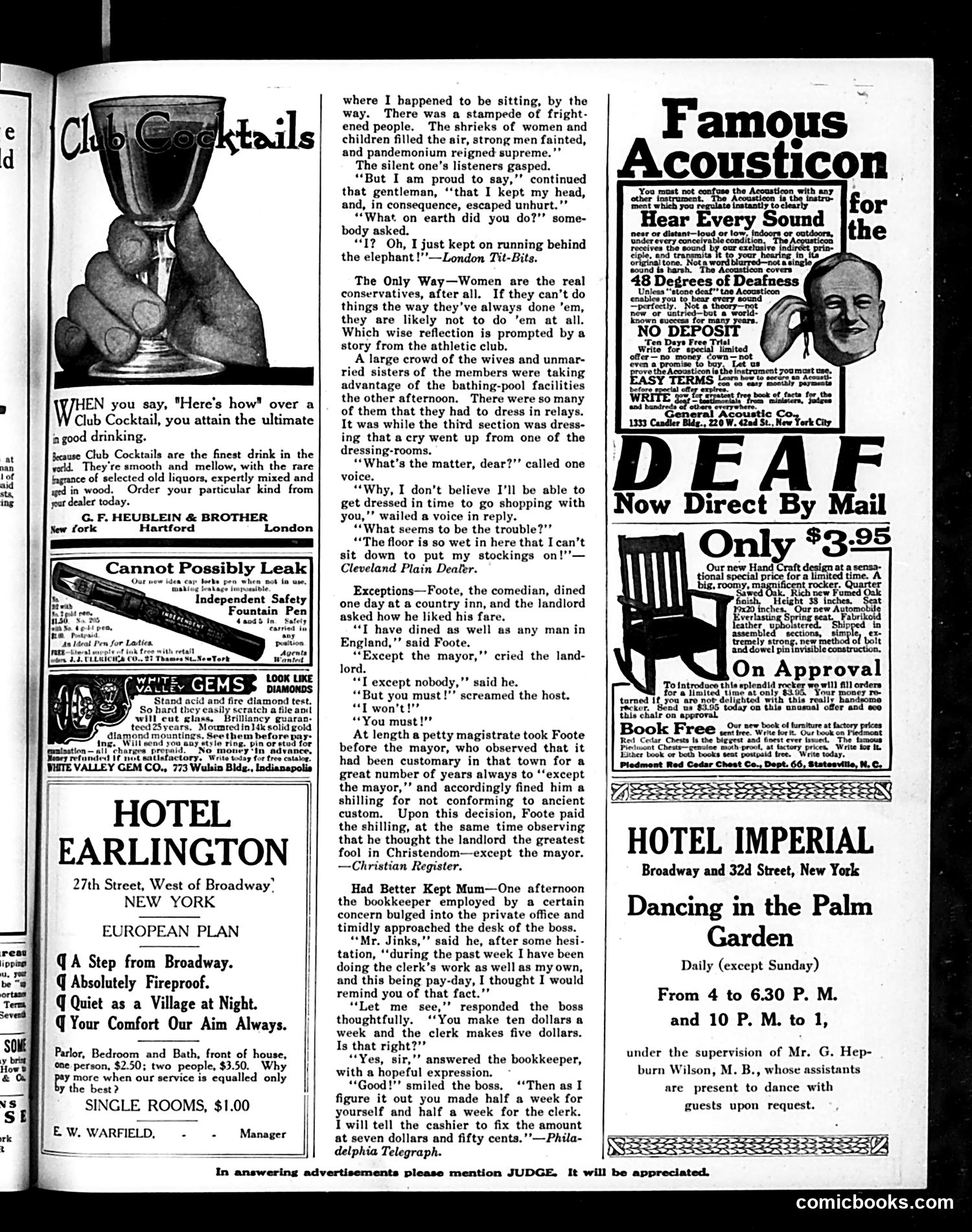
This is primarily an **advertising and humor page** from Judge magazine. The main content consists of brief satirical anecdotes rather than political cartoons. The humor pieces mock social conventions and human nature: 1. **"The Only Way"** satirizes women's rigidity about routines—a woman won't go shopping because the pool changing room floor is wet, refusing to adapt. 2. **"Exceptions"** features comedian Foote outwitting a town's absurd custom of always excepting the mayor from compliments. When fined for not following this tradition, he calls both the landlord and mayor fools. 3. **"Had Better Kept Mum"** jokes about a bookkeeper's failed salary negotiation—the boss uses faulty math to justify keeping his wages the same despite extra work. The page is dominated by **period advertisements**: Club Cocktails, fountain pens, hearing aids, and hotel listings. These reflect early 20th-century consumer culture and concerns (deafness remedies, luxury dining, affordable lodging). The satire targets everyday absurdities rather than political figures.
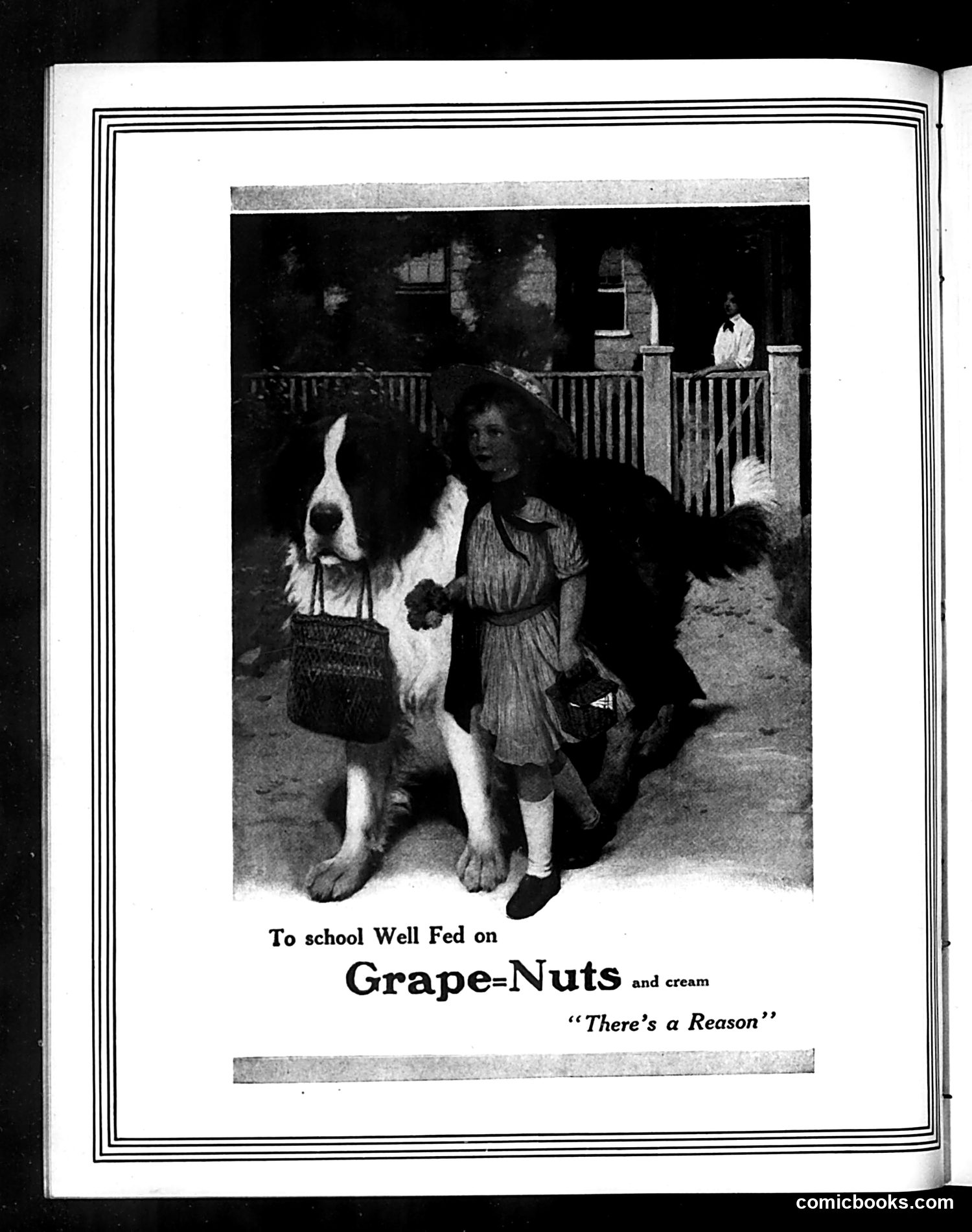
This is a **Grape-Nuts cereal advertisement**, not political satire. The image shows a large Saint Bernard dog accompanying a young girl to school, both appearing well-nourished and healthy. The dog carries a basket, suggesting it's a helper or companion. The ad's message: feeding children Grape-Nuts cereal results in robust health—so robust they can handle even a massive dog as a school companion. The tagline "There's a Reason" was Grape-Nuts' actual advertising slogan, implying scientific backing for the product's nutritional benefits. This reflects early 20th-century advertising that made broad health claims for breakfast cereals—a relatively new, heavily-marketed product category. The humor relies on the absurdity of the scenario while promoting the cereal's supposed vitality-building properties.