
Judge, 1914-03-21 · page 11 of 24
Judge — March 21, 1914 — page 11: what you’re looking at
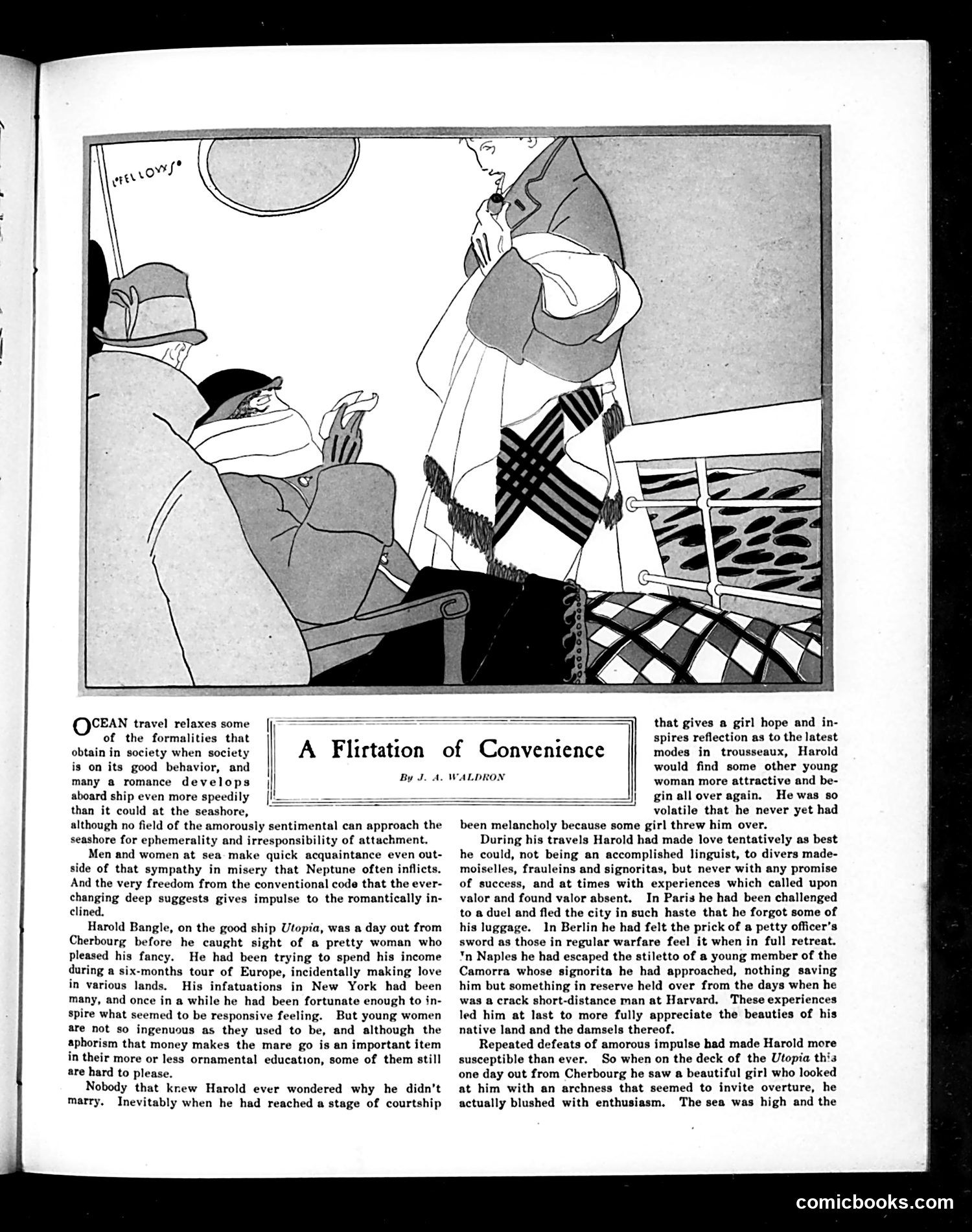
What you’re looking at
This is a short story (not a political cartoon) by J.A. Waldron about Harold Bangle, a wealthy American tourist who serially pursues women across Europe with little success. The narrative satirizes the romantic foolishness of a privileged man who treats courtship as casual sport during his leisure travels. Harold's repeated failures—being challenged to duels in Paris, stabbed in Berlin, chased by the Camorra in Naples—mock his incompetence and entitlement. The story suggests that ocean travel loosens social conventions, making shipboard romance both easier and more frivolous. The satire targets masculine vanity: Harold's money and leisure enable constant romantic attempts, yet his volatility and cowardice undermine each pursuit. The tale seems to argue that such irresponsible flirtation abroad reflects poorly on American travelers and reveals the hollowness of wealthy idleness.
📄 Transcribed text from this page (OCR, searchable)
Machine-transcribed from the original scan — historical spelling and the odd misread are preserved.
OCEAN travel relaxes some of the formalities that obtain in society when society is on its good behavior, and many a romance develops aboard ship even more speedily By J A Flirtation of Convenience A, WALDRON that gives a girl hope and in- spires reflection as to the latest modes in trousseaux, Harold would find some other young woman more attractive and be- gin all over again. He was so than it could at the seashore, although no field of the amorously sentimental can approach the seashore for ephemerality and irresponsibility of attachment. Men and women at sea make quick acquaintance even out- side of that sympathy in misery that Neptune often inflicts. And the very freedom from the conventional code that the ever- changing deep suggests gives impulse to the romantically in- clined. Harold Bangle, on the good ship Utopia, was a day out from Cherbourg before he caught sight of a pretty woman who pleased his fancy. He had been trying to spend his income during a six-months tour of Europe, incidentally making love in various lands. His infatuations in New York had been many, and once in a while he had been fortunate enough to in- spire what seemed to be responsive feeling. But young women are not so ingenuous as they used to be, and although the aphorism that money makes the mare go is an important item in their more or less ornamental education, some of them still are hard to please. Nobody that knew Harold ever wondered why he didn’t marry. Inevitably when he had reached a stage of courtship volatile that he never yet had been melancholy because some girl threw him over. During his travels Harold had made love tentatively as best he could, not being an accomplished linguist, to divers made- moiselles, frauleins and signoritas, but never with any promise of success, and at times with experiences which called upon valor and found valor absent. In Paris he had been challenged to a duel and fled the city in such haste that he forgot some of his luggage. In Berlin he had felt the prick of a petty officer’s sword as those in regular warfare feel it when in full retreat. ‘n Naples he had escaped the stiletto of a young member of the Camorra whose signorita he had approached, nothing saving him but something in reserve held over from the days when he was a crack short-distance man at Harvard. These experiences led him at last to more fully appreciate the beauties of his native land and the damsels thereof. Repeated defeats of amorous impulse had made Harold more susceptible than ever. So when on the deck of the Utopia this one day out from Cherbourg he saw a beautiful girl who looked at him with an archness that seemed to invite overture, he actually blushed with enthusiasm. The sea was high and the comicbooks.com