
Judge, 1914-03-21 · page 6 of 24
Judge — March 21, 1914 — page 6: what you’re looking at
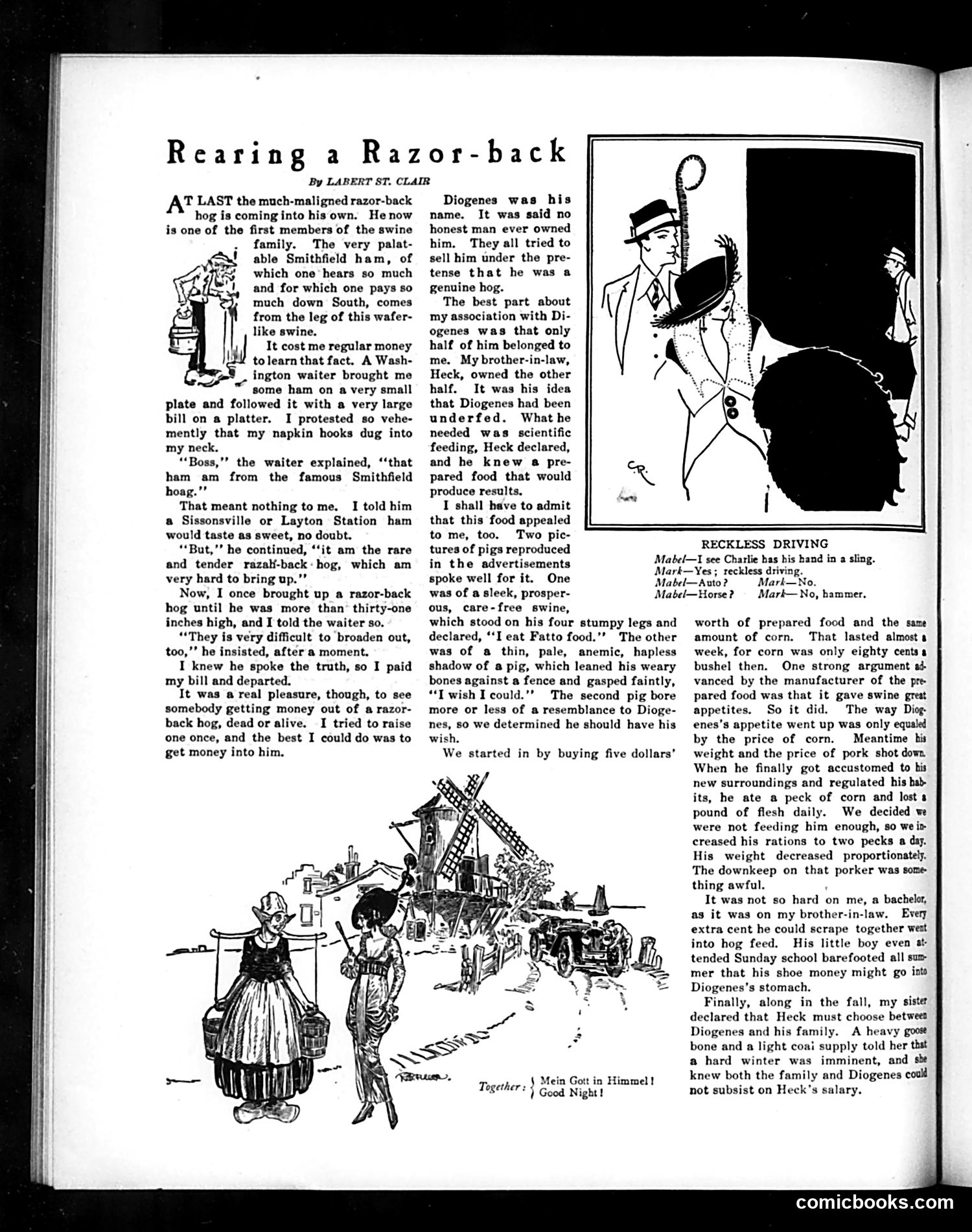
A restored page from Judge, 1914-03-21. Page through the whole issue in the reader above.
📄 Transcribed text from this page (OCR, searchable)
Machine-transcribed from the original scan — historical spelling and the odd misread are preserved.
Rearing a Razor-back By LABERT ST. CLAIR AT LAST the much-maligned razor-back hog is coming into hisown. He now is one of the first members of the swine family. The very palat- able Smithfield ham, of which one hears so much and for which one pays so much down South, comes from the leg of this wafer- like swine. It cost me regular money tolearn that fact. A Wash- ington waiter brought me < some ham on a very small plate and followed it with a very large bill on a platter. I protested so vehe- mently that my napkin hooks dug into my neck. “Boss,’’ the waiter explained, ‘‘that ham am from the famous Smithfield hoag.’” That meant nothing to me. I told him a Sissonsville or Layton Station ham would taste as sweet, no doubt. ‘‘But,”’ he continued, ‘‘it am the rare and tender razal-back- hog, which am very hard to bring up.”” Now, I once brought up a razor-back hog until he was more than’ thirty-one inches high, and I told the waiter so. “They is very difficult to broaden out, too,’’ he insisted, after a moment, I knew he spoke the truth, so I paid my bill and departed. It was a real pleasure, though, to see somebody getting money out of a razor- back hog, dead or alive. I tried to raise ‘one once, and the best I could do was to get money into him. Diogenes was his name. It was said no honest man ever owned him. They all tried to sell him under the pre- tense that he was a genuine hog. The best part about my association with Di- ogenes was that only half of him belonged to me. My brother-in-law, Heck, owned the other half. It was his idea that Diogenes had been underfed. What he needed was scientific feeding, Heck declared, and he knew a pre- pared food that would produce results, I shall have to admit that this food appealed to me, too. Two pic- tures of pigs reproduced in the advertisements spoke well for it. One was of a sleek, prosper- ous, care-free swine, which stood on his four stumpy legs and declared, ‘‘I eat Fatto food.’ The other was of a thin, pale, anemic, hapless shadow of a pig, which leaned his weary bones against a fence and gasped faintly, “I wish I could.” The second pig bore more or less of a resemblance to Dioge- nes, so we determined he should have his wish. We started in by buying five dollars’ § Mein Gott in Himmel! Together: ) Good Night | Mabel—Auto? Mabel—Horse? RECKLESS DRIVING Mabel—I see Charlie has his band in a sling. Mark—Yes; reckless driving. Mark—No. Mark—No, hammer. worth of prepared food and the same amount of corn. That lasted almost s week, for corn was only eighty cents a bushel then. One strong argument ad vanced by the manufacturer of the pre pared food was that it gave swine grest appetites. So it did. The way Diog- enes’s appetite went up was only equaled by the price of corn. Meantime his weight and the price of pork shot down When he finally got accustomed to bis new surroundings and regulated his bab its, he ate a peck of corn and lost s pound of flesh daily. We decided we were not feeding him enough, so we i> creased his rations to two pecks a day. His weight decreased proportionately. The downkeep on that porker was some thing awful. It was not so hard on me, a bachelor, as it was on my brother-in-law. Every extra cent he could scrape together west into hog feed. His little boy even at tended Sunday school barefooted all sum mer that his shoe money might go into Diogenes’s stomach. Finally, along in the fall, my sister declared that Heck must choose betwees Diogenes and his family. A heavy goose bone and a light coai supply told her thst a hard winter was imminent, and she knew both the family and Diogenes could not subsist on Heck’s salary, comicbooks.com