
Judge, 1914-03-21 · page 8 of 24
Judge — March 21, 1914 — page 8: what you’re looking at
What you’re looking at
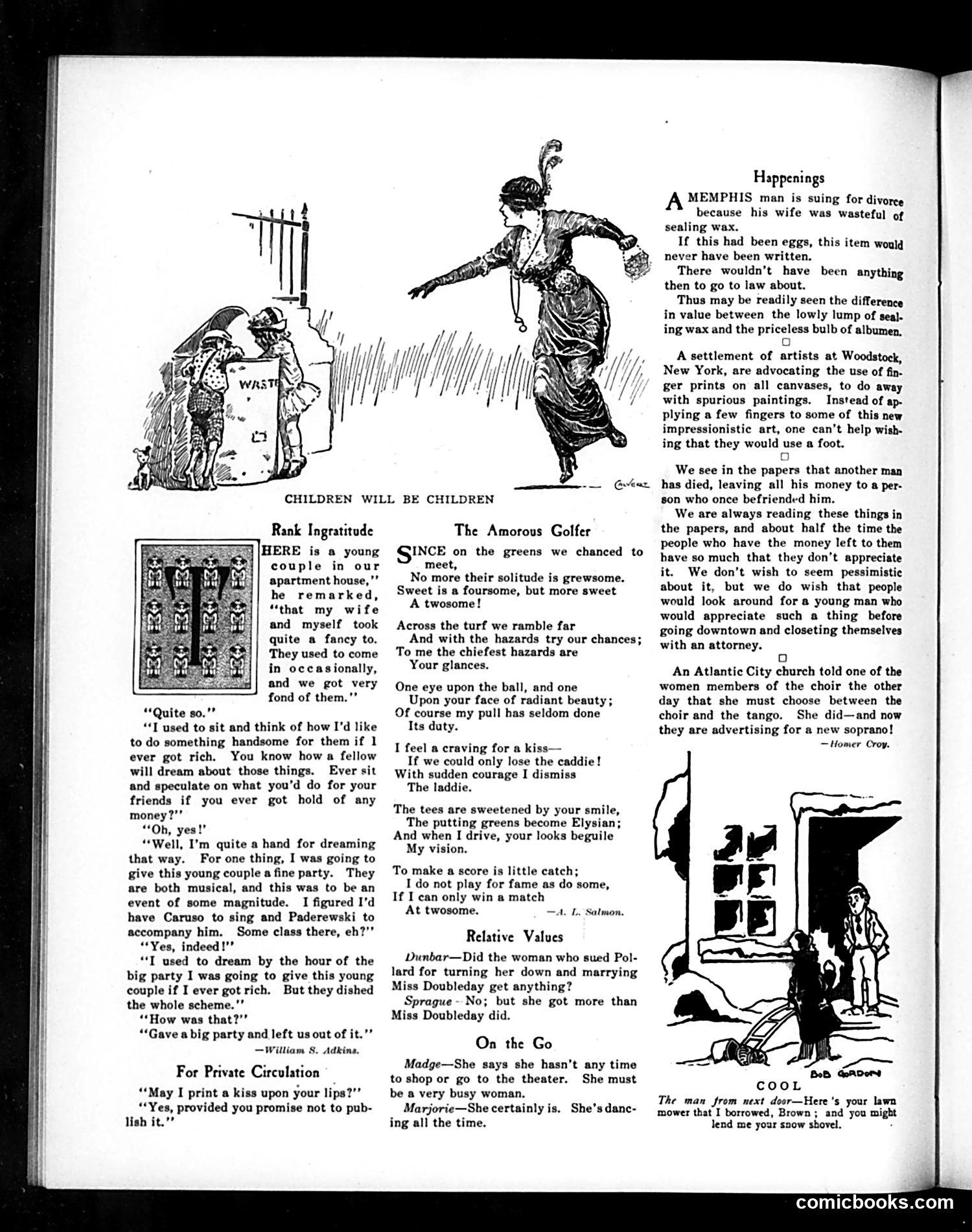
This page contains several short humorous pieces satirizing early 20th-century social behavior. The main cartoon, "Rank Ingratitude," mocks a man's disappointed expectations. He fantasized about befriending a poor young couple and eventually throwing them a lavish party (featuring famous musicians Caruso and Paderewski). However, the couple threw their own party and didn't invite him—so his imagined generosity never materialized. The joke targets both his presumption and the absurdity of elaborate daydreams about wealth. Other pieces mock contemporary social follies: a Memphis divorce over "wasteful" sealing wax (trivializing marriage), artists proposing fingerprints on paintings to prevent forgery, a woman choosing the tango over church choir duties, and the tired trope of deathbed money bequests to old acquaintances. The humor is gentle domestic satire typical of Judge magazine—poking fun at middle-class pretensions, romantic delusions, and social hypocrisy without harsh edge.
📄 Transcribed text from this page (OCR, searchable)
Machine-transcribed from the original scan — historical spelling and the odd misread are preserved.
CHILDREN WILL BE CHILDREN Rank Ingratitude couple in our apartment house,’’ he remarked, “that my wife and myself took quite a fancy to. They used to come in occasionally, and we got very fond of them."’ “Quite so.’” “T used to sit and think of how I'd like to do something handsome for them if 1 ever got rich. You know how a fellow will dream about those things. Ever sit and speculate on what you'd do for your friends if you ever got hold of any money?’’ “Oh, yes!’ “Well, I'm quite a hand for dreaming that way. For one thing, I was going to give this young couple a fine party. They are both musical, and this was to be an event of some magnitude. I figured I'd have Caruso to sing and Paderewski to accompany him. Some class there, eh?’’ “Yes, indeed!’’ “I used to dream by the hour of the big party I was going to give this young couple if I ever got rich. But they dished the whole scheme.’’ “How was that?’ “Gave a big party and left us out of it.”’ William 8. Adkins. For Private Circulation “May I print a kiss upon your lips?” “Yes, provided you promise not to pub- lish it.”” The Amorous Golfer SINCE on the greens we chanced to meet, No more their solitude is grewsome. Sweet is a foursome, but more sweet A twosome! Across the turf we ramble far And with the hazards try our chances; To me the chiefest hazards are Your glances. One eye upon the ball, and one Upon your face of radiant beauty; Of course my pull has seldom done Its duty. I feel a craving for a kiss— If we could only lose the caddie! With sudden courage I dismiss The laddie. The tees are sweetened by your smile, The putting greens become Elysian; And when I drive, your looks beguile My vision. To make a score is little catch; I do not play for fame as do some, If I can only win a match At twosome. A. L. Salmon. Relative Values Dunbar—Did the woman who sued Pol- lard for turning her down and marrying Miss Doubleday get anything? Sprague- No; but she got more than Miss Doubleday did. On the Go Madge—She says she hasn’t any time to shop or go to the theater. She must be a very busy woman. Marjorie—She certainly is. She's danc- ing all the time. Happenings A MEMPHIS man is suing for divorce because his wife was wasteful of sealing wax. If this had been eggs, this item would never have been written. There wouldn’t have been anything then to go to law about. Thus may be readily seen the difference in value between the lowly lump of seal. ing wax and the priceless bulb of albumen. Oo A settlement of artists at Woodstock, New York, are advocating the use of fin- ger prints on all canvases, to do away with spurious paintings. Instead of ap- plying a few fingers to some of this new impressionistic art, one can’t help wish- ing that they would use a foot. oO We see in the papers that another man has died, leaving all his money to a per- son who once befriended him. We are always reading these things in the papers, and about half the time the people who have the money left to them have so much that they don’t appreciate it. We don’t wish to seem pessimistic about it, but we do wish that people would look around for a young man who would appreciate such a thing before going downtown and closeting themselves with an attorney. oO An Atlantic City church told one of the women members of the choir the other day that she must choose between the choir and the tango. She did—and now they are advertising for a new soprano! —Homer Croy. COOL The man from next door—Here 's your lawn mower that I borrowed, Brown ; and you might lend me your snow shovel, . comicbooks.com