
Judge, 1914-03-21 · page 10 of 24
Judge — March 21, 1914 — page 10: what you’re looking at
What you’re looking at
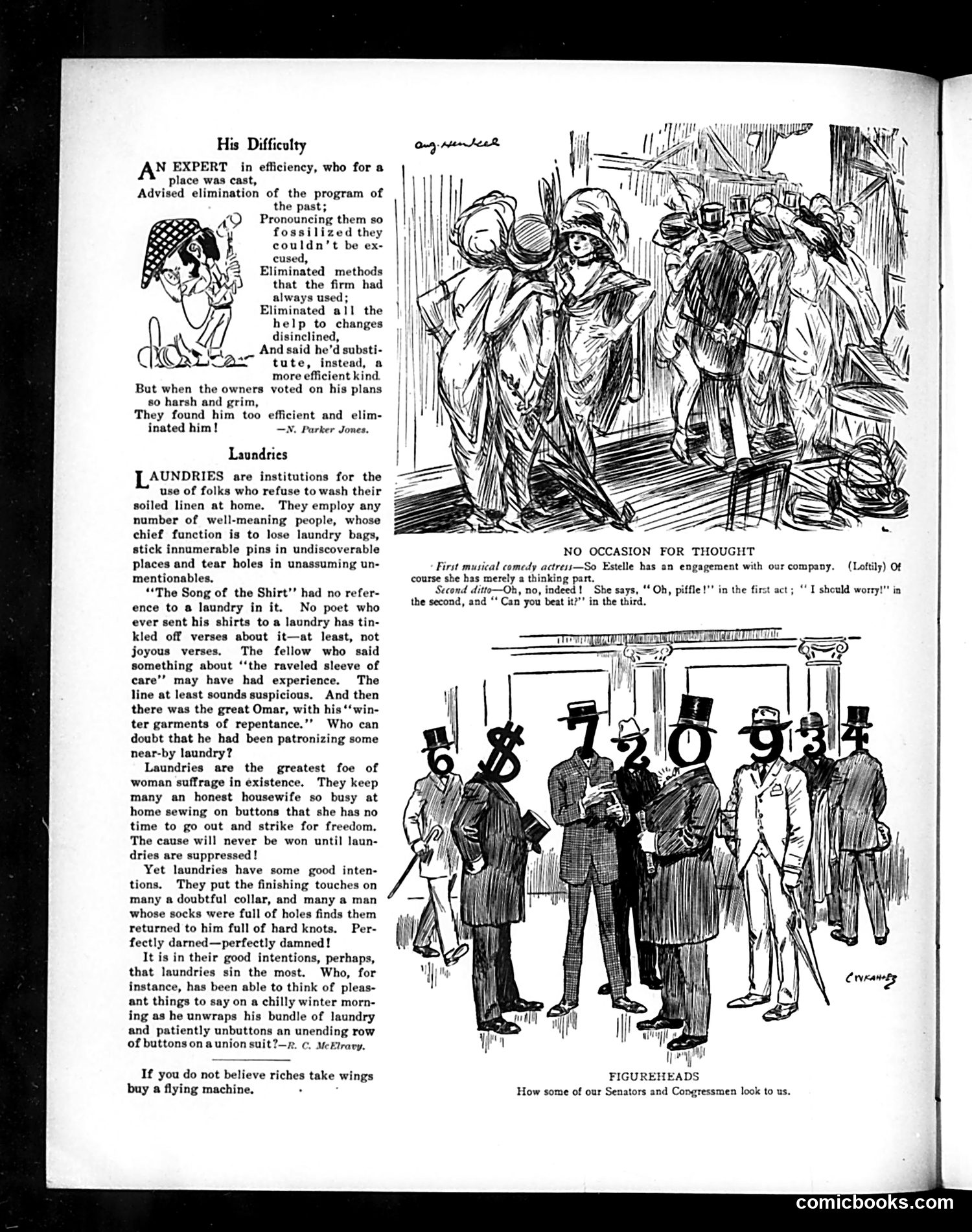
The page contains two main satirical pieces. **"His Difficulty"** (top left) mocks an "efficiency expert" hired to modernize a business. He eliminates old methods and workers he deems obsolete, replacing them with harsh new systems. However, the owners find him "too efficient" and eliminate *him*—a joke about how radical "efficiency" can backfire and alienate people in power. **"Figureheads"** (bottom) is a crude political cartoon depicting senators and congressmen as literal figureheads—their heads replaced by large numbers. The caption notes they "look to us" this way, suggesting politicians are interchangeable, faceless, or purely decorative rather than meaningful individuals. This reflects early-20th-century cynicism about governmental effectiveness. The other content discusses laundries (humorously blaming them for preventing women's suffrage by keeping housewives busy) and a theater joke about an actress hired only for trivial lines, not actual acting talent.
📄 Transcribed text from this page (OCR, searchable)
Machine-transcribed from the original scan — historical spelling and the odd misread are preserved.
His Difficulty N EXPERT in efficiency, who for a place was cast, Advised elimination of the program of the past; Pronouncing them so fossilized they couldn't be ex- cused, Eliminated methods that the firm had always used; Eliminated all the help to changes disinclined, OS _~ And said he’d substi- TA tute, instead, a more efficient kind. But when the owners voted on his plans so harsh and grim, They found him too efficient and elim- inated him! —N. Parker Jones. Laundries LAUNDRIES are institutions for the use of folks who refuse to wash their soiled linen at home. They employ any number of well-meaning people, whose chief function is to lose laundry bags, stick innumerable pins in undiscoverable NO OCCASION FOR THOUGHT places and tear holes in unassuming un- First musical comedy actress—So Estelle has an engagement with our company. (Loftily) Of mentionables. course she has merely a thinking part. “The Song of the Shirt’ had no refer- Second ditto—Ob, no, indeed! She says, ‘Oh, piffle!" in the first act ; ‘* I should worry!" in ence to a laundry in it. No poet who the second, and ‘‘ Can you beat it?’’ in the third. ever sent his shirts to a laundry has tin- kled off verses about it—at least, not joyous verses. The fellow who said something about ‘‘the raveled sleeve of care’? may have had experience. The line at least sounds suspicious. And then there was the great Omar, with his ‘‘win- ter garments of repentance.’’ Who can doubt that he had been patronizing some near-by laundry? Laundries are the greatest foe of woman suffrage in existence. They keep many an honest housewife so busy at home sewing on buttons that she has no time to go out and strike for freedom. The cause will never be won until laun- dries are suppressed! Yet laundries have some good inten- tions. They put the finishing touches on many a doubtful collar, and many a man whose socks were full of holes finds them returned to him full of hard knots. Per- fectly darned—perfectly damned! It is in their good intentions, perhaps, that laundries sin the most. Who, for instance, has been able to think of pleas- ant things to say on a chilly winter morn- ing as he unwraps his bundle of laundry and patiently unbuttons an unending row of buttons on aunion su . C. McElravy. If you do not believe riches take wings FIGUREHEADS buy a flying machine. : How some of our Senators and Congressmen look to us. comicbooks.com