
Judge, 1914-03-21 · page 7 of 24
Judge — March 21, 1914 — page 7: what you’re looking at
What you’re looking at
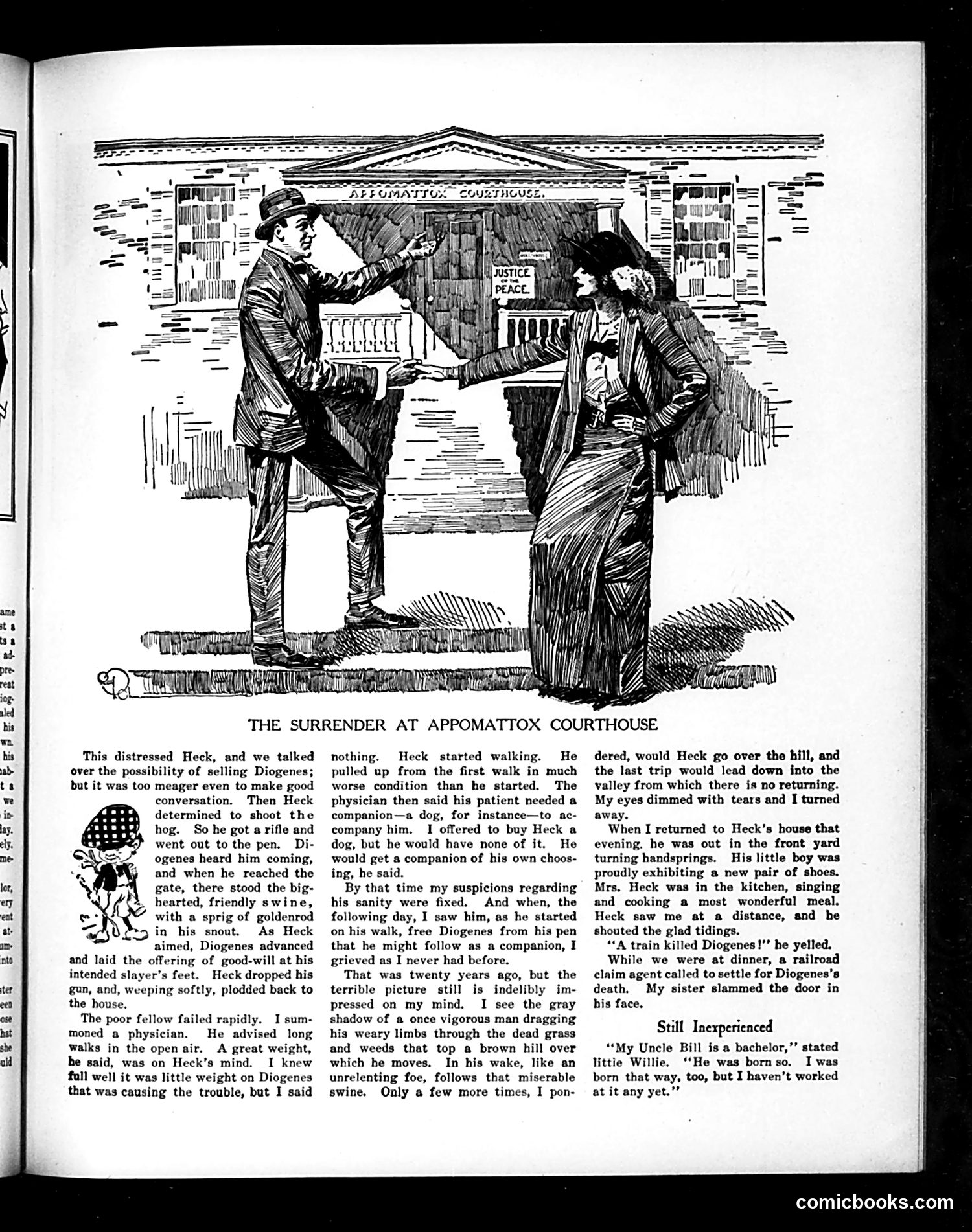
This page contains two distinct pieces. The main cartoon depicts two figures at a courthouse (labeled "Justice" and "Peace") in what appears to be a formal surrender scene, likely referencing the Civil War's end at Appomattox in 1865. Below is a longer prose story about a man named Heck who becomes emotionally attached to his pig, Diogenes. The narrative traces Heck's depression and recovery after the pig is killed by a train. The story uses the pig's death as darkly comic relief—Heck's mental state improves dramatically once his burden (literally and figuratively) is removed. At bottom is a brief humor section titled "Still Inexperienced" featuring a child's naive joke about his uncle's bachelorhood. The page mixes Civil War-era political satire with character humor typical of Judge magazine's satirical approach.
📄 Transcribed text from this page (OCR, searchable)
Machine-transcribed from the original scan — historical spelling and the odd misread are preserved.
Te) f ayy? aie ' PGs \ sia THE SURRENDER AT APPOMATTOX COURTHOUSE This distressed Heck, and we talked over the possibility of selling Diogenes; but it was too meager even to make good conversation. Then Heck determined to shoot the hog. So he got a rifle and went out to the pen. Di- ogenes heard him coming, and when he reached the gate, there stood the big- hearted, friendly swine, with a sprig of goldenrod in his snout. As Heck aimed, Diogenes advanced and laid the offering of good-will at his intended slayer’s feet. Heck dropped his gun, and, weeping softly, plodded back to the house. The poor fellow failed rapidly. I sum- moned a physician. He advised long walks in the open air. A great weight, he said, was on Heck’s mind. I knew fall well it was little weight on Diogenes that was causing the trouble, but I said nothing. Heck started walking. He pulled up from the first walk in much worse condition than he started. The physician then said his patient needed a companion—a dog, for instance—to ac- company him. I offered to buy Heck a dog, but he would have none of it. He would get a companion of his own choos- ing, he said. By that time my suspicions regarding his sanity were fixed. And when, the following day, I saw him, as he started on his walk, free Diogenes from his pen that he might follow as a companion, I grieved as I never had before. That was twenty years ago, but the terrible picture still is indelibly im- pressed on my mind. I see the gray shadow of a once vigorous man dragging his weary limbs through the dead grass and weeds that top a brown hill over which he moves. In his wake, like an unrelenting foe, follows that miserable swine. Only a few more times, I pon- dered, would Heck go over the hill, and the last trip would lead down into the valley from which there is no returning. My eyes dimmed with tears and I turned away. When I returned to Heck’s house that evening. he was out in the front yard turning handsprings. His little boy was proudly exhibiting a new pair of shoes. Mrs. Heck was in the kitchen, singing and cooking a most wonderful meal. Heck saw me at a distance, and he shouted the glad tidings. “A train killed Diogenes !’’ he yelled. While we were at dinner, a railroad claim agent called to settle for Diogenes’s death, My sister slammed the door in his face. Still Inexperienced “My Uncle Bill is a bachelor,” stated littie Willie. ‘‘He was bornso. I was born that way, too, but I haven’t worked at it any yet.”” comicbooks.com