
A complete issue · 24 pages · 1914
Judge — March 14, 1914
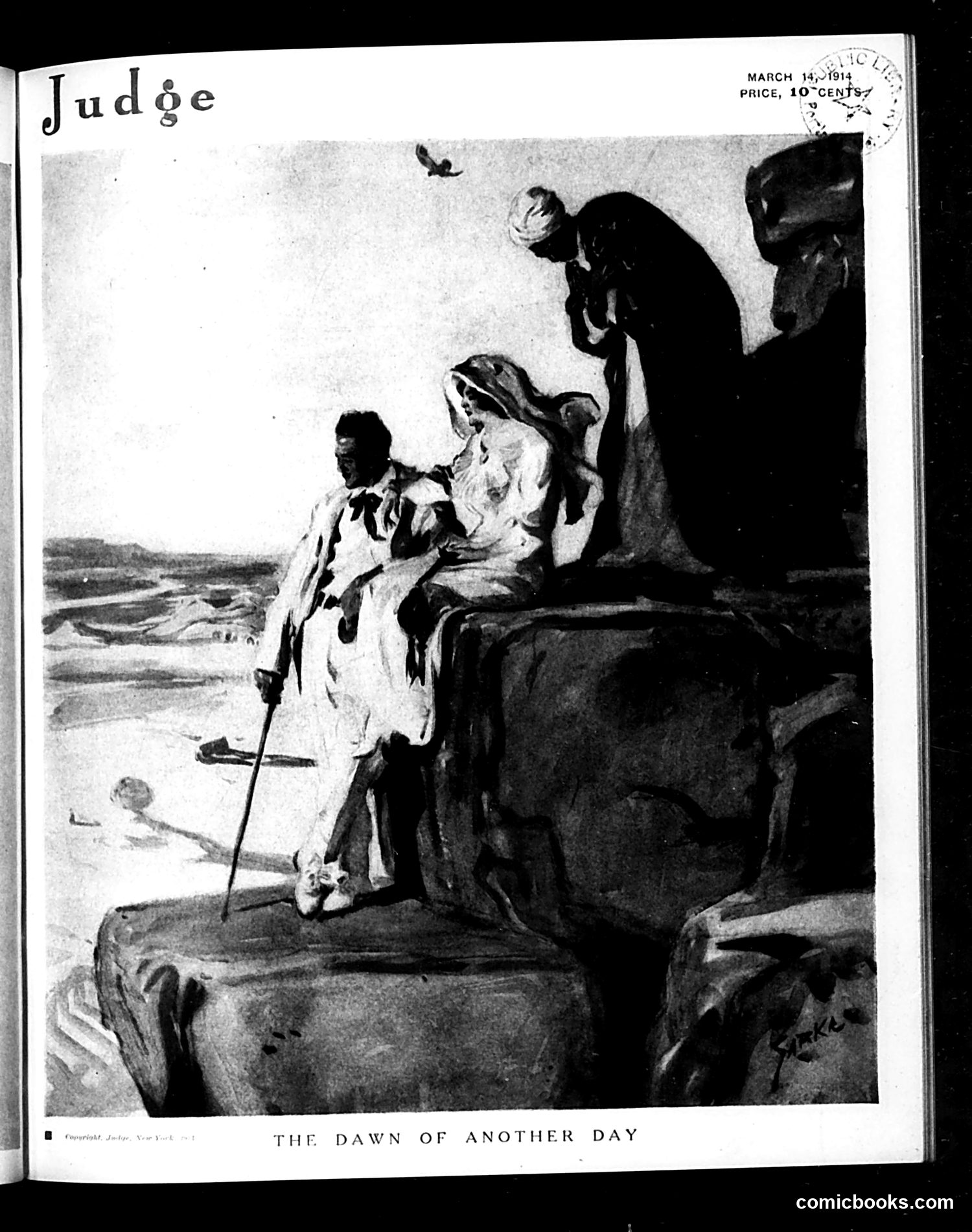
This March 14, 1914 Judge cartoon depicts what appears to be a biblical or allegorical scene rather than direct political satire. The image shows figures in robes observing a sunrise over a landscape, with the title "The Dawn of Another Day" suggesting themes of renewal or new beginnings. Without clearer identification of the specific figures or clearer OCR text explaining the cartoon's context, I cannot definitively identify which political or social event this references. The allegorical style and religious imagery suggest it may comment on hopes for peace, reform, or resolution of a contemporary crisis from early 1914, but I cannot assert the specific meaning with certainty based on the image alone.
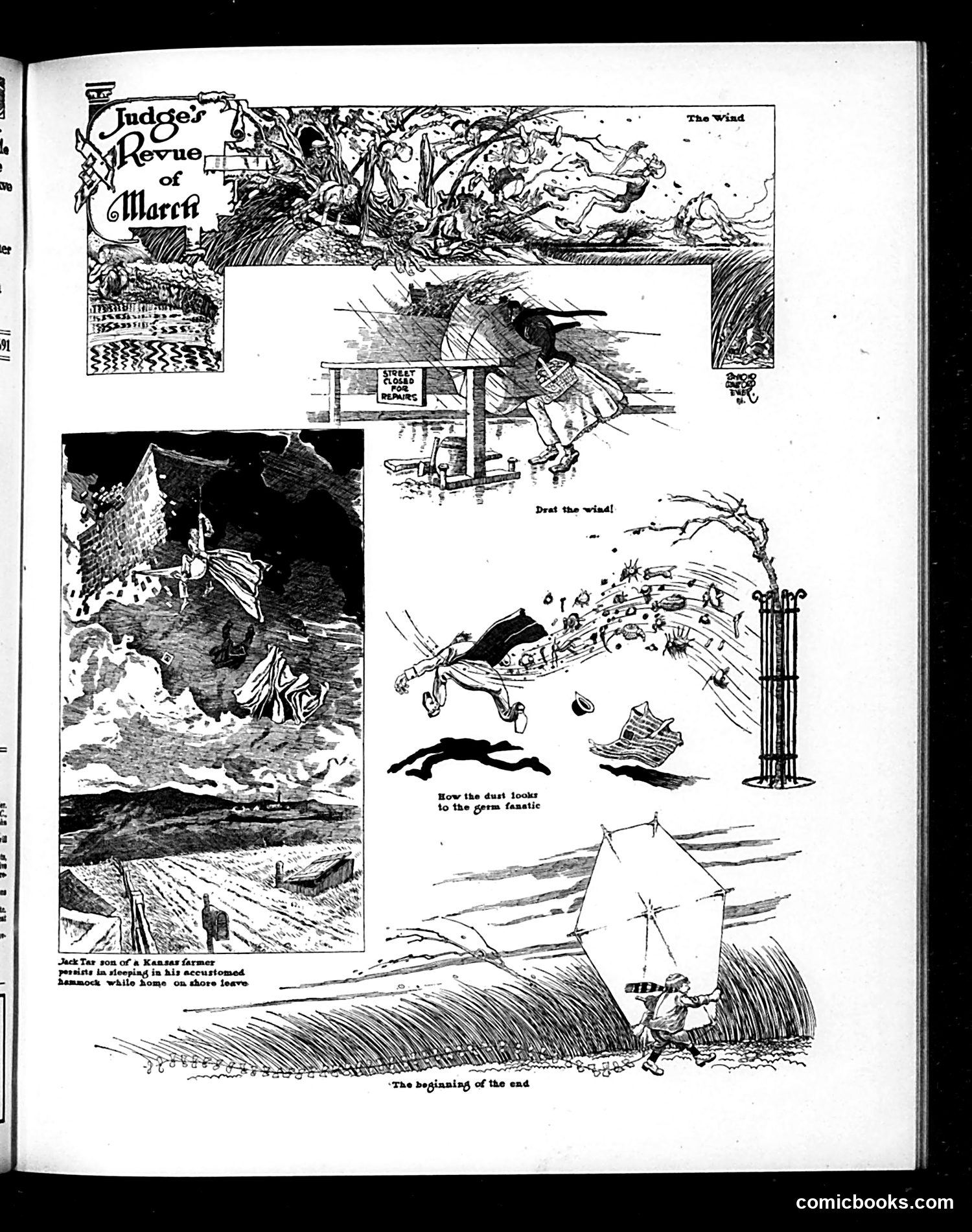
This page satirizes the effects of strong winds through several illustrated scenarios. The title "The Wind" anchors the theme, with captions including "Dust the wind!" and "How the dust looks to the germ fanatic" suggesting early 20th-century anxieties about hygiene and germs. One panel shows "Jack Toe son of a Kansas farmer puzzles in sleeping in his accustomed hammock while home on shore leave"—likely mocking someone's disorientation during leave, possibly a military reference. The various vignettes depict wind's chaotic effects: blown objects, scattered debris, and figures struggling against gusts. The satire appears directed at both nature's indifference and contemporary obsessions with sanitation and proper behavior during disruption. The overall tone is lighthearted rather than political.
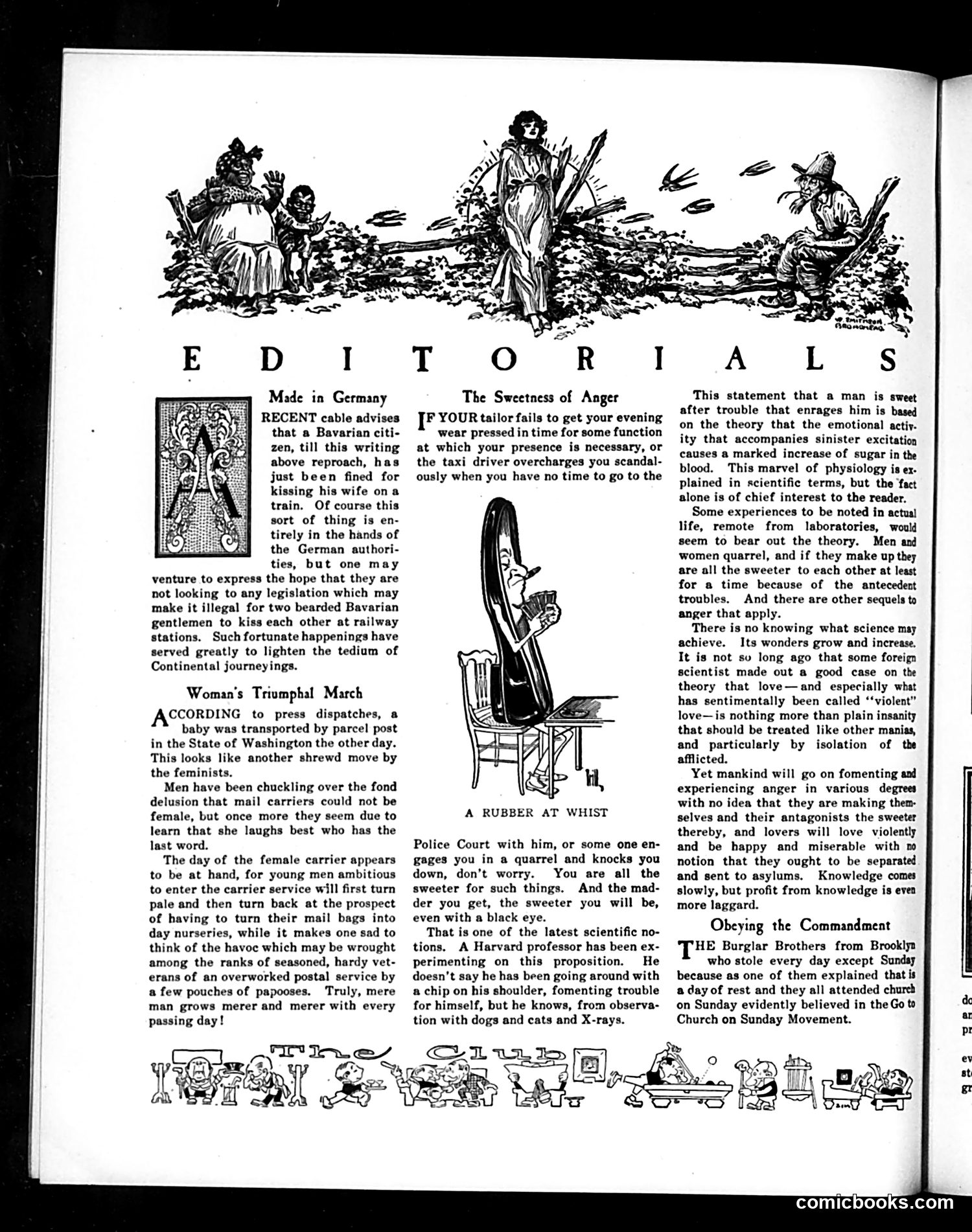
This page contains three satirical pieces: 1. **"Made in Germany"** criticizes German cable advisors allegedly influencing American policy regarding two-handed kisses at train stations—suggesting foreign interference in social customs. 2. **"Woman's Triumphal March"** mocks female mail carriers, suggesting they're unsuited for the job. The satire implies that while women might eventually succeed in such roles, the novelty is ridiculous and men find it amusing to watch them struggle. 3. **"A Rubber at Whist"** (the illustration) depicts a woman sitting awkwardly, likely satirizing women's participation in card games or social activities considered improper for females. 4. **"Obeying the Commandment"** criticizes the Brocklyn brothers for selectively observing Sunday rest, suggesting hypocrisy in religious observance. The page reflects early 20th-century anxieties about gender roles and women entering traditionally male-dominated spaces.
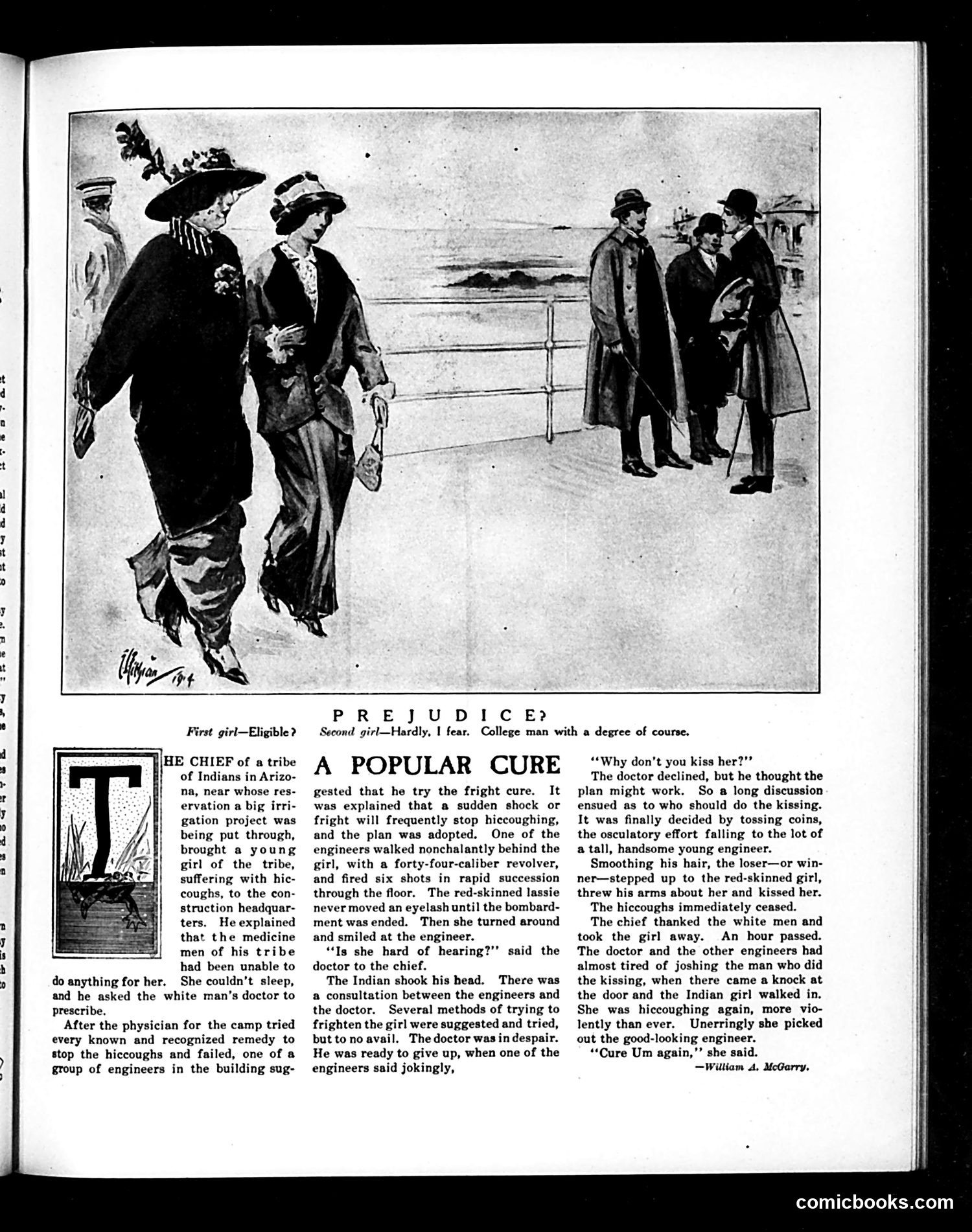
This illustrated story satirizes medical treatment and cultural attitudes of the early 20th century. The cartoon depicts a tribe's chief seeking help for a young girl suffering from hiccoughs. Various "cures" are attempted by engineers and a doctor—including shock tactics and a forty-four caliber revolver fired near her—all failing until a young engineer's kiss stops her hiccoughs. The satire targets both outdated folk remedies and the era's pseudoscientific medical practices. The title "Prejudice?" and the narrative suggest commentary on racial attitudes and the assumed superiority of "white men" solutions. The story's conclusion—that an engineer's romantic gesture succeeds where medical expertise fails—appears to mock both contemporary medicine's ineffectiveness and gender dynamics of the period.
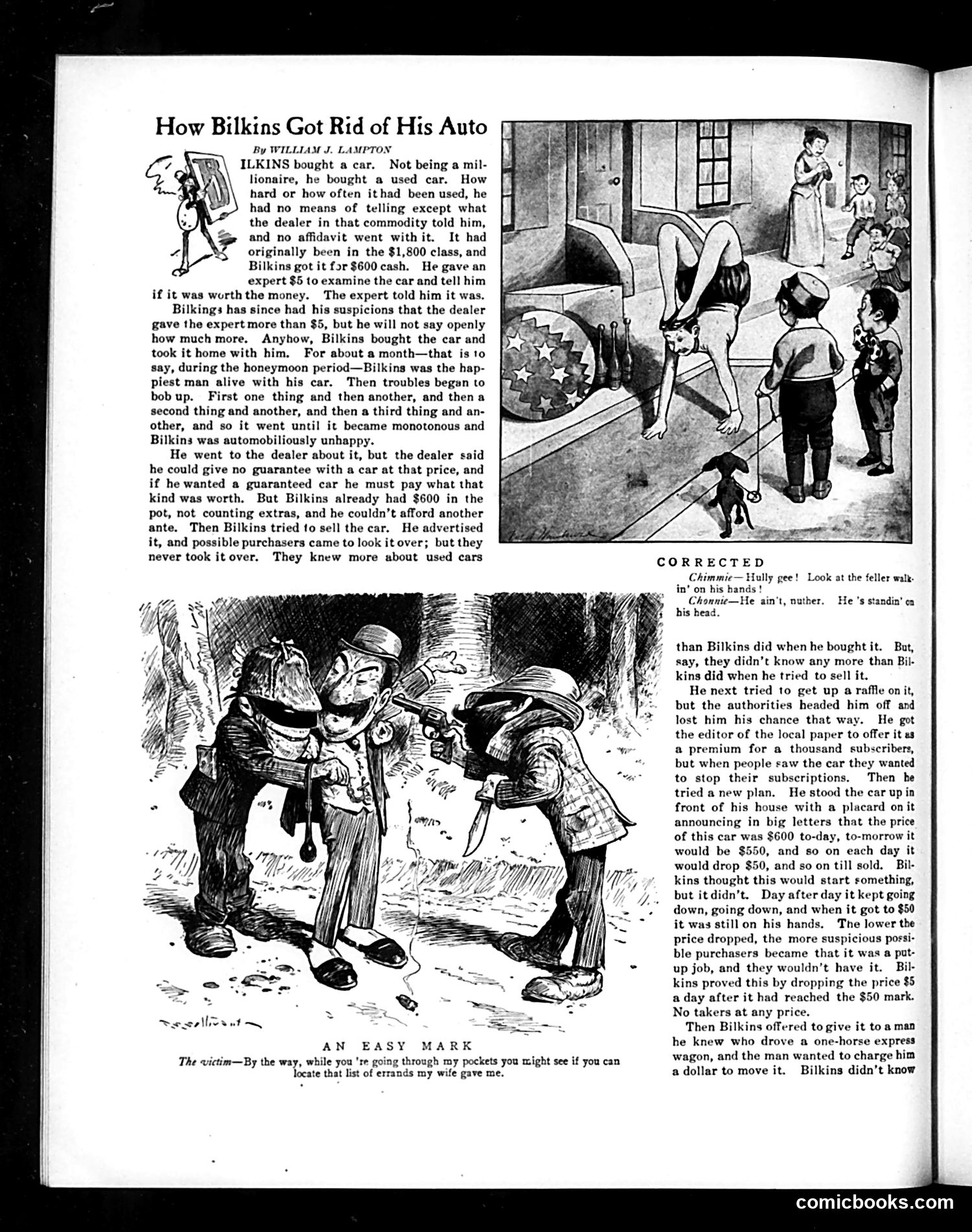
This story satirizes the used-car market and buyer's remorse in the early automobile era. Bilkins, an ordinary man (not wealthy), purchases a used car cheaply ($600) without reliable information about its condition. The satire targets several vulnerabilities: the dealer's dishonesty, the supposed "expert" inspection (likely bribed), and Bilkins' own naïveté. The joke escalates as the car becomes a liability—constant repairs make it worthless, yet no one will buy it despite aggressive marketing tactics (raffles, newspaper premiums, daily price drops). The final irony: he must *pay* someone to take it away. The accompanying cartoon "An Easy Mark" depicts a pickpocket, reinforcing the theme of gullible victims being exploited by con artists—parallel to Bilkins' experience with the used-car dealer. This reflects genuine 1910s-era consumer frustrations with the nascent automobile industry's lack of regulation or consumer protections.
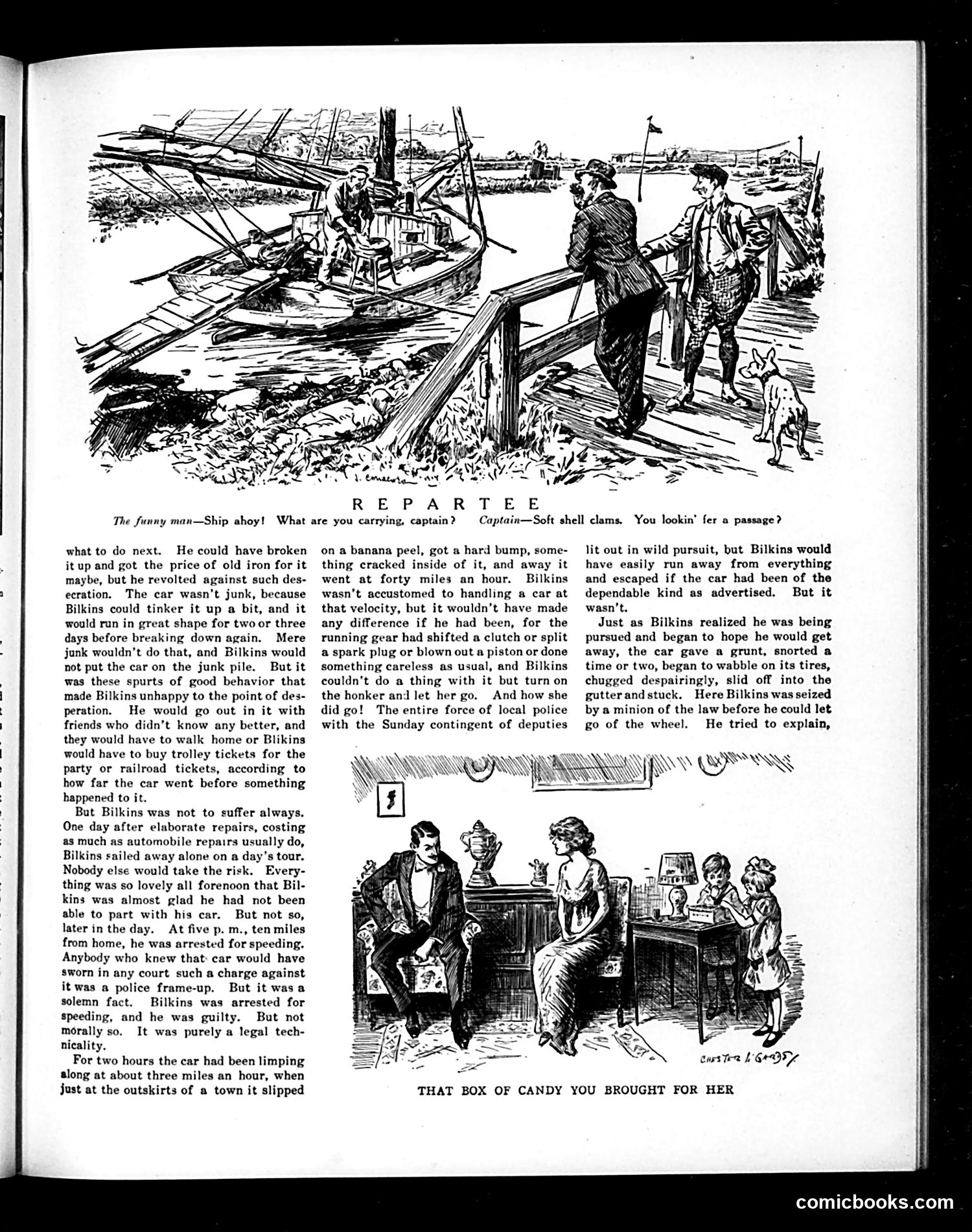
This humorous short story satirizes the early automobile era's mechanical unreliability and the legal absurdity it created. The protagonist, Bilkins, owns a chronically broken-down car that occasionally works well enough to deceive him into keeping it rather than scrapping it for parts. The satire's punch: Bilkins is arrested for speeding when his car unexpectedly lurches to forty miles per hour after hitting a banana peel—malfunctioning unpredictably rather than through reckless driving. The story highlights the legal technicality that traps him: he's technically guilty of speeding despite being morally innocent, since the car's mechanical failure (not his negligence) caused the violation. The "Repartee" heading and dock-scene illustration suggest this is a humorous miscellany page rather than focused political commentary. The lower illustration captioned "That Box of Candy You Brought for Her" appears unrelated domestic humor.
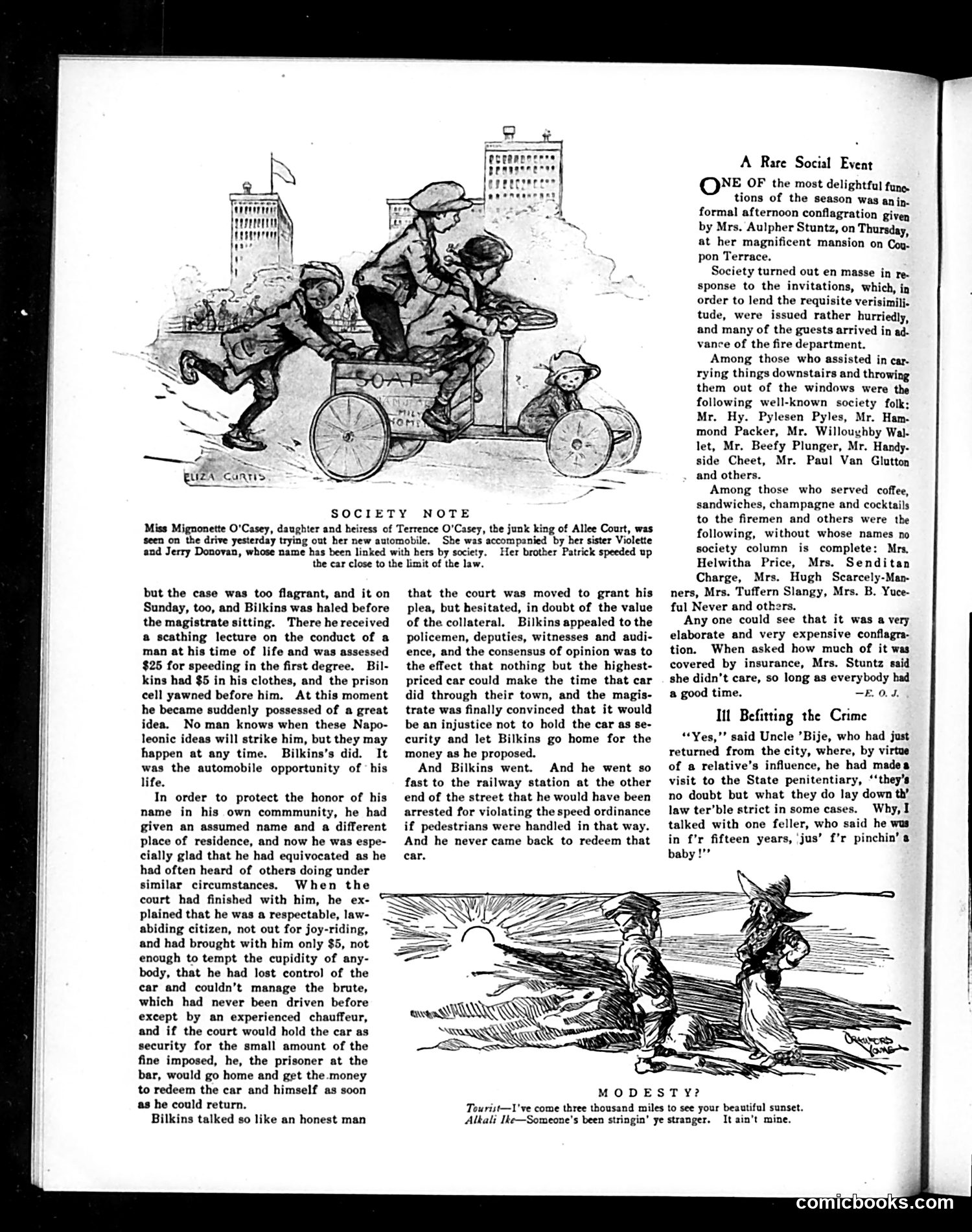
This page contains two satirical pieces mocking wealthy society and urban crime. **"Society Note"** (left): A con-man named Bilkins is caught speeding in a stolen automobile. Brought before a magistrate, he claims poverty ($5 only) and uses flattery—appealing to witnesses about the car's quality—to convince the court to hold the vehicle as collateral while he "retrieves" funds. He promptly flees and never returns. The satire targets both gullible legal authorities and the automobile's role as status symbol among the wealthy. **"A Rare Social Event"** (right): Mrs. Aulpher Stuntz hosts a society party that is actually her mansion burning down. Society figures with absurdly descriptive names ("Beefy Plunger," "Handy-side Cheet") attend enthusiastically, treating the fire as entertainment—some "carrying things downstairs," others serving refreshments to firefighters. The satire mocks the shallow frivolity of the wealthy elite and their performative social rituals. Both pieces ridicule turn-of-the-century American society: their gullibility, materialism, and detachment from reality.
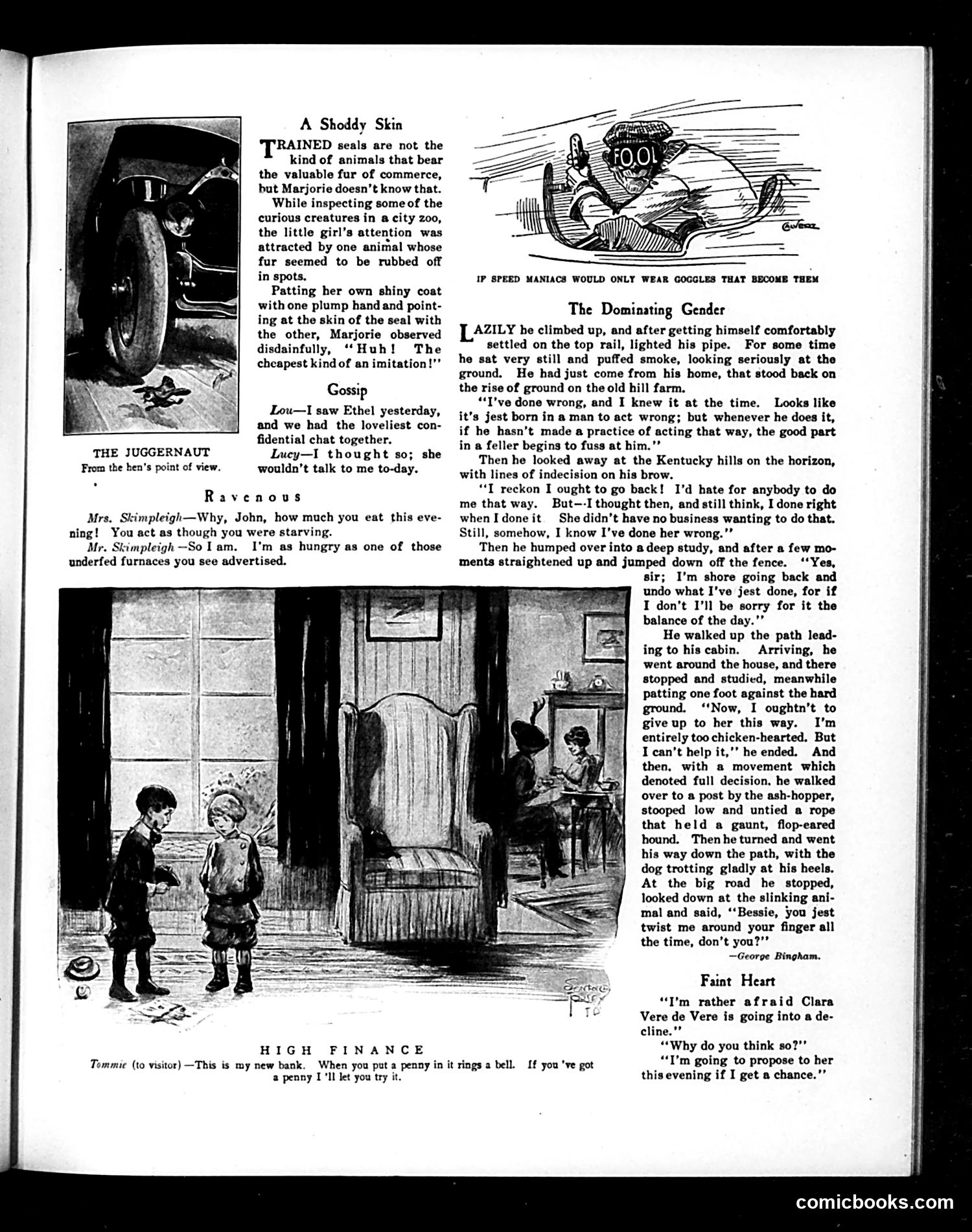
This page contains several short humorous pieces typical of early 20th-century Judge magazine: **"A Shoddy Skin"** satirizes child naïveté: a girl at the zoo mistakes a seal's patchy fur for cheap imitation fur, not understanding that trained seals naturally lose their valuable pelts. **"The Dominating Gender"** is a rural drama about a man who wronged a woman, wrestles with guilt, then resolves to make amends—ultimately choosing to free his dog (implied as a symbolic gesture of surrendering his stubbornness) before returning to apologize. **"High Finance"** is a brief joke about a toy bank that rings when coins drop in—a child's pride in showing it off. **"Gossip," "Ravenous,"** and **"Faint Heart"** are single-panel joke captions about social observations. The cartoons use sentimental or comedic scenarios to offer light social commentary on human nature, pride, and relationships—typical of Judge's satirical but family-friendly approach.
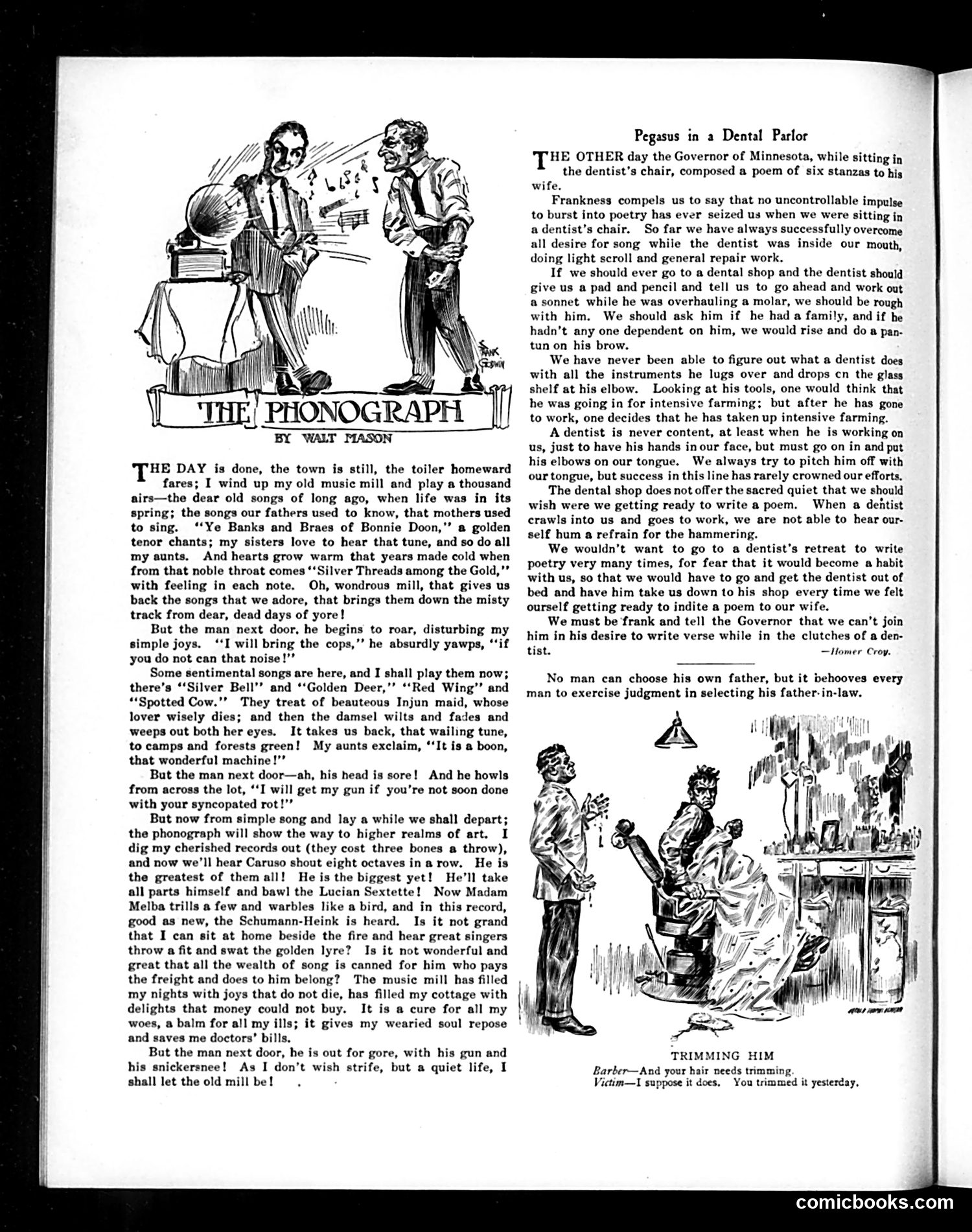
This satirical piece mocks the **Minnesota Governor** (identity unclear from the text) for composing poetry while sitting in a dentist's chair. The title's reference to Pegasus—the mythological winged horse symbolizing poetic inspiration—underscores the absurdity. The satire works on two levels: First, it ridicules the Governor's pretension that poetic inspiration could strike during dental work, a situation most people find unpleasant and distracting. Second, it implicitly critiques politicians attempting to present themselves as cultured or artistic when they should be attending to practical matters. The author (Homer Croy) uses deliberately crude language—suggesting he'd "do a pantan on his brow" (violence) if a dentist interrupted his discomfort with such requests—to emphasize how ridiculous the Governor's accomplishment actually is. The joke: real poetry requires serious artistic dedication, not improvisation under duress in a dentist's chair.
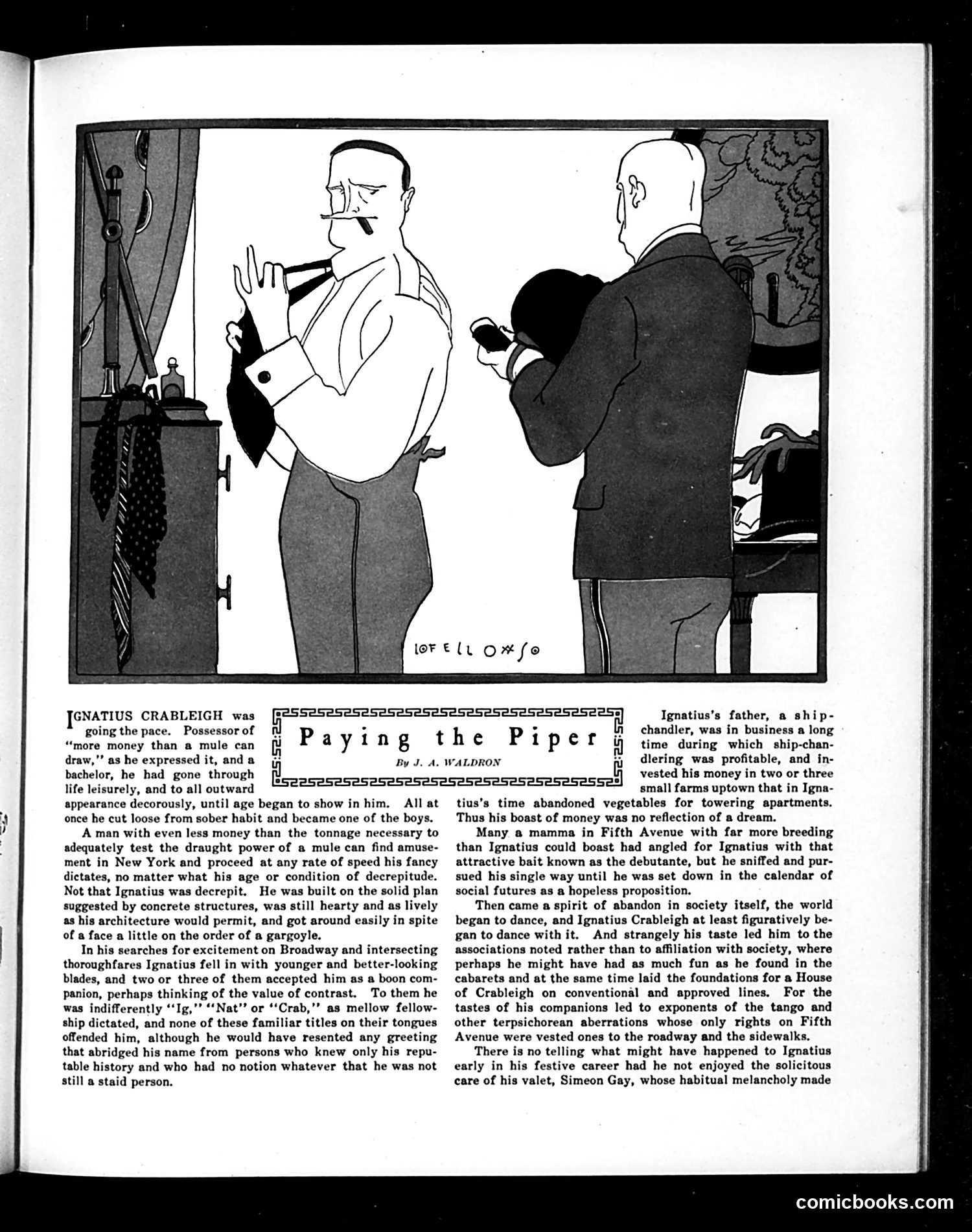
This illustrated story satirizes **Ignatius Crableigh**, a wealthy but physically unattractive older bachelor who suddenly abandons his respectable, staid lifestyle to pursue nightlife and modern dance with younger men in New York's cabarets and Broadway. The humor targets several social anxieties of the era: an aging man trying to stay young; wealthy but ungainly individuals attempting to join fashionable society; and the "moral decay" of modern urban nightlife (the tango and cabarets were considered scandalous). Crableigh inherited shipping fortune but never married despite his money, suggesting social awkwardness. The cartoon depicts him being dressed or groomed by a valet, likely illustrating his attempts at fashionable presentation. The title "Paying the Piper" suggests consequences for his hedonistic behavior will follow. The story exemplifies Judge's satirical treatment of Gilded Age excess and changing social mores in early 20th-century New York.
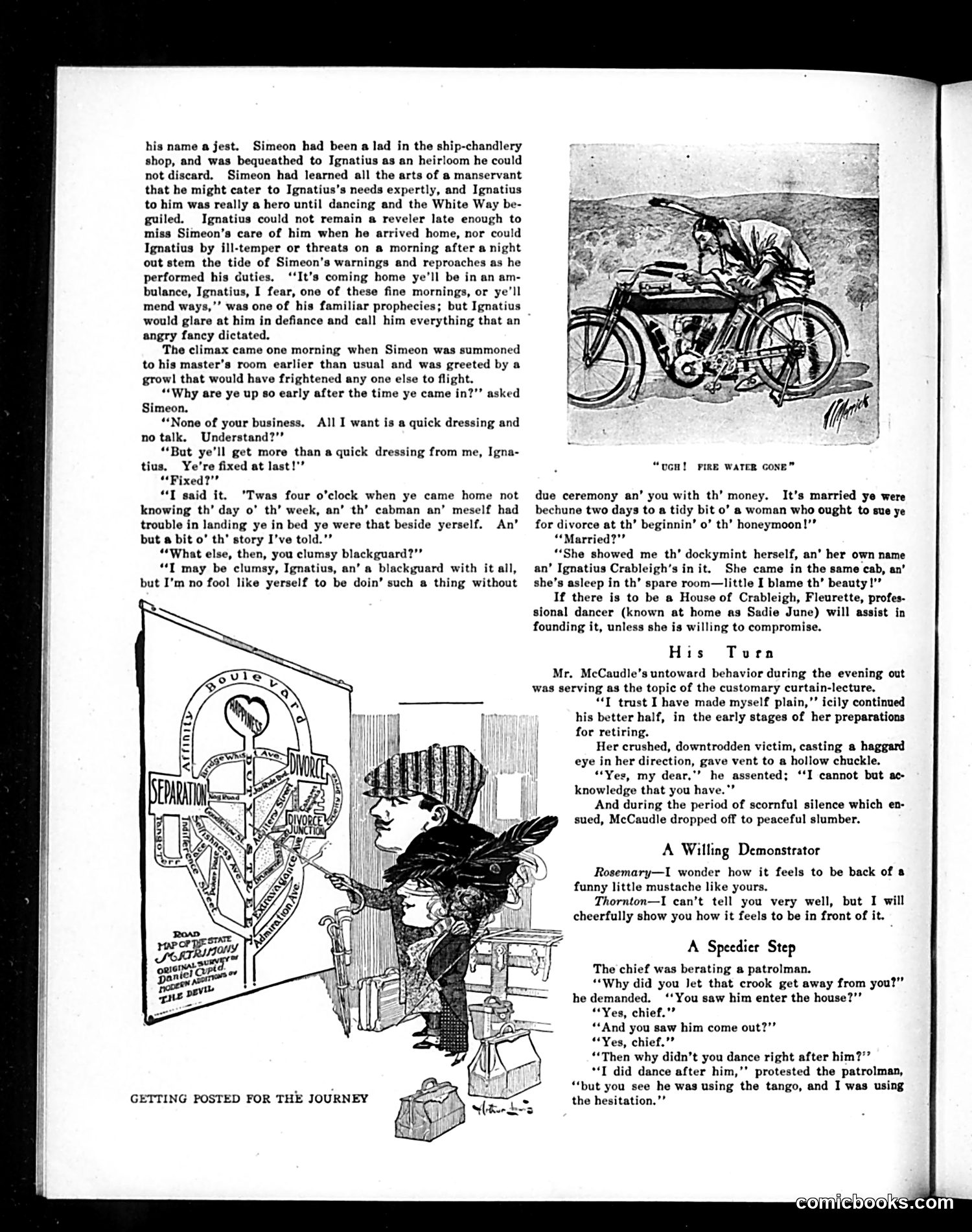
This page contains several humorous fictional sketches typical of Judge magazine's satirical style. The main story concerns Ignatius Crableigh, a wealthy man-about-town whose long-suffering servant Simeon discovers that Ignatius drunkenly married a professional dancer named Fleurette (also called Sadie June) during a night out. The satire targets wealthy idlers who squander their time and money on nightlife while their servants maintain the household—a common early-20th-century theme. Ignatius's defiant dismissal of his servant's moral warnings contrasts with the servant's eventual vindication. The page also includes three brief humorous vignettes: McCaudle falling asleep during his wife's lecture, a flirtation about mustaches, and a patrolman unable to chase a suspect because the criminal is dancing the tango while the officer can only manage the hesitation step—a joke playing on 1920s dance crazes and incompetence. The cartoons satirize class dynamics, marital discord, and modern absurdities.
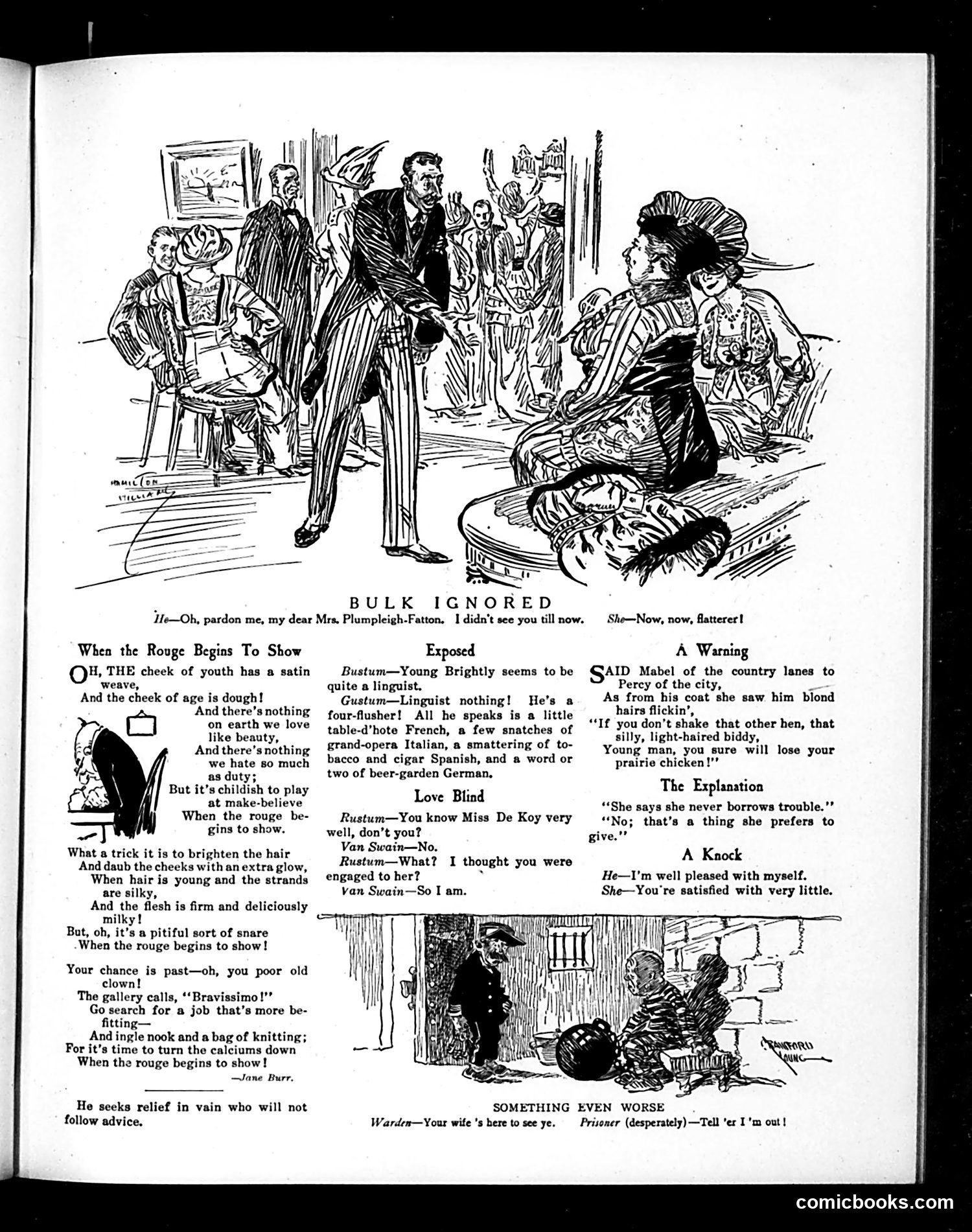
This page from *Judge* magazine contains several brief satirical jokes and a poem mocking vanity and social pretense in early 20th-century America. The main poem, "When the Rouge Begins To Show," attacks women's use of cosmetics—rouge, hair dye, and makeup—as deceptive performance. It argues that while youth can afford such artifice, aging women who continue applying makeup become pathetic figures, their "trick" exposed. The poem reflects period anxieties about female aging and authenticity. The shorter jokes mock various social types: a pretentious linguist who speaks only broken fragments of foreign languages; a man engaged but claiming not to know his fiancée (playing coy); rural versus urban courtship; and marital discord (a prisoner preferring jail to his wife). The cartoon titled "Bulk Ignored" shows a well-dressed society woman being snubbed by guests—satirizing either her social pretensions or her physical appearance. Overall, the page targets dishonesty, vanity, and social climbing through humor.
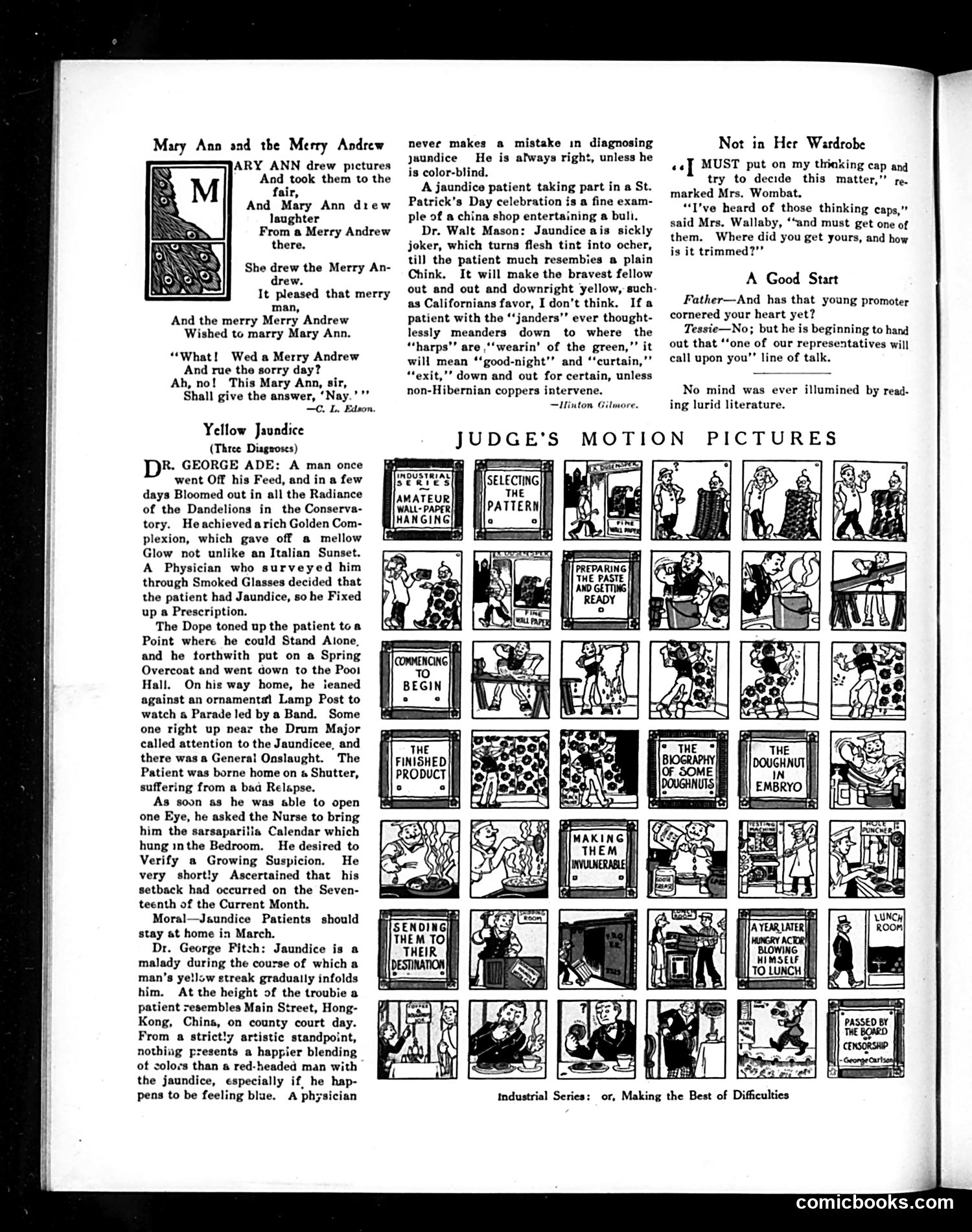
This page contains three distinct pieces: 1. **"Mary Ann and the Merry Andrew"** (top left): A light poem about a woman artist who draws pictures at a fair, attracting a cheerful performer (a "merry andrew"—period slang for a clown or jester). He wants to marry her, but she refuses, rejecting marriage to someone of such low social status. 2. **"Yellow Jaundice"** (center-left): Three humorous medical diagnoses of jaundice by different doctors (George Ade, George Fitch, and Walt Mason—all real humorists). The humor lies in their exaggerated descriptions and a cruel ethnic stereotype: comparing jaundiced patients to Chinese people ("Chink"). One diagnosis jokes that a jaundiced Irishman participating in St. Patrick's Day celebrations would cause chaos. 3. **"Judge's Motion Pictures"** (right side): A comic strip titled "Industrial Series: or, Making the Best of Difficulties" showing various domestic scenarios—wall-papering, cleaning, cooking—with visual gags. The page reflects early 20th-century attitudes, including casual ethnic stereotyping now considered offensive.
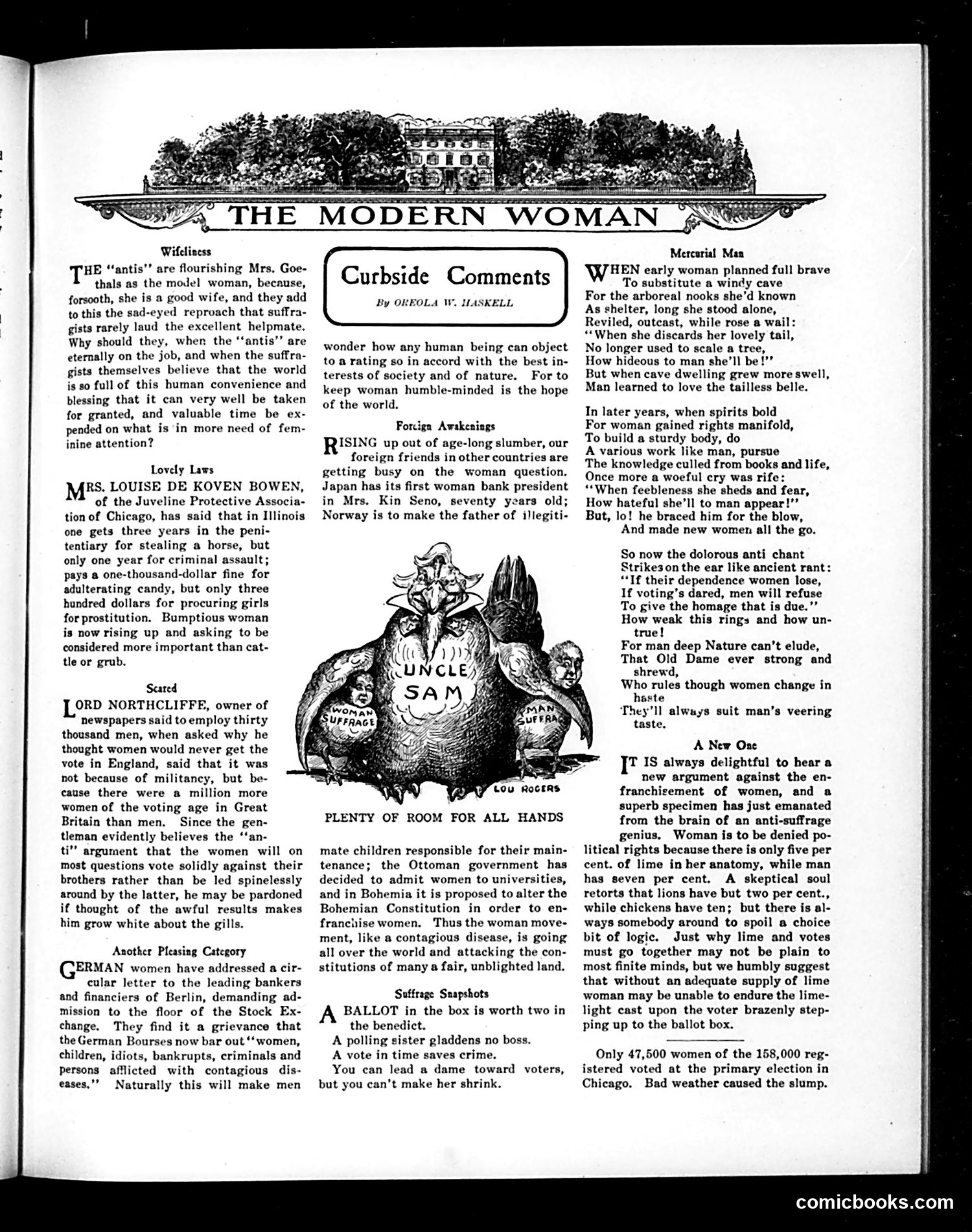
This page satirizes opposition to women's suffrage and equality circa early 1900s. The central cartoon shows "Uncle Sam" flanked by figures labeled "Woman Suffrage" and "Man Suffrage," titled "Plenty of Room for All Hands"—suggesting both perspectives deserve representation. The surrounding articles mock anti-suffrage arguments through irony: - **"Wifcliness"** ridicules those citing Mrs. Goethals as the "model woman" (a good housewife), questioning why suffragists should praise domestic service when it's already assumed. - **"Lovely Laws"** highlights absurd legal disparities: longer sentences for horse theft than sexual assault, higher fines for candy adulteration than procuring prostitutes—exposing how women and their safety rank below property. - **"Scared"** mocks Lord Northcliffe's fear that British women outnumber men 1 million-to-1, suggesting anti-suffragists contradictorily claim women won't vote independently while fearing unified female voting power. - **"Another Pleasing Category"** sarcastically compares excluding women from German stock exchanges to excluding "children, idiots, bankrupts, criminals and persons with contagious diseases." The "Curbside Comments" poem and snapshots continue the satirical defense of women's rights and voting power.
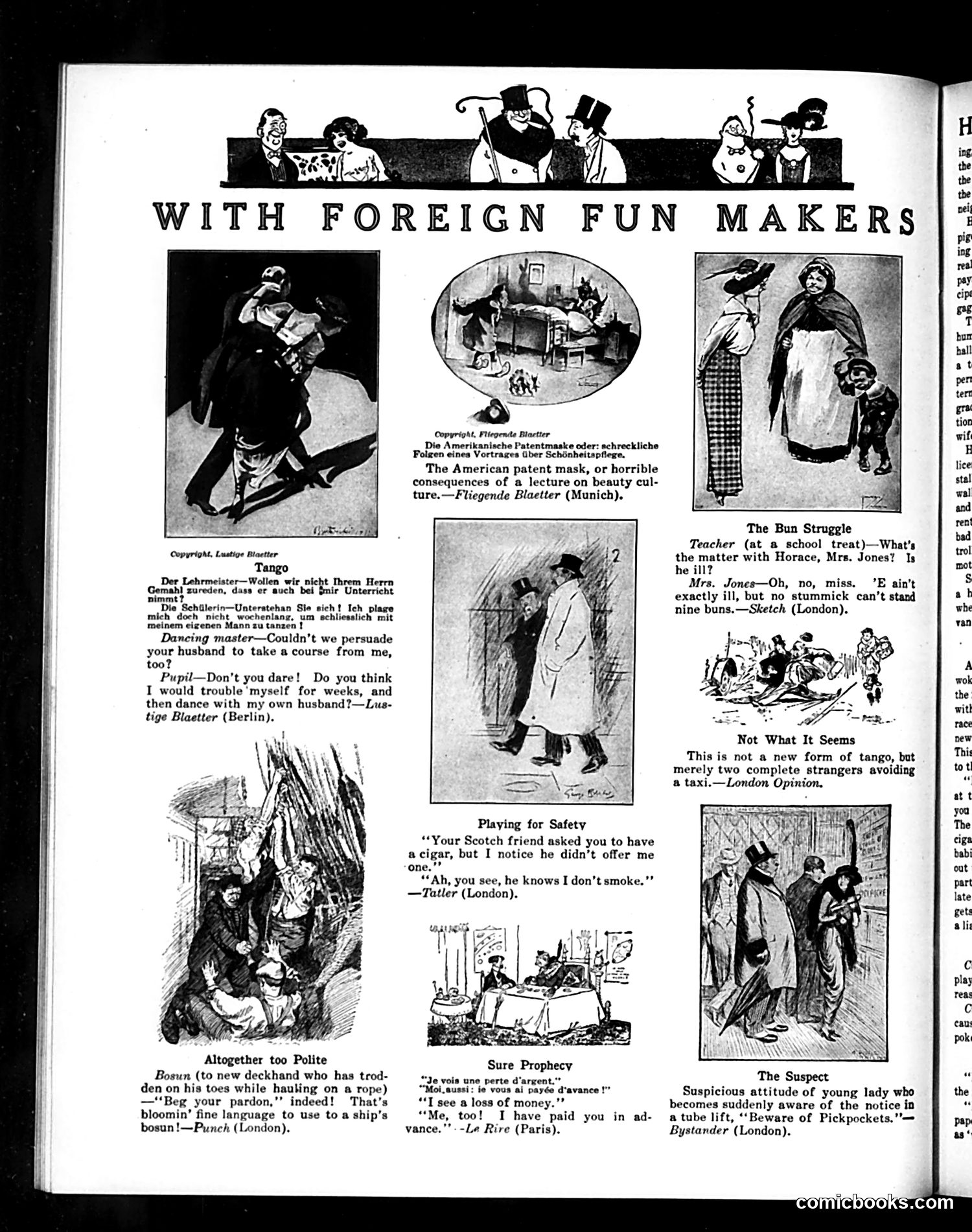
This page collects humorous reprints from European satirical magazines, showcasing cultural attitudes of the early 20th century. The **Tango** cartoon mocks the dance craze's intensity—a woman refuses her dance instructor's suggestion that her husband also take lessons, joking she won't struggle for weeks just to dance with her own spouse. This reflects anxieties about the tango's passionate reputation. The **American Patent Mask** cartoon satirizes beauty culture fads, showing a woman disfigured after attending a lecture on cosmetic treatments—poking fun at Americans' gullibility toward dubious "scientific" beauty procedures. Other items lampoon class dynamics ("Altogether too Polite"), Scottish frugality ("Playing for Safety"), and everyday struggles like children overeating at school treats ("The Bun Struggle"). The page demonstrates how Judge presented European humor to American readers, often mocking modern conveniences, new social trends (the tango), and vanity while reinforcing period stereotypes about national character.
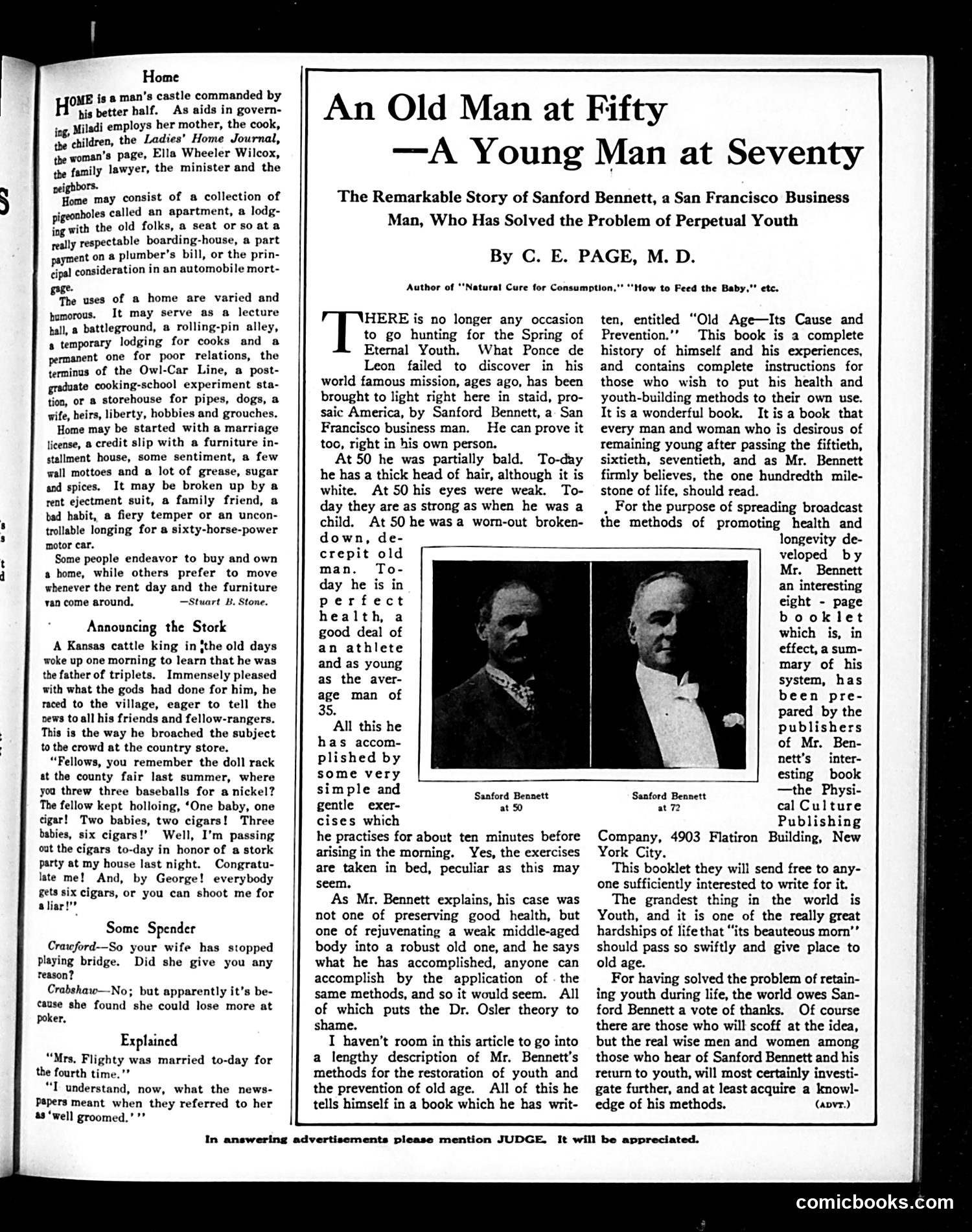
This page from *Judge* magazine contains two distinct sections: **Left side:** Humorous essays about "Home" and brief jokes. The anecdotes use exaggeration for comedic effect—a cattle rancher announcing triplets by comparing it to a carnival game, a wife who switched from losing money at bridge to poker. These are gentle domestic humor typical of early 20th-century magazines, poking fun at marriage, spending habits, and social conventions. **Right side:** An advertisement disguised as an article promoting Sanford Bennett's youth-restoration methods. The piece claims Bennett, a San Francisco businessman, discovered a way to reverse aging—at 50 he regained hair, vision, and vigor. The accompanying photographs show him at different ages. This is classic early-1900s patent-medicine-style promotion: dubious health claims wrapped in scientific language (referencing Dr. Osler's theories) and testimonials, designed to sell Bennett's instructional book on "health and youth-building methods." The satire lies in *Judge* printing obvious commercial propaganda alongside genuine humor—showing the blurred line between editorial and advertising in period magazines.
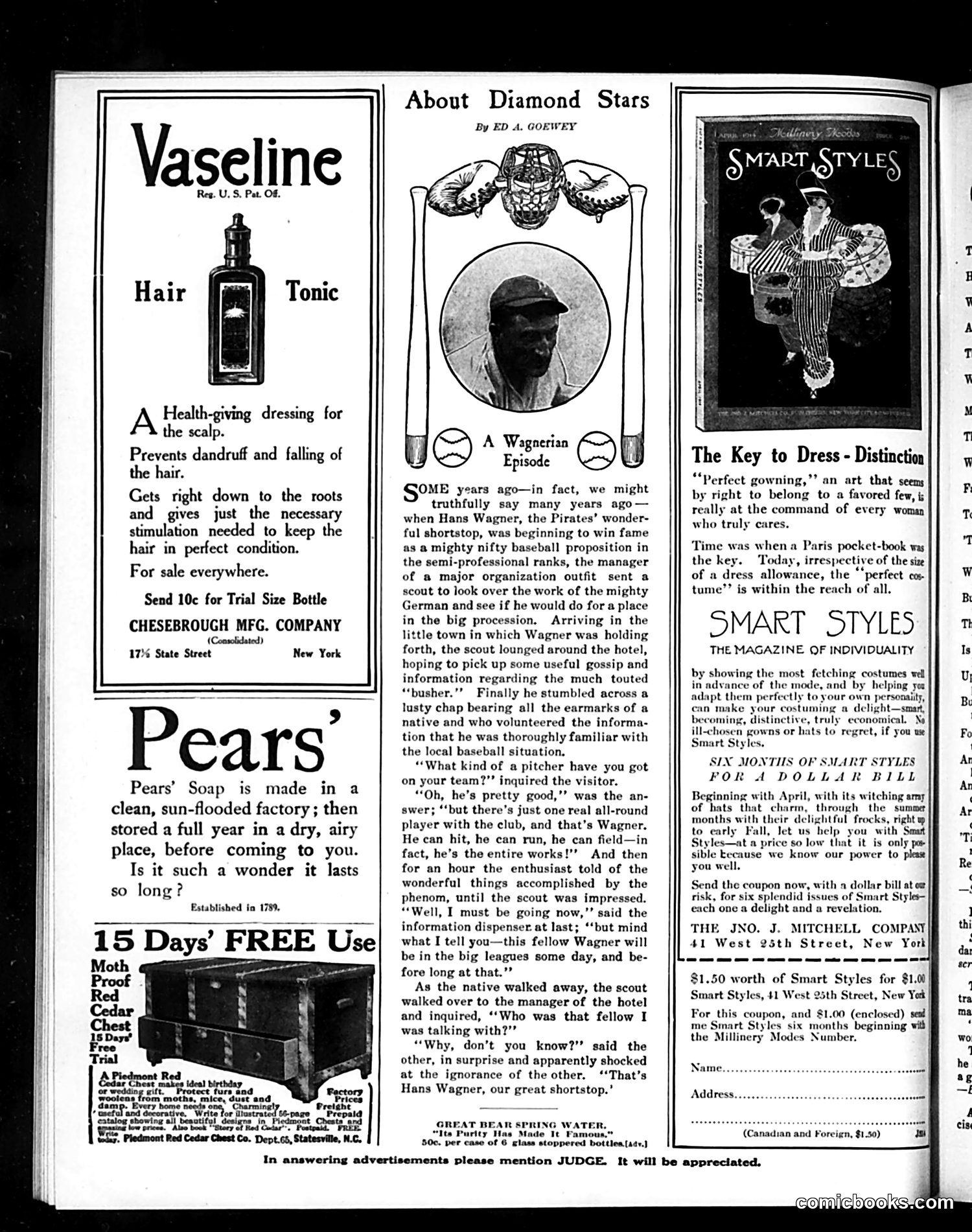
This page is primarily **advertising**, with one notable satirical article by Ed A. Goewey titled "About Diamond Stars." The central cartoon/article tells an anecdote about **Hans Wagner, a German shortstop** for the Pirates baseball team. A scout arrives to evaluate Wagner's talent and speaks with a local enthusiast who praises Wagner effusively—claiming he can hit, run, and field exceptionally well. After the conversation, the scout learns the enthusiast was actually **Wagner himself**, not a neutral local as assumed. **The satire**: The joke mocks **German immigrant braggadocio and self-promotion**. Wagner talks himself up so thoroughly that the scout is impressed without realizing he's hearing direct propaganda. The humor plays on ethnic stereotypes about Germans and the immigrant experience in early American baseball. The punchline exposes Wagner's shameless self-advertisement disguised as third-party endorsement. The remainder of the page features period advertisements for Vaseline, Pears' Soap, Smart Styles magazine, and other products typical of Judge's commercial content.
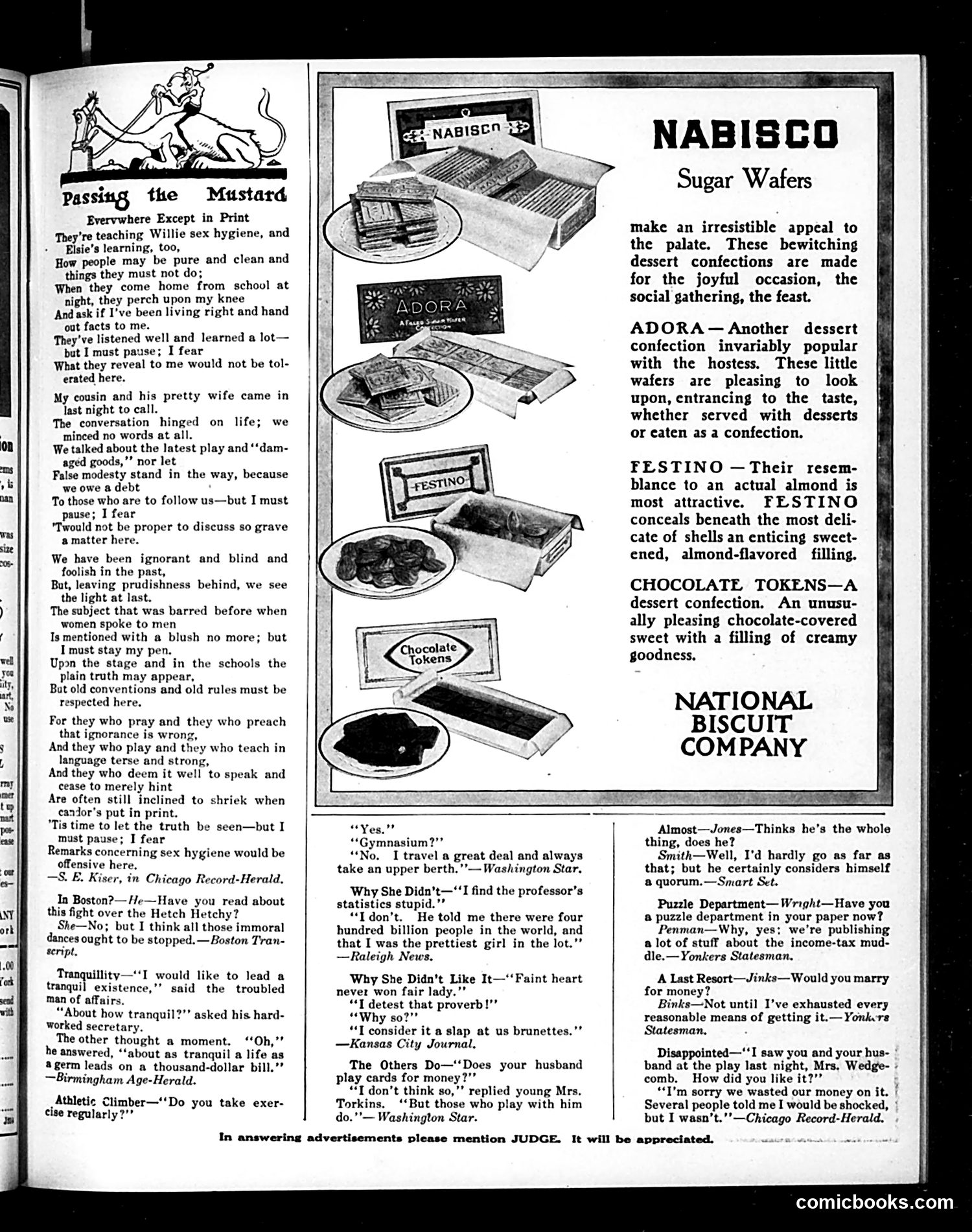
This page contains primarily **advertising** (National Biscuit Company products) and **joke snippets**, with one substantial satirical poem as the main content. The central piece, "Passing the Mustard" by S.E. Kiser, satirizes **Victorian hypocrisy about sex education**. The poem's irony: society now openly teaches children sex hygiene and discusses "damaged goods" (fallen women) on stage and in schools—yet the *magazine itself* won't print frank discussion of these topics. The repeated refrain "I must pause; I fear / What they reveal...would not be tolerated here" targets this contradiction: reformers champion openness while gatekeepers like *Judge* magazine maintain prudish censorship. The surrounding one-liners mock various social pretensions: Boston's selective morality, pseudo-intellectual statistics, and marital dynamics. The **Nabisco advertisement** is standard period marketing, unrelated to the satire. The core message: early 20th-century America claimed progressive sexual education while remaining fundamentally censorious in print media.
This page is primarily **advertisements and humor columns** rather than political cartoons. The content reflects early 20th-century American concerns: **Main Satirical Items:** 1. **"Not Foreigners"** joke: Mocks Ford Motor Company employees as culturally foreign—likely referencing Ford's massive immigrant workforce and their perceived otherness to native-born Americans. 2. **"Little Girl"** poem: A morality critique of 1920s women's fashion, specifically narrow, short skirts. The repeated warnings about exposure and impropriety reflect conservative anxieties about changing female dress codes and behavior during this era. 3. **Relationship jokes**: Standard domestic humor about marriage, divorce, and gender miscommunication. **Advertisements** dominate: whiskey (Harper), diamonds, piano lessons, a hotel ballroom, and various products—typical of Judge's commercial model. The page captures period preoccupations with immigration, women's roles, and consumerism rather than specific political events or figures.
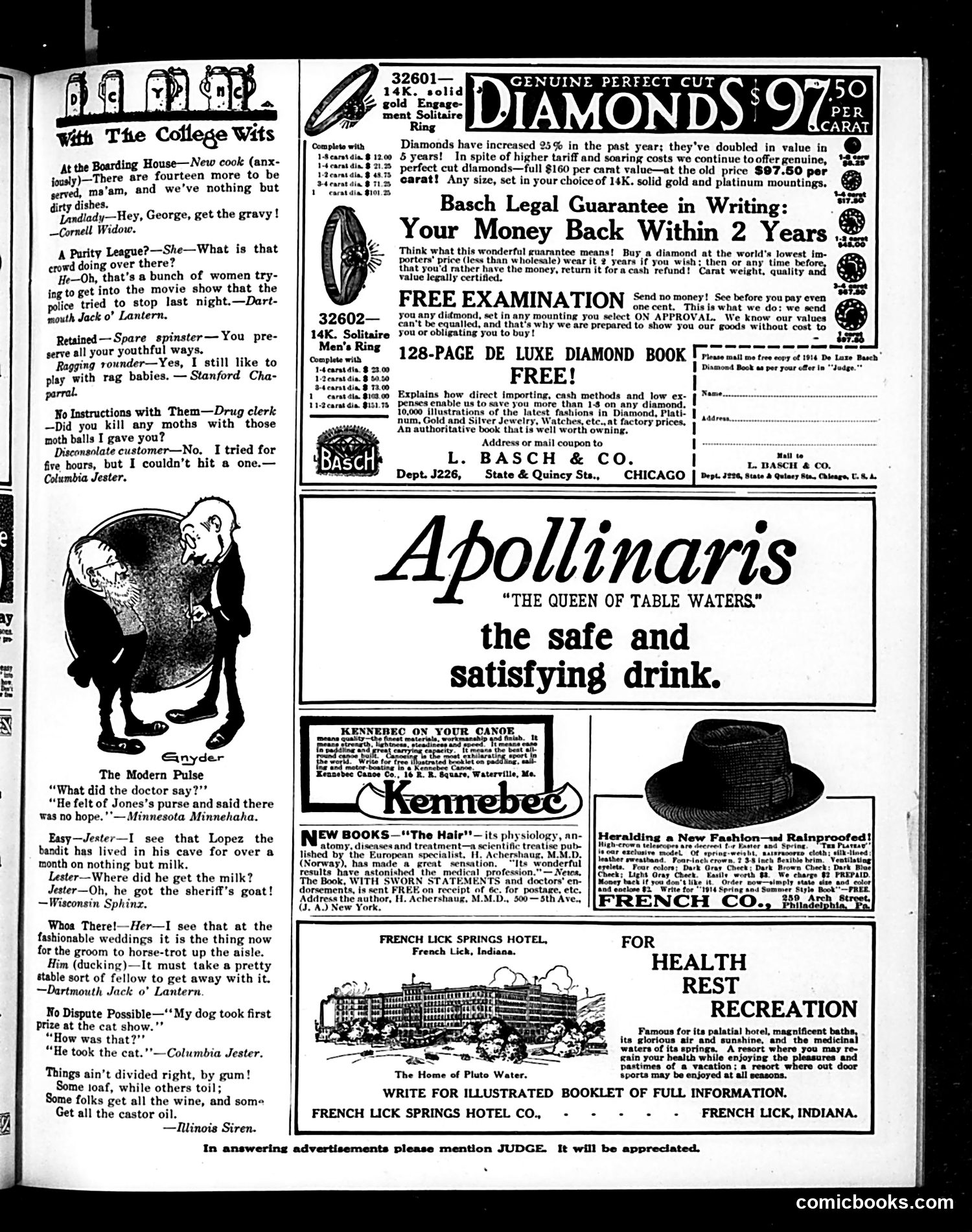
This is primarily an **advertising page** from Judge magazine, with some humorous filler content. The page's main feature is a **Basch Legal Guarantee diamond advertisement**, offering diamonds at $97.50 per carat—marked as unchanged despite a 25% price increase over the past year. The ad emphasizes the company's "legal guarantee" allowing buyers to wear diamonds for 2 years before requesting a refund, positioning this as revolutionary consumer protection. The left side contains a collection of **college humor jokes** reprinted from various university publications (Cornell Widow, Dartmouth Jack o' Lantern, etc.). These are brief, mild gags—puns and one-liners about boarding house food, movie showings, and wordplay. The cartoon labeled "The Modern Pulse" depicts a satirical doctor who judges patients' financial worth rather than health. The remaining space features typical period advertisements for luxury goods (Apollinaris sparkling water, French Lick Springs Hotel, and a straw hat retailer). This reflects Judge's mixed editorial/advertising model targeting affluent readers interested in consumer goods and college-oriented humor.
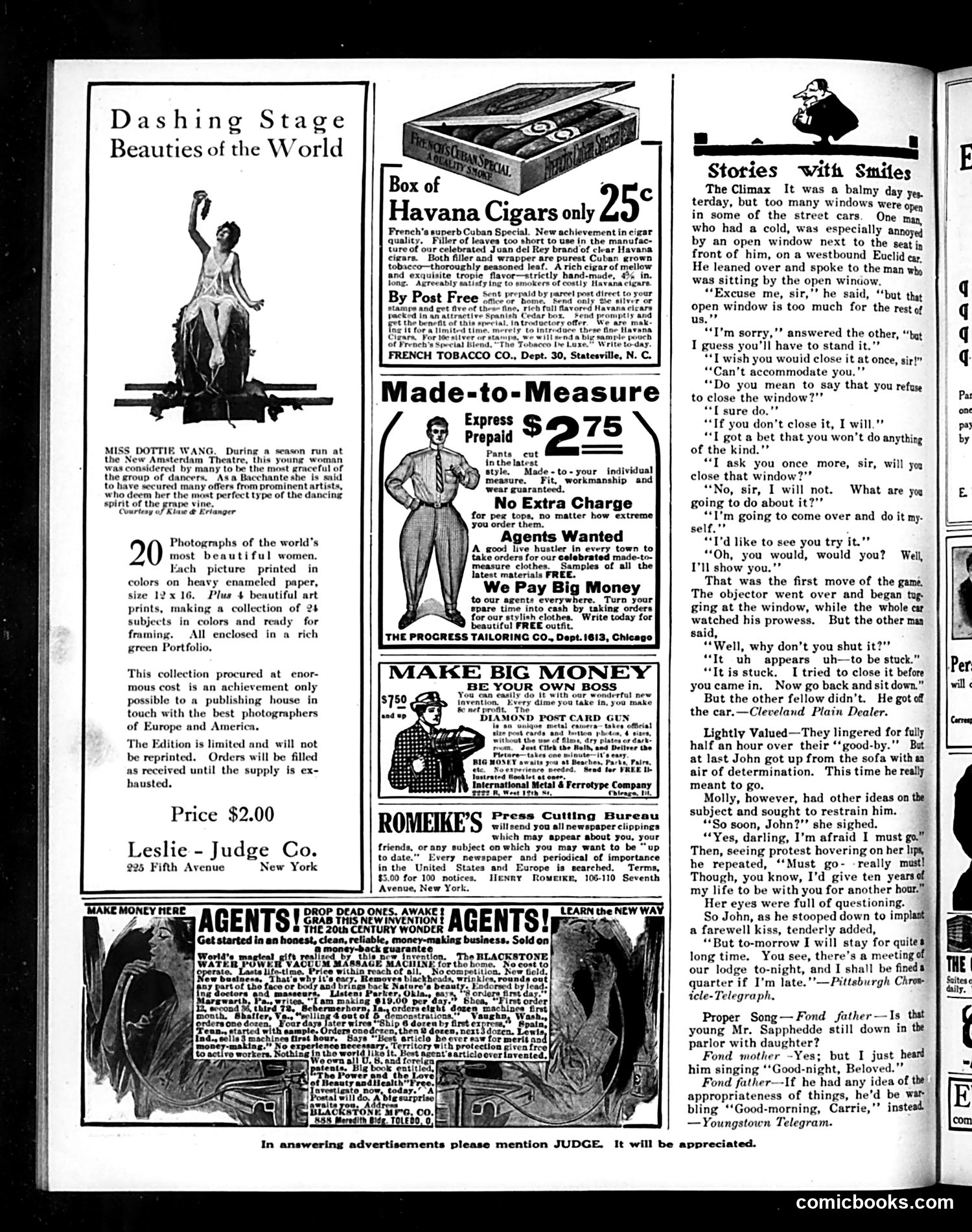
This page is primarily **advertisements and editorial content** from Judge magazine, with minimal satirical cartoons. The featured "Dashing Stage Beauties" section presents photographs of theatrical dancers, including "Miss Dottie Wang," reflecting the early 20th-century entertainment industry's fascination with stage performers. The bulk of the page contains period advertising: cigars, made-to-measure clothing, recruitment ads for sales agents, newspaper clipping services, and various get-rich-quick schemes promising commissions. These ads reveal common commercial practices and economic aspirations of the era. The small comic feature "Stories with Smiles" depicts a mundane urban conflict: a passenger annoyed by an open window on a streetcar refuses to close it, creating tension with someone suffering from a cold. This reflects everyday social friction in public transportation—a relatable scenario for contemporary readers commuting by trolley. The page demonstrates Judge's mixed format: celebrity culture, consumer goods marketing, and gentle comedy rather than hard-hitting political satire.
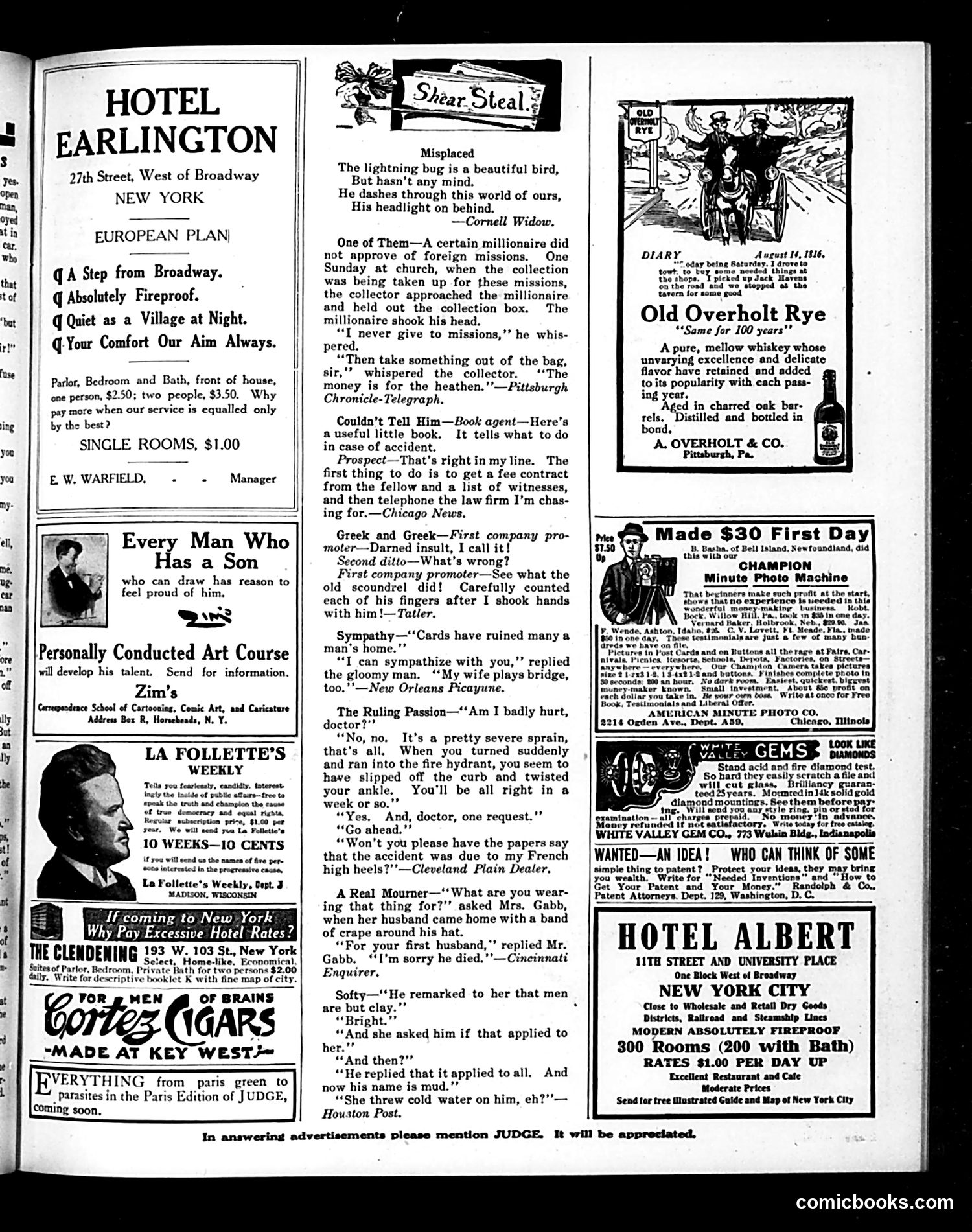
This page is primarily **advertisements and humor filler**, not political cartoons. It consists of hotel ads (Earlington, Hotel Albert), classified ads (art courses, La Follette's Weekly magazine), and a series of **short jokes** under the "Shear Steal" section. The jokes are mild social humor typical of early 20th-century periodicals: - **"Misplaced"**: A pun about lightning bugs (fireflies) with their rear lights - **Millionaire and missions**: Satire on wealthy men's reluctance to donate to charity - **Book agent**: Lawyer joke about opportunism - **Sympathy**: Joke about bridge-playing wives as marital problems - **Accident victim**: Satire on vanity—a woman wanting credit for her fashionable shoes for causing an accident The humor reflects period attitudes toward wealth, marriage dynamics, and materialism but contains no significant political content or identifiable caricatures. It's representative advertising-heavy magazine filler rather than satirical commentary.
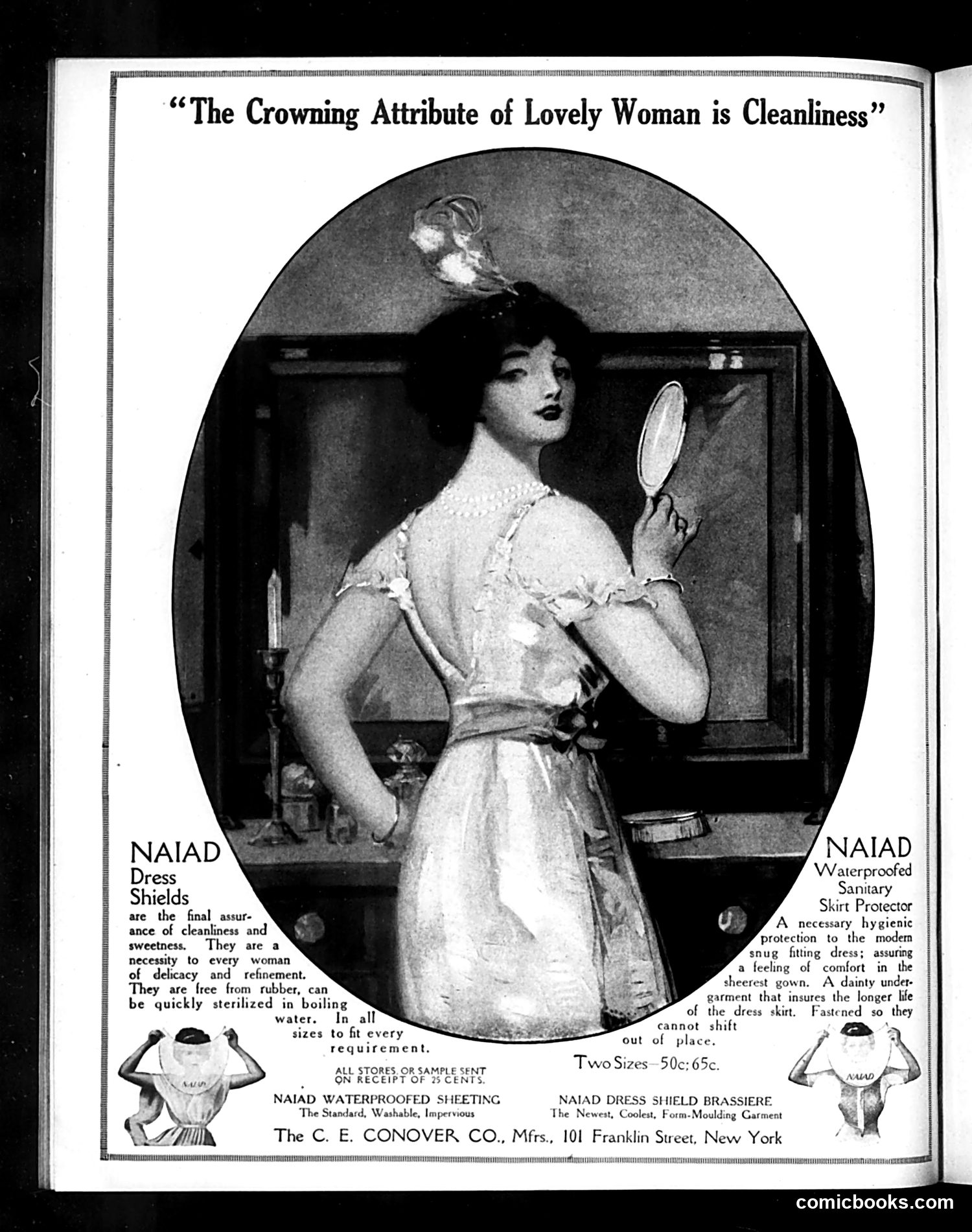
This page is **entirely advertisement**, not satire or political content. It promotes NAIAD brand undergarments—dress shields (underarm protectors) and a waterproofed skirt protector—manufactured by C.E. Conover Co. in New York. The quote "The Crowning Attribute of Lovely Woman is Cleanliness" frames these hygiene products as essential to feminine virtue. The image shows a woman in profile examining herself in a mirror, visually supporting the message that cleanliness (via these products) defines female attractiveness and respectability. For modern readers: This reflects early 20th-century anxieties about perspiration and menstruation as sources of social shame. The advertisement equates purchasing these protective garments with being a refined, desirable woman. Products like dress shields addressed real concerns about visible sweat stains on tight-fitting period clothing, but the marketing exploits female insecurity about bodily functions to drive sales. This represents a historical moment when commercialism began weaponizing shame around women's bodies.