
Judge, 1914-03-14 · page 10 of 24
Judge — March 14, 1914 — page 10: what you’re looking at
What you’re looking at
This satirical piece mocks the **Minnesota Governor** (identity unclear from the text) for composing poetry while sitting in a dentist's chair. The title's reference to Pegasus—the mythological winged horse symbolizing poetic inspiration—underscores the absurdity. The satire works on two levels: First, it ridicules the Governor's pretension that poetic inspiration could strike during dental work, a situation most people find unpleasant and distracting. Second, it implicitly critiques politicians attempting to present themselves as cultured or artistic when they should be attending to practical matters. The author (Homer Croy) uses deliberately crude language—suggesting he'd "do a pantan on his brow" (violence) if a dentist interrupted his discomfort with such requests—to emphasize how ridiculous the Governor's accomplishment actually is. The joke: real poetry requires serious artistic dedication, not improvisation under duress in a dentist's chair.
📄 Transcribed text from this page (OCR, searchable)
Machine-transcribed from the original scan — historical spelling and the odd misread are preserved.
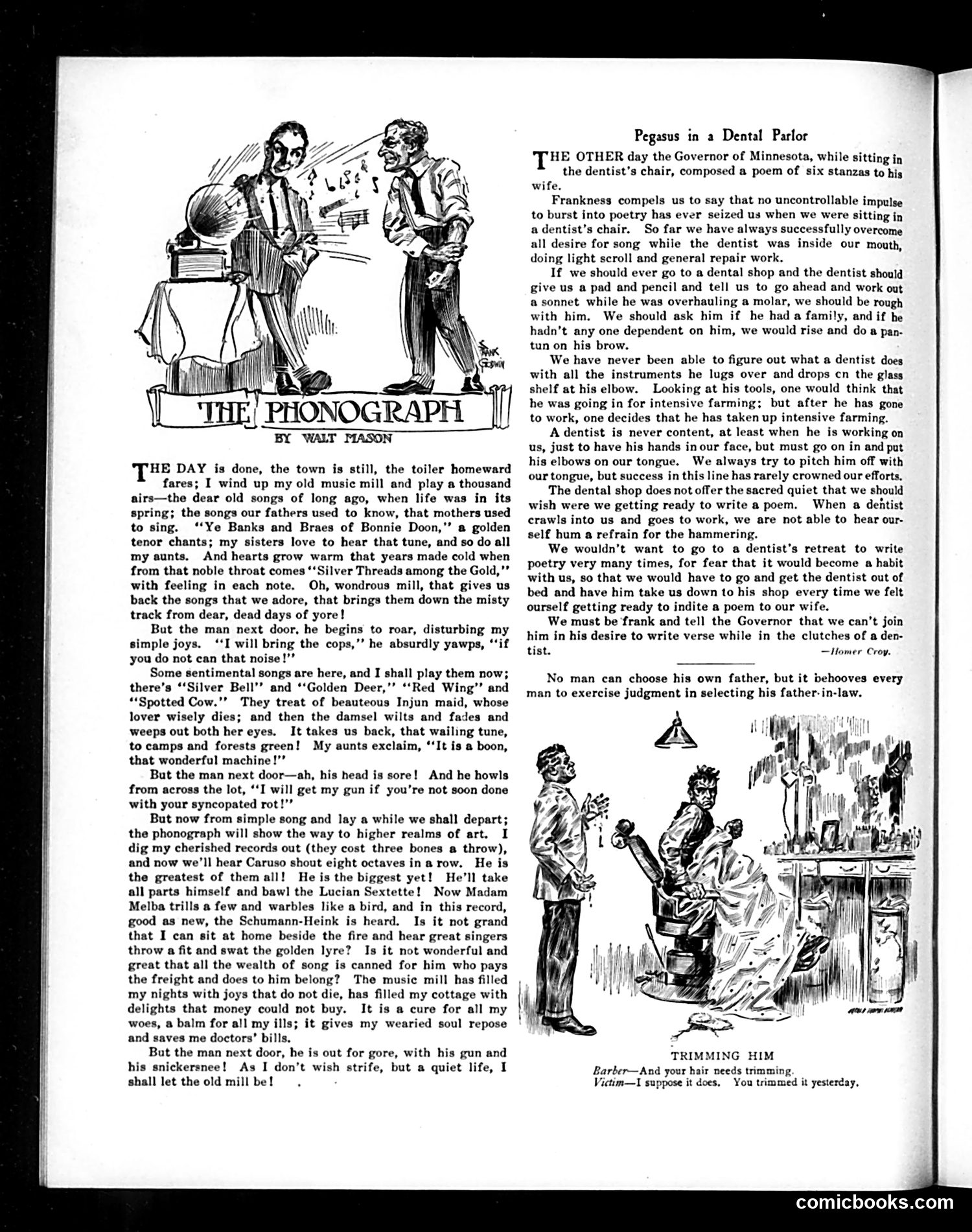
BY WALT MASON THE DAY is done, the town is still, the toiler homeward fares; I wind up my old music mill and play a thousand airs—the dear old songs of long ago, when life was in its spring; the songs our fathers used to know, that mothers used to sing. ‘‘Ye Banks and Braes of Bonnie Doon,” a golden tenor chants; my sisters love to hear that tune, and so do all my aunts. And hearts grow warm that years made cold when from that noble throat comes ‘‘Silver Threads among the Gold,” with feeling in each note. Oh, wondrous mill, that gives us back the songs that we adore, that brings them down the misty track from dear, dead days of yore! But the man next door, he begins to roar, disturbing my simple joys. ‘‘I will bring the cops,’’ he absurdly yawps, ‘‘if you do not can that noise!’’ Some sentimental songs are here, and I shall play them now; there's ‘‘Silver Bell’’ and ‘Golden Deer,”” ‘‘Red Wing’? and “Spotted Cow.'? They treat of beauteous Injun maid, whose lover wisely dies; and then the damsel wilts and fades and weeps out both her eyes. It takes us back, that wailing tune, to camps and forests green! My aunts exclaim, ‘‘It is a boon, that wonderful machine!” But the man next door—ah, his head is sore! And he howls from across the lot, ‘‘I will get my gun if you’re not soon done with your syncopated rot!’’ But now from simple song and lay a while we shall depart; the phonograph will show the way to higher realms of art. I dig my cherished records out (they cost three bones a throw), and now we'll hear Caruso shout eight octaves ina row. He is the greatest of themall! He is the biggest yet! He'll take all parts himself and baw! the Lucian Sextette! Now Madam Melba trills a few and warbles like a bird, and jn this record, good as new, the Schumann-Heink is heard. Is it not grand that I can sit at home beside the fire and hear great singers throw a fit and swat the golden lyre? Is it not wonderful and great that all the wealth of song is canned for him who pays the freight and does to him belong? The music mill has filled my nights with joys that do not die, has filled my cottage with delights that money could not buy. It is a cure for all my woes, a balm for all my ills; it gives my wearied soul repose and saves me doctors’ bills. But the man next door, he is out for gore, with his gun and his snickersnee! As I don’t wish strife, but a quiet life, I shall let the old mill be! Pegasus in a Dental Parlor THE OTHER day the Governor of Minnesota, while sitting in the dentist's chair, composed a poem of six stanzas to his wife. Frankness compels us to say that no uncontrollable impulse to burst into poetry has ever seized us when we were sitting in adentist’s chair. So far we have always successfully overcome all desire for song while the dentist was inside our mouth, doing light scroll and general repair work. If we should ever go to a dental shop and the dentist should give us a pad and pencil and tell us to go ahead and work out asonnet while he was overhauling a molar, we should be rough with him. We should ask him if he had a family, and if he hadn’t any one dependent on him, we would rise and do a pan- tun on his brow. We have never been able to figure out what a dentist does with all the instruments he lugs over and drops cn the glass shelf at his elbow. Looking at his tools, one would think that he was going in for intensive farming; but after he has gone to work, one decides that he has taken up intensive farming. A dentist is never content, at least when he is working on us, just to have his hands in our face, but must go on in and put his elbows on our tongue. We always try to pitch him off with our tongue, but success in this line has rarely crowned our efforts, The dental shop does not offer the sacred quiet that we should wish were we getting ready to write a poem. When a dentist crawls into us and goes to work, we are not able to hear our- self hum a refrain for the hammering. We wouldn’t want to go to a dentist’s retreat to write poetry very many times, for fear that it would become a habit with us, so that we would have to go and get the dentist out of bed and have him take us down to his shop every time we felt ourself getting ready to indite a poem to our wife. We must be frank and tell the Governor that we can’t join him in his desire to write verse while in the clutches of a den- tist. —Homer Croy. No man can choose his own father, but it behooves every man to exercise judgment in selecting his father-in-law. (iJ lt ies TRIMMING HIM Barber—And your hair needs trimming Victim—1 suppose it does, You trimmed it yesterday, comicbooks.com