
Judge, 1914-03-14 · page 19 of 24
Judge — March 14, 1914 — page 19: what you’re looking at
What you’re looking at
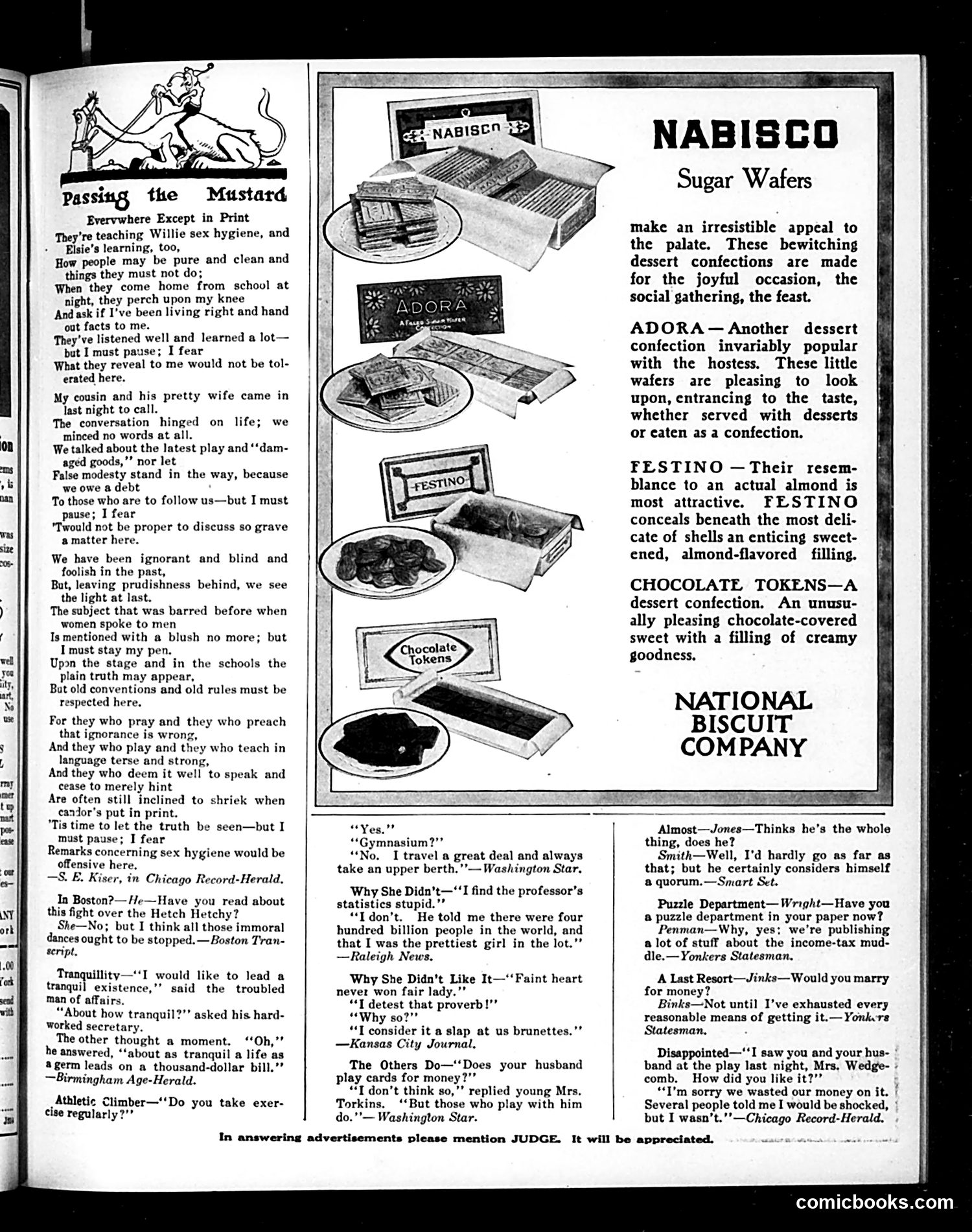
This page contains primarily **advertising** (National Biscuit Company products) and **joke snippets**, with one substantial satirical poem as the main content. The central piece, "Passing the Mustard" by S.E. Kiser, satirizes **Victorian hypocrisy about sex education**. The poem's irony: society now openly teaches children sex hygiene and discusses "damaged goods" (fallen women) on stage and in schools—yet the *magazine itself* won't print frank discussion of these topics. The repeated refrain "I must pause; I fear / What they reveal...would not be tolerated here" targets this contradiction: reformers champion openness while gatekeepers like *Judge* magazine maintain prudish censorship. The surrounding one-liners mock various social pretensions: Boston's selective morality, pseudo-intellectual statistics, and marital dynamics. The **Nabisco advertisement** is standard period marketing, unrelated to the satire. The core message: early 20th-century America claimed progressive sexual education while remaining fundamentally censorious in print media.
📄 Transcribed text from this page (OCR, searchable)
Machine-transcribed from the original scan — historical spelling and the odd misread are preserved.
Passing, the Mustard Evervwhere Except in Print They're teaching Willie sex hygiene, and Elsie’s learning, too, How people may be pure and clean and things they must not do; When they come home from schoul at night, they perch upon my knee And ask if I’ve been living right and hand out facts to me. They've listened well and learned a lot— but I must pause; I fear What they reveal to me would not be tol- erated here. My cousin and his pretty wife came in last night to call. The conversation hinged on life; we minced no words at all. We talked about the latest play and ‘‘dam- aged goods,”’ nor let False modesty stand in the way, because we owe a debt To those who are to follow us—but I must. pause; I fear 'Twould not be proper to discuss so grave a matter here, We have been ignorant and blind and foolish in the past, But, leaving prudishness behind, we see the light at last. The subject that was barred before when women spoke to men Is mentioned with a blush no more; but I must stay my pen. Upon the stage and in the schools the plain truth may appear, But old conventions and old rules must be respected here. For they who pray and they who preach that ignorance is wrong, And they who play and they who teach in language terse and strong, And they who deem it well to speak and cease to merely hint Are often still inclined to shriek when candor’s put in print. Tis time to let the truth be seen—but I must pause; I fear Remarks concerning sex hygiene would be offensive here. —S. E. Kiser, in Chicago Record-Herald, In Boston?—He—Have you read about this fight over the Hetch Hetchy? She—No; but I think all those immoral dances ought to be stopped.— Boston Tran- script. Tranquillity—‘‘I would like to lead a tranquil existence,’ said the troubled man of affairs. “About how tranquil?”’ asked his hard- worked secretary. The other thought a moment. ‘‘Oh,’’ he answered, ‘about as tranquil a life as germ leads on a thousand-dollar bill.’’ —Birmingham Age-Herald. Athletic Climber—‘‘Do you take exer- cise regularly ?"’ NABISCO Sugar Wafers make an irresistible appeal to the palate. These bewitching dessert confections are made for the joyful occasion, the social gathering, the feast. ADORA— Another dessert confection invariably popular with the hostess. These little wafers are pleasing to look upon, entrancing to the taste, whether served with desserts or eaten as a confection. FESTINO —Their resem- blance to an actual almond is most attractive. FESTINO conceals beneath the most deli- cate of shells an enticing sweet- ened, almond-flavored filling. CHOCOLATE TOKENS—A dessert confection. An unusu- ally pleasing chocolate-covered sweet with a filling of creamy goodness, NATIONAL BISCUIT COMPANY “Yes,” “Gymnasium?” “No. I travel a great deal and always take an upper berth.’"— Washington Star, Why She Didn'’t—‘“‘I find the professor’s statistics stupid.”” “I don’t. He told me there were four hundred billion people in the world, and that I was the prettiest girl in the lot.” —Raleigh News. Why She Didn’t Like It—‘‘Faint heart never won fair lady.’ “I detest that proverb!’’ “Why so?” “T consider it a slap at us brunettes.’’ —Kansas City Journal. The Others Do—‘‘Does your husband play cards for money?’’ “I don’t think so,’’ replied young Mrs. Torkins. ‘‘But those who play with him do.’’— Washington Star. Almost—Jones—Thinks he’s the whole thing, does he? Smith—Well, I'd hardly go as far as that; but he certainly considers himself a quorum.—Smart Set. Puzzle Department— Wright—Have you a puzzle department in your paper now? Penman—Why, yes; we're publishing a lot of stuff about the income-tax mud- dle.— Yonkers Statesman. A Last Resort—Jinks—Would you marry for money? Binks—Not until I’ve exhausted every reasonable means of getting it.— Yonkrs Statesman, Disappointed—‘‘I saw you and your hus- * band at the play last night, Mrs, Wedge- - comb. How did you like it?” 8 “I'm sorry we wasted our money on it. / Several people told me I would be shocked, | but I wasn’t.’’—Chicago Record-Herald. In answering advertisements please mention JUDGE. It will be appreciated. are we a+ - comicbooks.com