
A complete issue · 24 pages · 1914
Judge — January 17, 1914
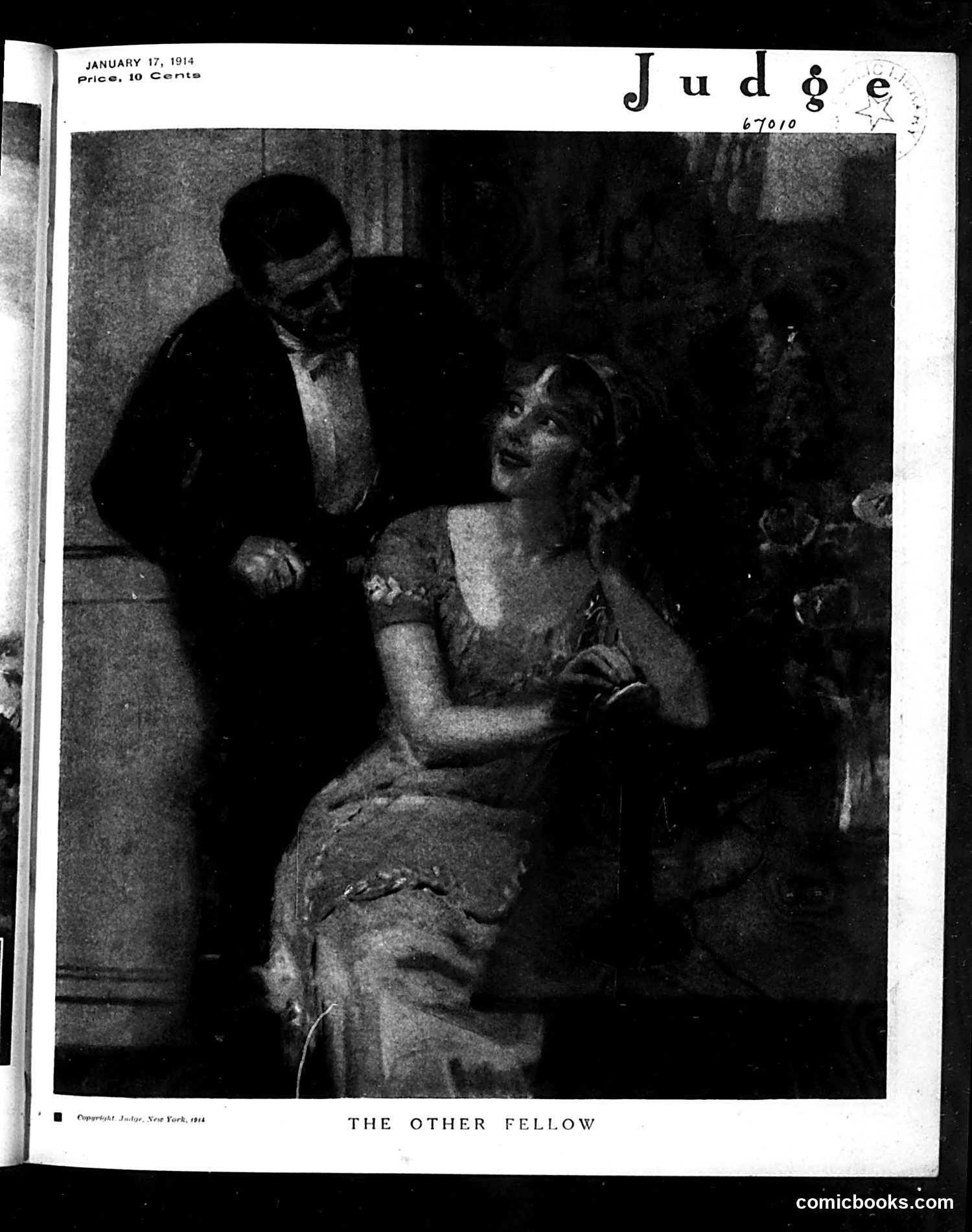
This appears to be a theatrical or dramatic scene rather than political satire. The image shows what looks like a stage production depicting an interaction between a standing man in dark formal clothing and a seated woman in an ornate dress, with additional figures visible in the background. The title "The Other Fellow" suggests a domestic drama involving romantic rivalry or infidelity—a common theme in early 20th-century theater. Without additional context about which specific play this references, the exact satirical point remains unclear. Judge magazine frequently reviewed theatrical productions, so this likely comments on a contemporary Broadway play or similar entertainment, though the specific critique intended is not evident from the image alone.
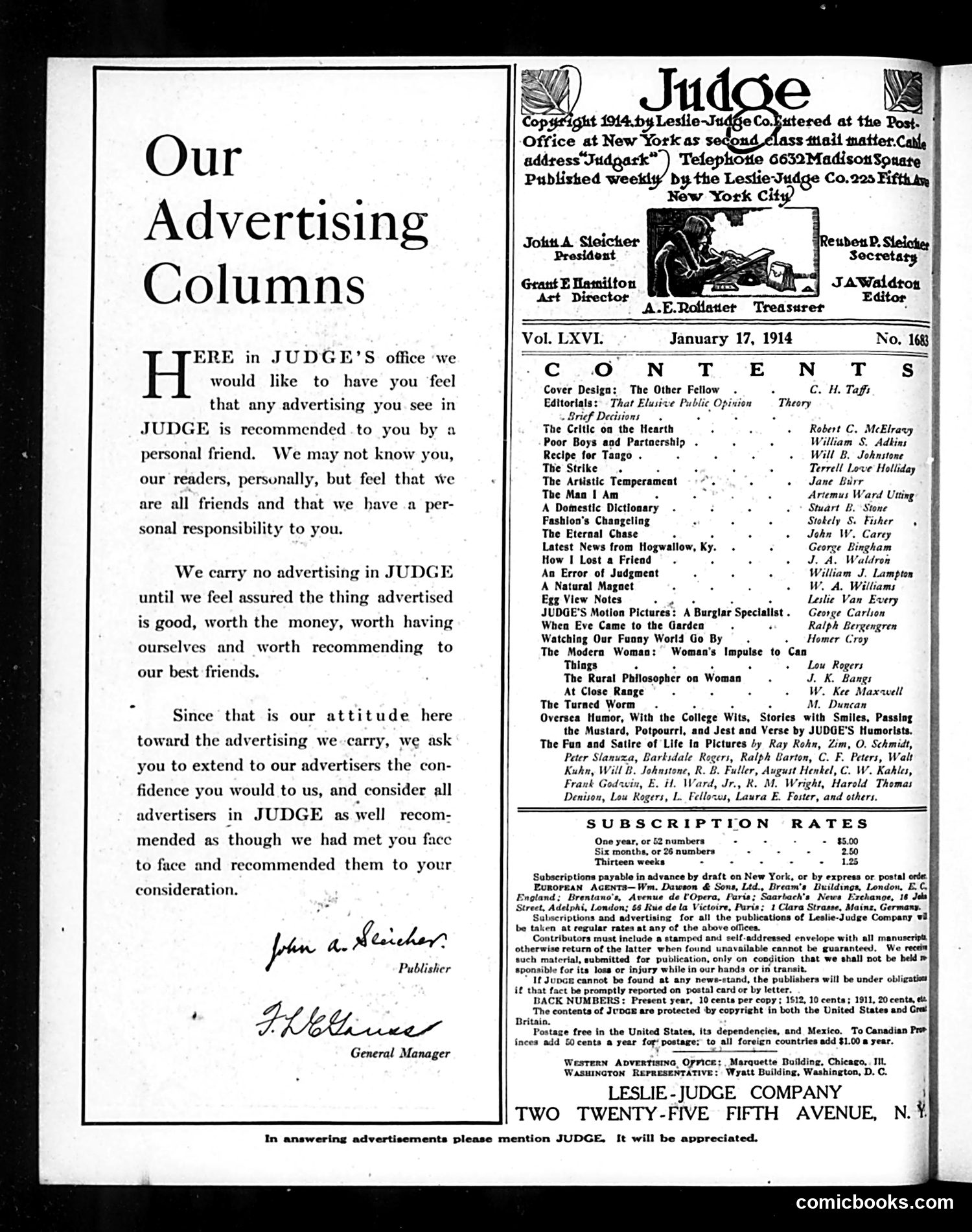
This page is primarily **advertising and editorial material** rather than political cartoons. The left side features an "Our Advertising Columns" statement signed by Publisher John A. Sleicher and General Manager J.W. Williams, explaining Judge's advertising standards—they only carry ads for products they personally recommend to readers as trusted friends. The right side shows the magazine's masthead, contents listing, and subscription rates ($5.00 annually in the US). The contents reference various satirical articles and stories typical of the era, though no specific political figures or events are clearly identifiable from this excerpt alone. This appears to be a standard magazine introduction page emphasizing editorial integrity.
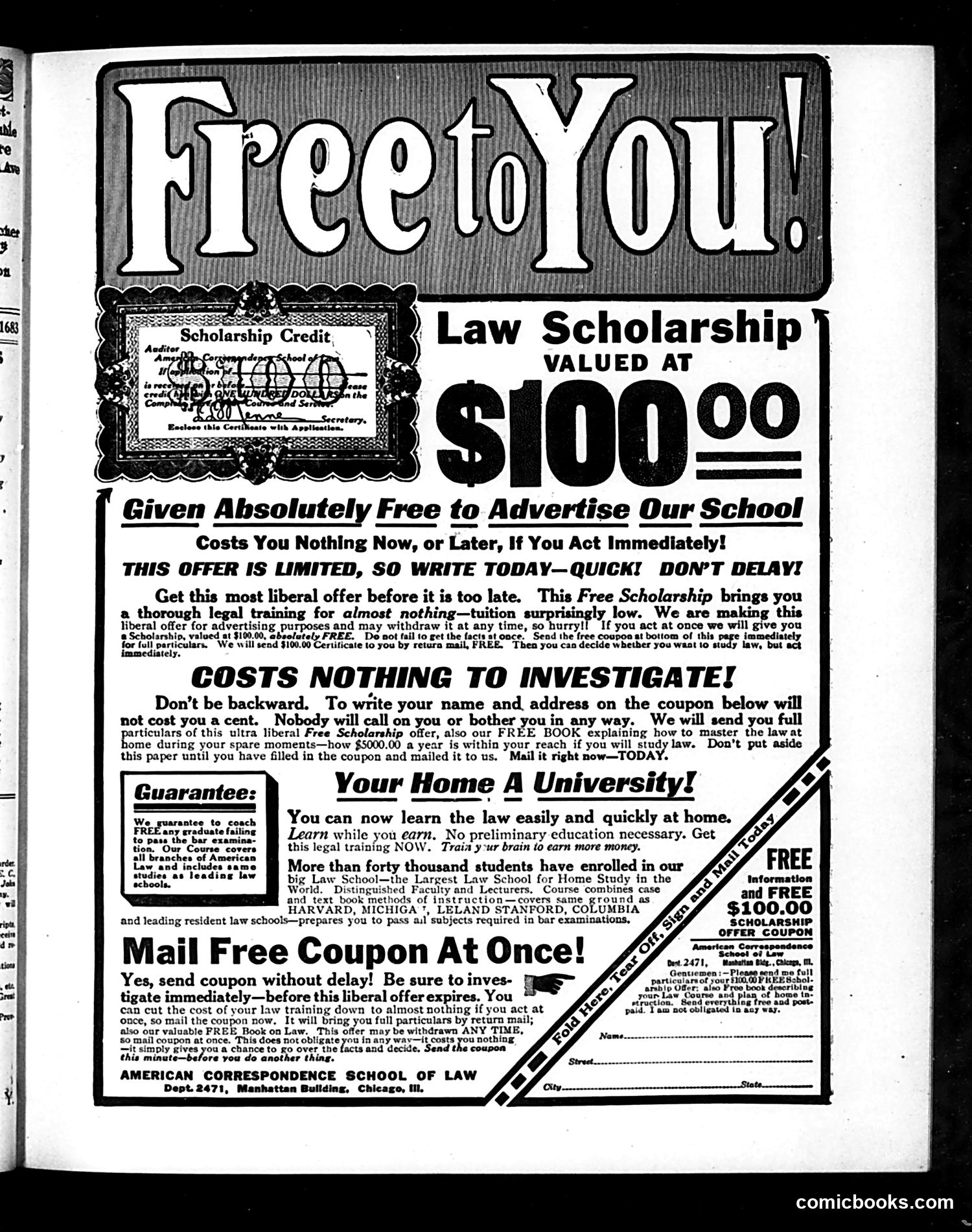
This page is **primarily an advertisement**, not satirical content. It's a full-page ad for the "American Correspondence School of Law" offering a purportedly "free" $100 law scholarship. The ad uses high-pressure sales tactics typical of early 20th-century mail-order education schemes: urgent language ("ACT IMMEDIATELY!", "DON'T DELAY"), promises of home-based learning, and repeated emphasis that investigation "costs nothing." The fine print reveals the catch—the "free scholarship" is given only "to advertise our school," meaning recipients must promote the institution. This appears in *Judge*, a satirical magazine, likely as an example of the dubious correspondence-school rackets that were common and frequently mocked during this era. The ad itself demonstrates the manipulative marketing practices the magazine's readers would have recognized as suspect.
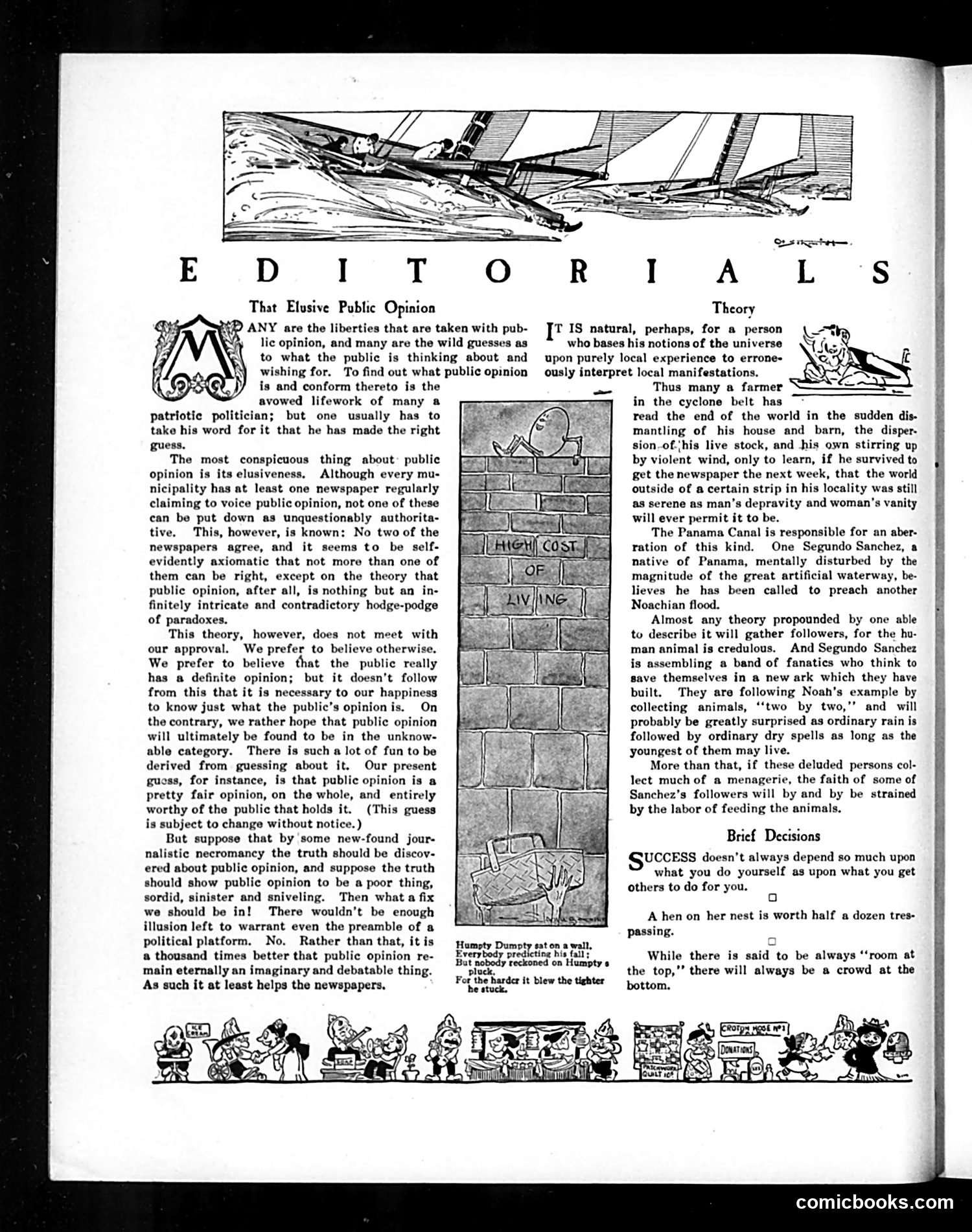
This page presents two distinct pieces: **Left Editorial ("That Elusive Public Opinion"):** A satirical essay arguing that public opinion is contradictory and unreliable. The author mocks politicians who claim to represent public will, suggesting newspapers themselves contribute to this confusion by guessing at what the public actually wants. The piece advocates for newspapers to maintain independent editorial positions rather than chase shifting popular sentiment. **Right Editorial ("Theory") with cartoon:** Mocks people who interpret local disasters as divine messages. The example describes a farmer whose cyclone destroyed his property, yet he preaches it as God's sign—a critique of religious fatalism. The "Humpty Dumpty" illustration shows someone sitting on a wall, caption warning of his impending fall. Both pieces express skepticism toward unexamined beliefs and false certainty.
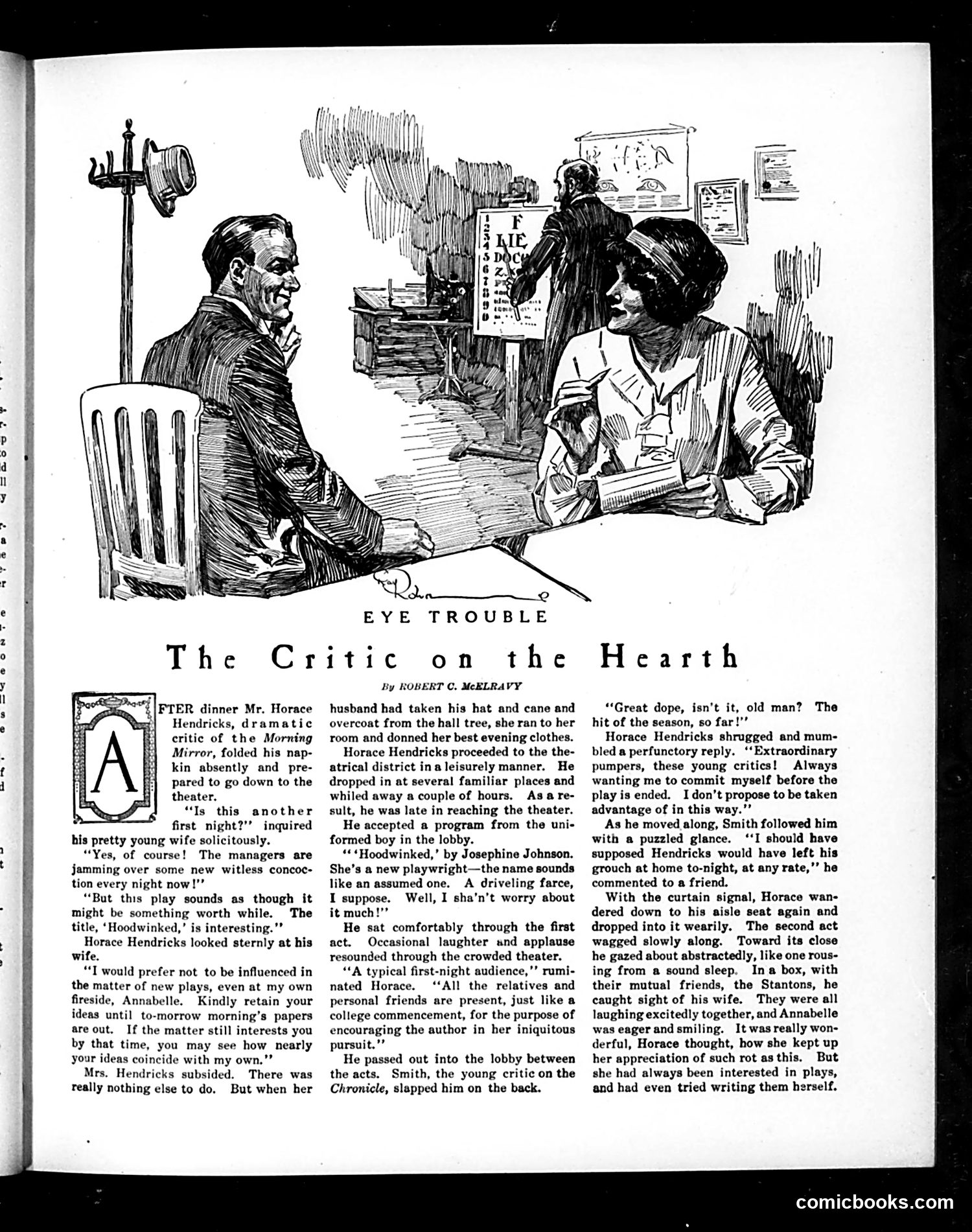
This story-illustration satirizes theater critics and their influence on Broadway. Mr. Horace Hendricks, a drama critic for the *Morning* (newspaper), attends a play called "Hoodwinked" starring newcomer Josephine Johnson. His wife, observing his skepticism, worries his negative review will damage the production. The satire targets how powerful critics could make or break theatrical productions in this era. Hendricks' dismissive attitude—viewing the play as "something worth while" only by accident—reflects the gatekeeping role critics held. The story illustrates the anxiety producers and performers felt about critics' outsized influence over public opinion and box office success.
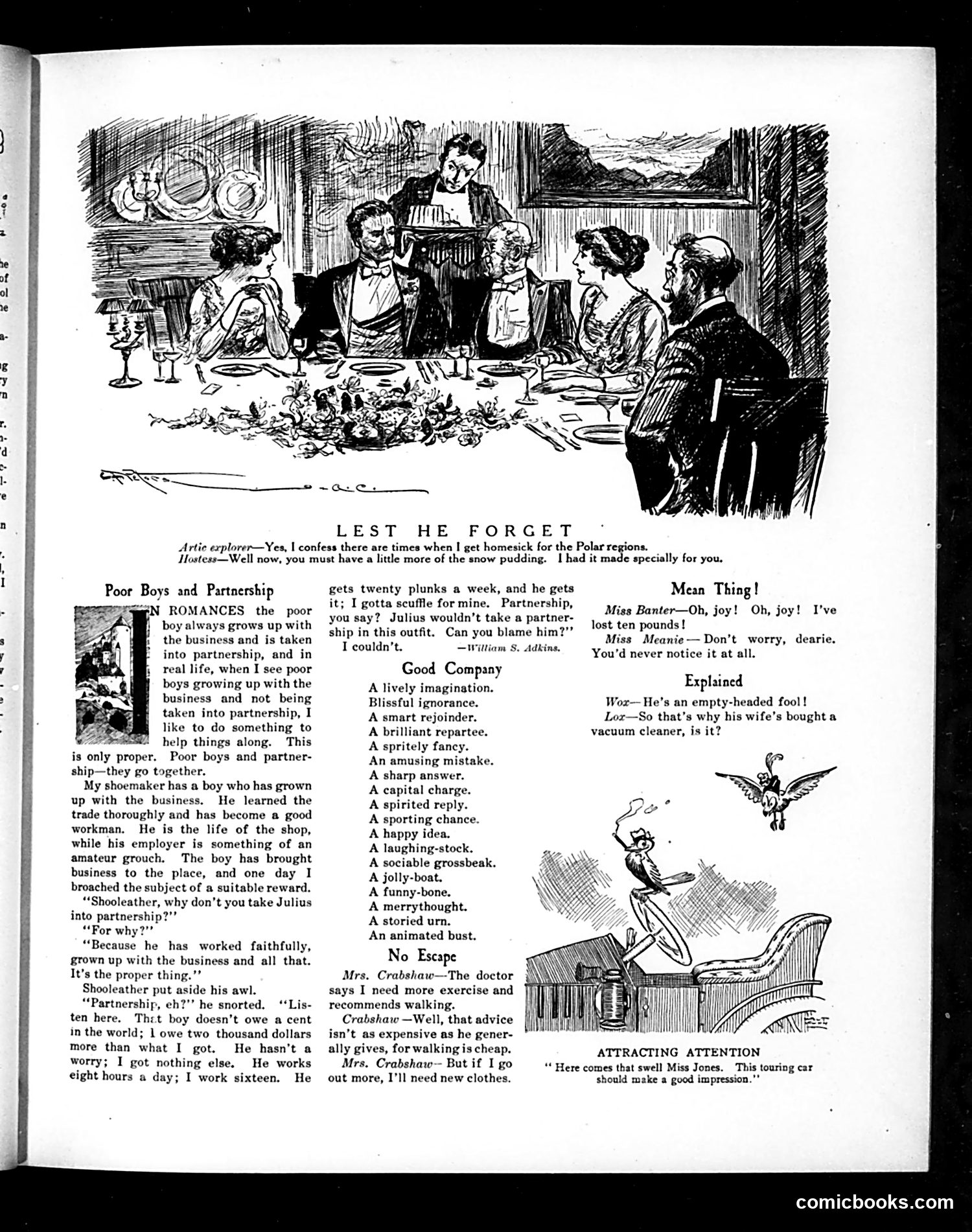
This page contains several short humorous sketches typical of early 20th-century satirical magazines. The main cartoon depicts a dinner party where an Arctic explorer nostalgic for polar regions is served "snow pudding" by his hostess—a gentle joke about literal interpretation of his homesickness. The accompanying text pieces mock social pretensions and economic hypocrisy. "Poor Boys and Partnership" criticizes a wealthy employer who refuses to make his loyal young employee a partner, justifying it through self-interest: he owes money while the boy owes nothing, so partnership would burden the boy. The satire targets greed disguised as concern for others. Other brief sketches include wordplay ("Good Company"), marital comedy ("Mean Thing!"), and observational humor about middle-class anxieties (the Crabshaw couple worrying about exercise and appearances). The page represents typical Judge humor: punching at social pretense, miserliness, and absurd logic among the middle and upper classes, using recognizable domestic scenarios rather than political commentary.
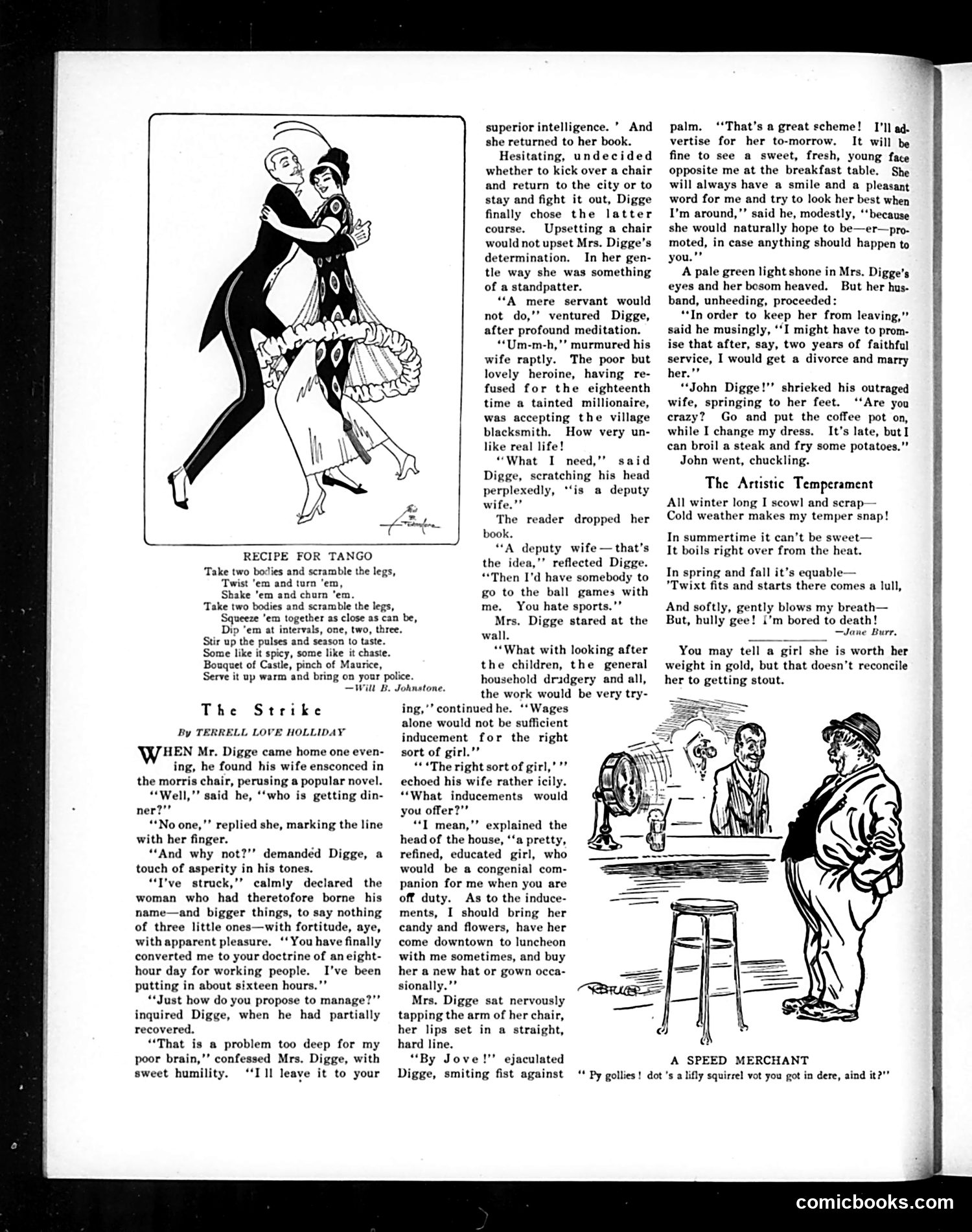
This story satirizes the hypocrisy of early-20th-century labor activism. Mr. Digge advocates for an eight-hour workday for factory workers, but his wife points out she works sixteen hours on household labor without complaint. When she "strikes" by refusing dinner, Digge proposes hiring a "deputy wife"—a young, attractive woman for companionship and appearance at meals, offering her candy, flowers, and hats as inducements. The satire cuts two ways: it mocks Digge's obliviousness to his wife's exhaustion and his willingness to replace her with a decorative substitute, while also ridiculing the era's dismissal of housework as "real" labor deserving recognition or compensation. Mrs. Digge's silent rage (the "pale green light" in her eyes) suggests the story's recognition of justified female fury at this arrangement.
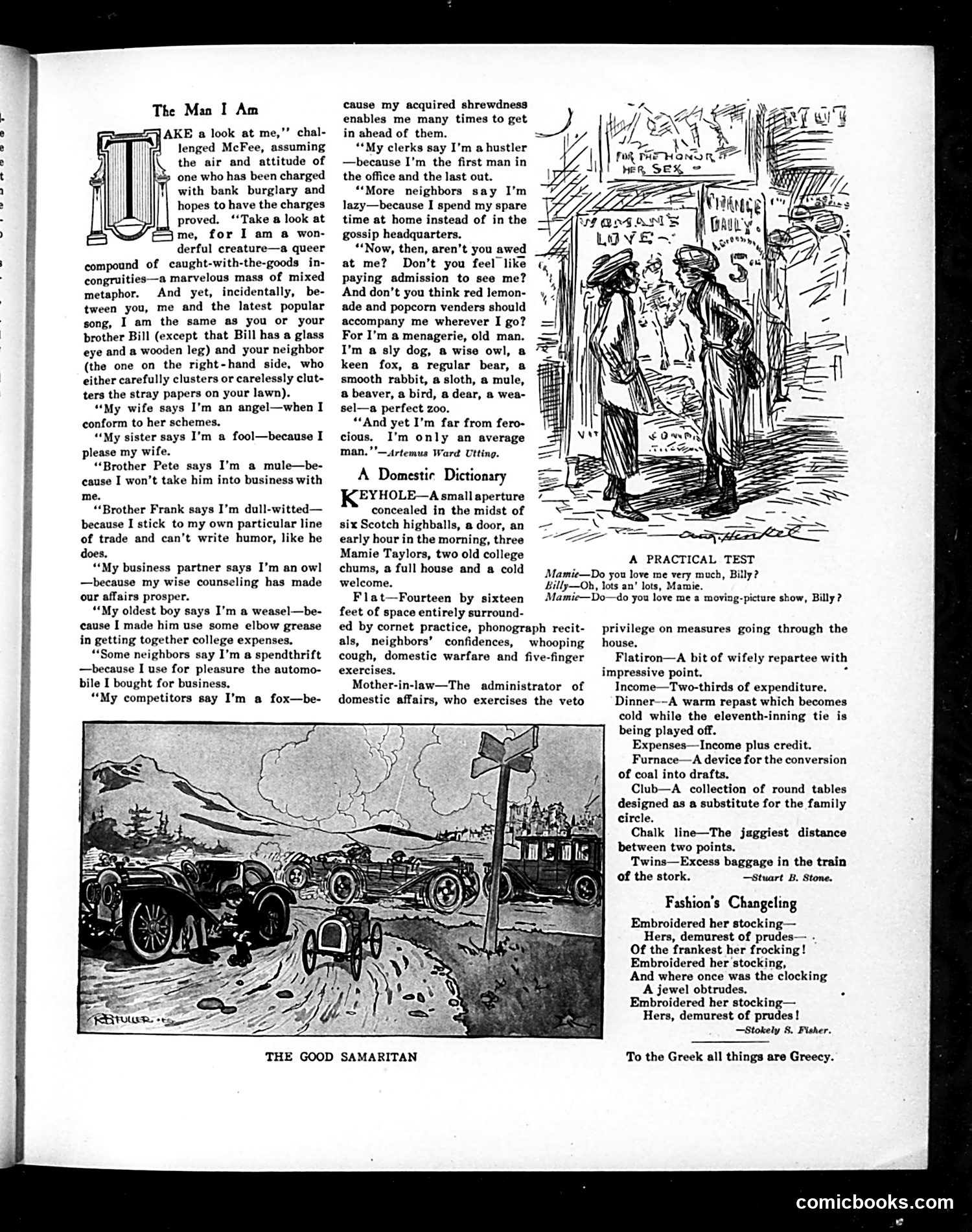
**Main Content: "The Man I Am"** This is a monologue by a character named McFee defending himself against unspecified charges (possibly bank burglary, per the text). The satire critiques how people are defined by contradictory judgments from others—his wife calls him an angel, his sister a fool, his brother a mule, his business partner an owl, his competitors a fox, his clerks a hustler. McFee ironically concludes he's a "menagerie" yet merely "an average man." The piece satirizes early 20th-century workplace culture and family dynamics: how the same person receives wildly different characterizations depending on observer perspective and self-interest. It suggests the impossibility of self-definition in modern society. **Secondary Content:** "A Domestic Dictionary" offers humorous definitions of household terms (keyhole, flat, mother-in-law) that mock domestic life and marriage. "The Good Samaritan" cartoon (bottom) and brief poems complete the page with additional light domestic humor targeting relationships and fashion trends. The overall effect: gentle satire on American middle-class identity and domestic life.
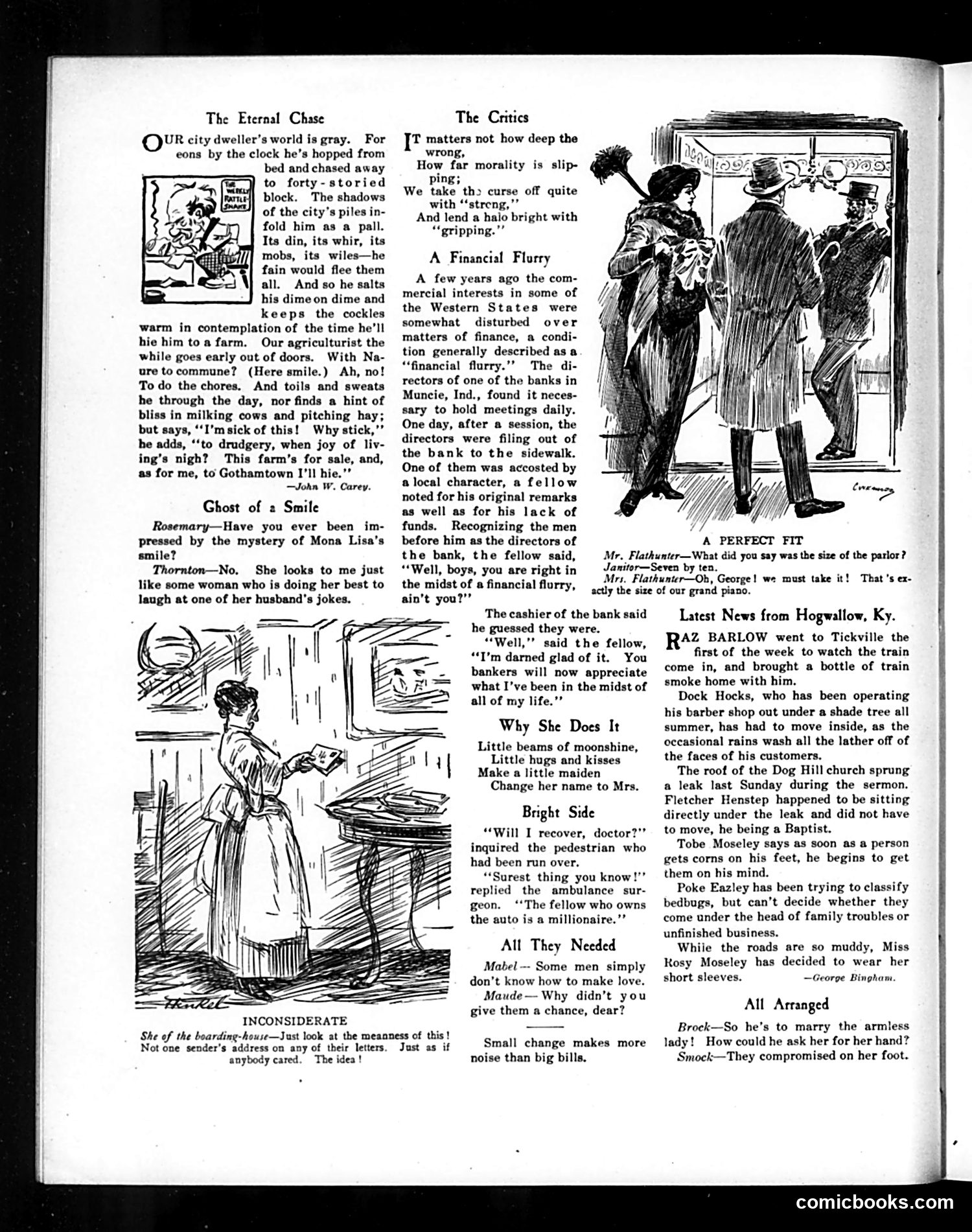
This page contains several short humorous pieces typical of early-20th-century American satirical magazines: **"The Eternal Chase"** satirizes the futile pursuit of happiness: a city dweller dreams of farm life to escape urban drudgery, while the farmer yearns to return to the city. The joke mocks the human tendency toward perpetual dissatisfaction. **"The Critics"** attacks literary reviewers for overlooking moral problems in works if they use trendy language like "strong" or "gripping"—a jab at shallow critical standards. **"A Financial Flurry"** recounts a Muncie, Indiana banker's anecdote where a poor man, upon hearing bankers discuss their financial crisis, quips that he's endured such hardship his entire life—mocking wealthy bankers' self-pity. **"The Boarding House"** cartoon depicts a landlady annoyed that letter-senders omitted return addresses. The remaining pieces are brief jokes about romance, real estate, and rural life ("Hogwallow, Ky."). The humor is gentle, family-friendly satire typical of Judge's era.
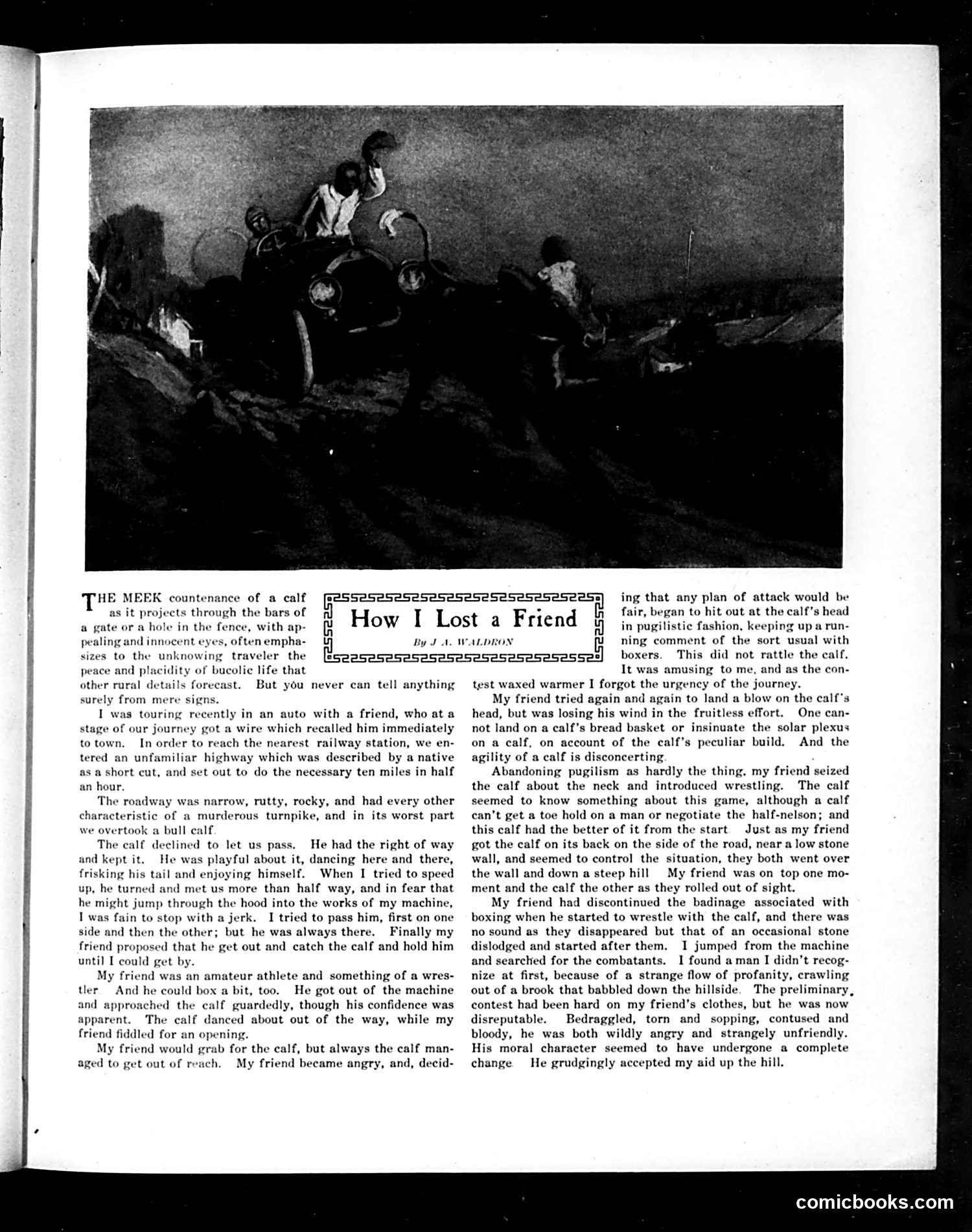
This is a humorous narrative essay with accompanying photograph, not a political cartoon. The story recounts a motorist's experience when his athletic friend attempts to move a stubborn calf blocking a narrow country road. The "joke" is situational comedy: the friend—confident in his boxing and wrestling skills—repeatedly fails to budge or control the small animal. Each strategy (boxing, wrestling) backfires; the calf proves surprisingly agile and strong. The climax occurs when both combatants tumble over a stone wall down a hillside. The satire targets masculine pride and overconfidence. An educated, physically capable urban man is humbled by a simple farm animal. The friend emerges "bedraggled, torn and sopping, contused and bloody," his dignity destroyed—hence he becomes "unfriendly" to the narrator. This reflects early-20th-century urban audiences' amusement at the gap between city sophistication and rural realities.
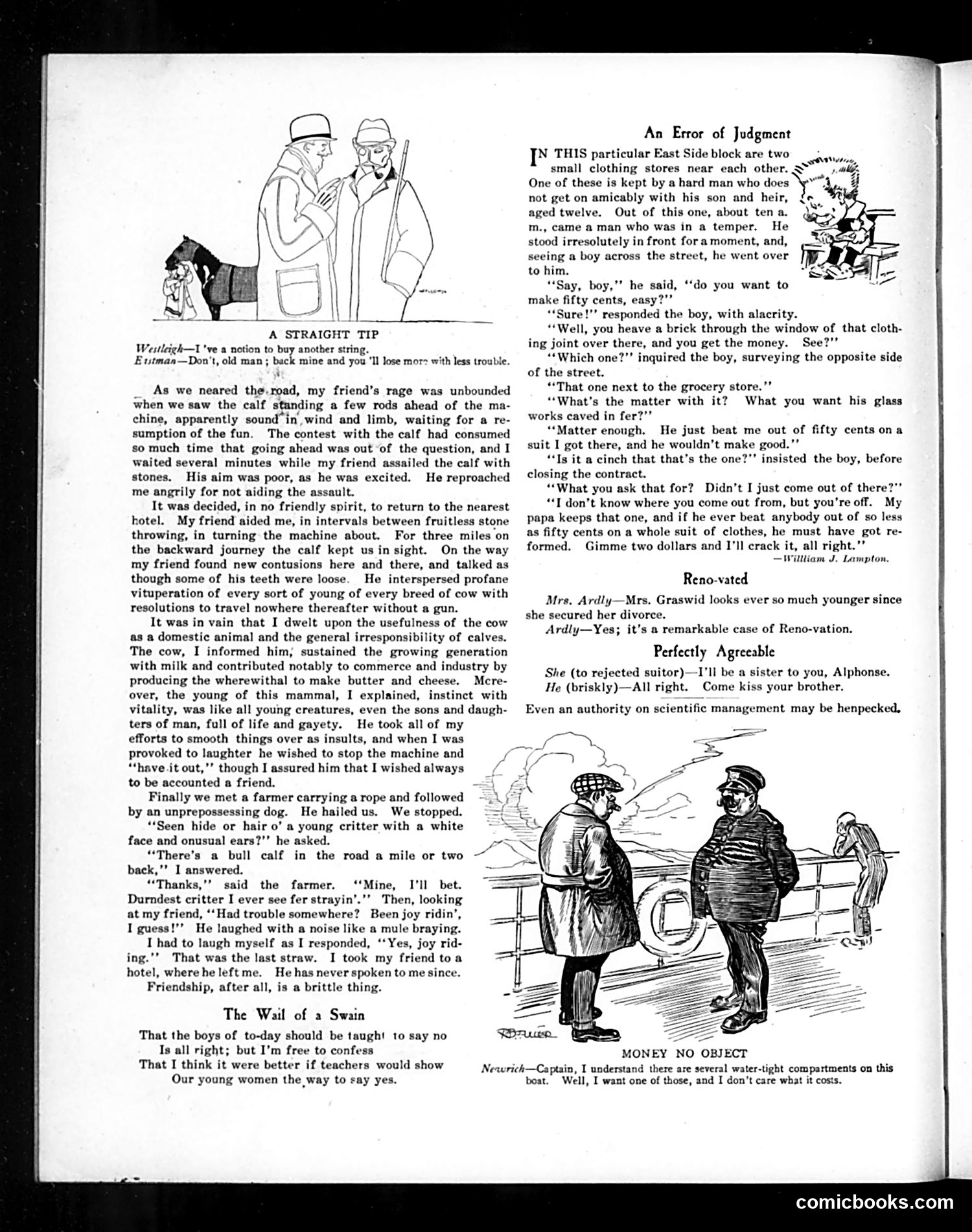
This page contains three distinct humorous pieces satirizing early 1900s American social life: **"A Straight Tip"** mocks automobile culture and male bonding. Two men quarrel after their car hits a calf; one blames the other and refuses to help, turning a minor incident into a friendship-ending feud. The satire targets both the new technology's dangers and masculine pride. **"An Error of Judgment"** depicts an East Side clothing merchant so angry over a business dispute that he bribes a boy to throw a brick through a competitor's window—then is outmaneuvered when the boy shrewdly negotiates for more money and reveals the man's own identity as the likely culprit. It satirizes petty urban merchant rivalry and poor impulse control. **"The Wail of a Swain"** is a brief poem mocking changing social standards: boys are taught to refuse romantic advances, but girls aren't taught to accept them—leaving suitors frustrated. All three pieces use gentle humor to critique contemporary behavior: recklessness, vindictiveness, and social confusion among working and middle-class Americans.
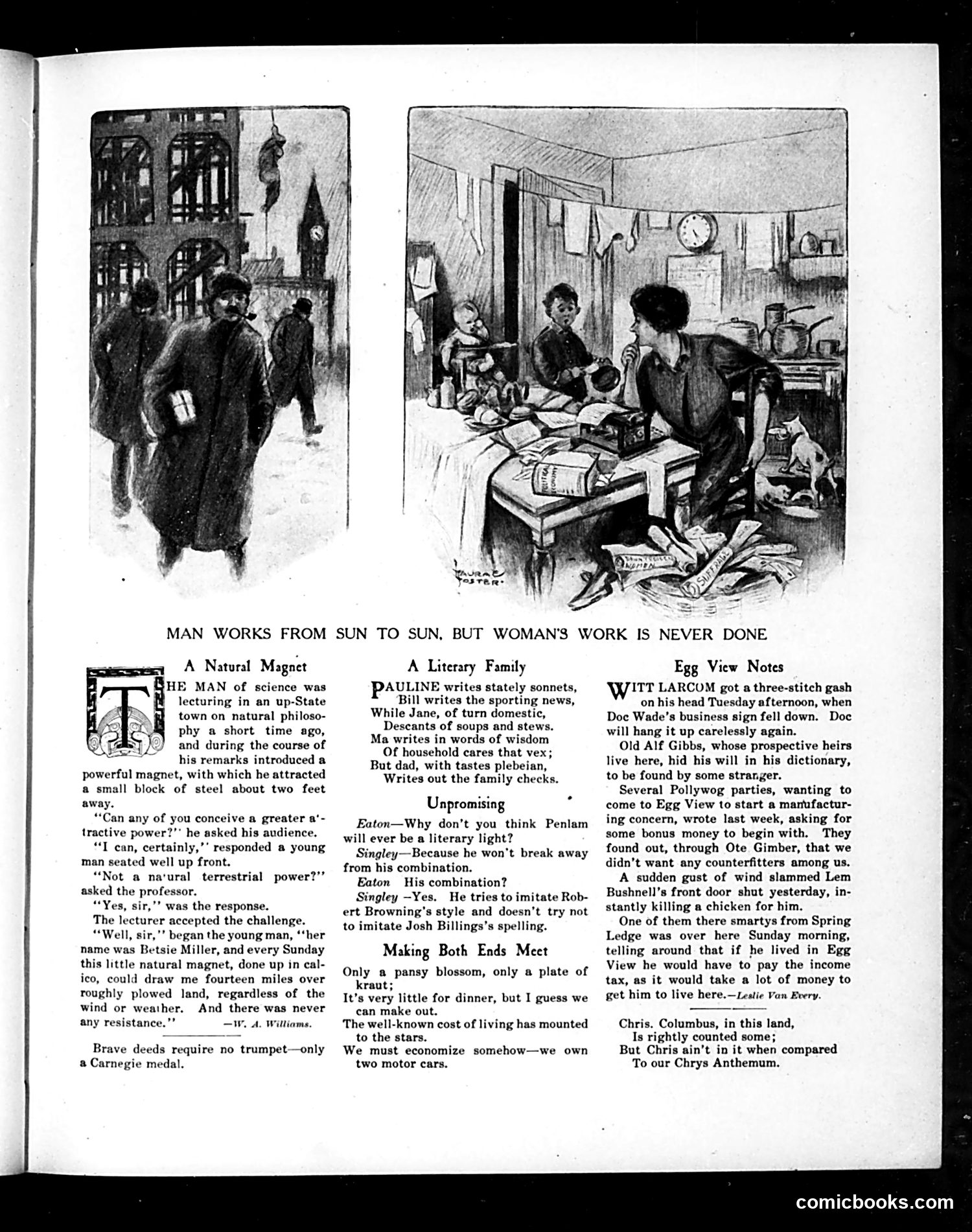
This page satirizes gender roles and domestic labor in early 20th-century America. The headline references a proverb about men's work having defined endpoints, while women's housework is endless. **Left cartoon ("A Natural Magnet"):** A young man claims the greatest attractive force isn't physics but a woman named "Betsie Miller," who could draw him fourteen miles through rough terrain "without any resistance"—a joke about female attractiveness and male powerlessness against it. **Center section ("A Literary Family"):** Satirizes a household where multiple family members write—sonnets, sports news, domestic advice—but the father merely "writes out the family checks." The joke: despite everyone's creative pursuits, only mundane financial transactions matter. **Right section ("Egg View Notes"):** Local gossip column humor about small-town life. **"Making Both Ends Meet":** Mocks working-class economic hardship—a family surviving on minimal food (pansy blossom and sauerkraut) while owning two motor cars, highlighting the contradiction between poverty and luxury spending.
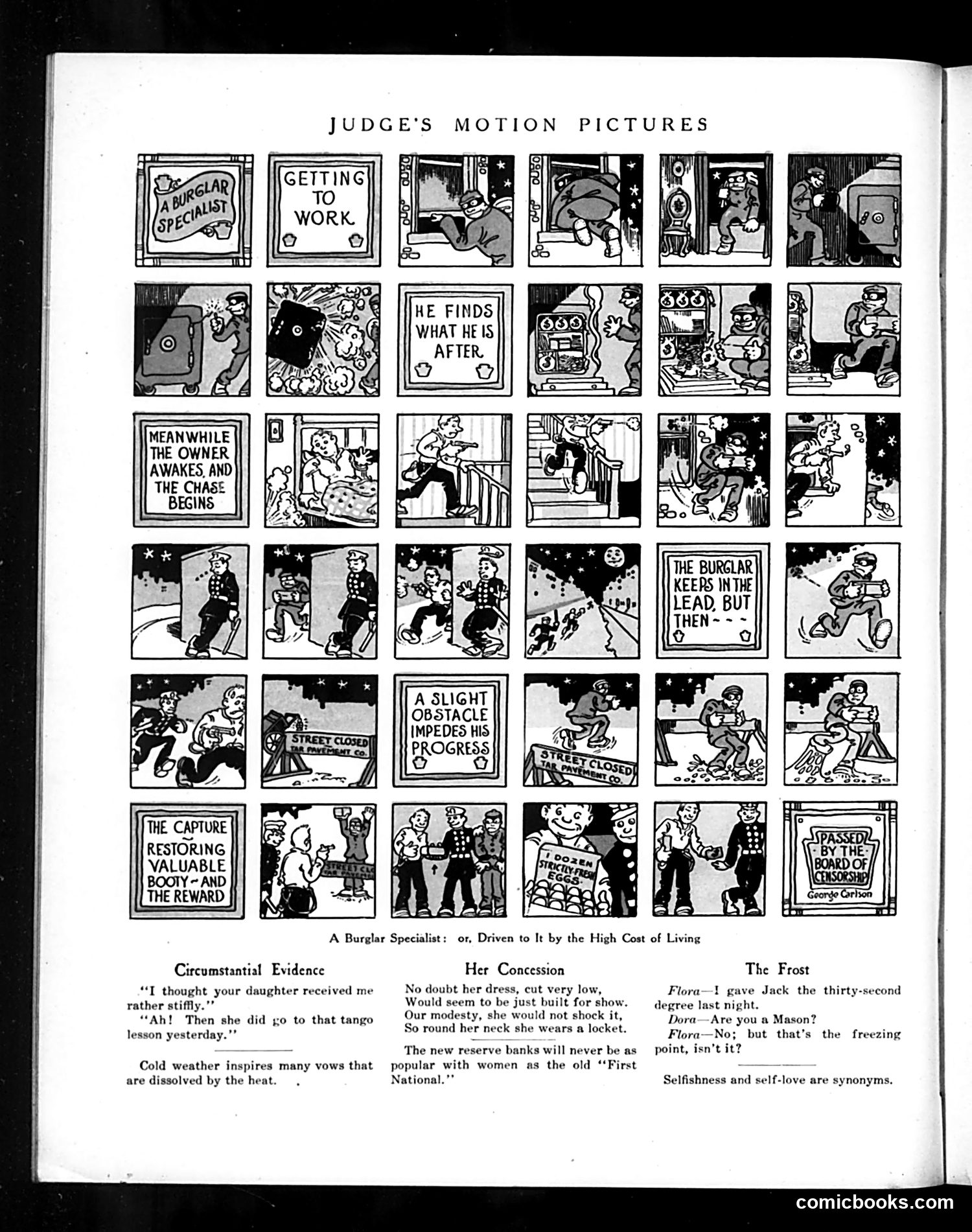
This is a six-panel comic strip satirizing economic hardship. The title promises irony: a burglar becomes a "specialist" not from criminal inclination but from desperation caused by the "High Cost of Living"—a real economic crisis affecting Americans in the early 20th century. The narrative follows a burglar who breaks into a home, finds valuables, but is ultimately captured and returned by authorities. The implicit critique is that poverty and inflation drive ordinary people to crime as survival mechanisms. Below are unrelated jokes about courtship, modesty, banking, and weather. The overall page combines visual humor (the comic strip) with brief gag commentary, typical of Judge magazine's satirical format mixing social criticism with domestic comedy.
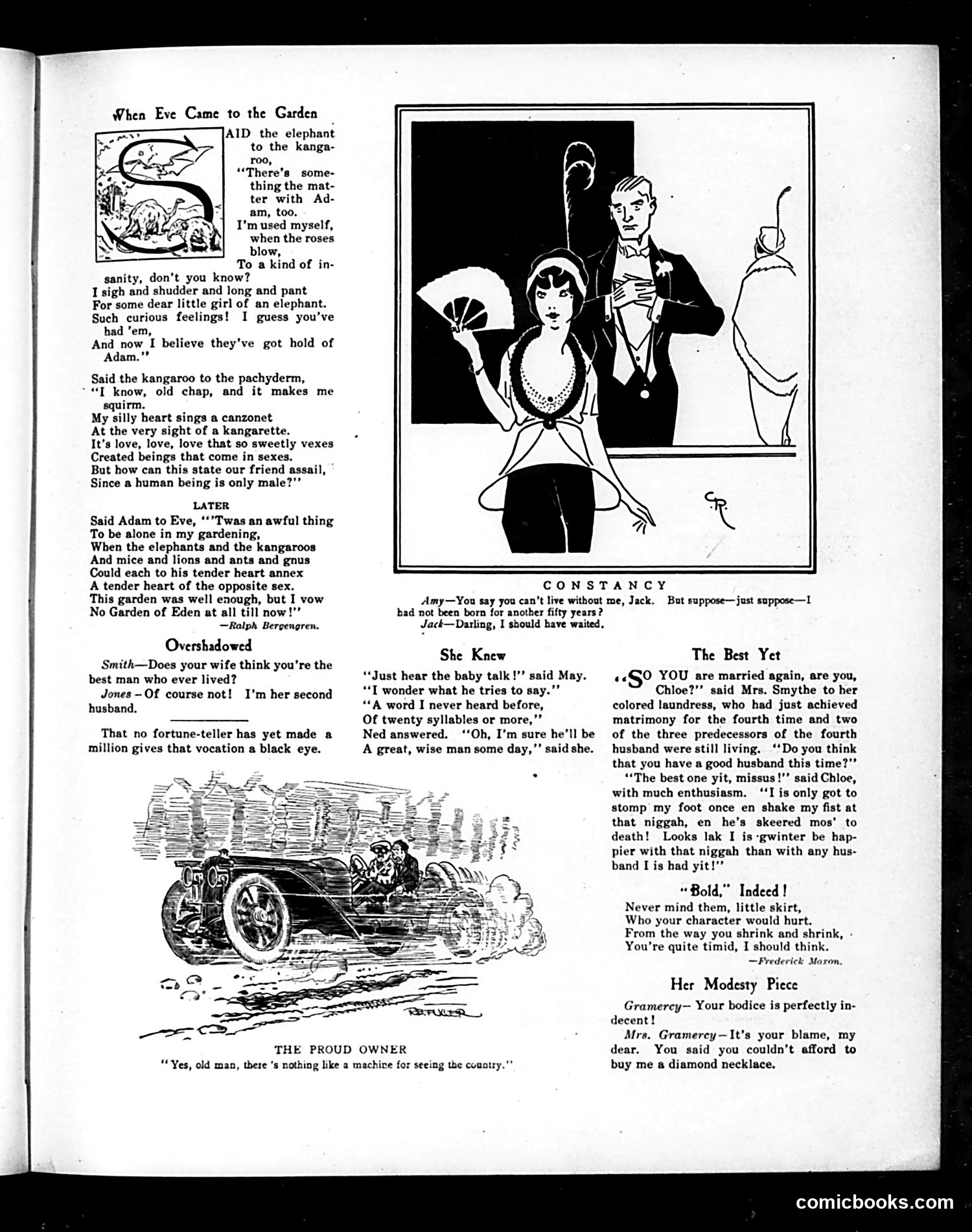
This page contains multiple humor pieces typical of early 20th-century satirical magazines: **"When Eve Came to the Garden"** presents a biblical parody where animals discuss romantic longing while Adam feels lonely. The joke: animals naturally pair by sex, but Adam—being human and male—has no female counterpart until Eve arrives. It's gentle satire on human desire and the Genesis creation story. **"Constancy"** jokes about a woman's conditional devotion: she claims she can't live without her boyfriend, but he sarcastically responds he'd have waited if she weren't born for fifty years—implying her love is shallow. **"The Best Yet"** contains dated racial humor depicting a Black laundress boasting about her fourth husband, whom she controls through intimidation. This reflects period stereotypes and offensive dialect writing common to Judge. **Other brief pieces** mock marriage dynamics: wives outranking husbands, infant speech, and a woman's immodesty blamed on her husband's inability to afford jewelry. The cartoons employ vintage illustration styles with period-typical social commentary.
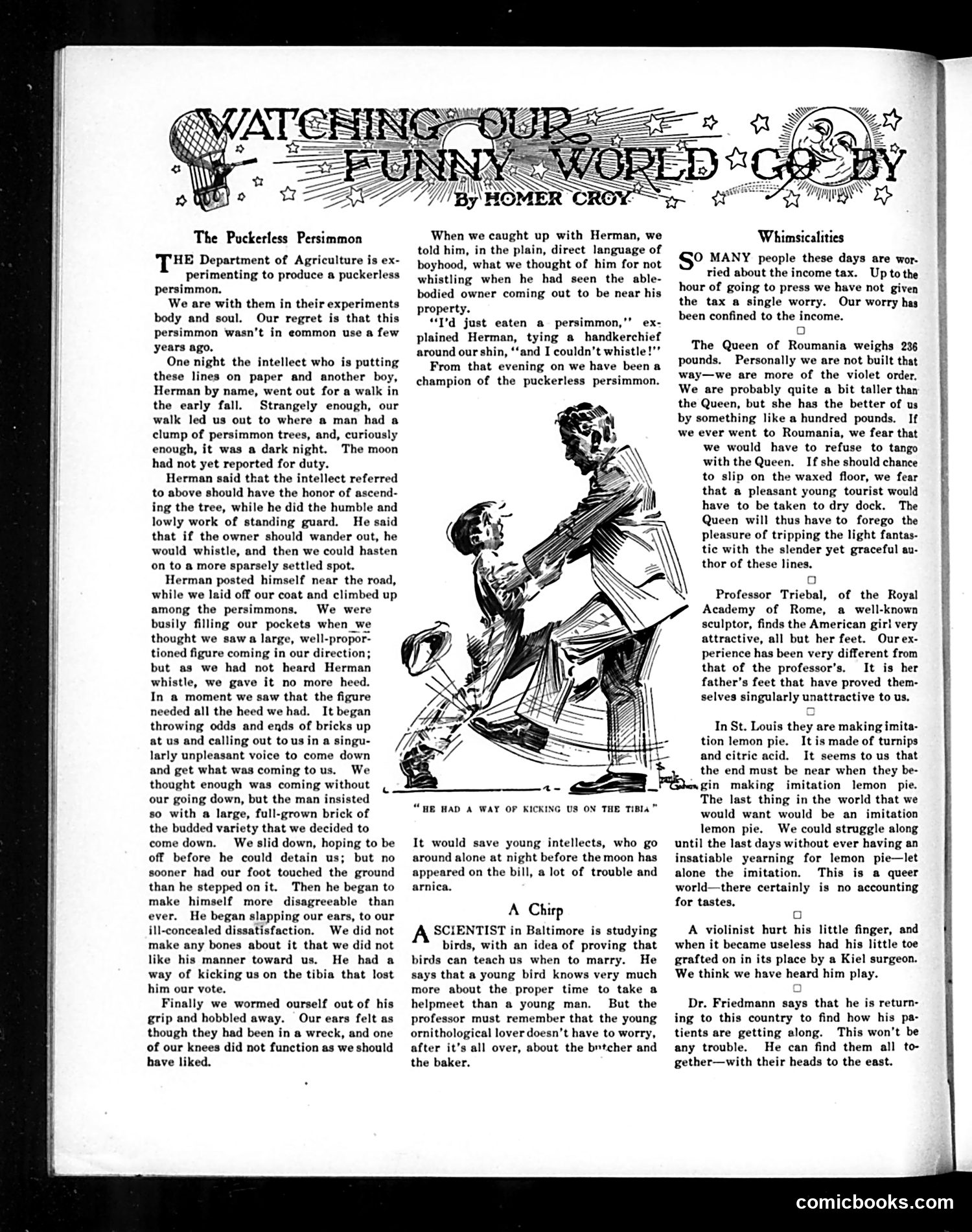
This humorous autobiographical essay by Homer Croy describes a childhood fruit-stealing escapade that went badly wrong. The author and his friend Herman sneak into an orchard to pick persimmons at night. Herman, posted as lookout, fails to whistle a warning when the property owner approaches—because he's eaten a persimmon and his mouth has puckered shut, rendering him unable to whistle. The owner catches the author, beats him severely, and steps on his foot. The joke's premise: the author becomes a passionate advocate for agricultural efforts to develop a puckerless persimmon variety, since such a fruit would have prevented Herman's inability to warn him. The accompanying "Whimsicalities" section offers brief, lighthearted social commentary on contemporary topics: income tax worries, Queen Marie of Romania's weight, and American girls' feet versus their fathers' feet (implying hostile fathers protecting daughters).
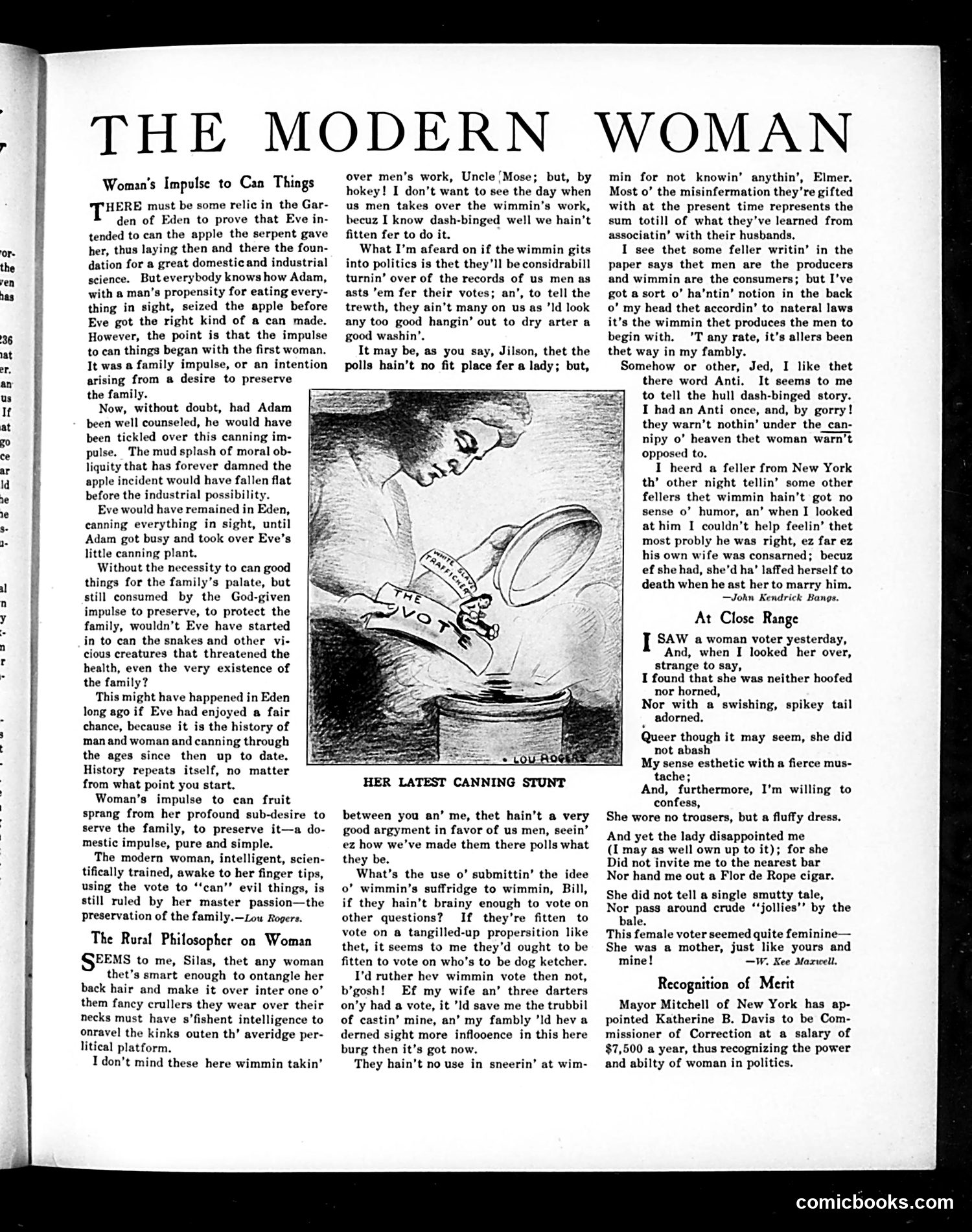
This page satirizes women's expanding role in public life, particularly voting rights. The cartoon "Her Latest Canning Stunt" depicts a woman literally canning/preserving a ballot box—a visual pun suggesting women are extending their domestic "canning" impulse into politics. The accompanying rural dialogue between "Silas" and another farmer presents folksy resistance to women's suffrage. The speakers acknowledge women's intelligence but worry that granting them votes will expose men's corruption ("turnin' over of the records of us men"). One character contradicts himself, first doubting women's fitness to vote, then admitting his wife and daughters voting would increase his family's political influence. The satire cuts both ways: it mocks rural male chauvinism while also portraying women's political engagement as merely an extension of domestic preservation instincts—a backhanded compliment wrapped in condescension. The piece reflects early 20th-century anxieties about women's suffrage.
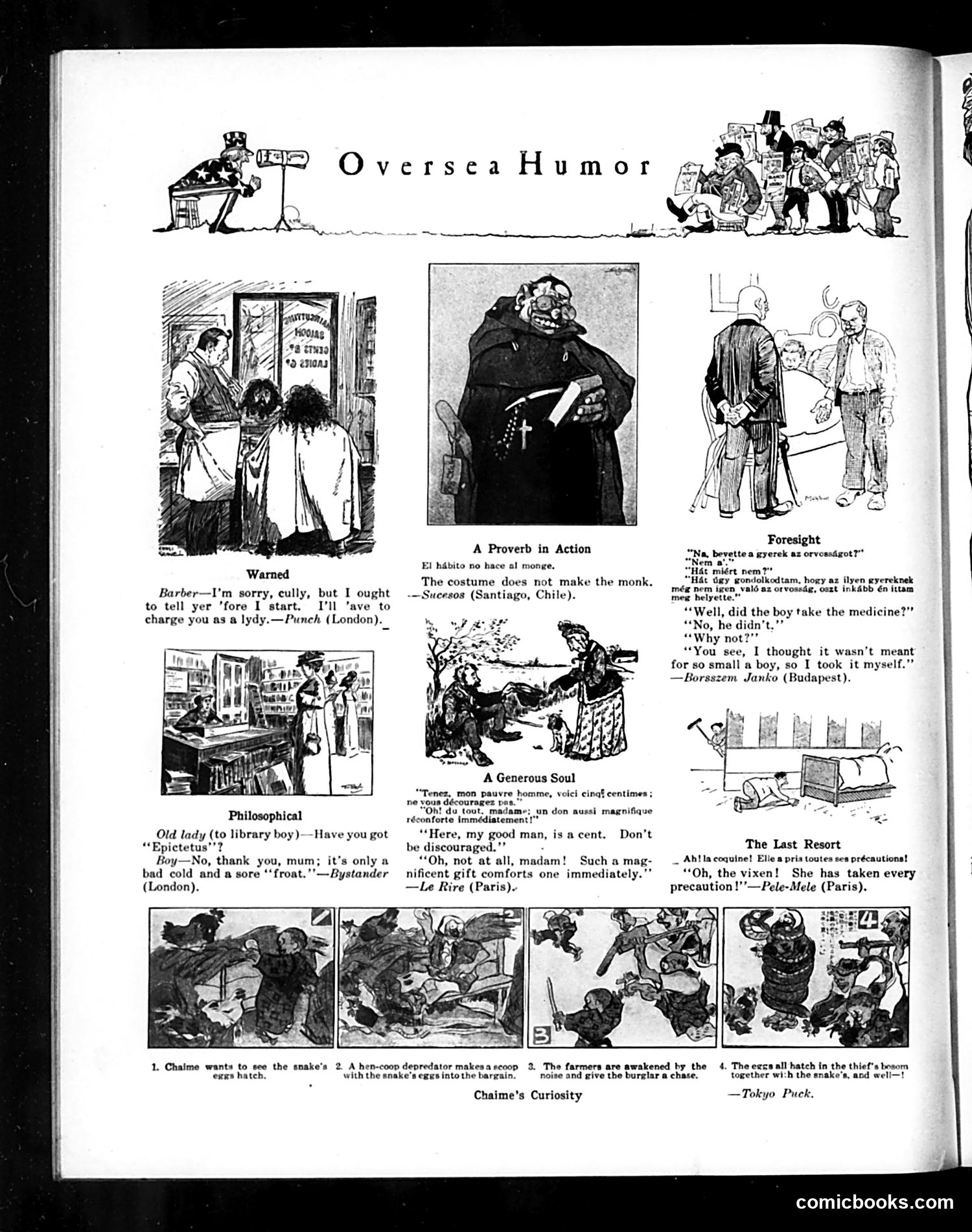
This page collects translated jokes and comics from international publications, showcasing how different cultures found humor in similar situations. The content includes: **Single-panel jokes** about misunderstandings (a barber charging a customer "as a lady," a library boy confusing "Epictetus" with a cold remedy) that rely on wordplay and class humor typical of early 20th-century satire. **Visual narratives** like "Chaime's Curiosity" (from *Tokyo Puck*), a four-panel sequence about a boy stealing snake eggs alongside a snake, resulting in snakes hatching in his clothing—absurdist slapstick humor. Other strips depict universal themes: parental medicine-avoidance, stingy charity, mistaken identity. The sources—*Punch* (London), *Le Rire* (Paris), *Borsszem Janko* (Budapest), *Tokyo Puck* (Japan)—demonstrate that humor about human folly, domestic life, and social pretense transcended national borders.
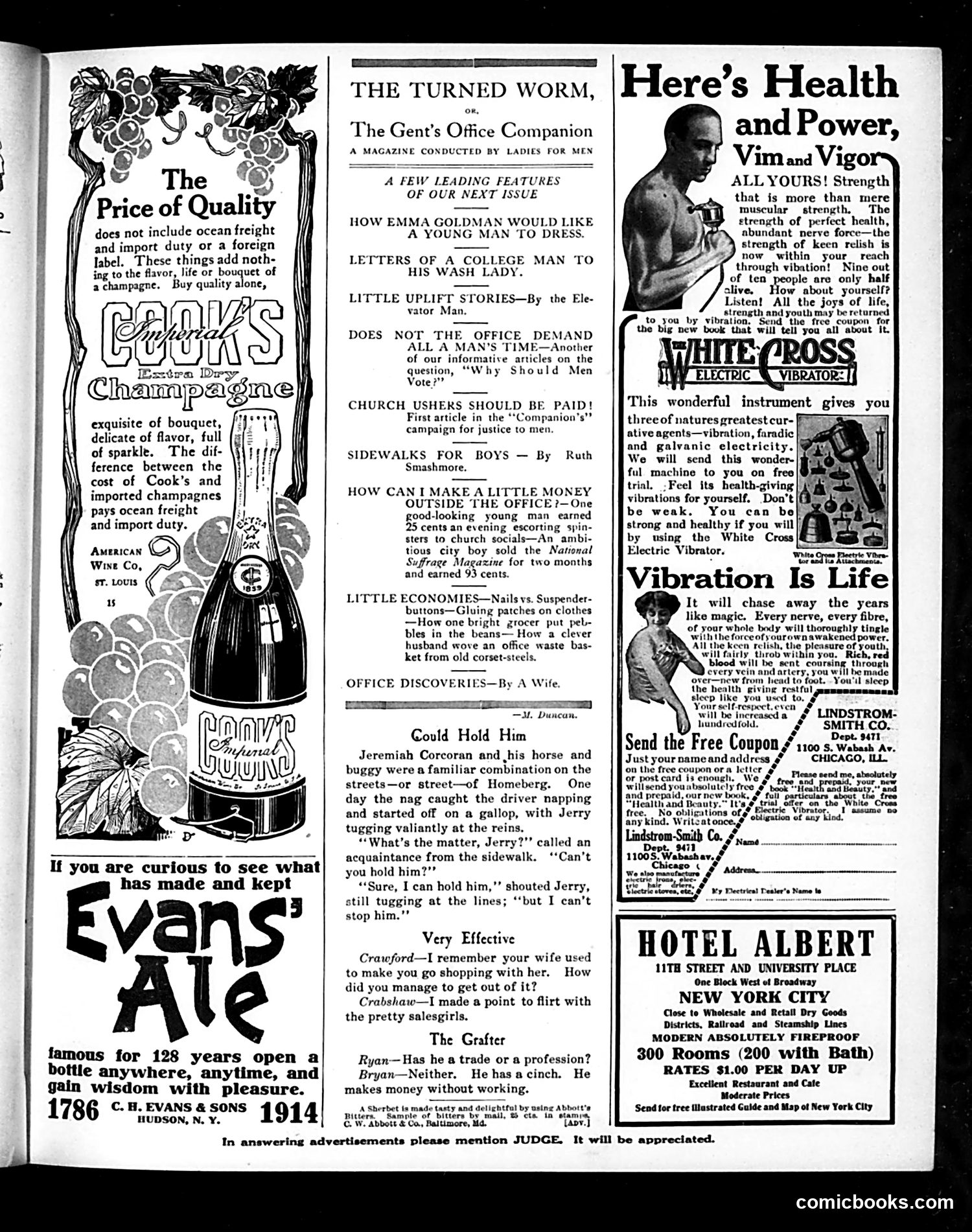
This page is primarily **advertisements and satirical filler content** rather than coherent political commentary. The left side advertises champagne and ale using quality-based messaging typical of early 1900s advertising. The center features "The Turned Worm," a mock magazine for men that satirizes **women's suffrage and gender role anxieties**. The satirical headlines mock feminist Emma Goldman, suggest men shouldn't vote, and joke about husbands' domestic complaints—reflecting anti-suffrage sentiment of the era. The short jokes below ("Gould Hold Him," "Very Effective," "The Grafter") are generic humor about control, marital dynamics, and fraud. The right side advertises **pseudo-medical devices**—a "White Cross Electric Vibrator" promising health, strength, and vitality through electrical vibration. This represents the era's dubious medical claims marketed to a desperate public before FDA regulation. Overall, this reflects 1914 anxieties about gender roles, health fads, and consumerism rather than specific political satire.
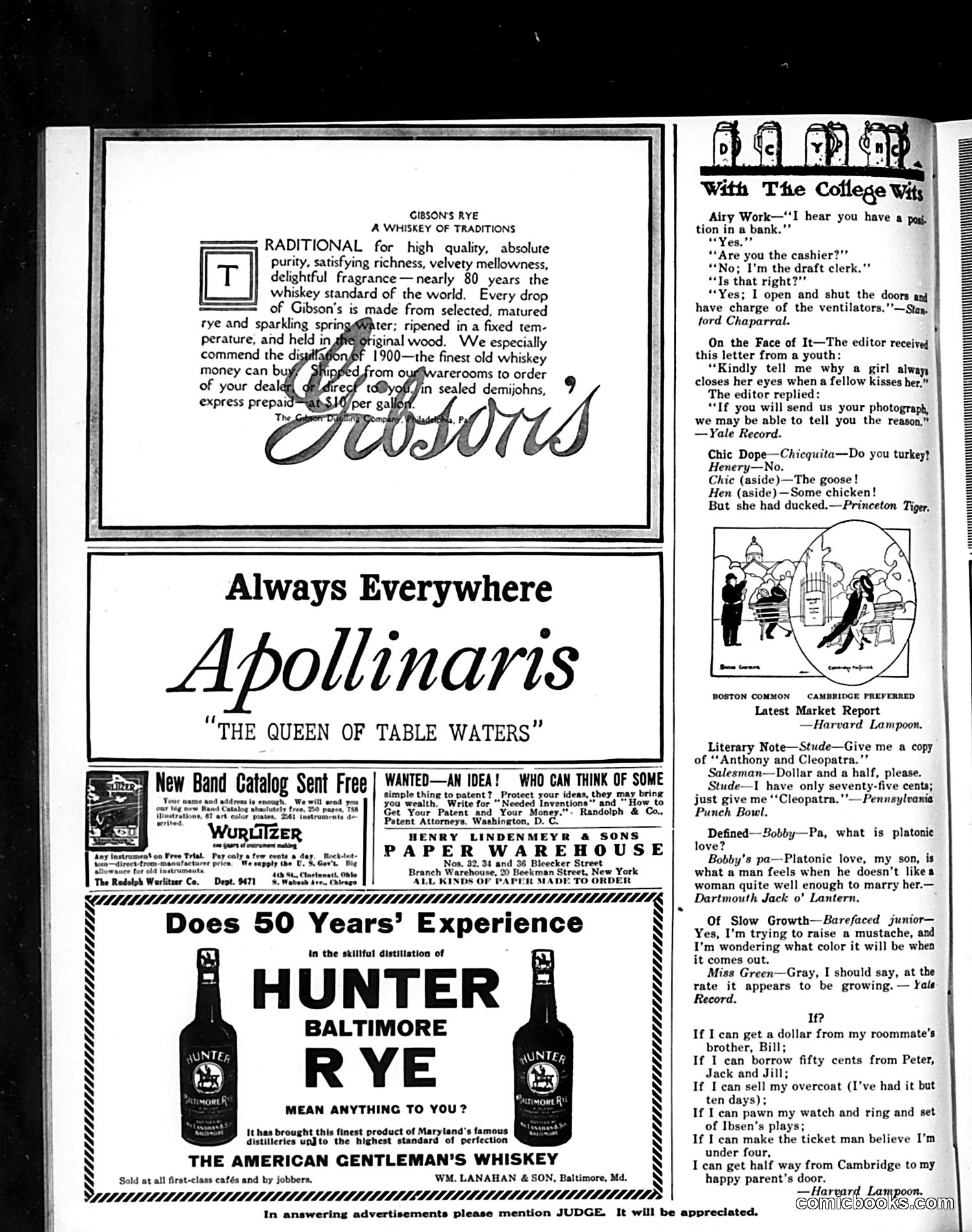
This page is primarily **advertising and humor** rather than political satire. It contains: **Advertisements:** Multiple whiskey and spirits ads (Gibson's Rye, Hunter Baltimore Rye, Apollinaris water) dominating the layout—typical of early 20th-century magazines that relied heavily on alcohol advertising. **College Humor Section** ("With The College Wits"): Brief jokes from various college publications (Yale Record, Princeton Tiger, Harvard Lampoon, Dartmouth Jack O'Lantern). These are lighthearted campus humor—a "draft clerk" confused about banking terminology, a student trying to raise mustache funds by borrowing from multiple sources, and gentle romantic/courtship jokes. **Key Point:** There's no discernible political cartoon or social satire here. The page reflects the magazine's mixed commercial and editorial model, with college-oriented humor appealing to its educated, likely upper-class readership. The recurring theme of financial scrappiness among students provides mild social commentary about collegiate life.
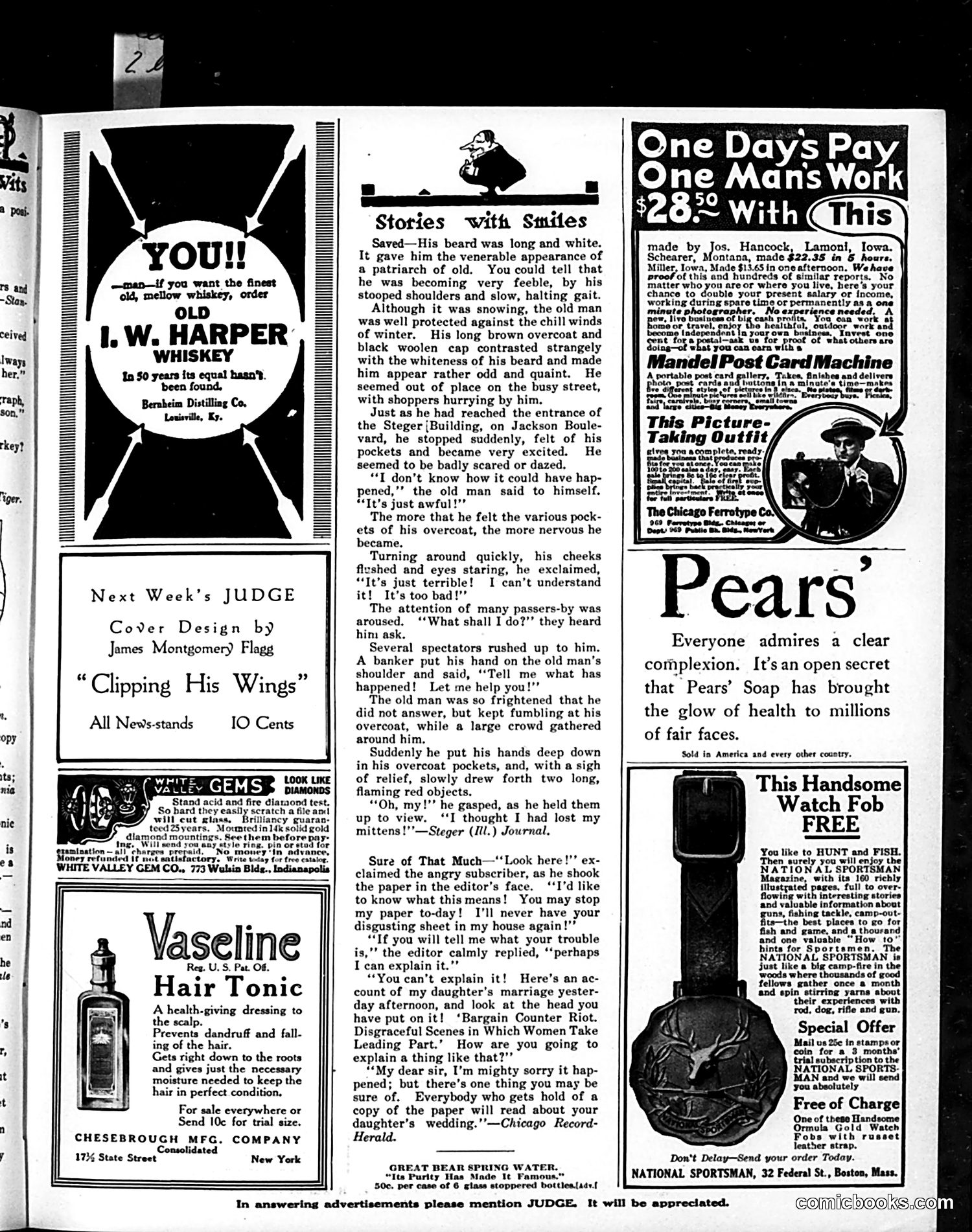
This page is primarily **advertising and filler content** with two lighthearted stories and commercial notices—typical for Judge magazine, a satirical weekly. The advertisements dominate: I.W. Harper whiskey, White Valley gems, Vaseline hair tonic, and mail-order products (Mandel-Post Card Machine, picture-taking outfit, Pears' soap). The two short stories are humorous anecdotes: 1. **"Stories with Smiles"** depicts an elderly man in the Steger Building causing a commotion, frantically searching his overcoat. The punchline: he was merely looking for his **mittens**, which he'd actually possessed all along—a comedy of misunderstanding. 2. **"Sure of That Much"** satirizes a newspaper editor's callous response to an angry subscriber whose daughter's wedding was headlined as a **"Bargain Counter Riot"** (a mismatched headline). The editor's silver lining: the mistake guaranteed the wedding publicity. Both stories reflect period humor: the elderly gentleman's absent-mindedness and editorial incompetence. There's no obvious political satire here—this is routine magazine filler.
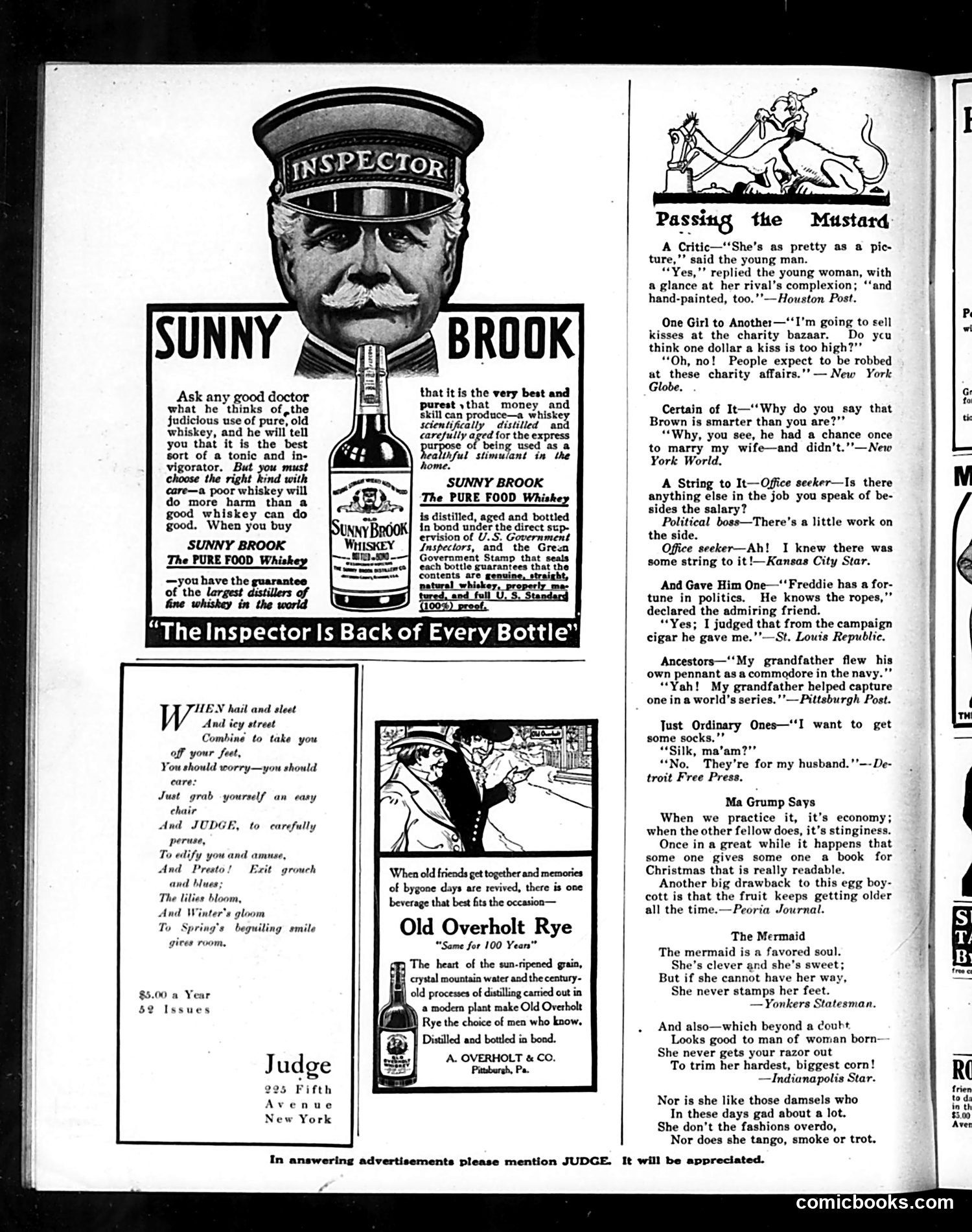
This page from *Judge* magazine contains **primarily advertisements for whiskey** (Sunny Brook and Old Overholt Rye), framed with health claims about whiskey's medicinal benefits—a common pitch during the Pre-Prohibition era. The actual satirical content appears in the right column: a series of brief **joke vignettes** mocking social pretension and marital dynamics. These include jabs at: women's makeup ("hand-painted"), charity event exploitation, a husband's intelligence measured by avoiding marriage to someone else, office politics and corruption, family boasting, and marital complaints about hosiery quality and women's cosmetic demands. The recurring theme is **deflating pomposity**—exposing vanity, hypocrisy, and the gap between stated values and actual behavior. The mermaid poem satirizes idealized femininity by suggesting mermaids are preferable because they *don't* demand the petty services real women do. The "Inspector" figure heading the whiskey ad promises government oversight and purity—an appeal to consumer trust during an era of widespread product adulteration and patent medicine fraud.
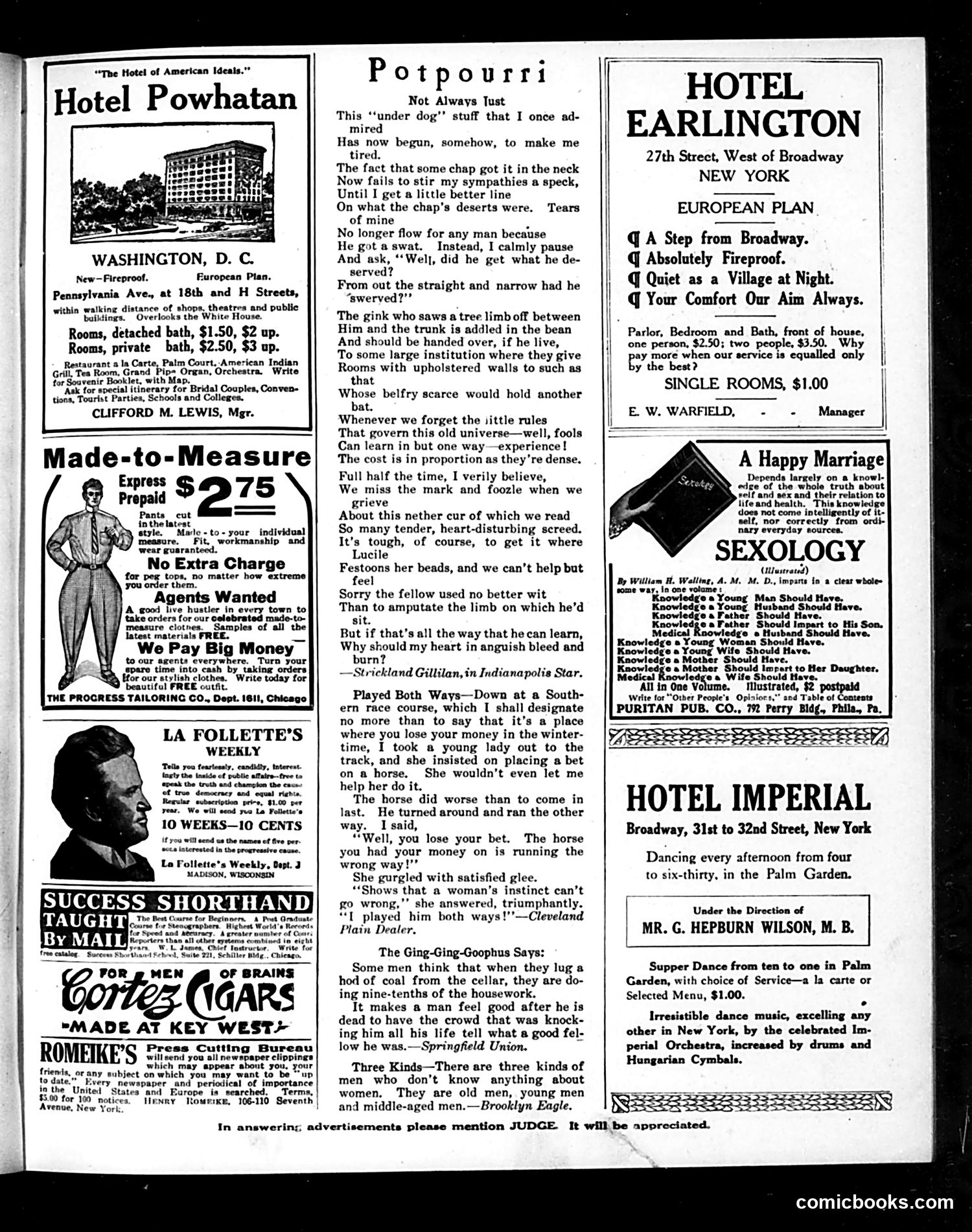
This page is primarily **advertising and miscellaneous content**, not political satire. The main piece is "Potpourri: Not Always Just," a philosophical poem by Strickland Gillilan questioning sentimental sympathy for underdogs. The author argues people deserve consequences for their own foolish actions—citing someone who sawed off a tree branch they were sitting on. He dismisses excessive pity, insisting people learn through hard experience rather than sentiment. The accompanying anecdote about a woman at a racetrack whose horse ran backward humorously illustrates this theme: she made a poor bet and lost, and that's simply how one learns. The page otherwise contains hotel advertisements (Powhatan, Earlington, Imperial), tailoring services, and magazine promotions—typical Judge magazine filler. There are **no identifiable political figures or cartoons** to analyze; this appears to be a regular content/advertising page rather than satirical material.
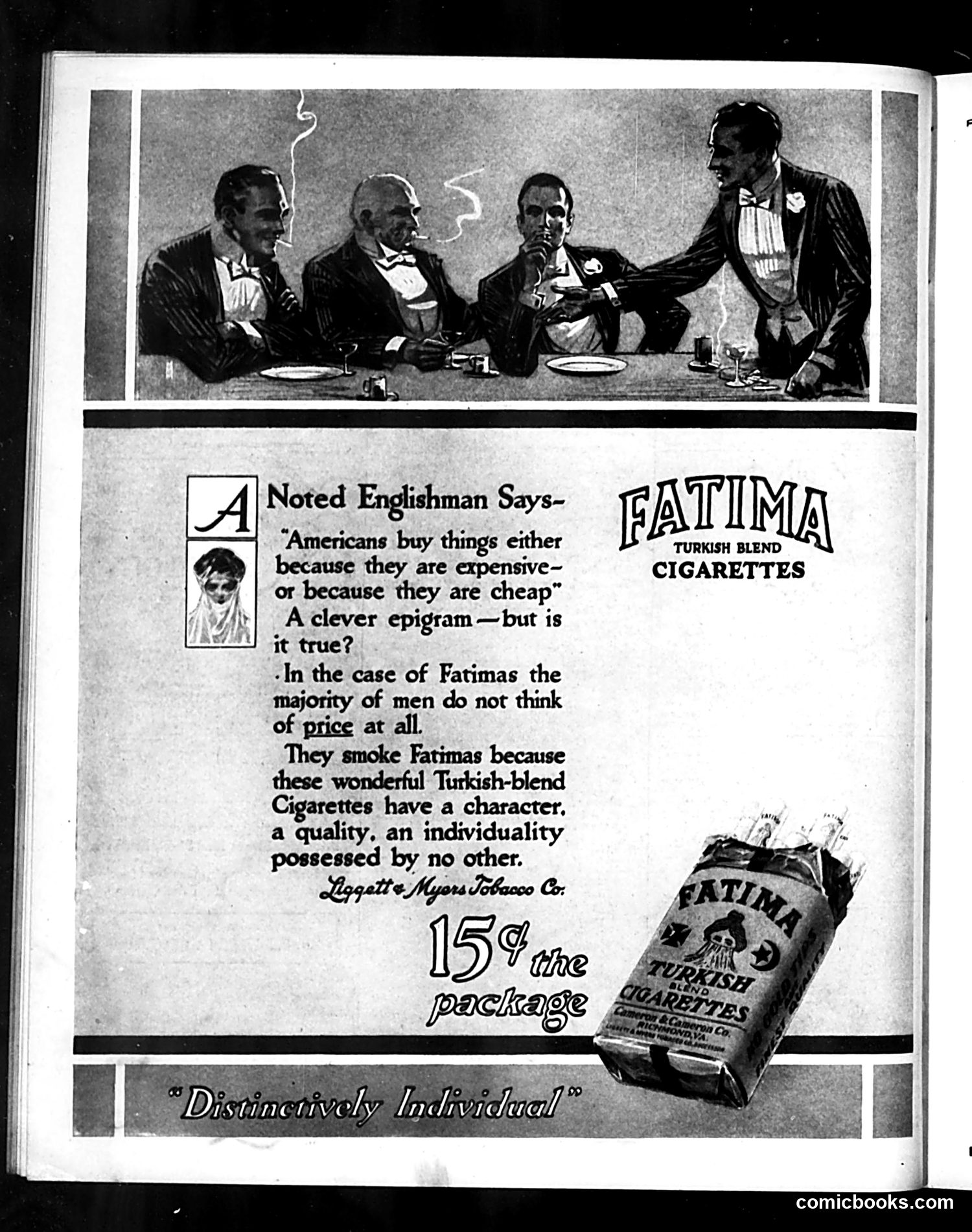
This is primarily a **cigarette advertisement** rather than political satire. It features four well-dressed men in formal attire at what appears to be a dinner or social gathering, discussing cigarettes. The ad quotes "a noted Englishman" making an observation about American consumer behavior—that Americans buy things either because they're expensive or cheap. The advertisement then **refutes this stereotype** by claiming Fatima Turkish-blend cigarettes are purchased for quality and character, not price. The tagline promises "Distinctively Individual" smoking. The cartoon serves the advertisement's purpose: depicting sophisticated gentlemen appreciating the product based on taste rather than cost. This was typical early-20th-century cigarette marketing, appealing to masculine refinement and social status. No specific political figures or satirical commentary appears to be present—it's commercial messaging rather than political commentary.