
Judge, 1914-01-17 · page 16 of 24
Judge — January 17, 1914 — page 16: what you’re looking at
What you’re looking at
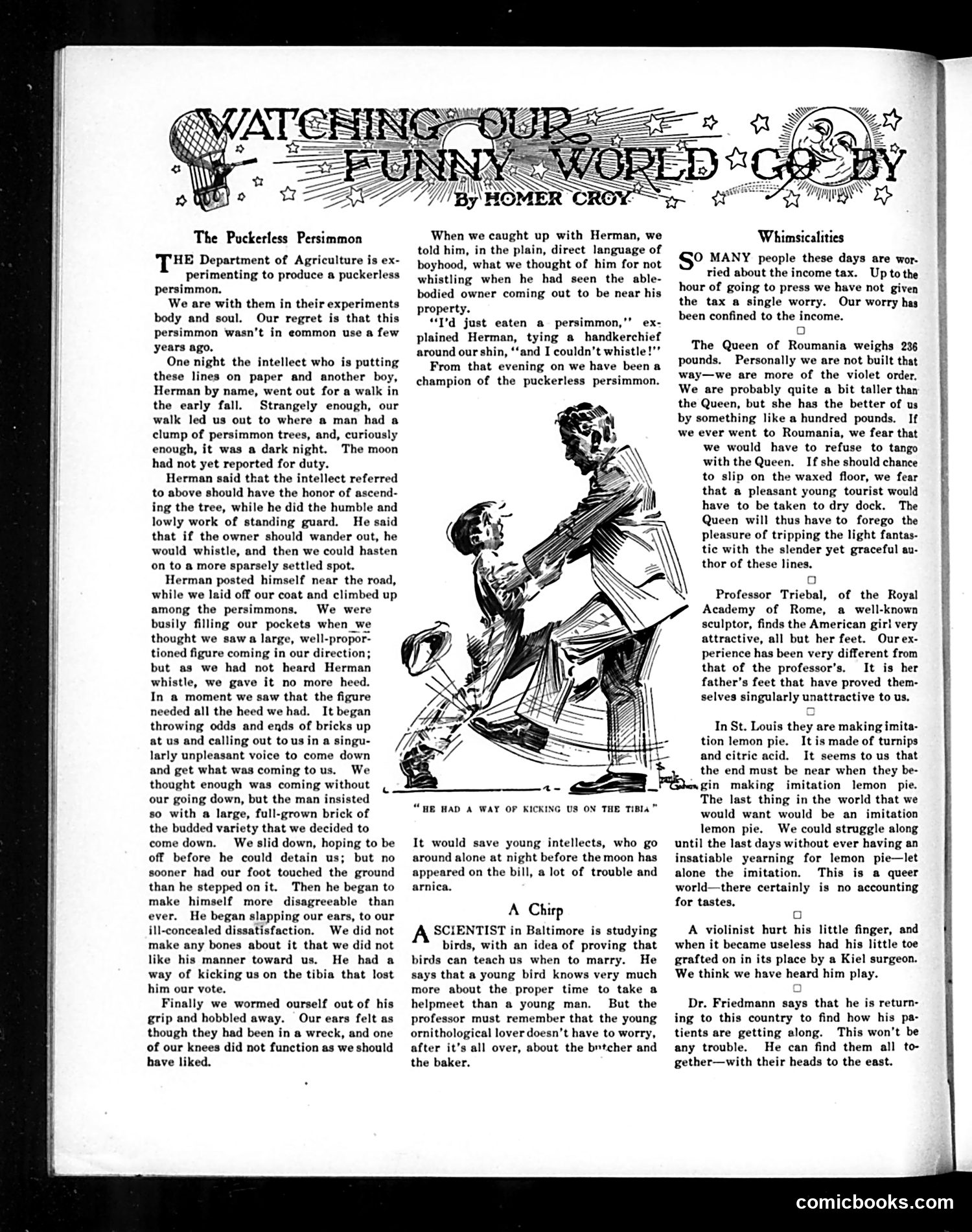
This humorous autobiographical essay by Homer Croy describes a childhood fruit-stealing escapade that went badly wrong. The author and his friend Herman sneak into an orchard to pick persimmons at night. Herman, posted as lookout, fails to whistle a warning when the property owner approaches—because he's eaten a persimmon and his mouth has puckered shut, rendering him unable to whistle. The owner catches the author, beats him severely, and steps on his foot. The joke's premise: the author becomes a passionate advocate for agricultural efforts to develop a puckerless persimmon variety, since such a fruit would have prevented Herman's inability to warn him. The accompanying "Whimsicalities" section offers brief, lighthearted social commentary on contemporary topics: income tax worries, Queen Marie of Romania's weight, and American girls' feet versus their fathers' feet (implying hostile fathers protecting daughters).
📄 Transcribed text from this page (OCR, searchable)
Machine-transcribed from the original scan — historical spelling and the odd misread are preserved.
The Puckerless Persimmon THE Department of Agriculture is ex- perimenting to produce a puckerless persimmon. We are with them in their experiments body and soul. Our regret is that this persimmon wasn't in eommon use a few years ago. One night the intellect who is putting these lines on paper and another boy, Herman by name, went out for a walk in the early fall. Strangely enough, our walk led us out to where a man had a clump of persimmon trees, and, curiously enough, it was a dark night. The moon had not yet reported for duty. Herman said that the intellect referred to above should have the honor of ascend- ing the tree, while he did the humble and lowly work of standing guard. He said that if the owner should wander out, he would whistle, and then we could hasten on to a more sparsely settled spot. Herman posted himself near the road, while we laid off our coat and climbed up among the persimmons. We were busily filling our pockets when_we thought we saw a large, well-propor- tioned figure coming in our direction; but as we had not heard Herman whistle, we gave it no more heed. In a moment we saw that the figure needed all the heed we had. It began throwing odds and ends of bricks up at us and calling out tous in a singu- larly unpleasant voice to come down and get what was coming tous. We thought enough was coming without our going down, but the man insisted so with a large, full-grown brick of the budded variety that we decided to come down. We slid down, hoping to be off before he could detain us; but no sooner had our foot touched the ground than he stepped on it. Then he began to make himself more disagreeable than ever. He began slapping our ears, to our ill-concealed dissatisfaction. We did not make any bones about it that we did not like his manner toward us. He had a way of kicking us on the tibia that lost him our vote. Finally we wormed ourself out of his grip and hobbled away. Our ears felt as though they had been in a wreck, and one of our knees did not function as we should have liked. When we caught up with Herman, we told him, in the plain, direct language of boyhood, what we thought of him for not whistling when he had seen the able- bodied owner coming out to be near his property. “I'd just eaten a persimmon,’’ ex- plained Herman, tying a handkerchief around our shin, ‘‘and I couldn’t whistle!"" From that evening on we have been a champion of the puckerless persimmon. ——_ Aa a Whimsicalities s° MANY people these days are wor- ried about the income tax. Up tothe hour of going to press we have not given the tax a single worry. Our worry has been confined to the income. o The Queen of Roumania weighs 236 pounds. Personally we are not built that way—we are more of the violet order. We are probably quite a bit taller than the Queen, but she has the better of us by something like a hundred pounds. If we ever went to Roumania, we fear that we would have to refuse to tango with the Queen. If she should chance to slip on the waxed floor, we fear that a pleasant young tourist would have to be taken to dry dock. The Queen will thus have to forego the pleasure of tripping the light fantas- tic with the slender yet graceful au- thor of these lines, oO Professor Triebal, of the Royal Academy of Rome, a_ well-known sculptor, finds the American gir! very attractive, all but her feet. Ourex- perience has been very different from that of the professor's. It is her father’s feet that have proved them- selves singularly unattractive to us. In St. Louis they are making imita- tion lemon pie. It is made of turnips and citric acid. It seems to us that é the end must be near when they be- _———— | Po gin making imitation lemon pie. “HE HAD A WAY OP KICKING US ON THE TIBIA” It would save young intellects, who go around alone at night before the moon has appeared on the bill, a lot of trouble and arnica. A Chirp SCIENTIST in Baltimore is studying birds, with an idea of proving that birds can teach us when to marry. He says that a young bird knows very much more about the proper time to take a helpmeet than a young man. But the professor must remember that the young ornithological lover doesn’t have to worry, after it’s all over, about the btcher and the baker. The last thing in the world that we would want would be an imitation lemon pie. We could struggle along until the last days without ever having an insatiable yearning for lemon pie—let alone the imitation. This is a queer world—there certainly is no accounting for tastes, a A violinist hurt his little finger, and when it became useless had his little toe grafted on in its place by a Kiel surgeon. We think we have heard him play. Dr. Friedmann says that he is return- ing to this country to find how his pa- tients are getting along. This won't be any trouble. He can find them all to- gether—with their heads to the east. comicbooks.com