
Judge, 1914-01-17 · page 7 of 24
Judge — January 17, 1914 — page 7: what you’re looking at
What you’re looking at
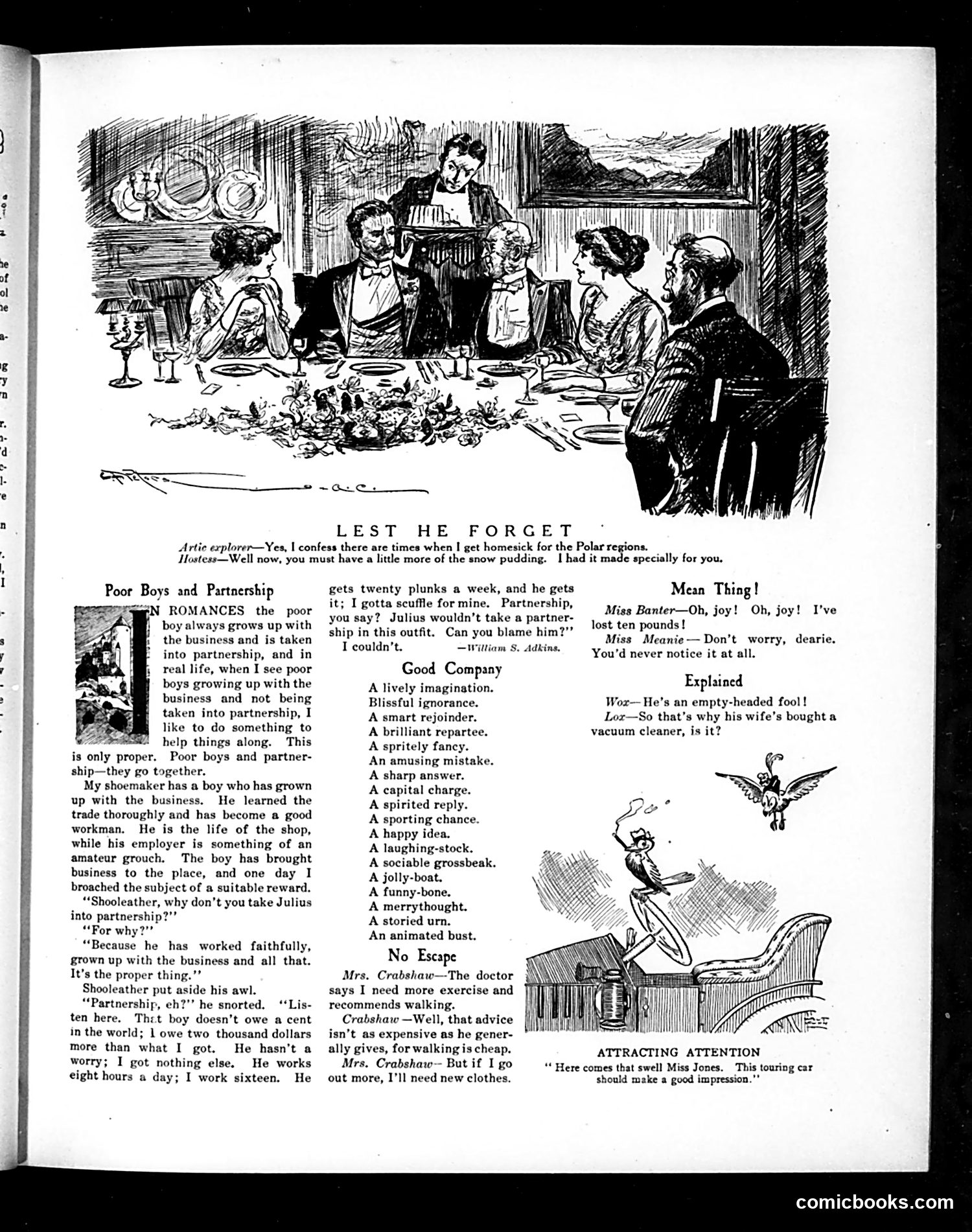
This page contains several short humorous sketches typical of early 20th-century satirical magazines. The main cartoon depicts a dinner party where an Arctic explorer nostalgic for polar regions is served "snow pudding" by his hostess—a gentle joke about literal interpretation of his homesickness. The accompanying text pieces mock social pretensions and economic hypocrisy. "Poor Boys and Partnership" criticizes a wealthy employer who refuses to make his loyal young employee a partner, justifying it through self-interest: he owes money while the boy owes nothing, so partnership would burden the boy. The satire targets greed disguised as concern for others. Other brief sketches include wordplay ("Good Company"), marital comedy ("Mean Thing!"), and observational humor about middle-class anxieties (the Crabshaw couple worrying about exercise and appearances). The page represents typical Judge humor: punching at social pretense, miserliness, and absurd logic among the middle and upper classes, using recognizable domestic scenarios rather than political commentary.
📄 Transcribed text from this page (OCR, searchable)
Machine-transcribed from the original scan — historical spelling and the odd misread are preserved.
LEST HE FORGET Artic explorer—Yes, | confess there are times when I get homesick for the Polar regions. _ Hostess—Well now, you must have a little more of the snow pudding. | had it made specially for you, Poor Boys and Partnership gets twenty plunks a week, and he gets Mean Thing! Sei ROMANCES the poor iti | Sojta scuffle for mine. | Partnership, afigg Banter—Oh, joy! Oh, joy! I've boy always grows up with Jp Ay eat Can you blame him? lost ten pounds! the business and is taken STP in this outfit. Can you blame him? Miss Meanie— Don’t worry, dearie. into partnership, and in T couldn't. SWI bam 8. AdRine. You'd never notice it at all. real life, when I see poor Good Company boys growing up with the Explained business and not being Blissful ignorance. Wox—He’s an empty-headed fool! taken into partnership, I A smart rejoinder. Loz—So that’s why his wife’s bought a like to do something to A brilliant repartee. vacuum cleaner, is it? help things along. This A spritely fancy. A lively imagination. Poor boys and partner- An amusing mistake. ship—they go together. A sharp answer. My shoemaker has a boy who has grown A capital charge. up with the business. He learned the A spirited reply. trade thoroughly and has become a good workman. He is the life of the shop, while his employer is something of an A laughing-stock. amateur grouch. The boy has brought A sociable grossbeak. business to the place, and one day I A jolly-boat. broached the subject of a suitable reward. A funny-bone. “Shooleather, why don’t you take Julius A merrythought. into partnership?” “For why?” “Because he has worked faithfully, grown up with the business and all that. No Escape It’s the proper thing.’” Mrs. Crabshaw—The doctor Shooleather put aside his awl. says I need more exercise and “Partnership, eh?’ he snorted. ‘‘Lis- recommends walking. ten here. Thct boy doesn’t owe a cent Crabshaw —Well, that advice in the world; 1 owe two thousand dollars isn’t as expensive as he gener- more than what I got. He hasn't a ally gives, for walking is cheap. ATTRACTING ATTENTION worry; I got nothing else. He works Mrs. Crabshaw-— But if I go “« Here comes that swell Miss Jones. This touring car eight hours a day; I work sixteen. He out more, I’ll need new clothes. should make a good impression.’’ A sporting chance. A happy idea. A storied urn. An animated bust. comicbooks.com