
Judge, 1914-01-17 · page 4 of 24
Judge — January 17, 1914 — page 4: what you’re looking at
What you’re looking at
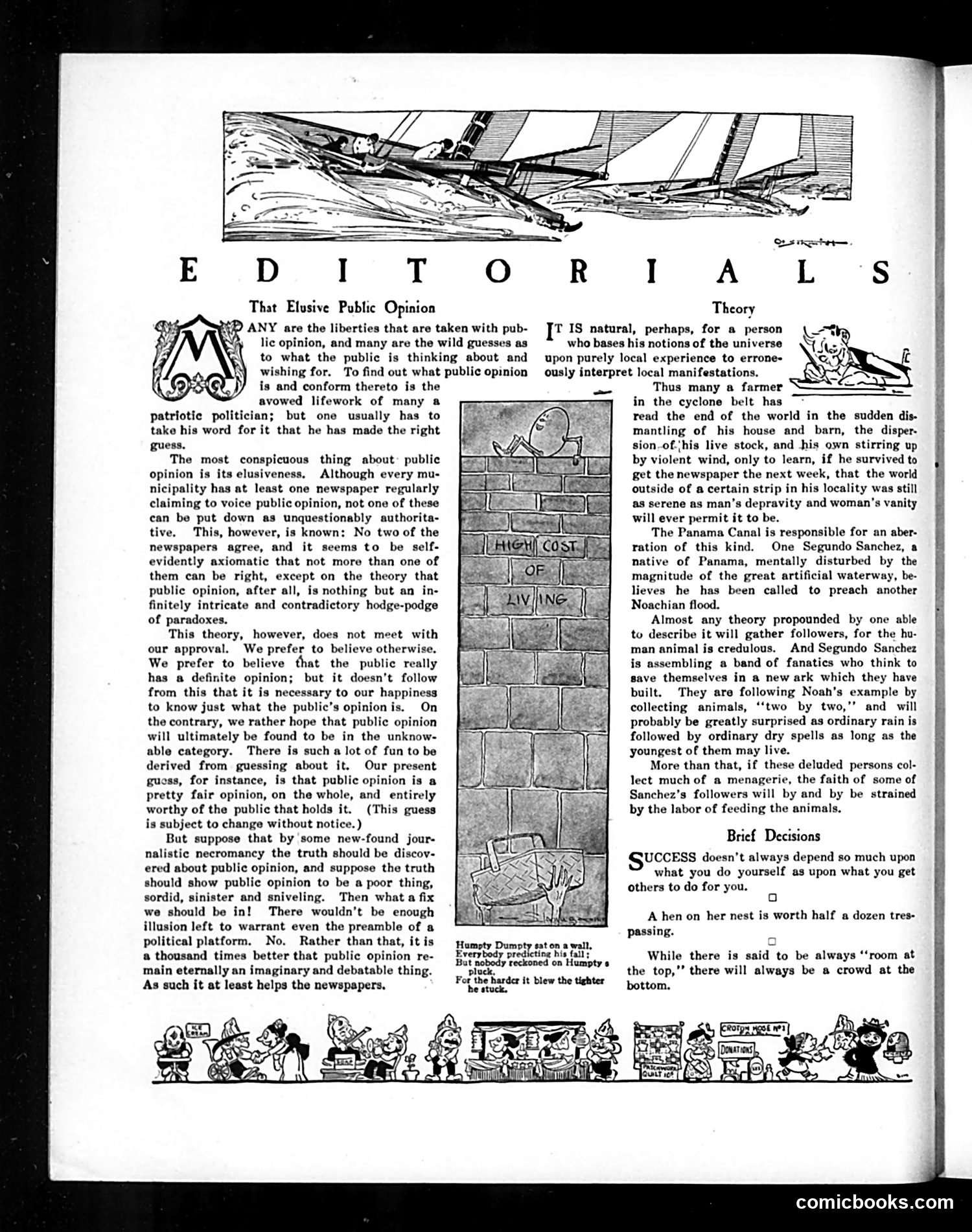
This page presents two distinct pieces: **Left Editorial ("That Elusive Public Opinion"):** A satirical essay arguing that public opinion is contradictory and unreliable. The author mocks politicians who claim to represent public will, suggesting newspapers themselves contribute to this confusion by guessing at what the public actually wants. The piece advocates for newspapers to maintain independent editorial positions rather than chase shifting popular sentiment. **Right Editorial ("Theory") with cartoon:** Mocks people who interpret local disasters as divine messages. The example describes a farmer whose cyclone destroyed his property, yet he preaches it as God's sign—a critique of religious fatalism. The "Humpty Dumpty" illustration shows someone sitting on a wall, caption warning of his impending fall. Both pieces express skepticism toward unexamined beliefs and false certainty.
📄 Transcribed text from this page (OCR, searchable)
Machine-transcribed from the original scan — historical spelling and the odd misread are preserved.
That Elusive Public Opinion » ANY are the liberties that are taken with pub- lic opinion, and many are the wild guesses as to what the public is thinking about and To find out what public opinion wishing for. is and conform thereto is the avowed lifework of many a patriotic politician; but one usually has to take his word for it that he has made the right guess. The most conspicuous thing about: public opinion is its elusiveness, Although every mu- nicipality has at least one newspaper regularly claiming to voice public opinion, not one of these can be put down as unquestionably authorita- tive. This, however, is known: No two of the newspapers agree, and it seems to be self- evidently axiomatic that not more than one of them can be right, except on the theory that public opinion, after all, is nothing but an in- finitely intricate and contradictory hodge-podge of paradoxes. This theory, however, does not meet with our approval. We prefer to believe otherwise. We prefer to believe that the public really has a definite opinion; but it doesn’t follow from this that it is necessary to our happiness to know just what the public’s opinionis. On the contrary, we rather hope that public opinion will ultimately be found to be in the unknow- able category. There is such a lot of fun to be derived from guessing about it. Our present guess, for instance, is that public opinion is a pretty fair opinion, on the whole, and entirely worthy of the public that holds (This guess is subject to change without notice.) But suppose that by some new-found jour- nalistic necromancy the truth should be discov- ered about public opinion, and suppose the truth should show public opinion to be a poor thing, sordid, sinister and sniveling. Then what a fix we should be in! There wouldn’t be enough illusion left to warrant even the preamble of a political platform. No. Rather than that, it is a thousand times better that public opinion re- main eternally an imaginary and debatable thing. As such it at least helps the newspapers, i. Humpty Dumpty sat on a wall, Everybody predicting his fall ; But y reckoned on Humpty 6 pluck, For the harder it blew the tighter be stuck, Theory [' IS natural, perhaps, for a person who bases his notions of the universe upon purely local experience to errone- ously interpret local manifestations. Thus many a farmer in the cyclone belt has ~ read the end of the world in the sudden dis- mantling of his house and barn, the disper. sion.of.'his live stock, and his own stirring up by violent wind, only to learn, if he survived to get the newspaper the next week, that the world outside of a certain strip in his locality was still as serene as man’s depravity and woman's vanity will ever permit it to be. The Panama Canal is responsible for an aber- ration of this kind. One Segundo Sanchez, a native of Panama, mentally disturbed by the magnitude of the great artificial waterway, be- lieves he has been called to preach another Noachian flood. Almost any theory propounded by one able to describe it will gather followers, for the hu- man animal is credulous. And Segundo Sanchez is assembling a band of fanatics who think to save themselves in a new ark which they have built. They are following Noah’s example by collecting animals, ‘‘two by two,’’ and will probably be greatly surprised as ordinary rain is followed by ordinary dry spells as long as the youngest of them may live. More than that, if t deluded persons col- lect much of a menagerie, the faith of some of Sanchez’s followers will by and by be strained by the labor of feeding the animals. Brief Decisions Success doesn’t always depend so much upon what you do yourself as upon what you get others to do for you. A hen on her nest is worth half a dozen tres- passing. While there is said to be always ‘‘room at the top,’’ there will always be a crowd at the comicbooks.com