
Judge, 1914-01-17 · page 17 of 24
Judge — January 17, 1914 — page 17: what you’re looking at
What you’re looking at
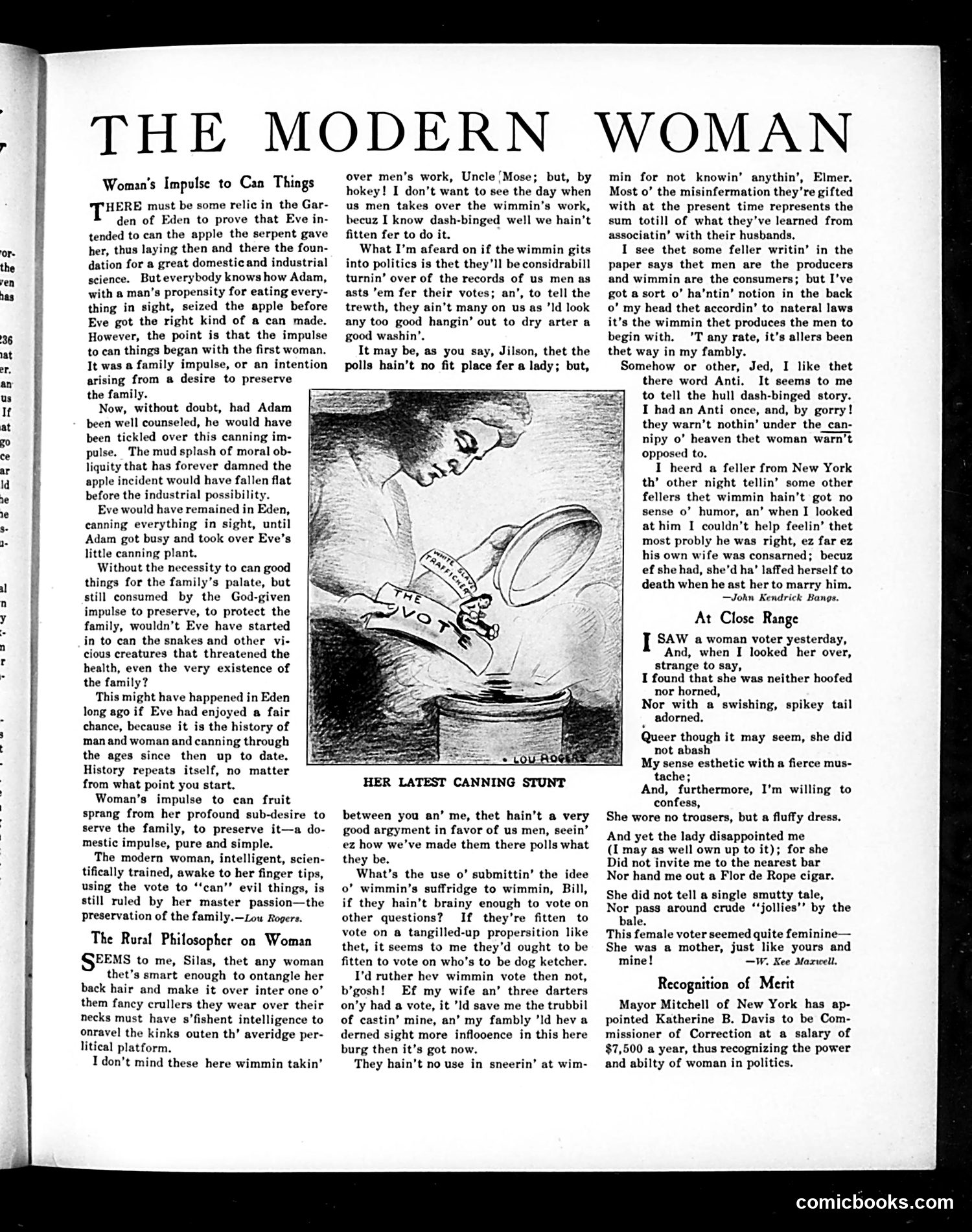
This page satirizes women's expanding role in public life, particularly voting rights. The cartoon "Her Latest Canning Stunt" depicts a woman literally canning/preserving a ballot box—a visual pun suggesting women are extending their domestic "canning" impulse into politics. The accompanying rural dialogue between "Silas" and another farmer presents folksy resistance to women's suffrage. The speakers acknowledge women's intelligence but worry that granting them votes will expose men's corruption ("turnin' over of the records of us men"). One character contradicts himself, first doubting women's fitness to vote, then admitting his wife and daughters voting would increase his family's political influence. The satire cuts both ways: it mocks rural male chauvinism while also portraying women's political engagement as merely an extension of domestic preservation instincts—a backhanded compliment wrapped in condescension. The piece reflects early 20th-century anxieties about women's suffrage.
📄 Transcribed text from this page (OCR, searchable)
Machine-transcribed from the original scan — historical spelling and the odd misread are preserved.
THE MODERN WOMAN Woman's Impulse to Can Things THERE must be some relic in the Gar- den of Eden to prove that Eve in- tended to can the apple the serpent gave her, thus laying then and there the foun- dation for a great domestic and industrial science. But everybody knows how Adam, with a man’s propensity for eating every- thing in sight, seized the apple before Eve got the right kind of a can made. However, the point is that the impulse to can things began with the first woman. It was a family impulse, or an intention arising from a desire to preserve the family. Now, without doubt, had Adam been well counseled, he would have been tickled over this canning im- pulse, The mud splash of moral ob- liquity that has forever damned the apple incident would have fallen flat before the industrial possibility. Eve would have remained in Eden, canning everything in sight, until Adam got busy and took over Eve’s little canning plant. Without the necessity to can good things for the family’s palate, but still consumed by the God-given impulse to preserve, to protect the family, wouldn’t Eve have started in to can the snakes and other vi- cious creatures that threatened the health, even the very existence of the family? This might have happened in Eden long ago if Eve had enjoyed a fair chance, because it is the history of man and woman and canning through the ages since then up to date. over men’s work, Uncle ‘Mose; but, by hokey! I don’t want to see the day when us men takes over the wimmin’s work, becuz I know dash-binged well we hain’t fitten fer to do it. What I’m afeard on if the wimmin gits into politics is thet they’ll be considrabill turnin’ over of the records of us men as asts ’em fer their votes; an’, to tell the trewth, they ain’t many on us as ’Id look any too good hangin’ out to dry arter a good washin’. It may be, as you say, Jilson, thet the polls hain’t no fit place fer a lady; but, History repeats itself, no matter from what point you start. Woman’s impulse to can fruit sprang from her profound sub-desire to serve the family, to preserve it—a do- mestic impulse, pure and simple. The modern woman, intelligent, scien- tifically trained, awake to her finger tips, using the vote to ‘‘can’’ evil things, is still ruled by her master passion—the Preservation of the family.—Lou Rogers. The Rural Philosopher on Woman SEEMs to me, Silas, thet any woman thet’s smart enough to ontangle her back hair and make it over inter one o’ them fancy crullers they wear over their necks must have s’fishent intelligence to onravel the kinks outen th’ averidge per- litical platform, T don’t mind these here wimmin takin’ HER LATEST CANNING STUNT between you an’ me, thet hain’t a very good argyment in favor of us men, seein’ ez how we’ve made them there polls what they be. What's the use 0’ submittin’ the idee o’ wimmin’s suffridge to wimmin, Bill, if they hain’t brainy enough to vote on other questions? If they’re fitten to vote on a tangilled-up propersition like thet, it seems to me they’d ought to be fitten to vote on who’s to be dog ketcher. I'd ruther hey wimmin vote then not, b’gosh! Ef my wife an’ three darters on’y had a vote, it "Id save me the trubbil of ca: ’ mine, an’ my fambly ’Id hev a derned sight more inflooence in this here burg then it’s got now. They hain’t no use in sneerin’ at wim- min for not knowin’ anythin’, Elmer. Most o’ the misinfermation they're gifted with at the present time represents the sum totill of what they’ve learned from associatin’ with their husbands, I see thet some feller writin’ in the paper says thet men are the producers and wimmin are the consumers; but I’ve got a sort o’ ha’ntin’ notion in the back o’ my head thet accordin’ to nateral laws it’s the wimmin thet produces the men to begin with. ’T any rate, it’s allers been thet way in my fambly. Somehow or other, Jed, I like thet there word Anti. It seems to me to tell the hull dash-binged story. I had an Anti once, and, by gorry! they warn’t nothin’ under the can- nipy o’ heaven thet woman warn’t opposed to. I heerd a feller from New York th’ other night tellin’ some other fellers thet wimmin hain’t got no sense 0’ humor, an’ when I looked at him I couldn’t help feelin’ thet most probly he was right, ez far ez his own wife was consarned; becuz ef she had, she'd ha’ laffed herself to death when he ast her to marry him. —John Kendrick Bangs. At Close Range I SAW a woman voter yesterday, And, when I looked her over, strange to say, I found that she was neither hoofed nor horned, Nor with a swishing, spikey tail , adorned. Queer though it may seem, she did not abash My sense esthetic with a fierce mus- tache; And, furthermore, I'm willing to confess, She wore no trousers, but a fluffy dress. And yet the lady disappointed me (I may as well own up to it); for she Did not invite me to the nearest bar Nor hand me out a Flor de Rope cigar. She did not tell a single smutty tale, Nor pass around crude ‘‘jollies’’ by the bale. This female voter seemed quite feminine— She was a mother, just like yours and mine! —W. Kee Maxwell, Recognition of Merit Mayor Mitchell of New York has ap- pointed Katherine B. Davis to be Com- missioner of Correction at a salary of $7,500 a year, thus recognizing the power and abilty of woman in politics. comicbooks.com