
Judge, 1914-01-17 · page 12 of 24
Judge — January 17, 1914 — page 12: what you’re looking at
What you’re looking at
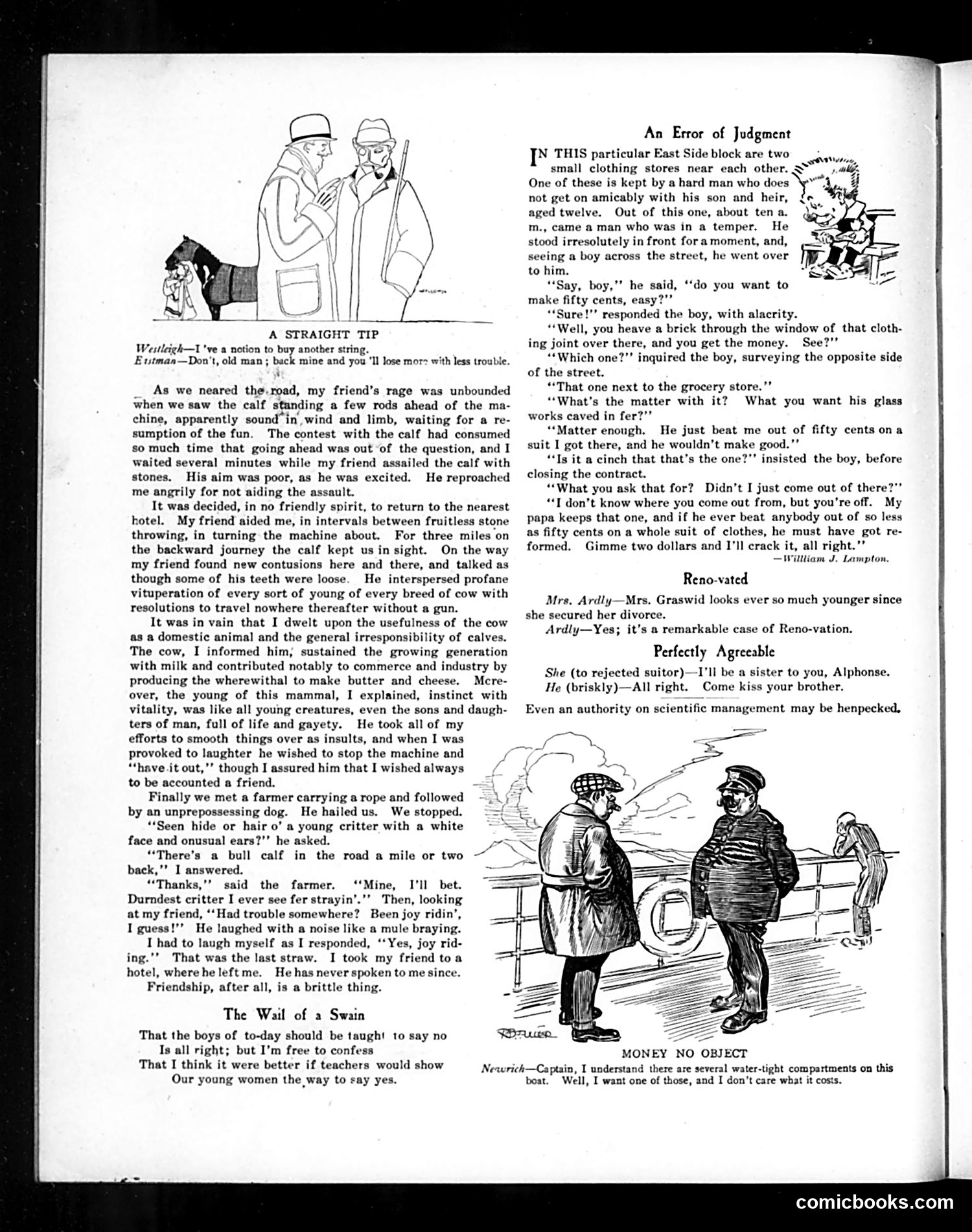
This page contains three distinct humorous pieces satirizing early 1900s American social life: **"A Straight Tip"** mocks automobile culture and male bonding. Two men quarrel after their car hits a calf; one blames the other and refuses to help, turning a minor incident into a friendship-ending feud. The satire targets both the new technology's dangers and masculine pride. **"An Error of Judgment"** depicts an East Side clothing merchant so angry over a business dispute that he bribes a boy to throw a brick through a competitor's window—then is outmaneuvered when the boy shrewdly negotiates for more money and reveals the man's own identity as the likely culprit. It satirizes petty urban merchant rivalry and poor impulse control. **"The Wail of a Swain"** is a brief poem mocking changing social standards: boys are taught to refuse romantic advances, but girls aren't taught to accept them—leaving suitors frustrated. All three pieces use gentle humor to critique contemporary behavior: recklessness, vindictiveness, and social confusion among working and middle-class Americans.
📄 Transcribed text from this page (OCR, searchable)
Machine-transcribed from the original scan — historical spelling and the odd misread are preserved.
A STRAIGHT TIP Westleigh—I "ve a notion to buy another string. Eutman—Don't, old man ; back mine and you ‘Il lose mor? with less trouble. _ As we neared the.road, my friend’s rage was unbounded when we saw the calf standing a few rods ahead of the ma- chine, apparently sound’in,wind and limb, waiting for a re- sumption of the fun. The contest with the calf had consumed so much time that going ahead was out of the question, and I waited several minutes while my friend assailed the calf with stones. His aim was poor, as he was excited. He reproached me angrily for not aiding the assault. It was decided, in no friendly spirit, to return to the nearest hotel. My friend aided me, in intervals between fruitless stone throwing, in turning the machine about. For three miles on the backward journey the calf kept us in sight. On the way my friend found new contusions here and there, and talked as though some of his teeth were loose. He interspersed profane vituperation of every sort of young of every breed of cow with resolutions to travel nowhere thereafter without a gun. It was in vain that I dwelt upon the usefulness of the cow as a domestic animal and the general irresponsibility of calves. The cow, I informed him, sustained the growing generation with milk and contributed notably to commerce and industry by producing the wherewithal to make butter and cheese. Mcre- over, the young of this mammal, I explained, instinct with vitality, was like all young creatures, even the sons and daugh- ters of man, full of life and gayety. He took all of my efforts to smooth things over as insults, and when I was provoked to laughter he wished to stop the machine and “thave.it out,’’ though I assured him that I wished always to be accounted a friend. Finally we met a farmer carrying a rope and followed by an unprepossessing dog. He hailed us. We stopped. “Seen hide or hair o’ a young critter with a white face and onusual ears?’’ he asked. “There’s a bull calf in the road a mile or two back,’’ I answered. “Thanks,’’ said the farmer. ‘‘Mine, I'll bet. Durndest critter I ever see fer strayin’.’’ Then, looking at my friend, ‘‘Had trouble somewhere? Been joy ridin’, I guess!’’ He laughed with a noise like a mule braying. I had to laugh myself as I responded, ‘*Yes, joy rid- ing.’’ That was the last straw. I took my friend toa hotel, where he leftme. He has never spoken to me since. Friendship, after all, is a brittle thing. The Wail of a Swain That the boys of to-day should be taught! to say no Is all right; but I’m free to confess That I think it were better if teachers would show Our young women the way to say yes. An Error of Judgment IX THIS particular East Side block are two ‘ “0 he SS small clothing stores near each other. =~ One of these is kept by a hard man who does Yy not get on amicably with his son and heir, aged twelve. Out of this one, about ten a. m., came a man who was in a temper. He stood irresolutely in front fora moment, and, seeing a boy across the street, he went over to him. “Say, boy,’ he said make fifty cents, easy “Sure!” responded the boy, with alacrity. “Well, you heave a brick through the window of that cloth- ing joint over there, and you get the money. See?’’ ‘‘Which one?”’ inquired the boy, surveying the opposite side of the street. “That one next to the grocery store.’’ “‘What’s the matter with it? What you want his glass works caved in fer?"’ “Matter enough. He just beat me out of fifty cents ona suit I got there, and he wouldn't make good.’’ “Is it a cinch that that’s the one?”’ insisted the boy, before closing the contract. ‘‘What you ask that for? Didn’t I just come out of there?"’ “I don’t know where you come out from, but you're off. My papa keeps that one, and if he ever beat anybody out of so less as fifty cents on a whole suit of clothes, he must have got re- formed. Gimme two dollars and I'll crack it, all right.’ —Willliam J. Lan leg. gZ “do you want to Reno-vated Mrs. Ardly—Mrs. Graswid looks ever so much younger since she secured her divorce. Ardly—Yes; it’s a remarkable case of Reno-vation. Perfectly Agrecable She (to rejected suitor)—I'll be a sister to you, Alphonse. He (briskly)—All right. Come kiss your brother. Even an authority on scientific management may be henpecked, Newrich—Captain, I understand there are several water-tight compartments on this boat. Well, I want one of those, and I don't care what it costs. comicbooks.com