
A complete issue · 24 pages · 1913
Judge — August 30, 1913
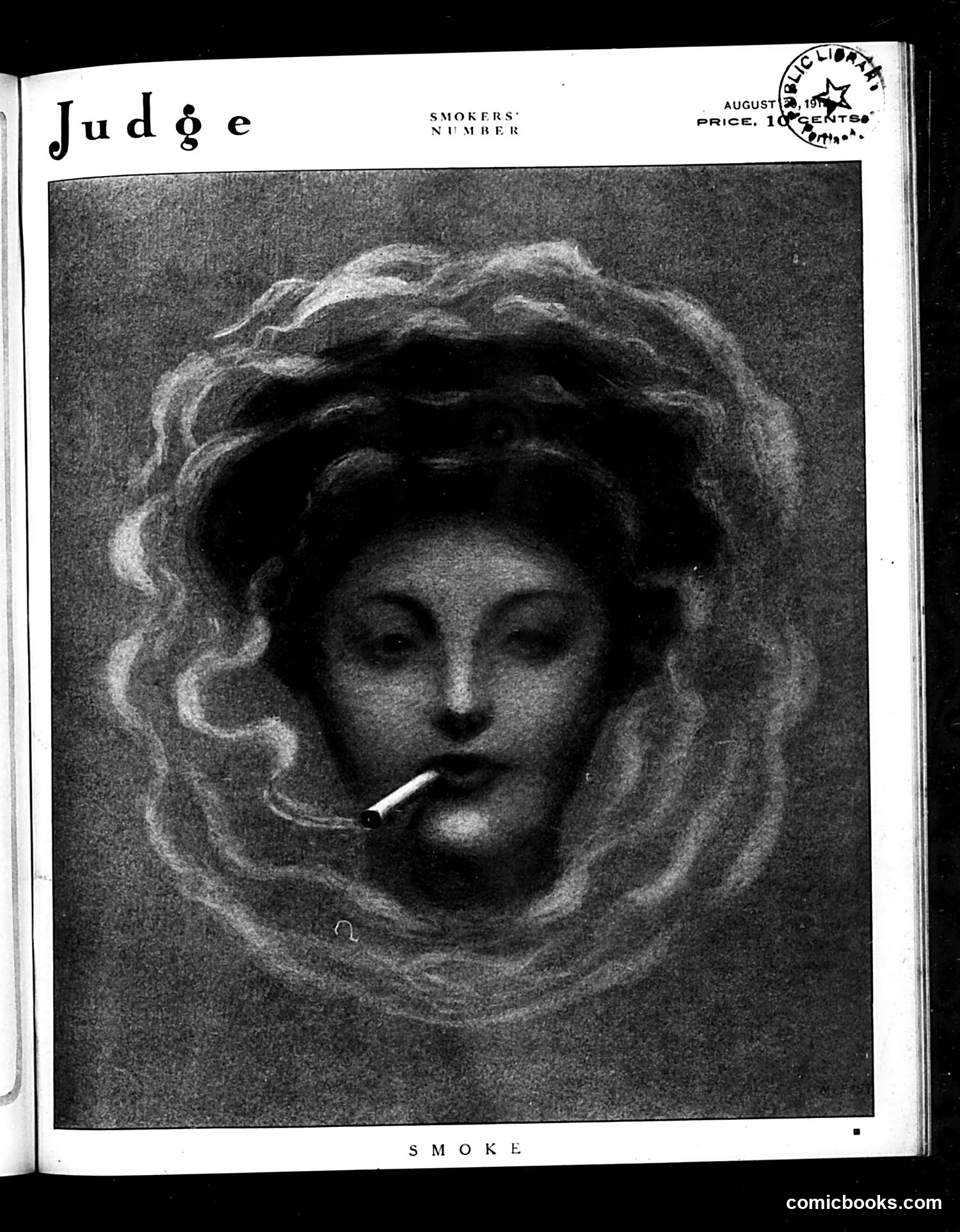
This page from *Judge* magazine (dated August, price 10 cents) features an illustration titled "Smoke" showing a woman's face emerging from cigarette smoke, with a cigarette in her mouth. The cartoon appears to be social commentary on women smoking—a controversial behavior in the early 20th century. The artistic rendering, with the woman's face ethereal and dissolving into smoke, likely satirizes anxieties about female smoking as a sign of moral decay or loss of feminine propriety. The title "Smoke" and the visual metaphor suggest the practice was seen as insubstantial, dangerous, or morally corrosive. This reflects broader early-1900s debates about changing women's social roles and behaviors, which *Judge*—a satirical magazine—would have addressed through mockery or social critique.
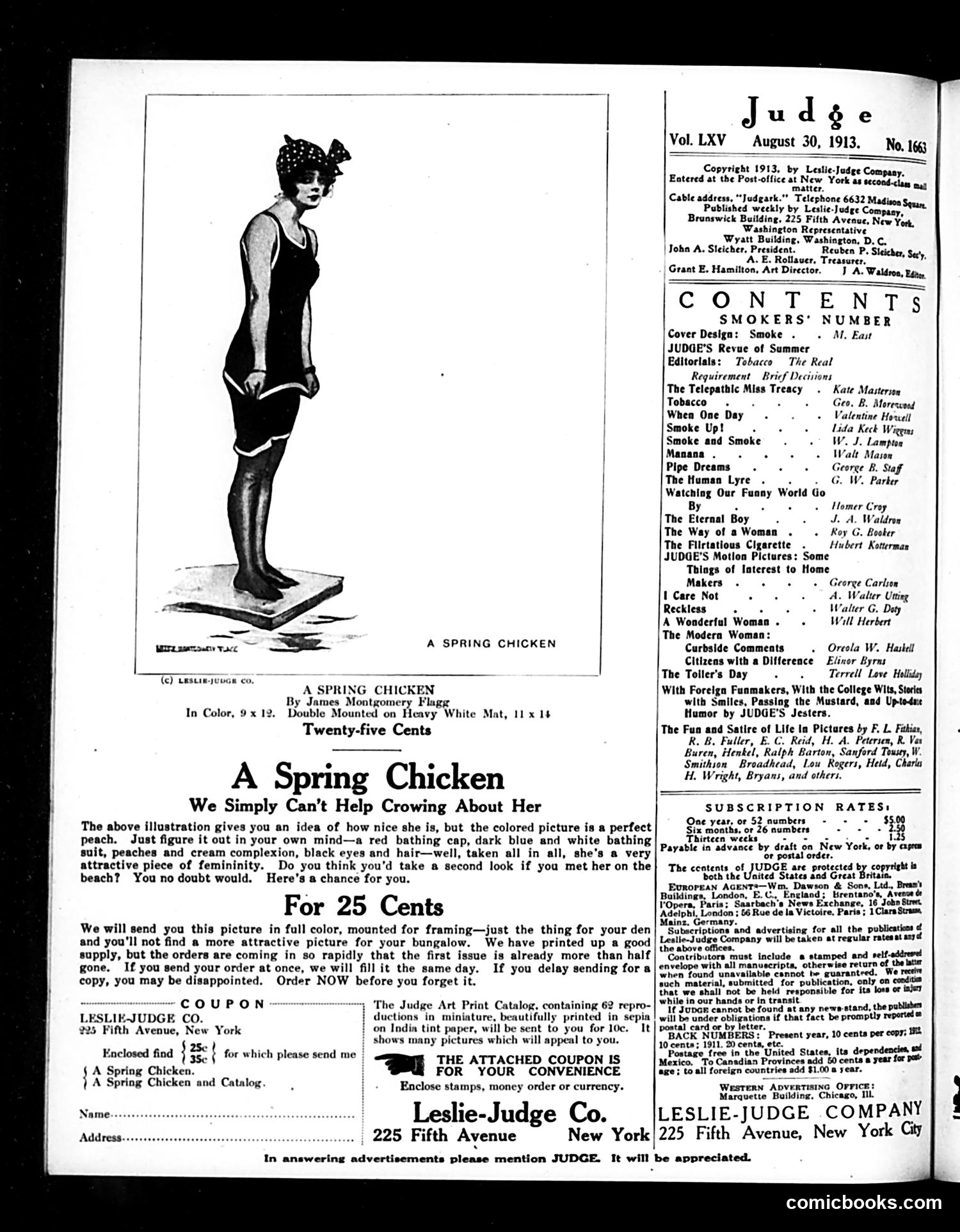
This page is primarily **advertising rather than political satire**. The main content promotes a colored illustration titled "A Spring Chicken" by James Montgomery Flagg, offered for 25 cents by Leslie-Judge Company. The illustration depicts a young woman in a bathing suit, styled to appeal to male readers of the era. The accompanying text uses the phrase "spring chicken"—a period expression meaning an attractive young woman—as a marketing hook, inviting readers to imagine the colored version and order it for their homes. The page demonstrates how early 20th-century magazines blended editorial content with advertising, using pin-up style artwork to drive subscriptions and merchandise sales. There is no apparent political or social satire here.
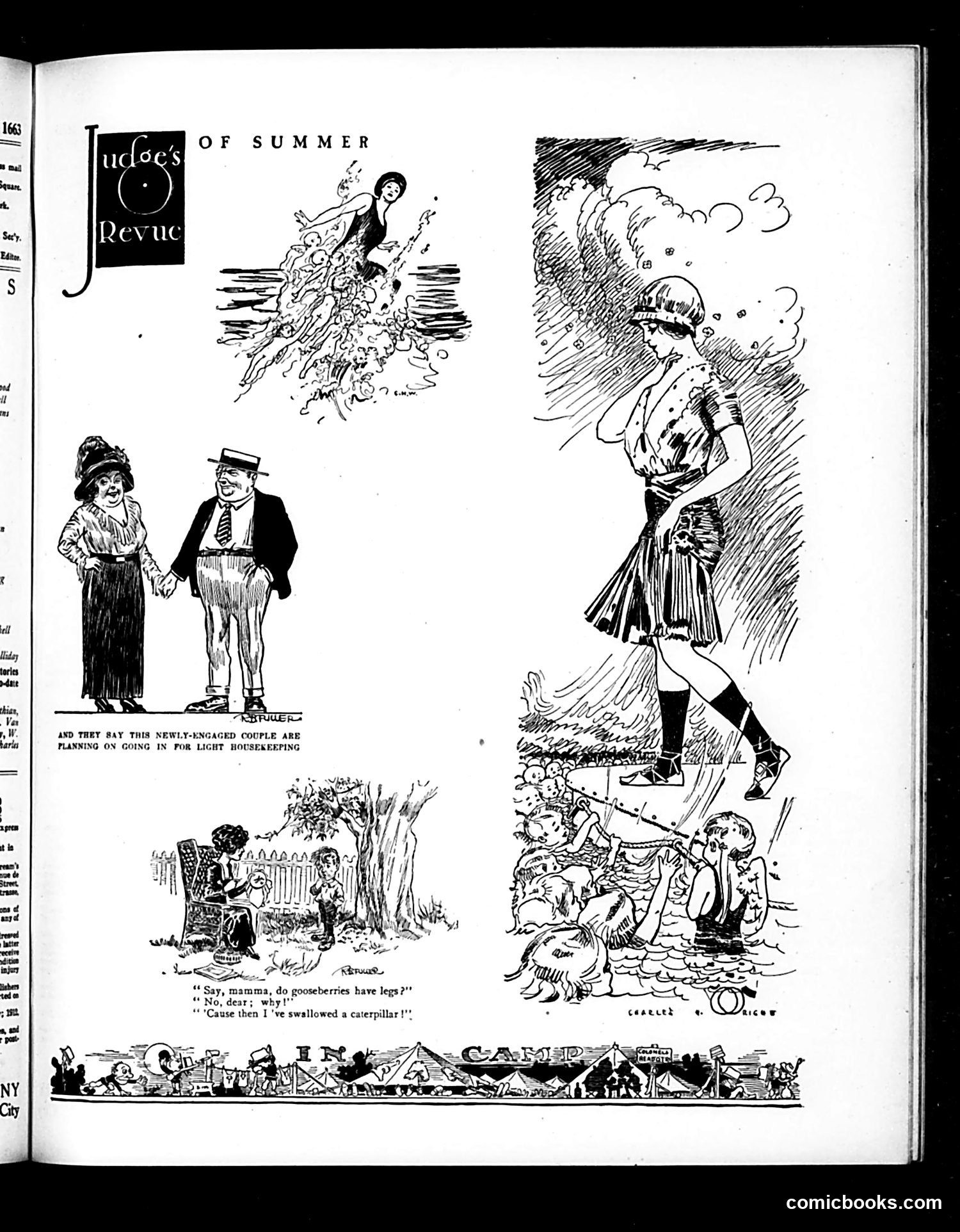
This page from *Judge* magazine features summer-themed satirical illustrations and humor. The top section shows a couple planning "light housekeeping," suggesting newlyweds considering domestic arrangements. The middle cartoon depicts children's wordplay: a mother asks if "gooseberries have legs," a child responds "no, dear, why?", then admits "cause then I've swallowed a caterpillar!" — standard children's joke humor. The right panel shows what appears to be a seaside or camping scene with children engaged in summer activities, with an adult figure supervising. The bottom features an "IN CAMP" banner suggesting vacation or recreational settings. The overall page celebrates summer leisure activities and family moments with gentle humor aimed at middle-class readers, typical of *Judge's* satirical but family-friendly editorial content.
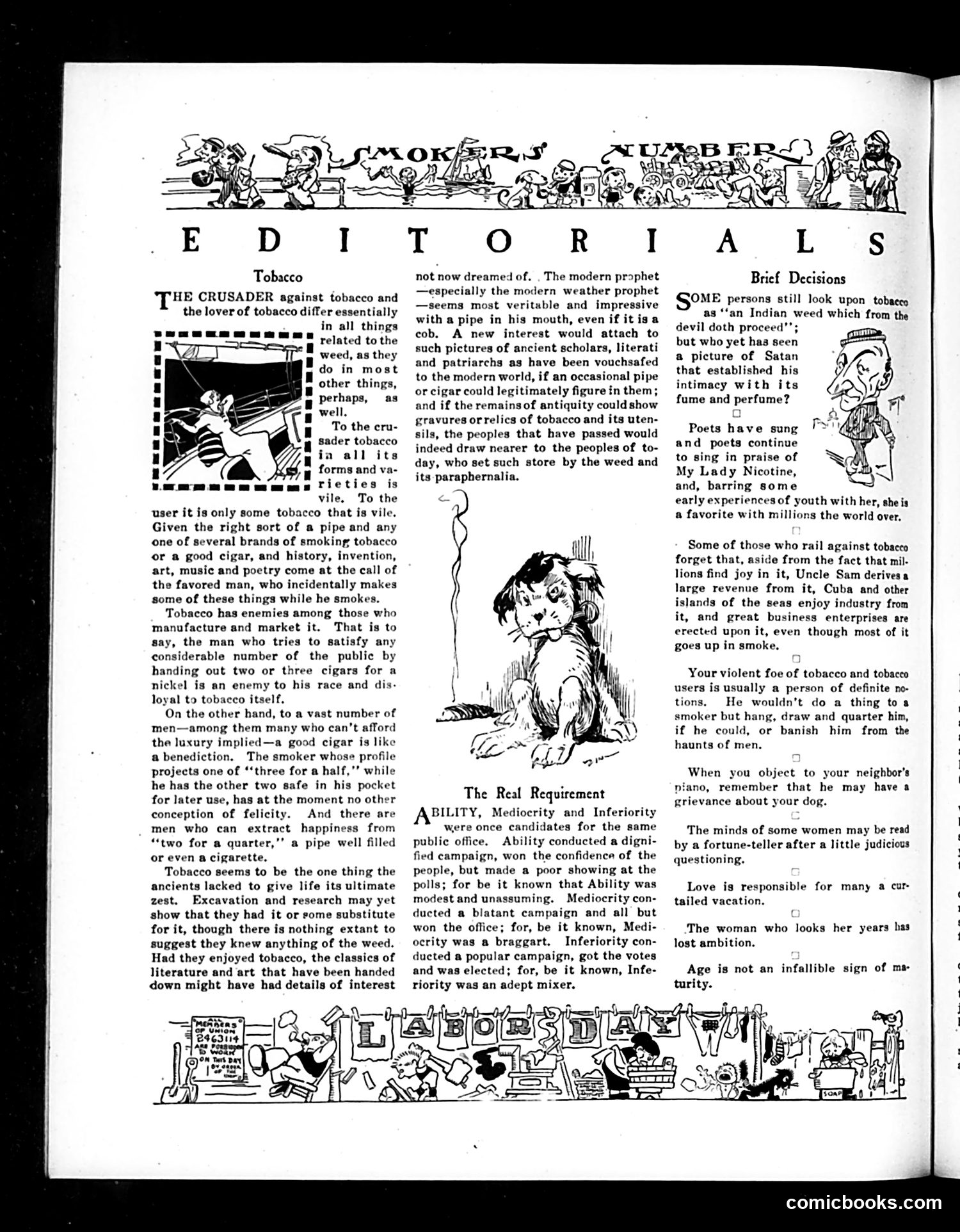
This page contains satirical commentary on tobacco use, a major social debate of the early 20th century. **"Tobacco" (left column):** A lengthy editorial argues that tobacco's critics exaggerate its harms while ignoring its cultural contributions to art, music, and poetry. The piece sarcastically notes tobacco "manufactures and markets itself" through devoted users, and dismisses critics as hypocritical—particularly those profiting from tobacco (like Cuba) while condemning it. **"Brief Decisions" and "The Real Requirement" (right side):** These short satirical quips mock anti-tobacco advocates and social pretension. One suggests objecting to a neighbor's piano is valid if you dislike their dog—implying inconsistent moral positions. Another mocks candidates winning office through mediocrity rather than ability. The cartoons use humor to defend tobacco against growing prohibitionist sentiment while simultaneously critiquing broader social hypocrisy and political incompetence.
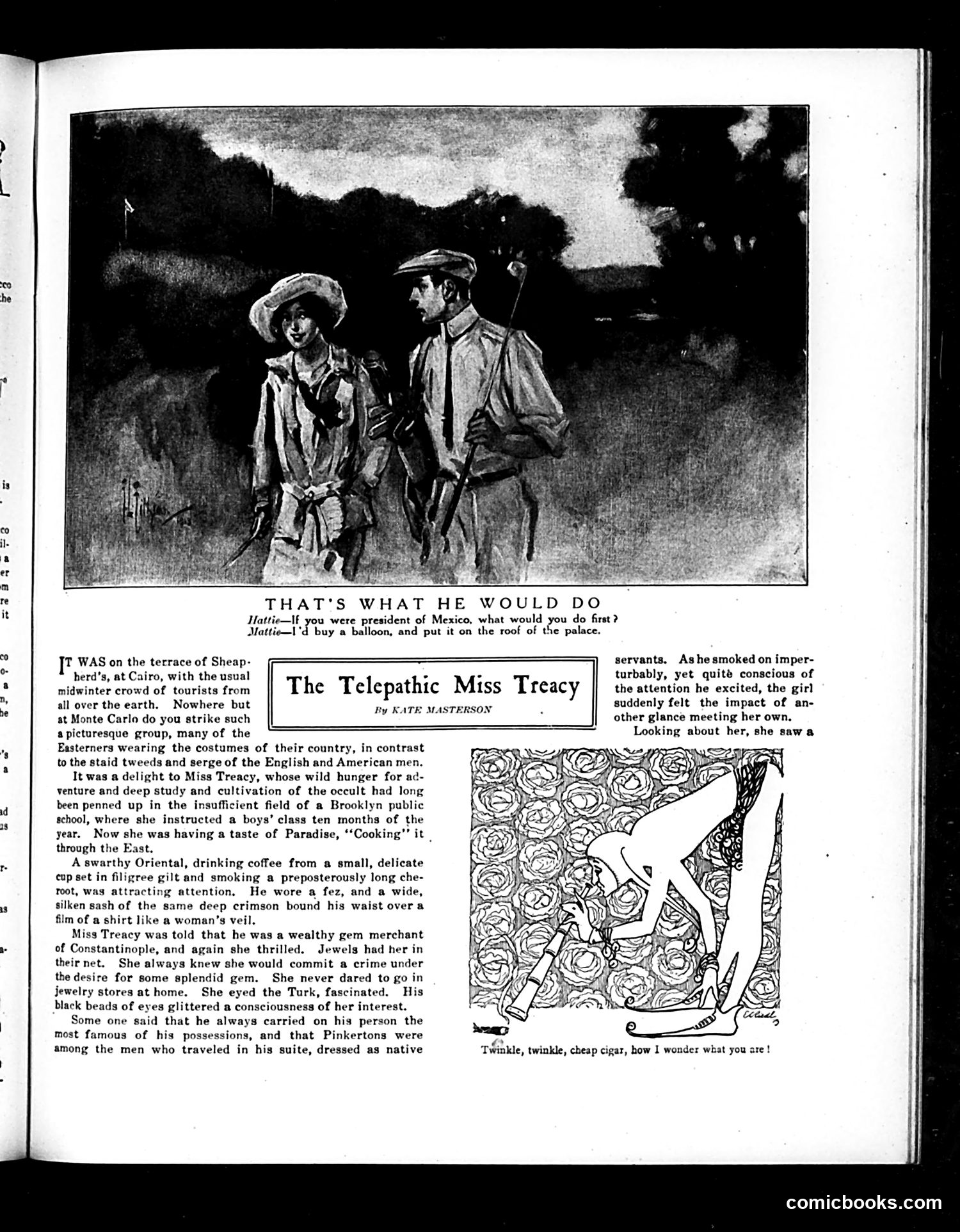
**Top Cartoon "That's What He Would Do":** This political cartoon depicts two figures in conversation. One asks the other: "If you were president of Mexico, what would you do first?" The response—"I'd buy a balloon, and put it on the roof of the palace"—appears to be satirizing Mexican leadership as frivolous or incompetent. This likely references early 20th-century instability in Mexico during its revolutionary period, mocking Mexican political figures as unprepared or absurd leaders. **"The Telepathic Miss Tracay" Story:** Below is the beginning of a serialized fiction story by Kate Masterson about a woman with occult abilities traveling in Cairo. The accompanying illustration shows her in an ornate interior, suggesting an exotic adventure narrative typical of Judge's entertainment content. The page blends political satire with popular fiction.
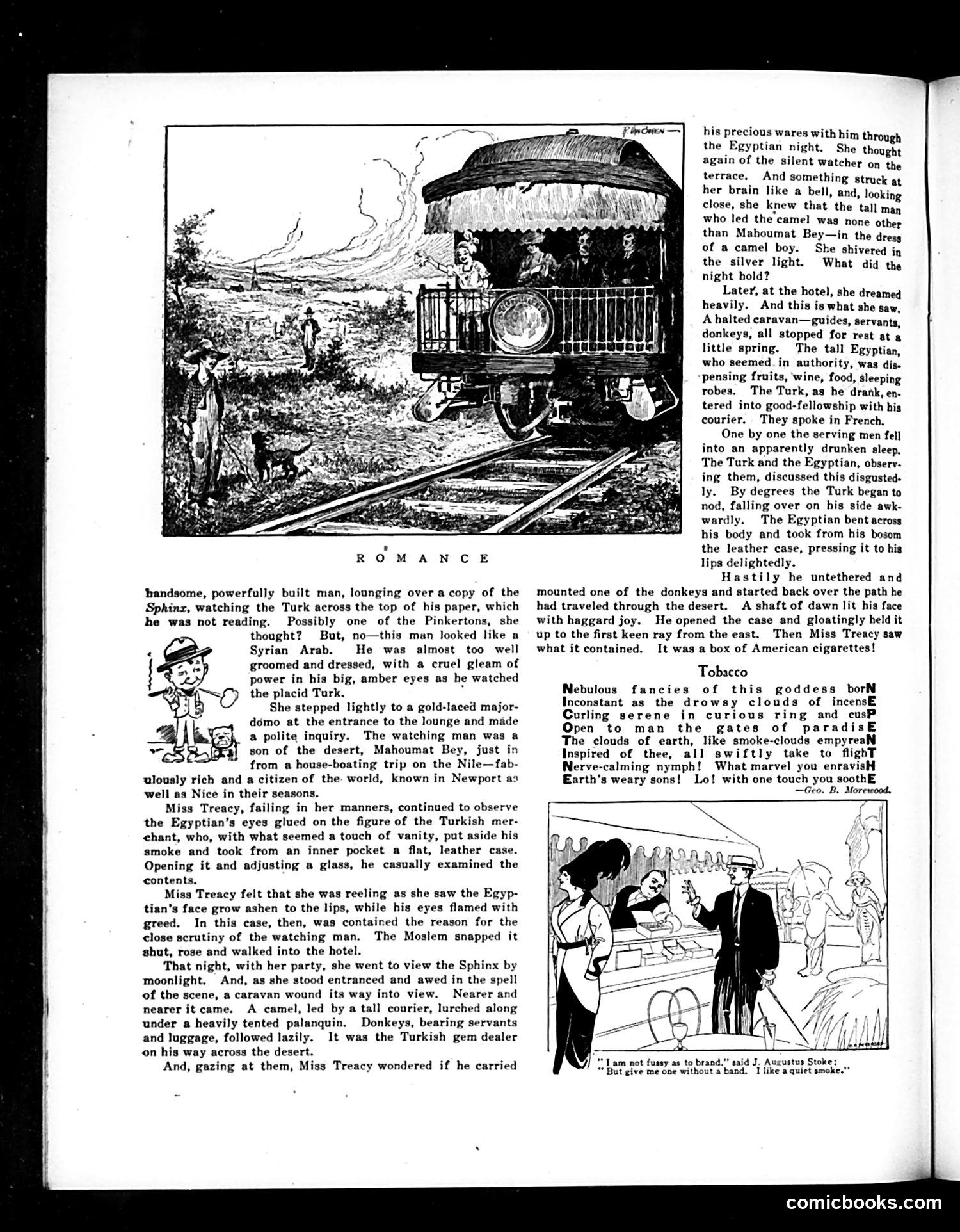
This page contains a serialized romance story with social satire centered on **American cigarettes as a luxury commodity**. The narrative follows Miss Treacy observing wealthy international travelers at an Egyptian hotel. She witnesses an Egyptian gentleman (Mahoumat Bey) coveting a leather case belonging to a Turkish gem dealer, suspecting it contains valuable jewels. The dramatic climax reveals the "precious" contents: **American cigarettes**. The satire mocks the absurdity of positioning American cigarettes as an exotic, globally-desired luxury item—so desirable that it rivals precious gems. This likely reflects early 20th-century American commercial aspiration and cigarette marketing's glamorization of smoking. The accompanying poem "Tobacco" romanticizes cigarettes as a "nerve-calming nymph," reinforcing the advertising message. The bottom illustration (partially visible) appears to depict a social scene, though its specific connection is unclear. This represents Judge magazine's blend of fiction, advertising, and gentle mockery of consumer culture and international pretension.
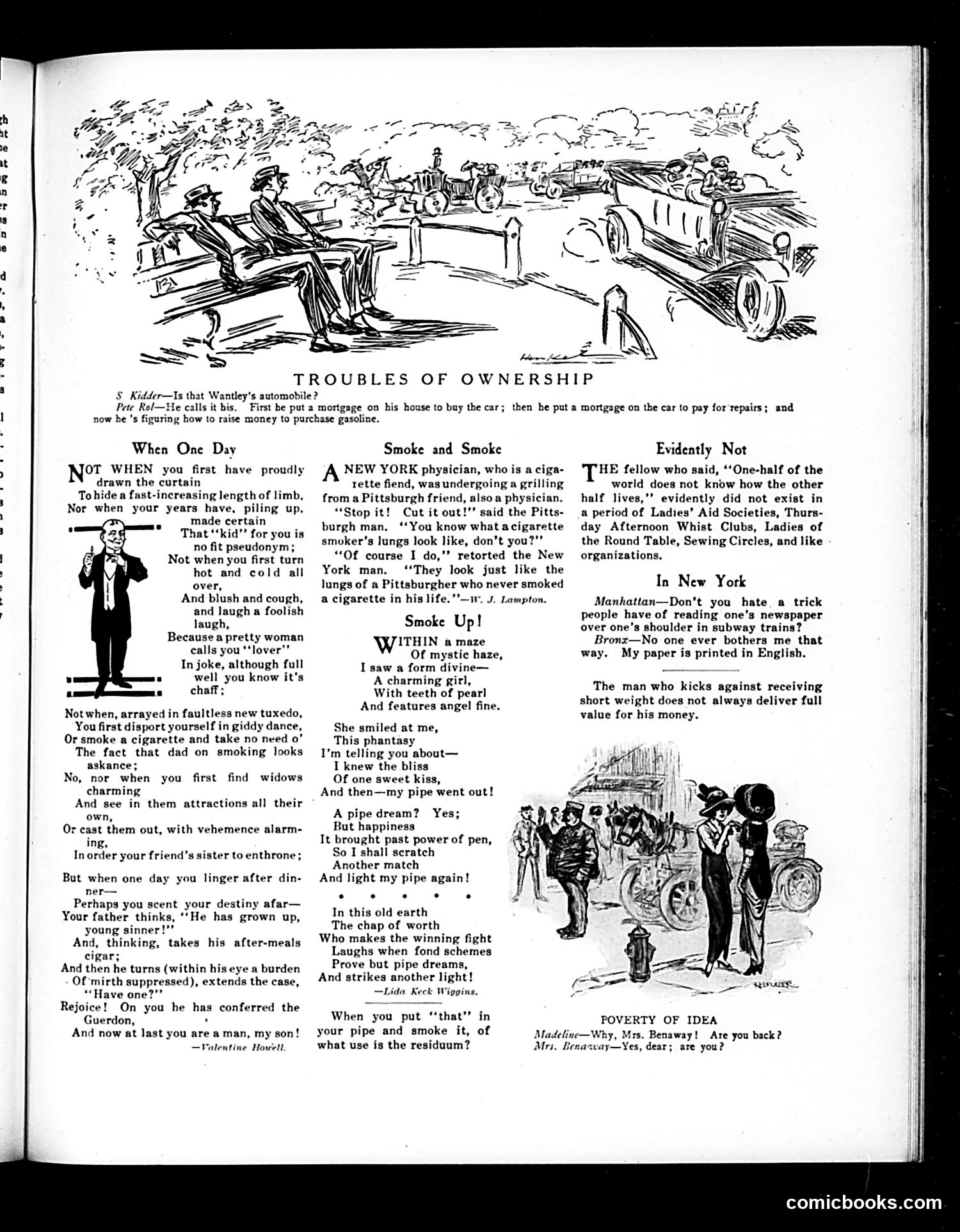
This page satirizes early 20th-century American automobile culture and masculine coming-of-age rituals. **Top cartoon**: Mocks the financial trap of car ownership. A man named Wantley buys an automobile, then must mortgage his house to pay for it, then mortgage the car itself for repairs—an escalating debt cycle that leaves him unable to afford gasoline. **"When One Day"**: A sentimental poem about manhood, climaxing when a father offers his son an after-dinner cigar—the ultimate mark of adulthood. The satire targets this ritualistic masculinity. **Smoking jokes**: Three pieces riff on cigarettes and pipes. A New York physician defends cigarettes by claiming Pittsburgh smokers have equally damaged lungs anyway. A romantic fantasy ends when the narrator's pipe goes out mid-kiss. The final quip plays on the phrase "put that in your pipe and smoke it." **"In New York"**: Mild social commentary about subway etiquette and newspaper reading. The overall theme: satirizing consumerism, masculine pretension, and the absurdities of modern urban life in the early 1900s.
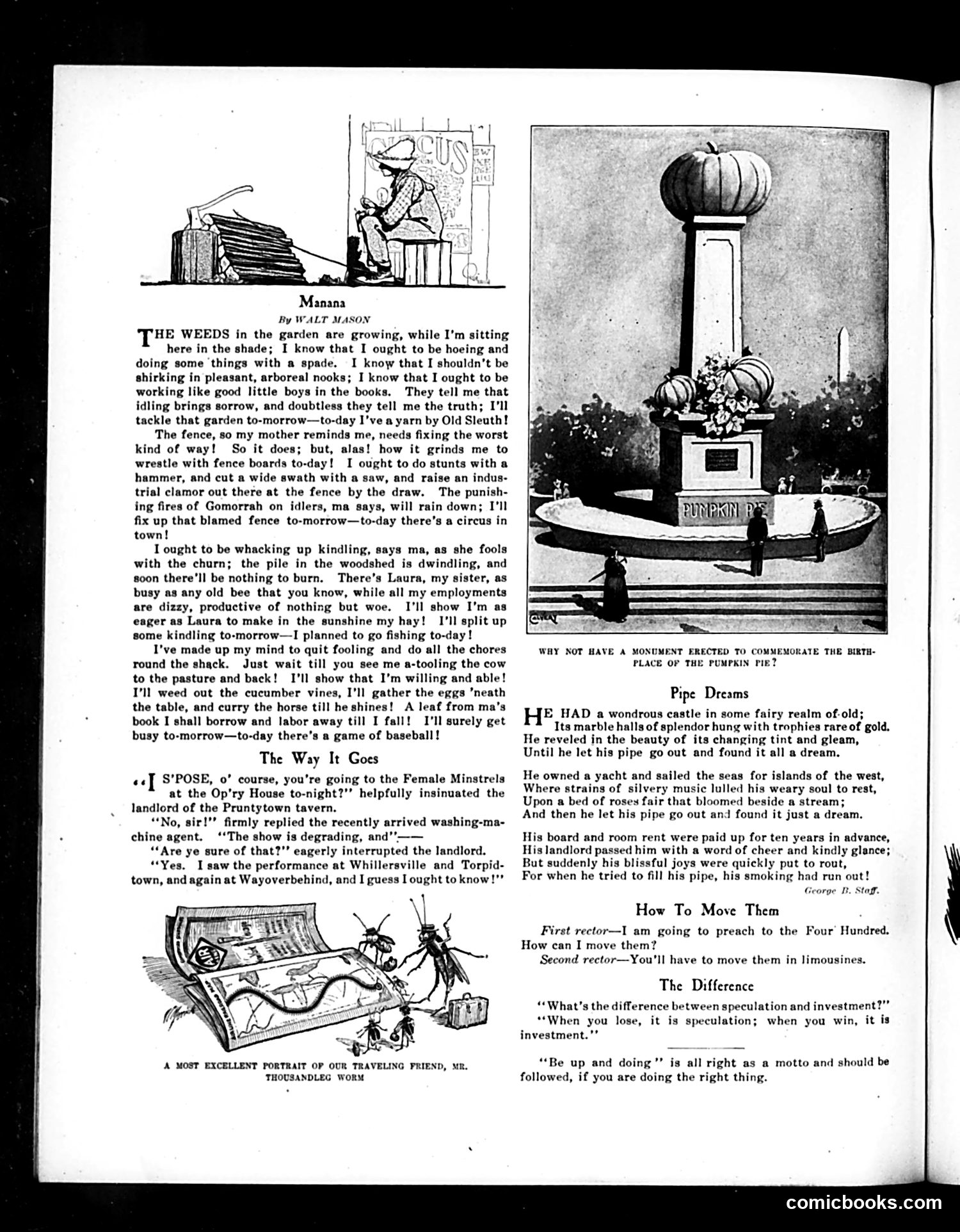
This page contains several humorous pieces typical of early 20th-century American satirical magazines: **"Manana" by Walt Mason** is a comic poem about procrastination. The narrator lists chores he should do today—hoeing weeds, fixing fences, gathering kindling—but repeatedly postpones them for tomorrow, distracted by pleasures like reading detective stories or attending a baseball game. It satirizes the human tendency to delay work, playing on the Spanish word "mañana" (tomorrow). **"Pipe Dreams"** is a brief poem about a man who loses his wealth and comfort when his pipe tobacco runs out—suggesting his prosperity was illusory, dependent on a simple pleasure. The remaining items are brief jokes: "The Way It Goes" pokes fun at a traveling washing-machine salesman's moral objections to female minstrel shows; "How To Move Them" is a rector joke about moving congregations via limousines; and "The Difference" plays on speculation versus investment terminology. The page reflects common Judge humor: gentle mockery of human weakness, small-town life, and contemporary concerns.
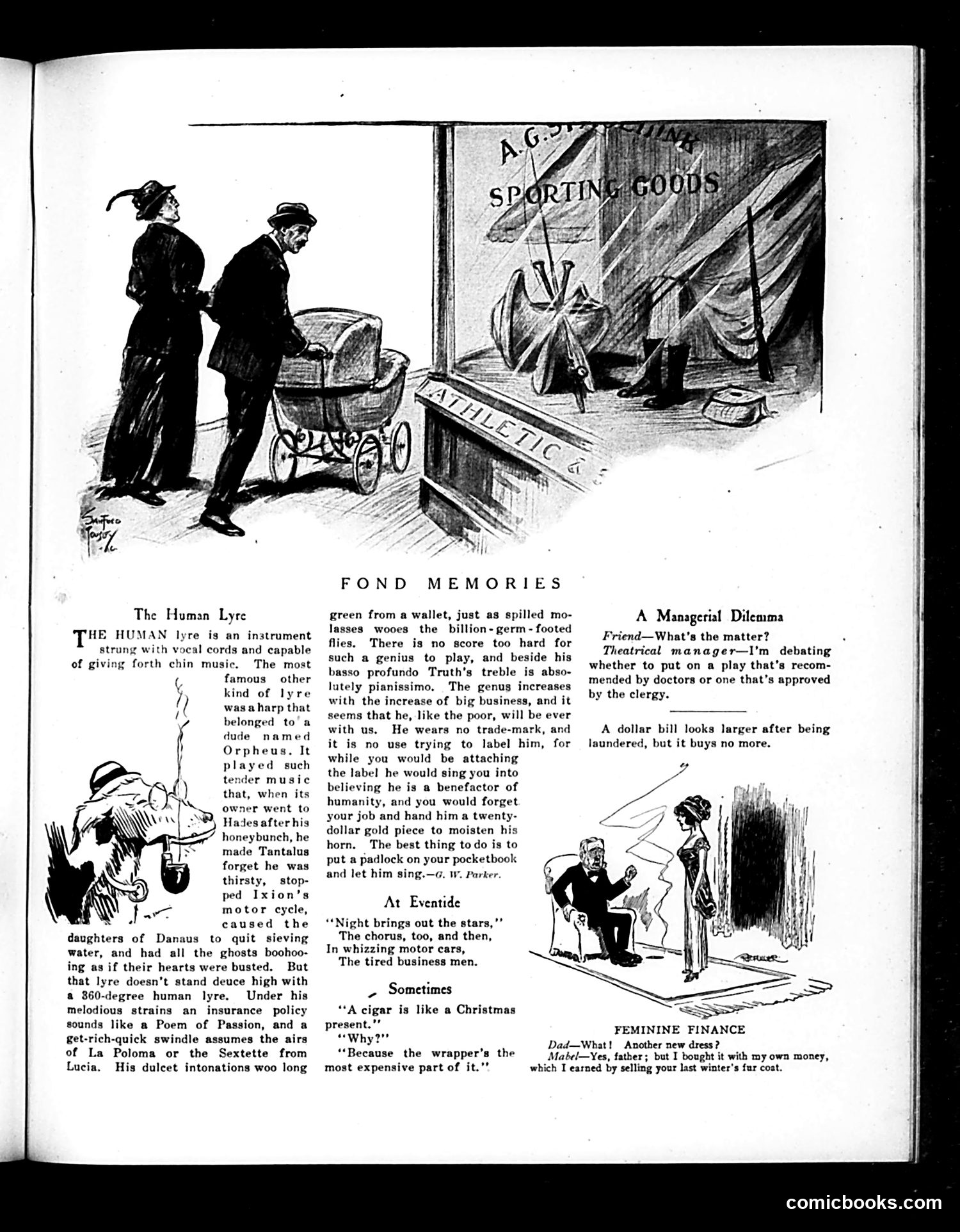
This page contains several short humorous pieces satirizing early 20th-century American life. **"The Human Lyre"** compares smooth-talking con artists to the mythological musician Orpheus. The satire suggests that charismatic swindlers use persuasive speech ("the human lyre") to manipulate people into handing over money through insurance schemes and get-rich-quick scams. The advice to "put a padlock on your pocketbook" warns readers against such con men. **"At Eventide"** humorously depicts tired businessmen escaping the city in motor cars at night—a jab at both the new automobile culture and urban work exhaustion. **"A Managerial Dilemma"** jokes about a theatrical manager unable to decide whether to stage a play endorsed by doctors or clergy, satirizing how entertainment competed for different audiences' moral approval. **"Feminine Finance"** presents a domestic scene where a daughter defends her new dress purchase by claiming she earned the money independently—likely satirizing both women's limited financial autonomy and fashionable excess.
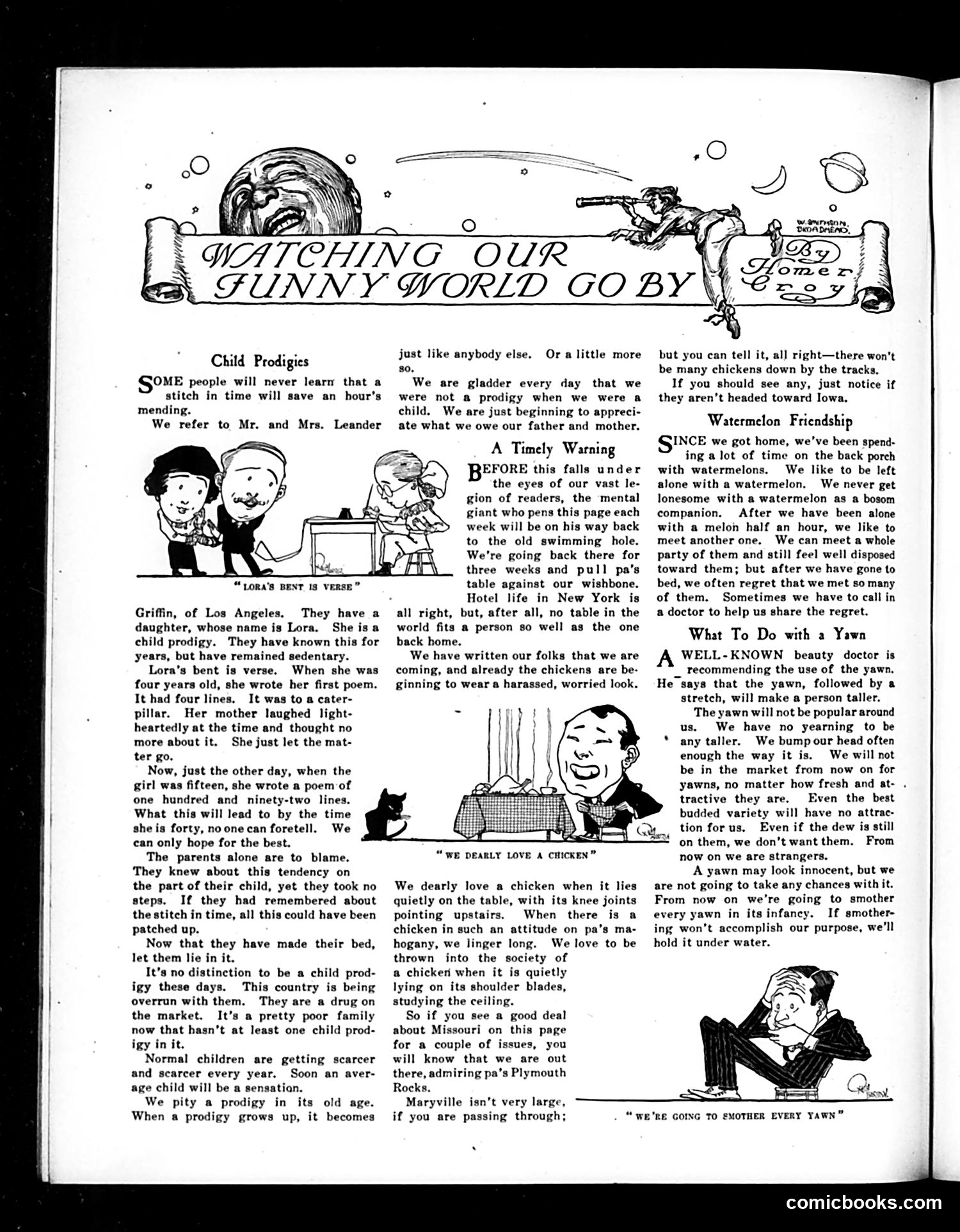
This *Judge* magazine page satirizes American excess and parental neglect through humor. The main cartoon mocks the "child prodigy" phenomenon—parents of a girl named Lora who writes poetry but do nothing to discourage or channel her talent, then act surprised when she's still writing at fifteen. The satire's point: prodigies are now so common they're worthless ("a drug on the market"), and parents who ignore warning signs are foolish. The remaining columns use exaggerated rural nostalgia—the author leaving New York to visit his Missouri hometown (Maryville), obsess over eating chickens and watermelons, and worry about yawning making him taller. The humor mocks both middle-class pretension and small-town simplicity, typical of *Judge's* satirical tone during this era.
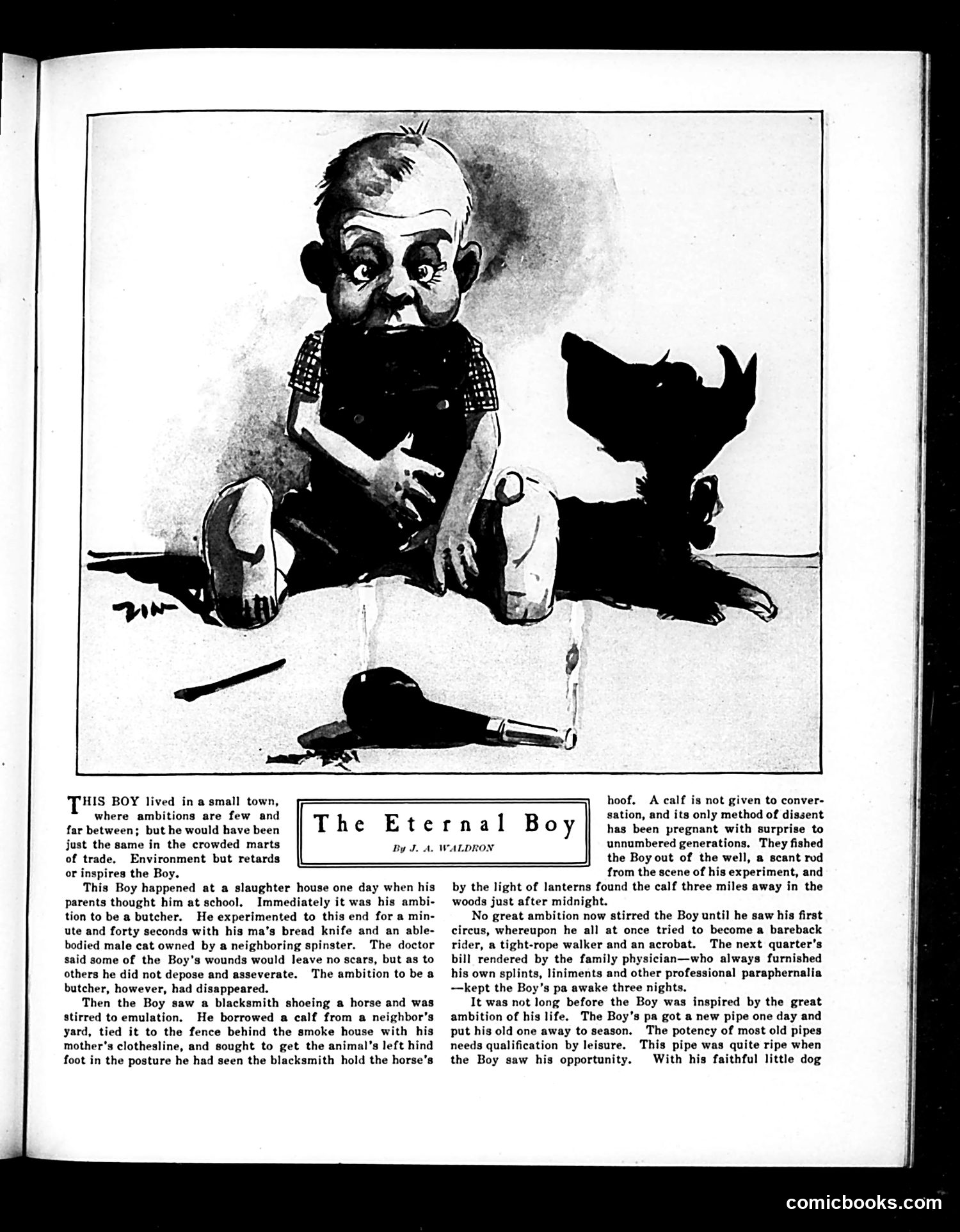
This is a humorous story-cartoon about a mischievous boy whose impulsive ambitions lead to disaster. The illustration shows the boy with a calf and dog, referencing his ill-fated attempt to imitate a blacksmith. The narrative describes a recurring pattern: the boy witnesses an adult profession (butcher, blacksmith, circus performer) and immediately tries to replicate it with dangerous results—injuring himself and others' animals. Each failed experiment costs his father money in doctor bills. The satire targets not the boy, but adults' assumption that environment shapes character. The story argues instead that certain boys are simply "eternal"—inherently reckless and ambitious regardless of circumstances. The humor lies in the escalating chaos: from attacking a cat, to torturing a borrowed calf, to attempting acrobatics, culminating in his father's old pipe becoming the next temptation. The joke is essentially about the universal, unchangeable nature of boyish mischief.
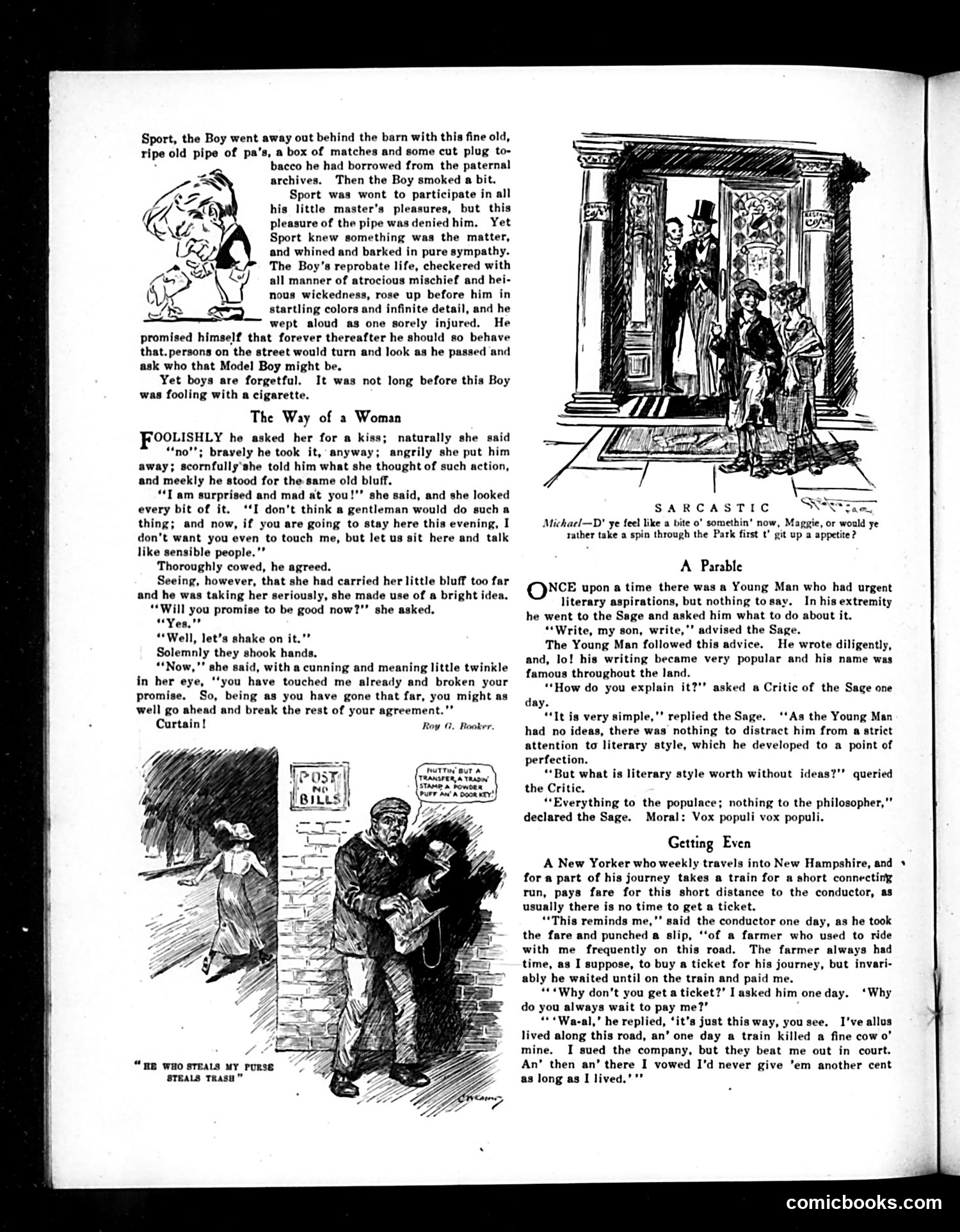
This page contains three humorous pieces typical of early 20th-century American satire: **"Sport, the Boy"** (top left): A morality tale where a boy smokes his father's pipe behind the barn, experiences guilt and remorse, promises reform—then promptly forgets and smokes a cigarette instead. The satire mocks youthful hypocrisy and the fleeting nature of childhood resolutions. **"The Way of a Woman"** (center): A battle-of-wits romance sketch where a woman rejects a man's unwanted kiss, then punishes him with an ultimatum not to touch her—only to use a "cunning" reversal to seduce him into breaking his own promise. The joke satirizes feminine manipulation and the performative nature of courtship etiquette. **"A Parable"** (right): An ironic tale where a Young Man becomes famous despite having "no ideas," succeeding purely through stylistic perfection. The Sage declares style matters to common people while philosophers value substance—satirizing lowbrow taste and the disconnect between popularity and actual merit. All three pieces mock human nature: inconsistency, romantic games, and the public's preference for form over content.
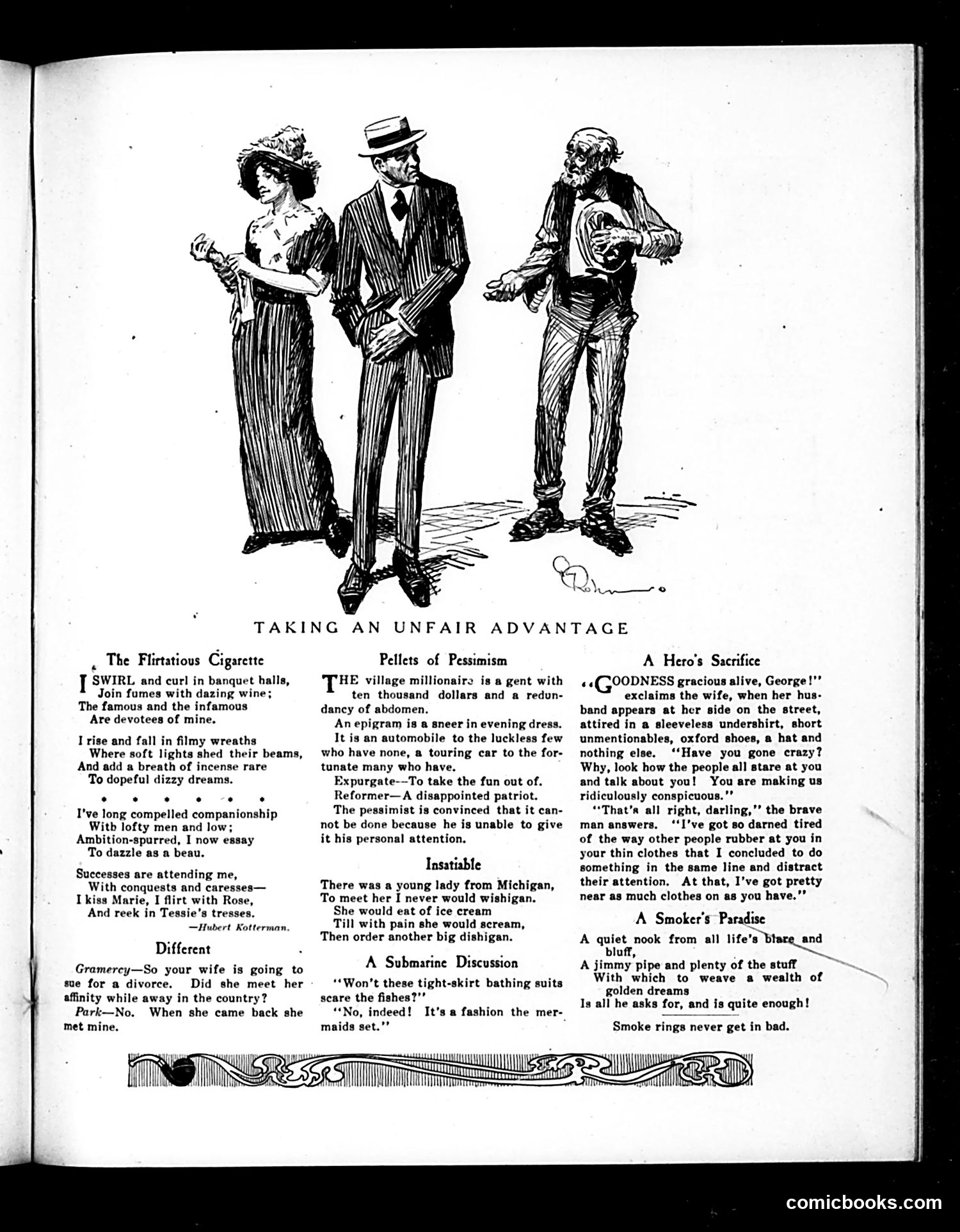
This page from *Judge* magazine contains multiple satirical pieces mocking early 20th-century social conventions and gender relations. **Main Cartoon**: Three figures illustrate "Taking an Unfair Advantage"—a woman, a man in a suit and hat, and another man. The title suggests commentary on social manipulation, likely depicting how cigarettes (personified in the left poem) were used as social props to gain romantic or social advantage. **The Poems**: "The Flirtatious Cigarette" personifies smoking as a seductive force used to win over "Marie," "Rose," and "Tessie," satirizing how cigarettes functioned as social lubricants in courtship. The other verses mock various social types—the pessimistic millionaire, the insatiable woman from Michigan, fashionable bathing suits, and a man who exposes himself to distract attention from his wife's revealing clothes. **The Jokes**: These mock contemporary social anxieties: divorce, consumerism, women's fashion, and changing gender dynamics—all suggesting that modern conveniences and fashion were destabilizing traditional social order.
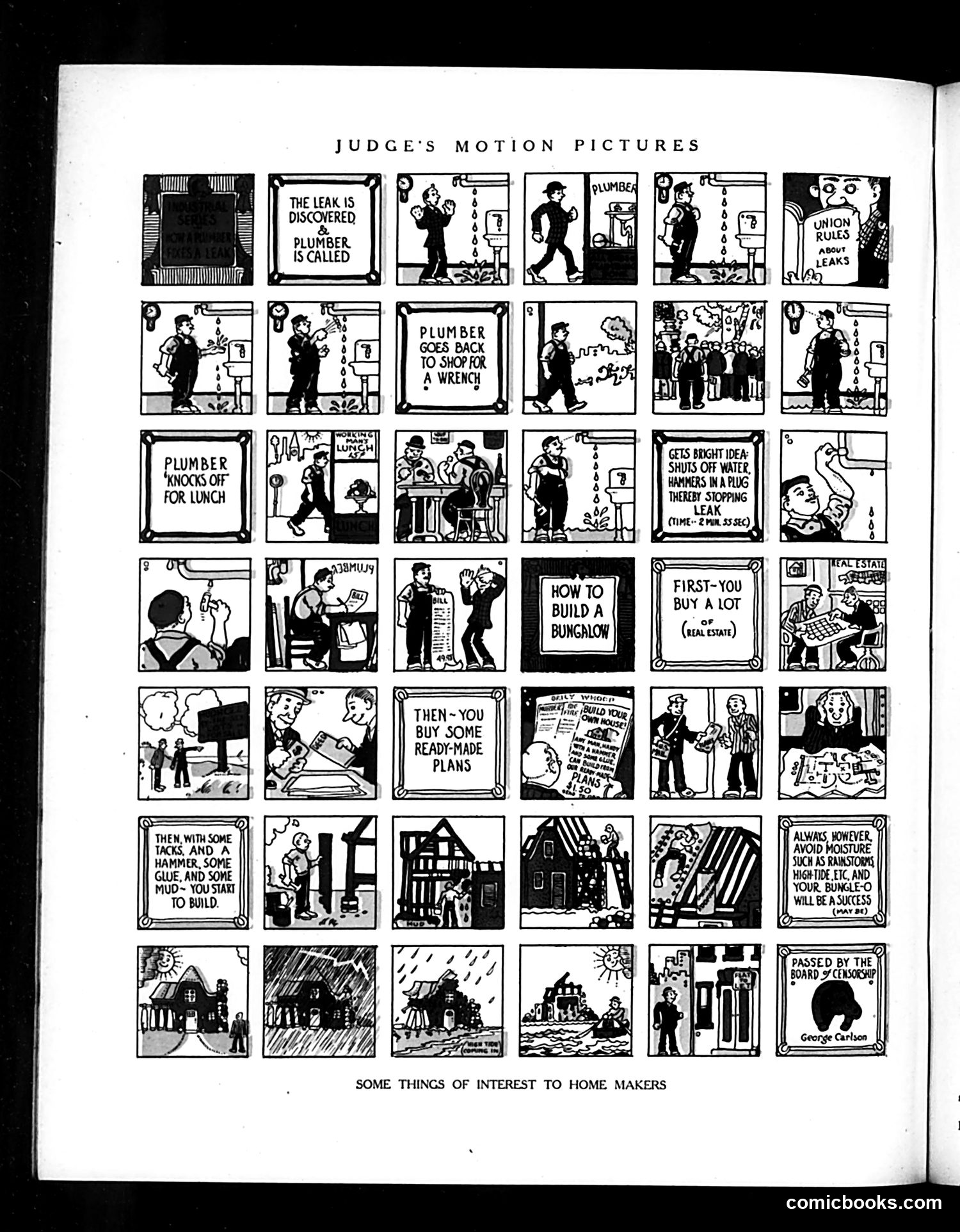
This page presents a sequential comic strip satirizing home construction and repair in early 20th-century America. The narrative follows a homeowner who discovers a leak, calls a plumber, and embarks on a journey to build his own house instead—presumably to avoid future contractor expenses. The strip mocks the era's DIY aspirations and housing optimism, showing the plumber's visit triggering the homeowner's decision to purchase ready-made building plans and construct a bungalow himself. The final panels depict various construction stages and weather challenges (rain, sun). The closing caption "Passed by the Board of Censorship" (attributed to George Carlson) ironically suggests this domestic narrative required approval—likely mocking overzealous censorship boards of the period by applying them to an innocuous home-building story. The satire targets both incompetent contractors and naive homeowner enthusiasm.
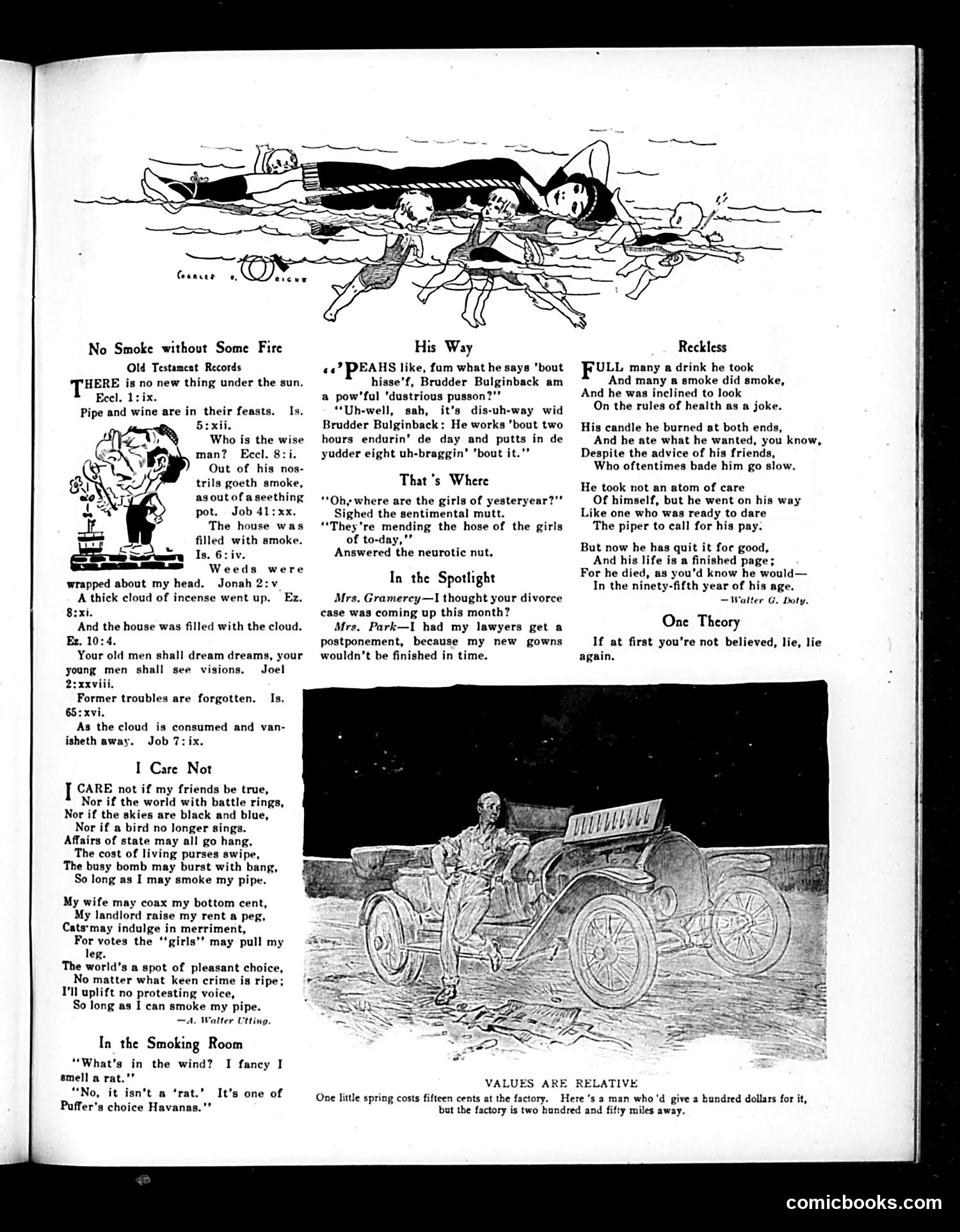
This page from *Judge* magazine (early 20th century) collects several pieces celebrating smoking and satirizing those who worry about health or morality. **Main theme**: Tobacco use as masculine independence and pleasure-seeking, mocking prudish concerns. **Key content**: - "No Smoke without Some Fire" uses Biblical quotations humorously to justify pipe smoking as ancient and wise - "I Care Not" is a poem declaring indifference to worldly troubles—wars, poverty, failing relationships—so long as one can smoke - A dialect joke about "Brudder Bulginback" working two hours and bragging eight hours - "In the Spotlight" mocks a divorcing woman prioritizing new gowns - "Reckless" tells of a man who burned his candle at both ends, lived 95 years ignoring health advice, and died—presented as darkly amusing **The satire targets**: Health reformers, moralists, and "neurotic" people worrying about smoking's effects. The magazine's position is that smoking represents carefree masculine vitality against suffocating social rules.
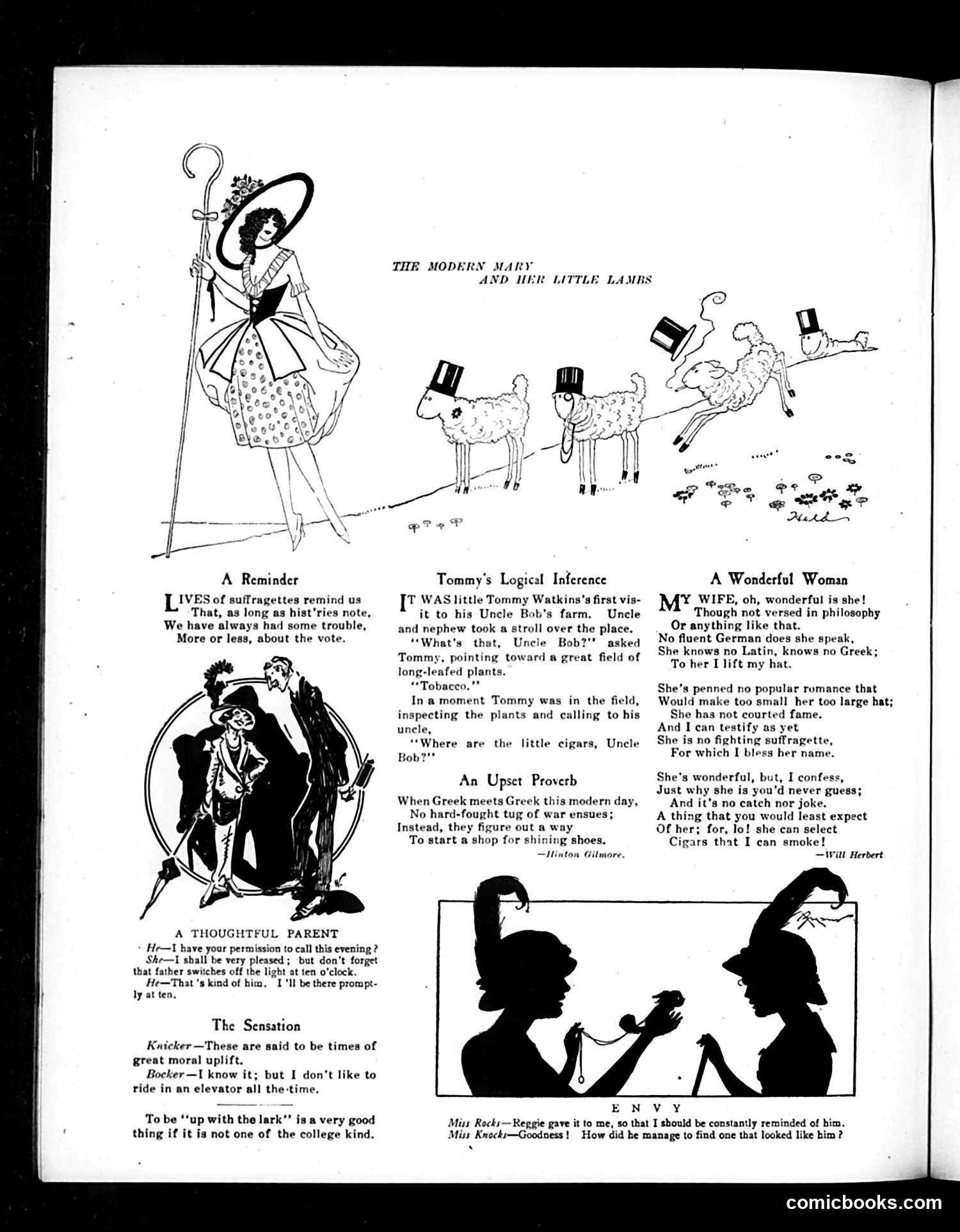
This page contains multiple satirical pieces mocking early 20th-century social issues: **"A Reminder"** references the women's suffrage movement, sarcastically suggesting voting rights agitation has always caused "trouble." **"A Thoughtful Parent"** jokes about courting customs: a suitor arranges to visit when the father turns off lights at 10 p.m., implying parental supervision of young couples. **"Tommy's Logical Inference"** plays on a child's innocent misunderstanding—Tommy sees tobacco plants and asks where the "little cigars" are, treating the crop as finished product. **"An Upset Proverb"** mocks Greek immigrants opening shoe-shining businesses instead of engaging in conflict, playing on stereotypes about Greek immigration. **"A Wonderful Woman"** praises a wife specifically for *not* being educated, a suffragette, or pursuing fame—essentially celebrating her domestic limitation. **"Envy"** makes a crude joke about appearance, with one woman asking how another found a man resembling an unflattering piece of jewelry. The overall tone reflects anti-suffrage, anti-immigrant, and anti-intellectual attitudes common to early-1900s satirical magazines.
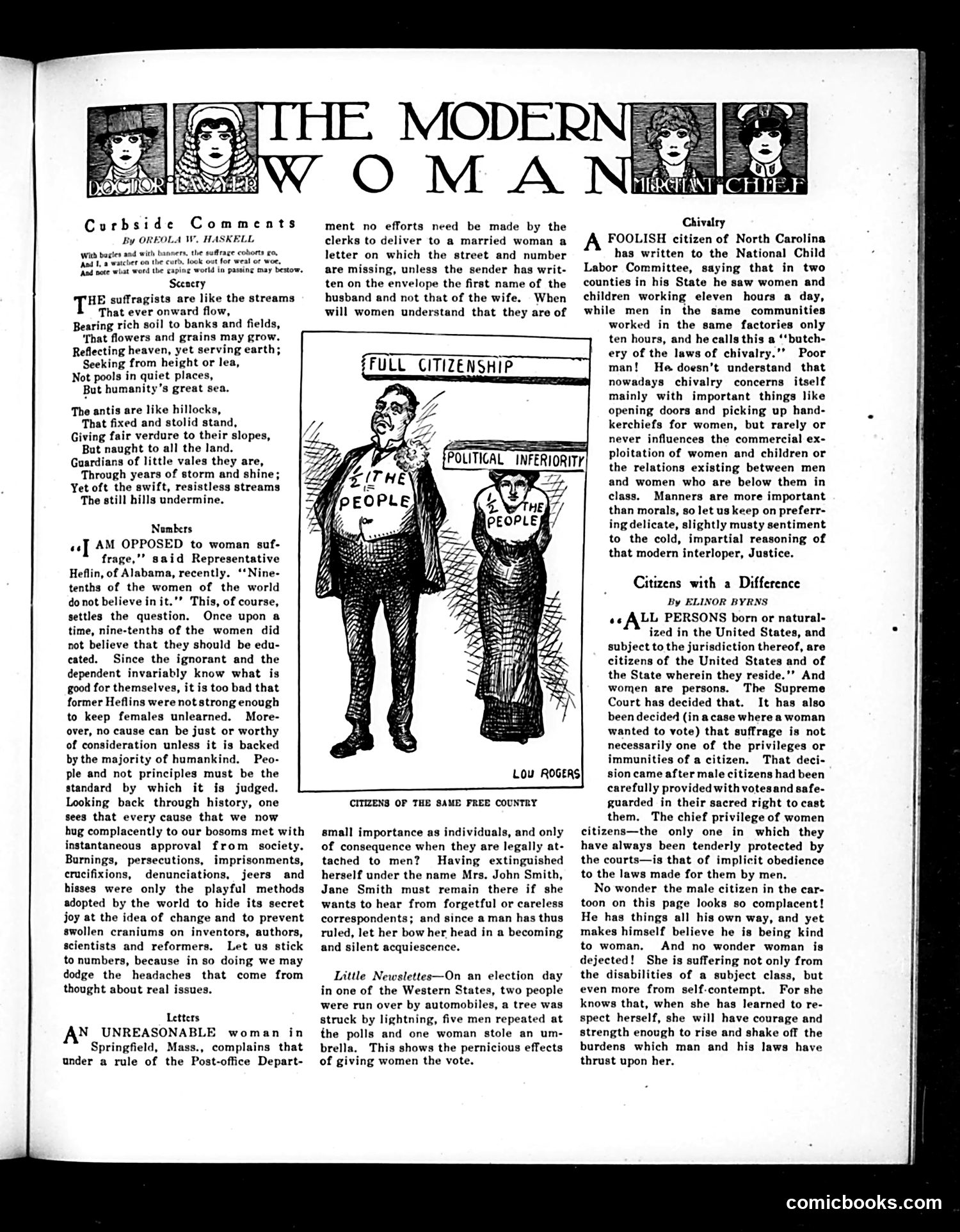
This page satirizes **opposition to women's suffrage** through multiple pieces of biting irony: **The Main Cartoon** (by Lou Rogers) depicts two figures labeled "Full Citizenship" and "Political Inferiority"—the latter a stunted version of the former—illustrating how denying women voting rights creates unequal citizenship in "the same free country." **The Curbside Comments** mock anti-suffrage arguments through sarcasm. Representative Heflin's claim that "nine-tenths of women oppose suffrage" is ridiculed by noting that nine-tenths once opposed female education—yet progress happened anyway. The piece sardonically suggests society should abandon principles and just count votes. **The Letter Section** highlights absurd legal/social consequences: married women can't receive mail addressed in their own names; their identity legally dissolves into "Mrs. [Husband's Name]." **"Citizens with a Difference"** attacks the hypocrisy of "chivalry"—men open doors for women but exploit them and children in factories for longer hours than male workers. The final anecdote absurdly blames women's voting for unrelated disasters, mocking circular anti-suffrage logic. The satire consistently demonstrates that opposing women's suffrage relies on illogical, self-serving arguments.
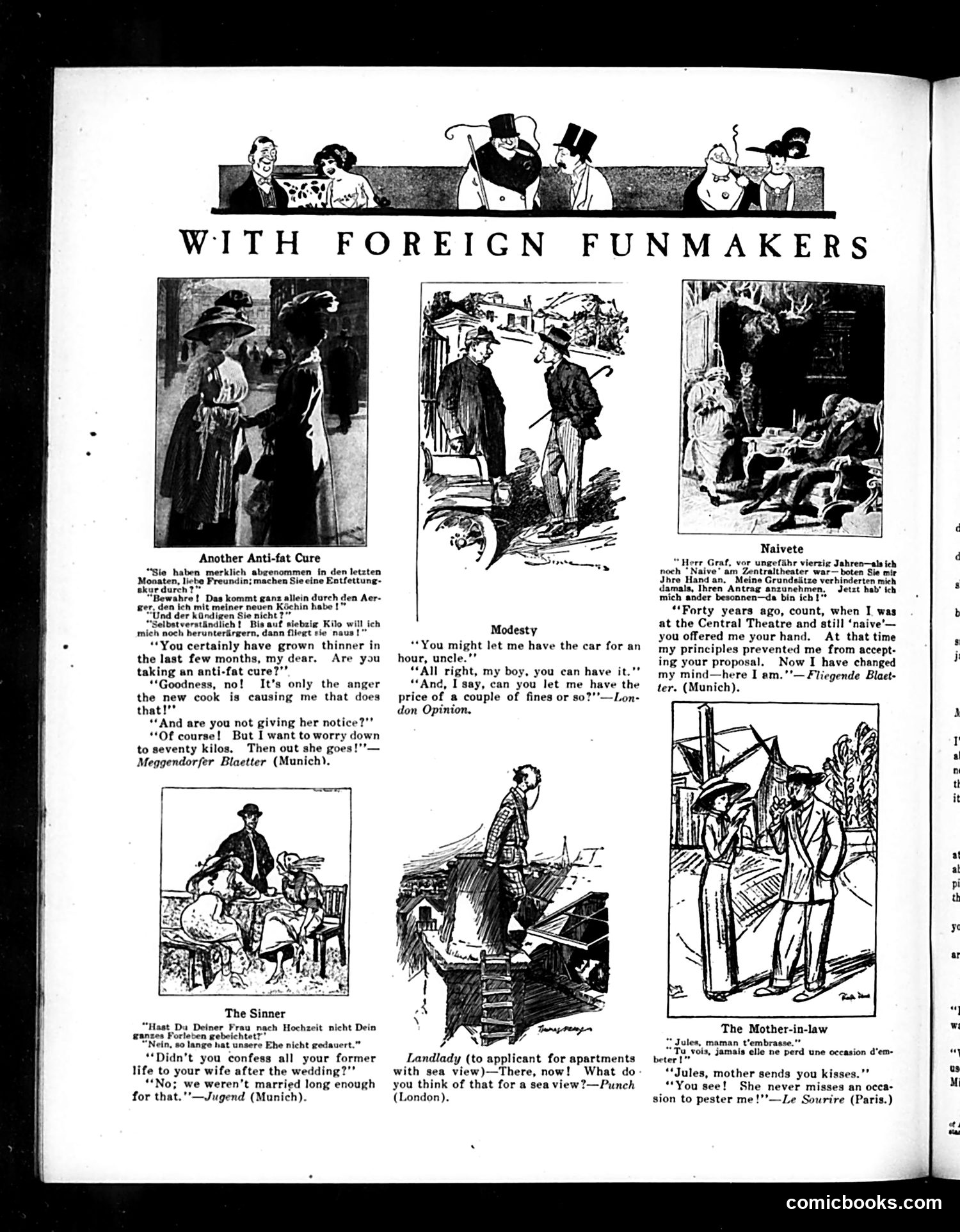
This page collects humor from European satirical magazines (Munich, Paris, London sources cited). The cartoons mock middle-class social anxieties common in early 20th-century Europe: **"Another Anti-fat Cure"**: A woman claims stress from firing her cook causes weight loss—she deliberately delays dismissal to lose more weight. The joke satirizes both vanity and the casual cruelty of employers toward servants. **"The Sinner"**: A man admits he never confessed his past to his wife because "we weren't married long enough"—dark humor about marital discord and short-lived marriages. **"Modesty" and "Landlady"**: Standard domestic comedy—a nephew cadges car money; a landlord pitches an apartment. **"Naïveté"**: A woman returns after 40 years, having rejected a nobleman's proposal for "principles," now willing to accept him. Satire of female opportunism and changing morality with age. **"Mother-in-law"**: Stereotype of the intrusive in-law who uses affection as excuse for meddling. The page showcases cross-European humor about class, marriage, and domestic life.
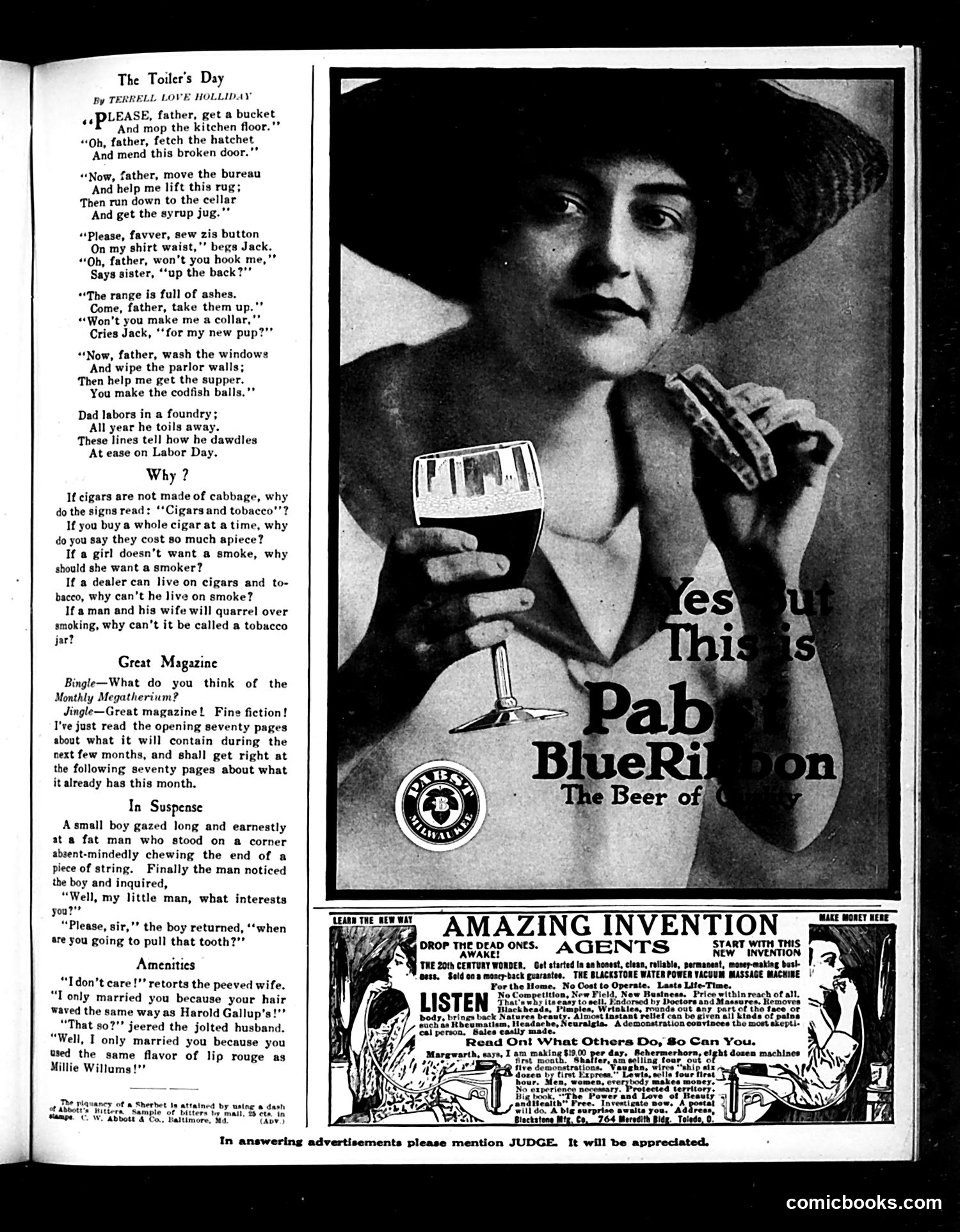
This poem by Terrell Love Holliday satirizes Labor Day's purpose through ironic contrast. A foundry worker toils year-round but spends his single day of rest being relentlessly pestered by family members demanding chores: mopping floors, fetching tools, mending doors, sewing buttons, washing windows, and cooking. The joke's bitter point: despite nominally celebrating labor, this father gets no actual rest on Labor Day—he's simply reassigned from factory work to domestic drudgery. The poem mocks both the hollowness of the holiday and the endless demands placed on working-class fathers. The surrounding page content includes unrelated humor pieces ("Why?" riddles about cigars, a "Great Magazine" joke, and miscellaneous anecdotes) and advertisements for the "Blackstone Water Power Vacuum Massage Machine"—typical Judge magazine filler from the early 20th century.
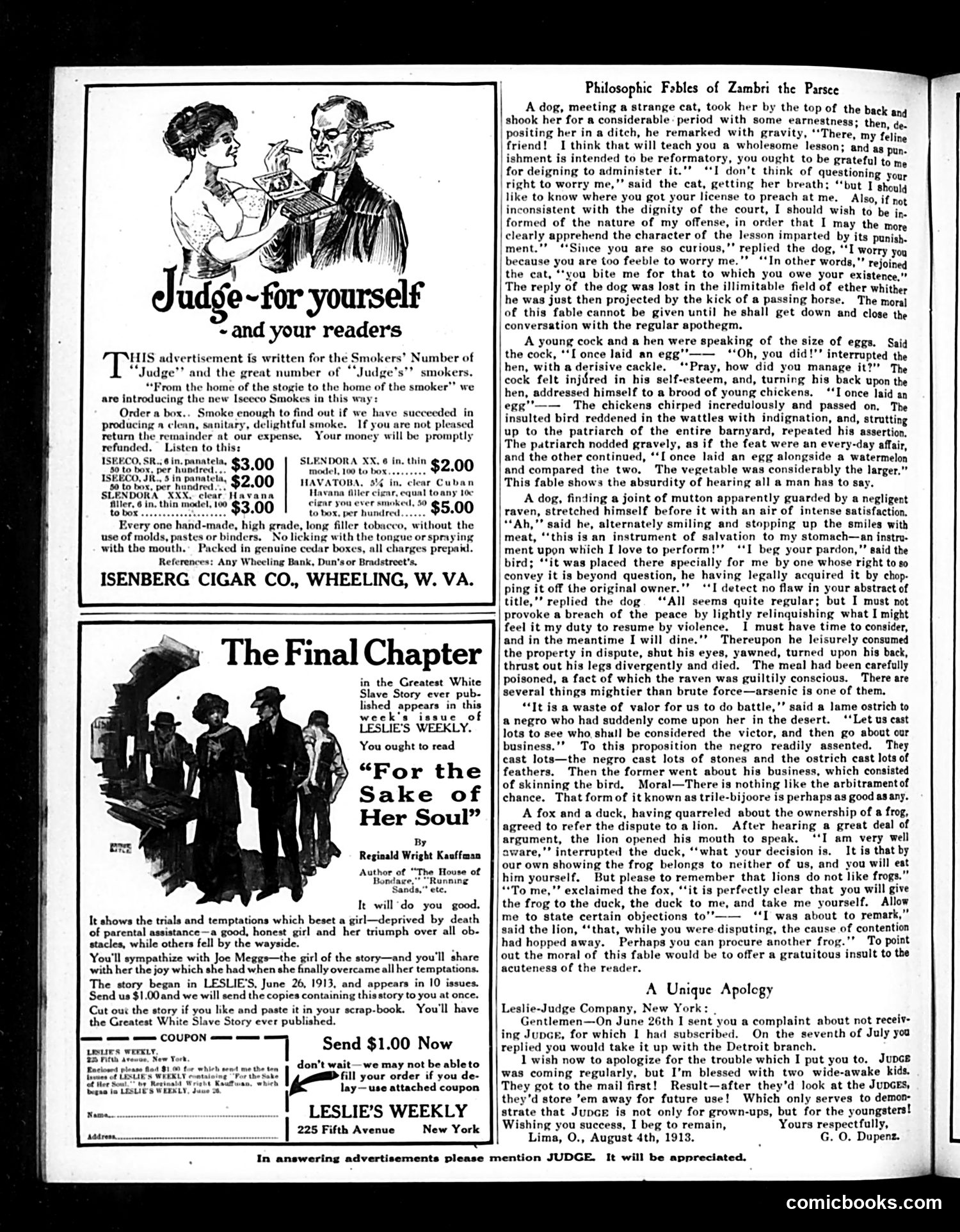
This page contains **primarily advertisements and serialized fiction**, not political cartoons requiring historical context. The top half features a **cigar advertisement** for Iseeco Smokes from Wheeling, West Virginia, using the Judge magazine branding to market products to the publication's male readership. Below that is a **promotional notice** for Leslie's Weekly advertising the final installment of a serialized story titled "For the Sake of Her Soul" by Reginald Wright Kauffman. The narrative appears to be melodrama about a poor orphaned girl ("Joe Meggs") overcoming moral temptations—typical early 1910s "white slave" literature addressing urban poverty and vice. The right column contains **"Philosophic Fables of Zambri the Parsee,"** a series of animal fables with moral lessons (dog punishing a cat; a rooster claiming to have laid eggs). These appear to be humorous, didactic tales rather than topical satire. The page reflects **early 20th-century magazine culture**: targeted advertising, serialized melodrama, and moral instruction through humor—all appealing to Judge's educated, male readership.
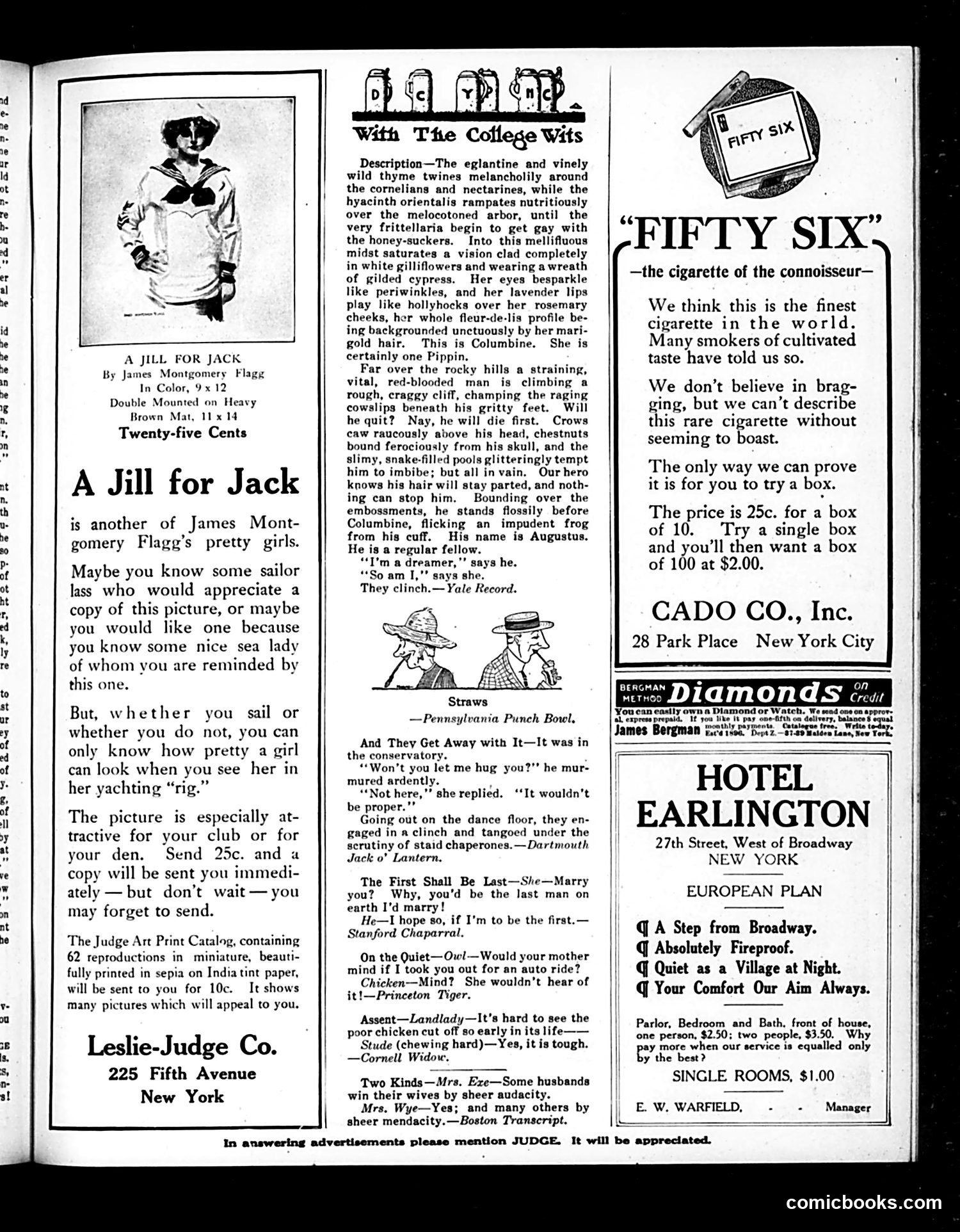
This page combines advertising and satirical humor typical of early 20th-century Judge magazine. The main content includes: 1. **"A Jill for Jack"** — An advertisement for a James Montgomery Flagg illustration of an attractive woman in yachting attire, available as a print for 25 cents. Flagg was a renowned commercial illustrator known for pin-up style imagery. 2. **"With The College Wits"** — A collection of short jokes mocking pretentious college humor. The opening parodies overwrought, flowery literary language ("eglantine," "mellifiuous") before launching into an equally absurd romance narrative. The humor satirizes collegiate affectation and flowery writing styles. 3. **Additional short jokes** about courtship, propriety, and domestic situations reflecting early 1900s social conventions. 4. **Product advertisements** including Fifty Six cigarettes and Hotel Earlington. The satire targets college students' pretentiousness and the era's strict social conventions around romance and propriety.
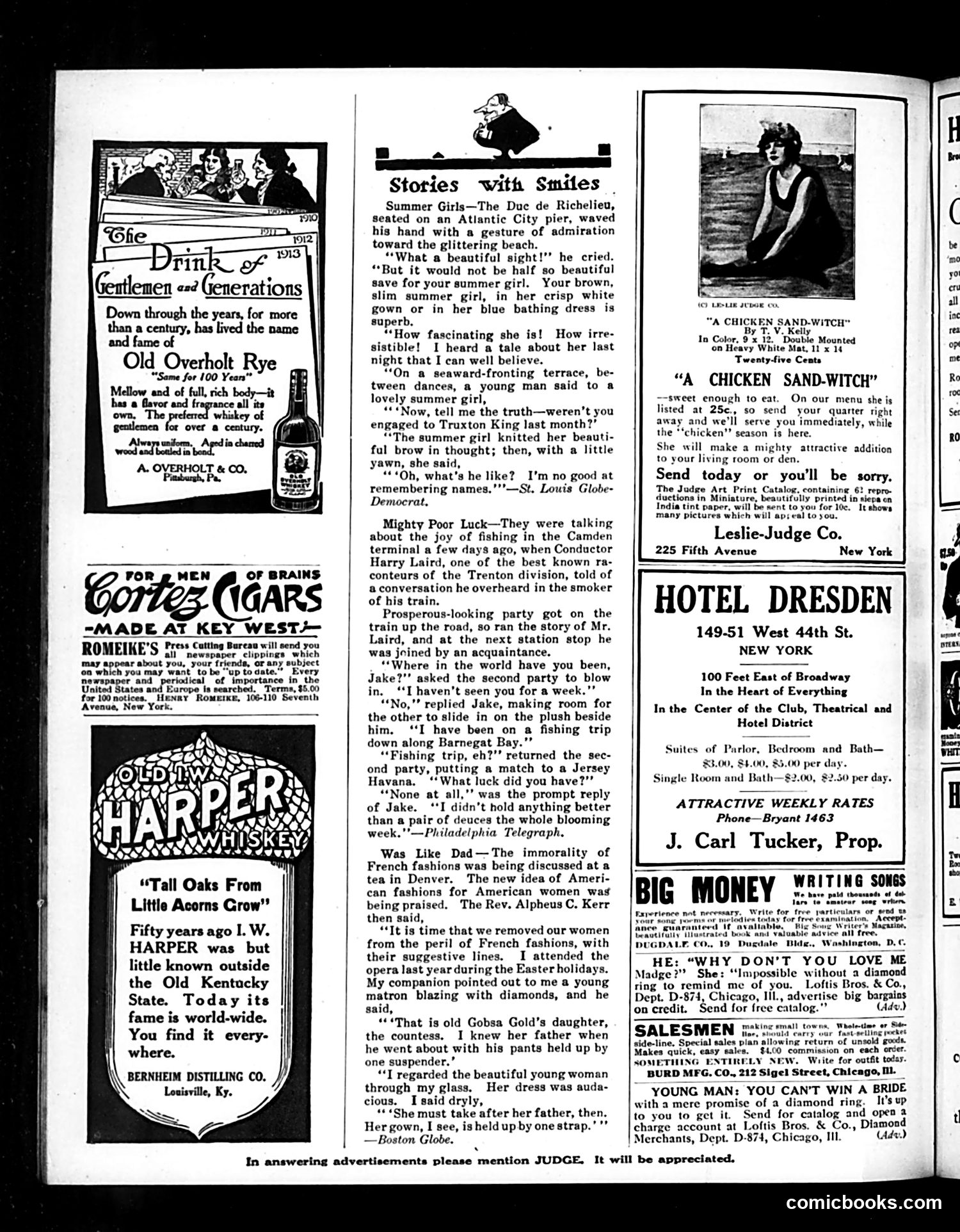
This page is primarily **advertisements and humorous anecdotes**, not political satire. The top-left features ads for **Old Overholt Rye whiskey** and **Cortez Cigars**, typical period luxury goods marketing emphasizing tradition and quality. The center section, "Stories with Smiles," contains three lighthearted jokes: 1. A French duke's observation about Atlantic City's "summer girls" in their fashionable bathing attire—humor based on a woman forgetting an engagement because she can't remember the man's name. 2. A fishing story where a man admits to having "no luck" catching fish, only cards (a pair of deuces)—wordplay on "luck." 3. A reverend's anecdote about removing women from "French fashions" with "suggestive lines"—reflecting early 20th-century anxieties about immodest European dress. The right side advertises a **"Chicken Sand-Witch" art print** and the **Hotel Dresden** in New York. The humor is gentle, period-appropriate, and entirely commercial rather than satirical.
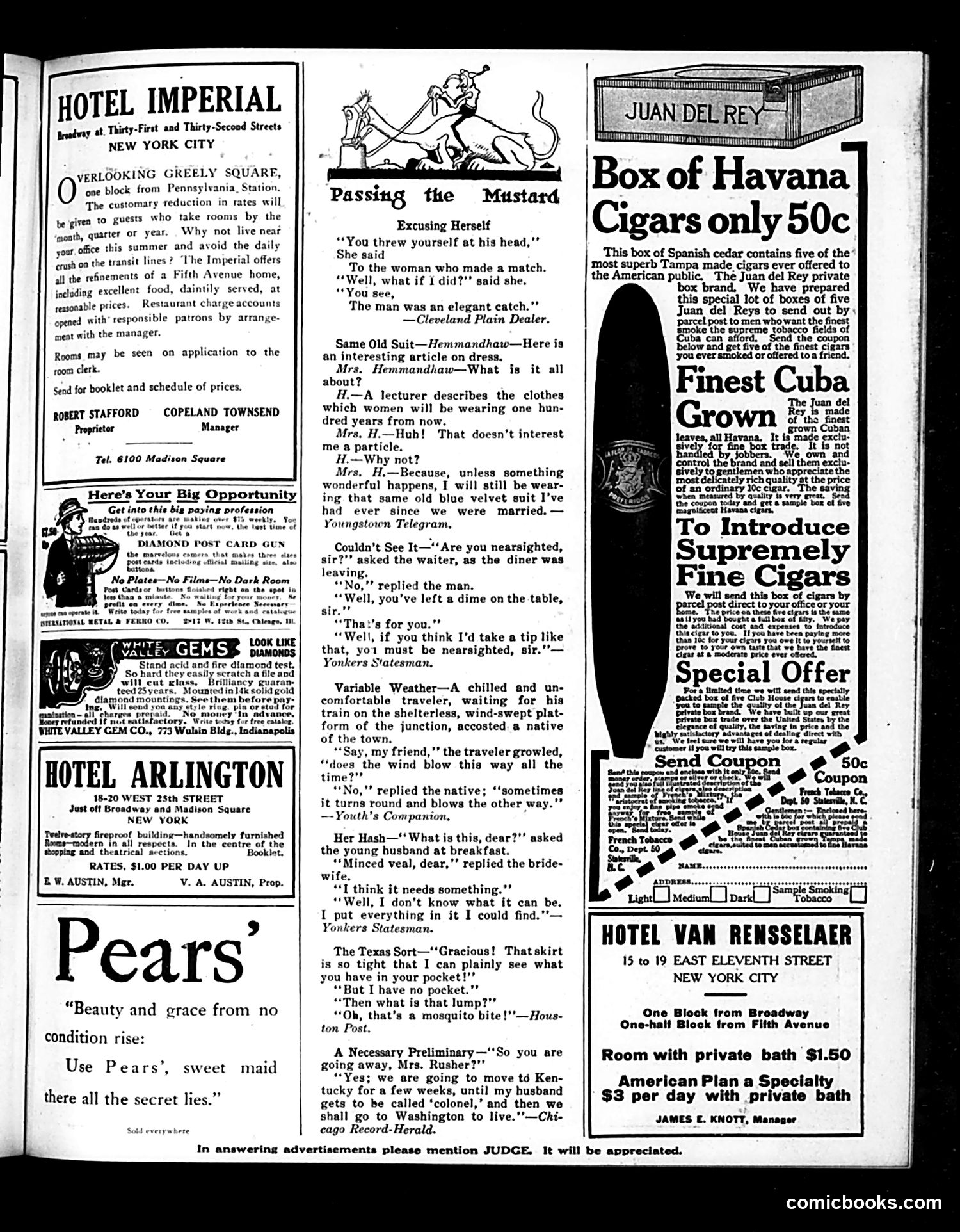
This page is primarily **advertising with light satirical humor pieces**—typical of Judge magazine's format. The cartoons are brief, untitled comic anecdotes rather than political satire: - **"Passing the Mustard"**: A woman defends aggressively pursuing a romantic match; the joke mocks aggressive female courtship behavior (then considered socially improper). - **"Same Old Suit"**: A husband mocks his wife for wearing the same dress for decades; satirizes marital tedium and wives' limited wardrobes. - **"Nearsighted waiter"**: A waiter assumes a diner forgot to leave a tip; the diner sarcastically insults him. - **"Variable Weather"**: A traveler complains about wind; a native replies it sometimes blows the other way—gentle absurdist humor. The remaining pieces mock new wives' cooking, women's tight skirts, and moving to Kentucky for social status. **The satire targets**: gender relations, women's fashion constraints, and class pretensions. These reflect early-20th-century social anxieties about gender roles and social climbing—nothing particularly political. The page is dominated by **hotel and product advertisements** (cigars, diamonds, soap).
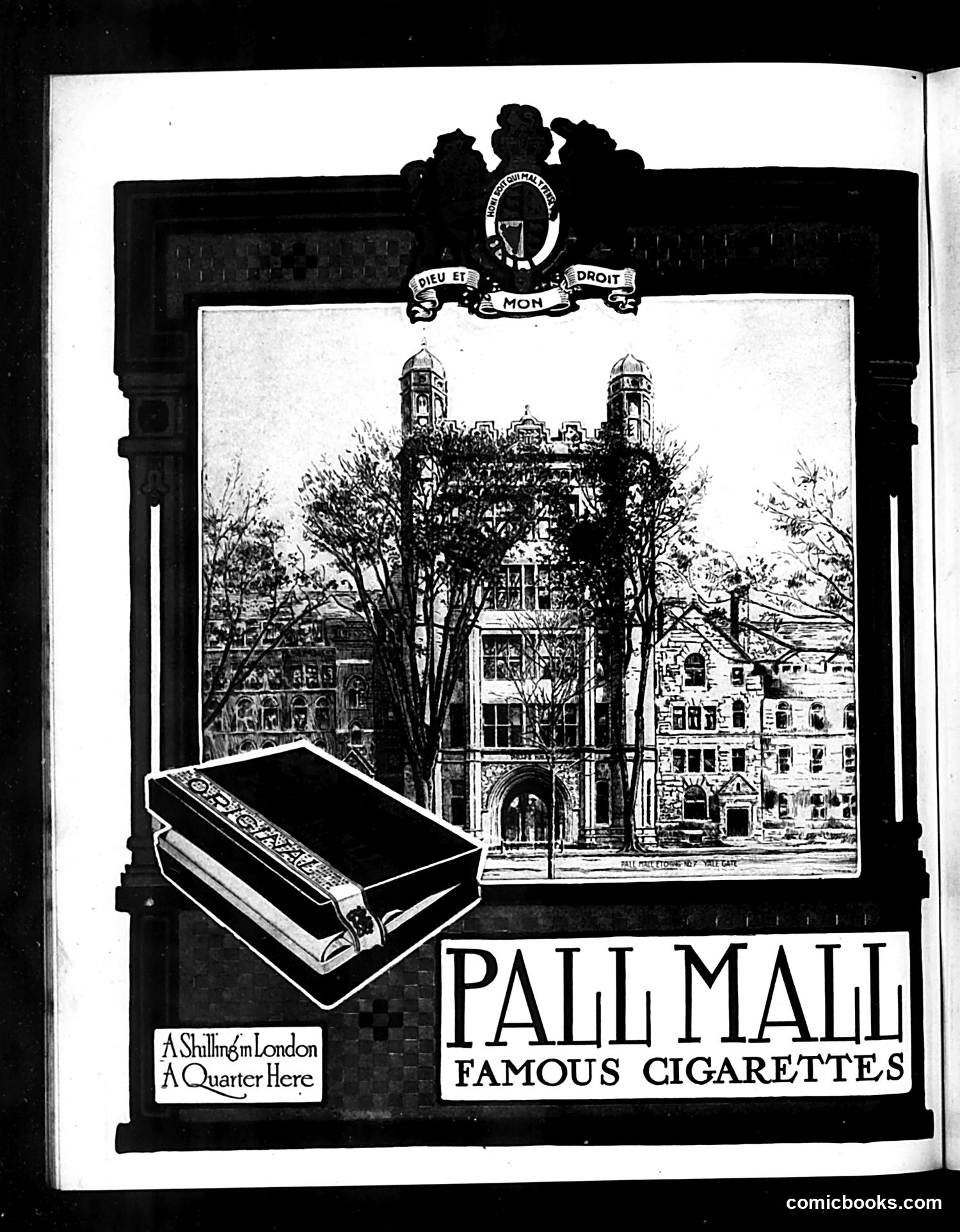
This is a **cigarette advertisement**, not political satire. The page promotes **Pall Mall Famous Cigarettes** with the tagline "A Shilling in London, A Quarter Here"—establishing pricing for British versus American markets. The visual features an ornate architectural illustration of what appears to be a prestigious London building with twin towers, framed decoratively. A package of Pall Mall cigarettes is prominently displayed. The heraldic crest above includes Latin text ("Dieu Et Mon Droit"), suggesting aristocratic or British institutional associations meant to convey quality and prestige. The ad capitalizes on transatlantic appeal and aspirational branding—positioning the cigarettes as refined and cosmopolitan. This reflects early 20th-century advertising strategies linking consumer products to European sophistication and class status.