
Judge, 1913-08-30 · page 10 of 24
Judge — August 30, 1913 — page 10: what you’re looking at
What you’re looking at
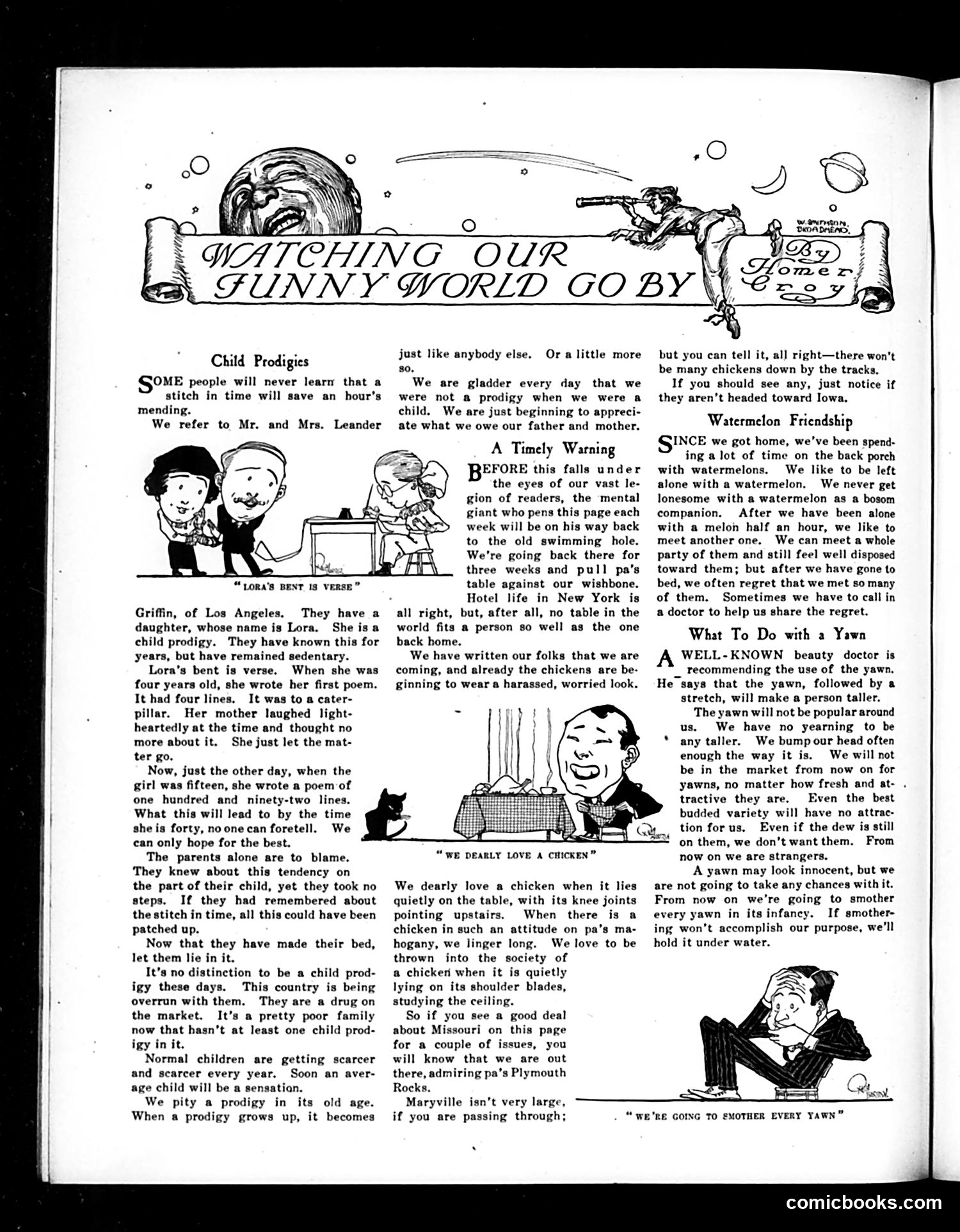
This *Judge* magazine page satirizes American excess and parental neglect through humor. The main cartoon mocks the "child prodigy" phenomenon—parents of a girl named Lora who writes poetry but do nothing to discourage or channel her talent, then act surprised when she's still writing at fifteen. The satire's point: prodigies are now so common they're worthless ("a drug on the market"), and parents who ignore warning signs are foolish. The remaining columns use exaggerated rural nostalgia—the author leaving New York to visit his Missouri hometown (Maryville), obsess over eating chickens and watermelons, and worry about yawning making him taller. The humor mocks both middle-class pretension and small-town simplicity, typical of *Judge's* satirical tone during this era.
📄 Transcribed text from this page (OCR, searchable)
Machine-transcribed from the original scan — historical spelling and the odd misread are preserved.
Child Prodigies SOME people will never learn that a stitch in time will save an hour’s mending. We refer to Mr. and Mrs. Leander “ Lora’s BENT 13 VERSE” Griffin, of Los Angeles, They have a daughter, whose name is Lora. She is a child prodigy. They have known this for years, but have remained sedentary. Lora’s bent is verse. When she was four years old, she wrote her first poem. It had four lines. It was to a cater- pillar. Her mother laughed light- heartedly at the time and thought no more about it. She just let the mat- ter go. Now, just the other day, when the girl was fifteen, she wrote a poem of one hundred and ninety-two lines. What this will lead to by the time she is forty, noone can foretell. We can only hope for the best. The parents alone are to blame. They knew about this tendency on the part of their child, yet they took no steps. If they had remembered about the stitch in time, all this could have been patched up. Now that they have made their bed, let them lie in it. It’s no distinction to be a child prod- igy these days. This country is being overrun with them. They are a drug on the market. It’s a pretty poor family now that hasn’t at least one child prod- igy in it. Normal children are getting scarcer and scarcer every year. Soon an aver- age child will be a sensatian. We pity a prodigy in its old age. When a prodigy grows up, it becomes just like anybody else. Or a little more 80. We are gladder every day that we were not a prodigy when we were a child. We are just beginning to appreci- ate what we owe our father and mother. A Timely Warning EFORE this falls under the eyes of our vast le- gion of readers, the mental giant who pens this page each week will be on his way back to the old swimming hole. We're going back there for three weeks and pull pa’s table against our wishbone. Hotel life in New York is all right, but, after all, no table in the world fits a person so well as the one back home. We have written our folks that we are coming, and already the chickens are be- ginning to wear a harassed, worried look. “WE DEARLY LOVE A CHICKEN” We dearly love a chicken when it lies quietly on the table, with its knee joints pointing upstairs. When there is a chicken in such an attitude on pa’s ma- hogany, we linger long. We love to be thrown into the society of a chickeri when it is quietly lying on its shoulder blades, studying the ceiling. So if you see a good deal about Missouri on this page for a couple of issues, you will know that we are out there, admiring pa’s Plymouth Rocks. Maryville isn’t very large, if you are passing through; but you can tell it, all right—there won't be many chickens down by the tracks. If you should see any, just notice if they aren’t headed toward Iowa. Watermelon Friendship INCE we got home, we’ve been spend- ing a lot of time on the back porch with watermelons. We like to be left alone with a watermelon. We never get lonesome with a watermelon as a bosom companion. After we have been alone with a melon half an hour, we like to meet another one. We can meet a whole party of them and still feel well disposed toward them; but after we have gone to bed, we often regret that we met so many of them. Sometimes we have to call in a doctor to help us share the regret. What To Do with a Yawn WELL-KNOWN beauty doctor is recommending the use of the yawn. He says that the yawn, followed by a stretch, will make a person taller. The yawn will not be popular around us. We have no yearning to be any taller. We bump our head often enough the way it is. We will not be in the market from now on for yawns, no matter how fresh and at- . tractive they are. Even the best budded variety will have no attrac- tion for us. Even if the dew is still on them, we don’t want them. From now on we are strangers. A yawn may look innocent, but we are not going to take any chances with it. From now on we're going to smother every yawn in its infancy. If smother- ing: won't accomplish our purpose, we'll hold it under water. . “WE'RE GOING TO MOTHER EVERY YAWN” comicbooks.com