
Judge, 1913-08-30 · page 12 of 24
Judge — August 30, 1913 — page 12: what you’re looking at
What you’re looking at
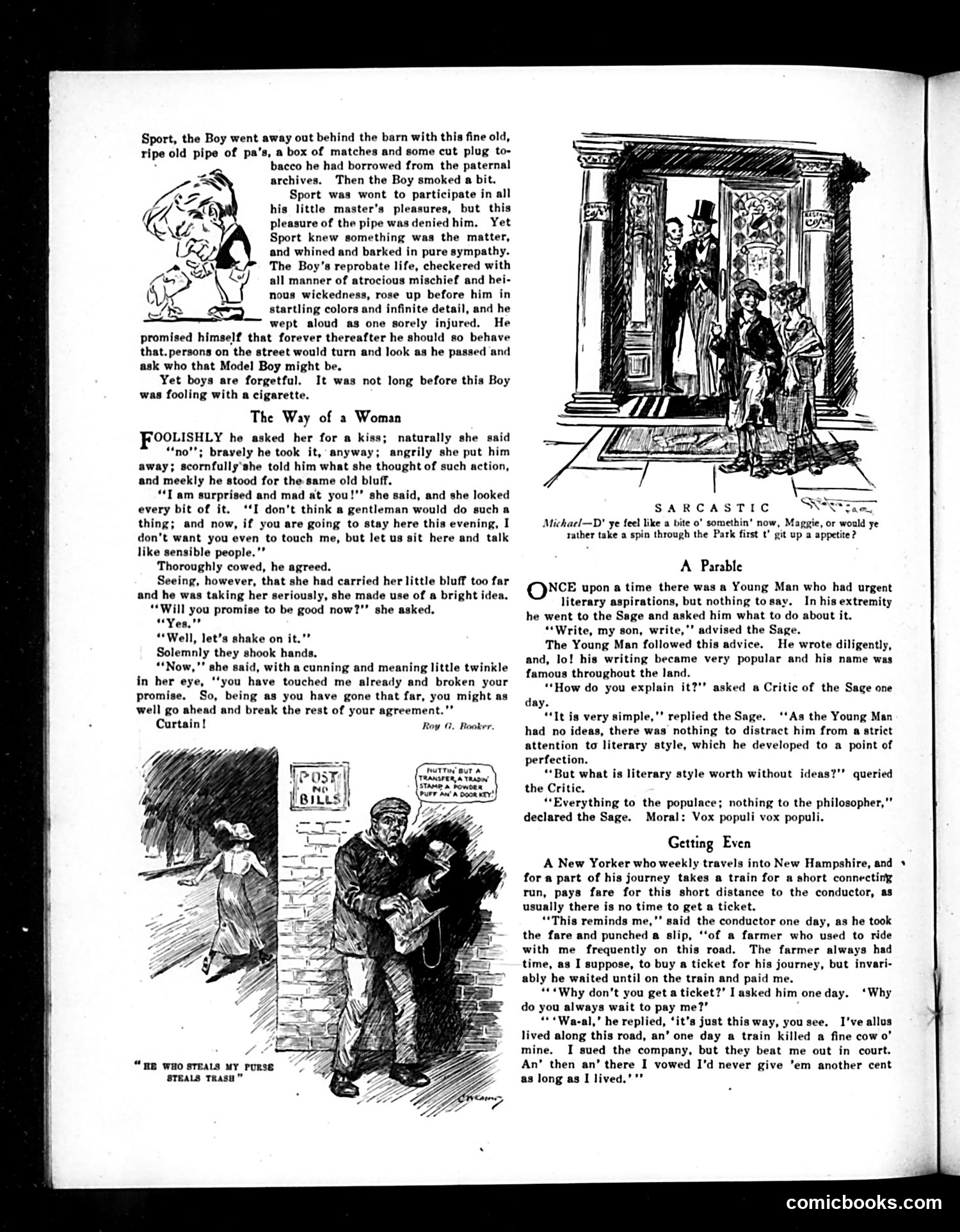
This page contains three humorous pieces typical of early 20th-century American satire: **"Sport, the Boy"** (top left): A morality tale where a boy smokes his father's pipe behind the barn, experiences guilt and remorse, promises reform—then promptly forgets and smokes a cigarette instead. The satire mocks youthful hypocrisy and the fleeting nature of childhood resolutions. **"The Way of a Woman"** (center): A battle-of-wits romance sketch where a woman rejects a man's unwanted kiss, then punishes him with an ultimatum not to touch her—only to use a "cunning" reversal to seduce him into breaking his own promise. The joke satirizes feminine manipulation and the performative nature of courtship etiquette. **"A Parable"** (right): An ironic tale where a Young Man becomes famous despite having "no ideas," succeeding purely through stylistic perfection. The Sage declares style matters to common people while philosophers value substance—satirizing lowbrow taste and the disconnect between popularity and actual merit. All three pieces mock human nature: inconsistency, romantic games, and the public's preference for form over content.
📄 Transcribed text from this page (OCR, searchable)
Machine-transcribed from the original scan — historical spelling and the odd misread are preserved.
Sport, the Boy went away out behind the barn with this fine old, ripe old pipe of pa’s, a box of matches and some cut plug to- . bacco he had borrowed from the paternal archives. Then the Boy smoked a bit. Sport was wont to participate in all his little master's pleasures, but this pleasure of the pipe was denied him, Yet Sport knew something was the matter, and whined and barked in pure sympathy. a SS The Boy's reprobate life, checkered with os as all manner of atrocious mischief and hei- Oy y nous wickedness, rose up before him in ft ) startling colors and infinite detail, and he wept aloud as one sorely injured. He promised himself that forever thereafter he should so behave that. persons on the street would turn and look as he passed and ask who that Model Boy might be. Yet boys are forgetful. It was not long before this Boy was fooling with a cigarette. The Way of a Woman FOOLISHLY he asked her for a kiss; naturally she said no'’; bravely he took it, anyway; angrily she put him cornfully‘she told him what she thought of such action, and meekly he stood for the same old bluff. “‘T am surprised and mad at you!'’ she said, and she looked every bit of it. ‘I don’t think a gentleman would do such a thing; and now, if you are going to stay here this evening, I don’t want you even to touch me, but let us sit here and talk like sensible people."” Thoroughly cowed, he agreed. Seeing, however, that she had carried her little bluff too far and he was taking her seriously, she made use of a bright idea. “*Will you promise to be good now?’’ she asked. “Well, let’s shake on i Solemnly they shook hands. “‘Now,”’ she said, with a cunning and meaning little twinkle in her eye, ‘‘you have touched me already and broken your promis So, being as you have gone that far, you might as well go ahead and break the rest of your agreement.” Curtain! Roy @. Rooker. “HB WHO STEALS MY PURSE STEALS TRASH” 3a SARCASTIC Wie Michael—D' ye feel like a bite o’ somethin’ now, Maggie, or would ye rather take a spin through the Park first t’ git up a appetite ? A Parable NCE upon a time there was a Young Man who had urgent literary aspirations, but nothing tosay. In his extremity he went to the Sage and asked him what to do about it. “Write, my son, write,’’ advised the Sage. followed this advice. He wrote diligently, and, g became very popular and his name was famous throughout the land. “How do you explain it?” asked a Critic of the Sage one day. “It is very simple,”’ replied the Sage. ‘‘As the Young Man had no ideas, there was nothing to distract him from a strict attention to literary style, which he developed to a point of perfection. “But what is literary style worth without ideas?’ queried the Critic. “Everything to the populace; nothing to the philosopher,”’ declared the Sage. Moral: Vox populi vox populi. Getting Even A New Yorker who weekly travels into New Hampshire, and for a part of his journey takes a train for a short connecting run, pays fare for this short distance to the conductor, as usually there is no time to get a ticket. “This reminds me,’’ said the conductor one day, as he took the fare and punched a slip, ‘‘of a farmer who used to ride with me frequently on this road. The farmer always had time, as I suppose, to buy a ticket for his journey, but invari- ably he waited until on the train and paid me. “**Why don’t you get a ticket?’ I asked him one day. do you always wait to pay me?” “**Wa-al,’ he replied, ‘it’s just this way, you see. I’ve allus lived along this road, an’ one day a train killed a fine cowo’ mine. I sued the company, but they beat me out in court. An’ then an’ there I vowed I'd never give 'em another cent as long as I lived.’ “Why comicbooks.com