
Judge, 1913-08-30 · page 17 of 24
Judge — August 30, 1913 — page 17: what you’re looking at
What you’re looking at
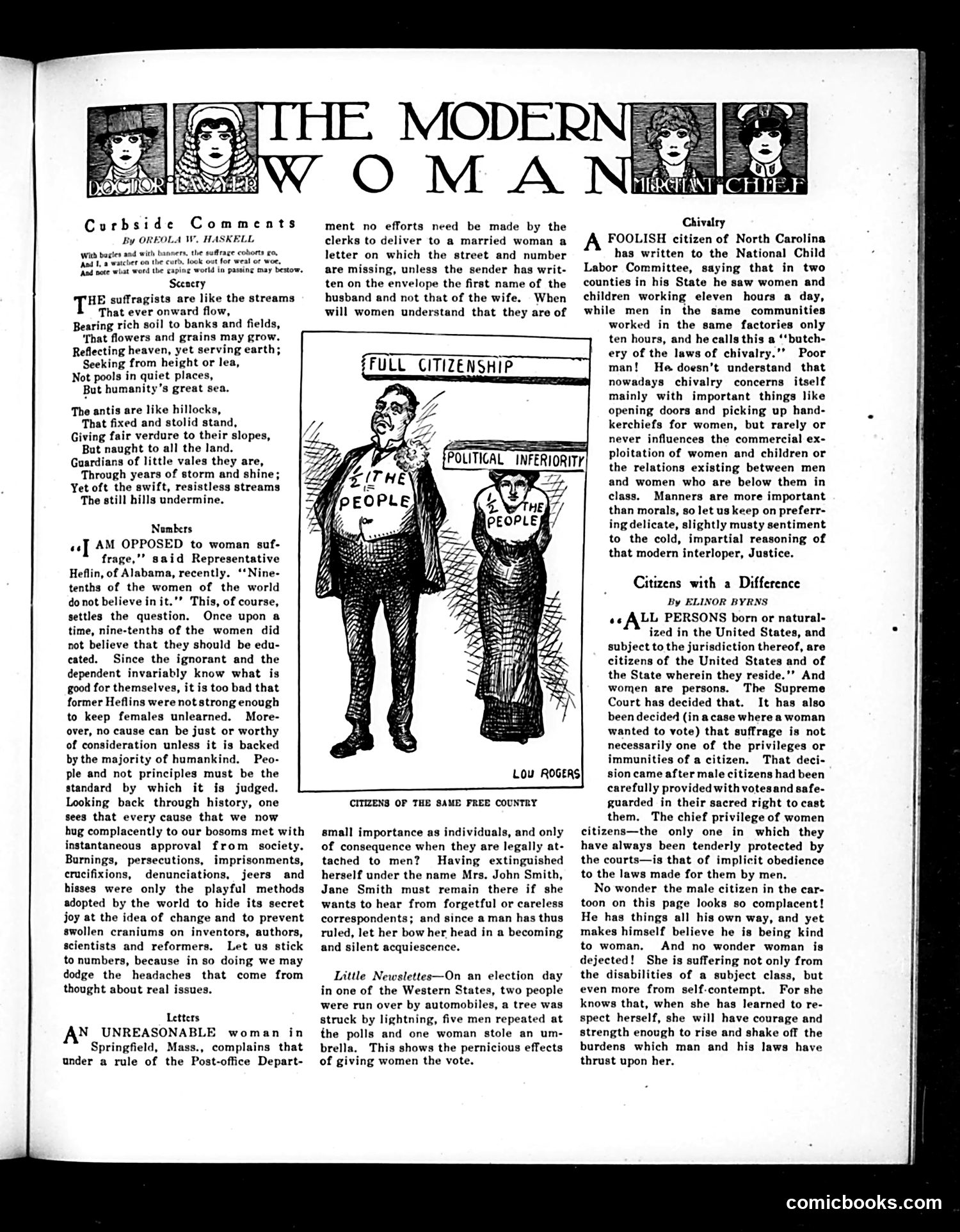
This page satirizes **opposition to women's suffrage** through multiple pieces of biting irony: **The Main Cartoon** (by Lou Rogers) depicts two figures labeled "Full Citizenship" and "Political Inferiority"—the latter a stunted version of the former—illustrating how denying women voting rights creates unequal citizenship in "the same free country." **The Curbside Comments** mock anti-suffrage arguments through sarcasm. Representative Heflin's claim that "nine-tenths of women oppose suffrage" is ridiculed by noting that nine-tenths once opposed female education—yet progress happened anyway. The piece sardonically suggests society should abandon principles and just count votes. **The Letter Section** highlights absurd legal/social consequences: married women can't receive mail addressed in their own names; their identity legally dissolves into "Mrs. [Husband's Name]." **"Citizens with a Difference"** attacks the hypocrisy of "chivalry"—men open doors for women but exploit them and children in factories for longer hours than male workers. The final anecdote absurdly blames women's voting for unrelated disasters, mocking circular anti-suffrage logic. The satire consistently demonstrates that opposing women's suffrage relies on illogical, self-serving arguments.
📄 Transcribed text from this page (OCR, searchable)
Machine-transcribed from the original scan — historical spelling and the odd misread are preserved.
Curbside Comments Ms - ‘ord the caping world in passing may bestow. Scenery THE suffragists are like the streams That ever onward flow, Bearing rich soil to banks and fields, ‘That flowers and grains may grow. Reflecting heaven, yet serving earth; Seeking from height or lea, Not pools in quiet places, But humanity’s great sea. The antis are like hillocks, That fixed and stolid stand, Giving fair verdure to their slopes, But naught to all the land. Guardians of little vales they are, Through years of storm and shine; Yet oft the swift, resistless streams The still hills undermine. Nombers rf AM OPPOSED to woman suf- frage,’’ said Representative Heflin, of Alabama, recently. ‘‘Nine- tenths of the women of the world donot believe init.” This, of course, settles the question. Once upon a time, nine-tenths of the women did not believe that they should be edu- cated. Since the ignorant and the dependent invariably know what is good for themselves, it is too bad that former Heflins were not strong enough to keep females unlearned. More- over, no cause can be just or worthy of consideration unless it is backed by the majority of humankind. Peo- ple and not principles must be the standard by which it is judged. Looking back through history, one sees that every cause that we now hug complacently to our bosoms met with instantaneous approval from society. Burnings, persecutions, imprisonments, crucifixions, denunciations, jeers and hisses were only the playful methods adopted by the world to hide its secret joy at the idea of change and to prevent swollen craniums on inventors, authors, scientists and reformers. Let us stick to numbers, because in so doing we may dodge the headaches that come from thought about real issues. Letters N UNREASONABLE woman in Springfield, Mass., complains that under a rule of the Post-office Depart- ment no efforts need be made by the clerks to deliver to a married woman a letter on which the street and number are missing, unless the sender has writ- ten on the envelope the first name of the husband and not that of the wife. When will women understand that they are of CHIEF A FOOLISH citizen of North Carolina has written to the National Child Labor Committee, saying that in two counties in his State he saw women and children working eleven hours a day, while men in the same communities worked in the same factories only ten hours, and he calls this a ‘‘butch- ery of the laws of chivalry.’’ Poor man! He doesn’t understand that nowadays chivalry concerns itself mainly with important things like opening doors and picking up hand- kerchiefs for women, but rarely or never influences the commercial ex- the relations existing between men POLITICAL INFERIORITY) Plcitation of women and children or oi CITIZENS OP THE SAME FREE COUNTRY amall importance as individuals, and only of consequence when they are legally at- tached to men? Having extinguished herself under the name Mrs. John Smith, Jane Smith must remain there if she wants to hear from forgetful or careless correspondents; and since a man has thus ruled, let her bow her head in a becoming and silent acquiescence. Little Newslettes—On an election day in one of the Western States, two people were run over by automobiles, a tree was struck by lightning, five men repeated at the polls and one woman stole an um- brella. This shows the pernicious effects of giving women the vote. and women who are below them in class. Manners are more important than morals, so let us keep on preferr- ing delicate, slightly musty sentiment to the cold, impartial reasoning of that modern interloper, Justice. Citizens with a Difference By ELINOR BYRNS ‘ «ALL PERSONS born or natural- ized in the United States, and subject to the jurisdiction thereof, are citizens of the United States and of the State wherein they reside.’’ And women are persons. The Supreme Court has decided that. It has also been decided (in acase where a woman wanted to vote) that suffrage is not necessarily one of the privileges or immunities of a citizen. That deci- sion came after male citizens had been carefully provided with votesand safe- guarded in their sacred right to cast them. The chief privilege of women citizens—the only one in which they have always been tenderly protected by the courts—is that of implicit obedience to the laws made for them by men. No wonder the male citizen in the car- toon on this page looks so complacent! He has things all his own way, and yet makes himself believe he is being kind to woman, And no wonder woman is dejected! She is suffering not only from the disabilities of a subject class, but even more from self-contempt. For she knows that, when she has learned to re- spect herself, she will have courage and strength enough to rise and shake off the burdens which man and his laws have thrust upon her. comicbooks.com