
Judge, 1913-08-30 · page 20 of 24
Judge — August 30, 1913 — page 20: what you’re looking at
What you’re looking at
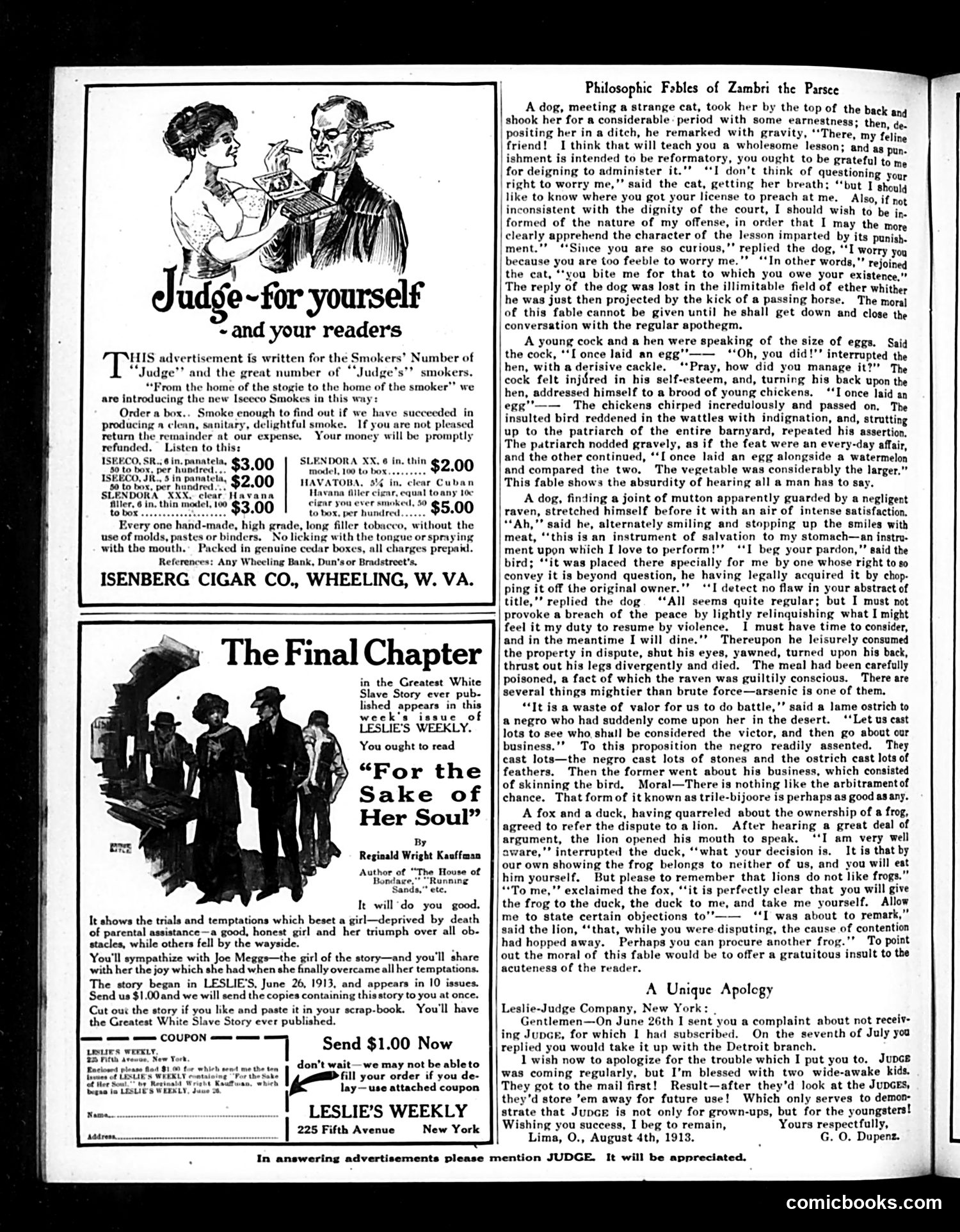
This page contains **primarily advertisements and serialized fiction**, not political cartoons requiring historical context. The top half features a **cigar advertisement** for Iseeco Smokes from Wheeling, West Virginia, using the Judge magazine branding to market products to the publication's male readership. Below that is a **promotional notice** for Leslie's Weekly advertising the final installment of a serialized story titled "For the Sake of Her Soul" by Reginald Wright Kauffman. The narrative appears to be melodrama about a poor orphaned girl ("Joe Meggs") overcoming moral temptations—typical early 1910s "white slave" literature addressing urban poverty and vice. The right column contains **"Philosophic Fables of Zambri the Parsee,"** a series of animal fables with moral lessons (dog punishing a cat; a rooster claiming to have laid eggs). These appear to be humorous, didactic tales rather than topical satire. The page reflects **early 20th-century magazine culture**: targeted advertising, serialized melodrama, and moral instruction through humor—all appealing to Judge's educated, male readership.
📄 Transcribed text from this page (OCR, searchable)
Machine-transcribed from the original scan — historical spelling and the odd misread are preserved.
NG Judge~for yourself ~ and your readers HIS advertisement is written for the Smokers’ Number of Judge’? and the great number of “‘Judge’s’? sme 5 “From the home of the stogie to the home of the smoker"’ we are introducing the new Iseeco Smokes in this way: Order a box.. Smoke enough to find out if we have ceeded in producing a clean, sanitary, delightful smoke. If you are not pleased return the remainder at our expense. Your money will be promptly refunded. Listen to this: Sin-panatela, $3.00 ISEECO, JiR, 3 in panatela, 50 to box, per hundred SLENDORA XXX. clear Havana Aller, 6 in, th del, I to bo! Every and-made, high grade, long filler tob without the use of molds, pastes or binders. No licking with the tongue or spraying with the mouth.» Packed in genuine cedar boxes, all charges prepaid. References: Any Wheeling Bank, Dun’sor Bradstreet’s, ISENBERG CIGAR CO., WHEELING, W. VA. The Final Chapter in the Greatest White Slave Story ever pub- lished appears in this week's ue of LESLIE'S WEEKLY. You ought to read “For the Sake of Her Soul” By Reginald Wright Kauffman Author of “The House of Bonda: It will'do you good. It shows the trials and temptations which beset a girl—deprived by death of parental assistance—a honest girl and her triumph over all ob- stacles, while others fell by the wayside. . You'll sympathize with Joe Meggs—the girl of the story—and you'll share with her the joy which she had when she finally overcame all her temptations. The story began in LESLIE'S, June 26, 1913, and appears in 10 issues. Send us $1.00 and we will send the copies containing this story to you at once. Cut out the story if you like and paste it in your scrap-book. You'll have the Greatest White Slave Story ever published. SoS EN ee ae Send $1.00 Now LESLIE'S WEFELY, a don’t wait—we may not be ableto fill your order if you de- lay—use attached coupon se LESLIE’S WEEKLY ee | 225 Fifth Avenue New York Philosophic Fables of Zambri the Parsee A dog, meeting a strange cat, took her by the top of the back ang shook her for a considerable: period with some earnestness; then, ¢ positing her in a ditch, he remarked with gravity, “There, my feling |friend!” I think that will teach you a wholesome lesson; and'as pire ishment is intended to be reformatory, you ought to be grateful to me | for deigning to administer it.” ‘I don't think of questioning your right to worry me,”’ said the cat, getting her breath; “but T should like to know where you got your license to preach at me. Also, if not inconsistent with the dignity of the court, I should wish to'be in formed of the nature of my offense, in order that I may the more clearly apprehend the character of th n imparted by its punish. ment."” ‘*Since you are so curious," replied the dog, “I worry you because you are too feeble to worry me.”* ‘‘In other words,"’ rejoined the cat, “you bite me for that to which you owe your existence.” The reply of the dog was lost in the illimitable field of ether whither he was just then projected by the kick of a passing horse. The moral of this fable cannot be given until he shall get down and close the conversation with the regular apothegm. A young cock and a hen were speaking of the size of eggs. Said the cock, ‘‘L once laid an egg’’-—— ‘Oh, you did!’’ interrupted the hen, with a derisive cackle. ‘*Pray, how did you manage it?” The cock felt injéred in his self-esteem, and, turning his back upon the hen, addressed himself to a brood of young chickens. ‘‘I once laid an egg’’—— The chickens chirped incredulously and passed on. The insulted bird reddened in the wattles with indignation, and, strutting up to the patriarch of the entire barnyard, repeated his assertion, The patriarch nodded gravely, as if the feat were an every-day affair, and the other continued, ‘‘L once laid an egg alongside a watermelon and compared the two. The vegetable was considerably the larger.” This fable shows the absurdity of hearing all a man has to say, A dog, finding a joint of mutton apparently guarded by a negligent raven, stretched himself before it with an air of intense satisfaction. “Ah,’’ said he, alternately smiling and stopping up the smiles with meat, ‘this is an instrument of salvation to my stomach—an instru- | ment upon which I love to perform!"’ ‘*I beg your pardon,’’ said the bird; ‘‘it was placed there specially for me by one whose right to so convey it is beyond question, he having legally acquired it by chop- ping it off the original owner."’ ‘‘I detect no flaw in your abstract of title,’’ replied the dog ‘‘All seems quite regular; but I must not provoke a breach of the peace by lightly relinquishing what I might feel it my duty to resume by violence. I must have time to consider, and in the meantime I will din Thereupon he leisurely consumed the property in dispute, shut his eyes, yawned, turned upon his back, thrust out his legs divergently and died. The meal had been carefully poisoned, a fact of which the raven was guiltily conscious. There are several things mightier than brute force—arsenic is one of them, “It is a waste of valor for us to do battle,’’ said a lame ostrich to a negro who had suddenly come upon her in the desert. ‘‘Let us cast lots to see who. shull be considered the victor, and then go about our business.’” To this proposition the negro readily assented. They cast lots—the negro cast lots of stones and the ostrich cast lots of feathers. Then the former went about his business, which consisted of skinning the bird. Moral—There is nothing like the arbitrament of chance. That form of it known as trile-bijoore is perhaps as good as any. A fox and a duck, having quarreled about the ownership of a frog, agreed to refer the dispute to a lion. After hearing a great deal of Jargument, the lion opened his mouth to speak. ‘I am very well | aware,” interrupted the duck, ‘‘what your decision is. It is that by our own showing the frog belongs to neither of us, and you will eat him yourself. But please to remember that lions do not like frogs.” “To me,’’ exclaimed the fox, ‘‘it is perfectly clear that you will give the frog to the duck, the duck to me, and take me yourself. Allow me to state certain objections to’’. “T was about to remark,” said the lion, ‘‘that, while you were disputing, the cause of contention had hopped away. Perhaps you can procure another frog.'’ To point out the moral of this fable would be to offer a gratuitous insult to the acuteness of the reader, A Unique Apology Leslie-Judge Company, New Yor! Gentlemen—On June 26th I sent ing Jur for which I had subscri On the seventh of July you replied you would take it up with the Detroit branch. 1 wish now to apologize for the trouble which I put you to. Jupce was coming regularly, but I’m blessed with two wide-awake kids. They got to the mail first! Result—after they’d look at the JUDGES, they'd store ’em away for future use! Which only serves to demon- strate that Jupce is not only for grown-ups, but for the youngsters! Wishing you success, I beg to remain, Yours respectfully, Lima, O., August 4th, 1913. G. O. Dupenz. u a complaint about not receiv- In answering advertisements please mention JUDGE. It will be appreciated. comicbooks.com