
A complete issue · 24 pages · 1913
Judge — July 5, 1913
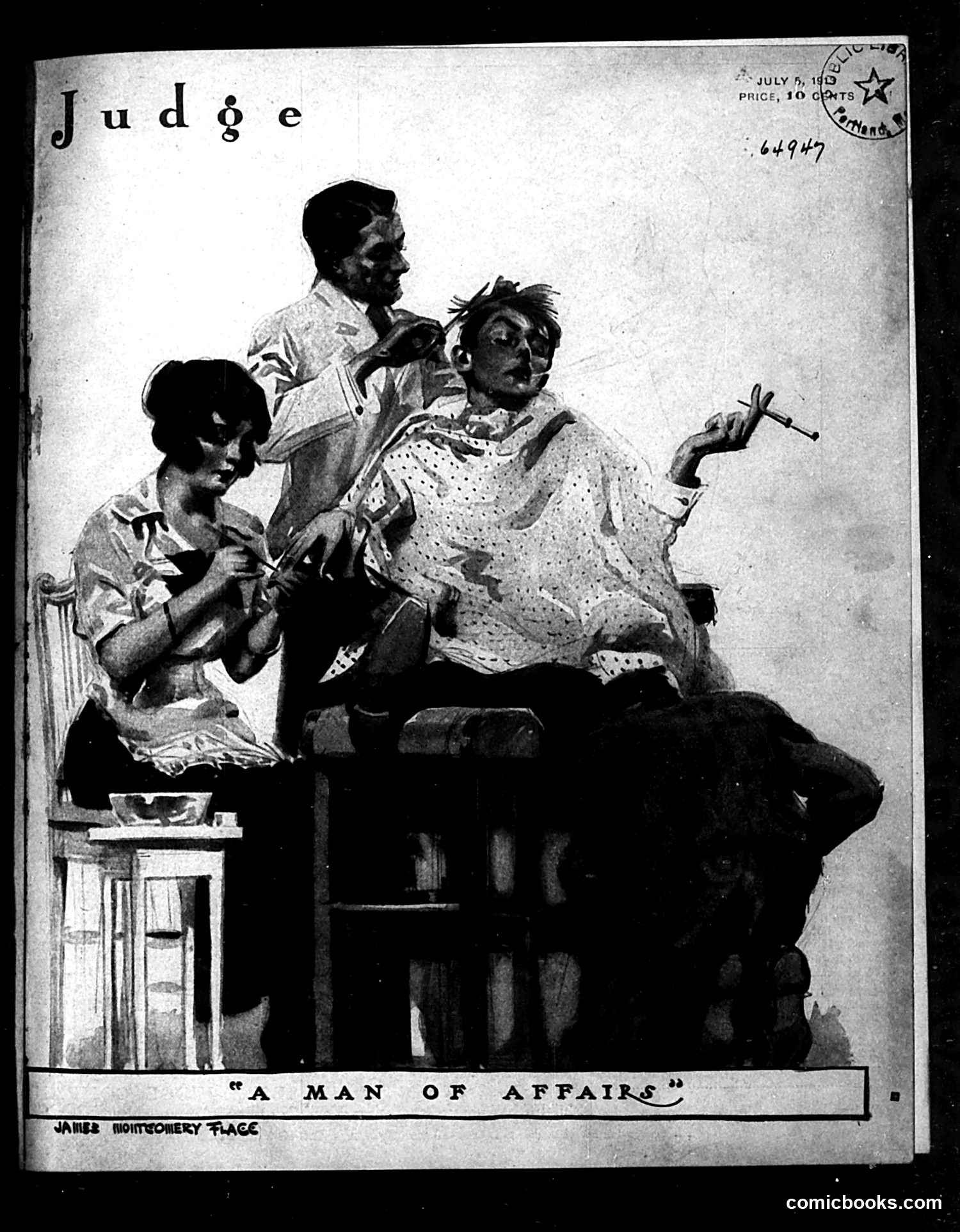
This Judge magazine page depicts a satirical scene titled "A Man of Affairs," credited to artist James Montgomery Flagg. The illustration shows three figures engaged in what appears to be a manicure or nail-care scene, with one man seated while others attend to his hands and nails. A dog is also present. The satire likely mocks a wealthy or influential man's excessive attention to personal grooming and appearance—suggesting vanity and concern with superficial matters rather than substantive affairs. The title's irony is key: a genuine "man of affairs" (someone handling important business) would be occupied with serious matters, not elaborate personal grooming. This was a common Judge magazine theme: ridiculing the frivolous preoccupations of the leisure class or specific public figures.
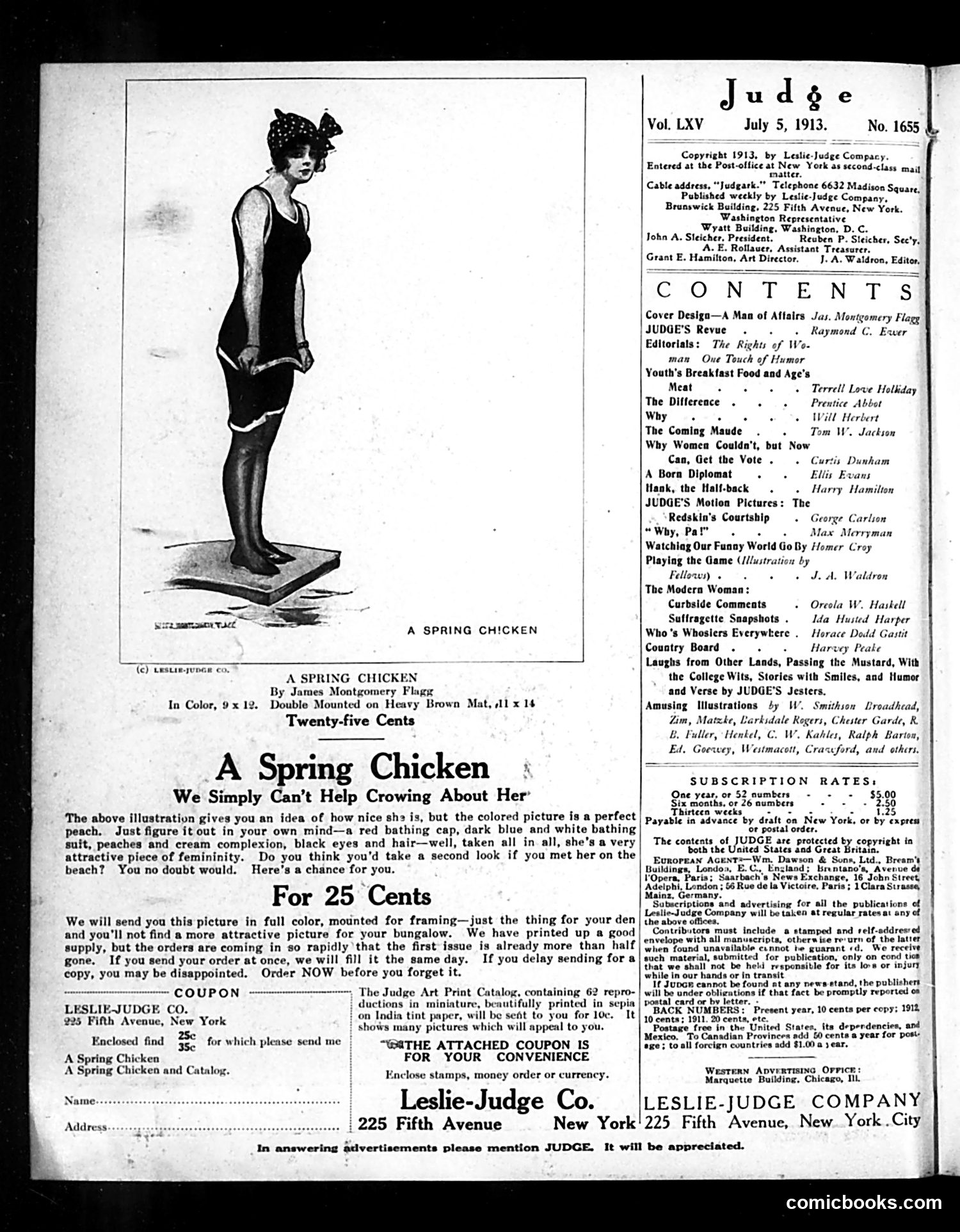
This page is primarily an **advertisement** for a print ("A Spring Chicken" by James Montgomery Flagg) rather than political satire. The illustration depicts an attractive young woman in a short dress, striking a confident pose. The accompanying text plays on the phrase "spring chicken" (slang for an attractive young woman), claiming the colored print captures her appeal perfectly—"dark blue and white bathing suit, peaches and cream complexion, black eyes and hair." The ad promises readers can own this image for 25 cents. The humor is gentle rather than satirical: it's a light, flirtatious marketing approach typical of early 20th-century advertising, appealing to male readers' appreciation of attractive women while celebrating Flagg's popular illustration style.
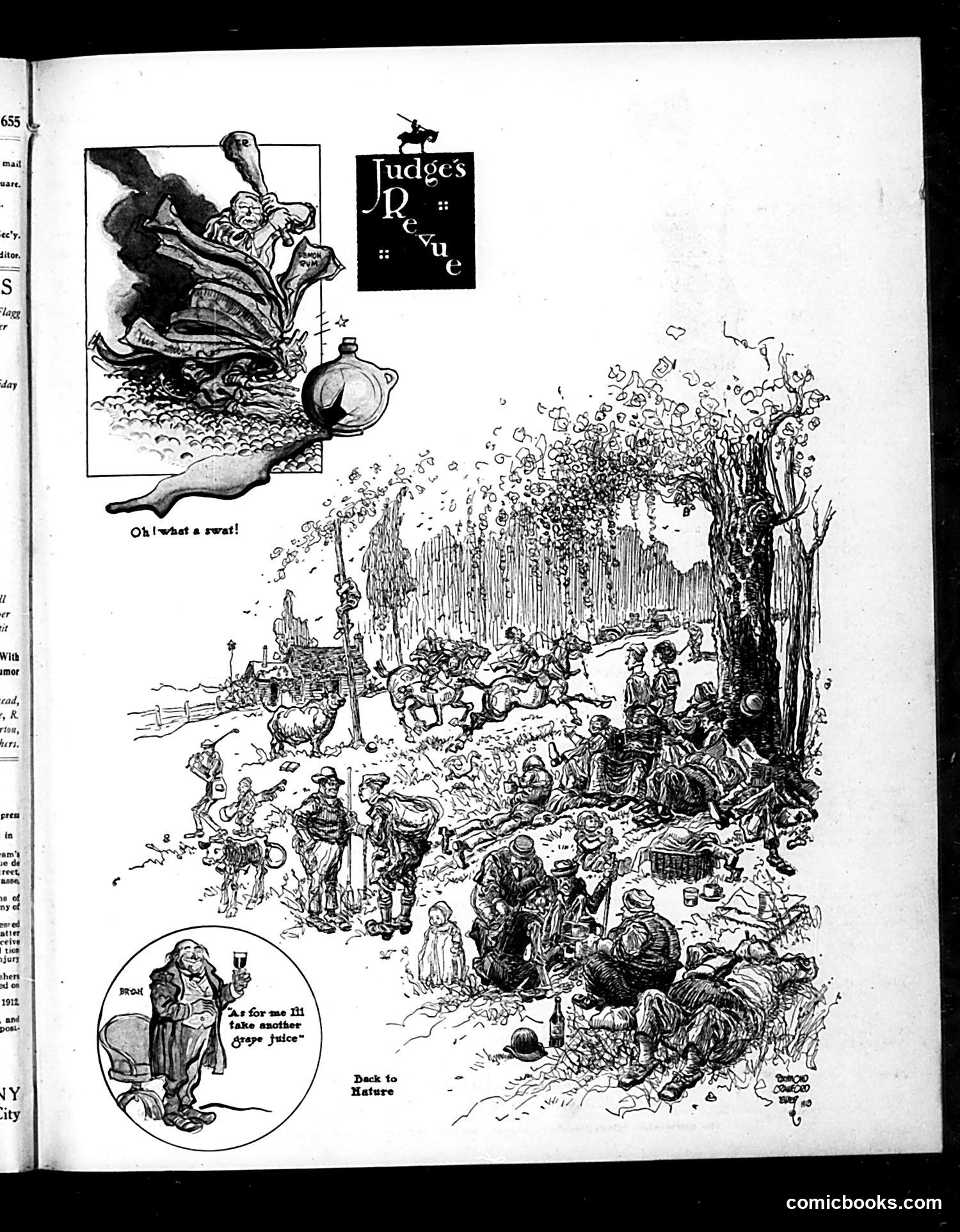
This page from *Judge* magazine features two satirical cartoons. The top left shows a figure emerging from what appears to be a cornucopia or harvest vessel, with the caption "Oh! what a swat!" — likely commenting on harvest abundance or agricultural policy. The main illustration depicts a large outdoor gathering or picnic scene beneath a massive tree, labeled "Back to Nature." The crowded composition suggests satire of the contemporary "back to nature" movement — a popular early 20th-century trend advocating simplified living and nature connection. The cartoonist appears to mock this ideal by showing it attracting chaotic crowds, undermining the movement's premise of peaceful communion with nature. The circular inset shows a figure with grape juice, adding commentary (exact reference unclear).
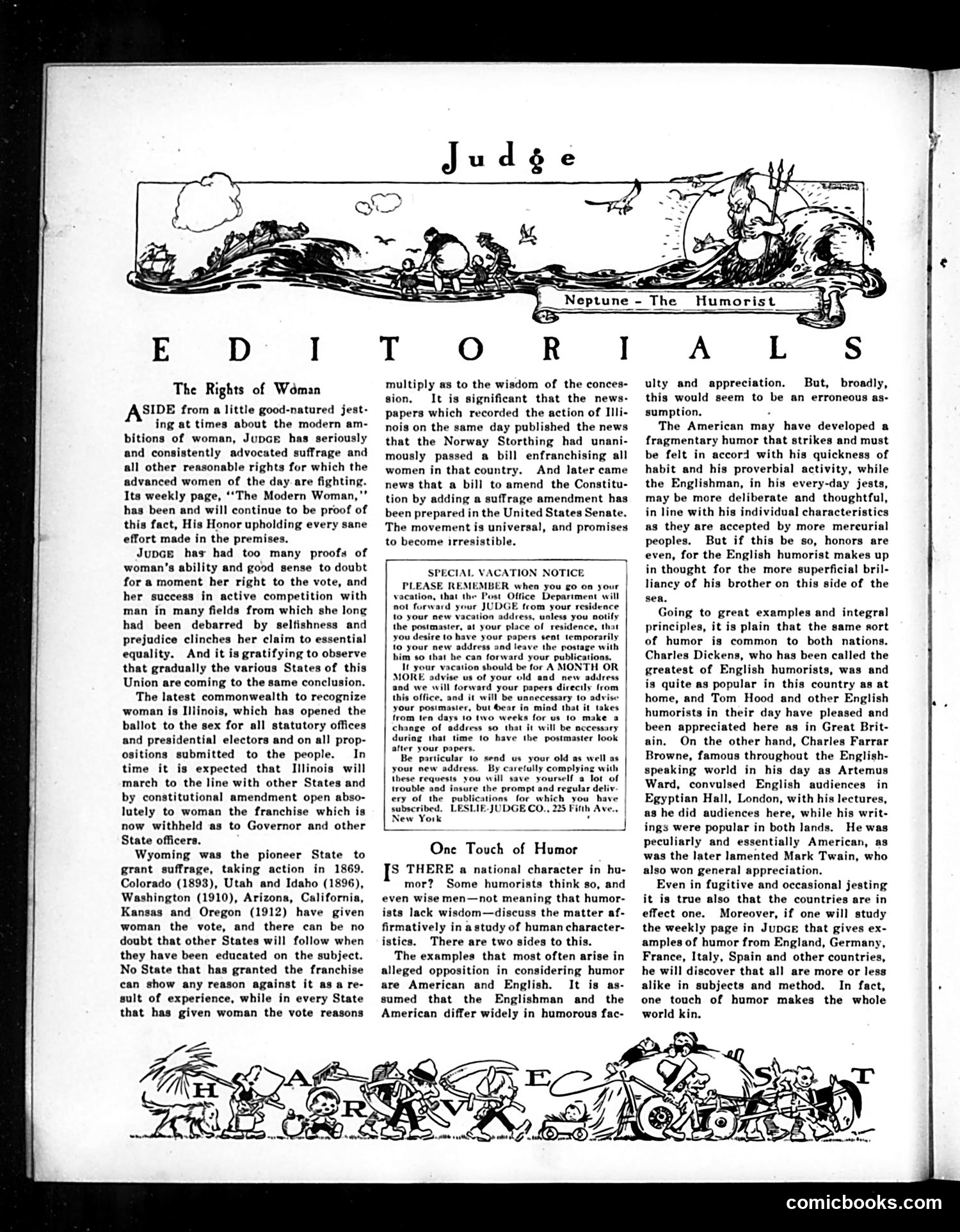
This editorial page discusses women's suffrage rights, celebrating recent progress in granting women voting rights across American states (Illinois, Colorado, Wyoming, Washington, and others mentioned). The text argues for expanding these rights nationally. The header illustration labeled "Neptune - The Humorist" appears to be decorative rather than directly political. The main content compares American and English humor traditions, noting that both countries feature humor in their publications. It references famous English humorists like Charles Dickens, Charles Lamb, and Tom Hood, suggesting that humor itself—particularly satirical commentary—is a legitimate vehicle for social and political discussion across both nations. The bottom decorative border shows various playful figures, typical of Judge's style.
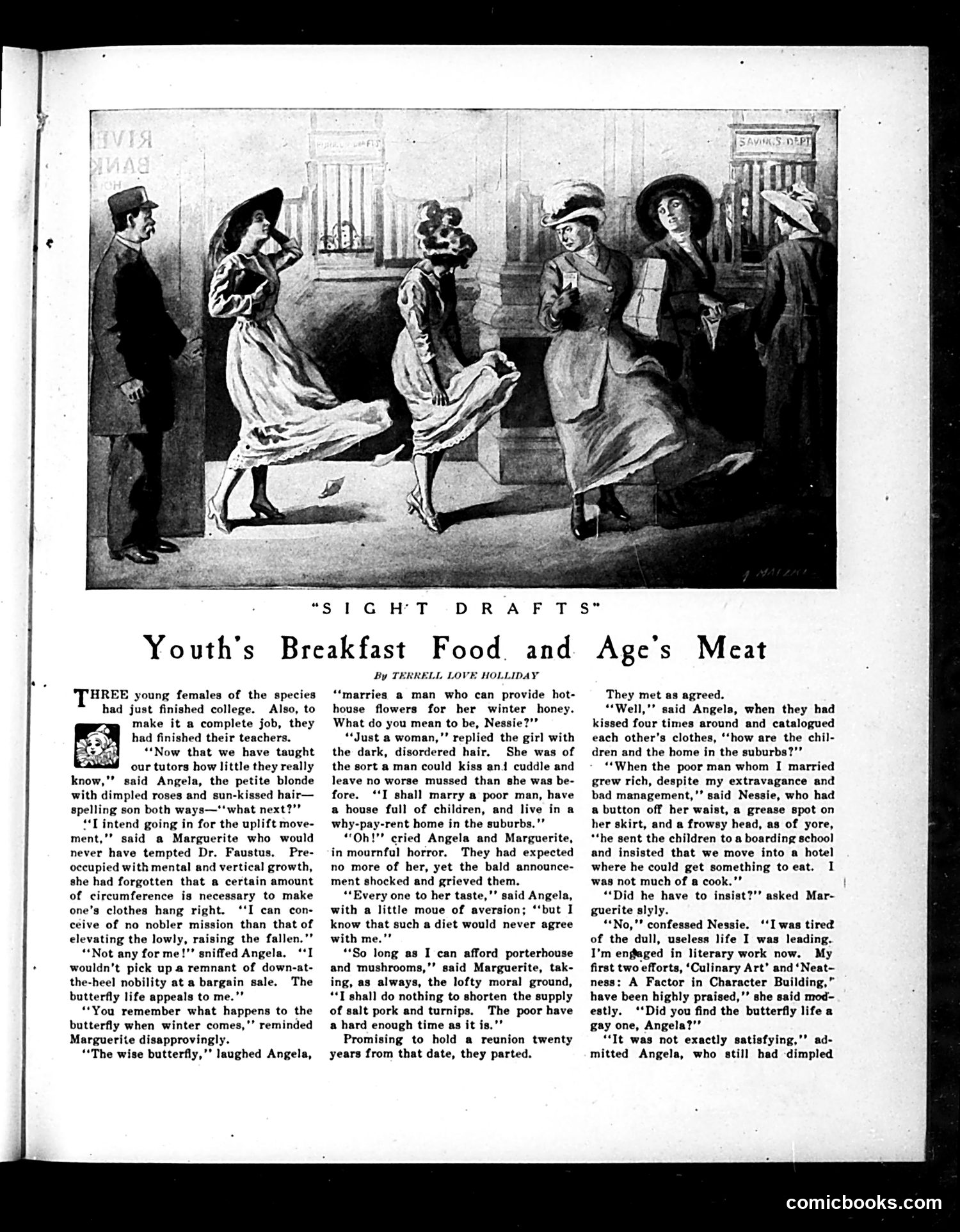
This satirical story by Terrell Love Holliday critiques women's marital expectations through three college-educated young women. The cartoon illustrates their conversation about marriage ideals versus reality. Angela, Marguerite, and Nessie initially express romantic notions about marrying poor men and living modestly. However, their real experiences diverge sharply: Angela married a wealthy man but ended up managing household chaos; Marguerite married a poor man with many children and dull suburban life; Nessie pursued literary work instead. The satire mocks the gap between youthful romantic idealism (the "breakfast food" of youth) and the practical, unglamorous realities of adult married life (the "meat" of age). It suggests women's college education doesn't prepare them for marriage's actual demands, whether to rich or poor husbands.
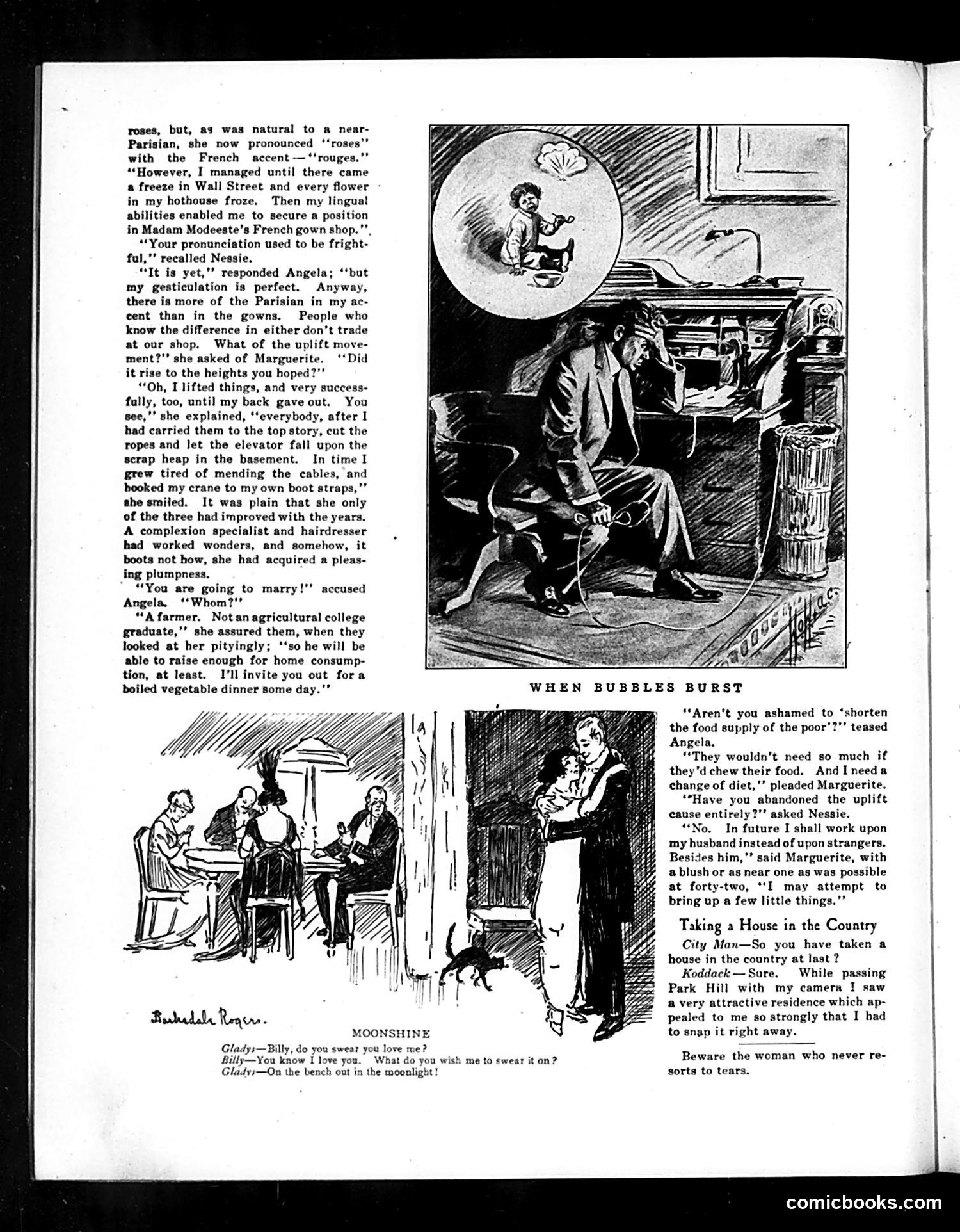
This page contains three satirical pieces mocking early 1900s social movements and female aspirations. The main story follows three women reuniting after years apart. Each represents a failed "uplift" movement: Angela worked in fashion; Nessie attempted the "uplift movement" (likely women's physical culture/exercise fads) until her back gave out; Marguerite is marrying a farmer. The satire targets women's ambitions—their French affectations, failed self-improvement schemes, and ultimate retreat into domesticity and marriage. The joke is that none achieved genuine betterment despite their efforts. "Moonshine" is a brief romance joke about a couple's public declaration of love. "When Bubbles Burst" mocks a woman defending her consumption habits as "uplift work," now planning to reform her husband instead—satirizing how women redirect their reformist energy toward controlling men's behavior. "Taking a House in the Country" is a photography pun: the "Koddack" (Kodak camera brand) enthusiast literally "snapped" a house he liked, confusing photography with property acquisition.
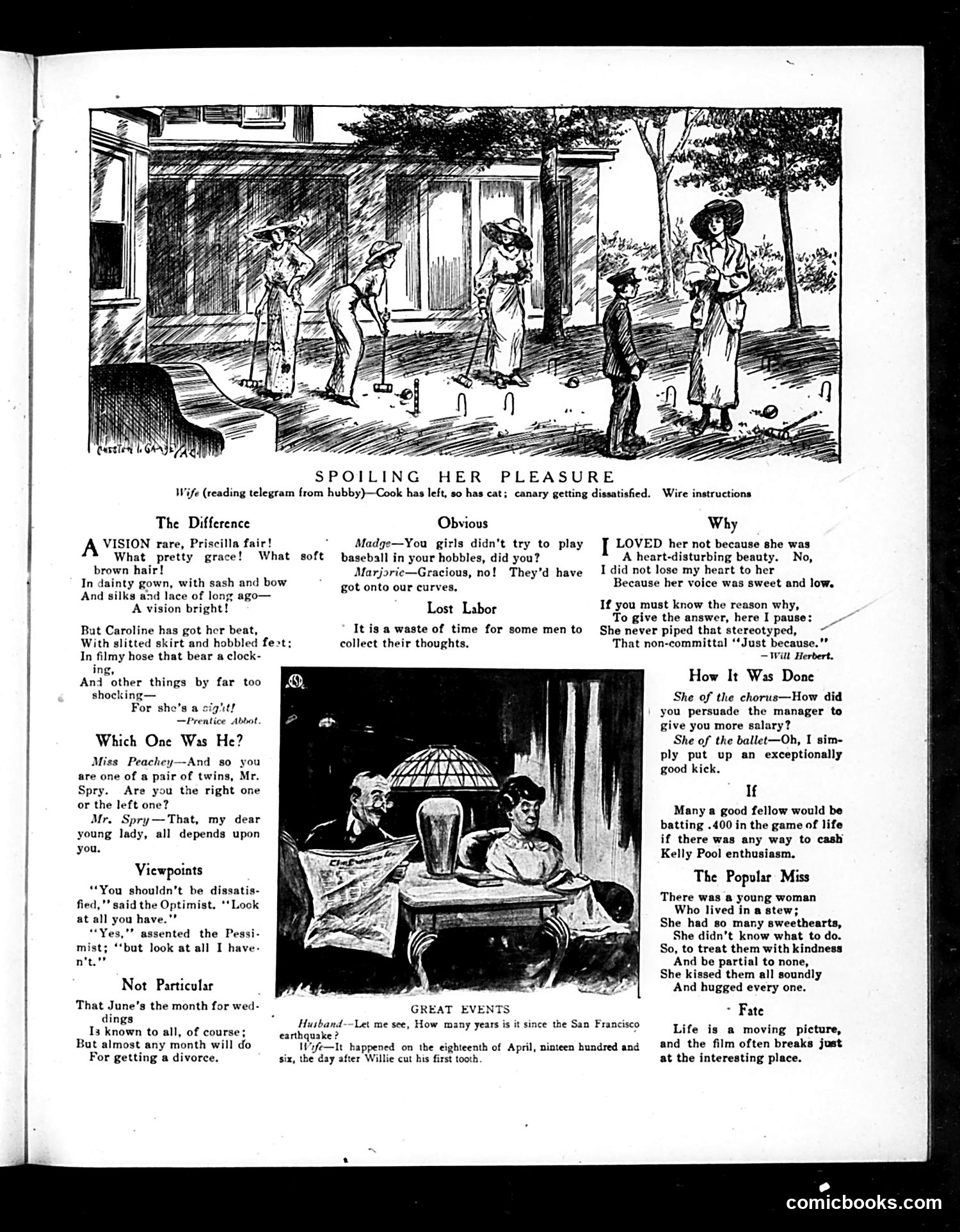
This Judge magazine page collects early 20th-century domestic and social satire. The main cartoon depicts a wife reading a telegram about household problems—the cook has quit, there's a cat issue, and the canary is unhappy—while her husband requests wire instructions. The joke satirizes marital dynamics: the husband's absence creates petty domestic chaos that demands his guidance. Surrounding items mock contemporary social issues. "The Difference" contrasts old-fashioned feminine modesty with modern women's daring fashions (slitted skirts, "hobbles"). Other pieces joke about divorce, marriage timing, women's ambitious behavior ("good kick"), and courtship. References to "Kelly Pool" suggest baseball gambling. The "San Francisco earthquake" reference likely dates this to the 1906 disaster era. Overall, the page reflects Belle Époque anxieties about changing gender roles, modern women's independence, and evolving courtship customs.
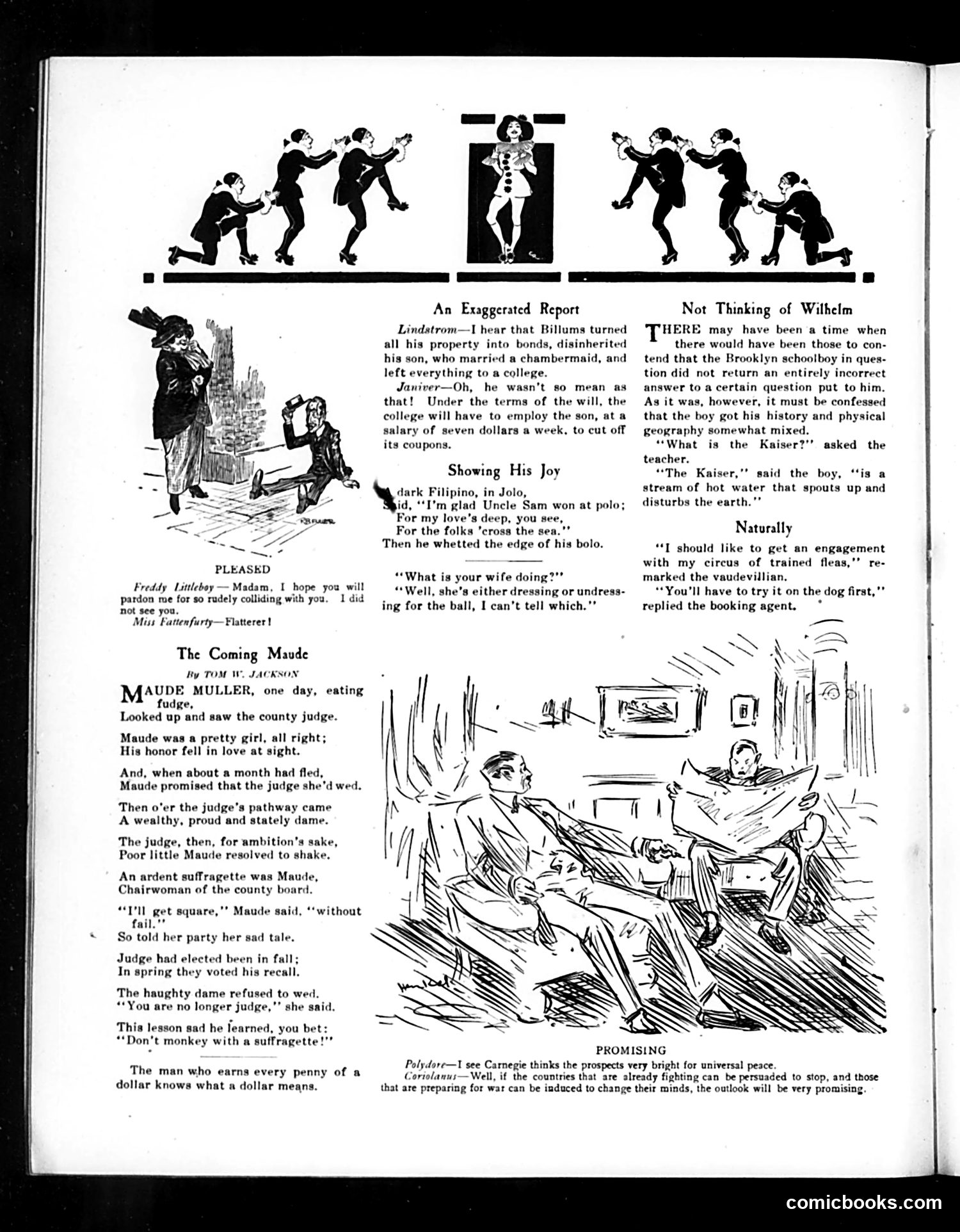
This page contains several brief satirical pieces typical of Judge magazine's humor: **"The Coming Maude"** tells of a county judge who abandons his fiancée, Maude Muller, to marry a wealthy woman. The joke's punch: Maude is a suffragette and county board chairwoman who retaliates by organizing women voters to recall him in the next election. The moral warns against "monkeying with a suffragette"—reflecting early-20th-century anxieties about women's political power following suffrage movements. **"Not Thinking of Wilhelm"** satirizes a Brooklyn schoolboy who, when asked "What is the Kaiser?" answers it's a geyser (hot water spring). This conflates Kaiser Wilhelm II of Germany with Yellowstone's geysers, suggesting American children's geographical confusion during a period of German-American tension. **"Showing His Joy"** presents a Filipino in Jolo (Philippines) celebrating Uncle Sam's polo victory, but the final line—"he whetted the edge of his bolo" (machete)—darkly suggests underlying violence despite surface cheerfulness, likely referencing colonial tensions. The other brief jokes address domestic manners and peace prospects.
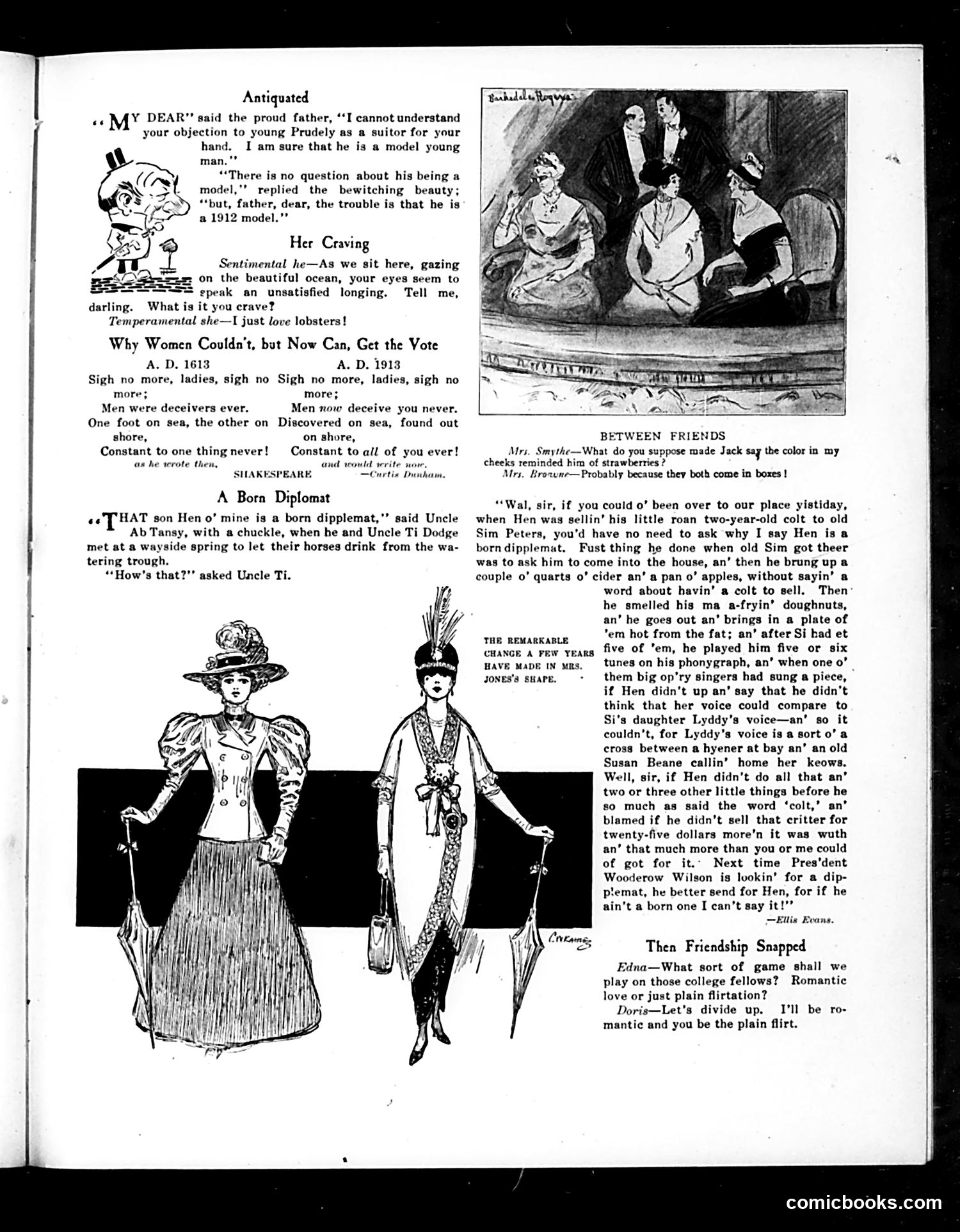
This page from Judge (circa 1913) contains several satirical pieces mocking social customs and gender relations: **"Antiquated"** jokes about outdated suitors—a father can't understand his daughter's objection to a "model young man," only to learn he's a 1912 model (implying he's become obsolete). **"Why Women Couldn't, but Now Can, Get the Vote"** adapts Shakespeare to contrast 1613 and 1913. The 1613 version claims men are deceivers; the 1913 version claims men "never" deceive women anymore—a sarcastic comment on women's newly acquired voting rights (1913 context suggests suffrage expansion). **"A Born Diplomat"** is a rural dialect anecdote about a farmer shrewdly selling a colt by entertaining the buyer first, subtly praising the buyer's daughter's voice—manipulative but effective salesmanship. **"Between Friends"** contains a crude joke about a woman's red cheeks resembling strawberries "because they both come in boxes"—implying artificial cosmetics. The fashion illustrations show the "remarkable change" in women's silhouettes over a few years, reflecting evolving dress styles.
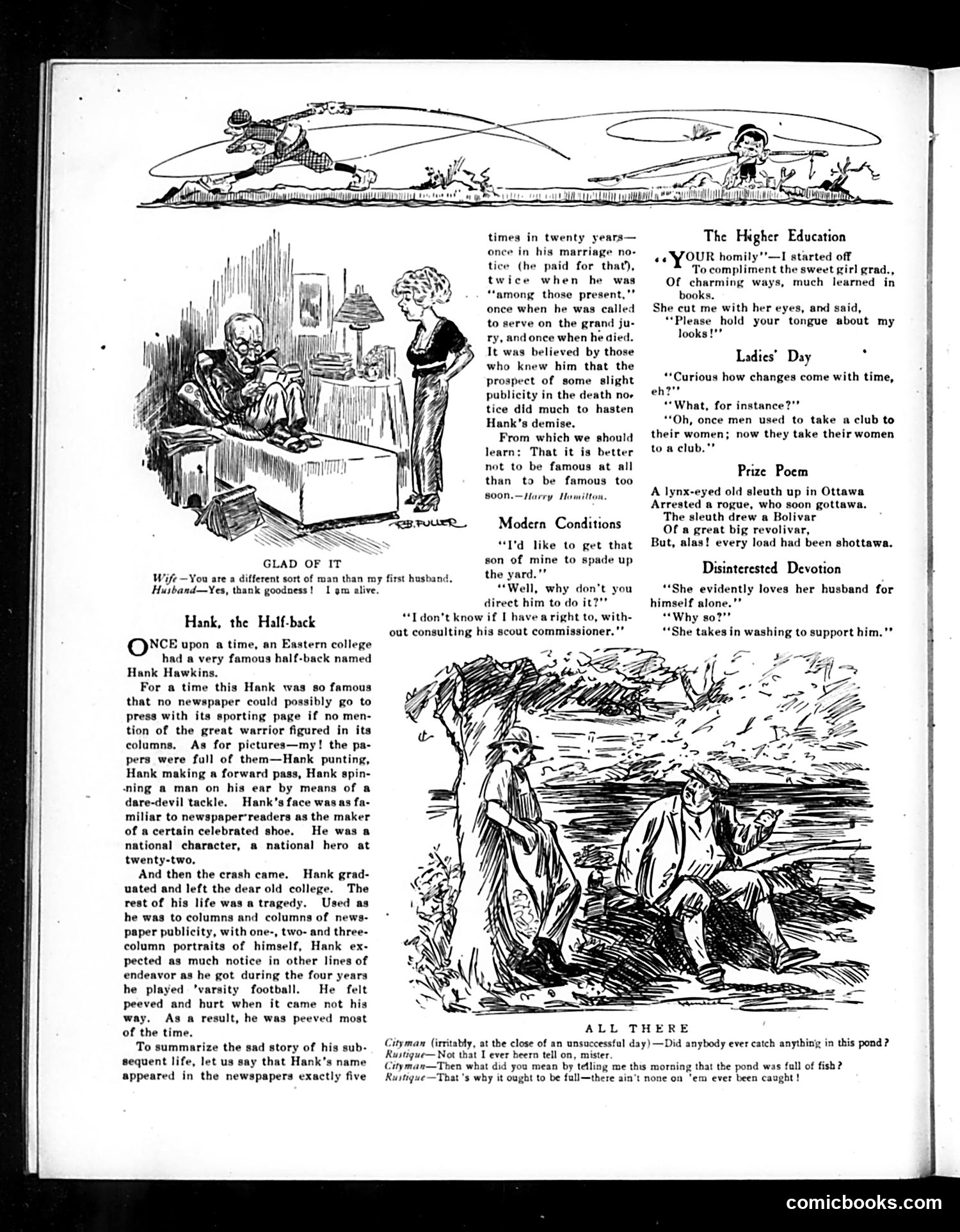
This satirical story mocks the fleeting nature of celebrity and Americans' obsession with athletic fame. Hank Hawkins, a college football star whose face dominated newspapers during his playing years, becomes a complete nonentity after graduation. Despite expecting continued prominence in adult life, he receives newspaper mention only five times in twenty years—his wedding, minor social appearances, jury duty, and death notice. The satire targets both Hank's inflated ego (he assumes his football celebrity should transfer to everyday life) and society's shallow celebrity culture. The moral warns that early fame can breed entitlement and disappointment rather than success. The accompanying humorous vignettes reinforce the magazine's broader critique of modern conditions—changing gender relations, scout commissioners interfering with parenting, and women's education prioritized over appearance—capturing early 20th-century anxieties about social transformation.
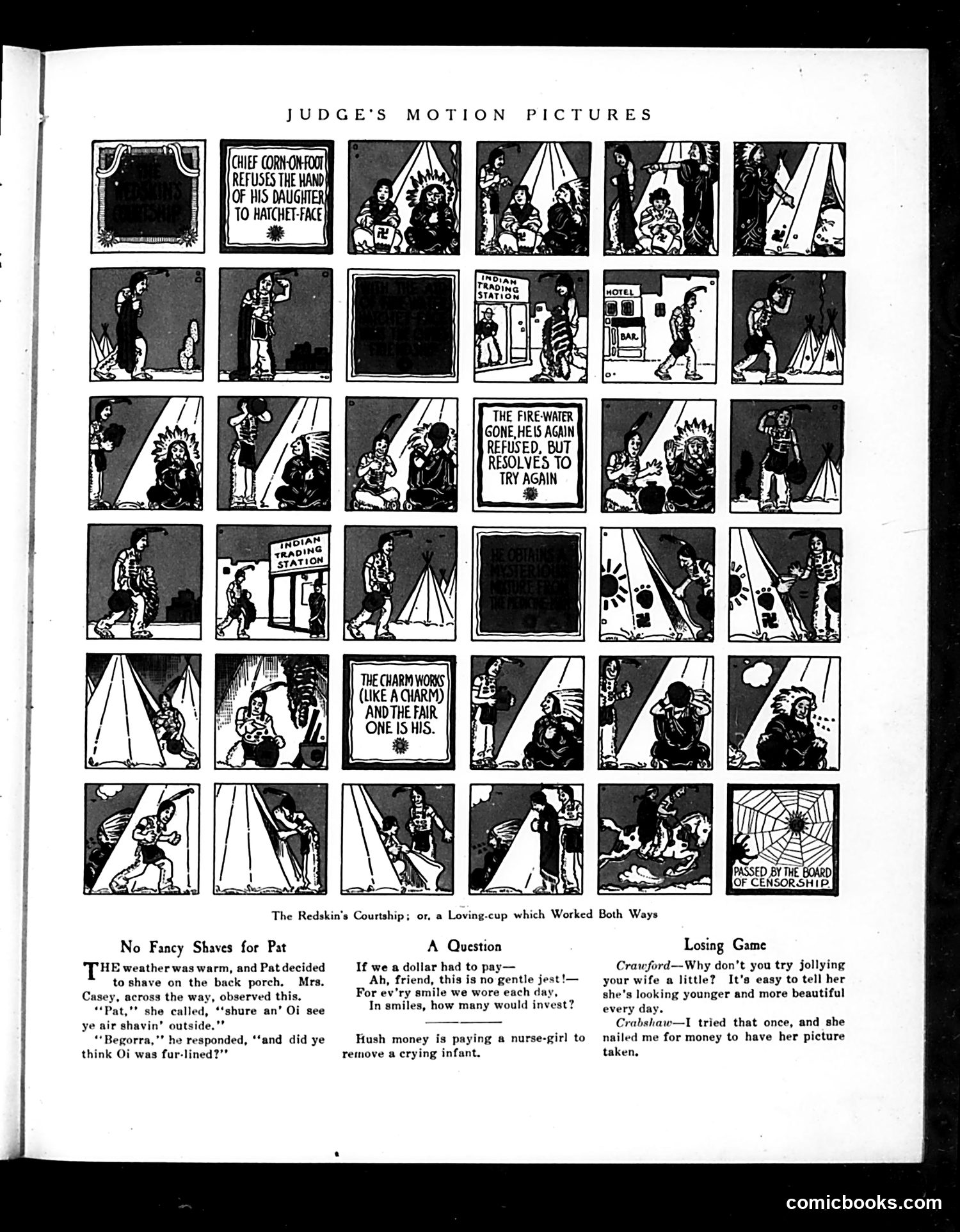
This page contains several unrelated short satirical pieces typical of Judge magazine: **"The Redskin's Courtship"** is a multi-panel comic strip (title visible at bottom) using racist stereotypes of Native Americans, depicting what appears to be a courtship scenario involving alcohol ("fire-water"). This reflects the era's deeply offensive caricaturing of Indigenous peoples. **"No Fancy Shaves for Pat"** is a brief Irish-dialect joke where Pat Casey shaves outdoors, leading to an exchange playing on Irish accent and working-class humor—typical of period ethnic humor. **"A Question"** is a short philosophical quip about the monetary value of smiling. **"Losing Game"** presents a domestic humor joke: a husband learns that complimenting his wife's appearance backfires when she demands money for photographs, satirizing both marital dynamics and vanity. The humor relies on ethnic stereotypes, gender roles, and class-based comedy common to early 20th-century American satire.
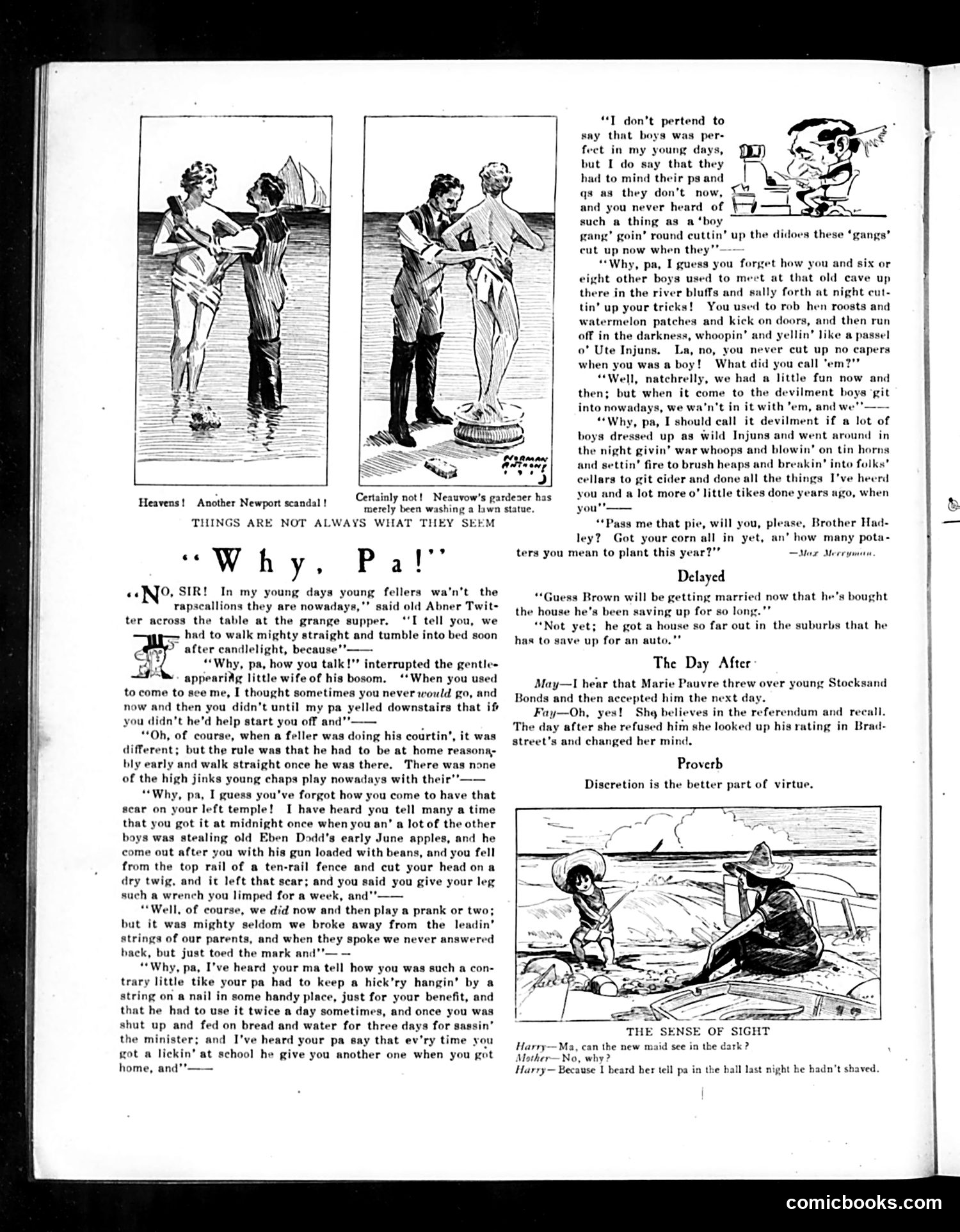
This page from *Judge* magazine contains a satirical dialogue titled **"Why, Pa!"** that mocks nostalgic complaints about youth misbehavior. **The Setup:** An elderly man (Abner Twitter) complains at a grange supper that boys today are "rapscallions" who misbehave—unlike his generation, which was disciplined and obedient. **The Satire:** His wife systematically contradicts him, reminding him of his own youthful transgressions: stealing apples, robbing henroosts, trespassing, destroying property, sneaking out late while courting, and receiving frequent beatings from his father. She also mentions him getting a scar from a dangerous prank. **The Point:** The cartoon satirizes the perennial generational complaint that "kids today are worse than we were." It exposes this as false nostalgia—the old man conveniently forgets his own identical misbehavior. The wife's patient, factual corrections highlight how each generation claims moral superiority despite similar youthful behavior. The page also includes unrelated short items ("Delayed," "The Day After," "The Sense of Sight").
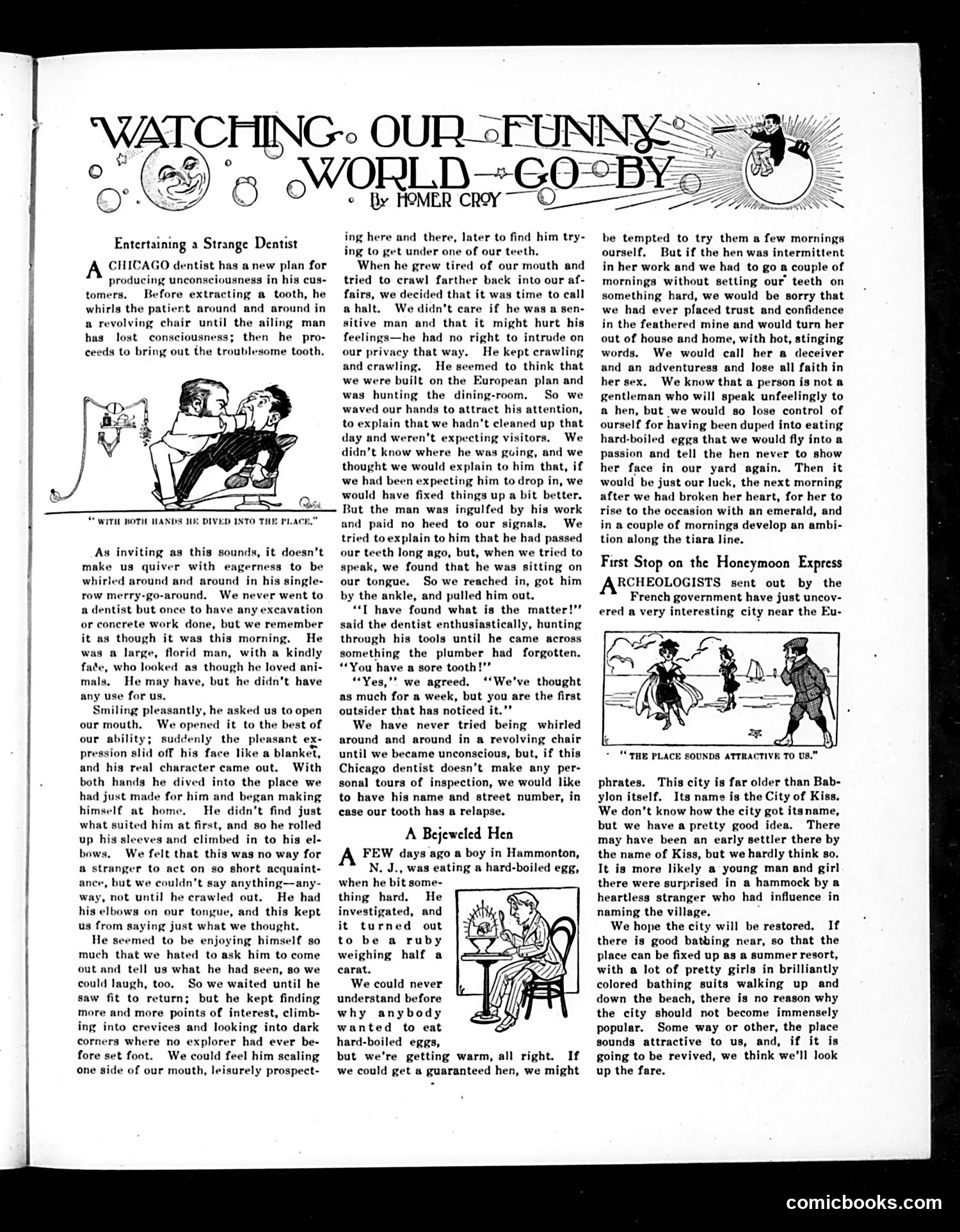
This page contains humorous personal essays by Homer Croy satirizing everyday American experiences, not political content. **"Entertaining a Strange Dentist"** mocks the anxiety of dental visits. The author describes a sadistic Chicago dentist who uses a revolving chair to unconsciously sedate patients before extraction. The narrative humorously portrays the dentist's invasive exploration of the author's mouth—crawling deep into crevices while the paralyzed patient cannot protest—as an absurd violation of personal space. The dentist's triumphant discovery of a "sore tooth" the patient already knew about punctures his professional authority. The satire targets both dental discomfort and the pretension of medical expertise. **"A Bejeweled Hen"** (incomplete on this page) appears to begin another anecdote about a boy in Hammonton, New Jersey finding something unexpected in a hard-boiled egg. Both pieces exemplify *Judge* magazine's style: lighthearted social commentary on middle-class American life through exaggerated personal anecdotes rather than political satire.
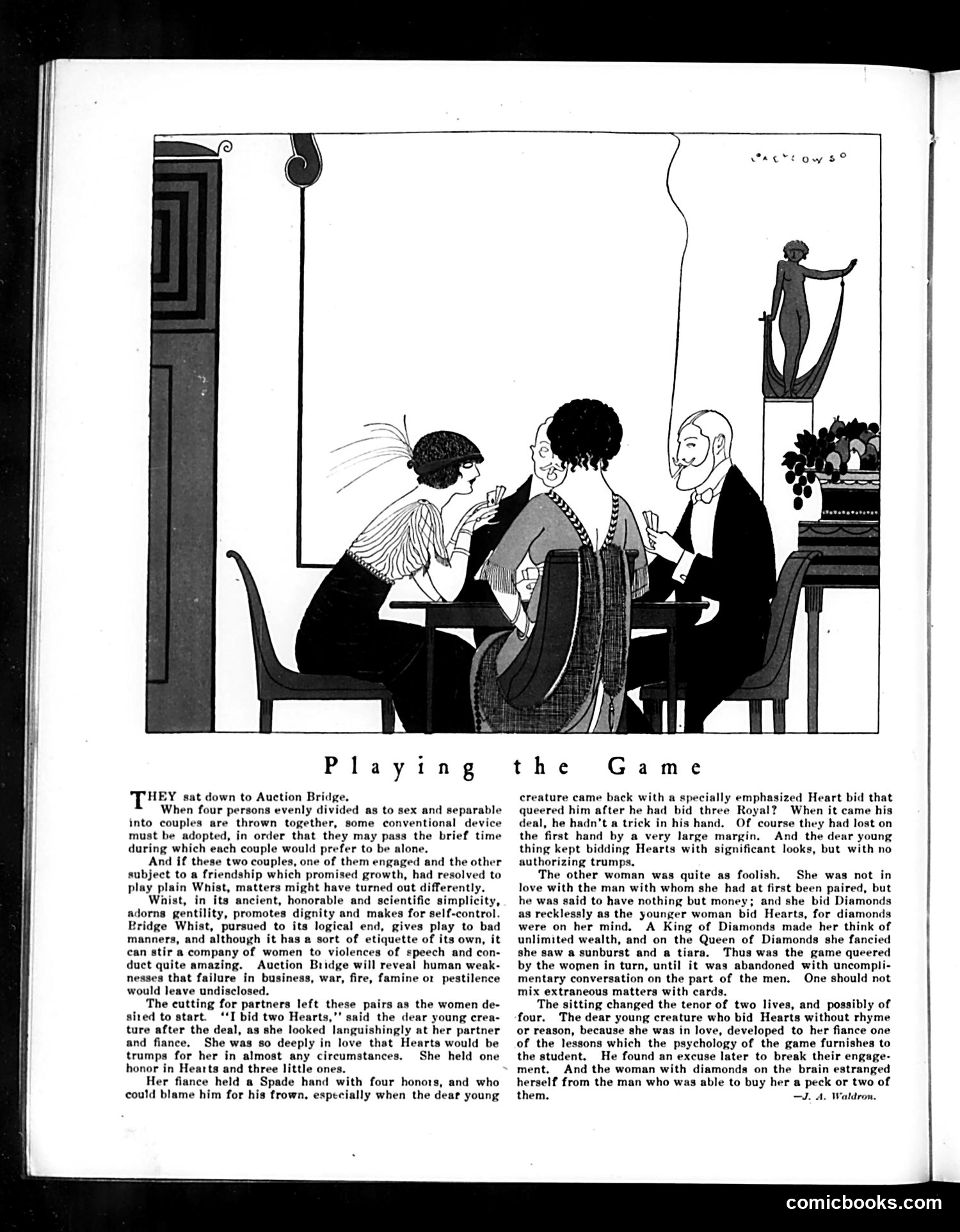
This is an illustrated short story (not a political cartoon) satirizing how card games reveal character flaws, particularly in women. The scene depicts four people playing Auction Bridge. The narrative contrasts this game with traditional Whist, arguing that Bridge's competitive nature exposes human weaknesses that "failure in business, war, fire, famine or pestilence would leave undisclosed." Two couples play: an engaged pair and two unattached people. The satire targets women's judgment: - The engaged woman bids Hearts recklessly because she's in love, not because her cards warrant it, signaling emotional irrationality to her fiancé - The other woman bids Diamonds obsessively, fantasizing about wealth and luxury items (tiaras), revealing materialistic shallowness The story concludes that these card-game revelations damage both relationships—the fiancé breaks their engagement, and the wealthy man distances himself from the diamond-obsessed woman. The moral: women shouldn't "mix extraneous matters with cards," implying their personal preoccupations corrupt judgment and expose unflattering truths.
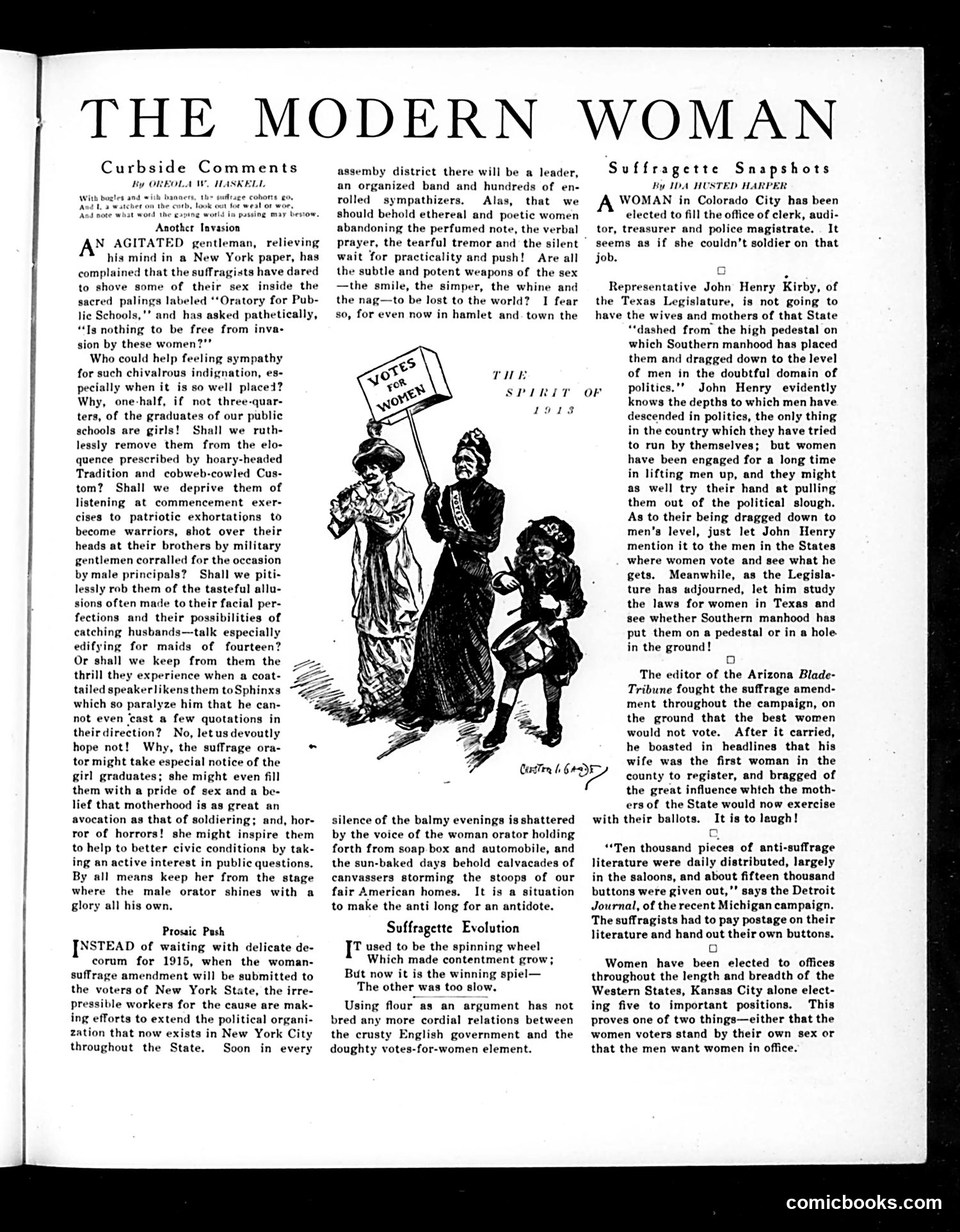
This page satirizes the women's suffrage movement through three pieces of mock-indignant commentary. **"Another Invasion"** uses irony to attack opponents of women speaking in public forums. The author sarcastically sympathizes with a man upset that suffragists want female students to hear women orators at school commencements—yet notes girls comprise half or more of public school graduates. The satire highlights the absurdity of excluding women from spaces where they're the majority audience. **"Prosaic Push"** mocks suffragists' practical organizing efforts, lamenting that women are abandoning "ethereal" femininity (smiling, whining) for ungraceful activism like soapbox speeches and canvassing door-to-door. **"Suffragette Evolution"** presents a short poem contrasting women's traditional domestic role (spinning wheel) with modern political activism (the "winning spiel"). The page's central cartoon depicts two suffragettes with a "VOTES FOR WOMEN" sign, visualizing their public activism. These pieces use heavy irony to defend suffragists against conservative critics who viewed women's political participation as unseemly and unfeminine.
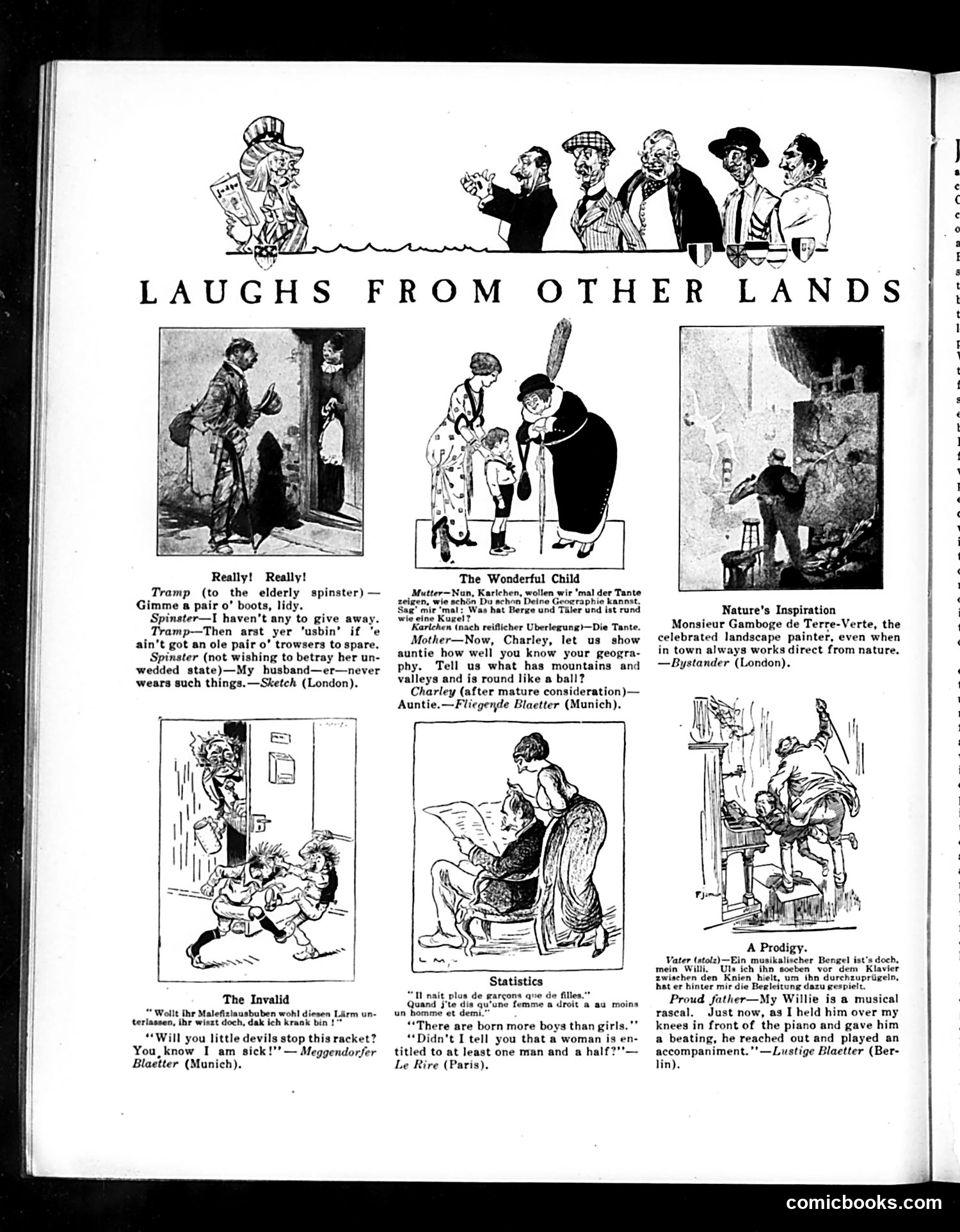
This page collects humorous short comics from European publications (German, French, British), presenting them as exotic foreign humor for American readers. The jokes rely on verbal misunderstandings and social absurdities: a tramp assumes an unmarried woman must have a husband; a child literally answers a geography riddle by pointing to his round-faced aunt; a painter insists on working "from nature" even in town (implying he paints models indoors); and a father beats his son while the boy plays piano accompaniment—presented as musical talent rather than abuse. The "Statistics" cartoon mocks gender relations, joking that women outnumber men so badly each woman deserves 1.5 men. These reflect early-20th-century Judge magazine's practice of presenting international humor as quaint or absurd, offering American audiences supposedly sophisticated European wit.
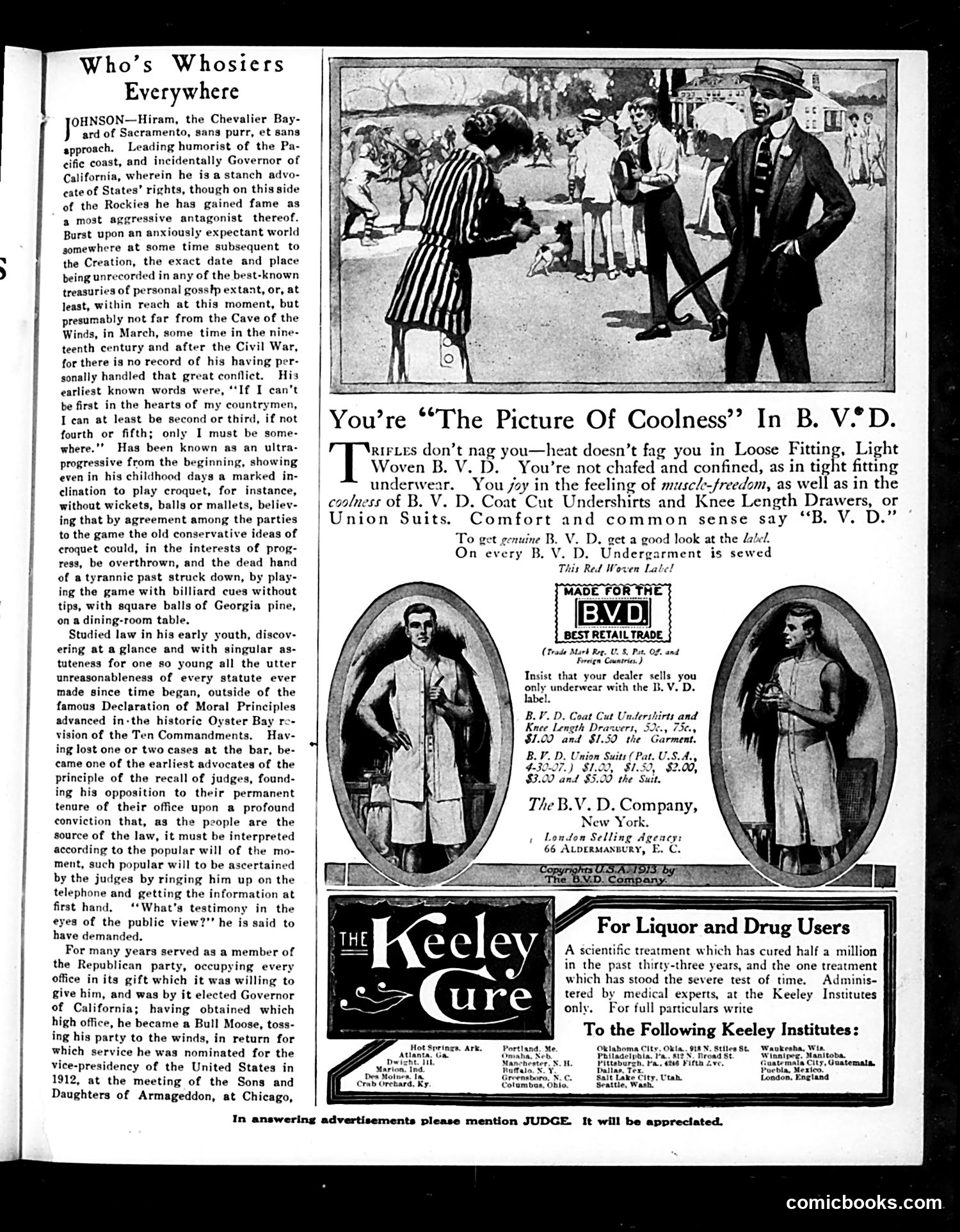
This page satirizes **Hiram Johnson**, California's Governor and 1912 Vice-Presidential candidate on Theodore Roosevelt's Progressive "Bull Moose" ticket. Judge mocks Johnson as a hypocritical radical: **The Joke**: Johnson championed "States' rights" while being the Pacific coast's most aggressive antagonist of states' rights—a transparent contradiction. The text ridicules his extreme progressivism through absurd examples (playing croquet without wickets or balls; wanting judges to phone constituents for legal interpretation rather than reading testimony). **Key Satirical Points**: - His political shapeshifting (Republican → Bull Moose) - His self-aggrandizing ambition ("If I can't be first...I must be somewhere") - His pretense to principle masking pure opportunism The accompanying cartoon shows Johnson (likely the figure on the right) in a social scene, though the specific visual joke is unclear from context alone. The page's remaining content is advertising (B.V.D. underwear, Keeley Cure).
This page is primarily **advertising and filler content** rather than political satire. The dominant elements are commercial ads for watches (Burlington Watch Company), hotels (Hotel Albert, Hotel Ostend), and consumer products (Pears' Soap). The only substantive satirical text is a brief piece titled "A Sure Sign"—a short joke about a man named Snubbins worried his garden will fail because neighbors' chickens show no interest in it. This is mild domestic humor, not political commentary. The "Country Board" section consists of loosely connected Biblical quotes about hospitality and rest, seemingly filler material. **Overall assessment**: This appears to be a typical Judge magazine page circa 1912-1913, where editorial satire shared space with lucrative advertising. The political content, if any existed on this particular page, is minimal—the magazine's satirical punch would have appeared elsewhere in the issue.
This satirical piece critiques women's theater etiquette, specifically large feathered hats that obstructed other patrons' views—a genuine social complaint of the era. The "judge" sentences an offending woman to experience her own obstruction by positioning a large woman in front of her at bargain sales for six months, creating symmetrical comeuppance. The satire targets women's vanity and disregard for others' rights, while also highlighting a gender double standard: men were barred from wearing hats in theaters by "honorable custom," yet women faced no equivalent social pressure. The piece uses exaggerated punishment to shame women into considering collective courtesy rather than individual fashion freedom. The page also includes brief humorous anecdotes and AT&T corporate advertising using coral polyp growth as metaphor for telephone system expansion—unrelated editorial content typical of Judge magazine's mixed format.
This page is primarily **advertisements and filler content** with minimal political satire. The main cartoon "Passing the Mustard" mocks changing social attitudes: a waiter refuses tips, claiming dignity as a "free-born American citizen," then immediately demands a "retaining fee, same as lawyers"—satirizing the absurdity of rejecting one form of compensation while demanding another, essentially the same thing under a different name. Other cartoons are light humor: "The General Effect Was Very Stylish" jokes about an ugly hat through repetition; "Timesaving" plays on practical absurdism about time-saving. The bulk of the page consists of product advertisements (One Minute Camera, Allen's Foot-Ease powder, hotels, raincoats, seasickness remedy) typical of Judge's revenue model. These ads reveal period concerns: foot problems, travel ailments, and hotel amenities were apparently significant consumer interests in this era. No identifiable political figures or major social commentary appears on this particular page.
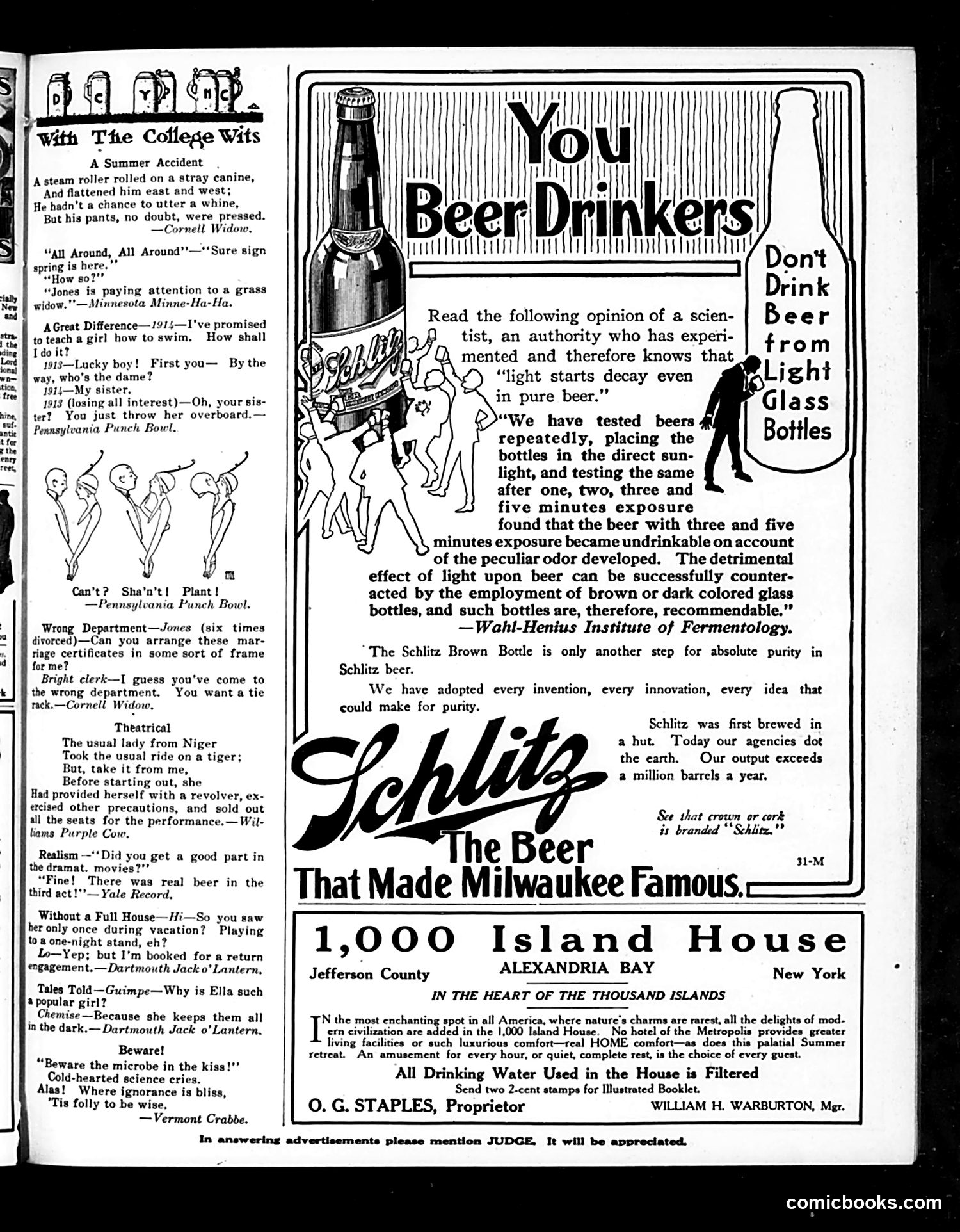
This page mixes college humor with advertising. The left side features brief satirical jokes from various college publications (Cornell Widow, Yale Record, etc.), covering typical 1910s collegiate themes: romantic mishaps, divorce humor, and cautionary tales about morality. The dominant content is a Schlitz beer advertisement claiming scientific authority. It cites the "Wahl-Henius Institute of Fermentology," stating that sunlight causes beer to spoil. The ad promotes Schlitz's brown bottles as a solution, positioning the company as puritanical and scientifically rigorous—marketing purity during the Prohibition era's moral scrutiny of alcohol. Below this is an unrelated resort advertisement for the 1,000 Island House in upstate New York. The juxtaposition is typical of Judge: lowbrow collegiate humor paired with advertisements making pseudo-scientific health claims to justify consumer products to anxious middle-class readers.
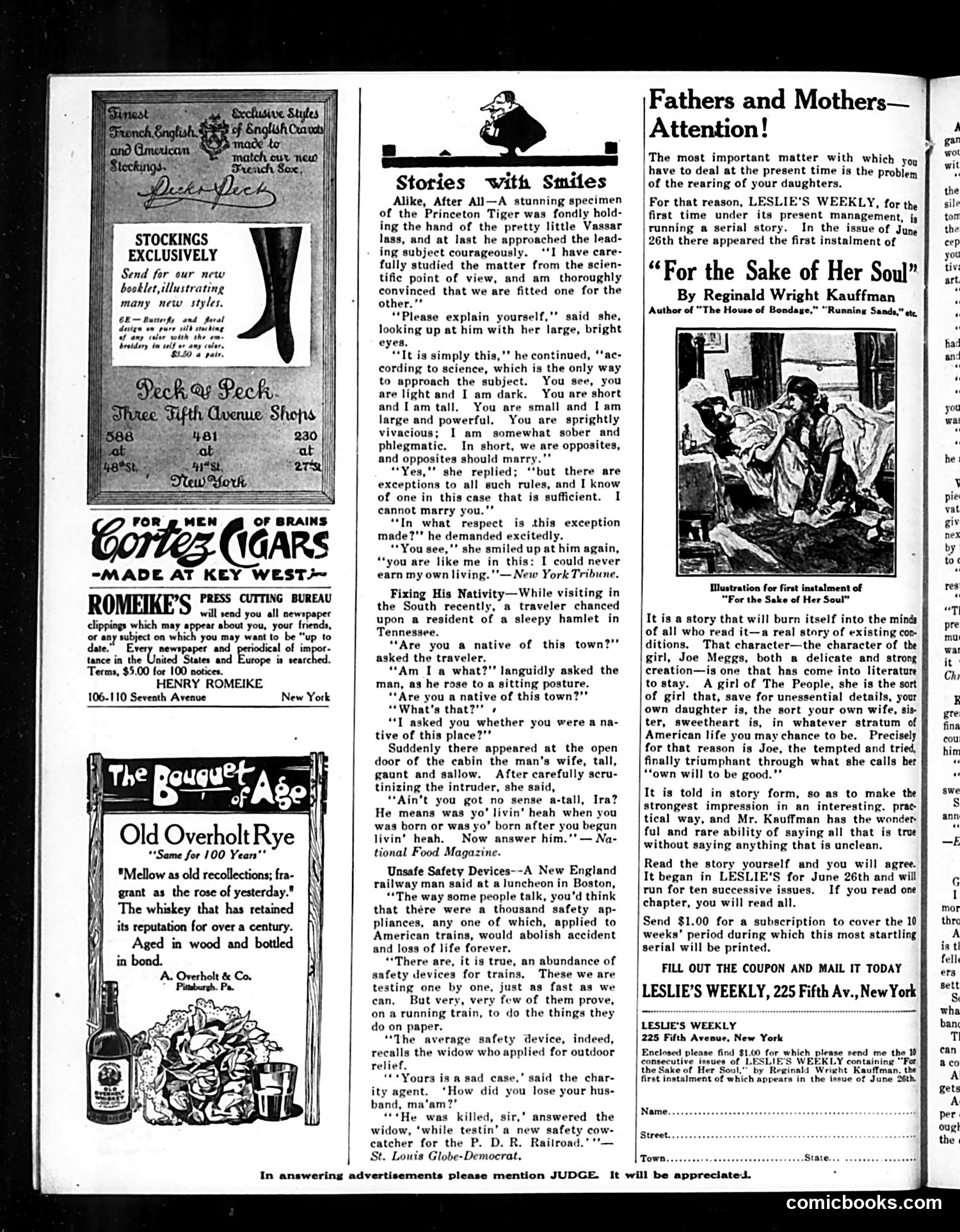
This page is primarily **advertising and promotional content** rather than political satire. The main feature is an advertisement for Leslie's Weekly promoting a serialized story titled **"For the Sake of Her Soul"** by Reginald Wright Kauffman, aimed at parents concerned with "the problem of the rearing of your daughters." The page includes three humorous anecdotes under "Stories with Smiles": 1. A Princeton/Vassar romance story playing on scientific compatibility theories 2. A rural Tennessee dialect joke about nativity 3. A railroad safety joke featuring a widow whose husband died testing a safety device These are **gentle domestic humor pieces** typical of early 20th-century magazines—no sharp political edge. The advertisements (stockings, cigars, Old Overholt whiskey, Romeike's clipping service) represent standard Judge magazine commercial content. The overall tone suggests this targets middle-class, educated readers concerned with propriety, safety, and product quality. There is **no identifiable political cartoon or significant satire** on this particular page.
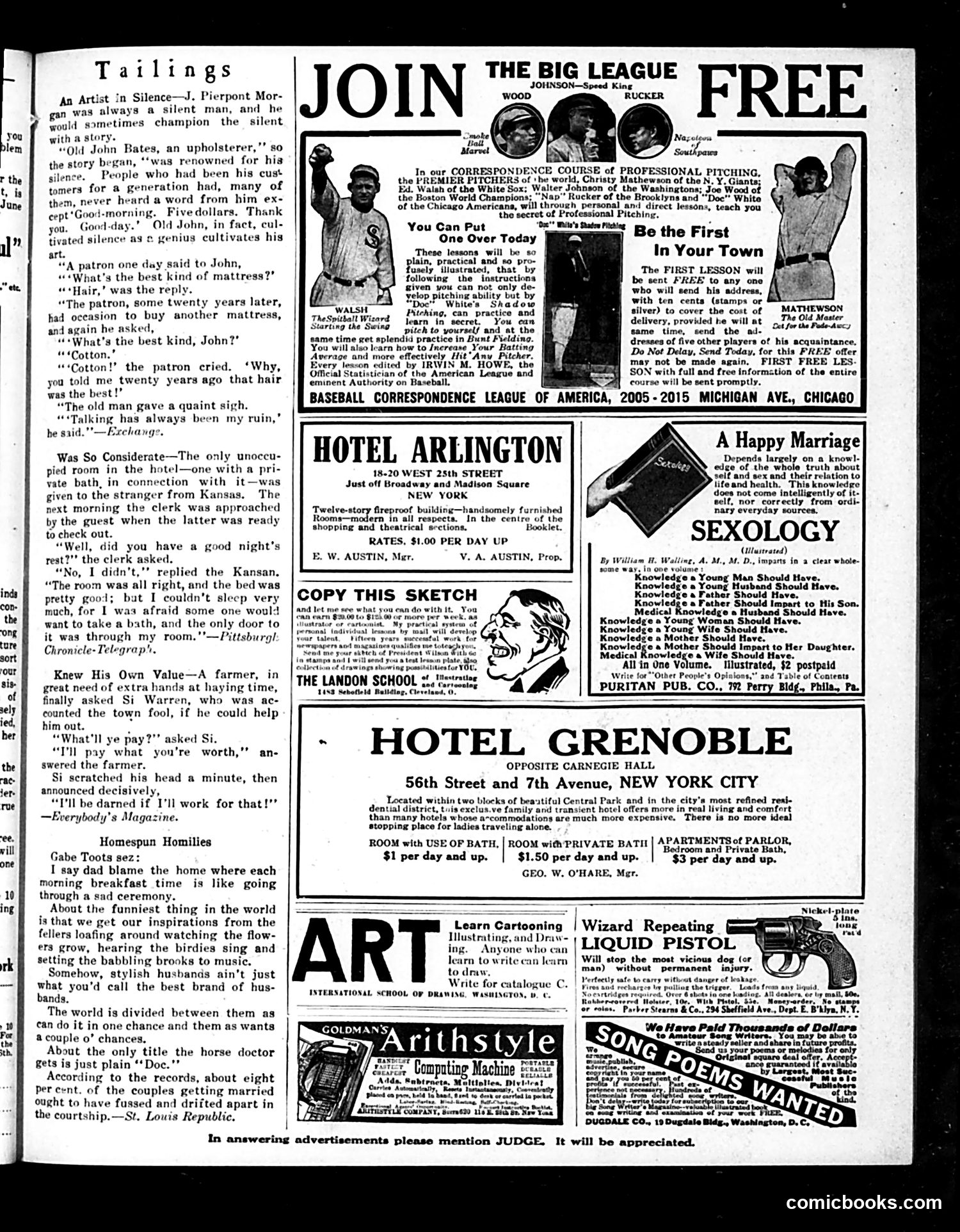
This is primarily an **advertising and humor page** from an early 1900s satirical magazine, not a political cartoon page. The main content includes: **"Tailings" humor column**: A series of brief anecdotes mocking silent people and foolish bargains—typical early 20th-century light humor about character types. **Large advertisement**: "The Big League" baseball correspondence course featuring famous pitchers (Christy Mathewson, Walter Johnson, "Doc" White) offering lessons by mail. This reflects the era's enthusiasm for mail-order education and professional baseball. **Other ads**: Hotel Arlington and Hotel Grenoble (NYC lodging), Landon School (cartooning lessons), Arithstyle (calculating machine), and "Song Poems Wanted" (a common hustle targeting amateur poets). **No significant political satire** is visible on this page. The humor is domestic and self-directed rather than satirizing public figures or events. This appears to be a filler page emphasizing commercial opportunities and gentle character humor typical of Judge's lighter content.
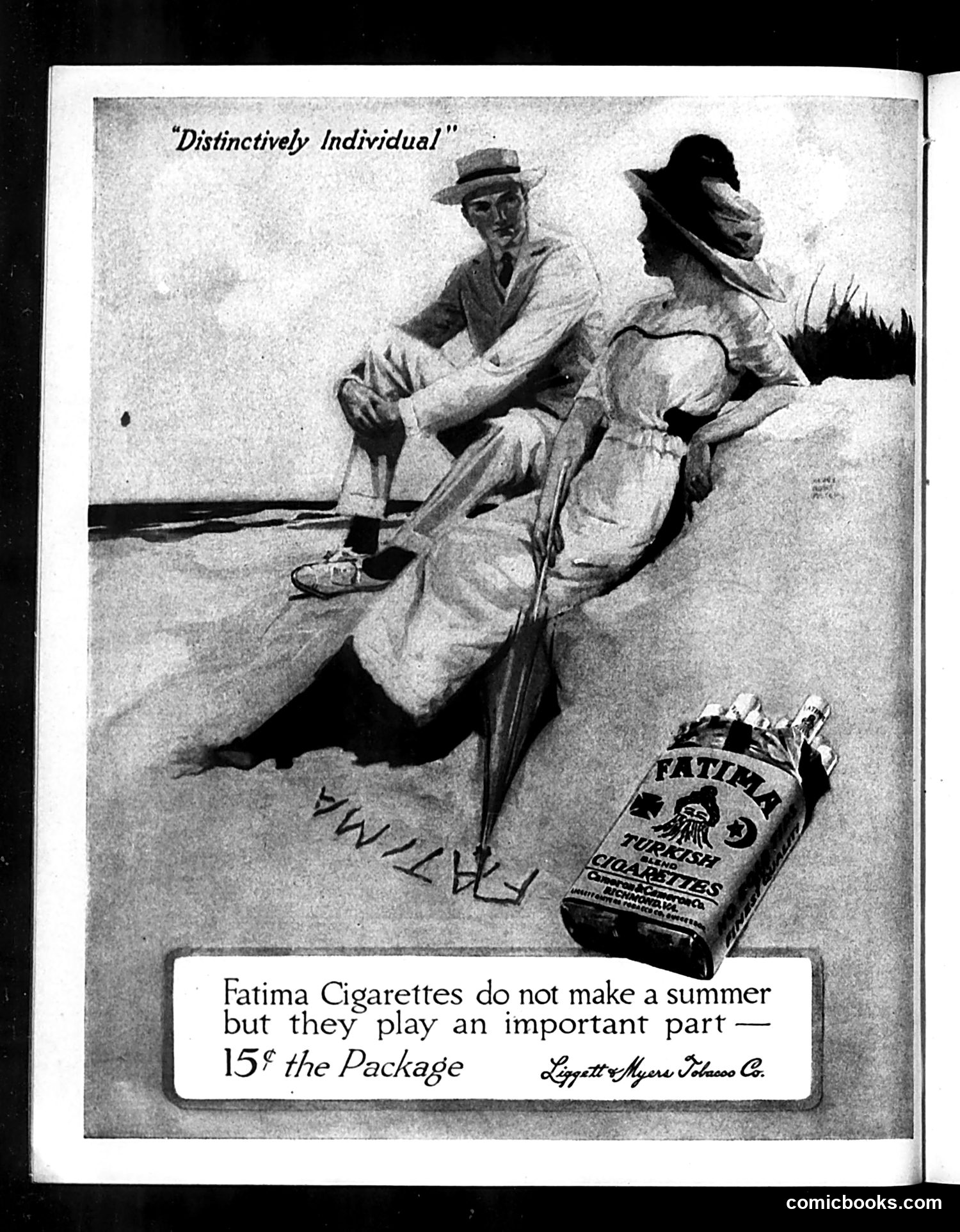
This is a cigarette advertisement rather than political satire. The image shows two men in summer clothing drawing or marking something in sand, with the tagline "Distinctively Individual" at the top. The ad's text plays on the proverb "one swallow does not make a summer," substituting Fatima cigarettes: they don't *make* summer, but they're an important part of enjoying it. This positions the product as an essential companion for leisure activities. The "distinctively individual" claim suggests Fatima cigarettes differentiate smokers through personal style—a common early 20th-century marketing appeal. The price of 15¢ per package is noted. This is vintage tobacco marketing targeting male consumers during an era when cigarette advertising was common in magazines like *Judge*.