
Judge, 1913-07-05 · page 14 of 24
Judge — July 5, 1913 — page 14: what you’re looking at
What you’re looking at
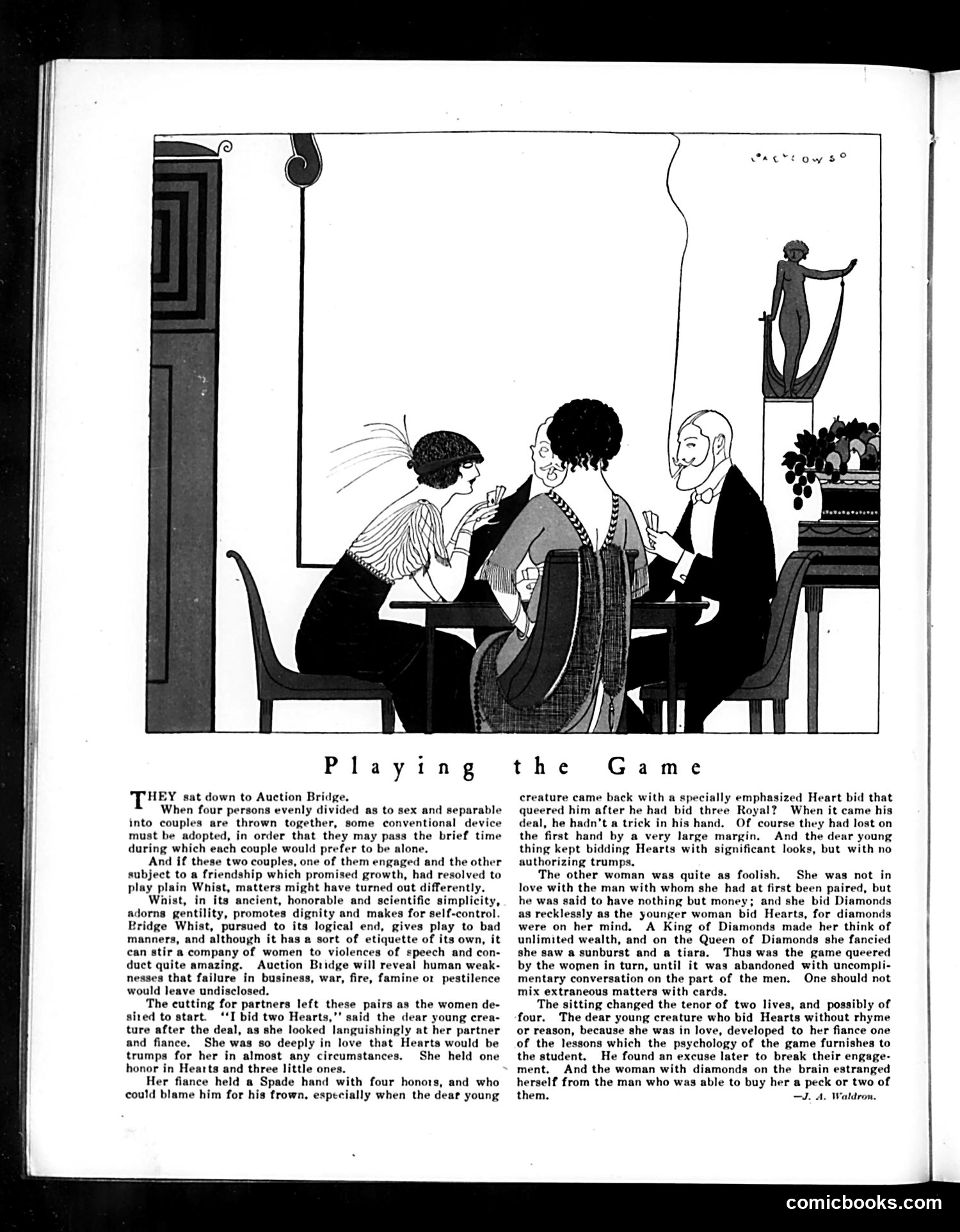
This is an illustrated short story (not a political cartoon) satirizing how card games reveal character flaws, particularly in women. The scene depicts four people playing Auction Bridge. The narrative contrasts this game with traditional Whist, arguing that Bridge's competitive nature exposes human weaknesses that "failure in business, war, fire, famine or pestilence would leave undisclosed." Two couples play: an engaged pair and two unattached people. The satire targets women's judgment: - The engaged woman bids Hearts recklessly because she's in love, not because her cards warrant it, signaling emotional irrationality to her fiancé - The other woman bids Diamonds obsessively, fantasizing about wealth and luxury items (tiaras), revealing materialistic shallowness The story concludes that these card-game revelations damage both relationships—the fiancé breaks their engagement, and the wealthy man distances himself from the diamond-obsessed woman. The moral: women shouldn't "mix extraneous matters with cards," implying their personal preoccupations corrupt judgment and expose unflattering truths.
📄 Transcribed text from this page (OCR, searchable)
Machine-transcribed from the original scan — historical spelling and the odd misread are preserved.
Playing HEY sat down to Auction Bridge. When four persons evenly divided as to sex and separable into couples are thrown together, some conventional device must be adopted, in order that they may pass the brief time during which each couple would prefer to be alone. And if these two couples, one of them engaged and the other subject to a friendship which promised growth, had resolved to play plain Whist, matters might have turned out differently. Waist, in its ancient, honorable and scientific simplicity, adorns gentility, promotes dignity and makes for self-control. Bridge Whist, pursued to its logical end, gives play to bad manners, and although it has a sort of etiquette of its own, it can stir a company of women to violences of speech and con- duct quite amazing. Auction Bridge will reveal human weak- nesses that failure in business, war, fire, famine or pestilence would leave undisclosed. The cutting for partners left these pairs as the women de- sired to start. ‘‘I bid two Hearts,’’ said the dear young crea- ture after the deal, as she looked languishingly at her partner and fiance. She was so deeply in love that Hearts would be trumps for her in almost any circumstances. She held one honor in Hearts and three little ones. Her fiance held a Spade hand with four honors, and who could blame him for his frown, especially when the dear young / ANS \ al the Game creature came back with a specially emphasized Heart bid that queered him after he had bid three Royal? When it came his deal, he hadn't a trick in his hand. Of course they had lost on the first hand by a very large margin. And the dear young thing kept bidding Hearts with significant looks, but with no authorizing trumps. The other woman was quite as foolish. She was not in love with the man with whom she had at first been paired, but he was said to have nothing but money; and she bid Diamonds as recklessly as the younger woman bid Hearts, for diamonds were on her mind. A King of Diamonds made her think of unlimited wealth, and on the Queen of Diamonds she fancied she saw a sunburst and a tiara. Thus was the game queered by the women in turn, until it was abandoned with uncompli- mentary conversation on the part of the men. One should not mix extraneous matters with cards, The sitting changed the tenor of two lives, and possibly of four. The dear young creature who bid Hearts without rhyme or reason, because she was in love, developed to her fiance one of the lessons which the psychology of the game furnishes to the student. He found an excuse later to break their engage- ment. And the woman with diamonds on the brain estranged herself from the man who was able to buy her a peck or two of them. J. A. Waldron. comicbooks.com