
Judge, 1913-07-05 · page 5 of 24
Judge — July 5, 1913 — page 5: what you’re looking at
What you’re looking at
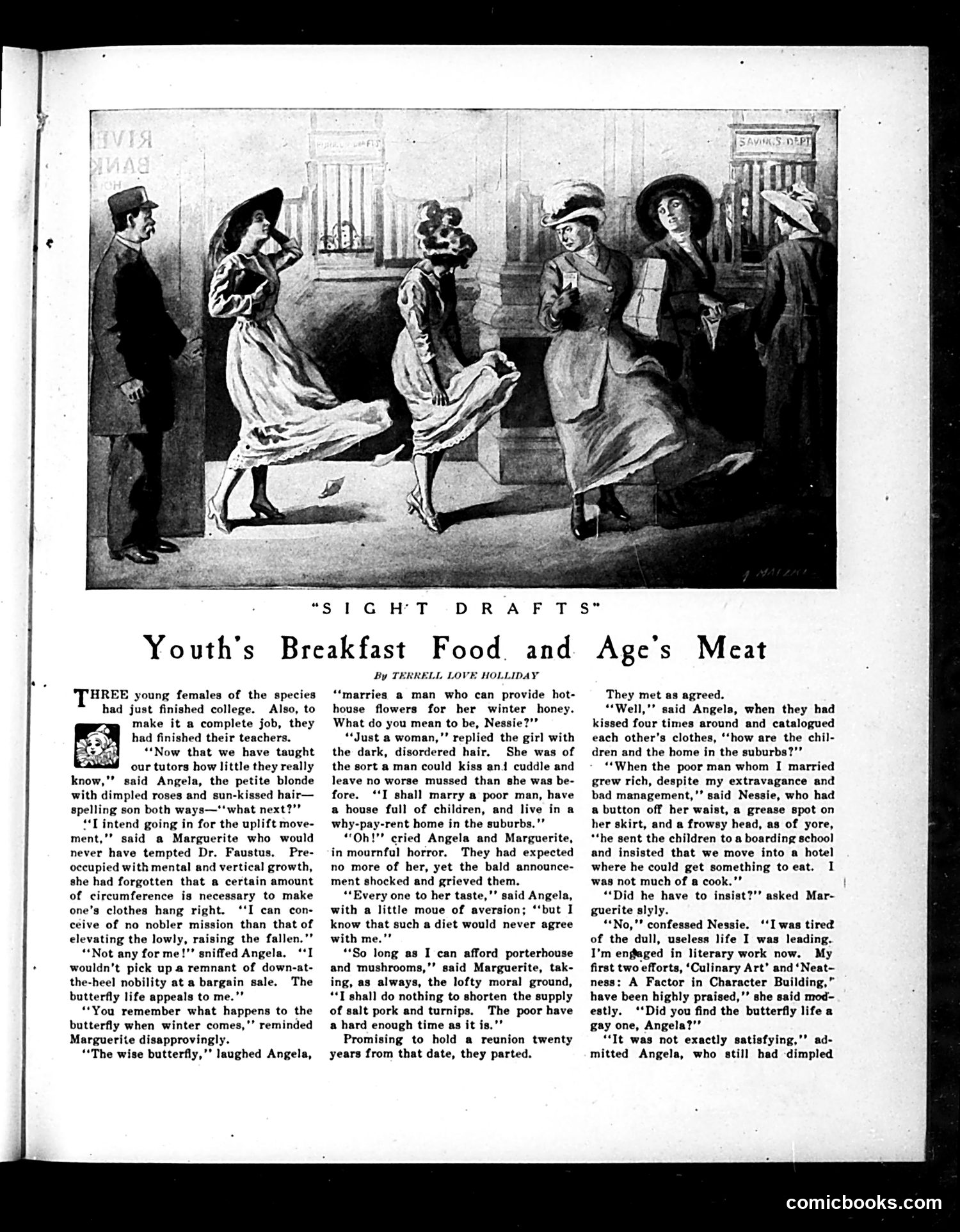
This satirical story by Terrell Love Holliday critiques women's marital expectations through three college-educated young women. The cartoon illustrates their conversation about marriage ideals versus reality. Angela, Marguerite, and Nessie initially express romantic notions about marrying poor men and living modestly. However, their real experiences diverge sharply: Angela married a wealthy man but ended up managing household chaos; Marguerite married a poor man with many children and dull suburban life; Nessie pursued literary work instead. The satire mocks the gap between youthful romantic idealism (the "breakfast food" of youth) and the practical, unglamorous realities of adult married life (the "meat" of age). It suggests women's college education doesn't prepare them for marriage's actual demands, whether to rich or poor husbands.
📄 Transcribed text from this page (OCR, searchable)
Machine-transcribed from the original scan — historical spelling and the odd misread are preserved.
“S 1GHT Youth's Breakfast Food. and Age’s THREE young females of the species had just finished college. Also, to make it a complete job, they had finished their teachers. “‘Now that we have taught our tutors how little they really know,"’ said Angela, the petite blonde with dimpled roses and sun-kissed hai spelling son both ways—**what next?”’ “TL intend going in for the uplift move- ment,’’ said a Marguerite who would never have tempted Dr. Faustus. Pre- occupied with mental and vertical growth, she had forgotten that a certain amount of circumference is necessary to make one’s clothes hang right. ‘‘I can con- ceive of no nobler mission than that of elevating the lowly, raising the fallen.’ “Not any for me!"’ sniffed Angela. ‘‘I wouldn’t pick up a remnant of down-at- the-heel nobility at a bargain sale. The butterfly life appeals to me.” “*You remember what happens to the butterfly when winter comes,’’ reminded Marguerite disapprovingly. “The wise butterfly,’’ laughed Angela, DRAFT By TERRELL LOVE HOLLIDAY “‘marries a man who can provide hot- house flowers for her winter honey. What do you mean to be, Nessie?” “‘Just a woman,”’ replied the girl with the dark, disordered hair. She was of the sort a man could kiss ani cuddle and leave no worse mussed than she was be- fore. ‘‘I shall marry a poor man, have a house full of children, and live in a why-pay-rent home in the suburbs."” “Oh!"’ cried Angela and Marguerite, in mournful horror. They had expected no more of her, yet the bald announce- ment shocked and grieved them. “Every one to her taste,’’ said Angela, with a little moue of aversion; ‘‘but I know that such a diet would never agree with me.”’ “So long as I can afford porterhouse and mushrooms,”’ said Marguerite, tak- ing, as always, the lofty moral ground, “‘I shall do nothing to shorten the supply of salt pork and turnips. The poor have a hard enough time as it is.’” Promising to hold a reunion twenty years from that date, they parted. = Meat They met as agreed. “‘Well,’’ said Angela, when they had kissed four times around and catalogued each other's clothes, ‘‘how are the chil- dren and the home in the suburbs?’’ “*When the poor man whom I married grew rich, despite my extravagance and bad management,’’ said Nessie, who had a button off her waist, a grease spot on her skirt, and a frowsy head, as of yore, *the sent the children to a boarding school and insisted that we move into a hotel where he could get something toeat. I was not much of a cook.’’ “Did he have to insist?’’ asked Mar- guerite slyly. “‘No,"" confessed Nessie. ‘‘I was tired of the dull, useless life I was leading. I'm engaged in literary work now. My first two efforts, ‘Culinary Art’ and ‘Neat- ness: A Factor in Character Building,” have been highly praised,’’ she said mod- estly. ‘‘Did you find the butterfly life a gay one, Angela?” “It was not exactly satisfying,’’ ad- mitted Angela, who still had dimpled ’ comicbooks.com