
Judge, 1913-07-05 · page 10 of 24
Judge — July 5, 1913 — page 10: what you’re looking at
What you’re looking at
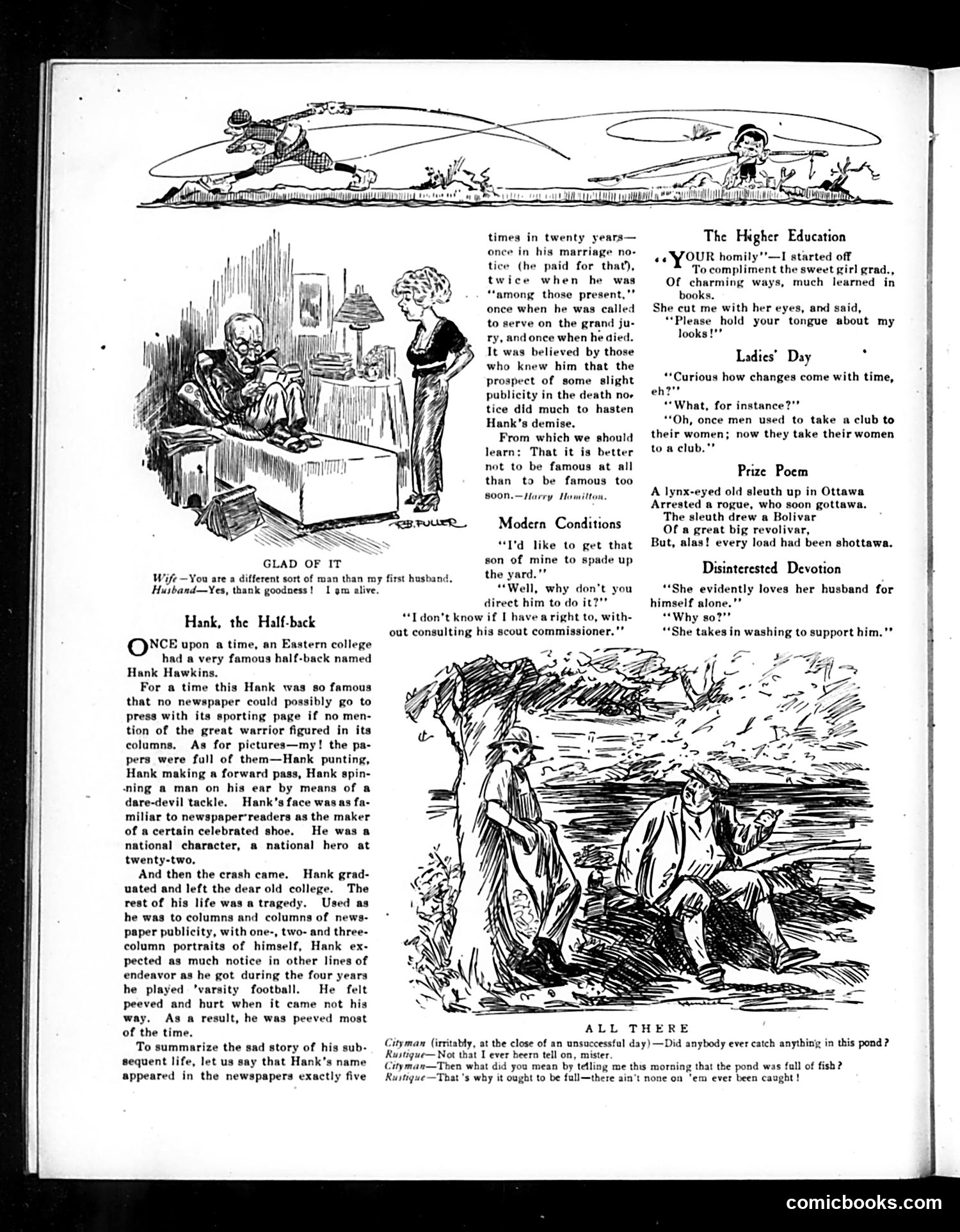
This satirical story mocks the fleeting nature of celebrity and Americans' obsession with athletic fame. Hank Hawkins, a college football star whose face dominated newspapers during his playing years, becomes a complete nonentity after graduation. Despite expecting continued prominence in adult life, he receives newspaper mention only five times in twenty years—his wedding, minor social appearances, jury duty, and death notice. The satire targets both Hank's inflated ego (he assumes his football celebrity should transfer to everyday life) and society's shallow celebrity culture. The moral warns that early fame can breed entitlement and disappointment rather than success. The accompanying humorous vignettes reinforce the magazine's broader critique of modern conditions—changing gender relations, scout commissioners interfering with parenting, and women's education prioritized over appearance—capturing early 20th-century anxieties about social transformation.
📄 Transcribed text from this page (OCR, searchable)
Machine-transcribed from the original scan — historical spelling and the odd misread are preserved.
GLAD OF IT You are a different sort of man than my first husband, Husband—Yes, thank goodness! 1 gm alive. Hank, the Half-back NCE upon a time, an Eastern college had a very famous half-back named Hank Hawkins. For a time this Hank was so famous that no newspaper could possibly go to press with its sporting page if no men- tion of the great warrior figured in its columns. As for pictures—my! the pa- pers were full of them—Hank punting, Hank making a forward pass, Hank spi -ning a man on his ear by means of a dare-devil tackle. Hank's face wasas fa- miliar to newspaper’readers as the maker of a certain celebrated shoe. He was a national character, a national hero at twenty-two. And then the crash came. Hank grad- uated and left the dear old college. The rest of his life was a tragedy. Used as he was to columns and columns of news- paper publicity, with one-, two- and three- column portraits of himself, Hank ex- pected as much notice in other lines of endeavor as he got during the four years he played ‘varsity football. He felt peeved and hurt when it came not his way. As a result, he was peeved most of the time. To summarize the sad story of his sub- sequent life, let us say that Hank’s name appeared in the newspapers exactly five times in twenty years— once in his marriage no- tice (he paid for that), twice when he was “among those present,’” once when he was called to serve on the grand ju- ry, and once when he died. It was believed by those who knew him that the prospect of some slight publicity in the death nor tice did much to hasten Hank’s demise. From which we should learn: That it is better not to be famous at all than to be famous too 800N.—Harry Homilton, Modern Conditions “I'd like to get that son of mine to spade up the yard."’ “Well, why don't you direct him to do it?” “T don’t know if I have aright to, with- out consulting his scout commissioner."* The Higher Education «e YOUR homily’’—I started off To compliment the sweet girl grad., Of charming ways, much learned in books. She cut me with her eyes, and said, “Please hold your tongue about my looks !"" Ladies’ Day . “Curious how changes come with time, eh?’ “What, for instance?"’ “Oh, once men used to take a club to their women; now they take their women to a club."" Prize Poem A lynx-eyed old sleuth up in Ottawa Arrested a rogue, who soon gottawa. The sleuth drew a Bolivar Of a great big revolivar, But, alas! every load had been shottawa. Disinterested Devotion “She evidently loves her husband for himself alone.’’ **Why so?” “She takes in washing to support him.'* ALL THERE Cityman (irritably, at the close of an unsuccessful day)—Did anybody ever catch anything in this pond ? Rustique—Not that I ever heern tell on, mister Cityman—Then what did you mean by telling me this morning that the pond was full of fish? Rustigue—That 's why it ought to be full—there ain't none on ‘em ever been caught! comicbooks.com