
A complete issue · 24 pages · 1913
Judge — May 24, 1913
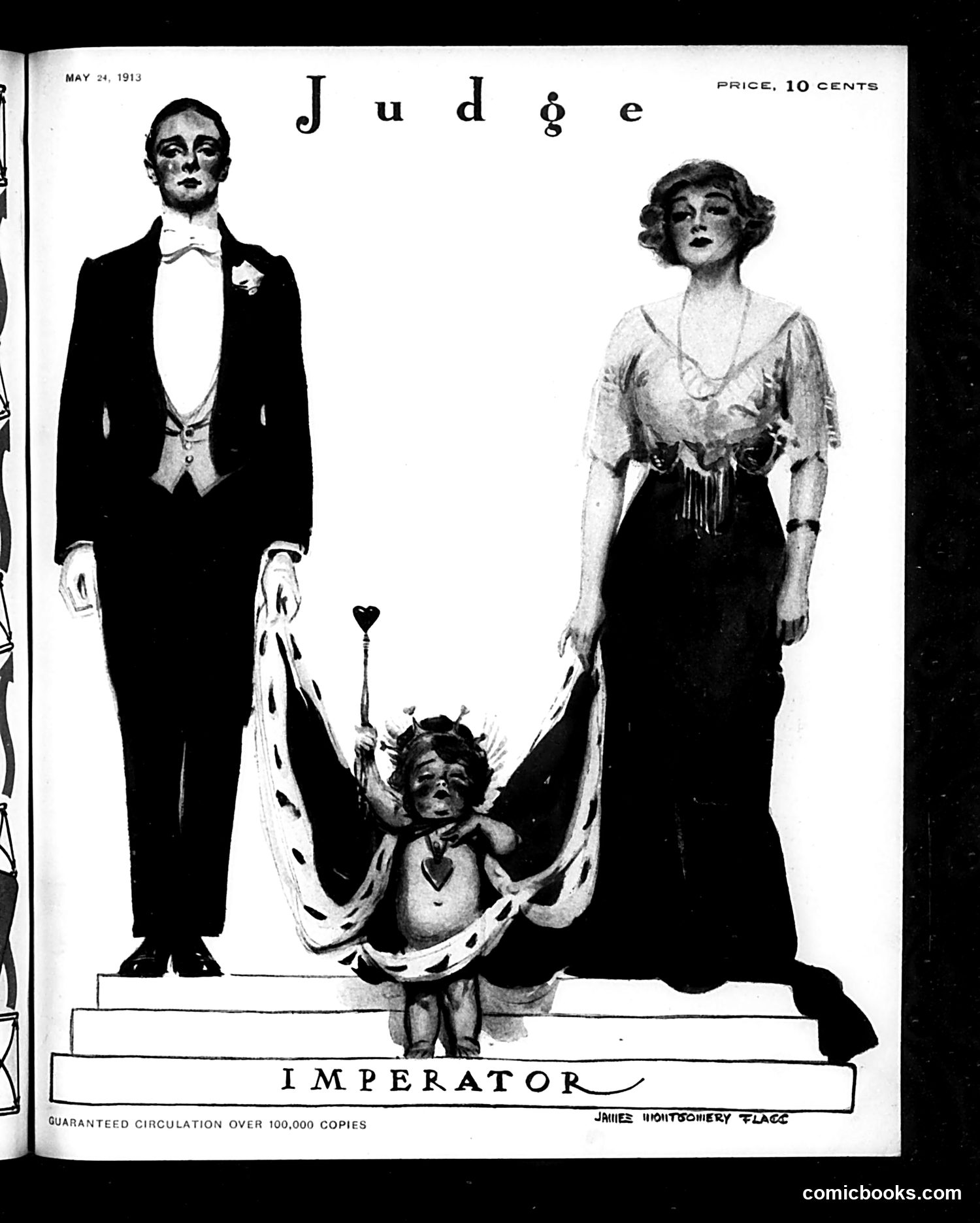
This cartoon by James Montgomery Flagg depicts a formal family portrait with the caption "Imperator" (Latin for "emperor" or "supreme ruler"). A man in formal evening dress stands on the left, a woman on the right, and between them a cherubic infant in elaborate robes holds aloft their train—symbolizing the child as the center of authority in the household. The satire critiques the power dynamic in contemporary American families, suggesting that children (particularly sons) have become the true "emperors" of the home, with parents reduced to serving them. This reflects early 20th-century anxieties about changing parental authority and child-rearing practices during an era of modernization and shifting social values.
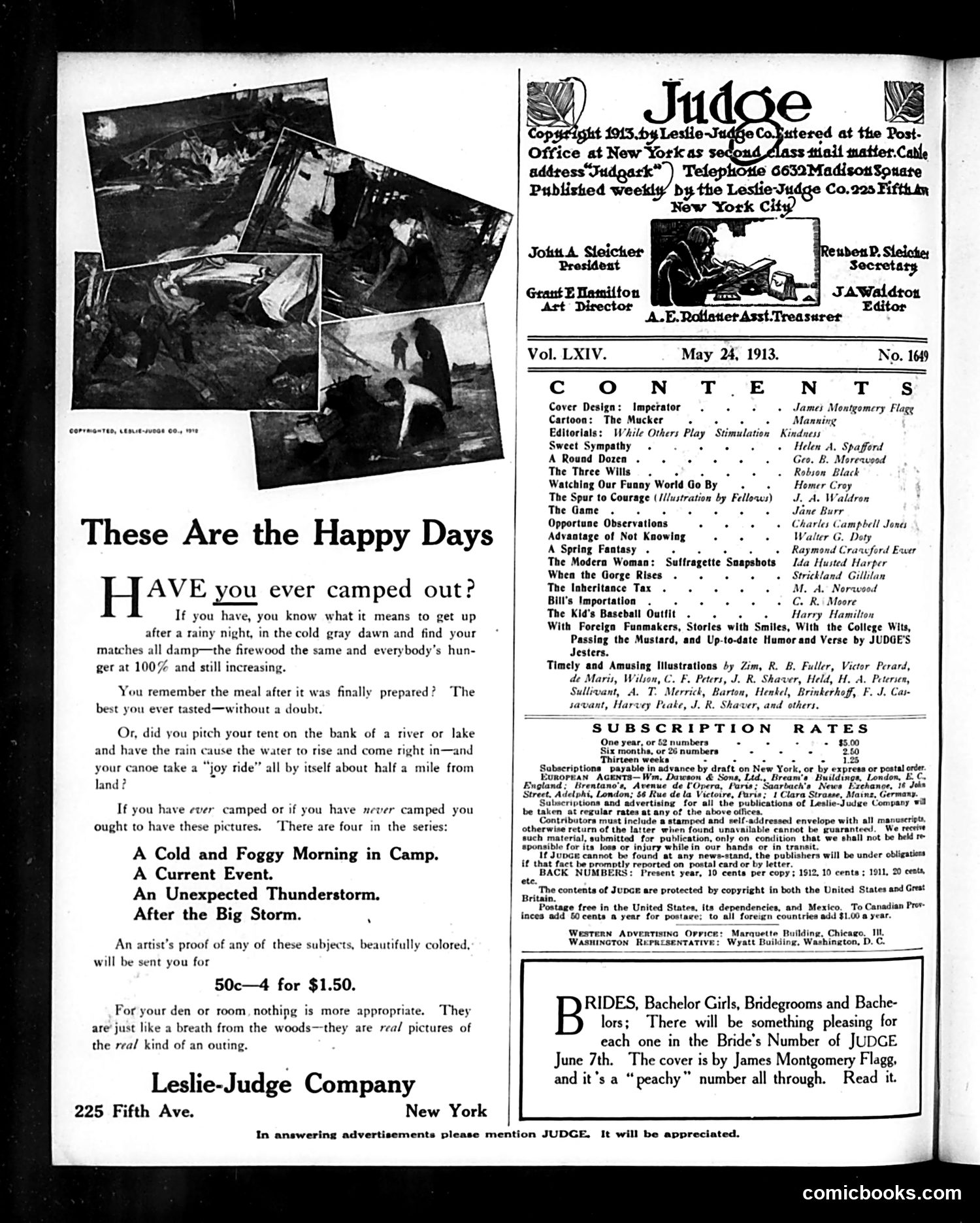
This page is primarily **advertising and editorial content rather than political satire**. The left side promotes a series of camping-themed illustrations available from Leslie-Judge Company—"A Cold and Foggy Morning in Camp," "A Current Event," "An Unexpected Thunderstorm," and "After the Big Storm." These appear to be decorative prints for home or office, marketed at 50 cents each or four for $1.50. The right side contains the magazine's masthead, table of contents, and subscription information. An advertisement at bottom promotes an upcoming "Bride's Number" featuring James Montgomery Flagg's cover art. **No clear political cartoon or satirical commentary is visible**. The page functions primarily as a commercial vehicle advertising artwork and magazine subscriptions to early-20th-century readers.
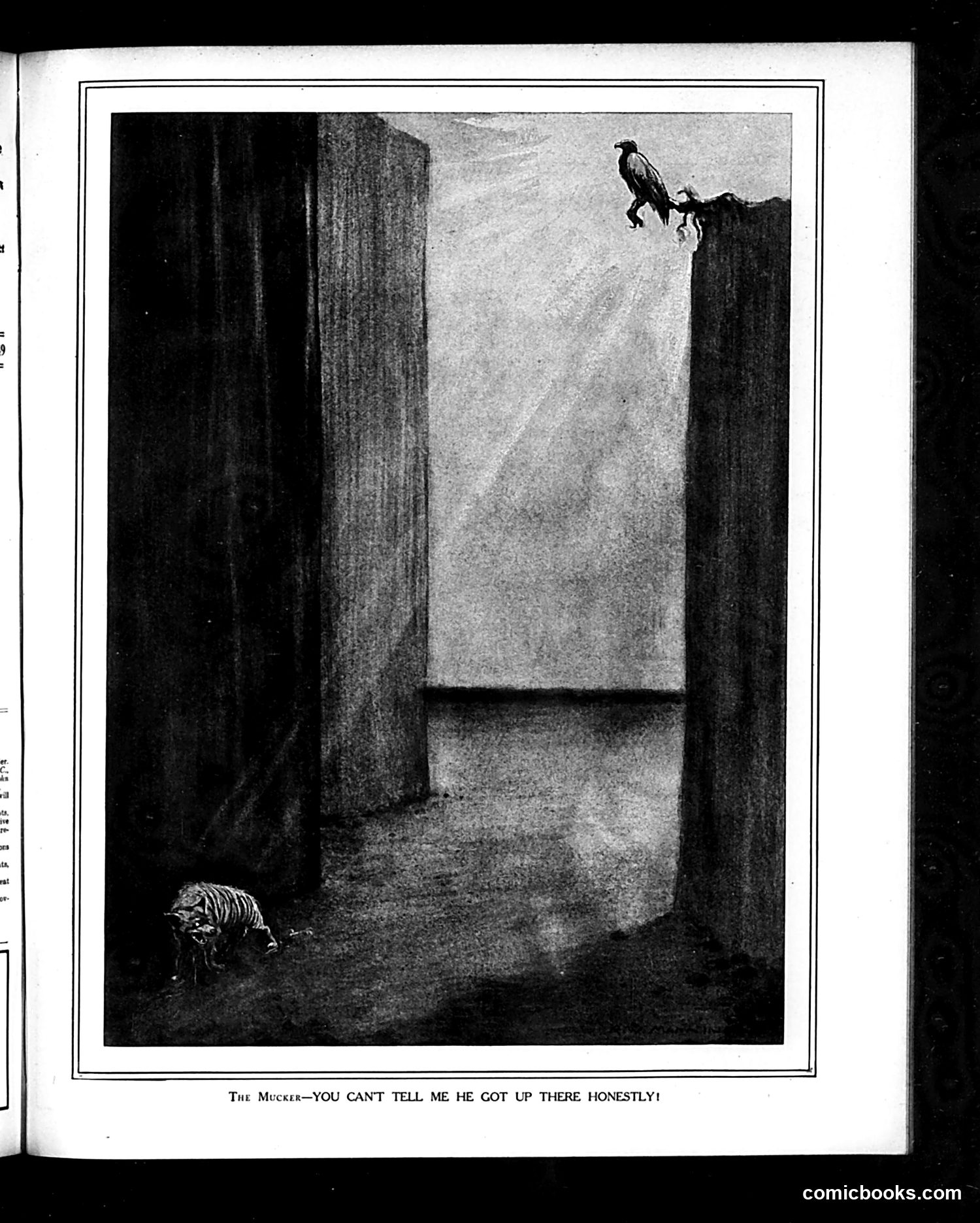
This cartoon depicts a dramatic scene in what appears to be an industrial or construction setting—tall concrete or stone walls frame a narrow passage. A small figure crouches in the lower left, while a bird (likely an eagle, symbol of America) perches atop the right wall above. The caption reads: "THE MUCKER—YOU CAN'T TELL ME HE GOT UP THERE HONESTLY!" The joke appears to satirize someone who achieved a high position (represented by the eagle's elevated perch) through dishonest means. "Mucker" was period slang for a corrupt person or someone engaged in shady dealing. The cartoon suggests skepticism about how this figure reached their prominent position—implying graft, manipulation, or other impropriety rather than merit. The specific identity remains unclear without additional context.
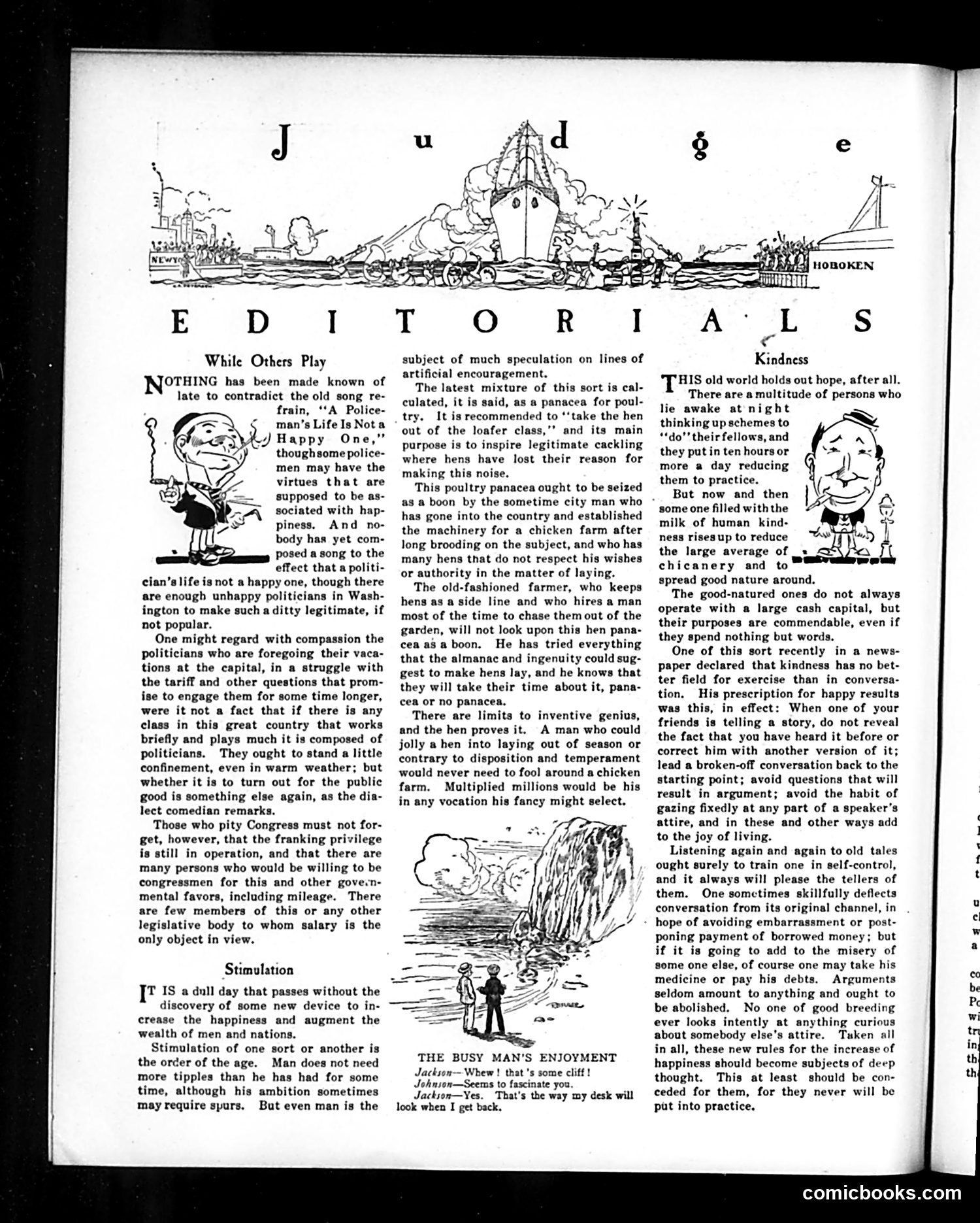
This page contains two distinct sections: **"Editorials" (top):** A political commentary criticizing politicians who avoid addressing substantive issues like tariffs while focusing on trivial matters. The text argues politicians lack seriousness and suggests the public should hold them accountable. The accompanying caricatures appear to satirize unnamed politicians as buffoonish figures. **"The Busy Man's Enjoyment" (bottom):** A brief comic dialogue about a man at a desk, apparently distracted or entertained during work. The joke seems to play on workplace procrastination or distraction. The page's header shows a harbor scene with ships and the word "HOBOKEN," suggesting New Jersey references, though the connection to the content is unclear. Without specific dates or identified individuals visible, precise political targets cannot be determined.
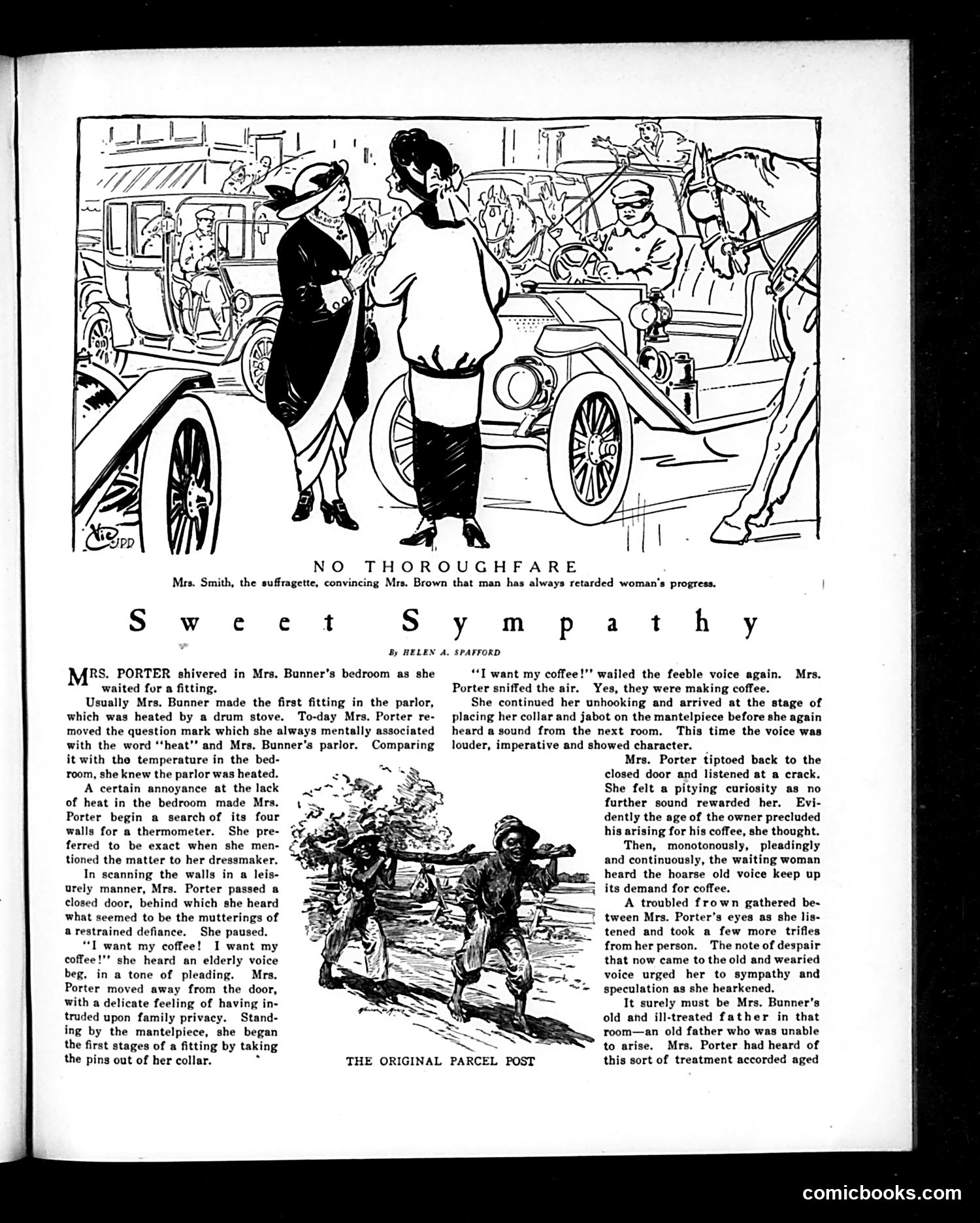
This page satirizes early 20th-century suffragettes and women's rights advocates. The top cartoon, titled "No Thoroughfare," depicts Mrs. Smith (a suffragette) attempting to convince Mrs. Brown that "man has always retarded woman's progress"—mocking suffragists' arguments about gender inequality. The accompanying story "Sweet Sympathy" by Helen A. Spafford ridicules Mrs. Porter, who complains constantly about minor domestic inconveniences (lacking coffee, finding the house cold) while lecturing others about women's oppression. The humor relies on portraying activists as hypocritical—demanding social progress while being unable to manage basic household tasks themselves. The satire suggests suffragettes were unreasonable complainers rather than serious reformers addressing genuine inequalities.
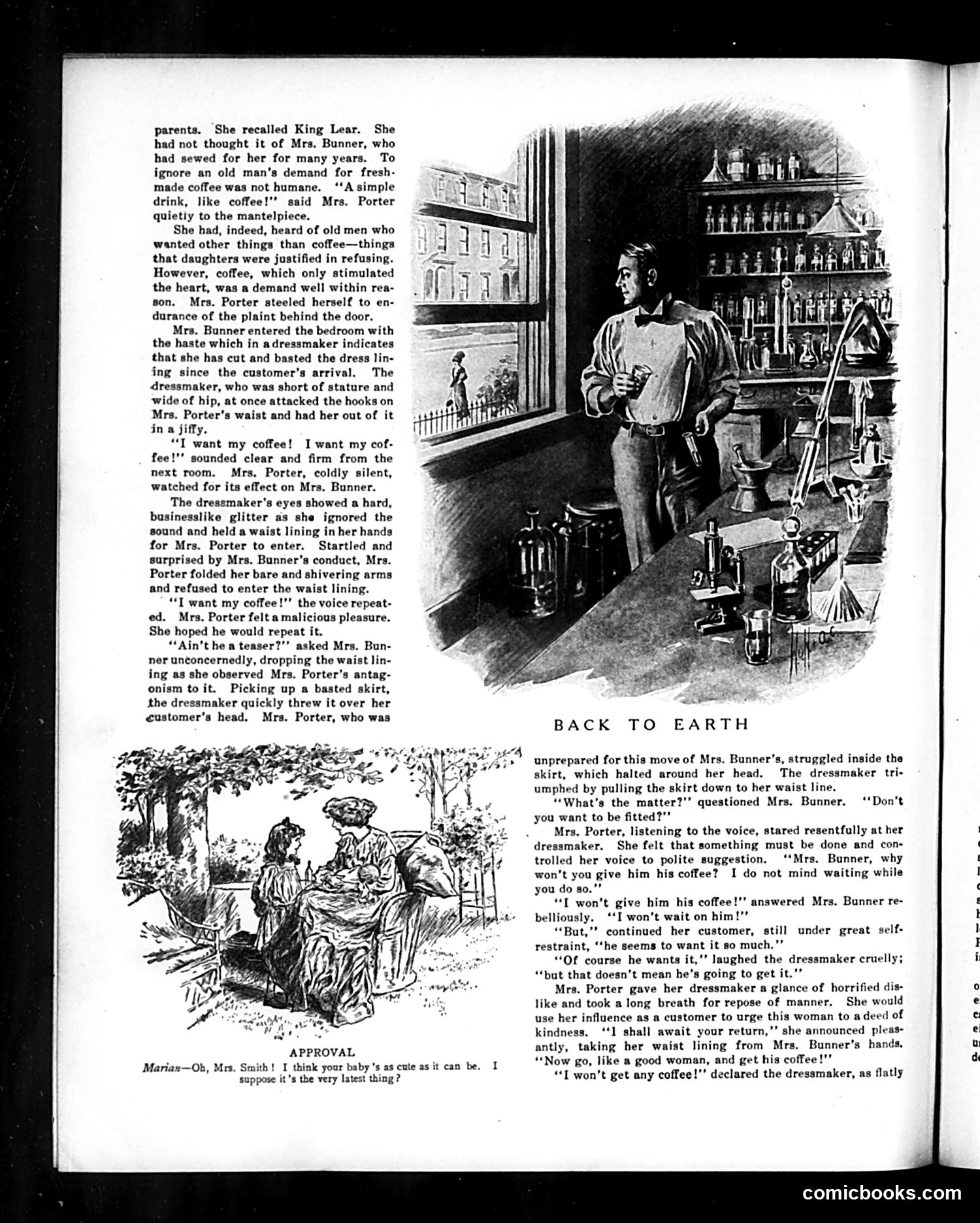
This page contains a satirical short story about class conflict and female defiance. Mrs. Porter, a wealthy customer, attempts to persuade her dressmaker Mrs. Bunner to serve coffee to an elderly man (likely Mrs. Bunner's father) demanding it from the next room. The satire targets working-class insubordination: Mrs. Bunner refuses her customer's polite requests, deliberately ignoring and even mocking the old man's pleas. She asserts her autonomy by refusing to obey—both the man's demands and her customer's expectations. Mrs. Porter, accustomed to deference, is shocked by this rudeness. The accompanying illustrations—one showing an apothecary shop ("Back to Earth") and another depicting a social gathering ("Approval")—appear unrelated to the main narrative, typical of magazine layout from this era. The story satirizes early-20th-century tensions between employers and working-class women who were increasingly asserting independence.
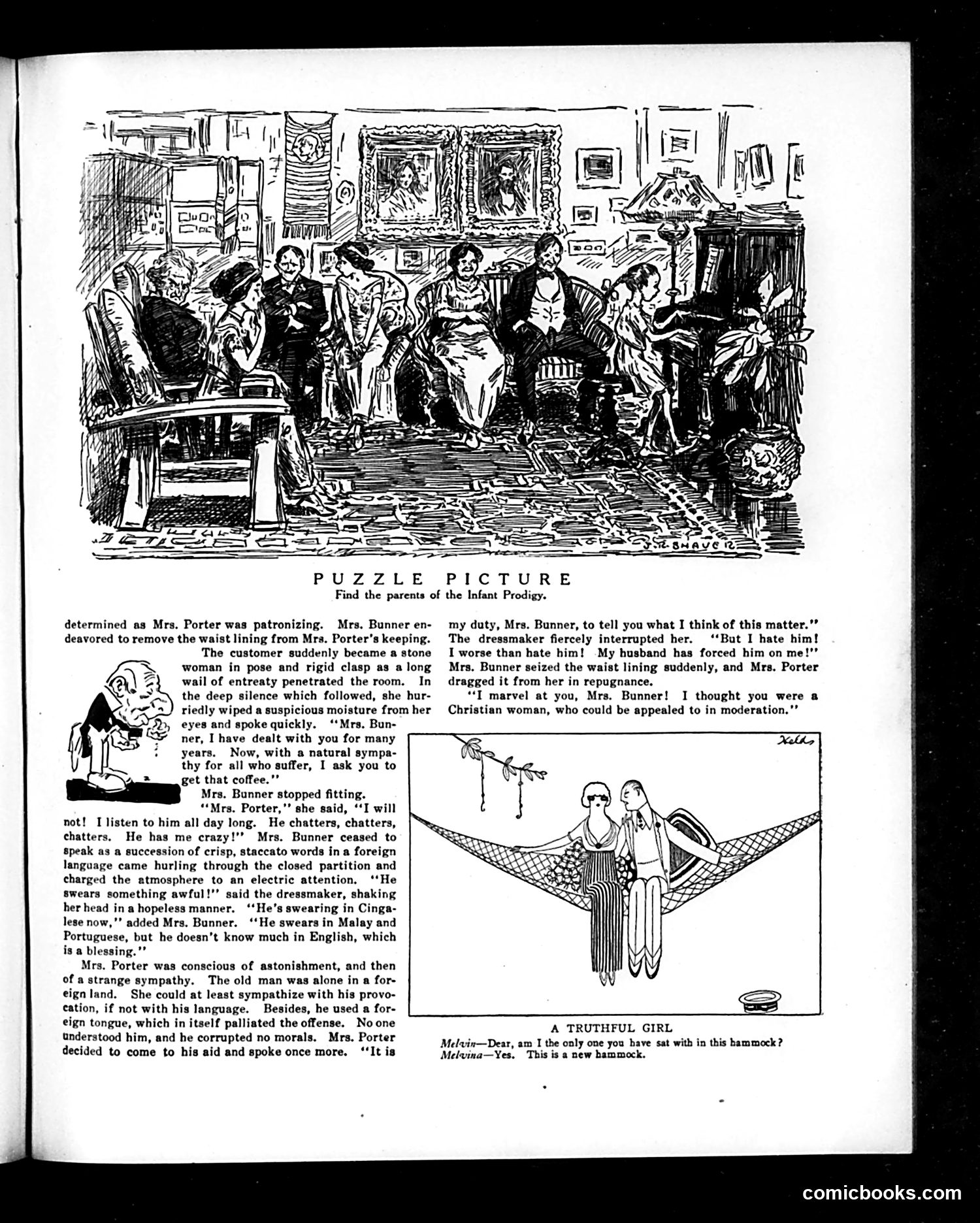
The page contains two satirical pieces reflecting early 20th-century domestic anxieties: **Top cartoon ("Puzzle Picture"):** Shows a drawing-room scene where Mrs. Porter (a wealthy customer) and Mrs. Bunner (her dressmaker) clash over a foreign servant—an "Infant Prodigy" whose identity readers must deduce. The joke satirizes class tensions and xenophobia: Mrs. Bunner, exhausted by the man's constant chatter in multiple foreign languages (Cingalese, Malay, Portuguese), complains bitterly. Mrs. Porter initially demands sympathy but gradually recognizes their shared frustration with the incomprehensible foreigner. The satire mocks both the servant's unintelligible behavior and the privileged women's condescension toward immigrant workers. **Bottom cartoon ("A Truthful Girl"):** A young couple in a hammock engages in flirtation. The girl's claim that this is "a new hammock" is her excuse for why only now she's alone with him there—a coy defense of propriety, suggesting previous romantic encounters elsewhere. Both pieces reflect contemporary anxieties about immigration, class mobility, and courting customs.
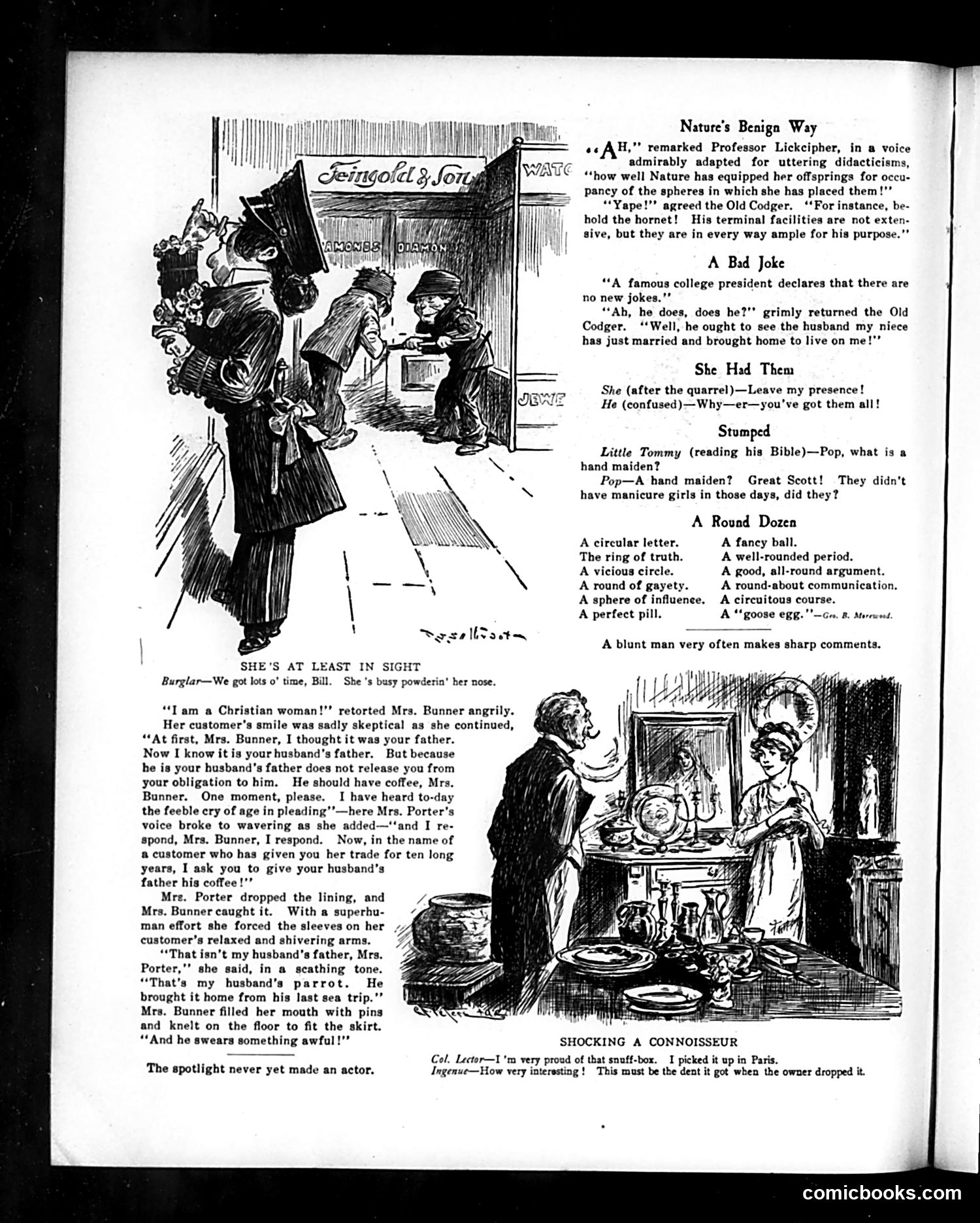
This page contains multiple short humor pieces typical of early 20th-century American satirical magazines: **Main cartoons**: The top left shows a burglar casing a shop while a woman powders her nose—the joke being that her vanity conveniently keeps her distracted. The bottom right depicts a snobbish collector (Col. Lector) showing off a snuff-box; a young woman (Ingenue) deflates his pretension by noting the dent came from the owner dropping it. **Short jokes and anecdotes** fill the page, mostly playing on domestic situations and wordplay. "She Had Them" jokes about marital disputes. "Stumped" misinterprets "handmaiden" as a modern manicurist—anachronistic humor. "A Round Dozen" lists puns on the word "round." **Longer narrative**: "She's at Least in Sight" presents a sewing customer (Mrs. Porter) guilting a seamstress (Mrs. Bunner) into serving coffee to an elderly father-in-law—only to reveal it's actually the woman's profane parrot, subverting the sentiment. The humor relies on class commentary, gender stereotypes, and wordplay typical of the era's satirical magazines.
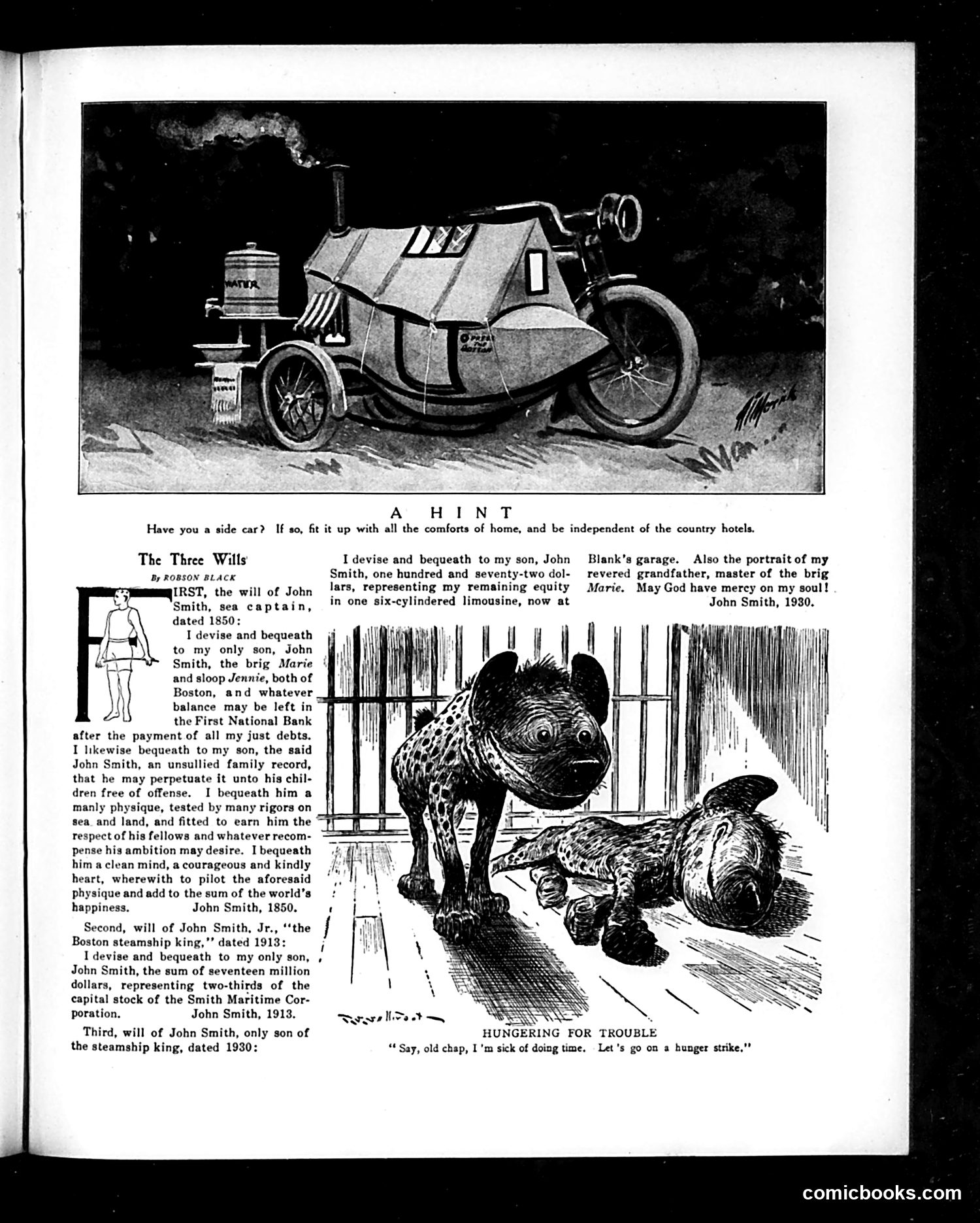
This satirical piece by Robson Black contrasts three generations of the Smith family across 80 years to critique America's moral and material decay. **The progression:** - 1850: A sea captain bequeaths his son *character*—ships, family honor, physical vigor, integrity - 1913: His descendant (the "steamship king") leaves only *money*—$17 million in stock - 1930: The grandson, inheriting vast wealth, is a dissolute criminal on hunger strike, complaining of boredom while imprisoned **The satire's point:** Wealth without virtue corrupts. Each generation abandons the values that created prosperity. The top image shows a "side car" motorcycle—modern comfort replacing self-reliance. By 1930, abundance has produced a spoiled, lawless heir incapable of meaningful work or character. The cartoon suggests that Depression-era America's problems stem not from poverty but from the wealthy's moral bankruptcy—a common Judge magazine theme during economic crisis.
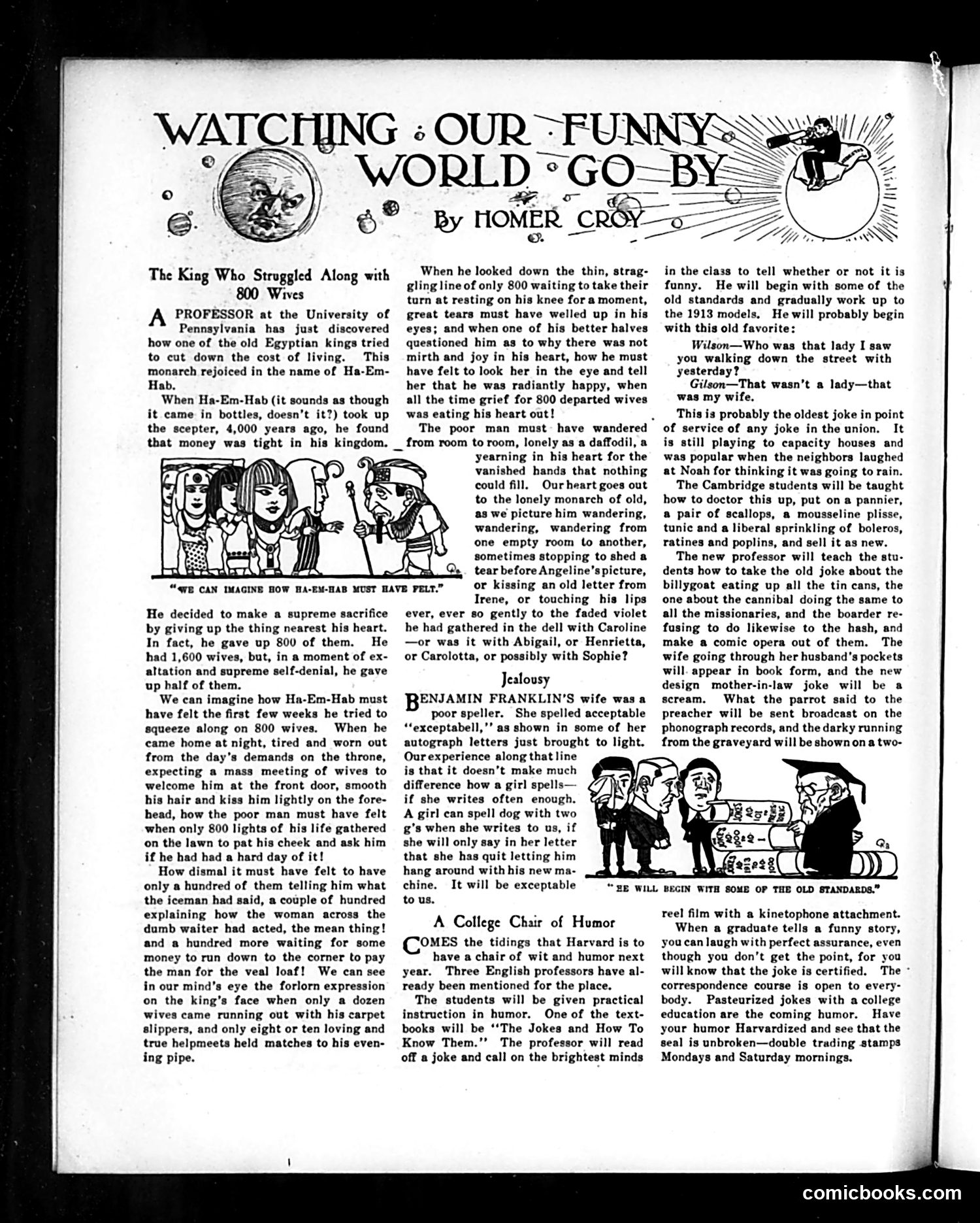
This page contains humorous essays by Homer Croy satirizing early 20th-century American life. The main piece mocks the "cost of living crisis" by using an absurd historical analogy: an Egyptian king (Ha-Em-Hab) who owns 1,600 wives must economize by keeping only 800—and the article hilariously dramatizes his supposed emotional devastation at losing half his wives. The satire targets contemporary concerns about economic hardship and marital obligations. The joke treats wives as burdensome possessions requiring financial and emotional maintenance, reflecting period attitudes while exaggerating them for comic effect. Secondary pieces include wordplay about spelling (Benjamin Franklin's wife) and an announcement that Harvard will offer a formal "chair of humor" with a textbook called "The Jokes and How To Know Them"—satirizing academic pretension by suggesting humor can be taught like any subject. The humor is dated and relies on stereotypes about marriage and gender, but reveals preoccupations of the 1910s-era American middle class regarding finances and social expectations.
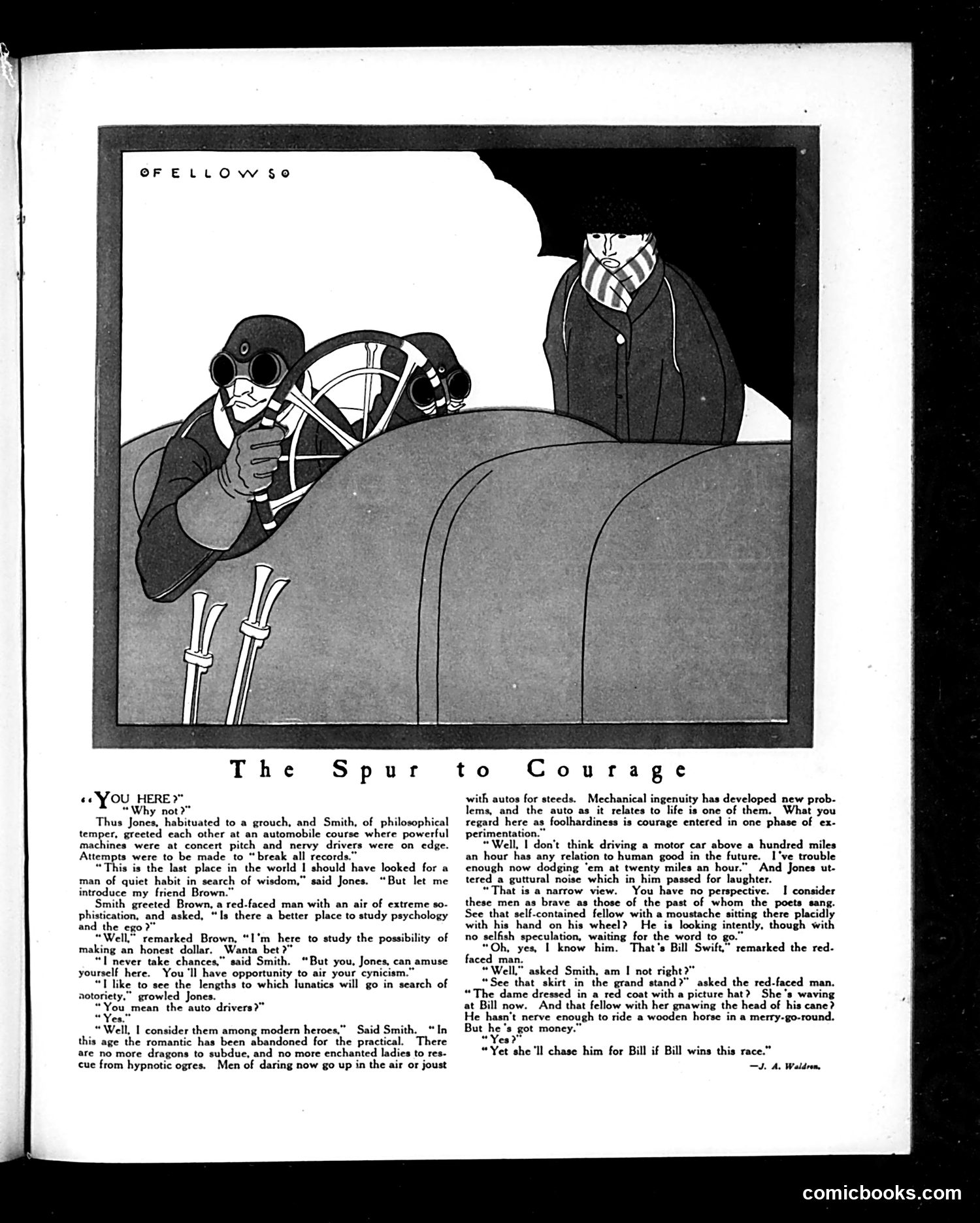
This story-comic presents a dialogue between three men—Jones (cynical), Smith (philosophical), and Brown (mercenary)—discussing automobile racing as modern heroism. Smith argues that auto racing represents contemporary courage equivalent to past dragon-slaying: mechanical challenges require genuine bravery. Jones dismisses it as dangerous lunacy with no social benefit. The narrative focuses on a race driver (Bill Swift) and spectators, including a woman in red whom Smith suggests will pursue Bill only if he wins—implying her affection is mercenary. The satire critiques early 20th-century attitudes toward automobiles and risk-taking. Smith's elevation of auto racing to knightly virtue reflects contemporary fascination with mechanical innovation and speed as markers of progress and courage. Jones's skepticism represents older sensibilities viewing such pursuits as reckless. The woman's conditional interest satirizes social mobility and fortune-hunting in the automobile age.
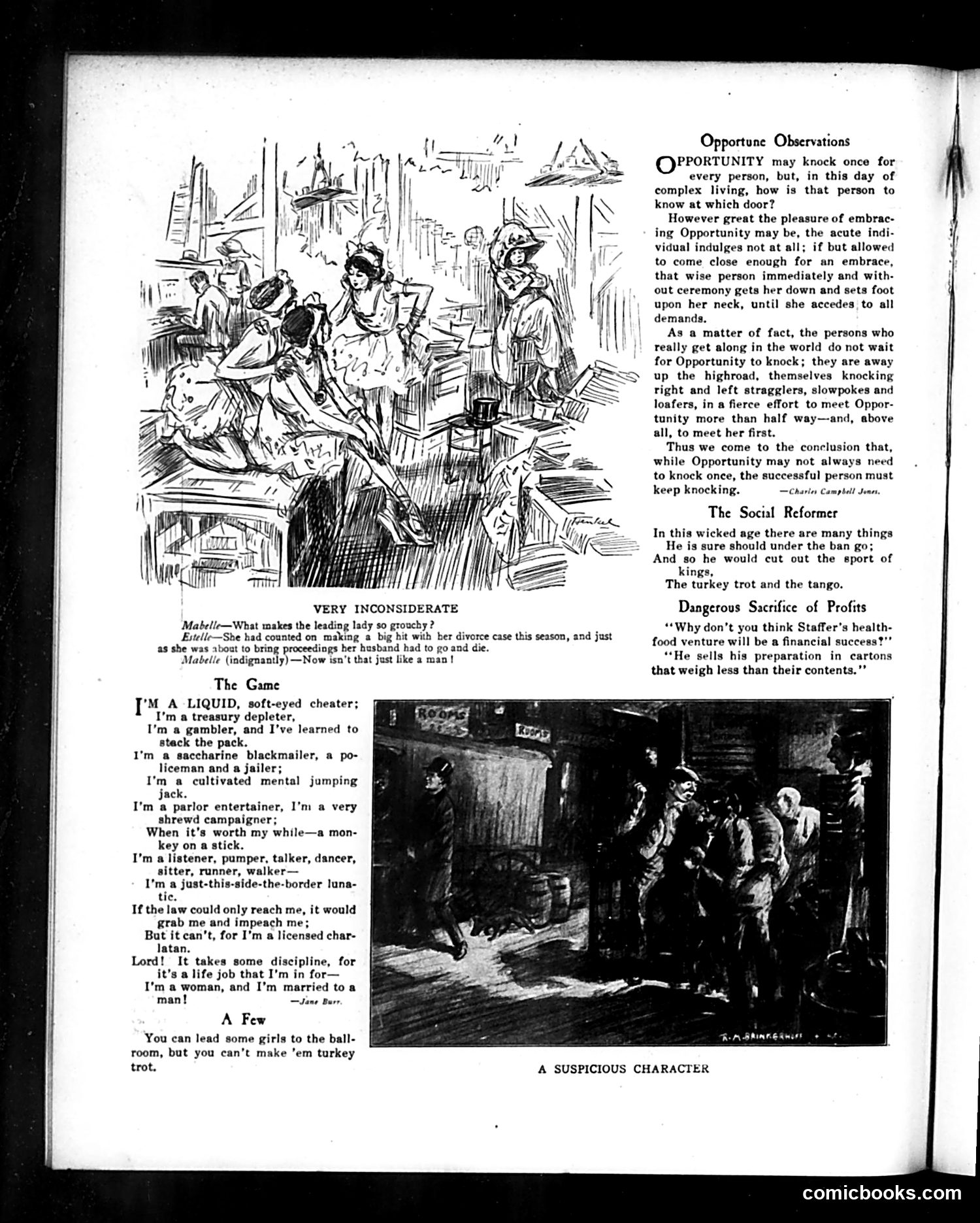
This page contains satirical commentary on early 20th-century American society through multiple short pieces: **"Very Inconsiderate"** mocks a theatrical actress who delayed divorce proceedings, only to have her husband die—ruining her planned publicity stunt. The joke targets both her calculating nature and the era's sensationalism around celebrity divorces. **"The Game"** is a confessional poem where a woman lists her deceptive roles (cheater, blackmailer, entertainer, etc.), culminating in the punchline: all her scheming is justified because "I'm married to a man!"—blaming male behavior for female dishonesty. **"Opportune Observations"** offers pseudo-philosophical advice about seizing opportunity rather than waiting passively. **"The Social Reformer"** criticizes prudish reformers wanting to ban "the sport of kings" (horse racing) and modern dances like the turkey trot and tango. **"Dangerous Sacrifice of Profits"** jokes that a health-food entrepreneur's cartons weigh less than their contents—implying he's cheating customers with empty packaging. The overall tone is cynical about contemporary manners, morality, and business practices.
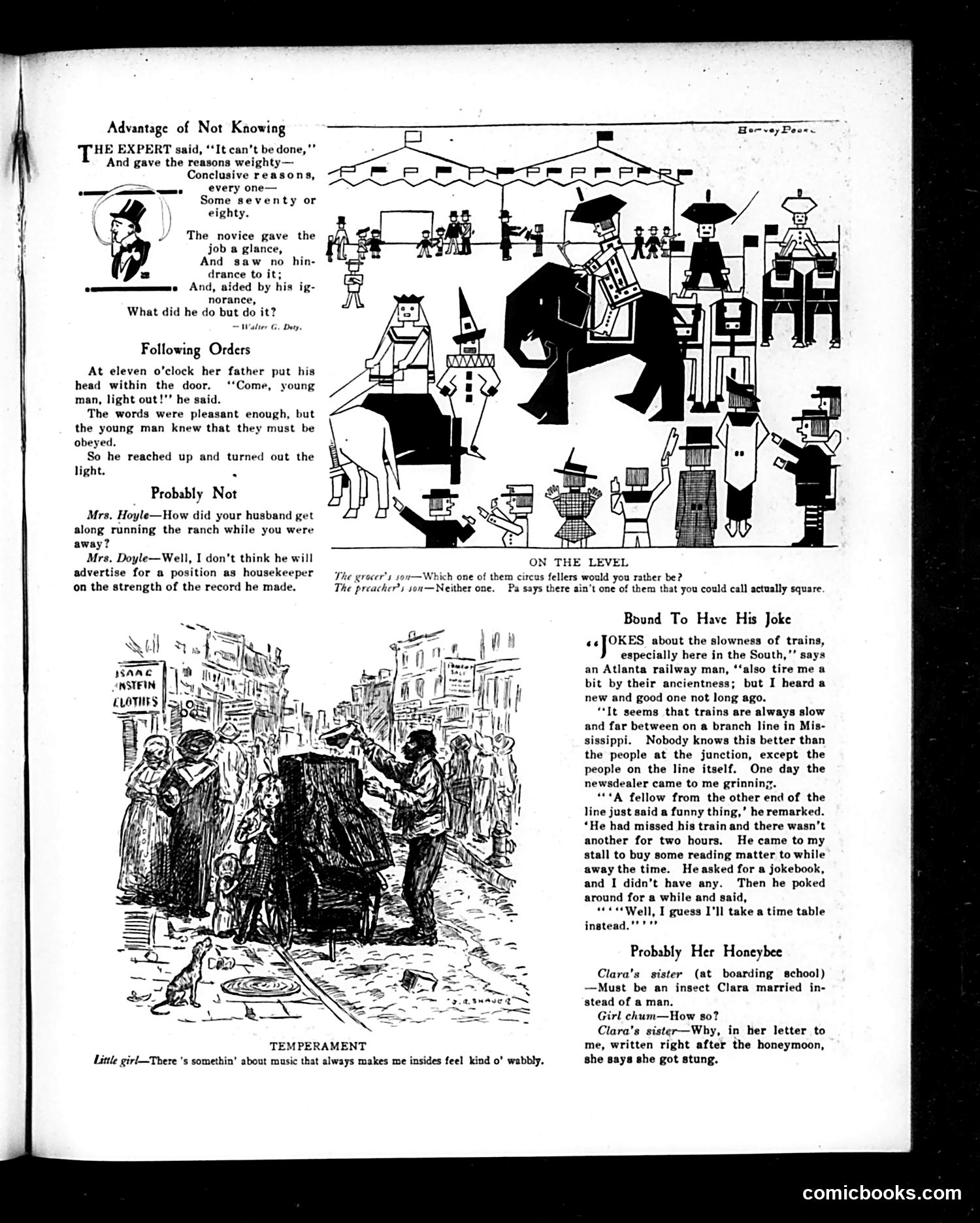
This Judge magazine page contains several brief humorous pieces typical of early 20th-century American humor: **"Advantage of Not Knowing"** satirizes how expertise can paralyze action. An expert lists 70-80 reasons why something can't be done, while an ignorant novice simply does it successfully—mocking overanalysis and bureaucratic obstruction. **"Following Orders"** uses double entendre: a father tells a young man courting his daughter to "light out" (leave); the man interprets it literally and turns off the light, proving his obedience through willful misunderstanding. **"On the Level"** and other brief jokes rely on puns and wordplay about circus performers, ranch management, and train delays in the American South—standard period humor. **"Probably Her Honeybee"** plays on "bee" (insect) versus the romantic expectations of marriage, ending with a sexual pun about the bride getting "stung"—contemporary risqué humor. The cartoons and text reflect early 1900s American sensibilities: absurdist logic, courtship proprieties, regional stereotypes, and mildly suggestive innuendo acceptable for the era.
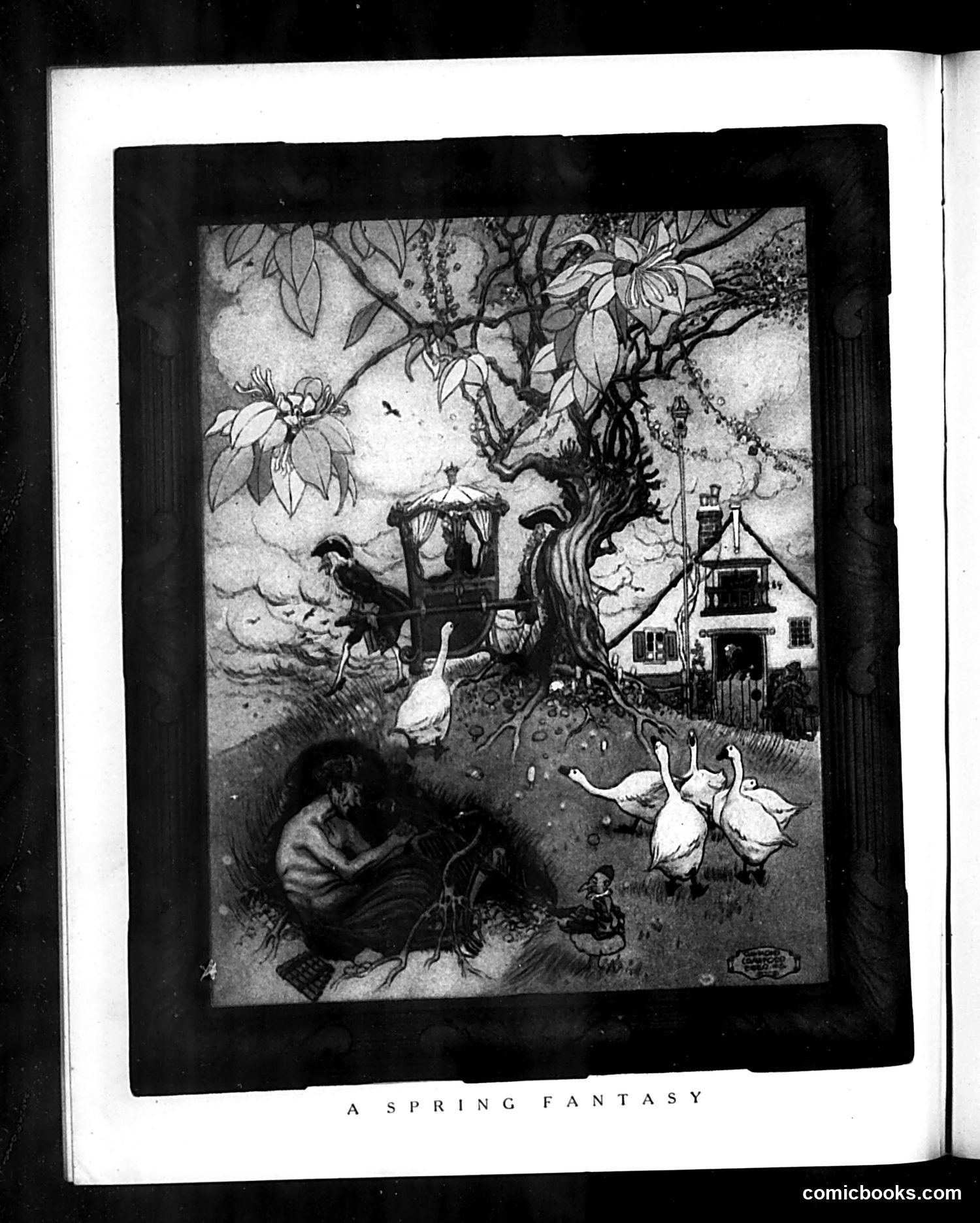
This illustration depicts a whimsical rural scene titled "A Spring Fantasy." The image shows a figure sleeping or reclining in the lower left foreground, appearing to dream the pastoral landscape above. The scene includes several geese or ducks in the yard, a cottage with a chimney on the right, gnarled trees with flowering branches overhead, and what appears to be a small structure or gazebo in the middle distance. The cartoon likely satirizes idealized romantic notions of spring and country life—contrasting urban dwellers' fantasies of rustic tranquility with reality. The dreaming figure suggests this pastoral idyll exists only in imagination. Without additional context or artist attribution visible, the specific social commentary remains unclear, though the work appears characteristic of Judge magazine's gentle satirical approach to contemporary American attitudes.
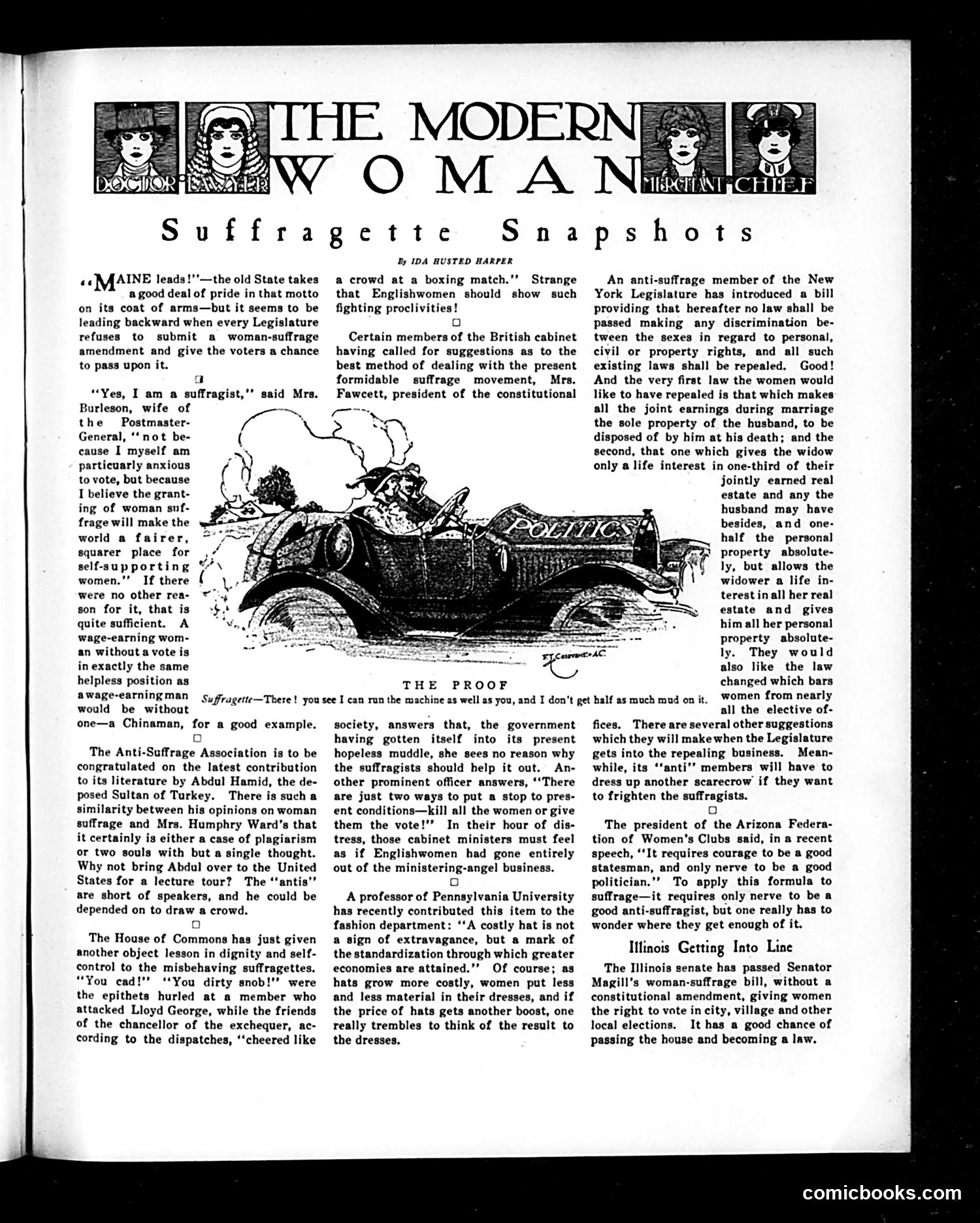
This page satirizes the women's suffrage debate circa 1910s America. The central cartoon shows a suffragette operating a car, claiming she does it "as well as you" without getting "half as much mud on it"—sarcastically suggesting women's competence to handle complex tasks, therefore voting. The text attacks **anti-suffrage arguments** through irony: quoting a British cabinet member's desperation ("kill all the women or give them the vote"), comparing anti-suffragists to the deposed Ottoman Sultan Abdul Hamid, and highlighting the economic illogic of women's fashion standards. The piece also critiques **legal discrimination**: an anti-suffrage New York legislator ironically introduces a bill eliminating sex-based discrimination in law—then suffragists would immediately repeal laws giving husbands sole control of joint marital earnings and limiting widows' inheritance rights. Judge uses satire to argue women deserve voting rights based on their economic contributions and legal vulnerability.
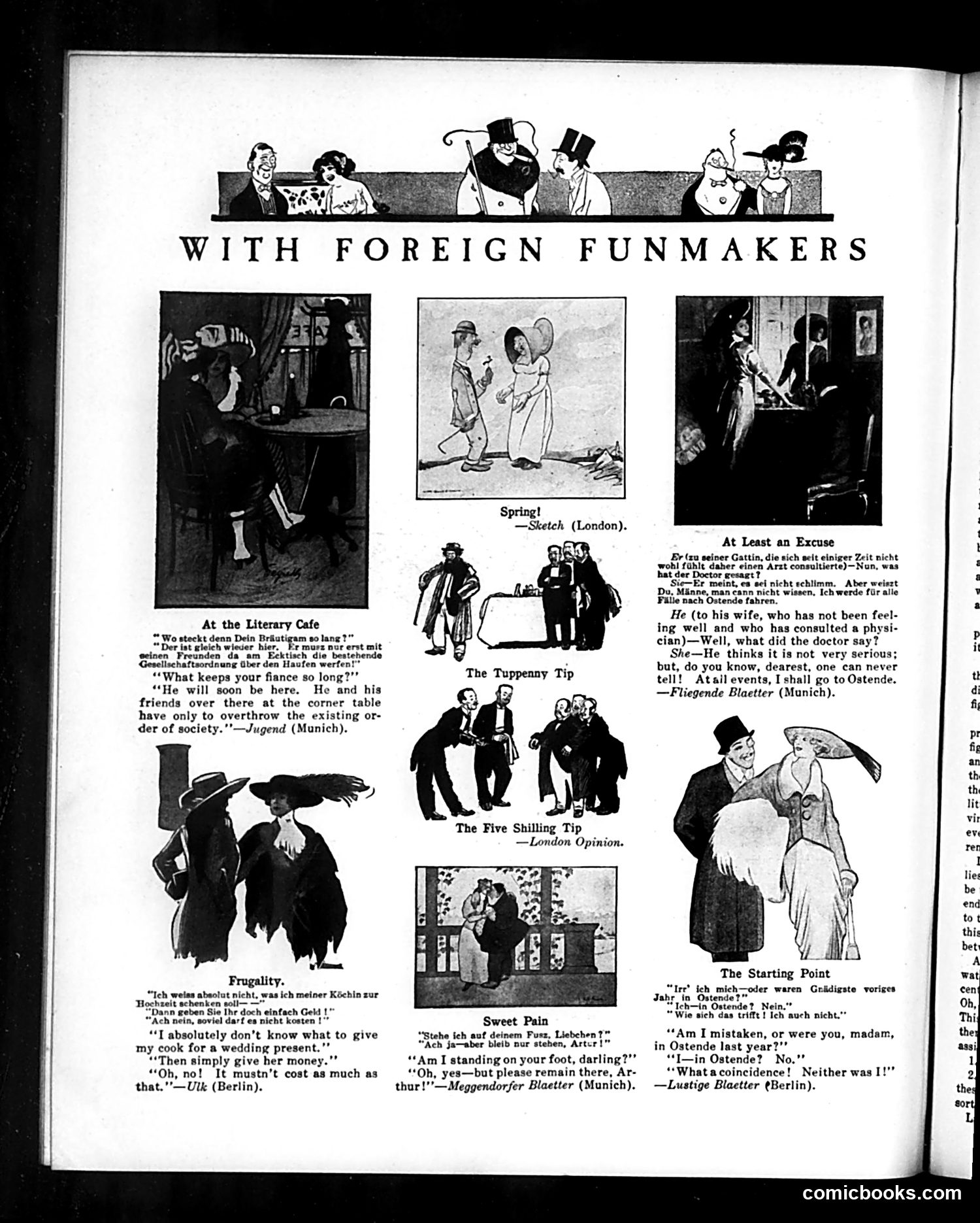
This page reprints humorous sketches from European satirical magazines (German, British, and Austrian publications cited), presenting them to American Judge readers. The cartoons satirize everyday social absurdities: **"At the Literary Cafe"** mocks intellectuals so consumed with revolutionary rhetoric they neglect personal obligations—a jab at idealistic radicals. **"Frugality"** jokes on class hypocrisy: a wealthy employer won't spend money on servant gifts despite offering advice to be generous. **"The Five Shilling Tip"** and related sketches humorously depict romantic and social awkwardness—misunderstandings and pretense in courtship. **"At Least an Excuse"** satirizes how people manufacture excuses for leisure travel, with "Ostende" (a Belgian resort) becoming the punchline—a husband uses a dubious health concern to justify a vacation. The page demonstrates early 20th-century transatlantic humor sharing, showing that middle-class anxieties about work, romance, and social propriety were universal across English-speaking and European audiences.
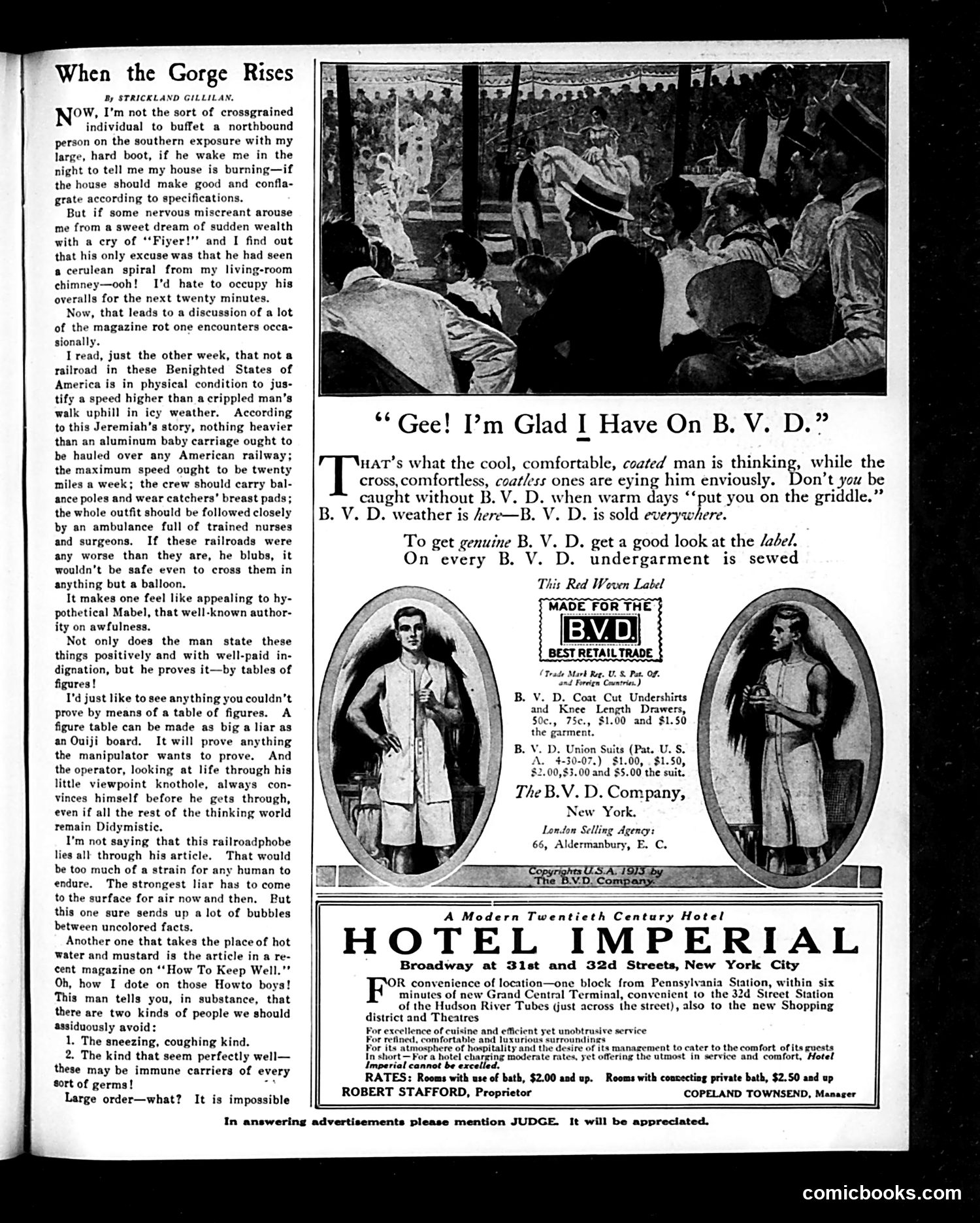
This page contains a satirical essay by Strickland Gillilan attacking exaggerated alarmism in magazine journalism. **The Target:** Gillilan mocks writers who use statistics and fear-mongering to prove catastrophic claims—specifically citing articles claiming American railroads are dangerously unsafe and others warning readers to avoid all people (both visibly sick and apparently healthy ones) to prevent disease transmission. **The Point:** The satire argues these writers manipulate data like "liars," using selective facts and tables of figures to prove anything they wish. The metaphor of "bubbles between uncolored facts" suggests their arguments surface only occasionally with truth. Gillilan suggests such writers convince themselves first, then use authority and indignation to frighten readers. **Context:** This reflects early-20th-century skepticism toward both alarmist journalism and pseudoscientific health advice—common magazine fare of the era. The essay advocates for rational thinking against manipulated statistics and fearmongering. The page also features B.V.D. undergarment advertisements, typical of Judge magazine's commercial content.
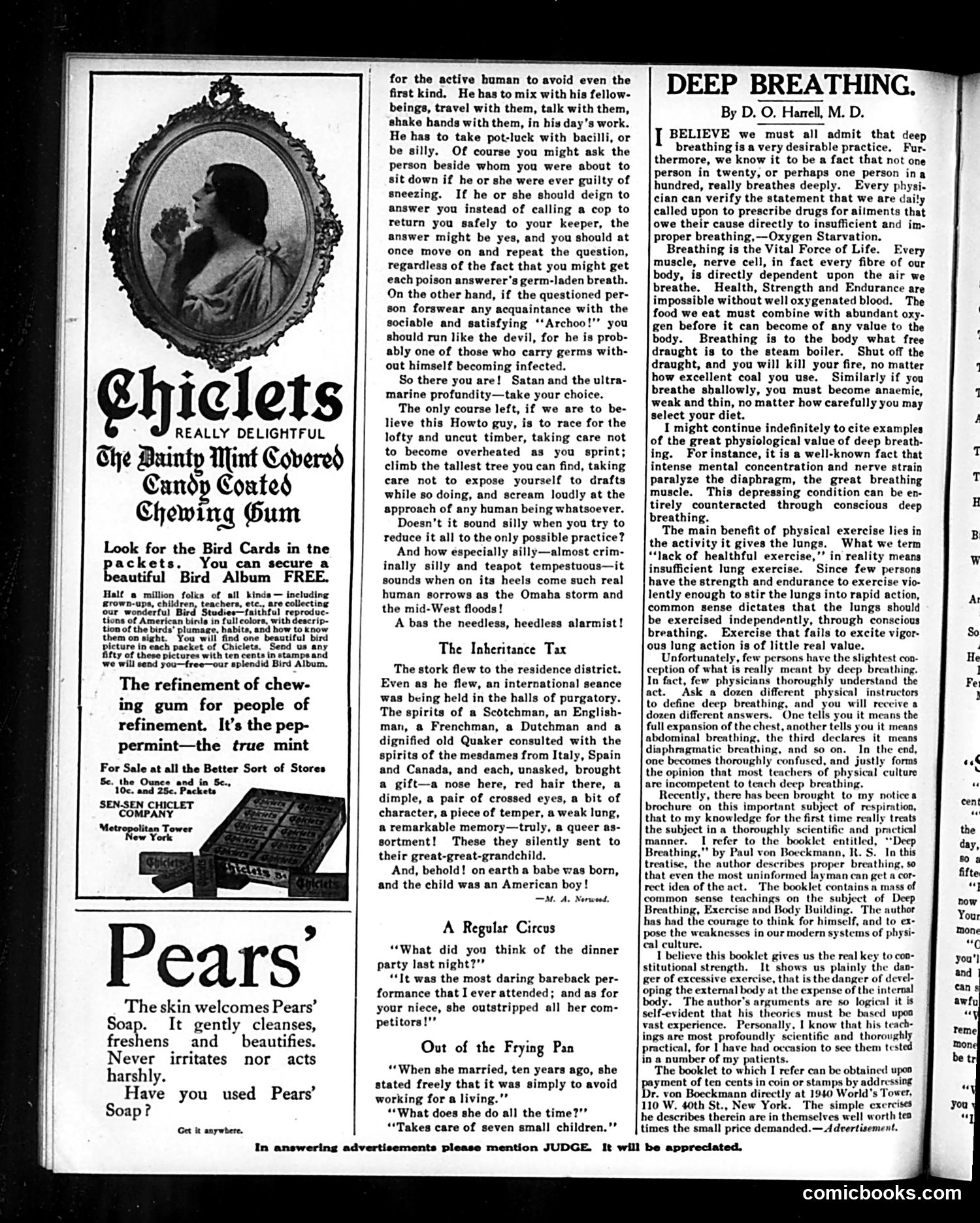
This page contains **primarily advertisements** (Chiclets gum, Pears' Soap) alongside three brief satirical pieces. The main content is **"Deep Breathing"** by D.O. Harrell, M.D.—a humorous attack on health faddism. It mocks overly cautious advice about avoiding germs through extreme measures (climbing trees, screaming at people), calling such behavior silly compared to real human suffering like the Omaha storm and Midwest floods. The satire targets alarmist health literature popular in the era. **"The Inheritance Tax"** uses gentle satire: ancestral spirits from various nations contribute character traits (Scottish frugality, French temperament, Italian passion) to a newborn American child, implying America as a mixture of inherited national characteristics. **"A Regular Circus"** is a brief joke about a woman performing "daring bareback" feats at a dinner party—likely referring to scandalous social behavior. The page reflects early 20th-century anxieties: germ theory, inheritance/eugenics interest, and evolving social propriety.
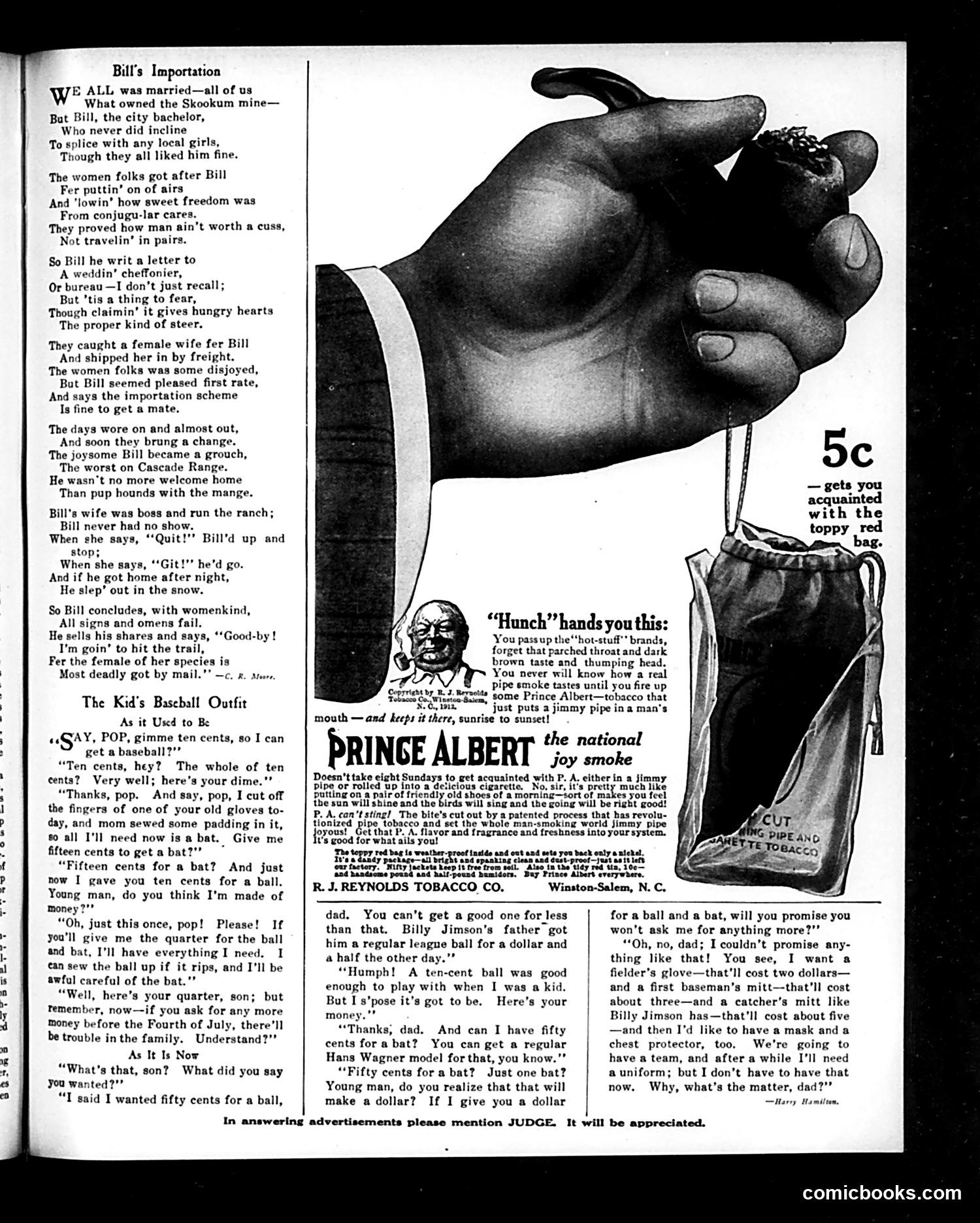
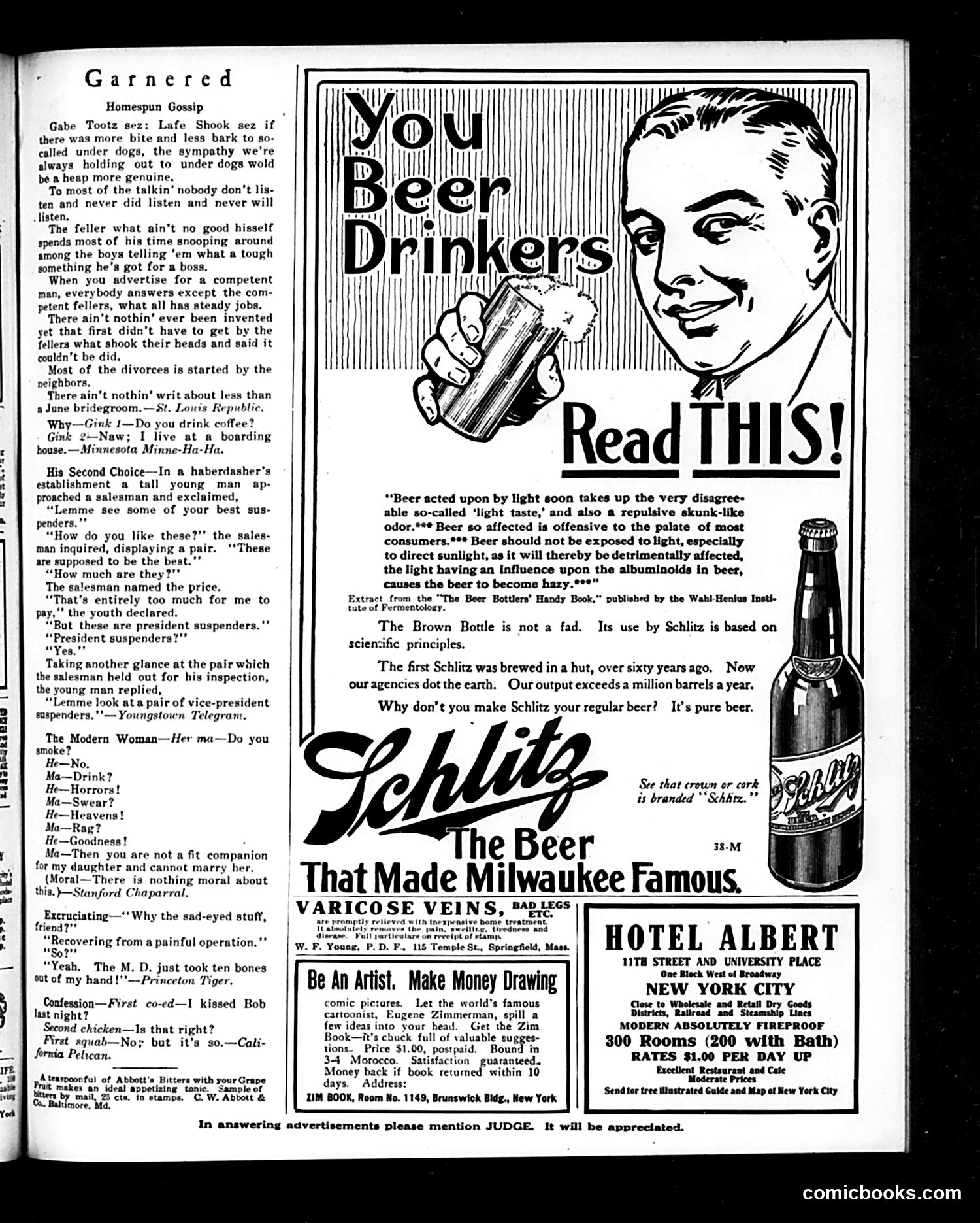
**Bill's Importation** is a cautionary poem about a bachelor who, pressured by married women in his mining community, orders a wife through a mail-order bride service. Initially pleased, Bill soon discovers his imported wife dominates him completely—she controls the ranch while he's relegated to sleeping in the snow. The moral: wives obtained by mail are "most deadly." This satirizes both the mail-order bride industry (apparently active enough to mock) and the tension between bachelor freedom and matrimonial servitude. **The Kid's Baseball Outfit** contrasts childhood then versus now through a father-son dialogue. In the past, children improvised equipment (cut gloves, homemade padding); a quarter bought a ball AND bat. Now the same boy demands fifty cents for just a ball—representing childhood consumerism and inflation. The **Prince Albert tobacco advertisement** below uses masculine appeals about pipe smoking's pleasures, emphasizing the tobacco's smoothness ("can't sting") and convenience.
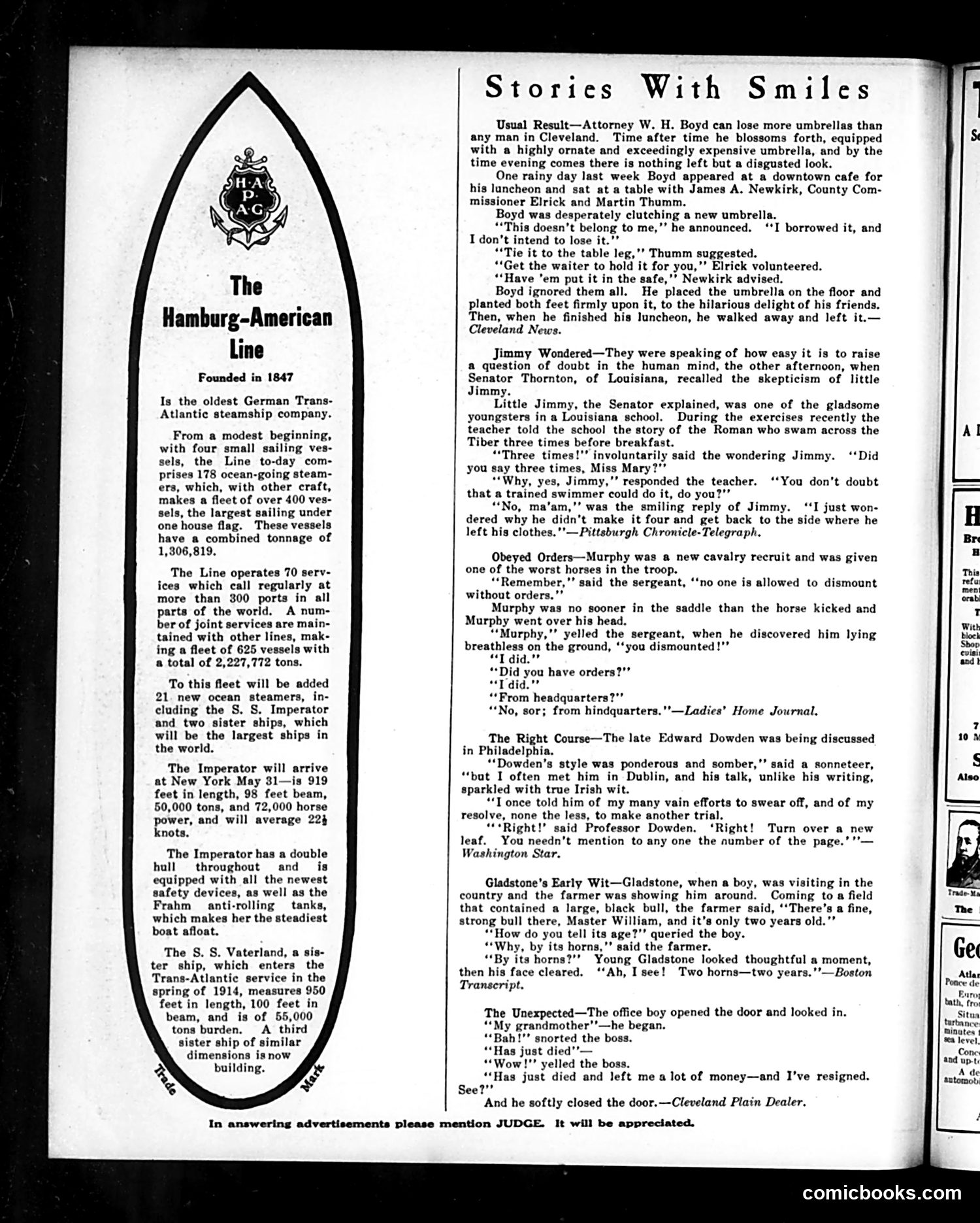
This page is primarily **advertising and humorous anecdotes**, not political satire. The left side features a lengthy advertisement for the **Hamburg-American Line**, a German steamship company, promoting its fleet expansion including the new S.S. Imperator—touted as the world's largest ship (arriving May 31, presumably 1913). The right side contains "Stories With Smiles"—four lighthearted comic anecdotes: 1. **Attorney Boyd's umbrella problem**: A Cleveland lawyer famous for losing borrowed umbrellas attempts to protect one by standing on it; leaves it behind anyway. 2. **Jimmy's skepticism**: A Louisiana schoolboy questions a teacher's story about a Roman swimming the Tiber three times, suggesting a fourth crossing to reach his clothes. 3. **Murphy's cavalry mishap**: A recruit on a wild horse gets bucked off but claims he received "orders" to dismount. 4. **The office boy**: Brief joke about an employee's resignation letter. These are gentle, domestic humor pieces reflecting early 20th-century American workplace and family life—no political commentary or caricature is evident.
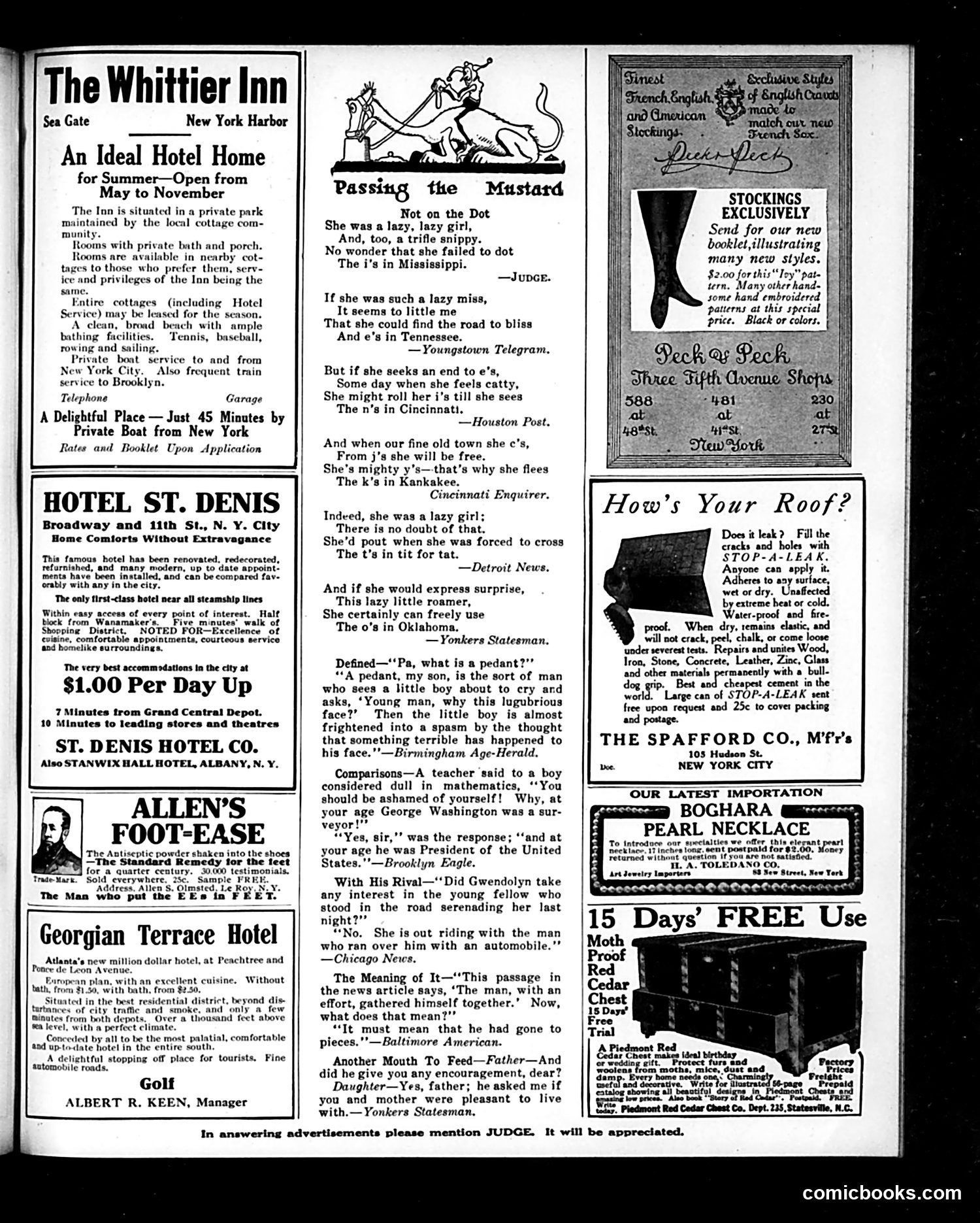
This page contains primarily **advertisements** interspersed with humorous wordplay pieces rather than political cartoons. The central comic content is a series of **puns based on geographic place names and homophones**. A "lazy girl" who fails to properly dot her i's and cross her t's becomes the vehicle for jokes about cities: she can find "i's in Mississippi," "e's in Tennessee," "n's in Cincinnati," "k's in Kankakee," etc. Each newspaper (Judge, Youngstown Telegram, Houston Post, etc.) contributes variations. Below this are unrelated joke sections about a "pedant" (a nitpicky person who uses pretentious language) and various brief anecdotes involving romantic rivalry and misunderstandings. **This is not political satire**—rather, it's light humor exploiting the coincidence that American city names contain letters that spell words. The "lazy girl" framing is simply a pretext for the wordplay. The tone is genteel, family-friendly comic magazine material typical of early 20th-century publications.
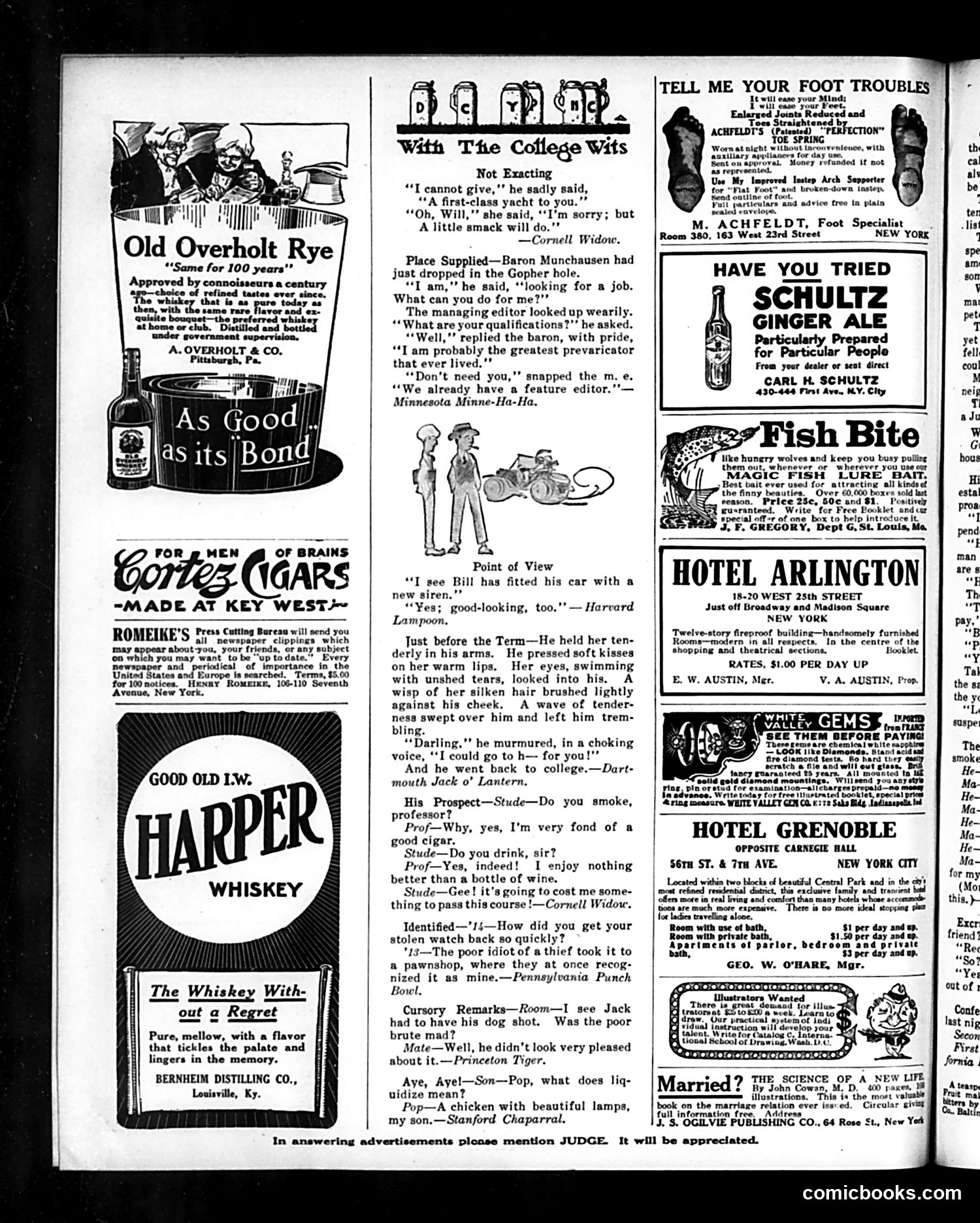
This page is primarily **advertisements and humor columns** from *Judge* magazine, not political cartoons. The ads (Old Overholt Rye whiskey, Harper Whiskey, Schultz Ginger Ale, hotels) dominate the layout—typical of early 20th-century magazines. The humor section titled "With The College Wits" collects brief jokes from various college publications (Cornell Widow, Harvard Lampoon, etc.). These are lightweight gags about college life: a baron applying for a job as a feature editor (playing on his reputation as a liar), a student realizing professors drink wine before asking them to pass his course, romantic declarations interrupted by the need to return to school. The cartoons are minimal and gentle—no sharp political satire. The page reflects the magazine's mix of advertising revenue and entertainment for educated, drinking audiences in the Prohibition-era context, though these ads suggest pre-Prohibition publication.
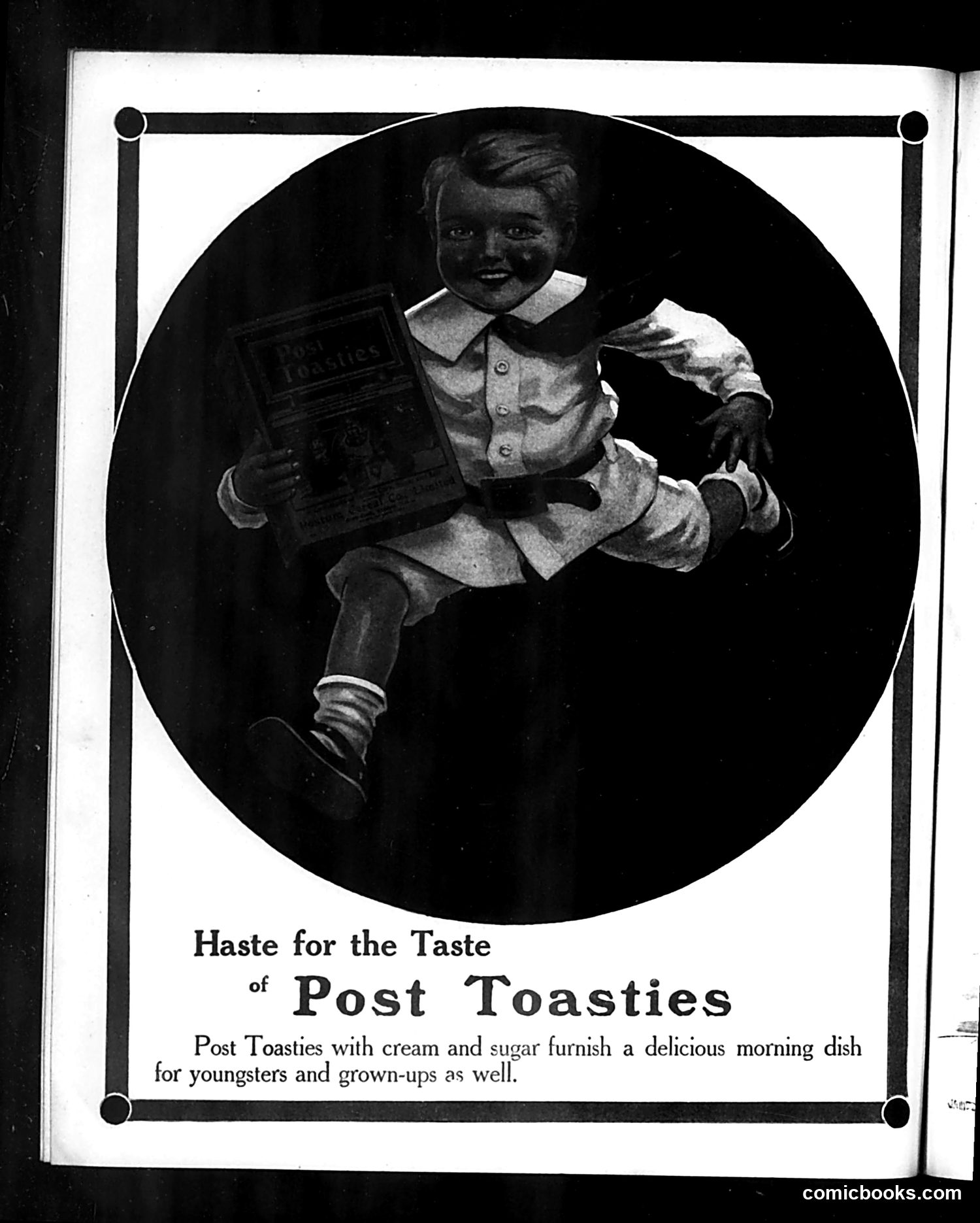
This is a straightforward **advertisement, not political satire**. It features a young child holding a box of Post Toasties cereal, smiling enthusiastically against a dark background. The headline "Haste for the Taste" is a playful pun suggesting eager consumption. The ad's sales pitch is simple: Post Toasties with cream and sugar make an appealing breakfast for both children and adults. There is no political commentary, social critique, or hidden meaning—this appears to be a genuine commercial promoting the cereal brand in Judge magazine, likely from the early 20th century. The only notable element is the child's exaggerated grin, typical of advertising imagery from that era, which modern viewers might find somewhat unsettling by contemporary standards.