
Judge, 1913-05-24 · page 4 of 24
Judge — May 24, 1913 — page 4: what you’re looking at
What you’re looking at
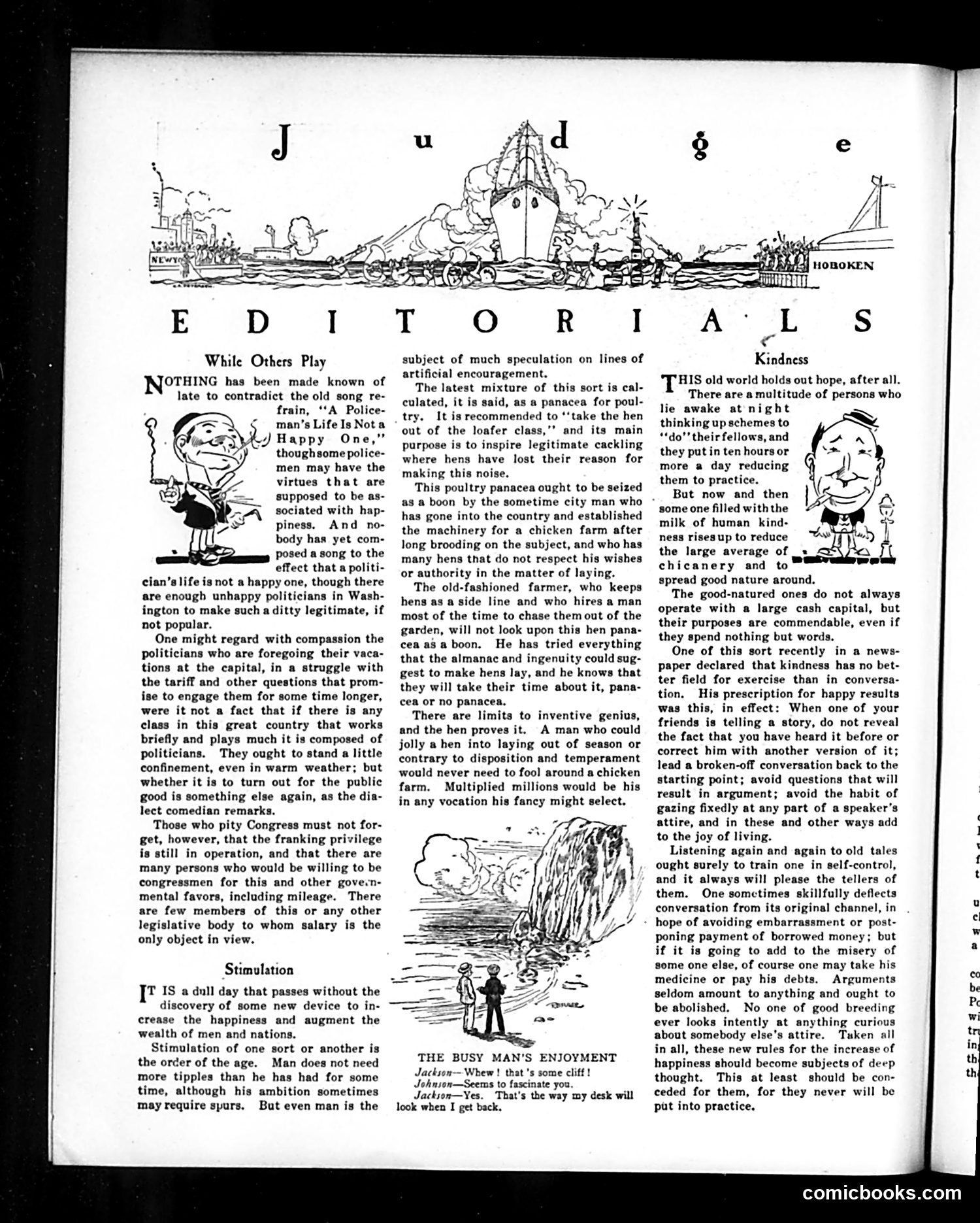
This page contains two distinct sections: **"Editorials" (top):** A political commentary criticizing politicians who avoid addressing substantive issues like tariffs while focusing on trivial matters. The text argues politicians lack seriousness and suggests the public should hold them accountable. The accompanying caricatures appear to satirize unnamed politicians as buffoonish figures. **"The Busy Man's Enjoyment" (bottom):** A brief comic dialogue about a man at a desk, apparently distracted or entertained during work. The joke seems to play on workplace procrastination or distraction. The page's header shows a harbor scene with ships and the word "HOBOKEN," suggesting New Jersey references, though the connection to the content is unclear. Without specific dates or identified individuals visible, precise political targets cannot be determined.
📄 Transcribed text from this page (OCR, searchable)
Machine-transcribed from the original scan — historical spelling and the odd misread are preserved.
While Others Play OTHING has been made known of late to contradict the old song re- frain, ‘‘A Police- man’s Life Is Nota 4) Happy One,” thoughsome police- men may have the virtues that are supposed to be as- sociated with hap- piness. And no- body has yet com- posed a song to the effect that a politi- cian’s life is not a happy one, though there are enough unhappy politicians in Wash- ington to make such a ditty legitimate, if not popular. One might regard with compassion the politicians who are foregoing their vaca- tions at the capital, in a struggle with the tariff and other questions that prom- ise to engage them for some time longer, were it not a fact that if there is any class in this great country that works briefly and plays much it is composed of Politicians. They ought to stand a little confinement, even in warm weather; but whether it is to turn out for the public good is something else again, as the dia- lect comedian remarks. Those who pity Congress must not for- get, however, that the franking privilege is still in operation, and that there are many persons who would be willing to be congressmen for this and other govecn- mental favors, including mileage. There are few members of this or any other legislative body to whom salary is the only object in view. Stimulation [" IS a dull day that passes without the discovery of some new device to in- crease the happiness and augment the wealth of men and nations. Stimulation of one sort or another is the order of the age. Man does not need more tipples than he has had for some time, although his ambition sometimes may require spurs. But even man is the subject of much speculation on lines of artificial encouragement. The latest mixture of this sort is cal- culated, it is said, as a panacea for poul- try. It is recommended to ‘‘take the hen out of the loafer class,"’ and its main purpose is to inspire legitimate cackling where hens have lost their reason for making this noise. This poultry panacea ought to be seized as a boon by the sometime city man who has gone into the country and established the machinery for a chicken farm after long brooding on the subject, and who has many hens that do not respect his wishes or authority in the matter of laying. The old-fashioned farmer, who keeps hens as a side line and who hires a man most of the time to chase them out of the garden, will not look upon this hen pana- cea asa boon. He has tried everything that the almanac and ingenuity could sug- gest to make hens lay, and he knows that they will take their time about it, pa cea or no panacea. There are limits to inventive genius, and the hen proves it. A man who could jolly a hen into laying out of season or contrary to disposition and temperament would never need to fool around a chicken farm. Multiplied millions would be his in any vocation his fancy might select. THE BUSY MAN'S ENJOYMENT Jackson—Whew ! that's some cliff! Johnion—Seems to fascinate you. Jackson—Yes. That's the way my desk will look when I get back. Tas old world holds out hope, after all. There are a multitude of persons who lie awake at night thinking up schemes to “‘do’’ their fellows, and they put in ten hours or more a day reducing them to practice. But now and then some one filled withthe milk of human kind- ness rises up to reduce the large average of chicanery and to spread good nature around. The good-natured ones do not always operate with a large cash capital, but their purposes are commendable, even if they spend nothing but words. One of this sort recently in a news- paper declared that kindness has no bet- ter field for exercise than in conversa- tion. His prescription for happy results was this, in effect: When one of your friends is telling a story, do not reveal the fact that you have heard it before or correct him with another version of it; lead a broken-off conversation back to the starting point; avoid questions that will result in argument; avoid the habit of gazing fixedly at any part of a speaker's attire, and in these and other ways add to the joy of living. Listening again and again to old tales ought surely to train one in self-control, and it always will please the tellers of them. One sometimes skillfully deflects conversation from its original channel, in hope of avoiding embarrassment or post- poning payment of borrowed money; but if it is going to add to the misery of some one else, of course one may take his medicine or pay his debts. Arguments seldom amount to anything and ought to be abolished. No one of good breeding ever looks intently at anything curious about somebody else’s attire. Tuken all in all, these new rules for the increase of happiness should become subjects of deep thought. This at least should be con- ceded for them, for they never will be put into practice. comicbooks.com