
Judge, 1913-05-24 · page 5 of 24
Judge — May 24, 1913 — page 5: what you’re looking at
What you’re looking at
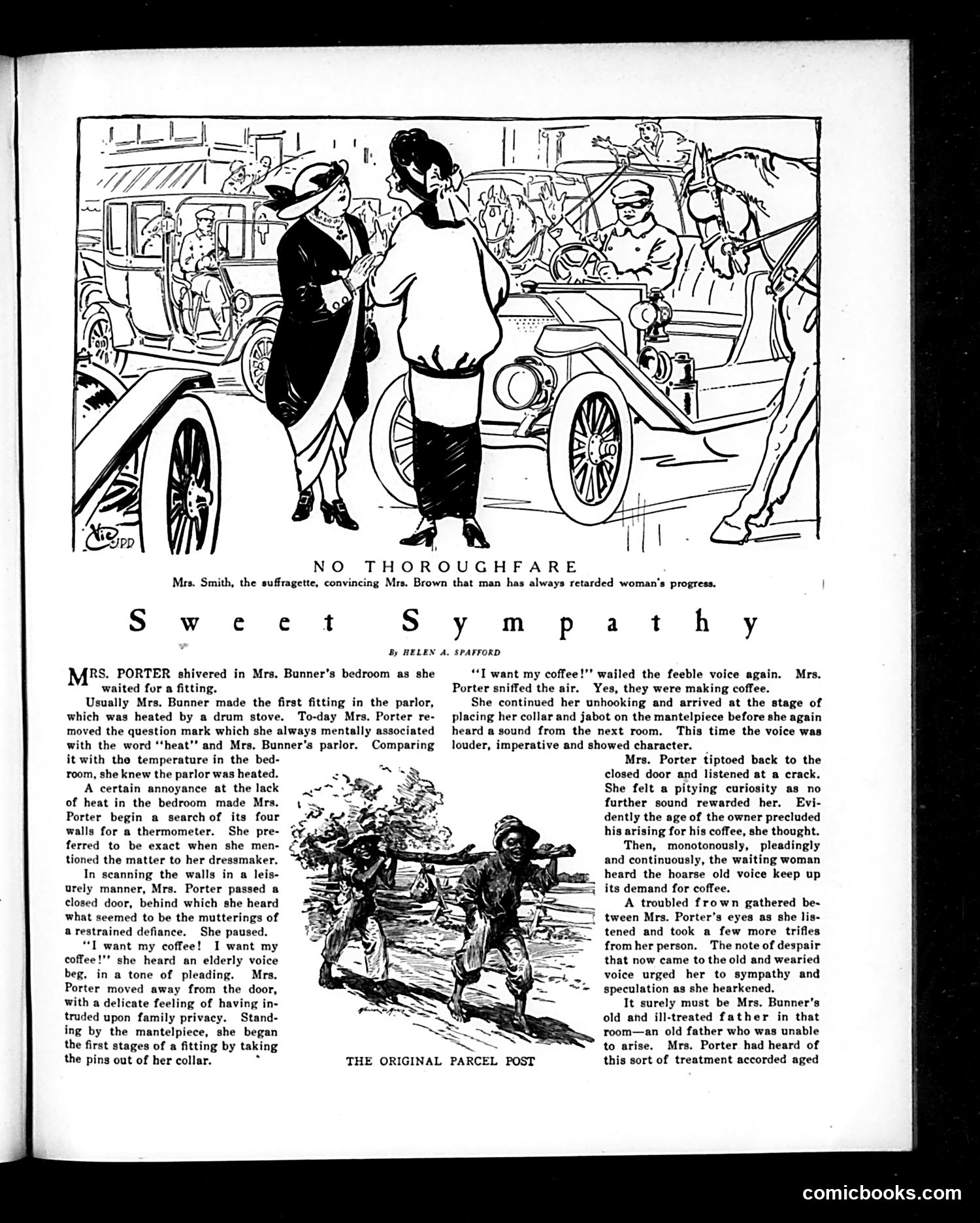
This page satirizes early 20th-century suffragettes and women's rights advocates. The top cartoon, titled "No Thoroughfare," depicts Mrs. Smith (a suffragette) attempting to convince Mrs. Brown that "man has always retarded woman's progress"—mocking suffragists' arguments about gender inequality. The accompanying story "Sweet Sympathy" by Helen A. Spafford ridicules Mrs. Porter, who complains constantly about minor domestic inconveniences (lacking coffee, finding the house cold) while lecturing others about women's oppression. The humor relies on portraying activists as hypocritical—demanding social progress while being unable to manage basic household tasks themselves. The satire suggests suffragettes were unreasonable complainers rather than serious reformers addressing genuine inequalities.
📄 Transcribed text from this page (OCR, searchable)
Machine-transcribed from the original scan — historical spelling and the odd misread are preserved.
NO THOROUGHFARE Mrs. Smith, the suffragette, convincing Mrs. Brown that man has always retarded woman's progress. S weet § By HELEN A. SPAFFORD MES. PORTER shivered in Mrs. Bunner’s bedroom as she waited for a fitting. Usually Mrs. Bunner made the first fitting in the parlor, which was heated by a drum stove. To-day Mrs. Porter re- moved the question mark which she always mentally associated with the word ‘‘heat’’ and Mrs. Bunner’s parlor. Comparing it with the temperature in the bed- room, she knew the parlor was heated. A certain annoyance at the lack of heat in the bedroom made Mrs. Porter begin a searchof its four walls for a thermometer. She pre- ¢ ferred to be exact when she men- tioned the matter to her dressmaker, In scanning the walls in a leis- urely manner, Mrs. Porter passed a closed door, behind which she heard what seemed to be the mutterings of a restrained defiance. She paused. “IT want my coffee! I want my coffee !"? she heard an elderly voice beg, in a tone of pleading. Mrs. Porter moved away from the door, with a delicate feeling of having in- truded upon family privacy. Stand- ing by the mantelpiece, she began the first stages of a fitting by taking the pins out of her collar. . THE ORIGINAL PARCEL POST h y “I want my coffee!’’ wailed the feeble voice again. Porter sniffed the air. Yes, they were making coffee. She continued her unhooking and arrived at the stage of placing her collar and jabot on the mantelpiece before she again heard a sound from the next room. This time the voice was louder, imperative and showed character. _ Mrs. Porter tiptoed back to the closed door and listened at a crack. She felt a pitying curiosity as no further sound rewarded her. Evi- dently the age of the owner precluded his arising for his coffee, she thought. Then, monotonously, pleadingly and continuously, the waiting woman heard the hoarse old voice keep up its demand for coffee. A troubled frown gathered be- tween Mrs. Porter’s eyes as she lis- tened and took a few more trifles from her person. The note of despair that now came to the old and wearied voice urged her to sympathy and speculation as she hearkened. It surely must be Mrs. Bunner’s old and ill-treated father in that > room—an old father who was unable > to arise. Mrs. Porter had heard of this sort of treatment accorded aged y m pa t Mrs, comicbooks.com