
Judge, 1913-05-24 · page 11 of 24
Judge — May 24, 1913 — page 11: what you’re looking at
What you’re looking at
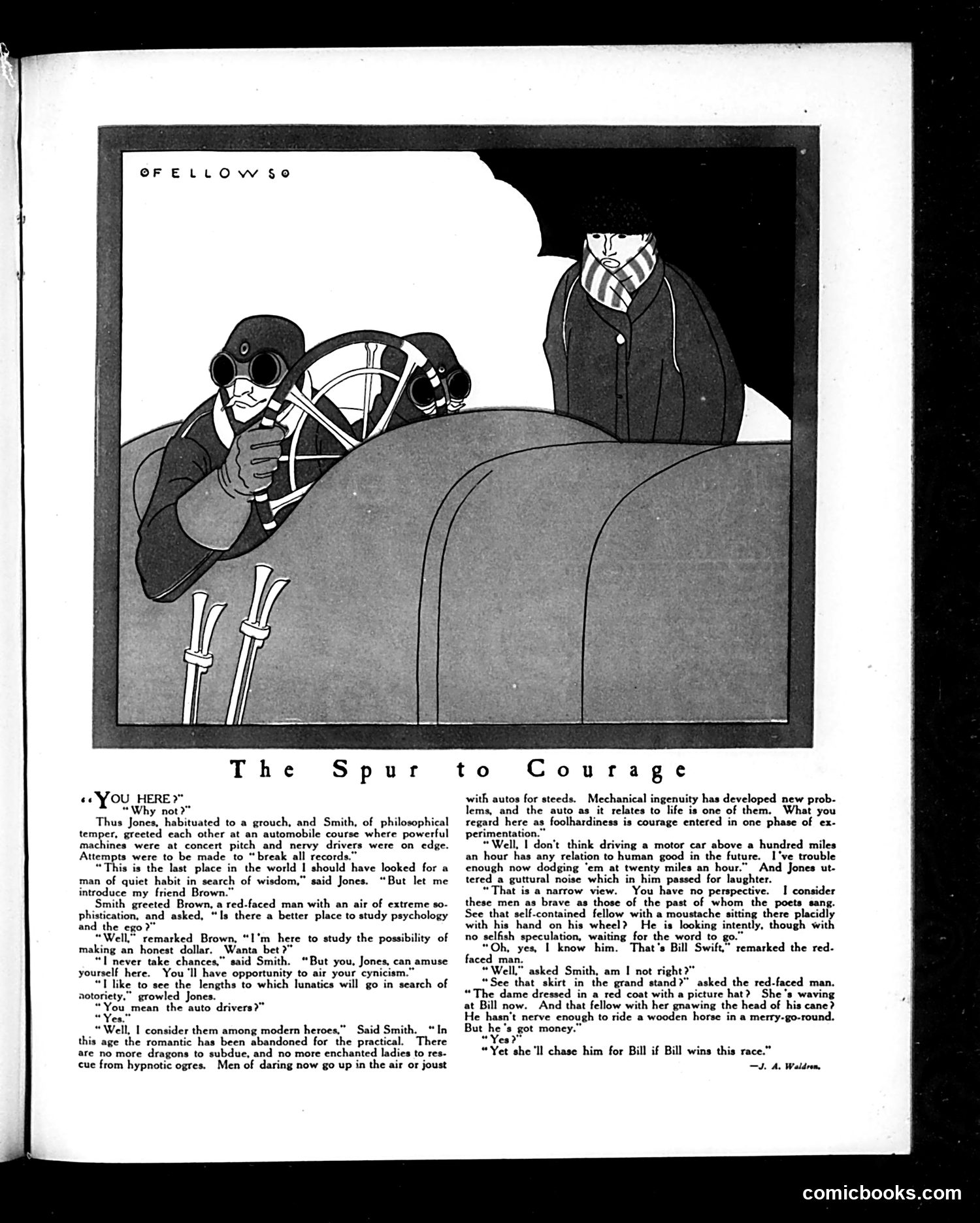
This story-comic presents a dialogue between three men—Jones (cynical), Smith (philosophical), and Brown (mercenary)—discussing automobile racing as modern heroism. Smith argues that auto racing represents contemporary courage equivalent to past dragon-slaying: mechanical challenges require genuine bravery. Jones dismisses it as dangerous lunacy with no social benefit. The narrative focuses on a race driver (Bill Swift) and spectators, including a woman in red whom Smith suggests will pursue Bill only if he wins—implying her affection is mercenary. The satire critiques early 20th-century attitudes toward automobiles and risk-taking. Smith's elevation of auto racing to knightly virtue reflects contemporary fascination with mechanical innovation and speed as markers of progress and courage. Jones's skepticism represents older sensibilities viewing such pursuits as reckless. The woman's conditional interest satirizes social mobility and fortune-hunting in the automobile age.
📄 Transcribed text from this page (OCR, searchable)
Machine-transcribed from the original scan — historical spelling and the odd misread are preserved.
The Spur OU HERE?” “Why not?” Thus Jones, habituated to temper, greeted each other at an were at concert pitch were to be made to “break all records.” “This is the last place in the world | should have looked for a man of quiet habit in search of wisdom,” said Jones. “But let me introduce my friend Brown.” Smith greeted Brown, a red-faced man with an air of extreme so- phistication, and asked, “Is there a better place to study psychology id the ego ell,” remarked Brown, “I'm here to study the possibility of making an honest dollar. Wanta bet?” “I never take chances,” said Smith. “But you, Jones, can amuse yourself here. You ‘ll have opportunity to air your cynicism. “I like to see the lengths to which lunatics will go in search of notoriety,” growled Jones. “You mean the auto drivers?” “Well, I consider them among modern heroes,” Said Smith.“ In this age the romantic has been abandoned for the practical. ere are no more dragons to subdue, and no more enchanted ladies to res- cue from hypnotic ogres. Men of daring now go up in the air or joust grouch, and Smith, of philosophical tomobile course where powerful d_ nervy daw rs were on edge. to Courage with autos for steeds. Mechanical ingenuity has developed new prob- lems, and the auto as it relates to life is one of them. t you regard here as foolhardiness is courage entered in one phase of ex- perimentation.” “Well, | don’t think driving a motor car above a hundred miles an hour has any relation to human good in the future. I’ve trouble enough now dodging ‘em at twenty miles an hour.” And Jones ut- tered a guttural noise which in him passed for laughter. “That is a narrow view. You have no perspective. 1 consider these men as brave as those of the past of whom the poets sang. See that self-contained fellow with a moustache sitting there placid with his hand on his wheel? He is looking intently, though wit no selfish speculation, waiting for the word to go.” “Oh, yes, | know him. That's Bill Swift remarked the red- faced mai “Well,” asked Smith, am I not right See that skirt in the grand stand “The dame dressed in a red coat with a at Bill now. And that fellow with her gnawing the head of cane? He hasn't nerve enough to ride a wooden horse in a merry-go-round. But | he's got money.” ‘es “Yet she ‘ll chase him for Bill if Bill wins this race.” |. A. Waldron, comicbooks.com