
Judge, 1913-05-24 · page 17 of 24
Judge — May 24, 1913 — page 17: what you’re looking at
What you’re looking at
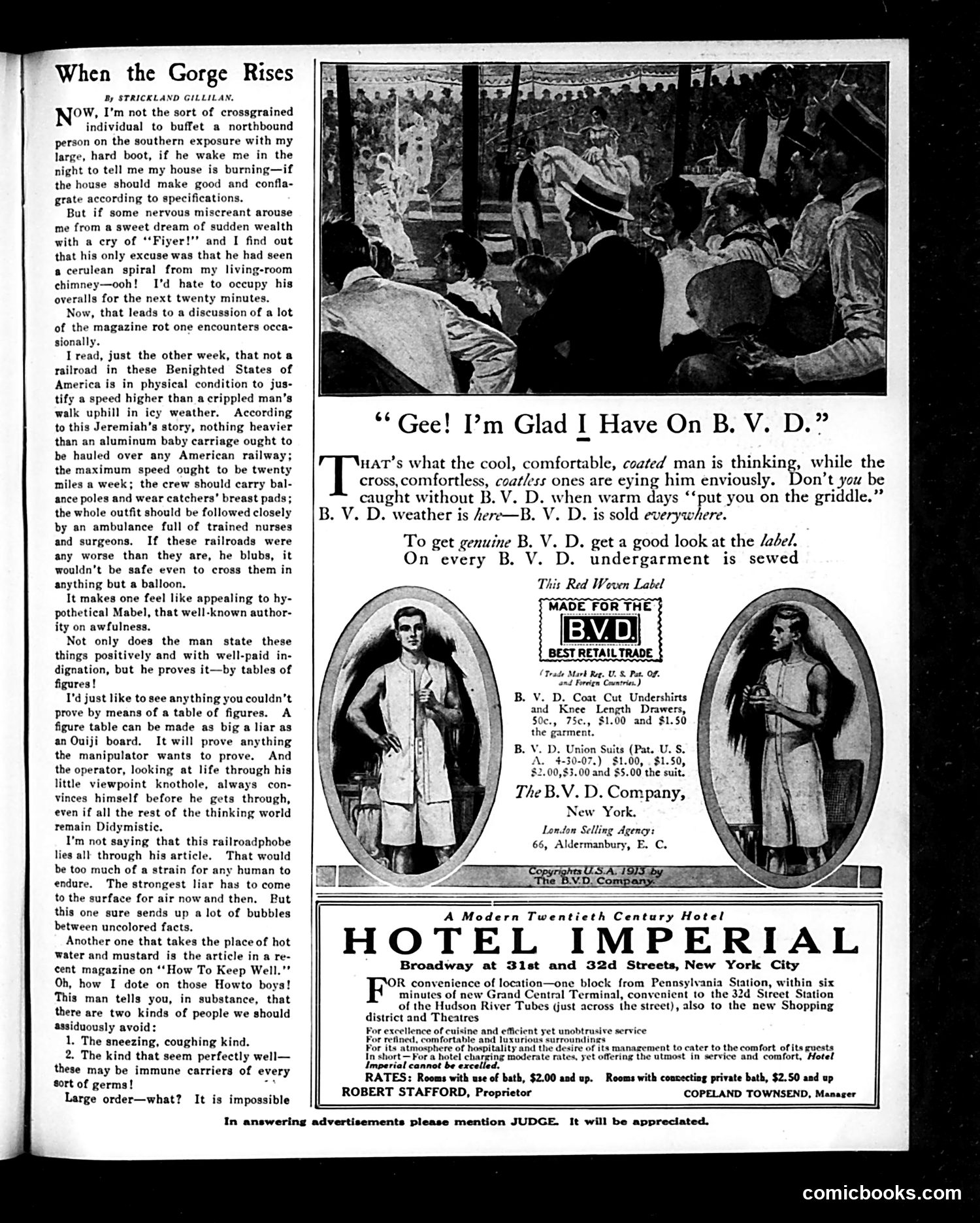
This page contains a satirical essay by Strickland Gillilan attacking exaggerated alarmism in magazine journalism. **The Target:** Gillilan mocks writers who use statistics and fear-mongering to prove catastrophic claims—specifically citing articles claiming American railroads are dangerously unsafe and others warning readers to avoid all people (both visibly sick and apparently healthy ones) to prevent disease transmission. **The Point:** The satire argues these writers manipulate data like "liars," using selective facts and tables of figures to prove anything they wish. The metaphor of "bubbles between uncolored facts" suggests their arguments surface only occasionally with truth. Gillilan suggests such writers convince themselves first, then use authority and indignation to frighten readers. **Context:** This reflects early-20th-century skepticism toward both alarmist journalism and pseudoscientific health advice—common magazine fare of the era. The essay advocates for rational thinking against manipulated statistics and fearmongering. The page also features B.V.D. undergarment advertisements, typical of Judge magazine's commercial content.
📄 Transcribed text from this page (OCR, searchable)
Machine-transcribed from the original scan — historical spelling and the odd misread are preserved.
When the Gorge Rises By STRICKLAND GILLILAN, Now. I’m not the sort of crossgrained individual to buffet a northbound person on the southern exposure with my large, hard boot, if he wake me in the night to tell me my house is burning—if the house should make good and confla- grate according to specifications. But if some nervous miscreant arouse me from a sweet dream of sudden wealth with a cry of ‘‘Fiyer!’’ and I find out that his only excuse was that he had seen acerulean spiral from my living-room chimney—ooh! I'd hate to occupy his overalls for the next twenty minutes. Now, that leads to a discussion of a lot of the magazine rot one encounters occa- sionally. I read, just the other week, that not a railroad in these Benighted States of America is in physical condition to jus- tify a speed higher than a crippled man’s walk uphill in icy weather. According to this Jeremiah’s story, nothing heavier than an aluminum baby carriage ought to be hauled over any American railway; the maximum speed ought to be twenty miles a week; the crew should carry bal- ance poles and wear catchers’ breast pads; the whole outfit should be followed closely by an ambulance full of trained nurses and surgeons. If these railroads were any worse than they are, he blubs, it wouldn't be safe even to cross them in anything but a balloon. It makes one feel like appealing to hy- pothetical Mabel, that well-known author- ity on awfulness. Not only does the man state these things positively and with well-paid in- dignation, but he proves it—by tables of figures! I’d just like to see anything you couldn't prove by means of a table of figures. A figure table can be made as big a liar as an Ouiji board. It will prove anything the manipulator wants to prove. And the operator, looking at life through his little viewpoint knothole, always con- vinces himself before he gets through, even if all the rest of the thinking world remain Didymistic. I'm not saying that this railroadphobe lies all through his article. That would be too much of a strain for any human to endure. The strongest liar has to come to the surface for air now and then. But this one sure sends up a lot of bubbles between uncolored facts. Another one that takes the place of hot water and mustard is the article in a re- cent magazine on ‘‘How To Keep Well.”” Oh, how I dote on those Howto boys! This man tells you, in substance, that there are two kinds of people we should assiduously avoid: 1, The sneezing, coughing kind. 2. The kind that seem perfectly well— these may be immune carriers of every sort of germs! Large order—what? It is impossible “*Gee! I’m Glad I Have On B. V. D.” cross, comfortless, coat/ess ones are eying him enviously. Don’t you be caught without B. V. D. when warm days ‘‘put you on the griddle.” v l Vuat’s what the cool, comfortable, coated man is thinking, while the B. V. D. weather is here—B. V. D. is sold everywhere. To get genuine B. V. D. get a good look at the label. On every B. V. D. undergarment is sewed This Red Woven Label (Trade Mark Reg. U.S. Pat. OF. and Foreign Countries) B. V. D. Coat Cut Undershirts and Knee Length Drawers, $0c., 7Se., $1.00 and $1.50 the garmen B, V. D. Union Suits (Pat. U.S. A. 4-30-07.) $1.00, . $1.50, 00 and $5.00 the suit. The BV. D. Company, New York. London Selling Agency: 66, Aldermanbury, E. C. A Modern Twentieth Century Hotel HOTEL IMPERIAL Broadway at 31st and 32d Streets, New York City R convenience of location—one block from Pennsylvania Station, within six minutes of new Grand Central Terminal, convenient to the 32d Street Station of the Hudson River Tubes (just across the street), also to the new Shopping district and Theatres For excellence of cuisine and efficient yet unobtrusive service mfortable and luxurious surroundings re of hospitality and the desire of its management to cater to the comfort of its guests \ moderate rates, yet offering the utmost in service and comfort, Hotel bath, $2.00 and up. Rooms with connecting private bath, $2.50 and up ROBERT STAFFORD, Proprietor COPELAND TOWNSEND, Manager In answering advertisements please mention JUDGE. It will be appreciated. comicbooks.com