
A complete issue · 24 pages · 1913
Judge — April 5, 1913
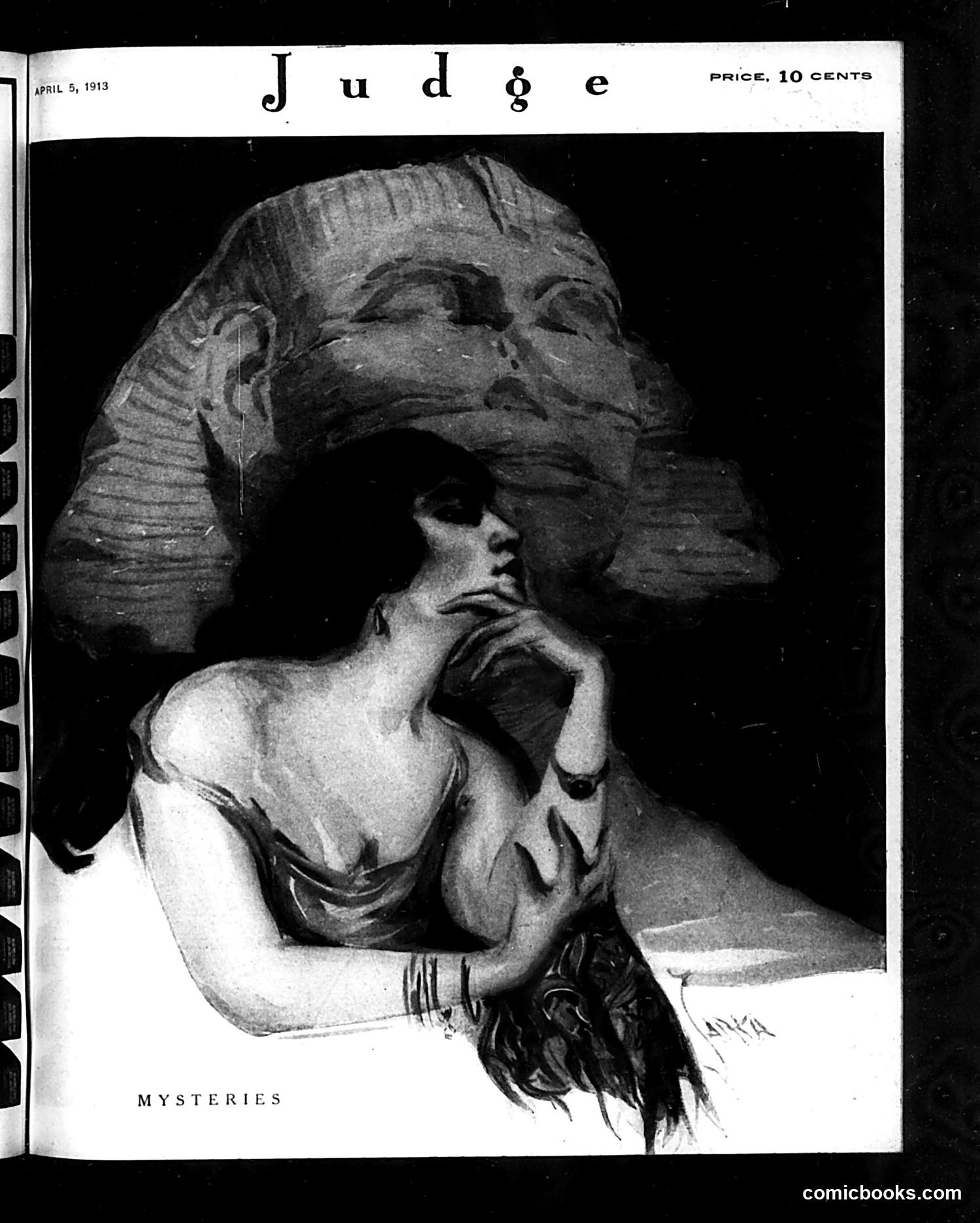
This illustration depicts an Egyptian sphinx alongside a contemplative modern woman. The caption "MYSTERIES" suggests a comparison between ancient enigmas and modern female psychology—a common satirical theme of the era. The 1913 dating is significant: this reflects Progressive Era anxieties about women's changing roles, particularly as suffrage movements gained momentum. The "mystery" of what women wanted or thought was a frequent subject of contemporary humor. The woman's pose—hand to chin, gazing upward—suggests she's contemplating something unknowable, mirroring the sphinx's famous enigmatic quality. This visual pun mocks the period's male perception that female consciousness remained fundamentally inscrutable and puzzling, despite (or because of) women's increasing public activism and political demands.
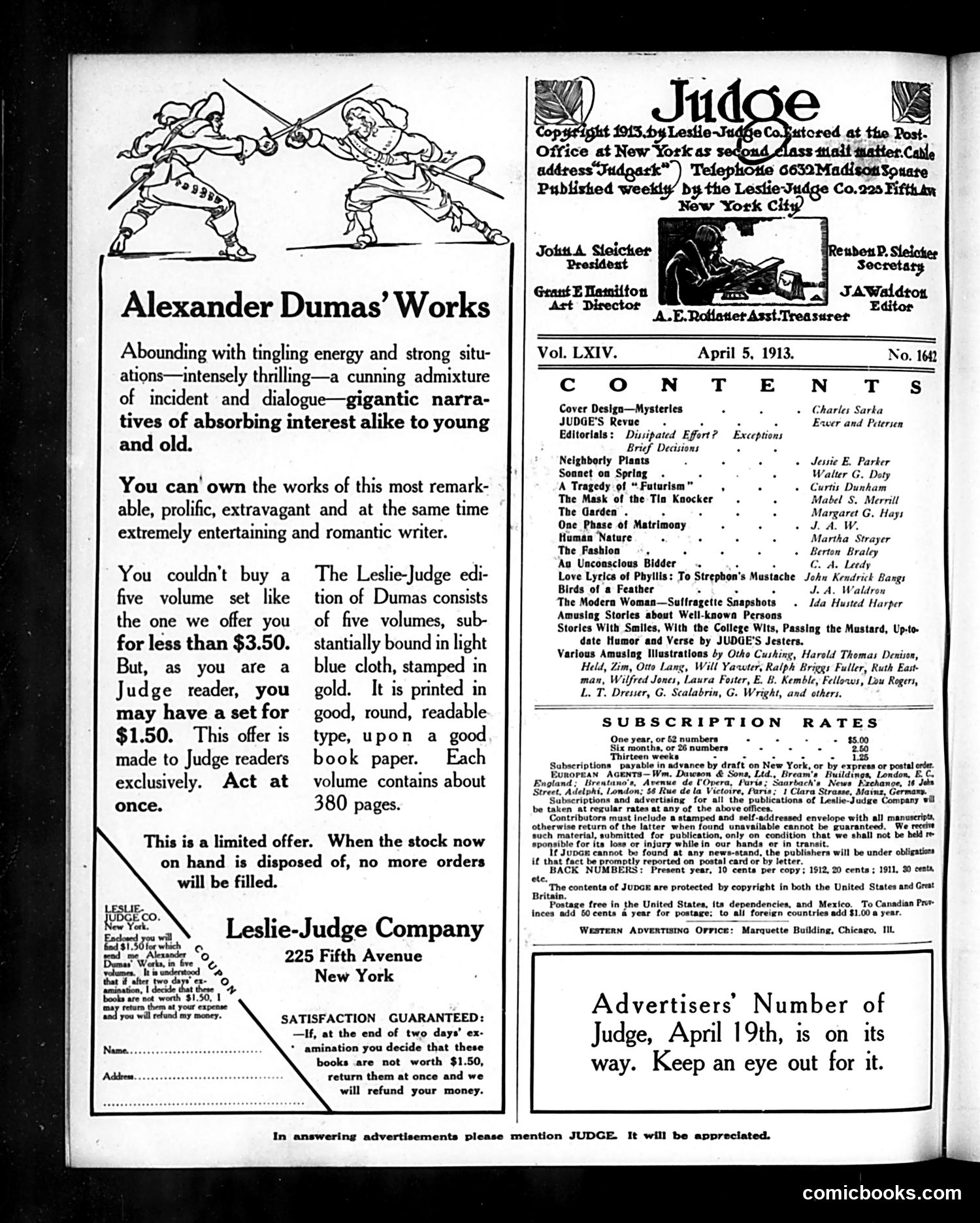
This page is primarily advertising. The dominant content is a Leslie-Judge Company advertisement for a five-volume set of Alexandre Dumas' works, offered at the special price of $1.50 for Judge readers (normally $3.50). The ad emphasizes the romantic, adventurous nature of Dumas' novels and their appeal to "young and old." The top illustration shows two sword-fighting figures in period costume, visually representing the swashbuckling adventure found in Dumas' famous works like *The Three Musketeers*. The page includes magazine masthead information and subscription rates. The right column contains the table of contents for this issue, listing various stories and articles by different authors. No political satire or social commentary appears on this particular page.
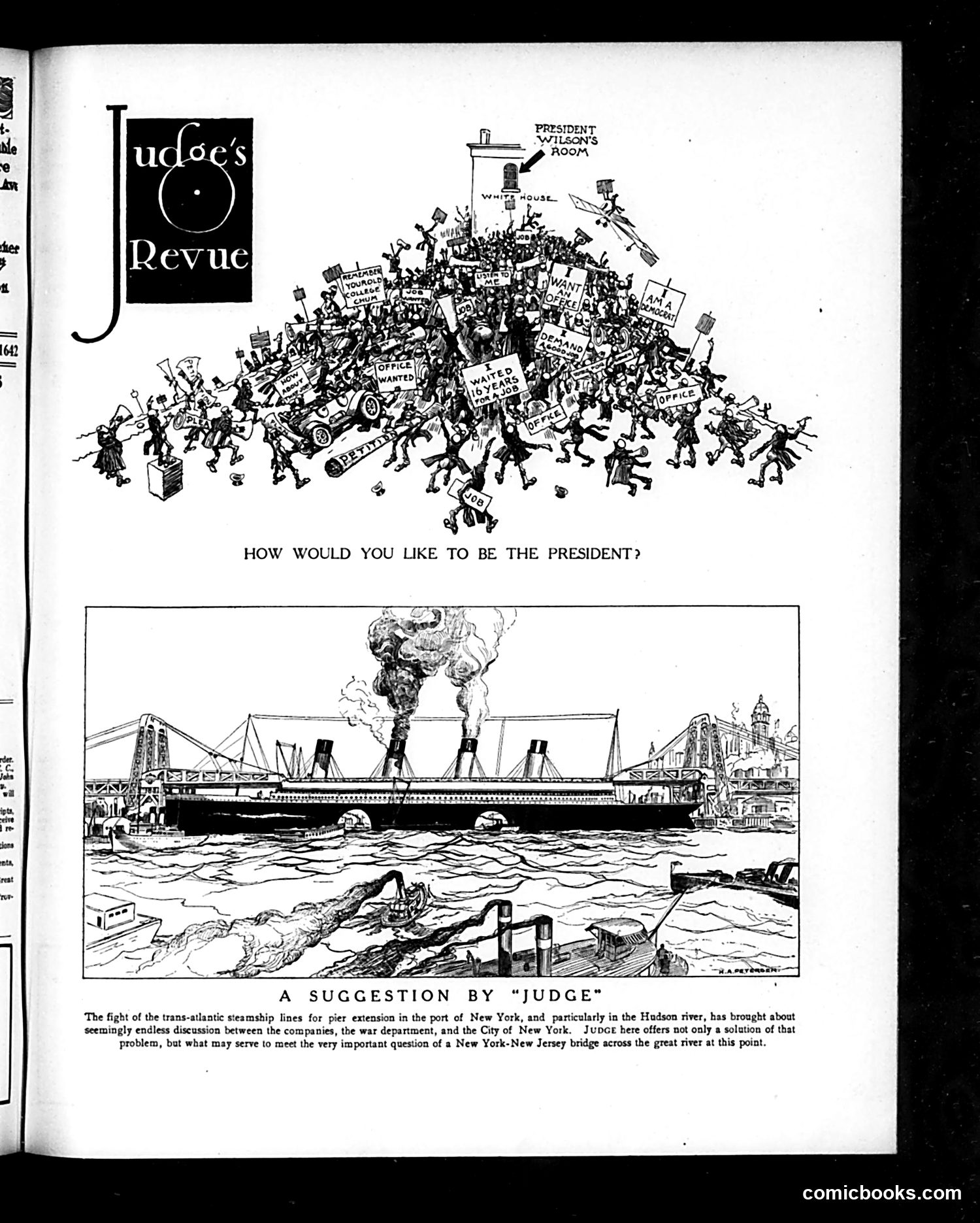
This page from *Judge* magazine satirizes debates about New York infrastructure and presidential authority circa World War I era. The top cartoon shows a chaotic crowd at the White House demanding various offices and positions, captioned "HOW WOULD YOU LIKE TO BE THE PRESIDENT?" It mocks the overwhelming demands placed on the sitting president. The bottom cartoon, "A SUGGESTION BY 'JUDGE,'" depicts a massive ocean liner with smoking funnels, sarcastically proposing a steamship as a solution to the trans-Atlantic pier extension controversy in New York Harbor. The accompanying text references disputes between shipping companies, the war department, and New York City regarding Hudson River pier space and a proposed New York-New Jersey bridge. The "suggestion" humorously implies such infrastructure problems are as absurd as docking a ship where a bridge should be.
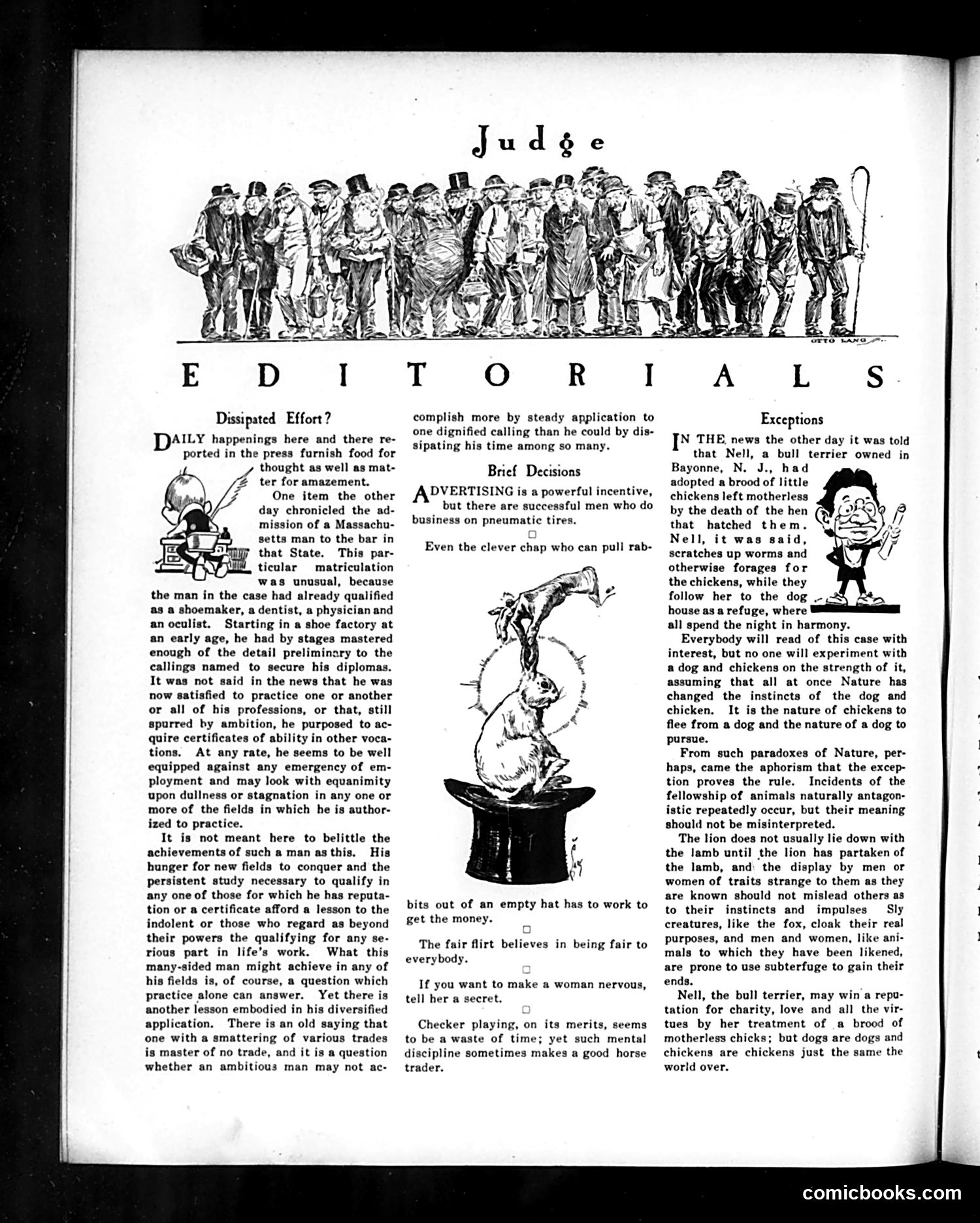
This page contains three distinct editorial pieces rather than traditional political cartoons: 1. **"Dispatched Effort?"** critiques a man who qualified in multiple professions (shoemaker, dentist, physician, oculist) yet achieved mastery in none. The satire suggests that excessive career-switching and credential-collecting without genuine expertise represents wasted ambition—a common American anxiety about professional dilettantism. 2. **"Brief Decisions"** discusses advertising's power while acknowledging that successful businessmen often operate on instinct rather than strategy. The accompanying illustration shows acrobatic dogs, likely satirizing the performative nature of commercial promotion. 3. **"Exceptions"** recounts an anecdote about a bull terrier named Neil who adopted orphaned chicks after their hen died, using animal behavior to illustrate natural instinct versus human pretension. The overall tone criticizes false expertise and celebrates authentic simplicity.
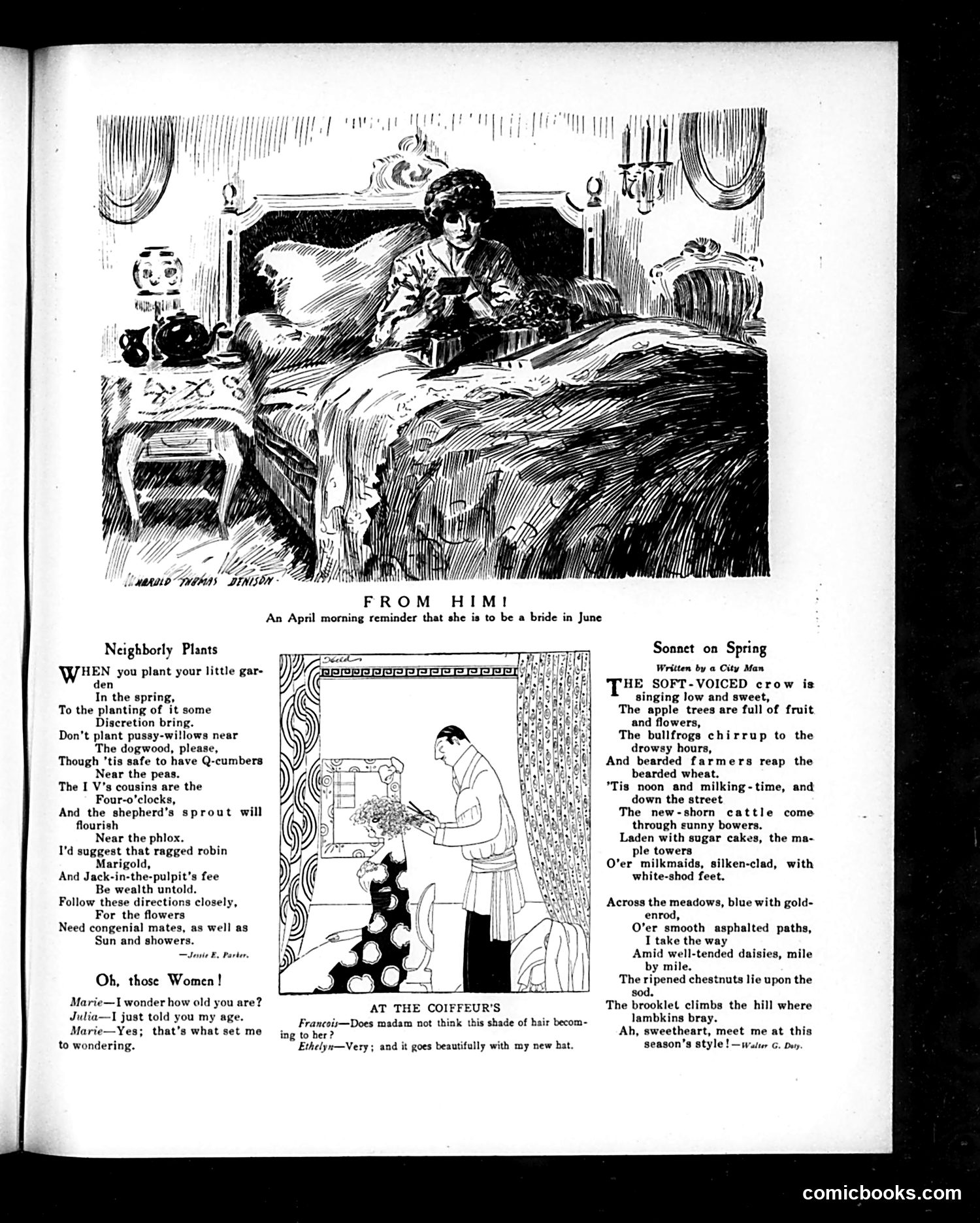
This page contains literary content rather than political satire. The top illustration "FROM HIMI" depicts a woman in bed receiving an April reminder about her June wedding—a domestic humor piece about marriage preparations. The center cartoon "AT THE COIFFEUR'S" shows a woman at a hair salon discussing a new hat with her stylist. The dialogue ("Does madame not think this shade of hair becoming to her?") is a gentle joke about women's vanity and fashion consciousness. The left column "Neighborly Plants" offers humorous gardening advice in verse, while the right column "Sonnet on Spring" provides romantic poetry about rural life. Overall, this is a lifestyle/humor page targeting affluent readers, focusing on domestic themes, fashion, and romance rather than political commentary.
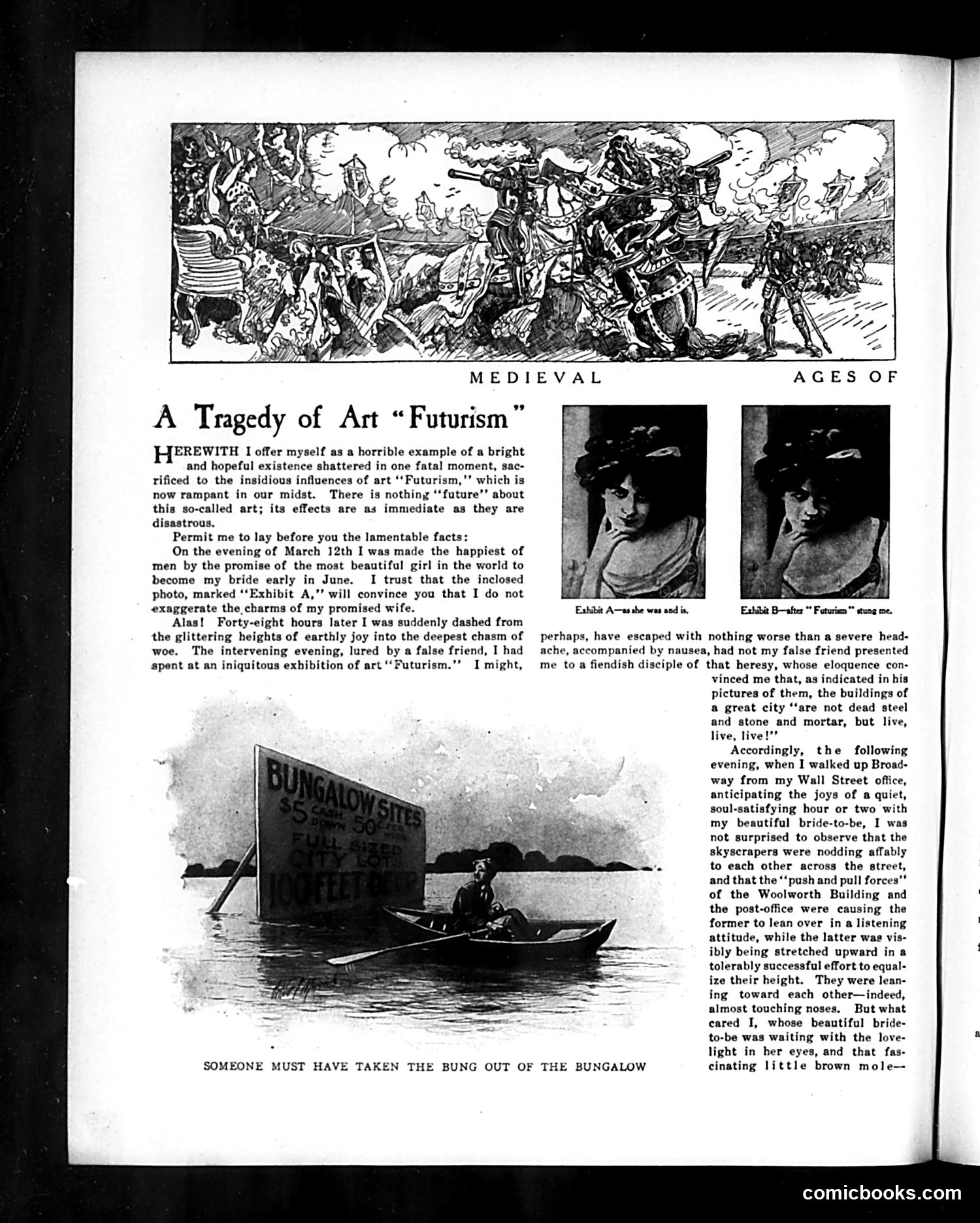
This satire mocks the early 20th-century Futurist art movement, which was gaining popularity in America and Europe. The author presents himself as a cautionary tale: engaged to a beautiful woman (Exhibit A), he attends a Futurist art exhibition and is so brainwashed by a disciple's rhetoric about buildings being "alive" with "push and pull forces" that his perception becomes distorted. Walking through New York afterward, he literally sees skyscrapers "nodding" to each other and the Woolworth Building leaning toward the post office. The joke is that Futurism's abstract philosophy about dynamic motion and life in modern architecture has made him hallucinate—he's mentally unstable from exposure to the movement. The cartoon suggests Futurism is dangerous nonsense that corrupts rational thought, particularly targeting young, educated men. This reflects widespread American conservative skepticism toward avant-garde European art movements in the 1910s-1920s.
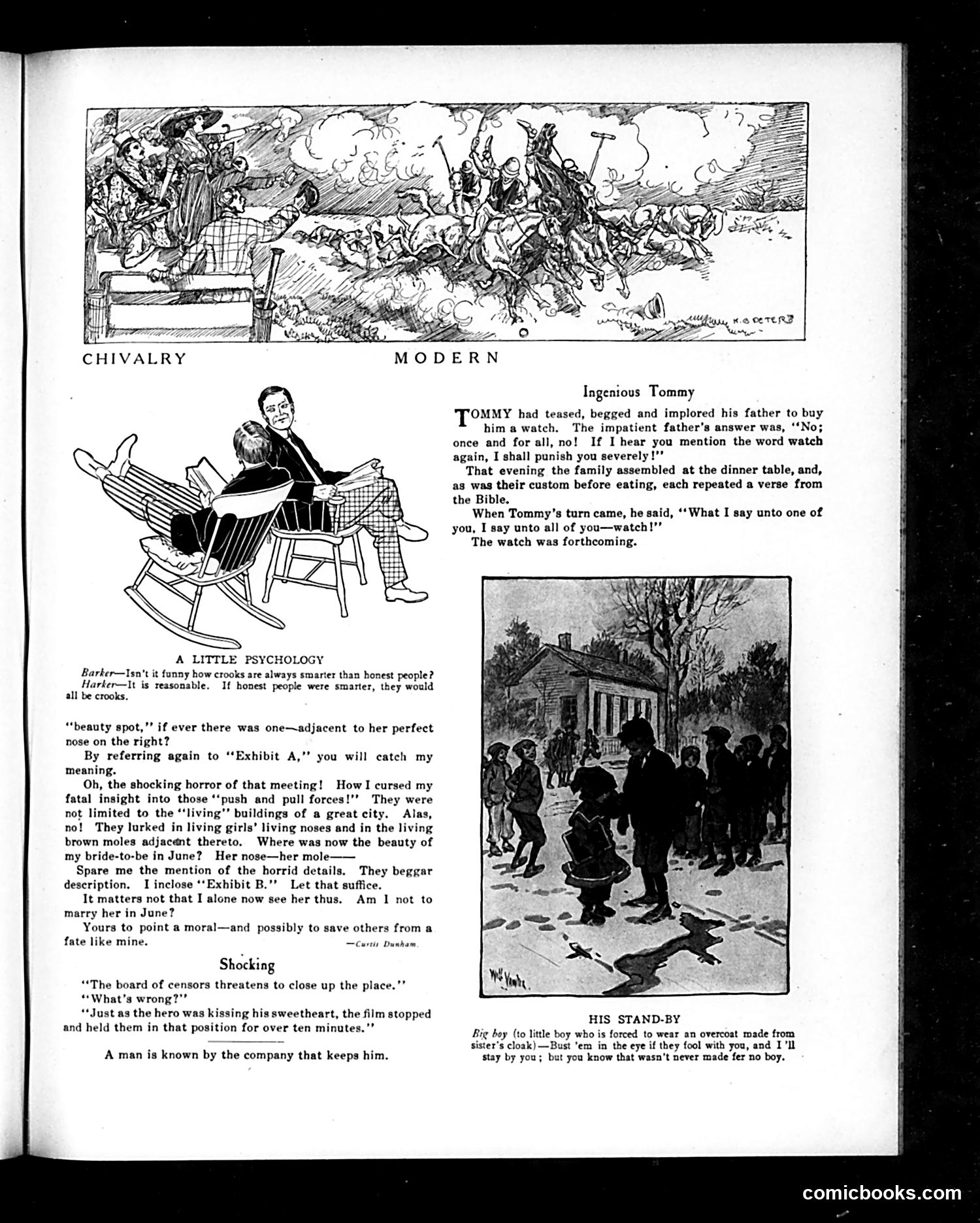
This page contains three separate satirical pieces typical of early 20th-century humor: **"Ingenious Tommy"**: A brief joke where a child cleverly circumvents his father's prohibition against mentioning "watch" by quoting scripture ("What I say unto one of you, I say unto all of you—watch!"), thereby getting the desired timepiece. The satire mocks parental authority as easily outsmarted by clever wordplay. **"A Little Psychology"**: A cynical two-line exchange suggesting that honest people lack the intelligence of criminals—if they were smarter, they'd be crooks too. This reflects era skepticism about morality versus self-interest. **"Shocking"** and **"His Stand-By"**: Brief anecdotes mocking film censorship (a heated issue of the period) and gender nonconformity, respectively. The page's satirical targets are parental stubbornness, moral pretense, emerging film censorship boards, and social conventions around masculinity—typical Judge magazine fare for urban, educated readers.
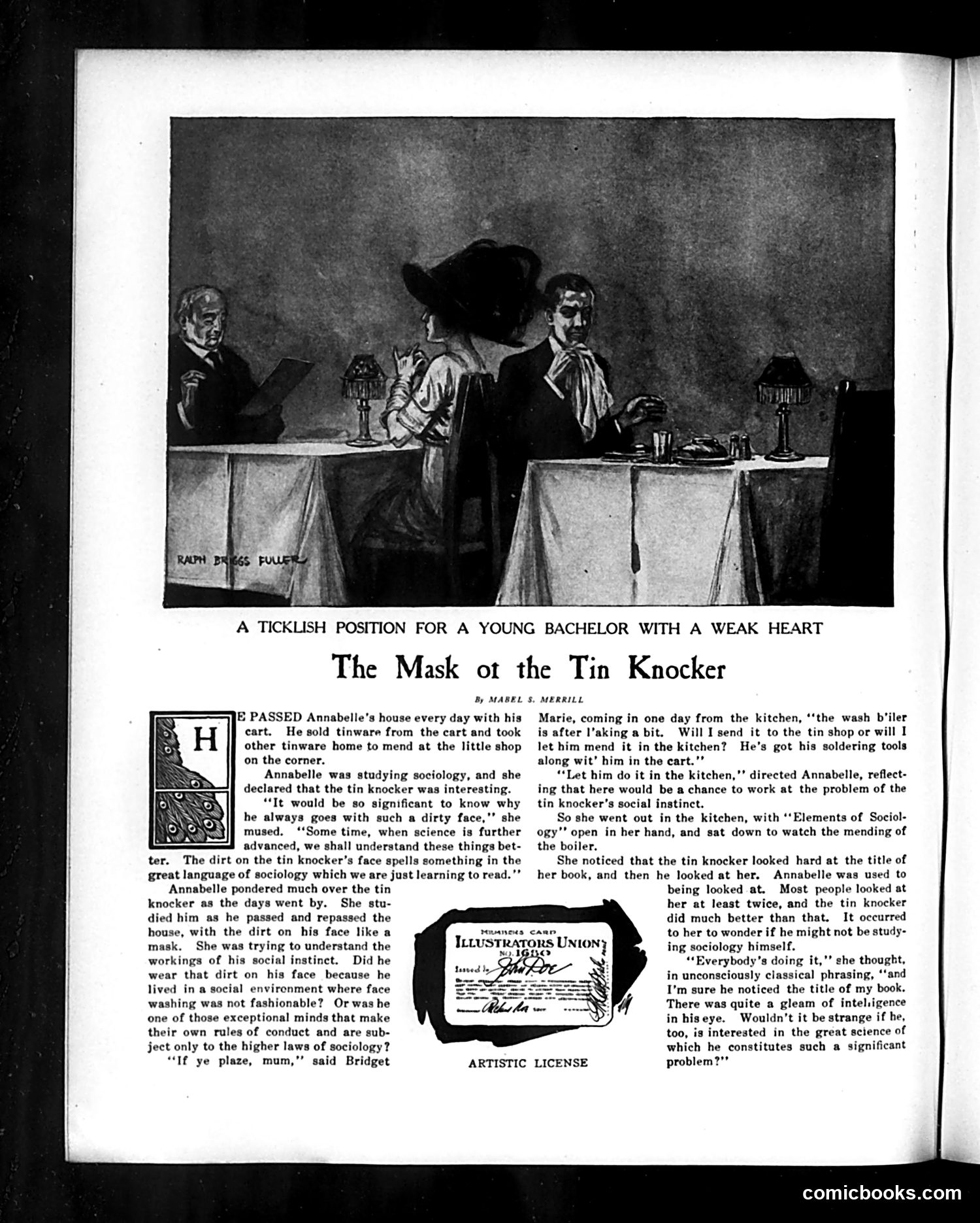
This satirical story mocks the early-20th-century intellectual fad of sociology. Annabelle, a fashionable young woman, becomes fascinated by the *idea* of understanding a working-class tin knocker's social behavior through sociological analysis. She theorizes his dirt-covered face reflects his "social environment" rather than simple lack of hygiene—applying pseudo-scientific jargon to avoid common sense. When she invites him to repair her boiler in the kitchen (to "study" him), she misinterprets his glance at her sociology textbook as intellectual interest, imagining he shares her academic pursuits. The satire ridicules how the newly-fashionable discipline of sociology was used by upper-class people to romanticize or intellectualize away the obvious realities of working-class life—turning a laborer's dirty face into a sociological "problem" worthy of scholarly consideration.
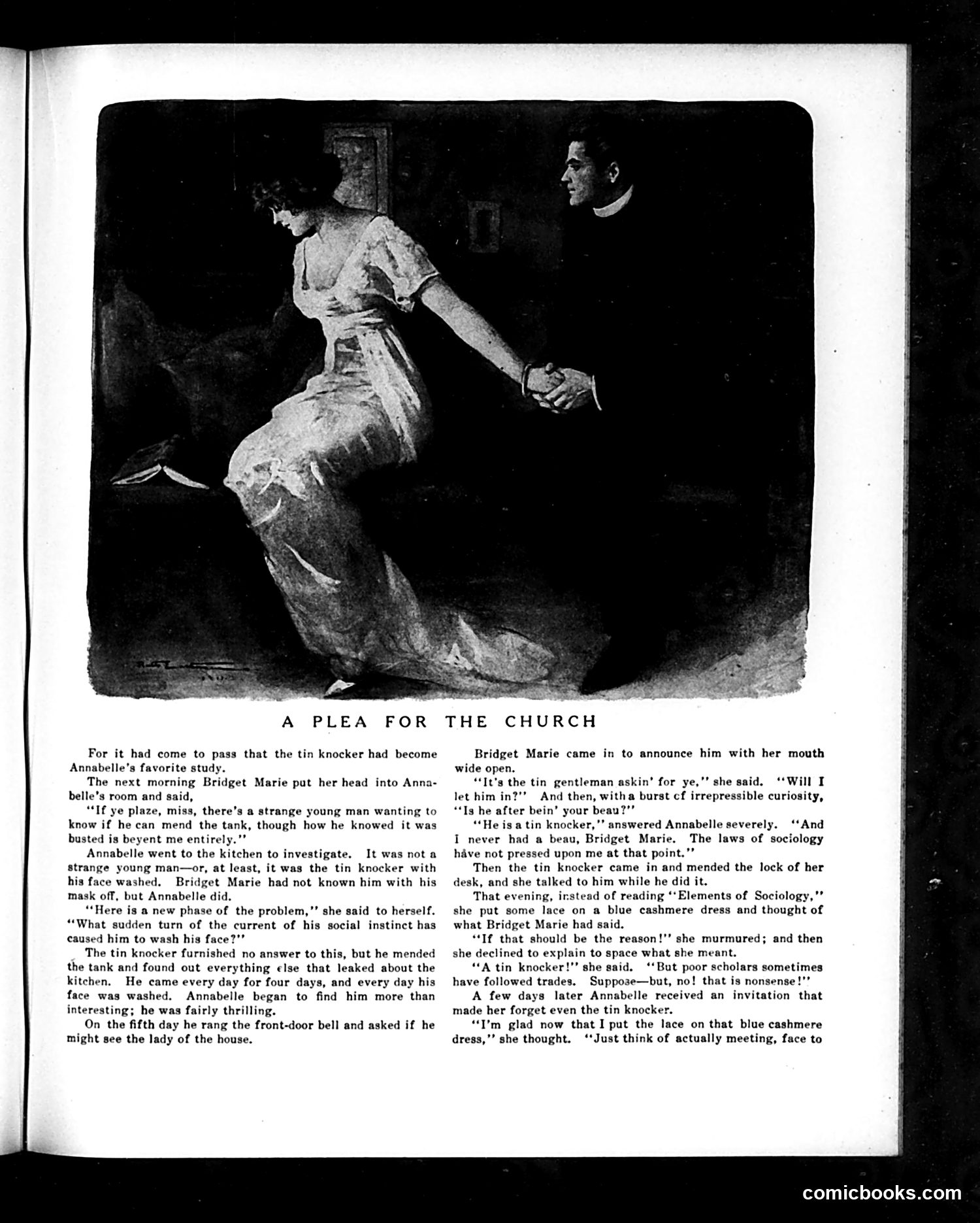
This satirical story mocks the pretensions of educated, intellectual women of the era. Annabelle, an upper-class woman absorbed in sociology texts, becomes infatuated with a working-class "tin knocker" (repairman). The humor lies in her rationalization: she tries to dignify the romance through sociology and scholarship, insisting she's never "had a beau" because "the laws of sociology have not pressed upon me." The satire's target is clear in the title—the story argues that intellectual women need "the Church" (traditional values and institutions) to guide them. Without religious moral authority, Annabelle falls for an unsuitable match, her learning providing no defense against romantic impulse. The Irish maid Bridget Marie represents common sense, while Annabelle's academic pretensions are exposed as mere cover for ordinary human desire. The joke: no amount of scholarly study can override nature and social class.
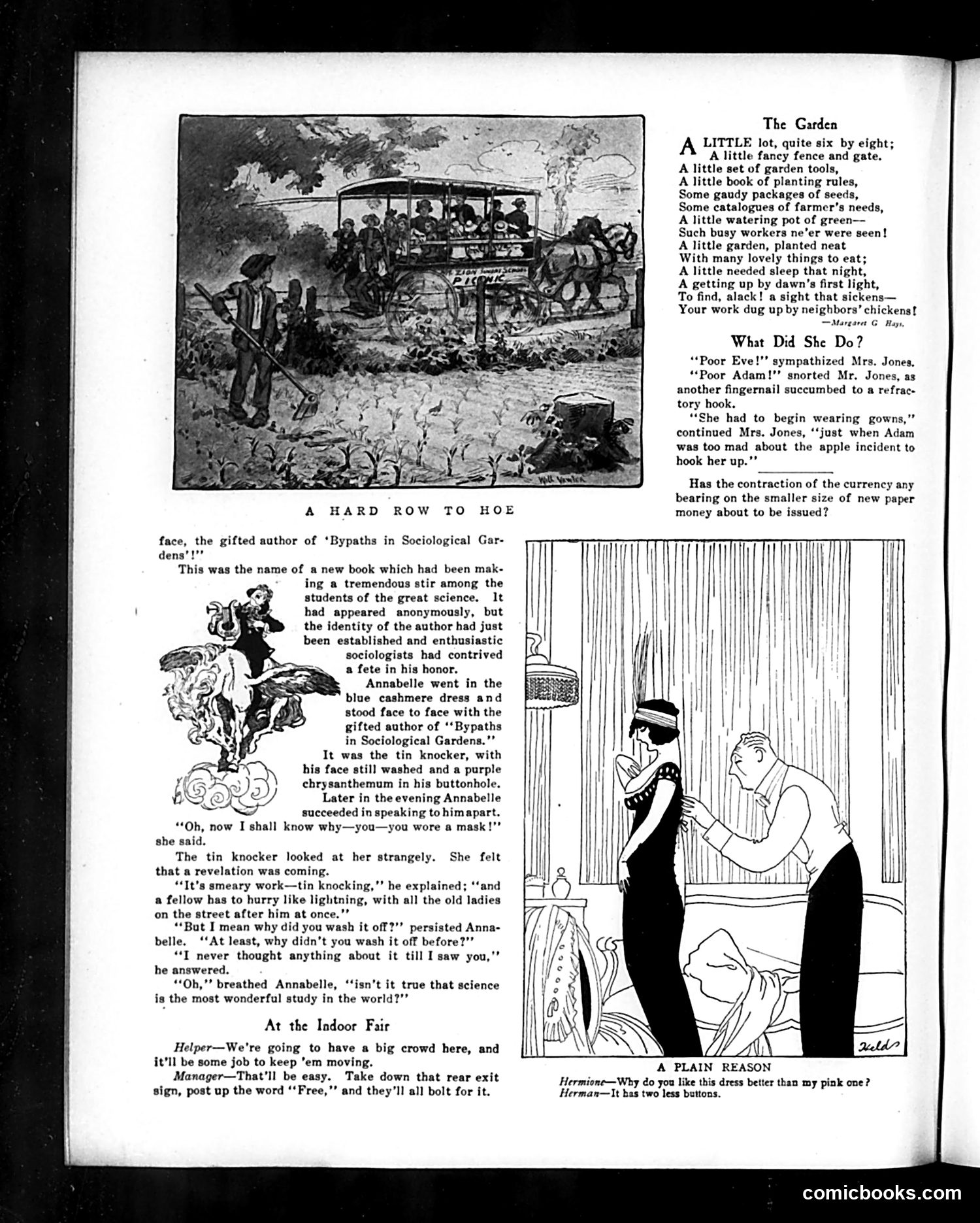
This page contains three distinct satirical pieces: **"The Garden"** (top left): A humorous poem by Margaret G. Hay about urban gardening's disappointments—the irony that careful home gardeners' work gets destroyed by neighbors' loose chickens, rendering all effort worthless. **"What Did She Do?"** (top right): A joke about Eve from the Garden of Eden. Mrs. Jones notes that Eve had to start wearing clothes after the apple incident, but Adam was too angry about that apple to help fasten her dress—a crude pun on "hook her up" (dress fastening) playing on domestic marital frustration. **The tin knocker story** (center-left): A satirical tale where an anonymous author of a prestigious sociology book is revealed to be a common tinsmith/knocker. The joke mocks intellectual pretension—Annabelle assumes his "unwashed" appearance at a masquerade was deliberate mystery, but he simply hadn't bothered cleaning up from work. **"At the Indoor Fair"** (bottom): A brief joke about crowd management—posting a "Free" sign will empty a venue as people rush the exit, satirizing public behavior.
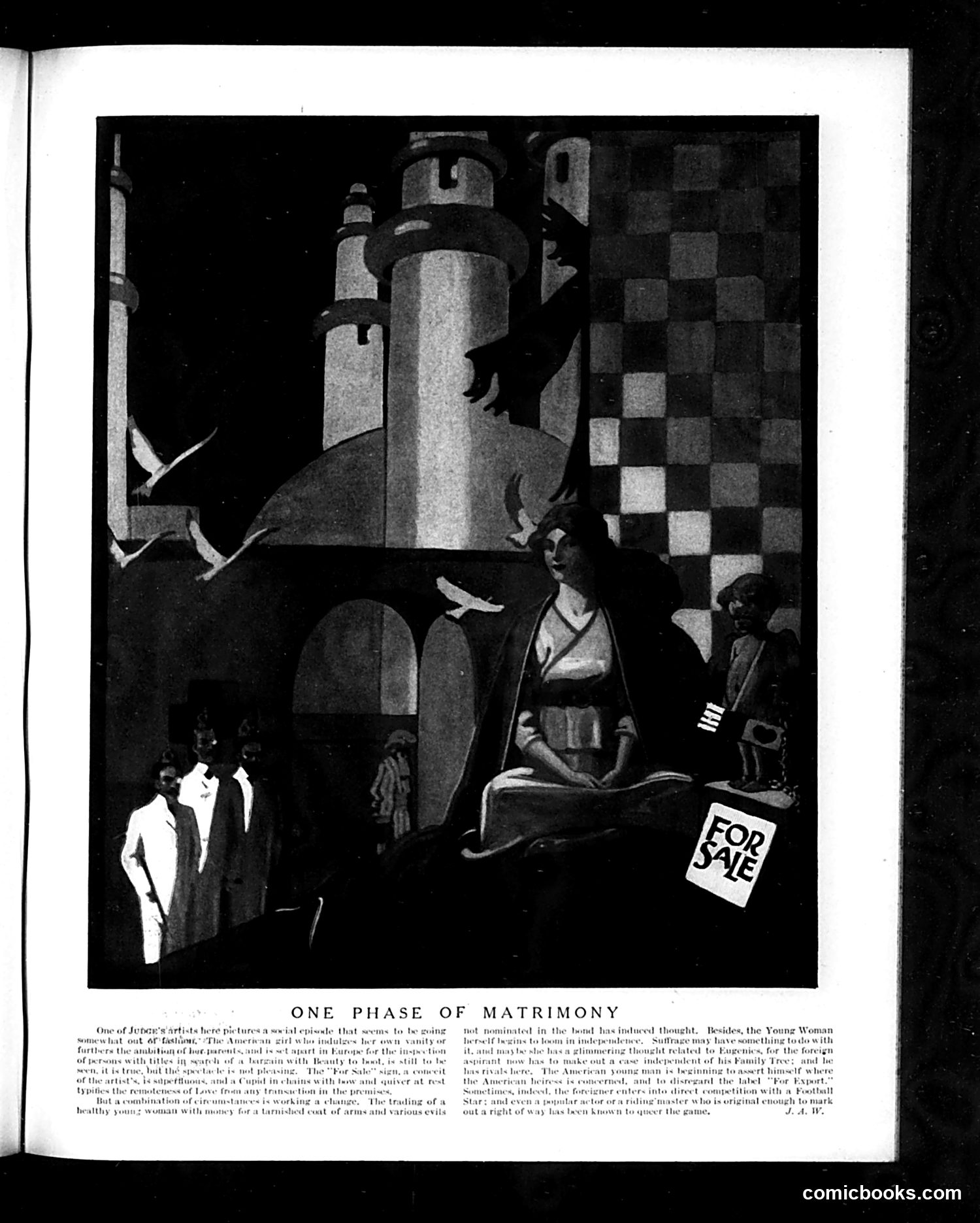
This satirical illustration depicts a theatrical scene mocking marriage dynamics of the era. A young woman sits center stage in an ornate interior (tower/castle backdrop), while figures below—including men in formal dress—observe. A "FOR SALE" sign appears prominently, suggesting the woman is being commodified or "sold" into marriage. The text criticizes how American girls are trained for vanity and financial gain rather than genuine companionship. It mocks the period's marriage conventions where wealth and social status determined unions. The theatrical framing suggests this "matrimonial market" is performative—a public spectacle rather than intimate commitment. The satire targets both the superficiality of young women and the transactional nature of upper-class marriages in early 20th-century America.
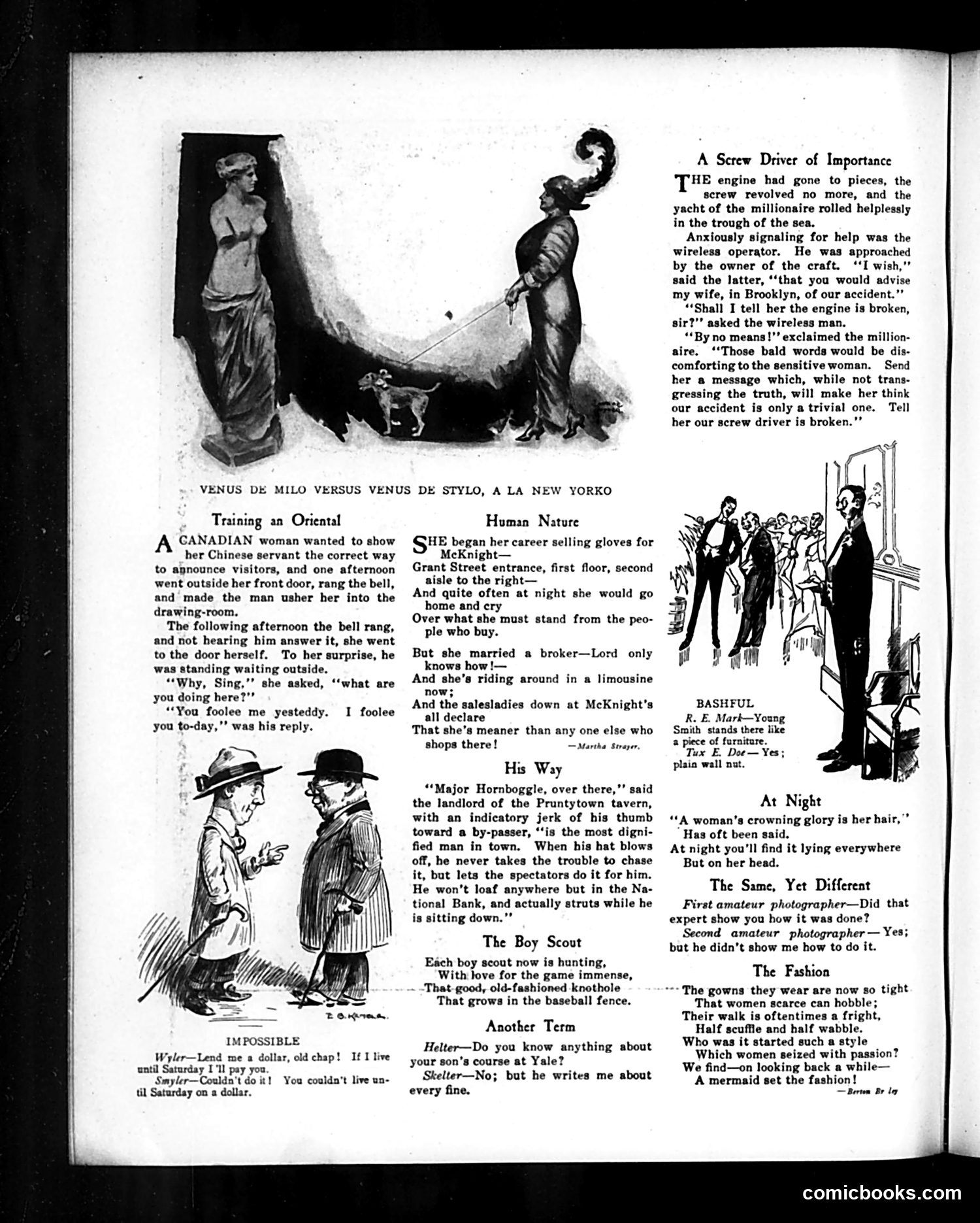
This page contains multiple short humorous pieces typical of early 20th-century satirical magazines: **"A Screw Driver of Importance"** (top): A wealthy yacht owner asks his wireless operator to deceive his wife about engine failure. The humor plays on the double meaning of "screw driver"—the millionaire wants the operator to use careful language ("our screw driver is broken") rather than admit serious damage, showing how the rich use euphemism to manage sensitive women. **Other sketches** include: a Chinese servant mimicking his employer's behavior ("Training an Oriental"), a woman's social mobility after marrying wealth ("Human Nature"), and a man's dignified affectation ("His Way"). **Bottom pieces** mock fashion trends (women's tight hobble skirts), amateur photographers, and boy scouts sneaking into baseball games. The satire targets wealthy pretension, gender stereotypes (sensitive wives, vain women), and social climbing—common Judge magazine themes reflecting early 1900s American attitudes.
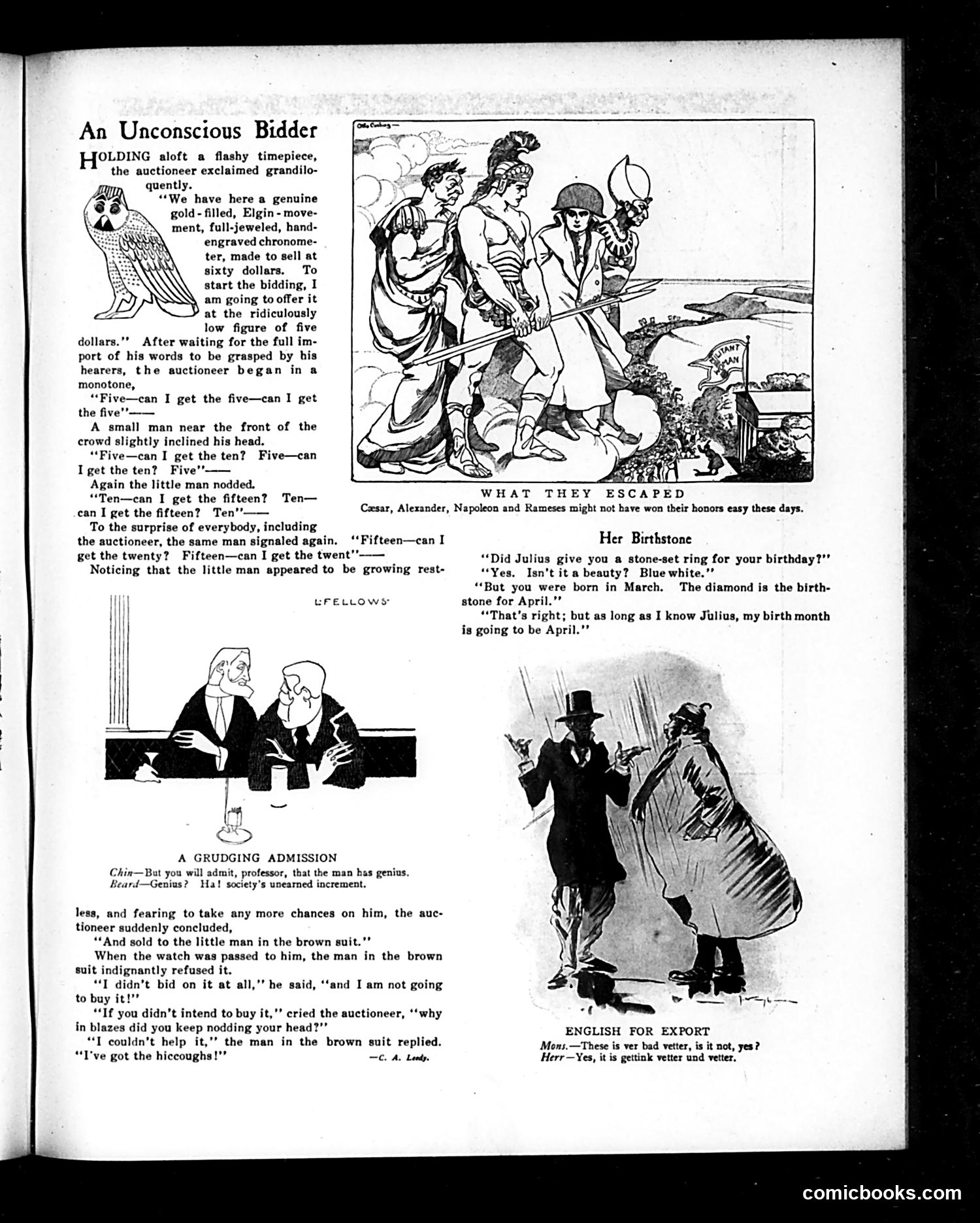
**"An Unconscious Bidder"** satirizes auction-house manipulation and human suggestibility. A man unknowingly bids on a watch by nodding from hiccoughs, not intent to purchase. The auctioneer, eager for a sale, interprets each involuntary head movement as a bid, escalating prices until the man protests. The joke critiques both auctioneers' aggressive sales tactics and bidders' careless participation in auctions—the man literally cannot help himself. **"A Grudging Admission"** appears to mock academic snobbery. A "Chin" character concedes a "Beard" character possesses genius, but Beard dismissively attributes success to "society's unearned increment"—suggesting the man succeeds through social advantage rather than merit. This satirizes intellectuals who dismiss accomplishment through ideology. **"Her Birthstone"** jokes about a woman changing her birth month to April to match her diamond ring's assigned stone, prioritizing the gift over factual accuracy—gentle satire of romantic compromise or materialism. **"English for Export"** depicts foreigners speaking broken English, likely mocking exaggerated immigrant dialects common in period humor.
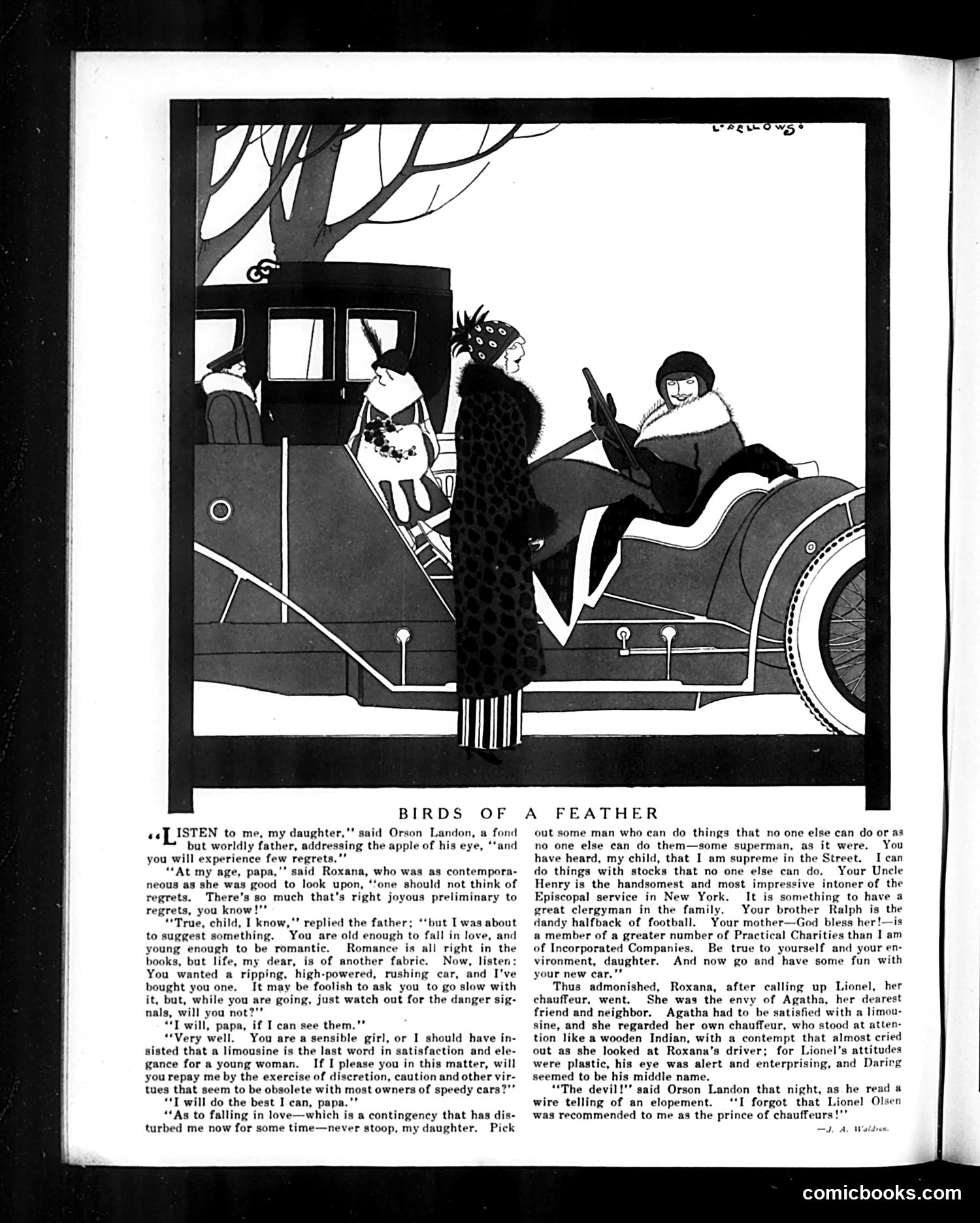
This is a satirical story-illustration about class and courtship in the Jazz Age. Orson Landon, a wealthy financier ("supreme in the Street"), lectures his daughter Roxana on choosing a suitable romantic partner—advising her to marry a man of exceptional accomplishment, like himself or her uncle the prominent clergyman. The irony: Roxana takes his advice literally but misapplies it. She falls for Lionel, the chauffeur, who possesses the one exceptional quality her father overlooked—the ability to drive dangerously well. The "danger signals" her father warned about prove prophetic: Lionel elopes with her. The satire mocks both parental hypocrisy (Landon's self-satisfied materialism) and the unpredictability of romance among the wealthy. The title suggests Roxana and Lionel are "birds of a feather"—equally reckless and suited to each other.
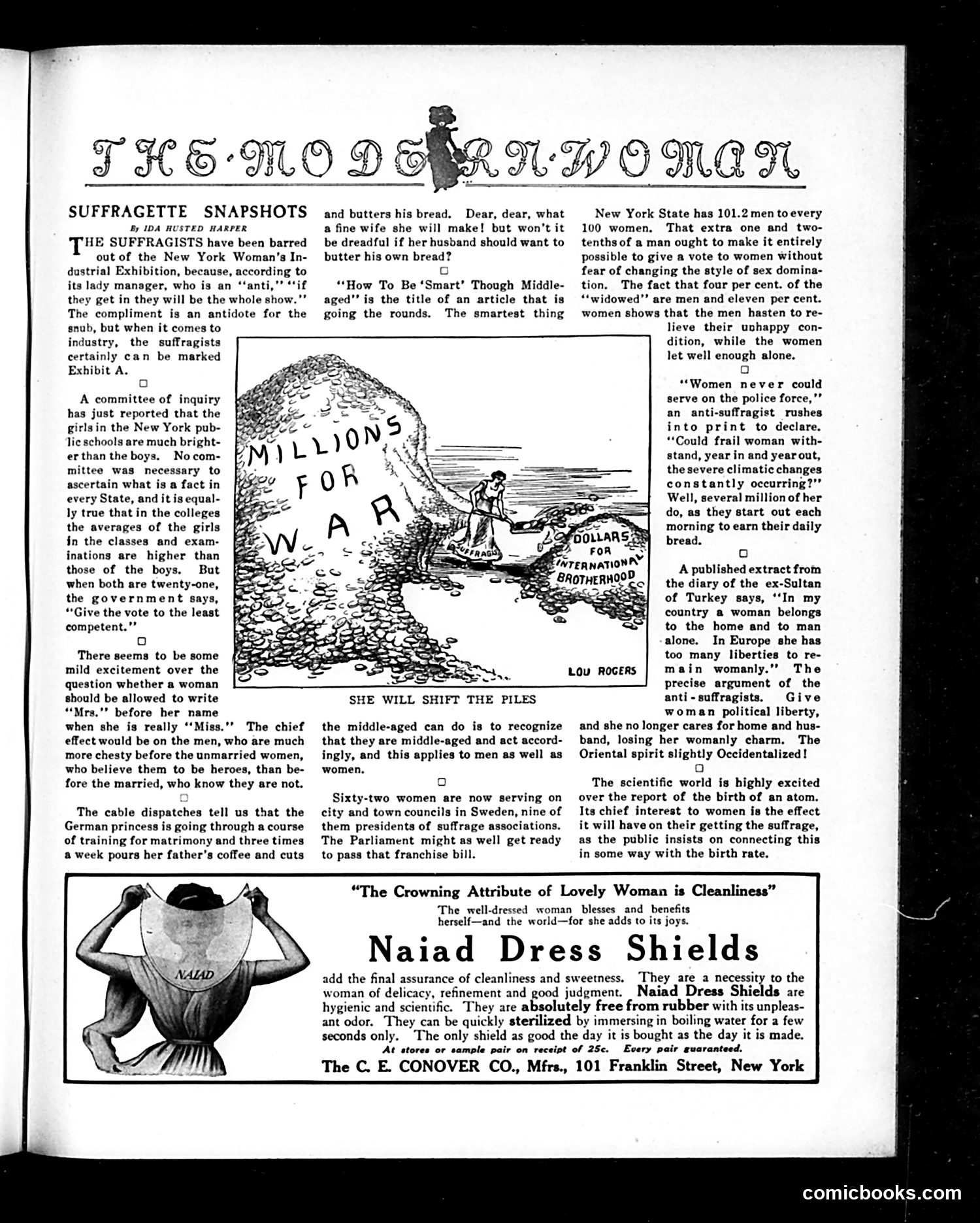
This page satirizes anti-suffrage arguments through the lens of Judge magazine's pro-suffrage writer, Ida Husted Harper. The central cartoon depicts a woman literally "shifting piles" of "Millions for War" and "Dollars for International Brotherhood"—suggesting women do crucial societal work yet lack political voice. Harper uses sharp irony throughout: she notes girls outperform boys academically, but at twenty-one the government denies them votes; she mocks the idea that women are "too frail" for police work despite managing household labor; she compares anti-suffragists to the ex-Sultan of Turkey, equating their views with Oriental despotism. The piece argues that women's demonstrated competence and labor make denying them suffrage illogical and absurd. The Naiad Dress Shields advertisement below is unrelated commercial content typical of Judge's funding model.
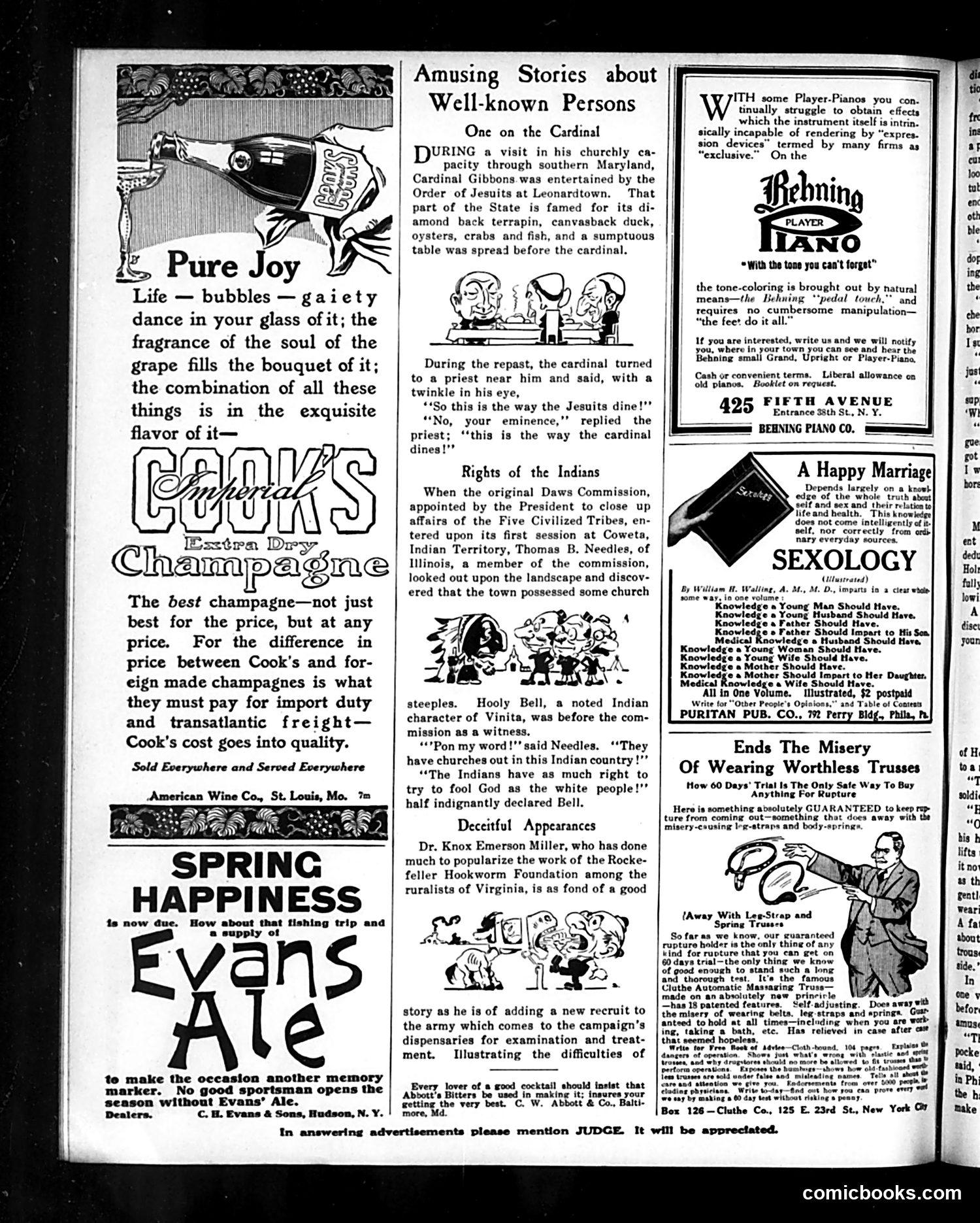
This page primarily contains **period advertisements and anecdotes** rather than political satire. The "Amusing Stories" section offers three light-hearted tales about notable figures: 1. **Cardinal Gibbons anecdote**: A Jesuit priest playfully suggests the cardinal eats better than typical Jesuit fare—gentle humor about ecclesiastical dining. 2. **Indian Rights story**: References the Dawes Commission (real historical body dissolving Native American tribal governments). Hooly Bell's retort—that Indians have equal right to "fool God" as white people—is sardonic commentary on religious hypocrisy and racial equality, though the humor tone suggests this was presented as mere entertainment rather than serious critique. 3. **Dr. Knox Emerson Miller**: Incomplete in the OCR, but references the Rockefeller Hookworm Foundation's rural health campaigns—a genuine early-20th-century public health initiative. The remainder consists of **product advertisements** (champagne, ale, player pianos, trusses, marriage guides)—typical Judge magazine filler. No significant political cartoons or social satire appears on this page.
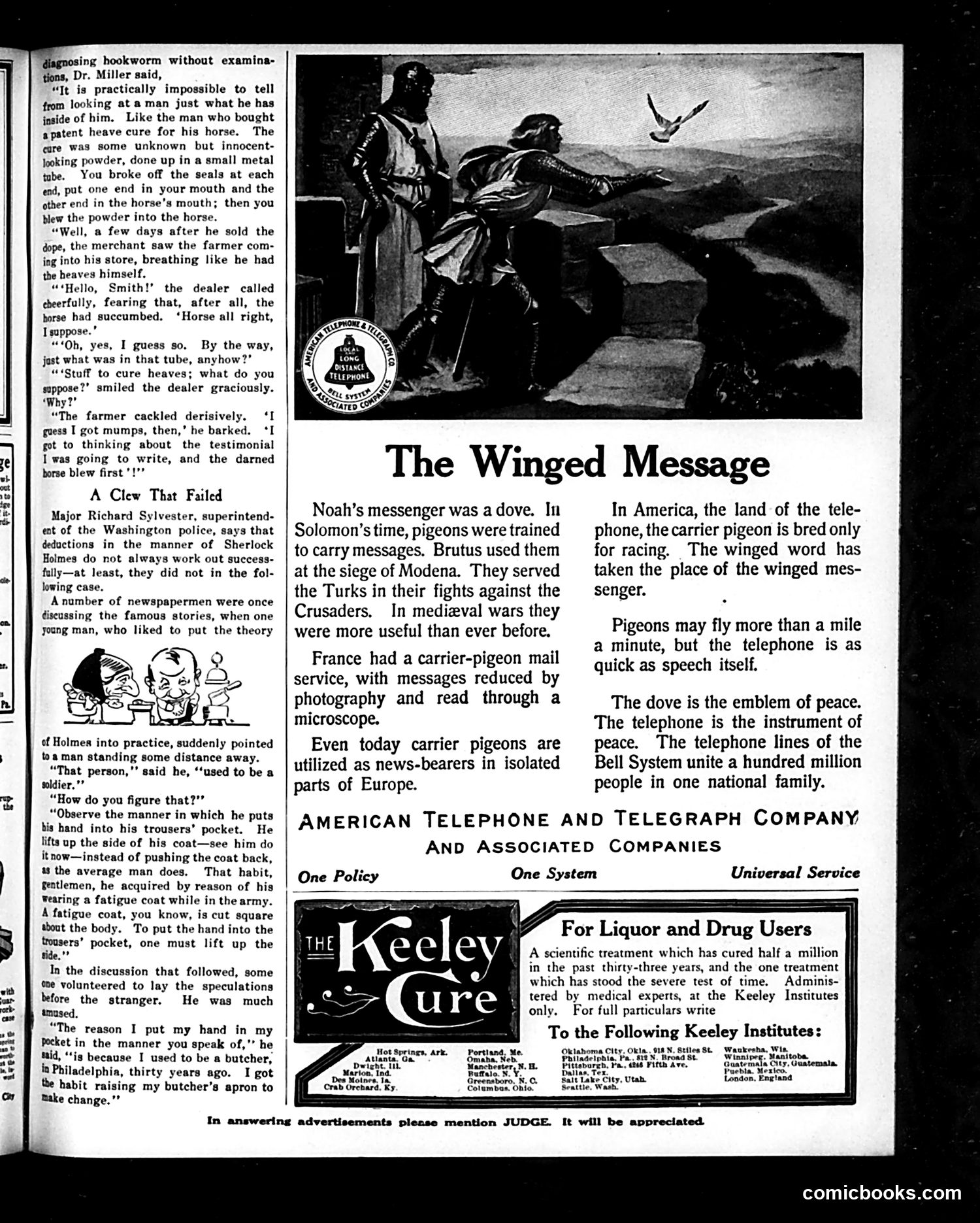
This page contains three distinct elements: **Left side:** Two humorous anecdotes about mistaken deductions. The first mocks medical diagnosis—a farmer accidentally inhales horse medicine instead of his horse, causing him to develop mumps. The second features Major Richard Sylvester (a real Washington police superintendent) describing how Sherlock Holmes-style observation fails: a man's distinctive hand-in-pocket gesture, attributed to military habit, actually stems from raising his butcher's apron thirty years prior. Both jokes satirize the era's faith in deductive reasoning and expertise. **Center:** "The Winged Message," an advertisement for American Telephone and Telegraph Company. It juxtaposes historical carrier pigeons (Noah's dove, Crusades, Napoleon) with modern telephone technology, arguing the telephone has superseded slower messenger pigeons. The ad equates telecommunications with peace and national unity—a common early 20th-century promotional claim. **Bottom:** Advertisement for the Keeley Cure, a patent medicine claiming to treat "liquor and drug users," reflecting the period's unregulated medical advertising.
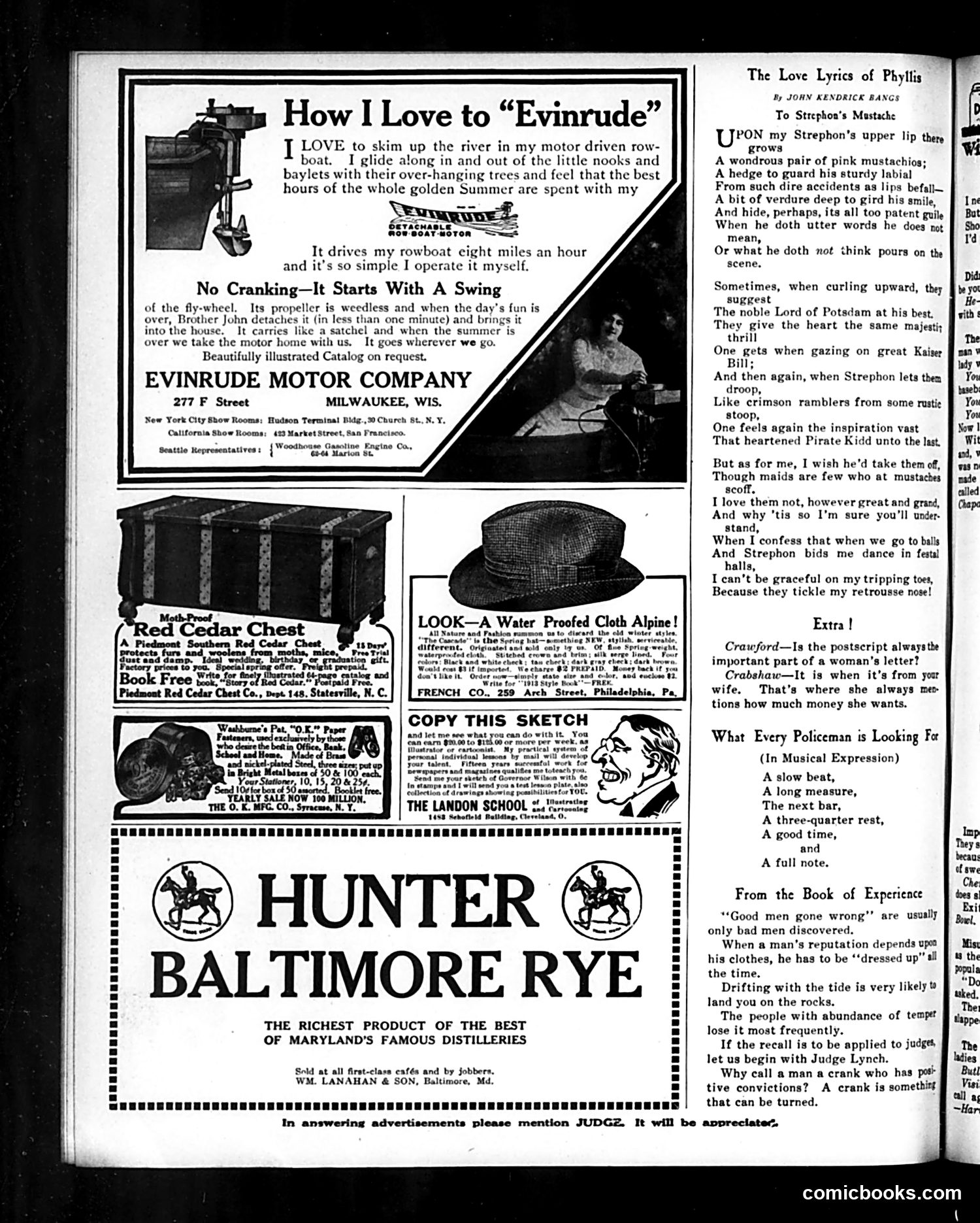
This page is primarily **advertising**, not political satire. The main content is a full-page advertisement for the **Evinrude Motor Company**, promoting their motorized rowboat attachment. The ad uses the slang phrase "Evinrude" as a verb (meaning to motor around), emphasizing the product's ease of use—it starts with a simple swing and requires no hand-cranking, a significant advantage over early motors. The right column contains unrelated filler content: a romantic poem about a man's mustache (mocking affected courtship), humor columns ("What Every Policeman is Looking For"), and advertisements for other products (a Red Cedar Chest, water-proof hat, art school, and Baltimore Rye whiskey). There is **no political cartoon** on this page—Judge magazine often mixed satirical content with straightforward advertising and light humor pieces. The overall tone reflects early 1910s consumer culture and genteel humor conventions.
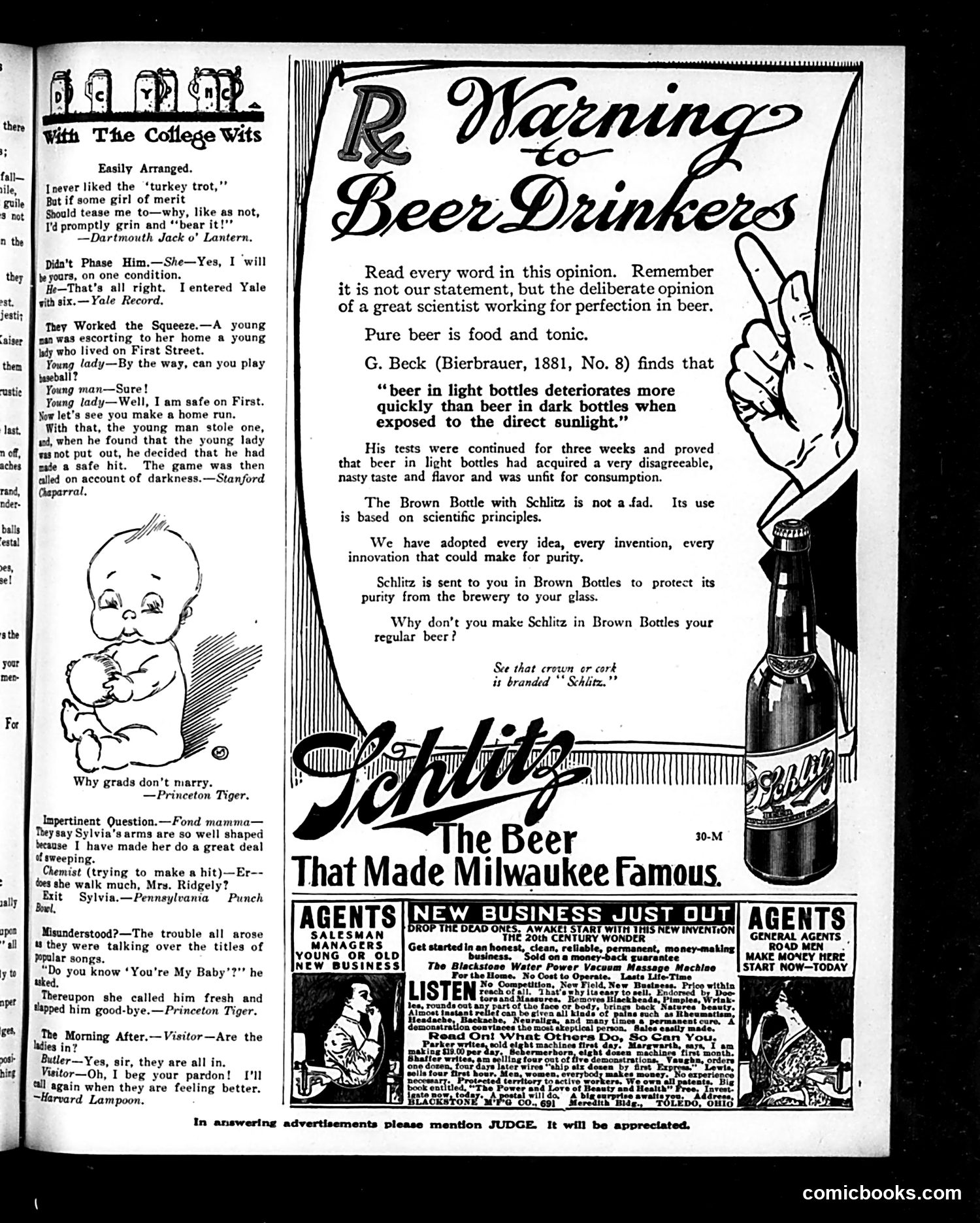
This page combines **humor columns** (left side) with **advertising** (right side), typical of Judge's format. **The Humor Section** features short jokes from college newspapers (Yale, Princeton, Stanford, Harvard). They're mostly mild sexual innuendo—a "turkey trot" dance reference, baseball metaphors for sexual conquest, and misunderstandings about "You're My Baby." These represent early-1900s collegiate humor: cheeky but restrained by modern standards. **The Main Advertisement** is for **Schlitz Beer**, claiming its brown bottles protect beer from sunlight damage. It cites a scientist (G. Beck, 1881) proving light exposure ruins beer's taste. The ad emphasizes "purity"—a major selling point in an era of food-safety concerns and before modern food regulations. The brown bottle became Schlitz's trademark. **Below** are recruitment ads for salesmen and agents, promising easy money—typical of early-1900s entrepreneurial advertising. The page reflects Judge's dual purpose: satirical commentary mixed with commercial revenue.
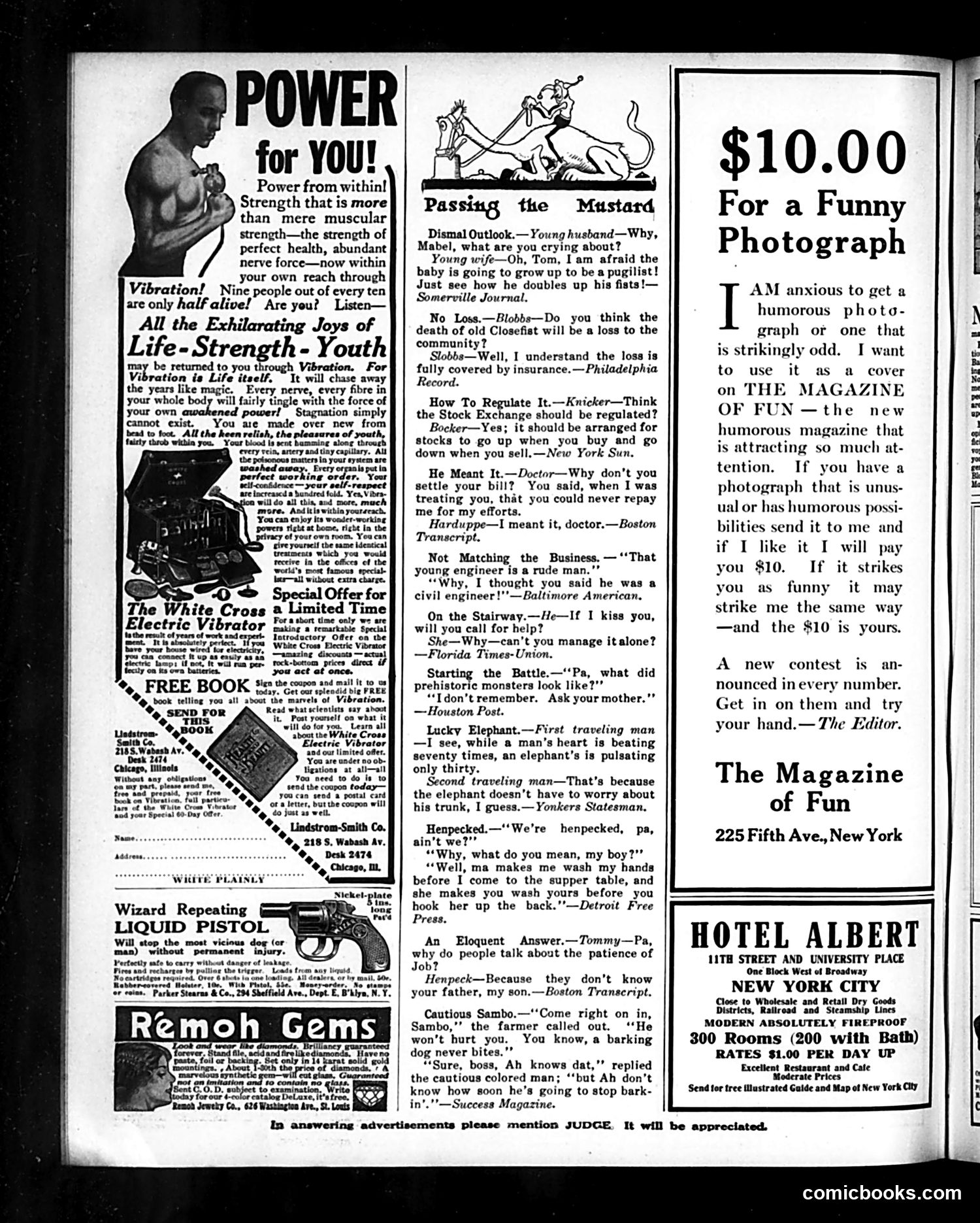
This page from *Judge* consists primarily of **advertisements and humor columns** rather than political cartoons. The major content includes: **Advertisements:** A "vibration machine" promising restored youth and strength through electrical stimulation—a common early 20th-century pseudoscientific wellness product. Also advertised: a "Liquid Pistol" weapon and "Remol Gems" jewelry. **Humor Sections:** The bulk of the page contains brief, generic jokes typical of the era's magazine humor—mostly puns about marriage, business, and class relations. Notable examples include jokes about: - A baby becoming a "pugilist" (boxer) - Stock market speculation - Henpecked husbands - Racial stereotypes (the "Cautious Sambo" joke) **Contest Notice:** *Magazine of Fun* solicits funny photographs for $10 payment. The page reflects early 20th-century commercial culture and period humor conventions, including casual racial caricatures considered acceptable then but offensive today.
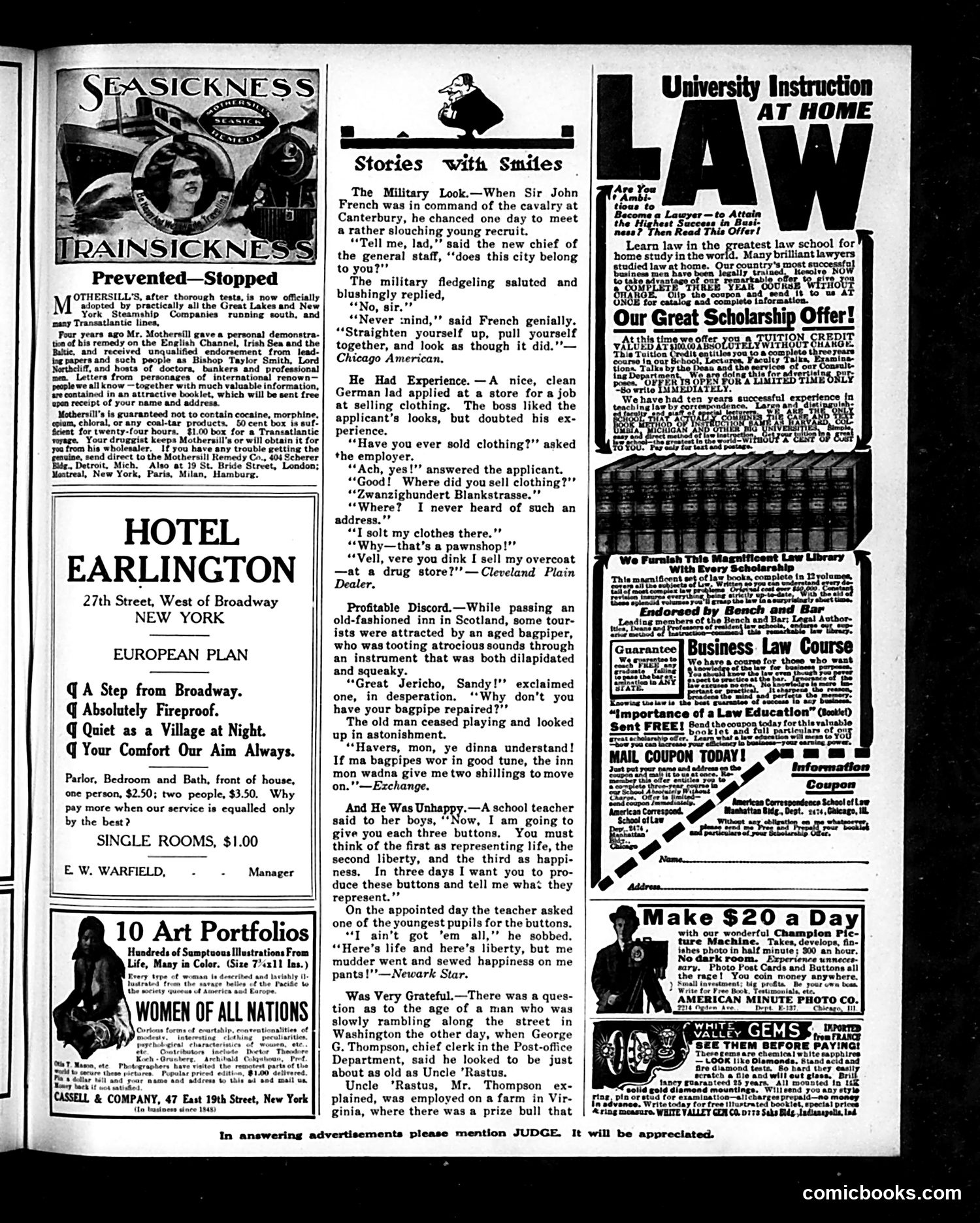
This page is primarily **advertising with brief humorous anecdotes**, not political satire. The "Stories with Smiles" section contains three short jokes: 1. **"The Military Look"** references Sir John French, actual commander of British cavalry, using him in a joke about military posture and discipline. 2. **"He Had Experience"** is a dialect humor piece playing on a German immigrant's misunderstanding—his claim to have "sold" clothing at a pawnshop (where he pawned his own overcoat) rather than a clothing store. 3. **"Profitable Discord"** depicts a Scottish bagpiper deliberately keeping his instrument broken so tourists will pay him to stop playing. The humor relies on **ethnic/national stereotypes** (German accent, Scottish frugality) typical of early 20th-century American comedy. The page is dominated by advertisements for seasickness remedy, hotels, art portfolios, and correspondence courses—standard Judge magazine content of the era.
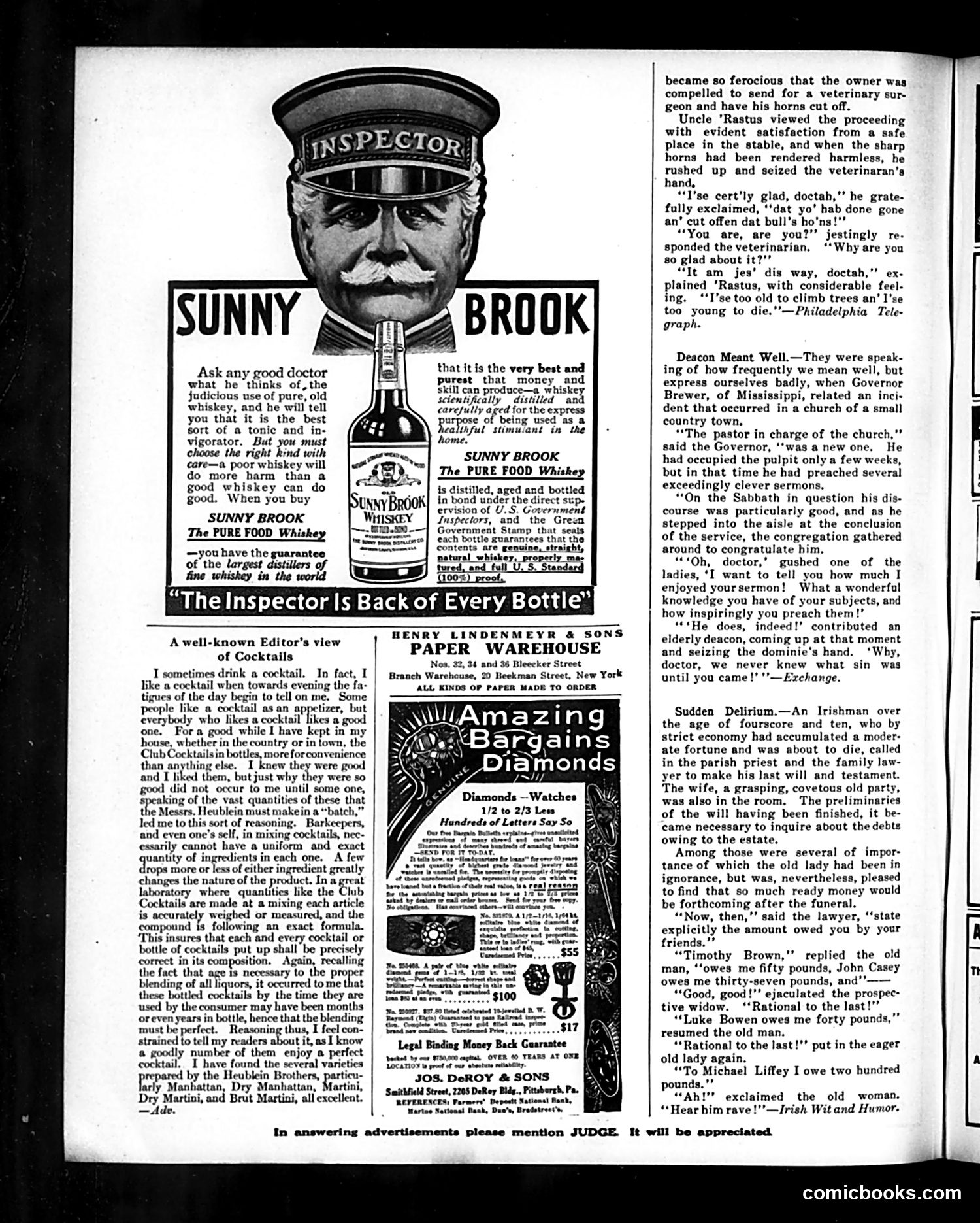
This page is primarily **advertising** rather than editorial content or political satire. The dominant feature is a large advertisement for Sunny Brook whiskey, fronted by an "Inspector" character assuring purity and government oversight under Pure Food standards. The page includes endorsements: an editor praising Heublein Brothers cocktails (pre-made, consistently blended), and testimonials for diamonds and watches sold "at less" cost. The only narrative humor appears in a brief story about "Uncle 'Rastus," a Black character using dialect, expressing gratitude to a veterinarian for removing a bull's horns. This reflects period stereotypes common in early-20th-century American publications. The whiskey advertisement emphasizes scientific distillation and government inspection—marketing appeals to consumers concerned about product safety following the Pure Food and Drug Act (1906). The page demonstrates how such regulations became selling points in advertising.
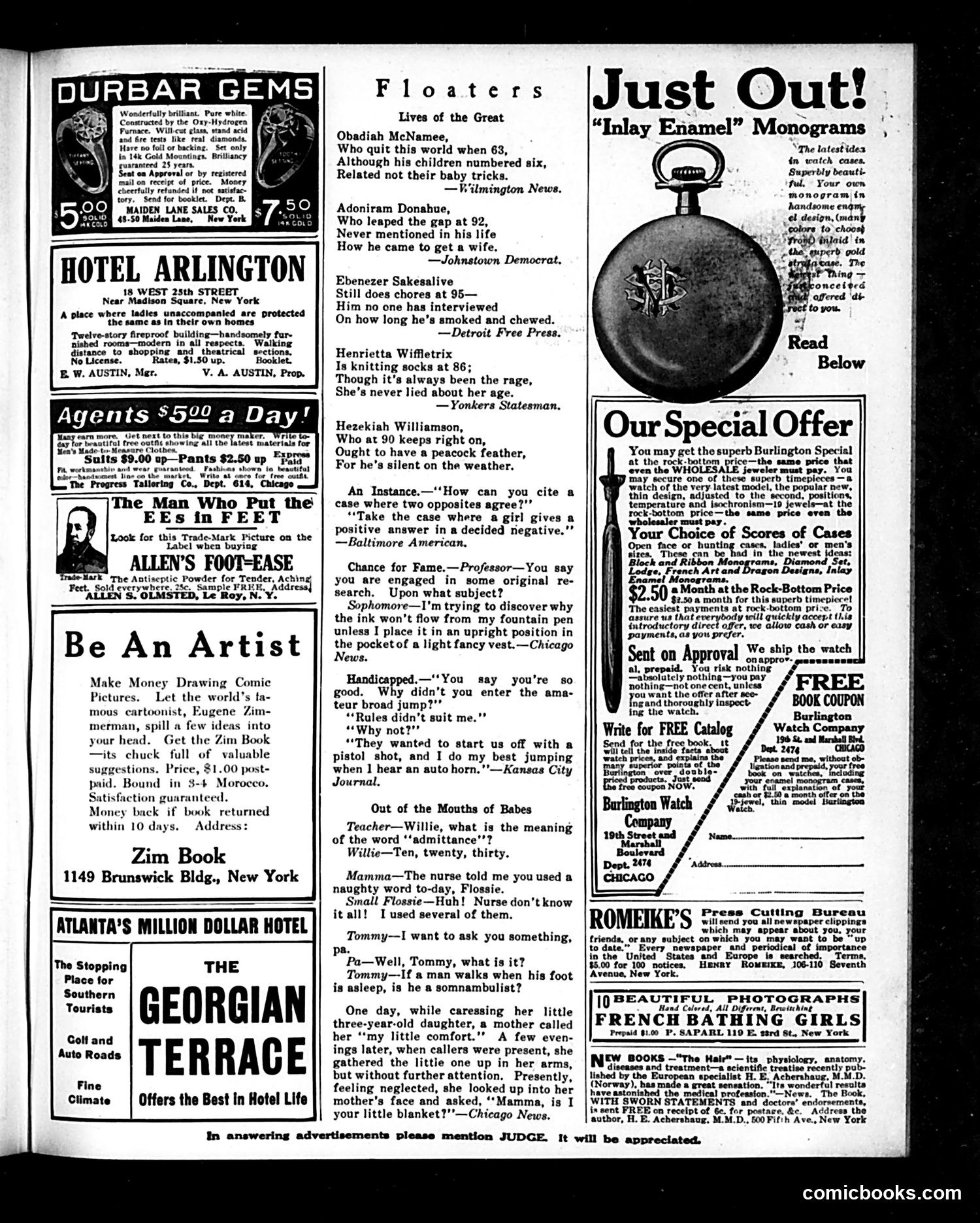
This page is primarily **advertising and humor content**, not political satire. The layout includes: **Main Features:** - Product advertisements (gemstones, hotels, foot powder, art instruction) - A humor section titled "Floaters: Lives of the Great"—short, ironic sketches about elderly people notable for what they *didn't* do or say (didn't lie about age, didn't complain about weather, etc.). The joke is the anticlimax: these long-lived people are remembered for their unremarkable silence or propriety rather than achievements. - Short jokes and anecdotes about wordplay and children's logic **Historical Context:** The humor relies on early 20th-century assumptions: automobile horns as novel sounds, fountain pens as frustrating technology, somnambulist vocabulary, and Victorian propriety about age and etiquette. **No significant political content is visible.** This appears to be a standard magazine filler page mixing commerce with light entertainment—typical for Judge's format during this era.
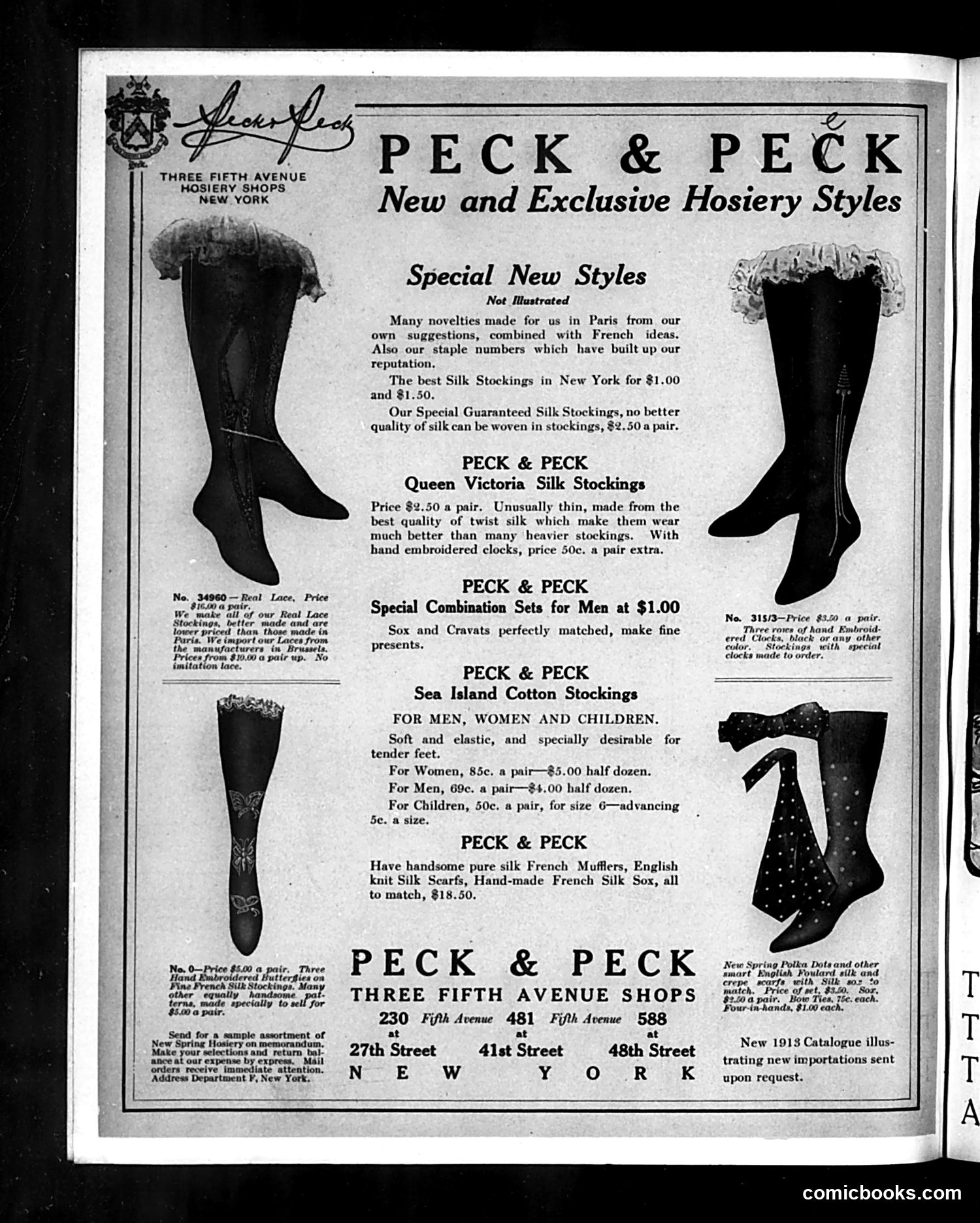
This is **not a cartoon or satirical content**—it is a straightforward **advertisement for Peck & Peck hosiery**, a New York department store with three Fifth Avenue locations. The page showcases silk and cotton stockings for men, women, and children, with product images and pricing. Notable offerings include "Queen Victoria Silk Stockings" at $2.50/pair (described as unusually thin) and Sea Island Cotton stockings. The ad emphasizes that novelties were "made for us in Paris from our own suggestions, combined with French ideas," suggesting exclusivity and continental prestige. There is **no political satire or cartoon present**. This appears in *Judge*, a satirical magazine, but this particular page is purely commercial content—likely paid advertising that occupied space in the publication. The only visual elements are product photographs of stockings and a bow-tie design.